Directional Proportional Valve Robotic Applications Use
Directional Proportional Valve Installation Service Tip
Directional Proportional Valve OEM Customization Guide
Directional Proportional Valve Sizing and Selection Tips
Directional Proportional Valve Supplier Selection Guide
Directional Proportional Valve for Agricultural Systems
Directional Proportional Valve Robotic Applications Use
Directional Proportional Valve Installation Service Tip
Directional Proportional Valve OEM Customization Guide
Directional Proportional Valve Sizing and Selection Tips
Directional Proportional Valve Supplier Selection Guide
Directional Proportional Valve for Agricultural Systems

WL6116 Directional Proportional Valve for Industrial Machinery

Directional proportional valve is a hydraulic valve controlled electrically that provides control of the direction and flow of hydraulic fluid. Unlike conventional directional valves having fixed switching positions, directional proportional valve has a variable control feature that enables movement, variable speed and high positioning accuracy. They are extensively used in industries such as automation, hydraulic machines, mobile equipment, robotics, CNC machines, injection molding machines and material handling machines. A typical directional proportional valve comprises spool, electromagnetic actuator, valve body, hydraulic ports and an electronic interface. The valve receives electrical command and shifts the position of spool . It regulates the flow continuously between the ports . In this way a flexible control of the hydraulic actuators is achieved. For reliable operation it is important to select properly the valve size, pressure rating, flow capacity, response characteristics, contamination control, and compatibility with the electrical system. Correct valve selection will help manufacturers to get accurate motion, stable operation, low energy consumption and reliable performance of the hydraulic system.

Directional Proportional Valve Description

A directional proportional valve is a control valve for hydraulic systems which controls the flow direction and flow rate of fluid by means of an electrical command. It shifts the internal spool gradually by means of a proportional solenoid or other actuator and not simply switches between fixed positions. This gradual spool shifting allows operators and controllers to regulate actuator speed, direction, acceleration and positioning. Directional proportional valves are commonly integrated with electronic controllers, PLCs, sensors and feedback systems. They can be used in hydraulic cylinders and hydraulic motors of industrial machines, automation equipment, mobile hydraulics, robots, CNC machinery, injection molding machinery and material handling systems. The capability of the proportional control makes them superior compared to standard directional valves in terms of motion smoothness and machine responsiveness.

Working of a Directional Proportional Valve

Directional proportional valve receives electrical command and generates a variable hydraulic response. Current to the proportional solenoid is provided by electronic controller . Electromagnetic force displaces the spool of the valve.

The displacement of the spool is dependent on the input signal. The small signal generates limited spool displacement and small hydraulic flow is possible. With increasing signal the spool displaces more . This opens the appropriate flow channels and allows larger hydraulic flow .

The position of the spool determines which hydraulic ports are connected. Thus the valve regulates the flow direction and flow rate. Depending on the particular configuration the hydraulic oil can be supplied to the cylinder extension and retraction ports or hydraulic motor rotation.

In advanced systems sensors and electronic feedback can be used to monitor spool position, pressure, speed or actuator movement. The controller is able to constantly correct the valve command to ensure accurate motion and stable operation.

Directional Proportional Valve Detail Display

Directional Proportional Valve Technical

Brand Weilong Model Number WL 6116
Rated Voltage (V) DC12V or 24V Rated Power (W) 7.2W
Work Mode Air Control Valve Working Pressure (MPa) 0.2 MPa
Airflow Rate 45-107 L/minute Reset Time(s) 1 S On, 1S Off
Service Life 200 Thousand Times Certification CE, ROHS, ISO9001,
Material Superior Magnet Iron Lead Wire Length (mm) 200 MM
Install Style Screw Tolerance of Dimension ± 0.1 MM
Water-proof None Insulation Class B
Hi-Pot Test AC 750V 50/60Hz 2s Non-excitation Holding Force 0
Working Temperature -10°C-90°C Duty Cycle 1-100%
Thread Depth (mm) / Payment Term TT, or LC at Sight
Sample Order Yes. Warranty 1 Year
MOQ 1000 pcs Supply Ability 5000 pcs per week
Delivery Time 30 Days Port of Loading Shenzhen

Why is the Directional Proportional Valve so popular?

As the modern hydraulic equipment requires accurate, flexible and energy-efficient motion control, directional proportional valves become popular. In general, conventional valves are limited with their simple switching functionality. On the contrary, the proportional technology allows for continuous adjustment of the hydraulic flow and direction.

That is why proportional valves are very important for automated machines where actuator speed, acceleration, positioning and repeatability have to be tightly controlled. They also can be integrated with PLCs, industrial controllers, sensors and digital automation systems.

Another important feature is efficiency. Directional proportional valves allow to reduce unnecessary flow and increase machine productivity by adjusting hydraulic flow according to the actual machine requirements.

Versatility of this technology is another reason for the popularity. This basic technology can be applied in industrial machines, mobile hydraulics, robots, CNC machines, presses, injection molding machines, agricultural machines and construction machines.

On the other hand, OEM manufacturers prefer proportional valves because of their electronic control and ability to customize the machine behavior. Manufacturers can create complicated hydraulic motion control systems using proper valve sizing, electronics, feedback and software without enlarging the size of the machine design.

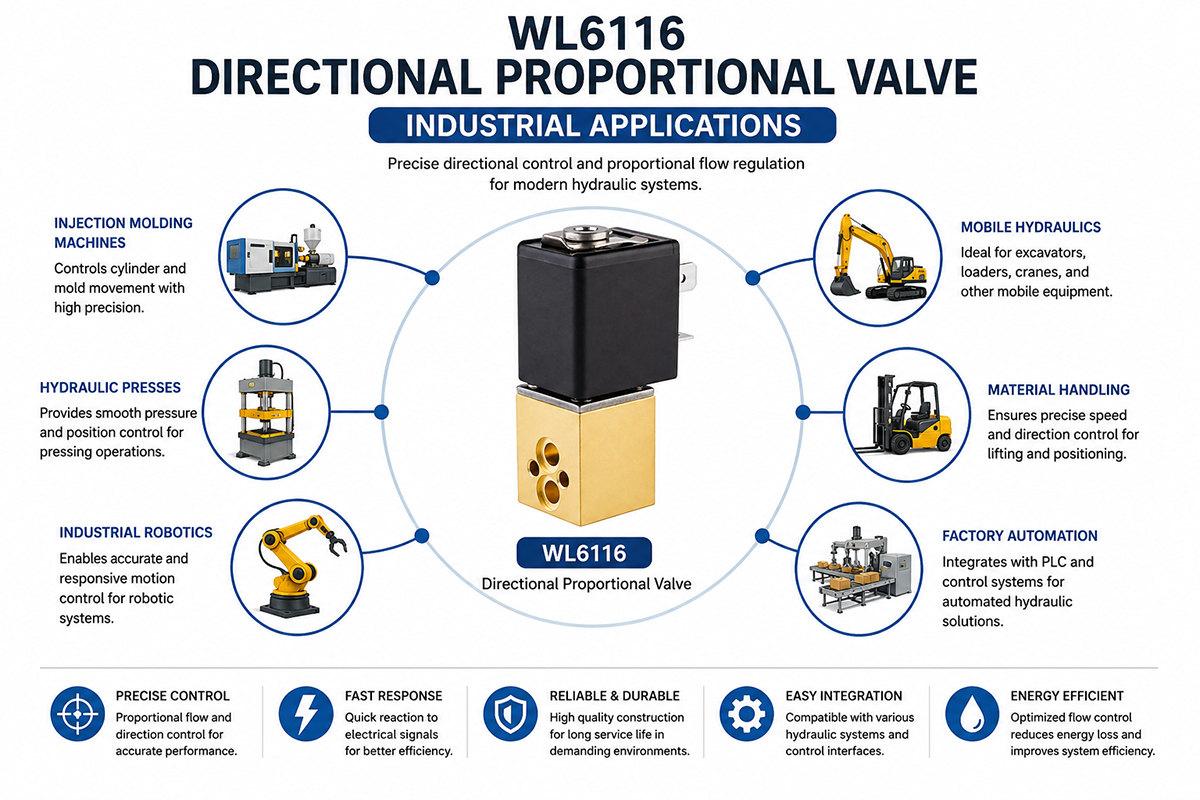
Directional Proportional Valve Applications

Directional Proportional Valve for Control Applications

Directional proportional valves are used in various applications where the accurate control of the hydraulic flow direction, speed and motion is required. In industrial automation they control hydraulic cylinders and motors of production machines, assembly machines and automated handling systems.

In CNC and machine tools proportional control enables control of hydraulic clamping, positioning, tool motion and auxiliary functions. The valves in injection molding machines can control the actuator motion with variable speed and smooth shifting.

Robots and material handling equipment are ideal applications for proportional directional control, since the hydraulic actuators need controlled acceleration, deceleration and positioning. In mobile hydraulics they are used in excavators, loaders, agricultural machines, cranes and other special vehicles.

They are also used in hydraulic presses where the controlled speed and direction of the actuator are required for forming and pressing applications. In process automation proportional valves can be used to control hydraulic actuators for gates, dampers, positioning mechanisms and other devices.

Some other applications include lifts, packaging machinery, metal working systems, plastic processing equipment, test systems and automated production lines.

Their ability to respond to the electrical command makes them especially useful in those applications where conventional directional valves cannot provide the required precision, smoothness and automation.

Directional Proportional Valve Adv. & Disadv

How Directional Proportional Valve Manages Flow Control

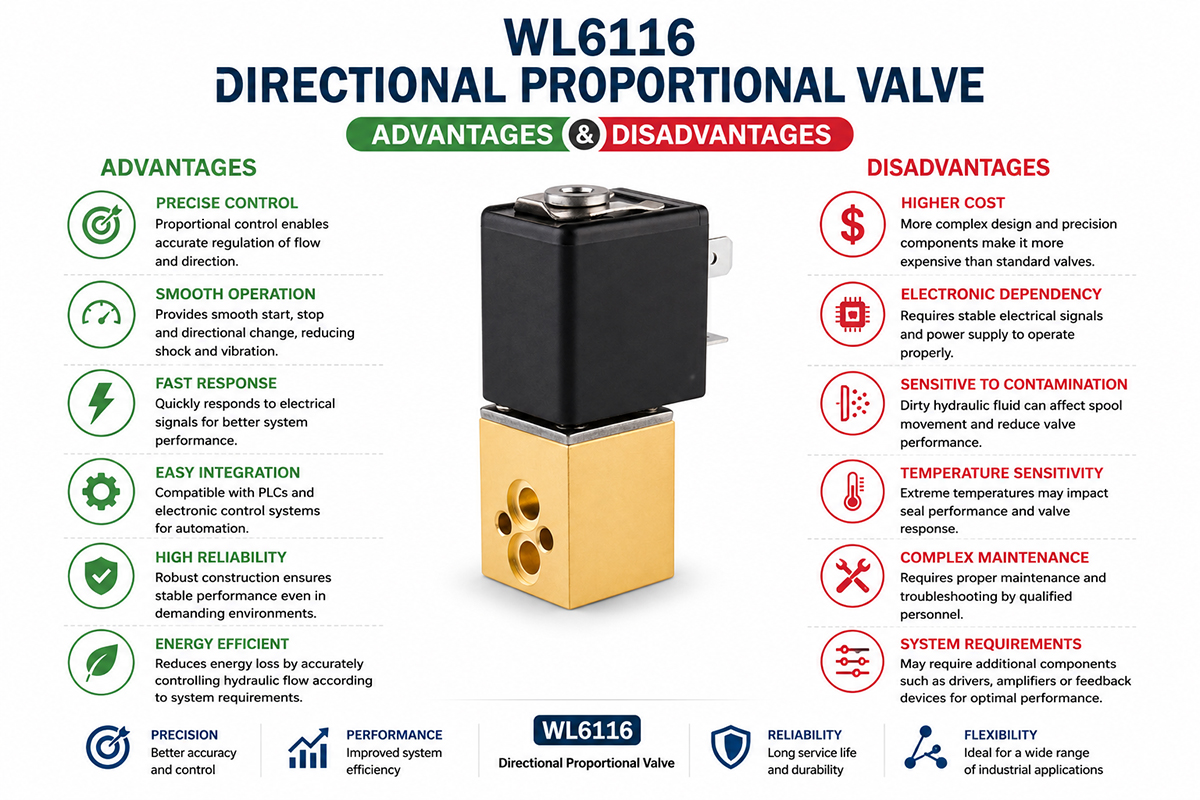
Directional Proportional Valve Advantages and Disadvantages

Advantages

Precise control – Directional proportional valves provide the variable control of the hydraulic flow and direction for accurate actuator motion.

Smooth operation: Gradual spool motion reduces the start and stop abruptness which decreases mechanical shock and vibration.

Electronics interface: They can be interfaced with PLCs, controllers, sensors and automation systems for advanced machine control.

Flexible performance – flow and direction can be changed according to the machine requirements.

Increased productivity: Improved motion control increases positioning accuracy, repeatability and machine performance.

Applications: Suitable for industrial automation, mobile hydraulics, robots, presses, CNC machines and material-handling machinery.

Disadvantages

Higher price: Proportional valves are usually more expensive than conventional directional valves.

Complexity of control: They require suitable electronic drivers, wiring and control software.

Sensitivity to contamination: Small spool clearances increase the sensitivity to the dirty hydraulic fluid.

Hydraulic heat generation: Continuous operation and friction losses may generate the hydraulic heat.

Complicated setup: Fine tuning of the command signals, ramp settings and feedback are required.

Maintenance: Electrical and hydraulic components require maintenance and inspection.

Despite the disadvantages, advantages of the proportional valves make them extremely valuable in those applications where precision and automation justify the extra price and complexity.

Directional Proportional Valve Working Principle Guide

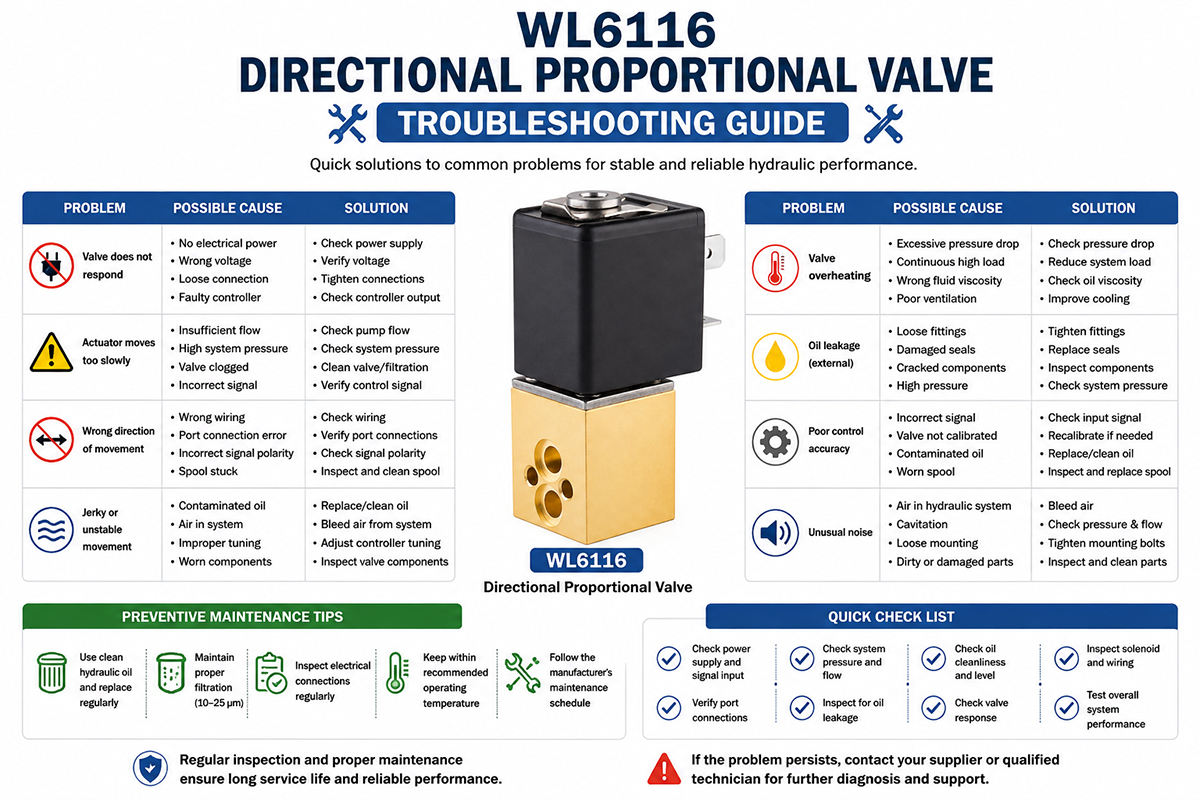
Directional Proportional Valve Troubleshooting

1. Valve does not respond

Check the power supply, wiring, connector, control signal and proportional driver. Ensure that input voltage or current comply with valve specifications.

2. Actuator motion is too slow.

Check if there is enough hydraulic flow available. Check the valve for blockages. Check the pump flow and ensure that pressure drops are not too large.

3. Jerky or Unsteady Motion

Contaminated hydraulic oil, stuck spool, improper signal tuning, air in the hydraulic system or wrong valve sizing can be reasons. Check filtration and air bleeding from the system as needed.

4. Wrong Direction!

Check the hydraulic port connections and spool configuration. The actuator moves in the wrong direction due to incorrect A/B port connections or wiring.

5. Extreme Heat

Check the pressure drop across the valve, unnecessary throttling, system pressure and pump settings. Excessive restriction can transform the hydraulic energy into the heat.

6. Valve Leakage

Check seals, fittings, valve faces and hydraulic connections. External leakage can require replacement of seals and repair of the component.

7. Bad Positioning Accuracy

Check the control signal, feedback sensor, valve hysteresis, load change and system tuning. Poor positioning accuracy can be influenced by contamination or spool wear.

8. Maintenance preventive

Clean hydraulic fluid, filtration, check electrical connections, monitor operating temperature and follow the manufacturer’s recommendations.

FAQ

1. What is a directional proportional valve?

A directional proportional valve is a hydraulic valve that regulates the flow direction of hydraulic fluid based on an electric signal. When compared to conventional directional valves, they ensure better actuator control.

2. How does the proportional directional valve function?

A proportional solenoid inside the valve displaces the internal spool in line with the electric signal sent. Various electric commands result in various spool displacements. Therefore, it is possible to vary continuously the hydraulic flow and its direction .

3. In what applications can I use directional proportional valves?

Directional proportional valves are mainly applied in automation, CNC machines, robotics, hydraulic presses, injection molding machines, mobile hydraulics, agricultural machinery, construction machinery, and material handling systems.

4. Main benefits of directional proportional valve?

Main benefits include precision in regulating flow, smooth operation of actuators, variable speed, electric control, high positioning accuracy, versatility and better compatibility with PLC and motion control systems.

5. How do I choose a directional proportional valve?

The following factors should be considered; maximum pressure, required flow, spool type, electrical input, reaction time, hydraulic fluid, temperature range, mounting dimensions, environment and desired control accuracy.

6. Why is my directional proportional valve moving erratically?

Main causes of erratic movements are contamination of hydraulic fluid, air in the system, faulty electrical signals, sticky spool, inappropriate valve size, unstable pressure or faulty tuning of the controller. Inspect electrical and hydraulic systems carefully.

7. How do I maintain the directional proportional valve?

Maintain the valve using filtered hydraulic fluid; regularly inspect electric connections and hydraulic fittings; monitor operating temperatures; check for any leaks; adhere to the recommended maintenance practices from the manufacturer.

8. Are directional proportional valves available as OEM products?

Absolutely. OEM directional proportional valves can be customized for required pressure ratings, flow capacity, spool characteristics, electrical input signals, mounting features, connectors, feedback options, materials and other performance parameters.

How to Select a Directional Proportional Valve

Selection of the right directional proportional valve involves selection of the valve so that the hydraulic, electrical, mechanical and environmental characteristics of the valve suit to the application.

1. Determine the Operating Pressure

Establish the operating pressure. Normal pressure. Maximum pressure. Select the valve with the higher pressure rating than in your service conditions. Average pressure is not a good basis for valve selection.

2. Calculate Required Flow Rate

Determine the maximum hydraulic flow for the cylinder or motor. Lack of flow capacity can result in pressure loss and reduction of the actuator speed. Over-sized valves can reduce control resolution.

3. Define Directional Requirements

Ensure that your application requires 2-way, 3-way, 4-way or some other valve spool configuration. The number and positioning of the ports should match the hydraulic circuit.

4. Investigate Proportional Control Accuracy

Establish the required accuracy of positioning, repeatability, hysteresis, response time and flow resolution. Some high precision automation applications require valves with built-in electronics or feedback.

5. Establish Electrical Compatibility

Match PLC, controller or drive to the valve. Voltage, current, input signal, connector and control method should be matched to the valve. Typical command types are analog voltage, digital command or current.

6. Assess Response Dynamics

Valves with fast response are used in motion control, robots, CNC machines and automatic machines. But the fast response has to be balanced with the stability of the system.

7. Investigate Fluid and Temperature Requirements

Ensure compatibility of the hydraulic fluid, viscosity range, operating temperature and sealing materials. Contamination control is also important to avoid problems with spool shifting.

8. Verify Installation Requirements

Assess mounting dimensions, port dimensions, flow direction, manifold compatibility and installation space.

9. Environmental Conditions

Vibration, dust, humidity, corrosion and temperature fluctuations should be assessed when working with outdoor and mobile equipment. Select the right enclosure and protection level.

10. OEM and Supplier Support Assessment

Select supplier who will provide you technical documentation, testing, customization, spare parts and engineering support. For custom machinery OEM customization will help you to optimize valve performance and integration.

Directional Proportional Valve Design: Tips to Avoid Common Pitfalls

Do not select too small the valve. Lack of flow capacity will result in pressure drops and actuator motion slowing down.

Avoid oversized valves. Oversized valves have poor low flow resolution and thus more complicated control.

Always take into account both normal and maximum system pressures. Match pressure ratings:

Select the right valve spool configuration. Wrong valve spool setup can lead to wrong actuator motion.

Check electrical signals Voltage, current, signal type, connector and controller compatibility.

Take response time into consideration. Slow responding valve can reduce the machine precision and productivity.

Control hydraulic contamination. Dirty fluid can lead to spool sticking, wear, leaking and unstable performance.

Consider the temperature. Select appropriate seals and materials for the right temperature range.

Pressure compensation is required in the case of variable loads to maintain consistent flow control.

Filtration is critical for accurate spool shifting.

Think about fail-safe behavior. What should the valve do if the power or control signal is lost.

Test your system as a whole. Valve performance should be tested with the pump, actuator, controller, sensors and hydraulic circuit.

Get A Free Quote Now

Contact Form

Related Products

Related News

Scroll to Top

Get A Free Quote Now !

Contact Form
If you have any questions, please do not hesitate to contact us.
Weilong Solenoid Company Culture
