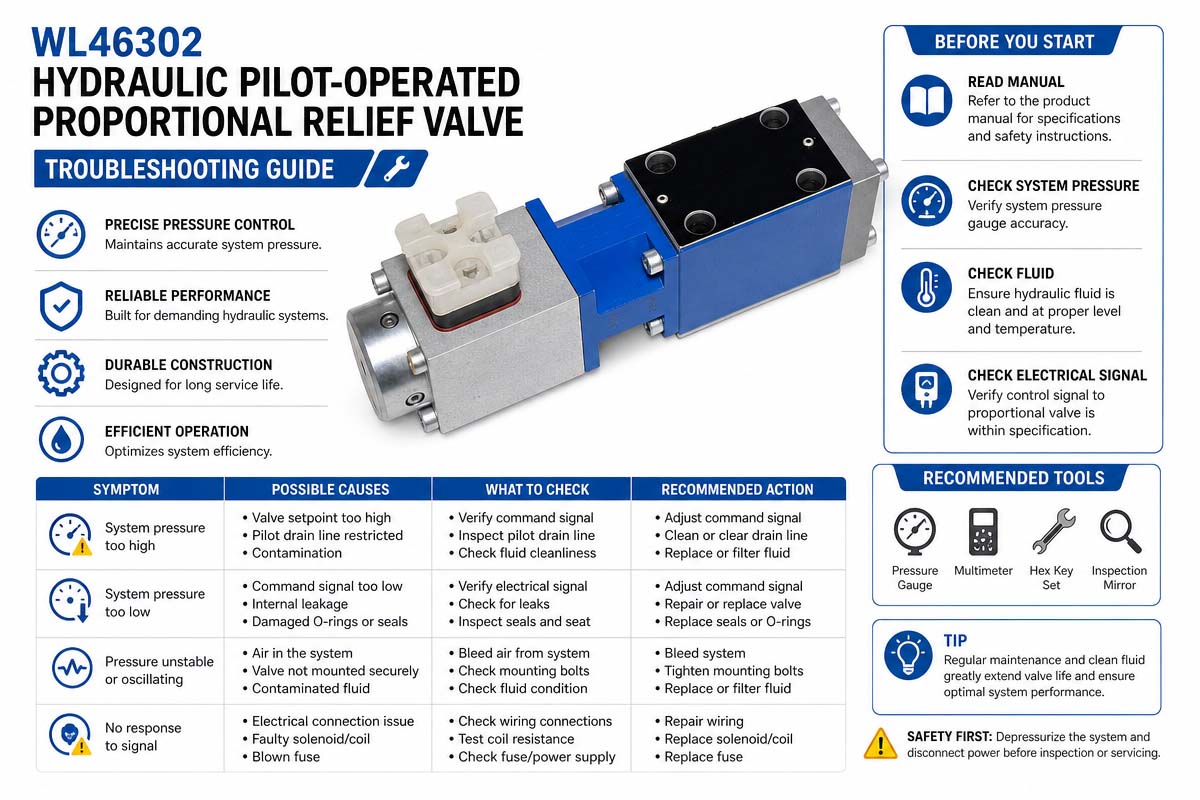
How to Choose a Hydraulic Pilot-Operated Relief Valve?
The WL46302 selection is not based solely on the hydraulic system pressure. Before issuing the purchase order, the whole operating environment should be reviewed and the valve requirements defined by the engineers.
1. Define the pressure range
Define the normal operating pressure, the relief pressure required, the minimum and maximum pressure settings, and the pressure fluctuations. The pressure range of the valve should cover the actual application, but the valve should not operate continuously at an unsuitable limit.
2. Define the required flow rate
Calculate the maximum flow that can be passed through the relief valve. Incorrect sizing of the valve can result in excessive pressure drop, unstable operation, heat generation, or inadequate pressure protection.
3. Define the proportional control signal.
Define if there is a need for a certain percentage of electrical input in the application. Control voltage/current, command range, connector, polarity, and driver characteristics should be defined prior to the production.
4. Assess response requirements
Some machines require rapid pressure changes while others require smooth and stable regulation. Define response time, pressure ramping, hysteresis, repeatability, and dynamics if required.
5. Check hydraulic fluid compatibility
Define the hydraulic oil or other fluid used in the hydraulic system. Make sure that seals, internal materials, coatings, and valve parts are compatible with the fluid selected.
6. Check installation requirements
Check the port size, port type, mounting style, envelope dimensions, orientation, electrical connector, and installation space. Mechanical interfaces should be verified on the approved 2D drawing or 3D model.
7. Consider environmental conditions.
Define operating temperature, ambient temperature, vibration, shock, humidity, contamination, corrosion exposure, and protection requirements.
8. Define expectations for reliability
Define the service life, duty cycle, test requirements, leakage limits, pressure stability, and inspection criteria for OEM applications.
9. Check safety requirements
A relief valve is an important safety component of the hydraulic system. The entire circuit should be reviewed for fail-safe behavior, emergency conditions, maximum pressure, and machine safety requirements.
10. Approve the samples prior to mass production.
For a WL46302 customized project, the prototype tests should confirm the pressure control, flow performance, response, leakage, temperature behavior, electrical compatibility, and mechanical installation prior to the mass production.
How to Avoid Common Design Pitfalls during the Design of a Hydraulic Pilot-Operated Relief Valve
Error 1: Only pressure requirement is provided.
Pressure alone won’t work. Include pressure, flow, control signal, temperature, hydraulic fluid, and application conditions.
Mistake 2: Failure to define the control signal
The proportional valve should fit its controller. The voltage/current command requirements and control characteristics should be clearly defined.
Mistake 3: Using an Unapproved Drawing
Minor changes in port location, mounting dimensions, connector position, or envelope size can lead to major installation problems.
Mistake 4: Failing to define hydraulic fluid
Seal material compatibility should be confirmed prior to the production.
Mistake 5: Failure to define dynamic requirements
If rapid pressure change is required, dynamic requirements should be defined in the design phase.
Mistake #6: Testing at room temperature only
Temperature influences hydraulic oil viscosity and valve performance. The test should reflect the real operating conditions.
Mistake 7: Simultaneously changing multiple parameters
When possible, change one major variable during prototype evaluation. Makes troubleshooting much easier.
Mistake 8: Failing to define acceptance criteria
Prior to ordering samples, agree on pressure accuracy, flow, leakage, response, electrical behavior, dimensions, endurance, and inspection methods.
Mistake #9: Assuming that the sample is production-ready by default
The prototype has to be tested against the final application. Mass production should not be started until the engineering approval is complete.