



Choosing a Permanent Magnet Holder
The choice of the most suitable permanent magnet holder is not about getting the strongest magnet on the market. The selection of the magnet holder should be based on the material, load, direction of installation, environment and safety requirements of the particular application.
1. Load computation
Calculate the exact weight of the equipment, tool or component to be mounted. Consider not only static weight but dynamic forces, vibration, impacts and movement.
2. Verify the mounting materials
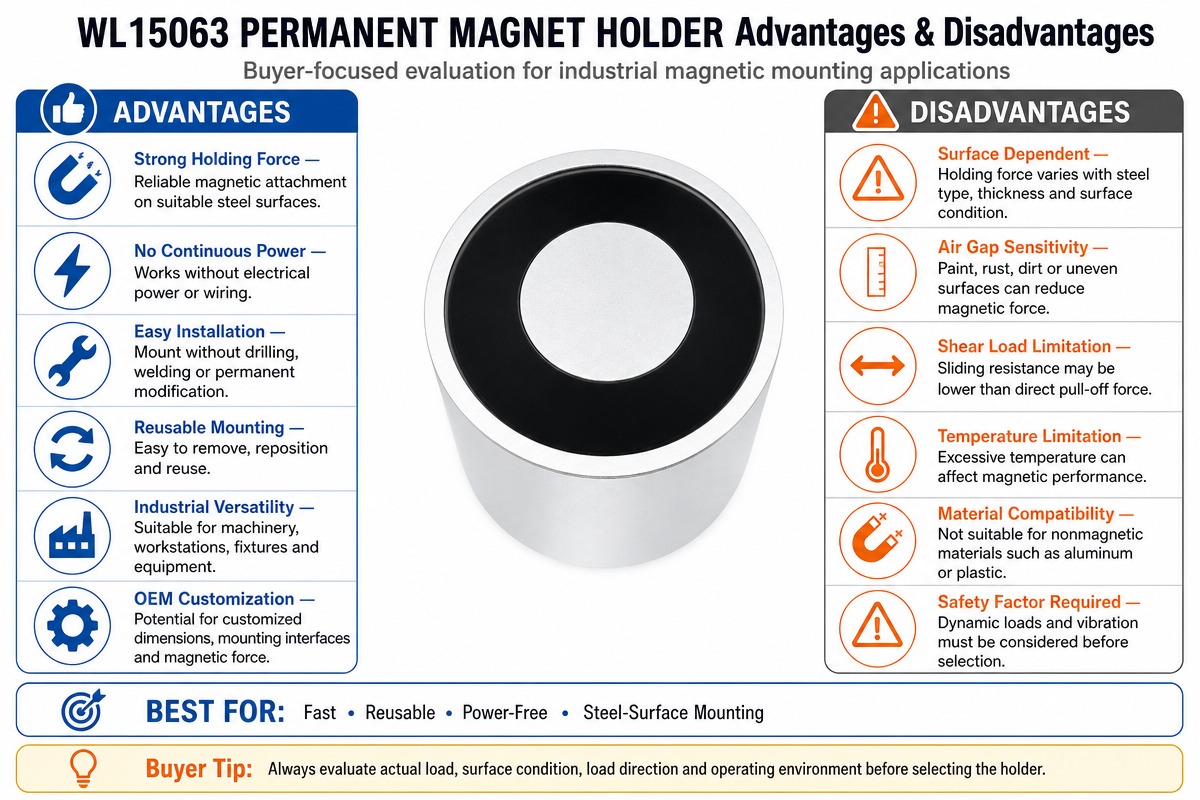
Permanent magnets usually work best on smooth, thick ferromagnetic steel. On stainless steel, aluminum, plastics and other non-magnetic materials, the holding force is either very low or even zero. Always check the material of the surface to mount to before selecting the holder.
3. Consider the load direction
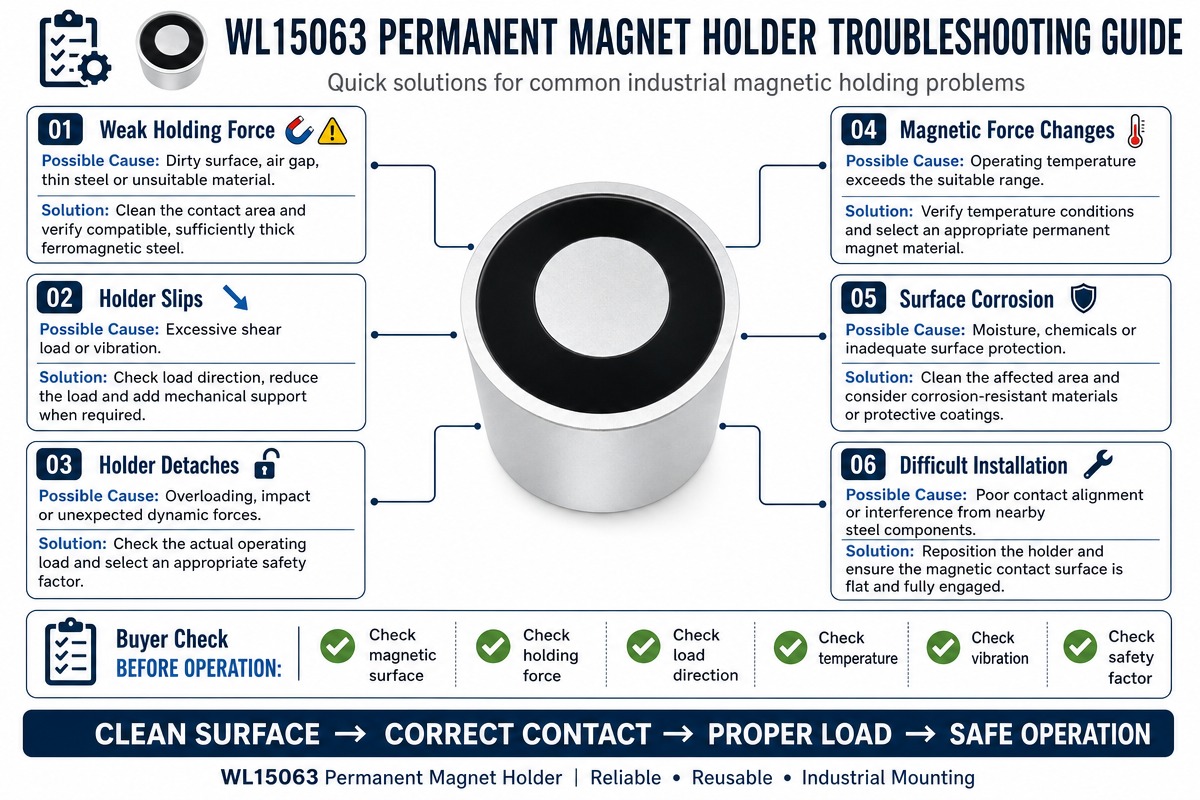
Sliding load is different from pull-off load. While the magnet may have very strong pull-off force, it may have quite poor sliding load resistance. If the holder is installed vertically or if it is exposed to vibrations, take into consideration the sliding load.
4. Determine the holding force
Select a holder with the holding force sufficient for the particular operating conditions. Paint, rust, gaps, curved surfaces, thin steel will negatively affect the magnetic performance.
5. Evaluate the contact area
Generally, a flat, smooth and fully engaged magnetic surface performs much better than the smaller and uneven contact area.
6. Consider the temperature.
The performance of permanent magnets depends on the temperature and select a material and holder design that is able to operate at expected temperature range.
7. Consider the environment
For factories, outdoor installations and humid environment, corrosion resistance, coatings and sealed construction should be considered.
8. Check the mounting compatibility
Make sure that the holder’s threaded holes, studs, mounting brackets or other mounting interfaces are compatible with your equipment.
9. Consider the mounting procedure and removal
If you need to re-position the design frequently, choose the holder that will be easy to mount and unmount.
10. Consider safety ratio
Do not use maximum possible holding force. Always select appropriate engineering safety ratio.
Tips to Avoid Typical Mistakes in Permanent Magnet Holder Design
Don’t select the magnet solely on the basis of its holding force. Actual performance largely depends on the magnetic circuit design.
Don’t overlook the air gap. Paint, dirt, rust, protective films and surface irregularities can reduce magnetic performance.
Don’t forget about sliding load. The magnet may have very high pull-off force but poor sliding load resistance.
Don’t select the magnet ignoring temperature. High temperature can degrade the magnetic performance.
Not all metals are magnetic. Check the surface material and its magnetic properties.
Don’t undersize the steel housing. Flux leakage in an imperfect magnetic circuit can reduce holding force.
Vibration should not be overlooked. The dynamic loads produced by industrial machinery can exceed static loads greatly.
Don’t neglect the safety ratio. Real world conditions are never identical to laboratory test conditions.
Don’t ignore corrosion protection. Humid and chemically aggressive environment can damage untreated parts.
Test the entire assembly. Verify the holder performance on the actual mounting surface, load direction, temperature and operating conditions


