Electromagnetic Gripper for Metal Parts Handling Design
Electromagnetic Gripper Benefits for Industrial Robots
Electromagnetic Gripper Selection Guide for Industry
Electromagnetic Gripper for Industrial Steel Handling
Electromagnetic Gripper for Industrial Robot Arms Guide
Electromagnetic Gripper in Manufacturing Automation Use
Electromagnetic Gripper for Metal Parts Handling Design
Electromagnetic Gripper Benefits for Industrial Robots
Electromagnetic Gripper Selection Guide for Industry
Electromagnetic Gripper for Industrial Steel Handling
Electromagnetic Gripper for Industrial Robot Arms Guide
Electromagnetic Gripper in Manufacturing Automation Use

WL1515 Electromagnetic Gripper for Automated Machine Tending

An electromagnetic gripper is an industrial gripper that picks, holds, transports and releases ferromagnetic parts by the means of electromagnetic forces. Electromagnetic grippers are often paired with robotic arms, automated material handling equipment, CNC machinery, assembly lines, and production lines. Electromagnetic gripper holds ferromagnetic components without using any mechanical fingers like other types of grippers. The gripper creates the magnetic field when receiving electricity in its magnetic circuit and holds suitable parts. When electricity is switched off or the magnetic field is controlled, the part is released. Industrial electromagnetic grippers are great helpers in steel sheet, plate, bar, stamped parts, fabricated and other magnetic materials handling. Electromagnetic grippers are fast, repeatable, easy-to-automate and compact. In order to select the correct gripper, it is necessary to consider such factors as workpiece material, weight, thickness, surface condition, air gap, operating temperature, duty cycle, power supply, and robot payload.

Electromagnetic Gripper Description

An electromagnetic gripper is an industrial or robotic gripper that creates magnetic force to attract and hold ferromagnetic materials. An electromagnetic gripper converts electrical energy to magnetic force by energizing the coil. Electromagnetic gripper can be mounted to a robotic arm, gantry system, automated machinery or special handling equipment. Examples of workpieces are steel sheets, plates, blocks, fabricated parts and other iron-based parts. Electromagnetic grippers are fast to pick and release, easy to control and reliable in material handling. Electromagnetic grippers are especially useful where mechanical fingers might need complex positioning or would interfere with the part.

How Does the Electromagnetic Grabber Work?

The electromagnetic gripper creates the magnetic force by passing an electric current through the coil and magnetic core.

Electricity supplied The control system supplies electric current to the electromagnetic coil.

Field created Current in the coil creates the magnetic field.

Magnetic circuit activated: Magnetic flux concentrated by the magnetic circuit at the pole faces.

Part attracts: The suitable ferromagnetic part attracts to the gripping surface.

Holding force maintained: The magnetic circuit maintains sufficient force to keep the part in motion.

Robot transports the load The gripper can pick up the part in an automated production process.

The controller activates the release command to eliminate magnetic force , and the part gets released.

Actual holding performance is strongly affected by the grade of the steel, the thickness, the flatness of the surface, the contact area, the air gap, the temperature, the magnetic circuit design and the electrical power.

Electromagnetic Gripper Video

Electromagnetic Gripper Detail Display

Electromagnetic Gripper

Brand Weilong Technology Model Number WL1515
Rated Voltage (V) DC 12V or 24V Rated Power (W) 3.8 W
Work Mode: Power on, magnet on. Holding Force (N) 2 kg
working duty 100% Resistance 100 Ω
Service Life 100 Thousand Times Certification CE, ROHS, ISO9001,
Material Superior Magnet Carbon Steel Housing Lead Wire Length (mm) 10 MM
Install Style Screw Hole Tolerance of Dimension ± 0.1 MM
Water-proof None Insulation Class B
Hi-Pot Test AC 750V 50/60Hz 2s Non-excitation Holding Force 0
Working Temperature -10°C-100°C Duty Cycle 1-100%
Thread Depth (mm) / Payment Term TT, or LC at Sight
Sample Order Yes. Warranty 2 Year
MOQ 1000 pcs Supply Ability 1000 pcs per week
Delivery Time 30 Days Port of Loading Shenzhen

Why is the electromagnetic gripper so popular?

Manufacturers are interested in faster, more flexible and more automated material-handling solutions and this is the reason why electromagnetic grippers are more and more popular. Nowadays, the production processes often involve steel sheets, machined components, fabricated parts and other ferromagnetic materials that can be easily handled with the help of magnetic forces.

The easier grip is another advantage. Electromagnetic gripper doesn’t require several mechanical fingers to grab the object. This allows to simplify tooling and increase the speed of pickup operation.

Electromagnetic grippers are also great helpers in automated material handling. Electromagnetic gripper can be controlled by the electrical signal and synchronized with robot, sensors, conveyors, CNC machine and production-control system.

Another advantage of electromagnetic gripper is its versatility. The various shapes of components can be handled by a single gripper design if the magnetic contact is sufficient. This feature is useful in environments where there are different sizes of product.

Automation trends also make manufacturers to minimize manual lifting and repetitive handling. Electromagnetic gripper increases the consistency of production and eliminates the necessity of the operator participation in material handling.

Being popular does not mean being suitable for all applications. Material compatibility, holding force, air gap, safety and power loss behavior have to be evaluated before installation.

Electromagnetic Gripper Applications

Electromagnetic Gripper Industrial Applications Guide

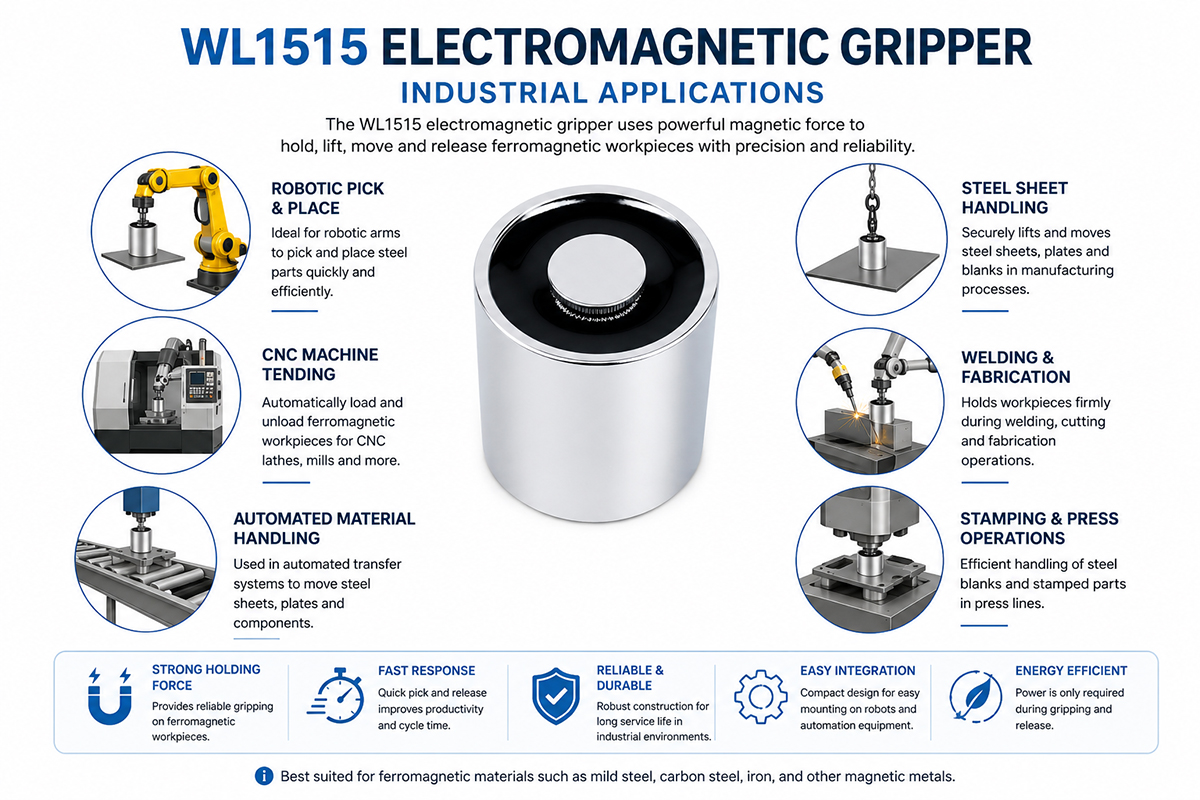
Electromagnetic grippers are widely used in industrial automation for picking, positioning, transporting or releasing of ferromagnetic parts.

Sheet metal handling: Electromagnetic grippers are able to lift steel sheets from the piles and transport them to the presses, forming machines, laser cutters or fabrication stations.

Robotic machine tending Electromagnetic grippers are able to load and unload suitable steel parts from CNC machines, machining centers and automated production machines.

Automotive manufacturing: Robotic systems can use the magnetic material handling technology to handle steel automotive parts, brackets, stamped parts and structural parts.

Metal fabrication: Electromagnetic grippers can be applied in metal fabrication lines to lift, move and transport plates, cut sections, brackets, frames and other steel parts from one process to another.

Press and stamping operations: Handling systems can transport steel blanks and stamped parts from storage, forming, inspection and processing stations.

Welding automation – Magnetic gripping can position suitable steel parts in automated assembly and welding processes.

Assembly lines: Electromagnetic grippers can transport steel parts from one conveyor to another, to fixtures, inspection stations and assembly machines.

Warehouse automation Robotic material handling systems can use electromagnetic grippers for automated transportation of suitable steel parts.

Machine tending and transfer This is another use of the gripper in repetitive loading and unloading operations requiring repeatable positioning and fast cycle times.

Electromagnetic Gripper Adv. & Disadv

Electromagnetic Gripper for Factory Robotic Automation

Advantages and Disadvantages of Electromagnetic Gripper

Pro’s

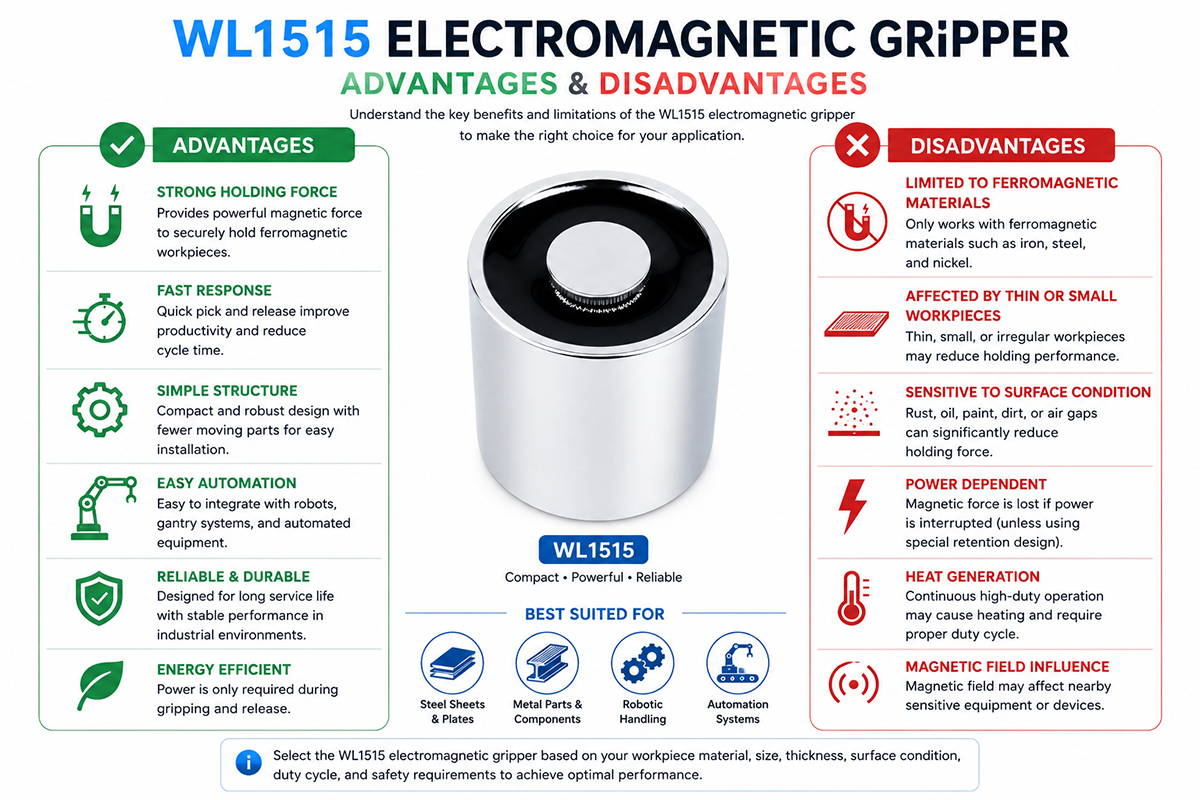
The advantages of the electromagnetic grippers for industrial automation are as follows. It is possible to use them to quickly select ferromagnetic parts and release them on command by the electrical signal. Compact design provides reduced robotic tooling and good access to the workpiece. Electromagnetic gripper is suitable for repetitive material handling and can be integrated with robotic arm, conveyors, CNC machines and automated production lines.

Another advantage of the gripper is that it is possible to transport some large or flat steel parts without the use of mechanical fingers around the part. It reduces mechanical interference and simplifies some pick-ups. With the right choice of the electromagnetic gripper, it is also possible to achieve repeatability and fast cycle times.

Cons

The major limitation is material compatibility. Electromagnetic grippers are specially designed for ferromagnetic materials and are either unsuitable or ineffective for many nonmagnetic metals and nonmetallic parts.

It is possible that the holding force is reduced because of air gap, thin material, curved surface, coatings, rust, dirt or poor contact. Most of the electromagnetic grippers require electrical power during the operation and that leads to the problems with energy consumption and power management.

Heating up can be a problem in case of continuous high duty operation. Depending on the gripper design, the power interruption also affects the performance of the gripper. Thus, safety engineering for suspended loads is important.

Finally, electromagnetic fields can be a problem for sensitive equipment or processes nearby. Thus, magnetic compatibility, safety, operating environment and actual workpiece conditions have to be evaluated before installation.

Electromagnetic Gripper for Robotic Pick and Place Tips

Electromagnetic Gripper Troubleshooting

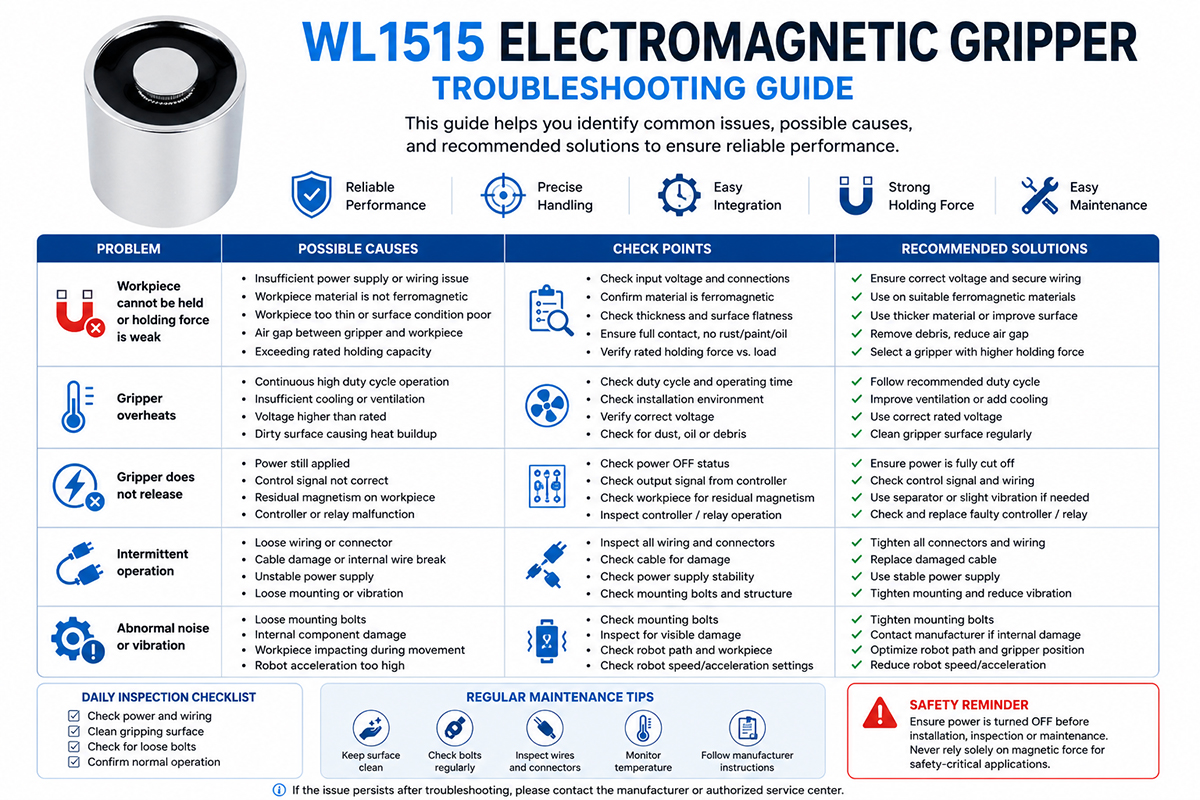
If the workpiece is not picked up correctly by the electromagnetic gripper, the first thing to check is the electrical supply. Voltage, wiring, connectors, controller output and operating signals should be checked. The wrong voltage or loose coil do not allow the coil to create the magnetic field.

The next step is to check the gripping surface. Dirt, oil, rust, paint, scale or other contaminations may create the air gap between the magnetic pole and the workpiece. The contact area and workpiece should be cleaned and positioned properly.

Check whether the material is really ferromagnetic. Some stainless steels and nonferrous metals may not provide enough magnetic attraction.

In case of insufficient holding force, check the workpiece thickness, surface flatness, dimensions and weight against the manufacturer’s data. Thin or curved workpiece may need a different gripper configuration.

In case of intermittent operation, check the cables, connectors, sensors, switching devices and control signals. The overheating can be caused by excessive duty cycle, wrong voltage, inadequate cooling or electrical problem.

If the gripper doesn’t release the workpiece check the control signal and de-energizing circuit. Mechanical contamination or residual magnetism may also be the reason.

Any unusual noise, high temperature, visible damage or recurring electrical faults should be investigated before further production use. Magnetic holding force shouldn’t be used as the only safety critical handling method without appropriate risk assessment and load retention measures.

FAQ

1. What is an electromagnet gripper?

Electromagnetic gripper is an industrial gripper device that employs magnetic fields produced through electricity in order to pick, hold, move and release ferromagnetic objects. It is used in robotic arms, production lines, CNC machines and material handling equipment.

2. What kind of materials can an electromagnet gripper handle?

Generally, electromagnetic robot gripper can process ferromagnetic materials like mild steel, carbon steel, iron and magnetic stainless steels. Non-magnetic materials such as aluminum, copper, brass, plastic and non-magnetic stainless steel cannot be processed effectively.

3. Explain the working principle of electromagnetic gripper?

Electricity is passed through the gripper coil, producing the magnetic field that is directed towards the gripping surface and used to attract and hold a magnetic material. Reduction of magnetic field is used to release the object.

4. What are the applications of electric magnetic gripper?

These include robotic material handling, sheet metal processing, CNC machine tending, automotive manufacturing, stamping, welding automation, fabrication, assembly lines, steel handling and automated warehousing systems.

5. How to choose the right electromagnetic gripper?

Factors to consider when choosing electromagnetic grippers include material, weight, thickness, size, surface condition of workpiece, holding force, air gap, robot payload, operating temperature, duty cycle, power supply and safety requirements. Testing should therefore be carried out using the workpiece.

6. Can the electromagnetic gripper grab thin steel sheets?

Yes, however, holding performance is dependent on thickness, steel grade, surface condition, contact area and air gap. The magnetic holding force can be significantly affected by thin sheets; consult manufacturers’ data.

7. What happens in case of a power outage?

It depends on the design of the electromagnetic gripper; some of them will lose magnetic force if power is cut off. • Consider load retaining measures and sensors for suspended or safety critical loads.

8. How to maintain an electromagnetic gripper?

Clean the magnetic surface of the gripper to remove any rust, oils, chips and dirt. Periodically inspect cables and connectors, mounting bolts, housing and electrical connections. Always monitor operating temperature and holding performance.

How to Select an Electromagnetic Gripper

Selection of an electromagnetic gripper involves matching of the magnetic performance of the gripper to the workpiece, robot, environment and automated process.

1.Determine the material of the workpiece.

First of all, it is necessary to establish whether the material is ferromagnetic. Only mild steel and other iron-based materials will work but aluminum, copper, brass, plastic and some stainless steels may not attract sufficiently. Thus, the material composition should be checked before selection.

2. Measure dimensions and weight of the workpiece.

Establish the maximum and minimum weight, length, width, thickness and shape of the workpiece. The nominal maximum rating should not be taken into account when selecting the gripper.

3. Examine the contact surface.

Flat, smooth and clean steel provides better magnetic coupling than curved, rough, painted, coated, rusty or uneven surface. Gaps in the surface considerably reduce the effective holding force.

4. Take into consideration the thickness of the material.

Thin steel may not be as good magnetically as thick steel. Check the manufacturer’s holding force data for the actual work piece thickness.

5. Define robot payload requirements.

The robot should carry the gripper, workpiece, mounting hardware, cabling and other tooling. Make sure that the total load is within the robot’s rated payload and moment limits.

6. Determine the proper electrical parameters.

Check the voltage, current, control signals, switching frequency, duty cycle, power consumption. Electrical compatibility of the gripper and controller should be checked.

7. Consider the safety.

Think about power-loss behavior, backup systems, sensors, mechanical retention, emergency-stop performance and other safety controls needed in case of dropping a load that can cause injury or equipment damage.

8. Analyze the environment.

Heat, dust, oil, moisture, vibration, impact and contamination in case of welding, machining, foundry or outdoor operation.

9. Evaluate the mounting options.

Examine the bolt pattern, mounting dimensions, cable routing, orientation and clearance around the gripping surface.

10. Workpiece real test.

Test the gripper with real workpieces under real operation conditions before using it in production process. That is the best way to check holding force, cycle time, release behavior and reliability of the gripper.

Tips to Avoid Common Mistakes in Electromagnet Gripper Design

Not all materials are magnetic.

Don’t select the gripper based on the weight of the workpiece.

Think about the air gap caused by paint, rust, dirt, coatings or uneven surfaces.

Consider the minimum workpiece thickness, not the maximum thickness.

Don’t base everything on the ideal lab conditions.

Check robot payload and moment limits.

Before installing the controller, check voltage and current requirements.

Think about the heat produced during high duty cycles.

Use proper cable protection and strain relief.

Think about the consequences of the power outage.

If workpiece detection is needed, consider installing appropriate sensors.

Allow sufficient clearance for pickup and release.

Test the gripper with actual production materials.

Check holding force at the actual working position.

Consider vibration and acceleration when a robot moves.

Keep magnetic contact surfaces clean and in good condition.

Don’t forget about safety and emergency-stop requirements.

Start high-speed production only after confirming the duty cycle of the gripper.

Document installation, inspection and maintenance requirements

Get A Free Quote Now

Contact Form

Related Products

Related News

Scroll to Top

Get A Free Quote Now !

Contact Form
If you have any questions, please do not hesitate to contact us.
Weilong Solenoid Company Culture
