Industrial Tubular Solenoid for Automation Systems
High Performance Industrial Tubular Solenoid Solutions
Reliable Industrial Tubular Solenoid Manufacturer
Industrial Tubular Solenoid for Smart Devices
Long stroke and 500 N loading=
Industrial Tubular Solenoid for Industrial Control
125mm stroke Industrial Tubular Solenoid with 50kgs loading
Custom Industrial Tubular Solenoid for Machinery
Heavy Duty Industrial Tubular Solenoid Solutions
High Force Industrial Tubular Solenoid Solutions
Industrial Tubular Solenoid Custom Design Services
Industrial Tubular Solenoid for Automation Systems
High Performance Industrial Tubular Solenoid Solutions
Reliable Industrial Tubular Solenoid Manufacturer
Industrial Tubular Solenoid for Smart Devices
Long stroke and 500 N loading=
Industrial Tubular Solenoid for Industrial Control
125mm stroke Industrial Tubular Solenoid with 50kgs loading=
Custom Industrial Tubular Solenoid for Machinery
Heavy Duty Industrial Tubular Solenoid Solutions
High Force Industrial Tubular Solenoid Solutions
Industrial Tubular Solenoid Custom Design Services
Industrial Tubular Solenoid for Automation Systems

WL132250 Industrial Tubular Solenoid for Automation Guide

An industrial tubular solenoid is a device that transforms electric current into linear motion. An industrial tubular solenoid consists of a tubular body wrapped with a copper coil, a magnetic circuit with iron core, and the sliding plunger. When an electric current runs through the coil, a magnetic field is generated to drive the plunger in order to create action.
Industrial tubular solenoids are widely used because of their compact construction, high energy conversion efficiency, and reliable operation. Compared with traditional solenoids, tubular solenoids feature much stronger magnetic force as well as higher energy efficiency. These solenoids can be customized in terms of force output, voltage, stroke length, mounting type, etc. They are widely applied in locking devices, vending machines, medical equipment, security devices, and packing machines.

Main Features of Industrial Tubular Solenoid

Compact in structure, these tubular solenoids have powerful magnetic force and can operate reliably. They are suitable for the need of high-speed, high-precision control in automation industry. These industrial solenoids are packaged in tubular form to save energy and increase magnetic force. With a rugged construction, these solenoids are durable, low maintenance and can work continuously and stably. Customized in push or pull action, these solenoids are customizable in voltage, stroke length, force output, mounting style and connection types.

Heavy Duty Industrial Tubular Solenoid Product Overview

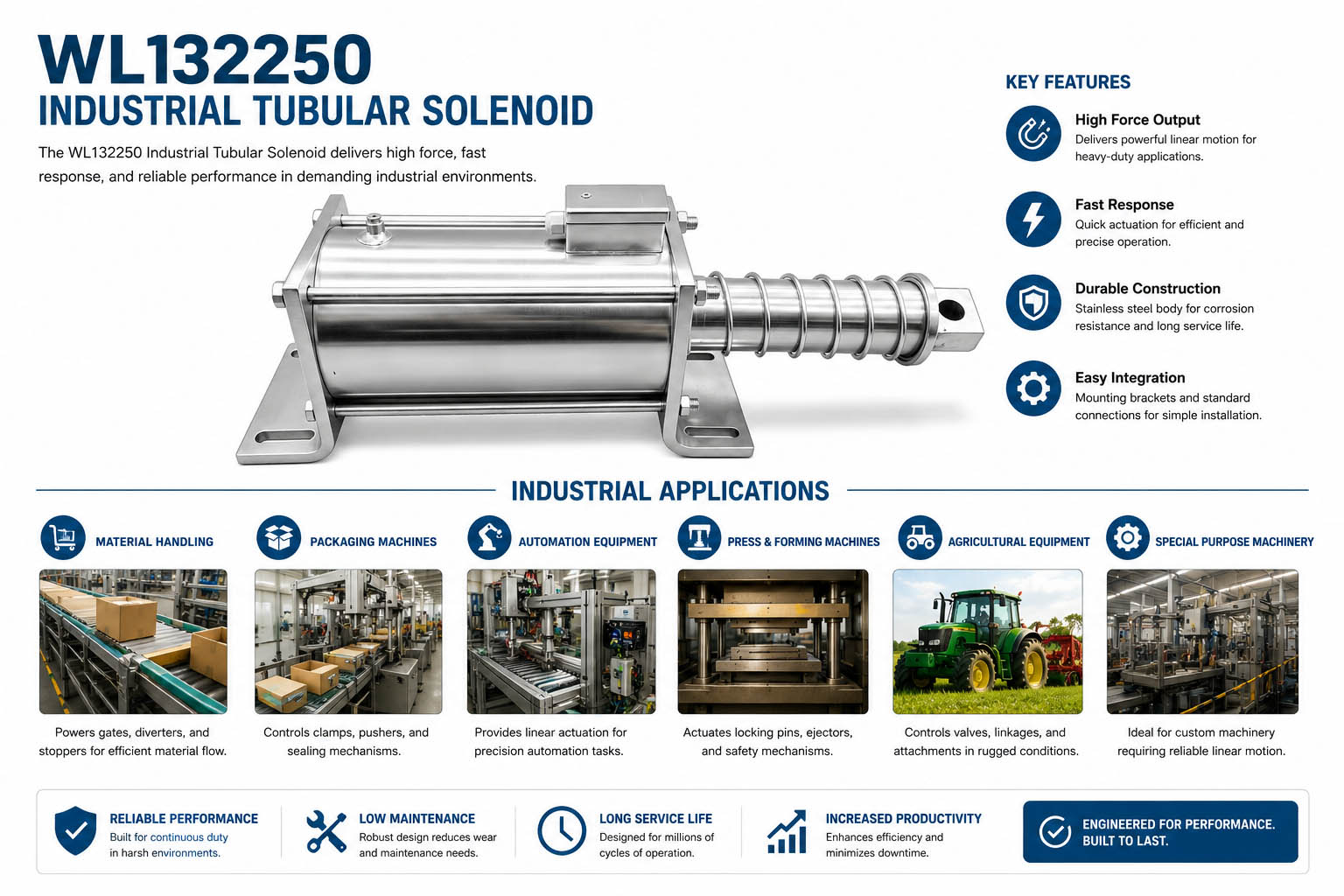
Industrial tubular solenoid is compacted electromagnetic actuators for producing linear push or pull action. The tubular design of these solenoids enhances the efficiency of magnetic flux, thereby producing high force output and fast response time. Industrial tubular solenoids are widely applied in automation equipment, security systems, medical devices, vending machines and industrial machinery. Various in voltage and force, these industrial tubular solenoids can be customized according to application needs.

Heavy Duty Industrial Tubular Solenoid Video

Heavy Duty Industrial Tubular Solenoid Detailed Display

Industrial Tubular Solenoid Technical Data Sheet

Brand Weilong Technology Model Number WL132250
Rated Voltage (V) DC 12 V , 24V,48V and 60V Rated Power (W) 5000-6000 W
Work Model Tubular  Pull Type Holding Force (N) 300-500N
Stroke (mm) 30–125 MM Reset Time(s) 0.1
Service Life 300 Thousand Times Certification CE, RoHS, ISO9001,
Material Carbon Steel Housing with Zinc Plated Coating Lead Wire Length (mm) 200
Install Style Adjustable Screw and Cap Tolerance of Dimension  +/-  0.1 MM
Water-proof  None Insulation Class F
Hi-Pot Test AC 1200V 50/60Hz 2s Non-excitation Holding Force 0
Working Temperature -10°C-100°C Duty Cycle 1-100%
Thread Depth (mm) / Payment Term TT, or LC At Sight
Sample Order Yes Warranty 1 Year
MOQ 1000 pcs Supply Ability 5000 pcs per Week
Delivery Time 30 Days Port of Loading shenzhen

How does an industrial tubular solenoid work?

When a direct current power supply is applied to the copper wire in the coil of an industrial tubular solenoid, a magnetic field is produced. This magnetic field generates an attractive force on the ferromagnetic plunger that resides inside the tubular housing.

Then, the plunger will be pushed inwardly to create the linear motion. Once the current flow stops, the plunger returns to the starting position with the help of a spring or external force. The whole process is relatively simple, efficient, and swift. Force output is determined by voltage, current, and stroke.

How can we manufacture the required industrial tubular solenoid with 50kg loading and 125mm stroke?


The challenge here is not making it stronger, but it’s the problem of its multidimensional nature (multi-physics limitation). The following main engineering limitations exist:

1. Trade-off Between Force and Stroke Distance (Main Design Problem)

The force depends on the air gap as follows:

F ∝ N²I²g²F \propto \frac{N^2 I^2}{g^2}F ∝ g²N²I²F, where F = force and g = air gap (stroke distance)

What is the issue here?

At the stroke of 125 mm, the air gap is quite large.

Magnetic force decreases exponentially depending on the distance to the plunger.

It is really difficult to provide 50 kg of force at full stroke without the following:

extremely large coil volume or

extremely high electric current or using some kind of magnetic amplifier

The result of designing a tubular solenoid will be the following:

high force at the start of stroke (0-10 mm)

force decreases at the end of a long stroke

2. Coil Size vs Electric Current (Overheating Risk)

In order to get a high force at a long stroke:

the number of ampere-turns should be quite high

you will require:

a thick copper wire or many coils or very high current

Consequences:

very high I² resistance heating = high current

Tubular housing

small space for coils

the risk of coils overheating above the class insulation limits (class F/H)

=> Thermal design is one of the key problems for your application

3. Magnetic Sättigung des Kernmaterials

It is necessary that flux in the iron core and plunger be sufficiently high:

Due to the high force requirements, the steel is saturated with magnetic flux (~1.6-2.0 Tesla)

Magnetic saturation

the additional current does not increase force substantially

The problem:

Tubular geometry implies restricted cross-section of iron core

A long stroke decreases flux path efficiency

4. Long Stroke and Air-Gap Flux Losses

When the stroke reaches 125 mm:

part of magnetic flux is “leaking” into the surrounding environment

low magnetic field density and distribution

As a result:

low efficiency of conversion to force (< 10-20%)

stronger force at the ends, weak force in the middle

5. Mechanical Problems of Tubular Solenoid with Large Stroke

Long-stroke solenoids have their specific mechanical issues:

The plunger is inclined or stuck

Requirements:

extra precise machining low-friction bearings/bushings wear-resistant coating

50 kg loading:

sideways loading and friction plays significant role

The failure or plunger sticking due to the misalignment

6. Trade-off Between Mass and Speed of Actuation

In order to push the force of 50 kg in a 125 mm stroke:

A larger plunger mass is necessary …

larger mass means more inertia and, therefore, slower speed

=> You will face the problem of trade-offs between the following:

high force = low speed of actuation

fast response = low force output

7. Duty Cycle and Forced Heating Issues

For industrial usage, usually the following is required:

high-frequency operation

However:

Large stroke and high force = large energy per cycle

Tubular housing => inability to dissipation quickly

=> The result often requires:

intermittent duty cycle (10 to 30%) or forced cooling system

8. Manufacturing Limitations and Housing Size

To have a 50 kg force at a 125 mm stroke:

Generally, you will need the following:

a large diameter coil

long magnetic circuit housing

However, the constraints are

price grows

Weight grows, installation space is restricted, and precision of machining improves

9. Efficiency Problem (Key Issue of Real Design)

During a long stroke solenoid performance:

the efficiency of conversion electrical to mechanical energy becomes low

“Almost all the energy is lost as heat, but not force.”

As a result, engineers are asking themselves:

“Is the solenoid the right device?”

10. Main Directions in Designing a Real Device

Engineers choose the design, which combines your requirements of 50 kg and a 125 mm stroke to provide:

Solenoid with mechanical advantage

Leverage mechanism

Rack & Pinion assembly

Magnetic latch with spring assistance

Alternative: hybrid actuator

release/lock solenoid

motor or pneumatic actuation of lever

Alternative C: Multistage Solenoid

high-power solenoid with small stroke

mechanical stage extending plunger position

Conclusion

Making the 50 kg force at a 125 mm stroke in a single pure tubular solenoid is problematic because

exponential decrease of force depending on the stroke length

peak force value limited by magnetic saturation

limits on continuous heating current

low efficiency of conversion with the long stroke

mechanical stability is important


Heavy Duty Industrial Tubular Solenoid Application

Industrial Tubular Solenoid Industrial Application

The applications of industrial tubular solenoids include industrial automation systems where valves, gates, and locking devices are controlled; they also regulate sorting devices and actuators. In packaging machinery, tubular solenoids are used for controlling the positioning of products, sealing, and mechanical switches.

In vending machines, these solenoids are used to control the dispensing actions as well as the locking function of vending machines. Tubular solenoids are used in electronic lock and access control equipment and security and safety systems. Their accuracy and reliability ensure that these solenoids are suitable for diagnostic instruments, medical dosing, and laboratory automation systems.

In office equipment such as printers, copiers, and document management systems, tubular solenoids are widely used. They also serve the automotive industry for fuel and transmission control systems and automatic locking devices. Tubular solenoids are ideal for agricultural machinery, smart homes, robotics, and industrial control panels.

Heavy Duty Industrial Tubular Solenoid Advantage and Disadvantage

Industrial Tubular Solenoid Advantage and Disadvantage

Industrial Tubular Solenoid Advantages

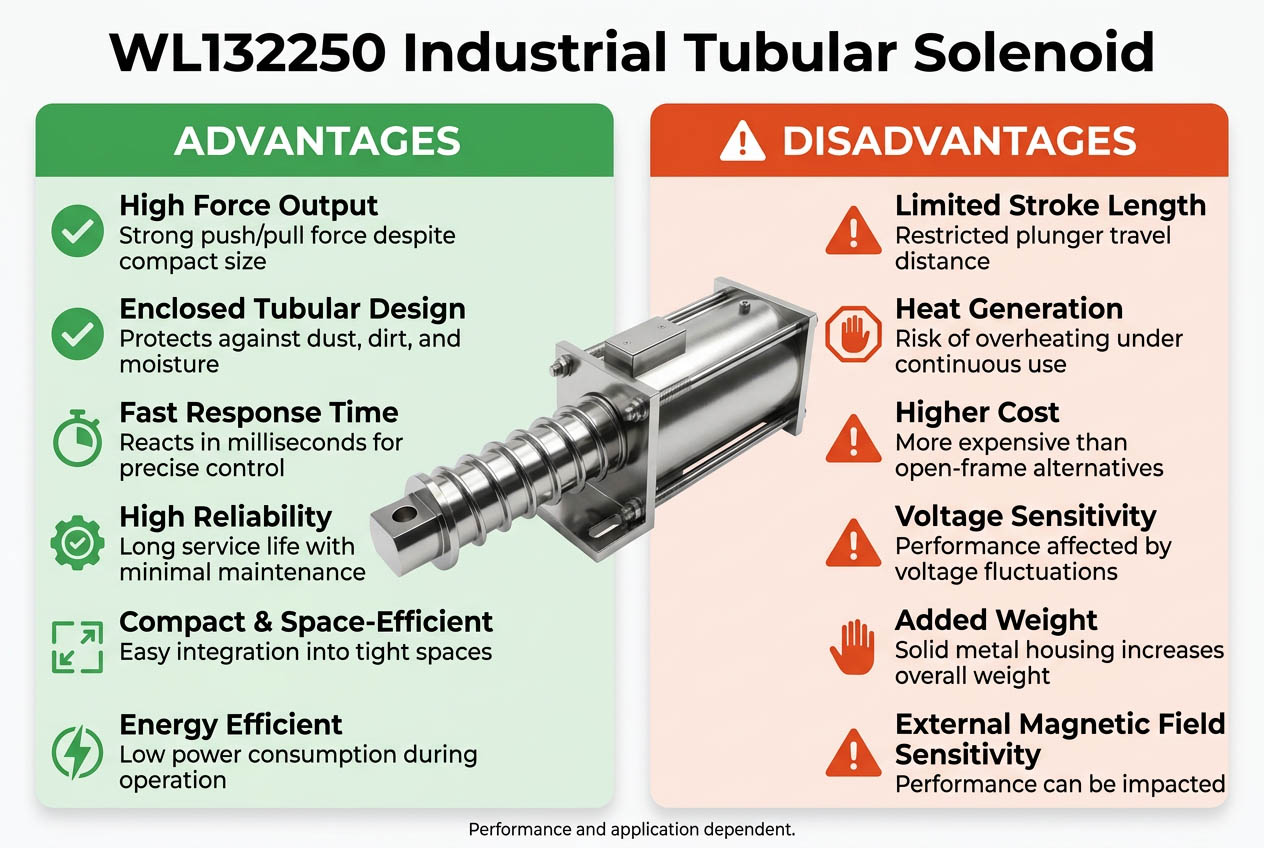
There are many advantages of tubular solenoids. Due to their compact design, industrial tubular solenoids have high force output. In addition, their closed-circuit construction makes them highly efficient. They can provide a quick response and achieve highly accurate linear motion. Moreover, the industrial tubular solenoids are reliable with a low cost of maintenance.

These solenoids can last millions of cycles when designed appropriately. In addition, the industrial tubular solenoids can be customized in voltage, force, stroke length, mounting, and environmental protection level.

Industrial Tubular Solenoid  Disadvantages

Tubular solenoids have their advantages as well as disadvantages. As the stroke length increases, the force decreases. Moreover, they generate heat if operated continuously. Excessive voltage and incorrect duty cycle may cause overheating, thereby reducing service life.

Moreover, the travel length of the tubular solenoids is usually shorter than motor-driven actuators. Thus, for very long stroke applications, other actuator types may be chosen. Magnetic force at the end of the stroke length is stronger than the beginning point, which results in non-uniform force output.

Industrial Tubular Solenoid Troubleshooting Guide

Industrial Tubular Solenoid Troubleshooting Guide

If your industrial tubular solenoid does not work, here are some ways to troubleshoot it:

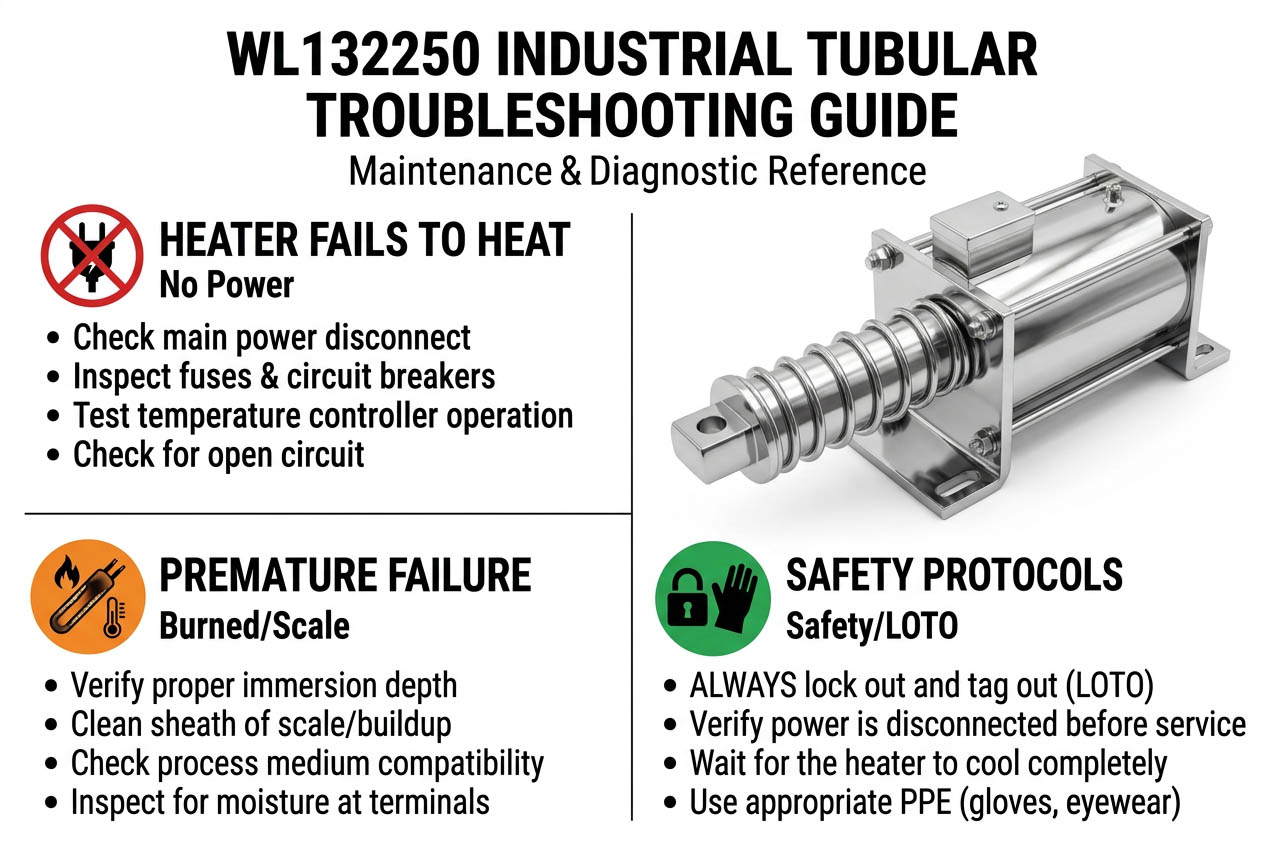
First, the supply voltage and current must be checked. If the voltage is lower than the requirement, magnetic force cannot be generated. Check whether there are any loose wiring connections, breaks, or damages to the wire. Next, overheating can be caused by overload or excessive voltage. A coil resistance test can be used to detect short circuits or damage to the windings.

Next, the plunger and tubular housing must be inspected for any signs of dirt, damage, corrosion, and obstruction. Then, the plunger may fail to respond if it cannot move smoothly. It may also be due to faulty springs.

Last but Finallyr vibration may be due to misalignment, wear and tear of components, or an unstable power supply.

FAQs of Industrial Tubular Solenoid

1. What is a tubular solenoid and why should I use it instead of the traditional open frame solenoid?

As its name says, a tubular solenoid is mounted into a cylindrical metal housing that totally encloses the core and coil of the solenoid. The tubular design improves the magnetic flux and also creates the magnetic shield against external interference as well as protects the inner parts of the solenoid against dust and other impurities. The open-frame solenoid has an exposed core in the form of C or D shapes. They are less expensive yet generate less force and have no magnetic shielding properties.

2. Can you explain the duty cycles of industrial tubular solenoids?

Standard industrial duty cycles are

Intermittent (such as 10%, 25%, 50%); the duty cycle depends on the time of solenoid energization and disengagement. This gives an opportunity to generate higher power (force) due to limited heating of the coil.

Continuous (100%). A solenoid operates without limitations of the energization time, yet it has a restricted power.

When choosing the solenoid, you should take into account the expected duty cycle to avoid coil burnout.

3. How can I calculate the force required by the industrial application?

The force output of the tubular solenoid changes in accordance with the distance from the point of energization of the plunger. So the force generated is the maximum at the beginning of the stroke and the minimum at the end of it. Manufacturers provide graphs of force-stroke characteristics for each particular model. You need to make sure that the force of the chosen solenoid is enough to overcome the mechanical load at each point of the stroke length.

4. What types of voltages do you have?

Industrial tubular solenoids can have DC or AC. Low-voltage DC includes 6, 12, 24, and 48V, and high voltage is 110 and 220V. Less frequently there are AC tubular solenoids; they have rectifiers inside of the coils. Do not exceed the nominal value—overvoltage shortens the solenoid’s life significantly.

5. Are push or pull models preferred in tubular solenoids?

The majority of tubular solenoids are pull solenoids which means that when energized the plunger pulls into the coil. Yes, you can also get push solenoids by adding an extender or spring on the plunger. Some models exist that operate in pull/push modes, so look at the datasheet for the maximum push stroke of the plunger.

6. What environmental protection can be achieved with industrial tubular solenoids?

Basic tubular solenoids have no protection against the environment (class IP00 – protecting against solids larger than 12mm). Use the protected variants (IP65, IP67) with O-ring, epoxy filling, or stainless steel housing in case of moisture, dust, and mild chemical presence in the working environment. Note: Protection decreases thermal exchange; therefore, reduce the power if the duty cycle remains unchanged.

7. Which type of return mechanism to select?

The tubular solenoid needs to have some return mechanism in case of de-energization. The following return mechanisms are possible for tubular solenoids:

Gravity (the solenoid should be installed vertically).

External spring (most popular, indicating free length and spring rate).

Return induced load (push of the mechanical system).

In some models, the return spring is included in the solenoid itself. The latter case will mean the absence of the return mechanism, and the solenoid will keep the last position.


8. What are the mounting options?

Standard mounting options for industrial solenoids:

Threaded front bushing with a hex nut (for mounting the solenoid to panel or bracket).

Mounting flanges perpendicular or parallel to the body with a threaded hole.

Through holes or back studs.

Custom brackets with minimal order quantity.

Friction and return force could depend on mounting direction especially for large stroke lengths.

How to Avoid Common Mistakes When Selecting an Industrial Tubular Solenoid

A wrongly selected tubular solenoid leads to inefficiency and premature failure of these actuators. Engineers usually overlook the stroke requirement and just check the voltage rating when selecting solenoids. Actually, the pressure at the operational stroke length must be measured.
Duty cycle is one of the most commonly overlooked aspects when selecting industrial solenoids. A tubular solenoid designed for intermittent use becomes overheated when used continuously. Moreover, engineers fail to consider the environmental factor. Moisture, high temperatures, vibrations, and dust affect solenoid performance and need certain protection.
Mounting of the industrial tubular solenoids must be properly done. Engineers sometimes neglect to consider space requirements and mechanical alignment, which reduce energy consumption and decrease efficiency. At an earlier stage, cable length, connection type, and electrical interface must be determined.
Life-cycle requirements are another factor that engineers usually overlook. To achieve high efficiency with a long service life, engineers tend to choose products that are not able to endure millions of cycles.

How to Choose an Industrial Tubular Solenoid

Selection of industrial tubular solenoids requires taking account of certain electrical, mechanical, and environmental factors.
1. Check for type of motion
Firstly you need to establish whether the system works on a push, a pull, or both. It defines the appropriate plunger and magnetic circuit design.
2. Define the required force
This means calculating the force necessary to perform desired work plus friction allowance and safety margins.
3. Establish the stroke length
Determine the actual stroke length required and measure the force where it is needed, as force characteristics differ depending on the stroke length.
4. Choose voltage and power
Standard voltages include DC 6V, 12V, 24V, and 48V and, less commonly, AC 110V and 220V. Available voltage determines the design and efficiency of the coil.
5. Consider duty cycle
Will it be an intermittent or continuous duty state? Thermal management should be taken care of in continuous-duty applications.
6. Consider environmental conditions
Temperature range, humidity, dust protection, vibrations, waterproofing, etc.
7. Consider installation limitations
Space is available for mounting and fixing, as well as for the cable layout and connectors used.
8. Estimate solenoid’s service life
Predict the total number of operational cycles required during the service period of the device. High-performance applications require special treatment during the designing and manufacturing process.
9. Make requests for customization
Specialized products include customized stroke length, force characteristics, cable assembly, mounting brackets, waterproofing features, etc.
10. Cooperate with a specialist industrial solenoid manufacturer
Such a company will offer you professional consultation, performance testing, prototyping, and production optimization services. As a result, it will guarantee high performance, increased lifespan, and low-cost operations. To accomplish these goals, buyers will consider their requirements and constraints before choosing.

Get A Free Quote Now

Contact Form

Related Products

Related News

Scroll to Top

Get A Free Quote Now !

Contact Form
If you have any questions, please do not hesitate to contact us.
Weilong Solenoid Company Culture
