Skip image slider
PTFE Solenoid Valve for Chemical Manufacturing Overview
PTFE Solenoid Valve for High Purity Handling Automation
PTFE Solenoid Valve for Corrosive Liquid Automation
PTFE Solenoid Valve for Laboratory Equipment Automation
PTFE Solenoid Valve for Corrosion Resistant Service Use
PTFE Solenoid Valve for Chemical Process Control Design

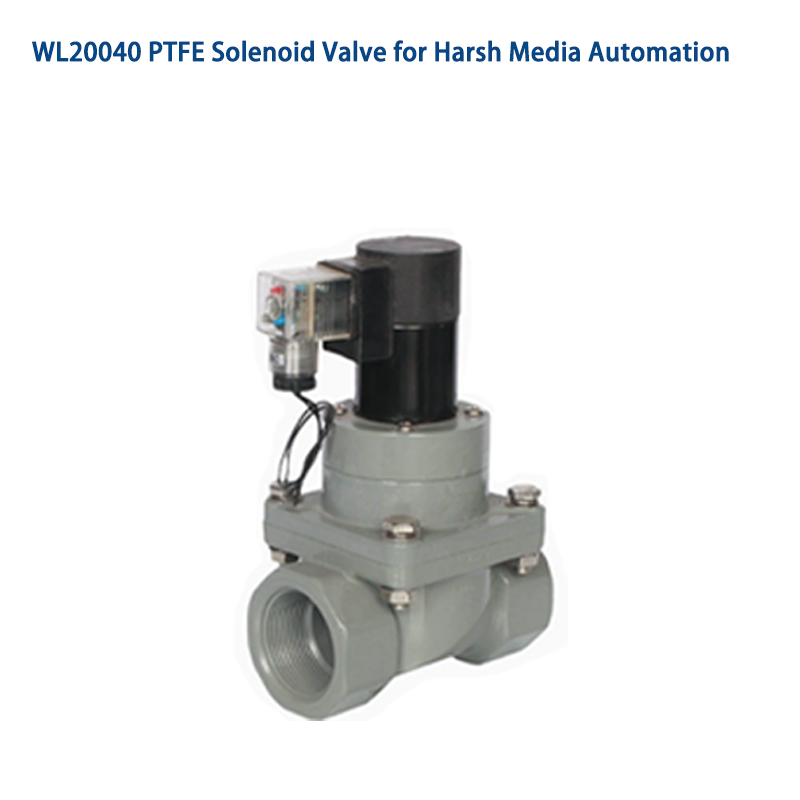
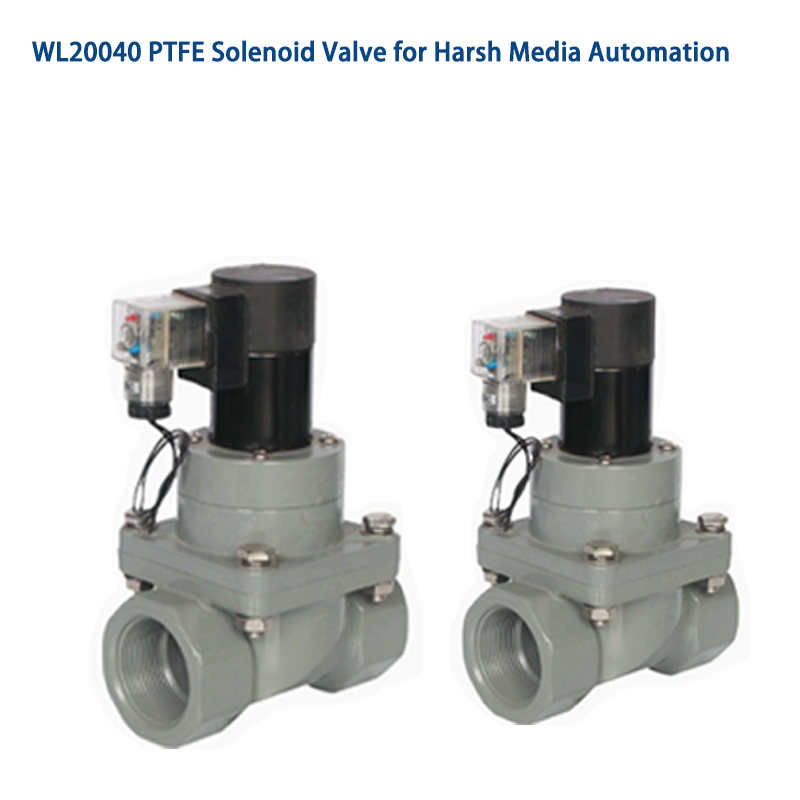
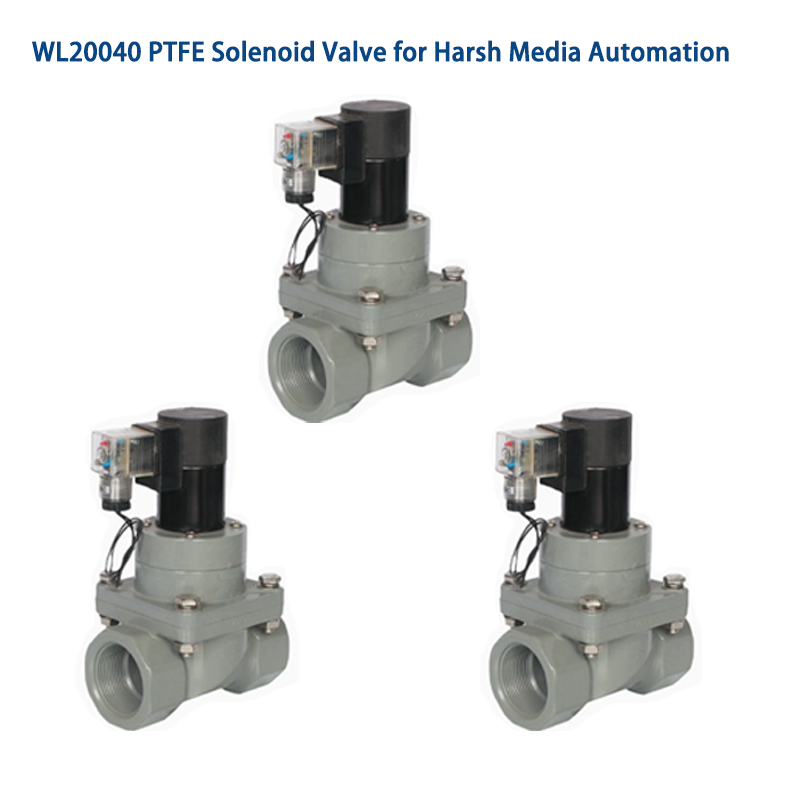
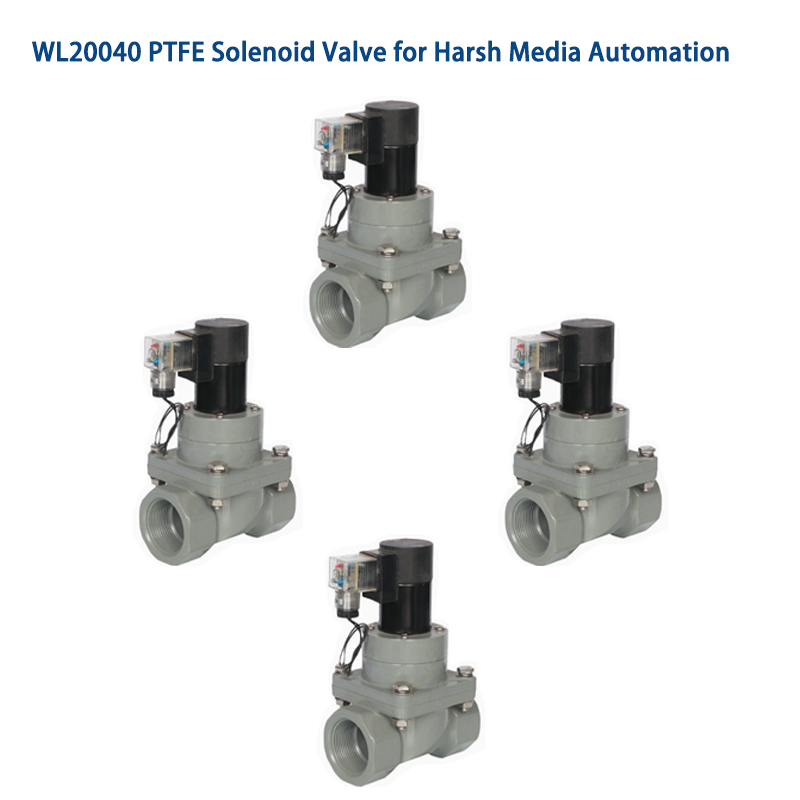
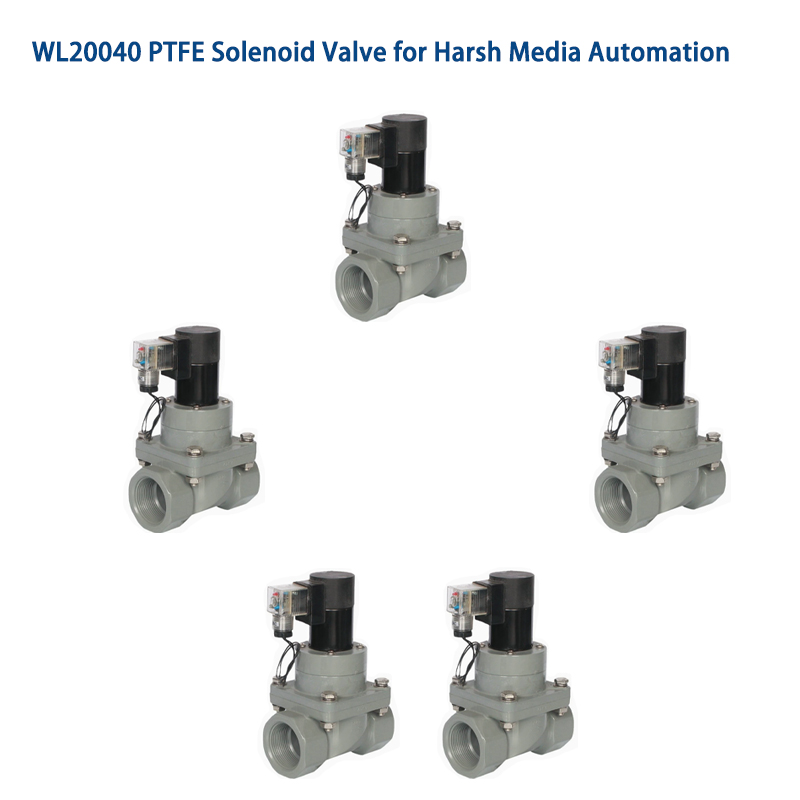
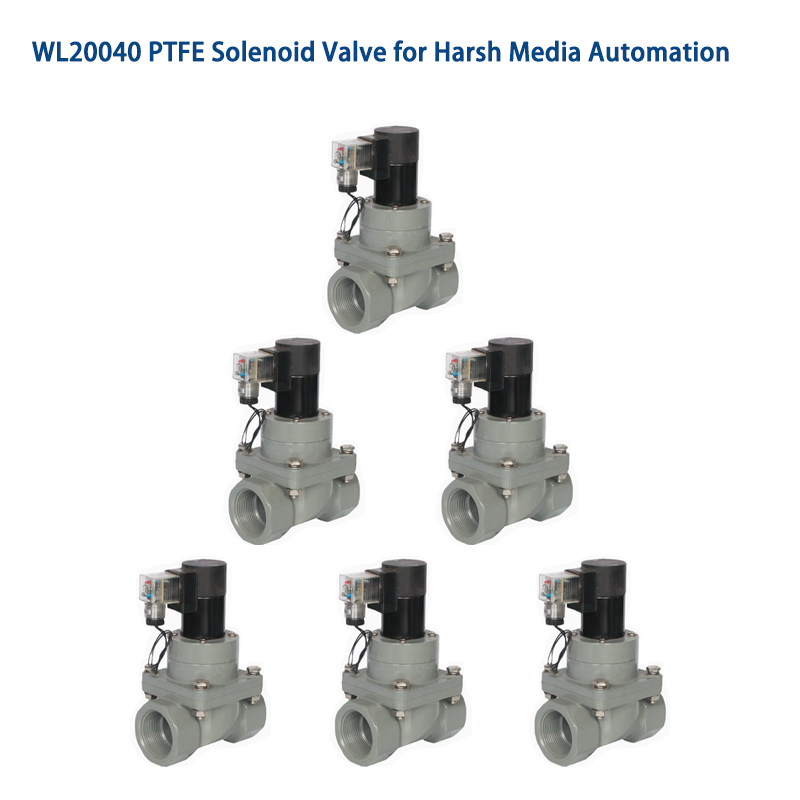
WL20040 PTFE Solenoid Valve for Harsh Media Automation

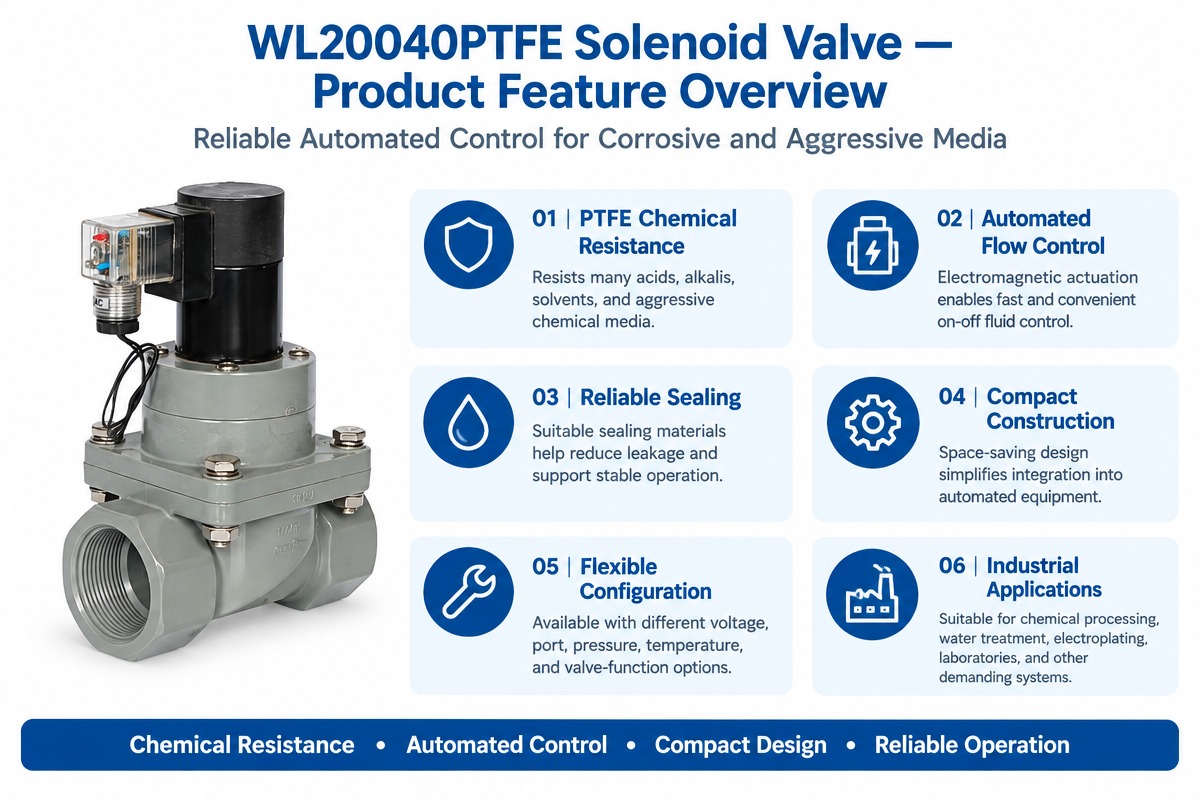
The PTFE Solenoid Valve is a control valve using electric energy to provide accurate on/off control of liquids and gases in demanding industrial applications. PTFE components ensure high resistance to corrosive chemicals, acids, alkalis, solvents and media. It unites automatic actuation with positive sealing providing the ability to control the fluid flow remotely and efficiently. PTFE valve construction reduces corrosion-related maintenance and increases service life of a valve being matched with the process medium, pressure, temperature and flow. Typical applications include chemical processing, water treatment, electroplating, semiconductor manufacturing, pharmaceutical production, laboratory equipment, and industrial cleaning. Compact design makes PTFE solenoid valves suitable for automated equipment in limited space for installation. Proper specification ensures reliable media isolation, switching performance and process control. Matching of the voltage, pressure, temperature, seal material and installation procedure are vital for the stable performance and to reduce leakage, downtime and early replacement in industrial continuous operations.

PTFE Solenoid Valve Description

What Is a PTFE Solenoid Valve?

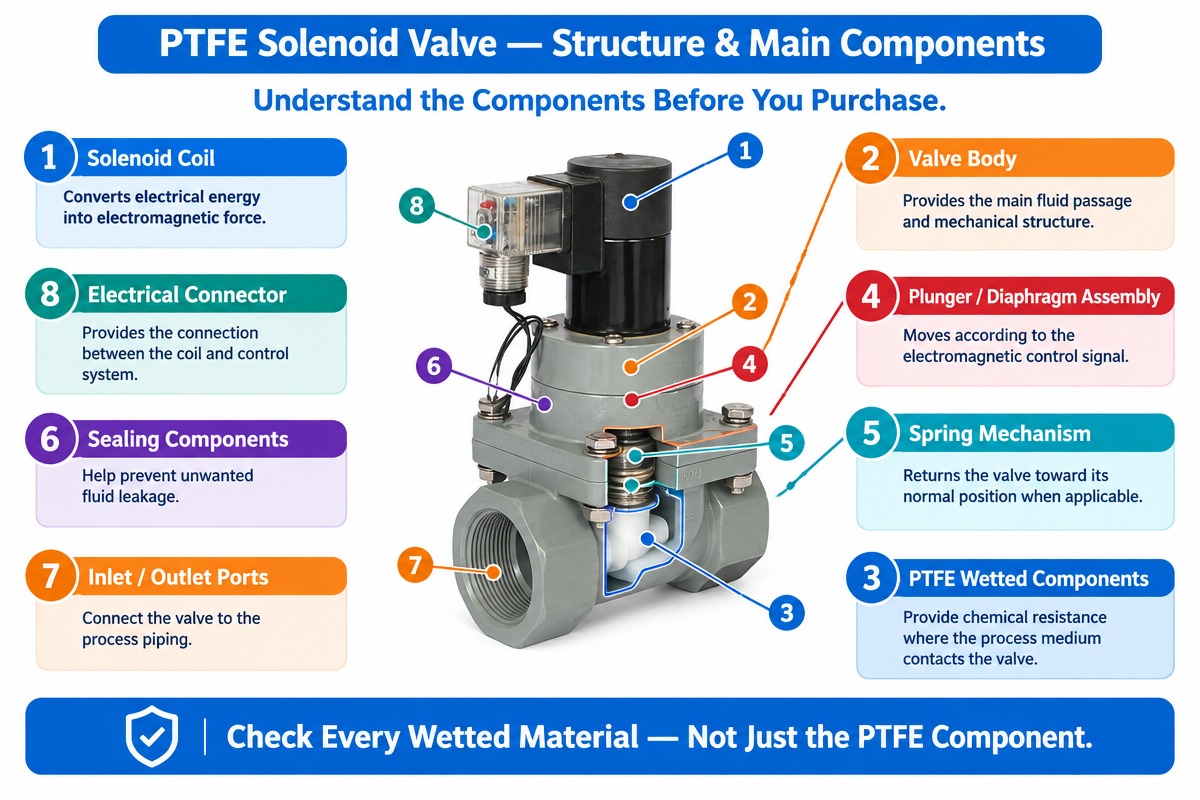
The PTFE solenoid valve is a valve actuated by the electric power via an electromagnetic coil for opening and closing of the internal plunger or diaphragm. PTFE (Polytetrafluoroethylene) is a material used for wetted parts, liners or seals. PTFE has a high resistance to corrosive chemicals and aggressive media. The electrical signal is supplied to the coil generating magnetic force moving the mechanism to open or close the fluid passage. When the power is off the valve is returned back to its normal position due to spring or pressure difference as provided by the design. PTFE solenoid valves are widely used for chemical processes, water treatment, electroplating and laboratory systems with the requirement of reliable fluid shut-off.

How Does a PTFE Solenoid Valve Work?

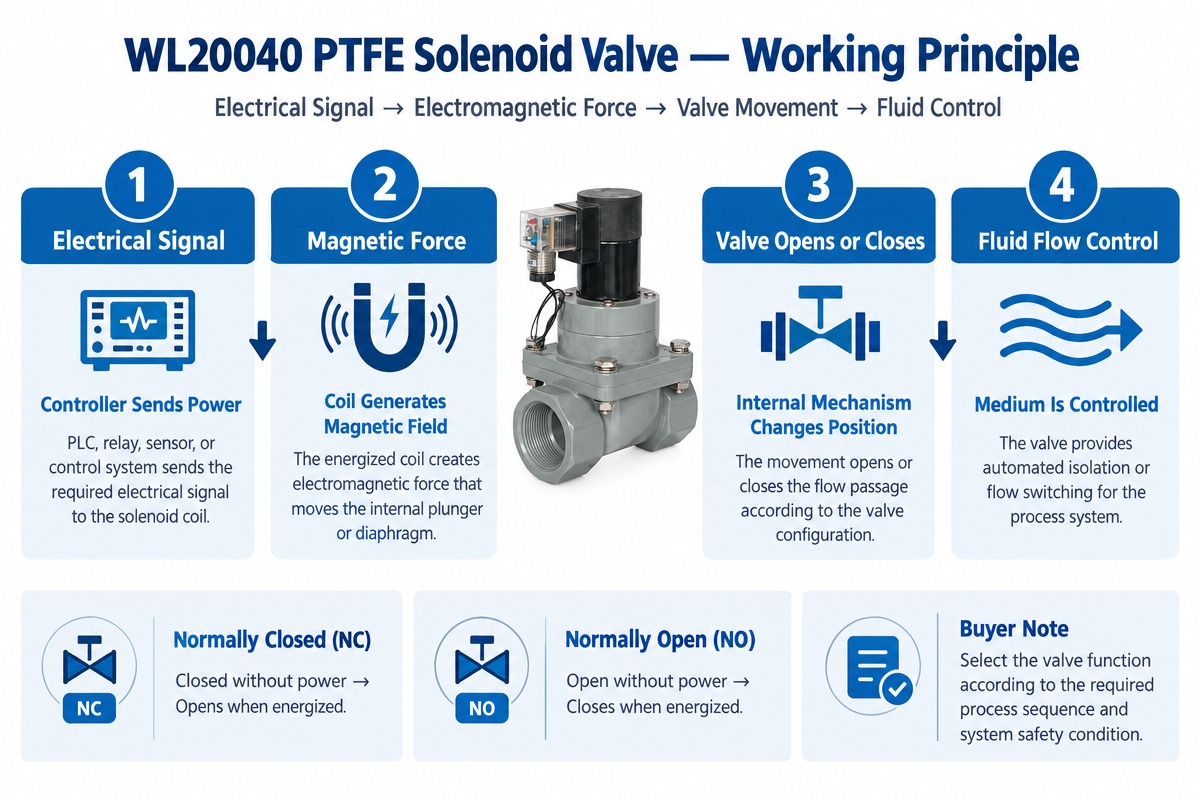
PTFE Solenoid Valve is an electric signal transformed to the mechanical actuation of the valve.

The control system supplies the voltage to the solenoid coil generating an electromagnetic field. The magnetic force drives an internal plunger or diaphragm that changes the position of the valve opening or closing the fluid passage.

For the normally closed (NC) valve the fluid passage is closed when the coil is de-energized. Applying the voltage to the coil the valve opens allowing the fluid flow.

In case of the normally open (NO) valve the fluid passage is open and the valve closes when the voltage is applied to the coil.

The valve returns to its normal position when the voltage signal is turned off either due to a spring action or the pressure difference as per design.

PTFE materials are in contact with the process medium and provide high chemical resistance. Correct operation requires compatibility of materials, pressure, temperature, voltage, flow rate and installation.

PTFE Solenoid Valve Video

PTFE Solenoid Valve Detail Display

PTFE Solenoid Valve Data Sheet

Brand Weilong Model Number WL 20040
Rated Voltage (V) DC12Vย  or 24V Rated Power (W) 10W
Work Mode Air or Liquid Control Valve Working Pressure (MPa) 60KPa
Air-Flow Rate 21 L/minute Reset Time(s) 1 S On, 1 S Off
Service Life 200 Thousand Times Certification CE, ROHS, ISO9001,
Pipe Gate ย inside: 4.0 mm Lead Wire Length(mm) 200 MM
Install Style Screw Tolerance of Dimension ยฑ 0.1 MM
Water-proof None Insulation Class B
Hi-Pot Test AC 600V 50/60 Hz 2s Non-excitation Holding Force 0
Working Temperature -10ยฐC-100ยฐC Duty Cycle 1-100%
Thread Depth (mm) / Payment Term TT, or LC At Sight
Sample Order Yes Warranty 1 Year
MOQ 1000 pcs Supply Ability 5000 pcs per week
Delivery Time 30 Days Port of Loading Shenzhen

Why are PTFE Solenoid Valves Becoming so Popular?

PTFE Solenoid Valves are gaining popularity because of increased demand for reliable automated control in chemically aggressive fluids. The material is useful in the applications where traditional materials can have a shorter life, because of high resistance to many acids, alkalis, solvents and corrosive process media.

Valves can interface with PLCs, sensors, controllers and automated production equipment using electrical actuation. Compact design allows integration in space constrained systems and provides fast and repeatable on-off control.

Increased demand is also supported by chemical processes, water treatment, semiconductor manufacturing, electroplating, pharmaceutical production and laboratory automation. PTFE valves are adapted to diverse operating conditions due to advanced material combination, seals, coils and connections.

But not every PTFE solenoid valve is suitable for every application. The engineers have to verify the chemical compatibility, pressure, temperature, flow, voltage, duty cycle and installation conditions before selection.

PTFE Solenoid Valve Applications

PTFE Solenoid Valve for Precise Flow Control Automation

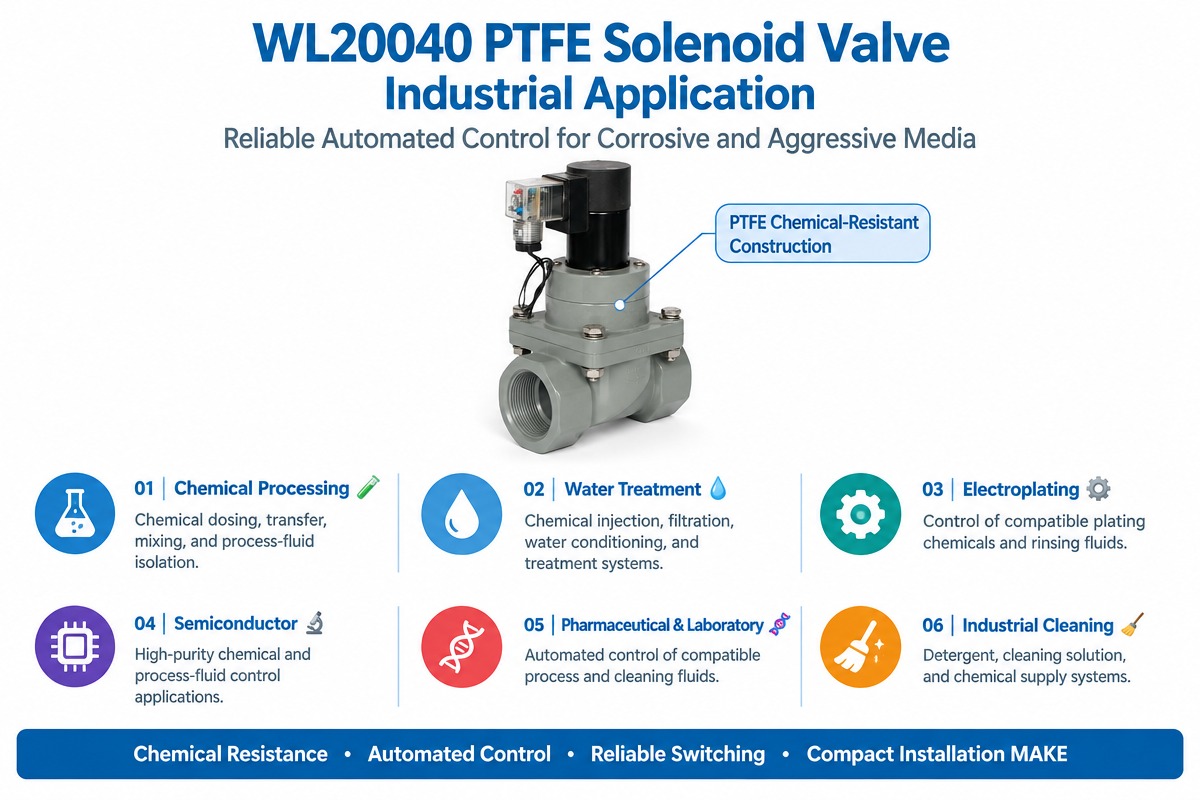
PTFE Solenoid Valves are widely used in the applications requiring automated fluid isolation where the process medium can be chemically aggressive. In the chemical processing plants the valves control acids, alkalis, solvents, cleaning fluids and other compatible chemicals in dosing, transfer, mixing and equipment isolation systems.

Water and wastewater treatment equipment use solenoid valves to control chemical injections, filtration and process-fluid switching. Corrosion resistant valves control treatment chemicals and rinsing solutions in electroplating systems. High purity fluid control is used in semiconductor manufacturing and laboratory equipment where material compatibility and cleanliness are important.

PTFE valves, when properly designed, can control chemicals, cleaning and utility-fluid control in pharmaceutical and biotech equipment. The solenoid valves are used in industrial cleaning machines to automate the supply of detergents, rinse water and chemicals. Useful application is the PTFE solenoid valves in printing, analytical instruments, surface treatment, battery production and special automation equipment.

The success of the application depends on the suitability of the valve construction to the actual medium. Proper sizing and installation will maintain the stable flow control and reduce leakage and maintenance during continuous operation. Many automated systems use these valves in the vicinity of pumps, dosing units, reactors, tanks or analytical modules to obtain required localized flow isolation and sequence.

PTFE Solenoid Valve Adv. & Disadv

PTFE Solenoid Valve for Chemical Fluid Isolation Design

Advantages and Disadvantages of PTFE Solenoid Valve

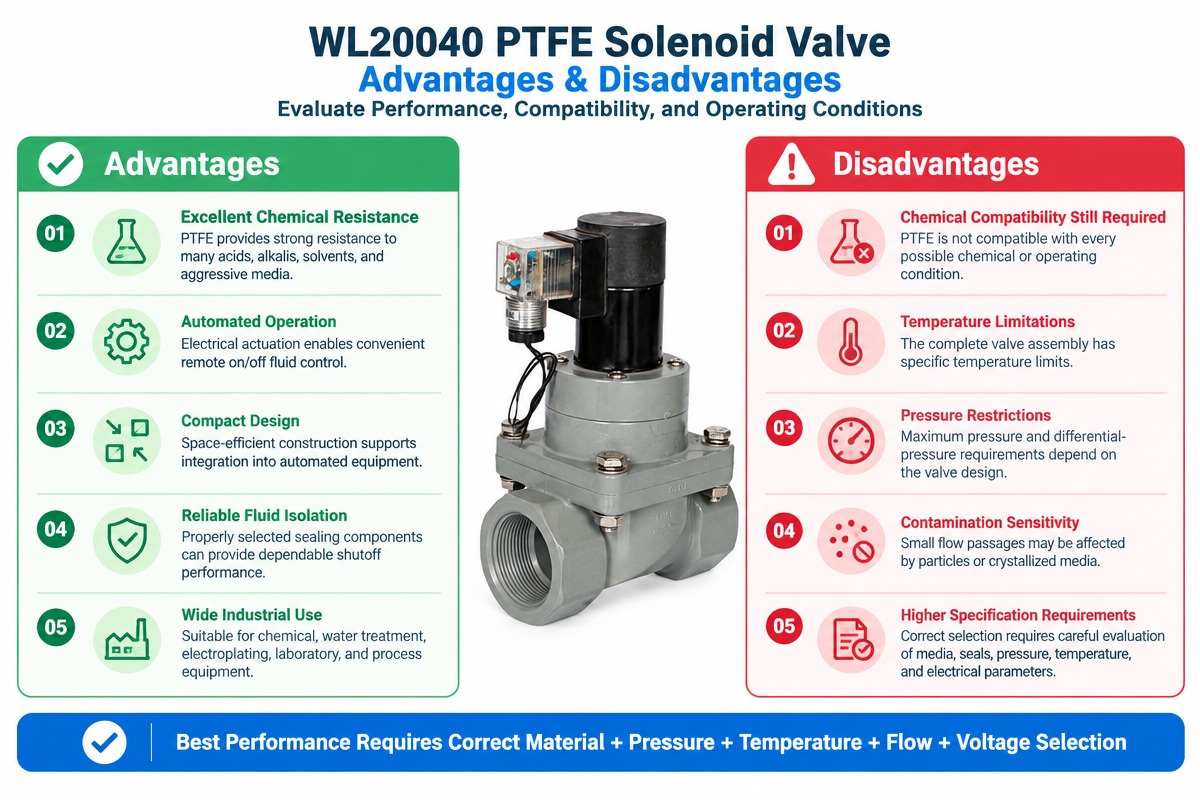
PTFE Solenoid Valves have a lot of advantages in controlling fluids. Main advantage is high resistance to the wide range of corrosive chemicals, acids, alkalis and solvents which help to provide corrosion protection of the wetted parts. Electrical actuation provides automatic on/off control and thus easy integration with PLCs, sensors and process controllers. Space-saving design saves the installation space and the fast switching allows effective process sequencing. PTFE materials also reduce corrosion-related maintenance when properly matched with the process medium.

But there are disadvantages of PTFE Solenoid Valves. PTFE is not compatible with all chemicals, temperatures, pressures and operating conditions. Application specific material verification is still required. Because of the materials and construction the cost of the valve can be higher than standard valves. The design can have temperature, pressure or flow capacity limitations. Fine orifice passages are vulnerable to particles, crystallization or contamination. Seals, diaphragms and other non-PTFE components can affect the overall compatibility. Incorrect sizing can cause pressure drop, slow response or unstable operation.

Prior to selection of a PTFE solenoid valve, the engineers have to consider media compatibility, flow requirements, pressure, temperature, electrical specifications, maintenance access and total operating cost. With the right model specified the corrosion resistance, automation, compact installation and maintenance can be achieved.

PTFE Solenoid Valve for Automated Chemical Process Tips

PTFE Solenoid Valve Troubleshooting

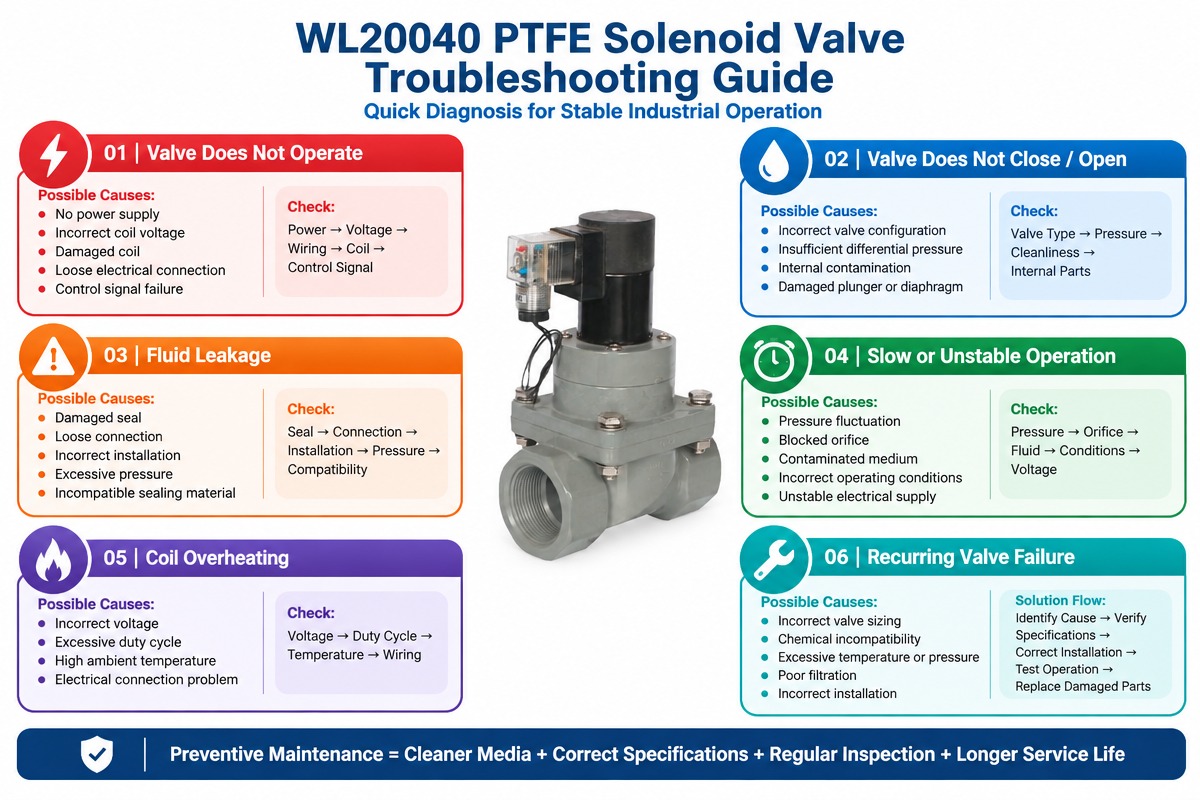
PTFE solenoid valve troubleshooting starts with isolation of the valve for safety and verifying the operating conditions. If the valve doesn’t open or close, check power supply, coil voltage, wiring, connector and control signal. Measure the coil according to the electrical specifications of the manufacturer and replace damaged components if necessary.

If the valve leaks, check the seal, connection, valve body and installation conditions. Verify that the medium is compatible with PTFE and selected sealing materials. Check the high pressure, incorrect flow direction, damaged sealing surfaces or presence of foreign particles.

If the operation is slow or erratic, check the inlet pressure, differential pressure, temperature and flow requirements. If the contamination is suspected, clean the valve using cleaning methods compatible with PTFE and other internal materials. Verify that the orifice is not partially blocked.

If the coil temperature becomes too high, check voltage, duty cycle, ambient temperature and electrical connection. If you hear or feel any unusual noise or vibration, check the mounting, pressure fluctuations, loose fittings and flow conditions.

Many failures can be caused by improper sizing, incompatible media, temperature too high, contamination or unsuitable operating conditions. Symptoms and operational data should be recorded prior to replacing parts. After maintenance check the normal operation of the valve. Inspection and filtration can reduce the recurrent failures.

FAQ

1. What is PTFE Solenoid Valve?

PTFE Solenoid Valve is a kind of electrically operated valve which automatically controls fluid flow. PTFE parts have a very high resistance to most of the aggressive chemicals, acids, alkalis and solvents thus making the valve suitable for difficult industrial applications.

2. What kinds of fluids are PTFE Solenoid Valves suitable for?

The valves are suitable for a variety of chemically aggressive fluids such as compatible acids, alkalis, solvents, chemicals and treated water. But the fluid compatibility depends on the concentration, temperature, pressure and the nature of the materials used in sealings and other wetted parts.

3. Why are solenoid valves manufactured in PTFE?

PTFE has excellent chemical resistance and non-sticking characteristics. This material can help protect the wetted parts from corrosion and chemical aggression. Thus PTFE can be useful in chemical processing, water treatment, electroplating, labware and many other applications where aggressive fluids are involved.

4. Is PTFE Solenoid Valve applicable in high temperatures?

PTFE has good temperature resistance, but the maximum operating temperature is defined by the entire valve design. The coil, seals, diaphragm, valve body and other materials may have different temperature resistance levels. Before installation always refer to the manufacturer’s data on the operating temperature range.

5. What should I know about choosing PTFE Solenoid Valves?

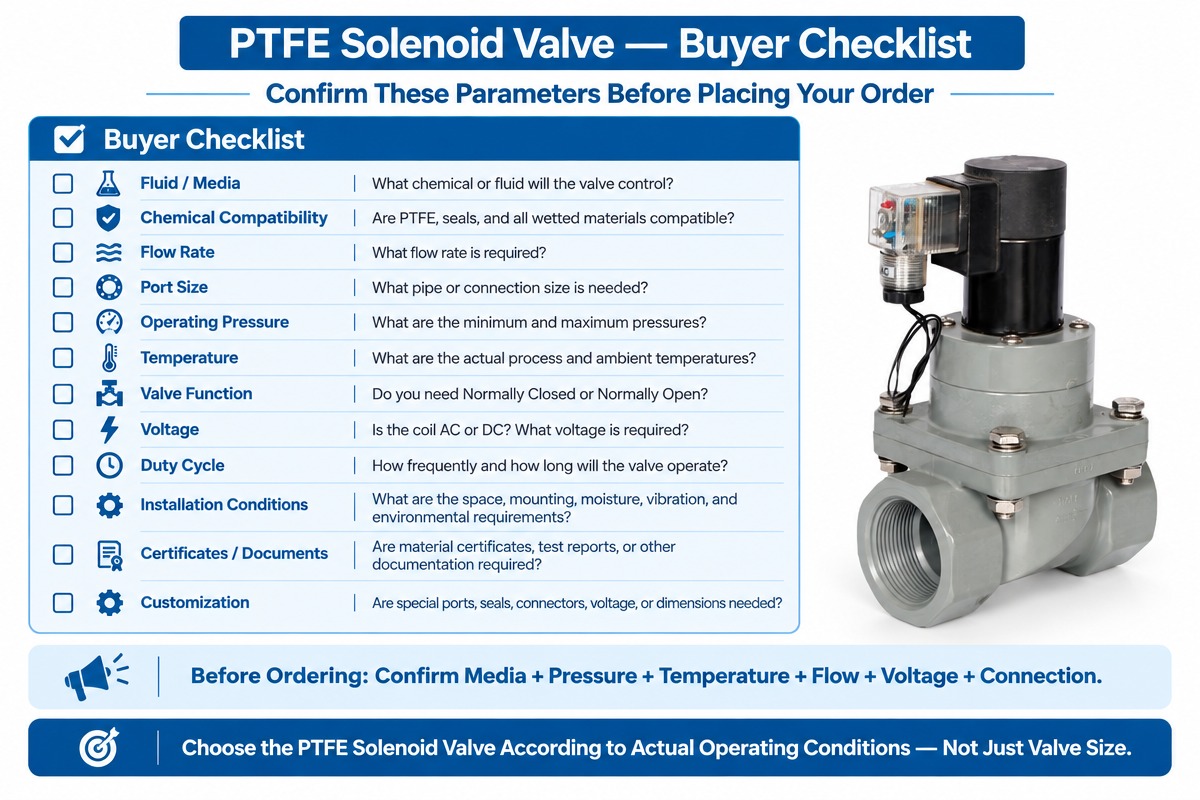
There are several parameters to consider when choosing the valve such as type of fluid, chemical concentration, flow rate, operating pressure, temperature, port size, voltage, valve purpose, seal material and the duty cycle. Appropriate matching of these parameters will provide reliable operation and long life of the device.

6. How do Normally Open and Normally Closed PTFE Solenoid Valves differ?

Normally Closed (NC) valve is closed without the electrical power supplied to the coil and opens with the current supplied to the coil. Normally Open (NO) valve is open in a de-energized state and closes when energizes. The correct choice depends on the control sequence and failure mode.

7. Why my PTFE Solenoid Valve leaks?

There may be several causes of the leaking problem โ€“ damaged sealings, improper installation, high pressure, incompatible media, contamination or worn-out internal parts. First check your connections, sealing surfaces, operating conditions and chemical compatibility of the media before replacement of the parts.

8. How to service my PTFE Solenoid Valve?

Regular checking of the valve, its electrical connections, sealings, fittings and operating conditions is recommended. Try to avoid contamination of the flow path and use proper filtering if necessary. Regular monitoring of pressure and temperature and replacement of worn out parts with compatible ones will ensure reliable operation of the device.

How to Select a PTFE Solenoid Valve

Selection of a PTFE Solenoid Valve involves more than just choosing of corrosion resistant material. Identification of the fluid, including concentration, temperature, viscosity, cleanliness and chemical composition is the first step. Next, verify compatibility of the medium with PTFE and all wetted seal materials. Then calculate the required flow rate and choose the proper orifice and port size. Oversizing can reduce control efficiency while undersizing can create high pressure drop and reduce the system capacity.

Checking of the operating pressure range including minimum and maximum pressures and pressure differential is an important stage. Temperature is also important as the valve, seals, coil and surrounding materials have to operate within their rated limits. Select normally closed or normally open operation as per control logic and safety requirements of the equipment.

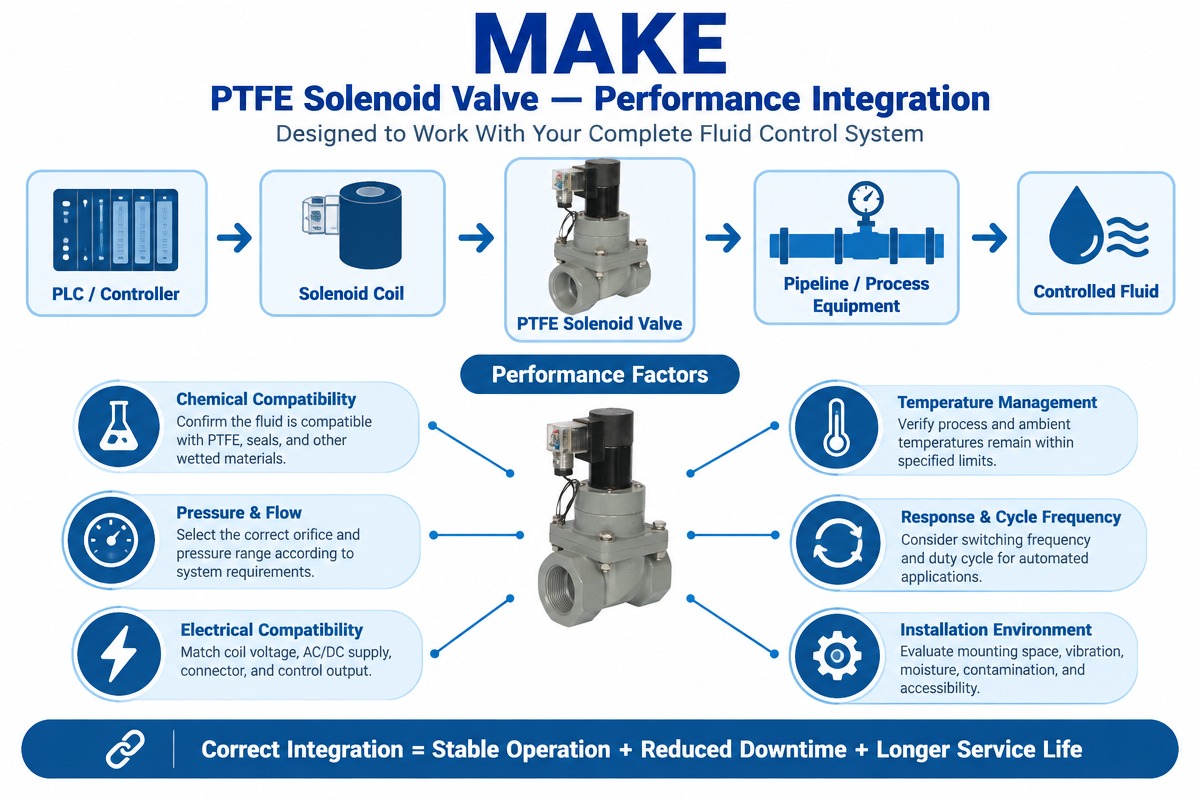
Electrical specifications have to match with the control system. Verify coil voltage, AC or DC supply, power consumption, connector type, insulation requirements and available PLC or relay outputs. If the frequent switching is expected, verify the duty cycle and the service life.

Proper installation conditions such as mounting position, space availability, pipe connection standard, environmental exposure, vibration and protection requirements have to be verified. If the valve is going to be installed in the outdoor or washdown environment, select appropriate enclosure and connection protection.

Finally, take into account flow direction, response time, leakage requirements, maintenance access, spare parts and supplier technical support. Request performance data and chemical compatibility prior to buying. Selection is a balance of media compatibility, pressure, temperature, flow, electrical requirements, installation conditions, reliability and operating cost. Also, consider whether the valve will be used continuously, intermittently or in high-cycle application as actuator heating and component wear may affect the service life. For hazardous or process applications verify required fail-safe position and system safety strategy prior installation. Maintain the records on material compatibility, electrical ratings, pressure limits and maintenance intervals so that replacement can be performed to original specifications.

Common Mistakes in Designing PTFE Solenoid Valves and How to Avoid Them

With corrosion resistant valves, common design mistakes with PTFE Solenoid Valve systems can reduce reliability.

Donโ€™t select just by PTFE material. Verify chemical compatibility of all wetted parts, including: seals, springs, diaphragms and fittings.

No, donโ€™t size by pipe diameter. Determine the flow rate, pressure drop and operating conditions before selecting the orifice.

Verify pressure requirements Some solenoid valve designs require a specific pressure differential across the valve for reliable operation.

Verify electrical requirements. Verify coil voltage. AC/DC supply. Power consumption and duty cycle.

Real fluid temperature Donโ€™t select the valve solely on ambient temperature.

Control contamination. Small openings can be clogged by deposits or chemicals or crystallization.

Correct installation. Follow flow direction if applicable. Use filtration as needed.

Provide Access for Maintenance Provide sufficient space for inspection, coil replacement, seal maintenance and electrical connections.

Application data should be carefully evaluated before final design approval.
Get A Free Quote Now

Contact Form

Related Products

Related News

Introduction to Pinch Valve Manufacturer A pinch valve is an excellent way to control the flow of liquid or gas […]

Scroll to Top

Get A Free Quote Now !

Contact Form
If you have any questions, please do not hesitate to contact us.
Weilong Solenoid Company Culture