12V Solenoid Lock for Smart Access Safety Control guide
12V Solenoid Lock for Secure Door for Access Control solutions
12V Solenoid Lock for Industrial Safety Access System
12V Solenoid Lock for Cabinet Access Safety Solutions
12V Solenoid Lock for Electronic Access Safety System
12V Solenoid Lock for Locker Access Safety Control Lock
12V Solenoid Lock for Smart Access Safety Control guide
12V Solenoid Lock for Secure Door for Access Control solutions
12V Solenoid Lock for Industrial Safety Access System
12V Solenoid Lock for Cabinet Access Safety Solutions
12V Solenoid Lock for Electronic Access Safety System
12V Solenoid Lock for Locker Access Safety Control Lock

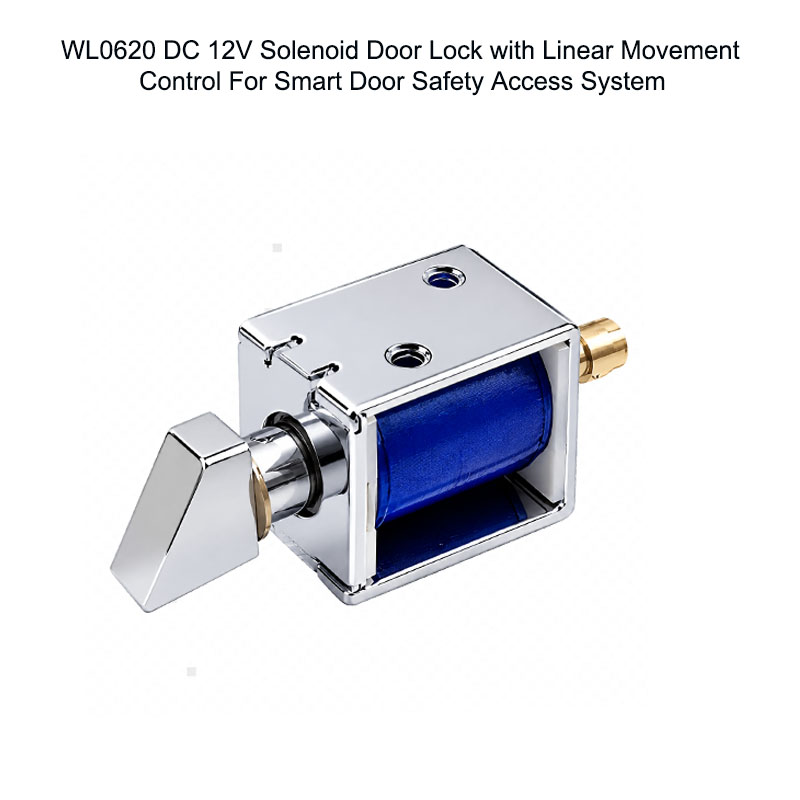
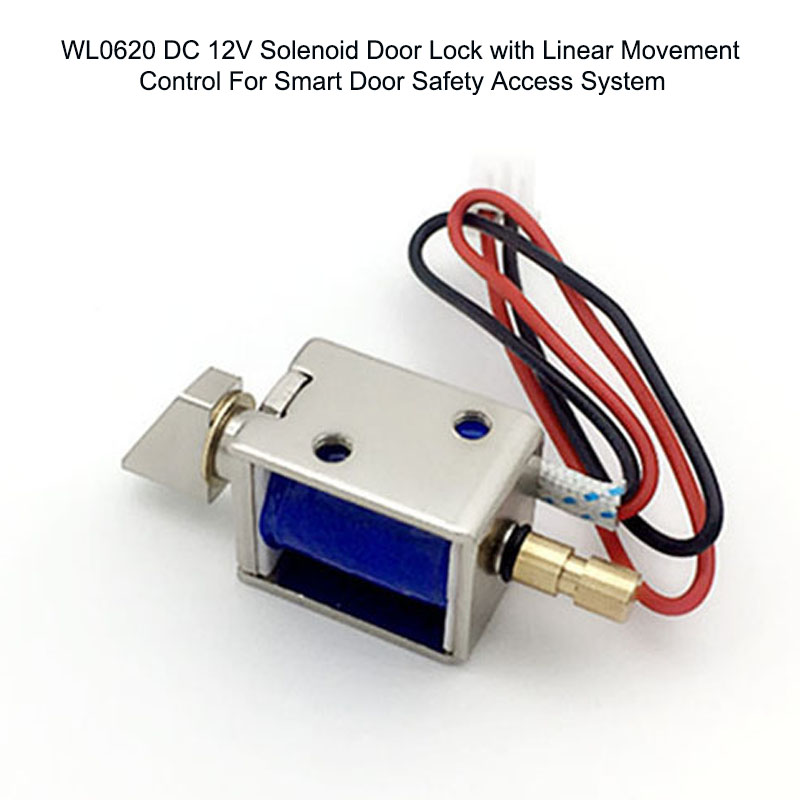
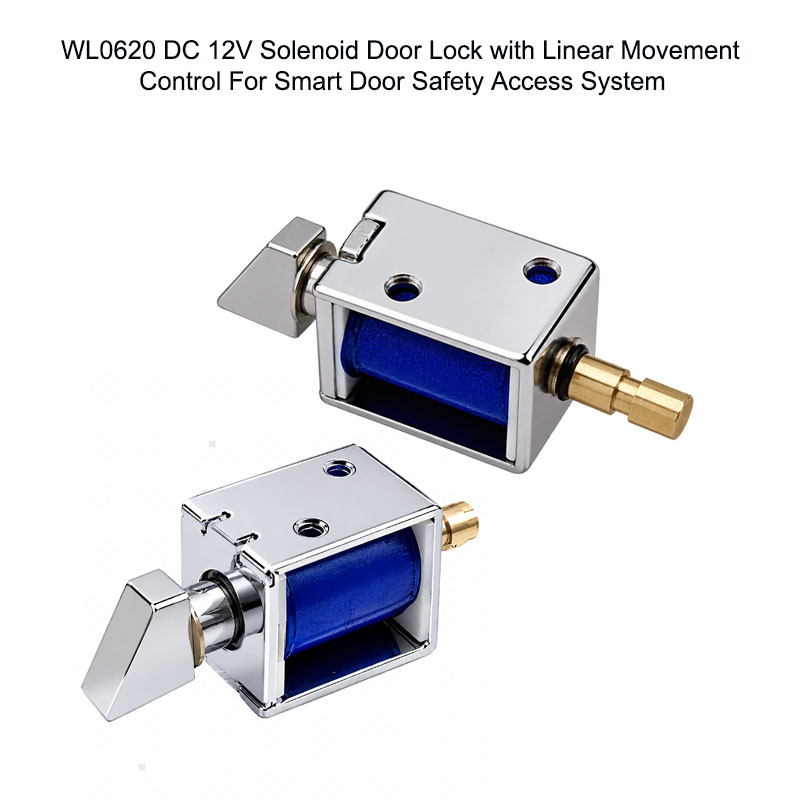
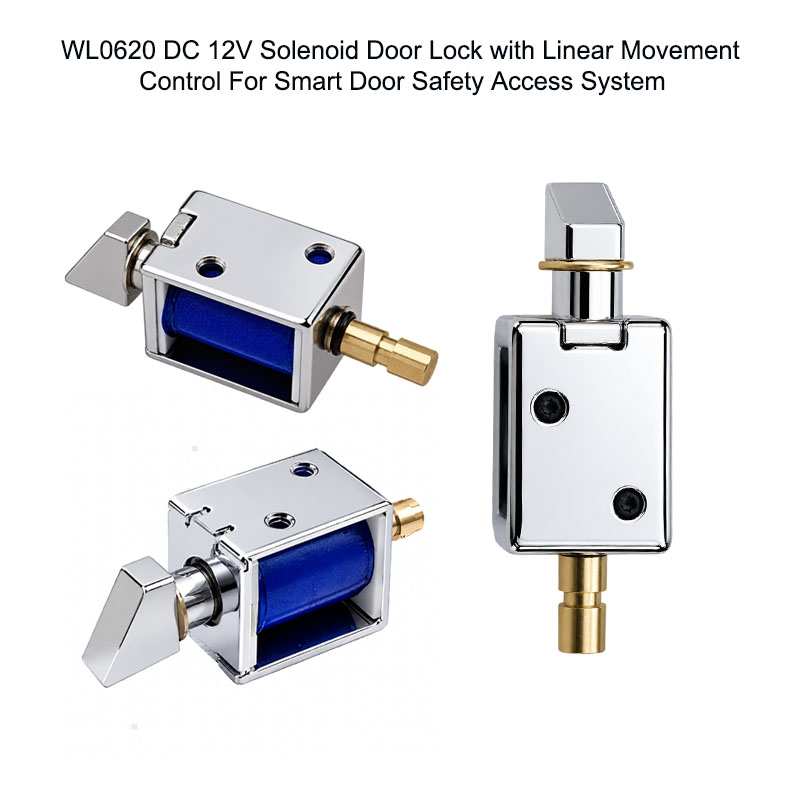
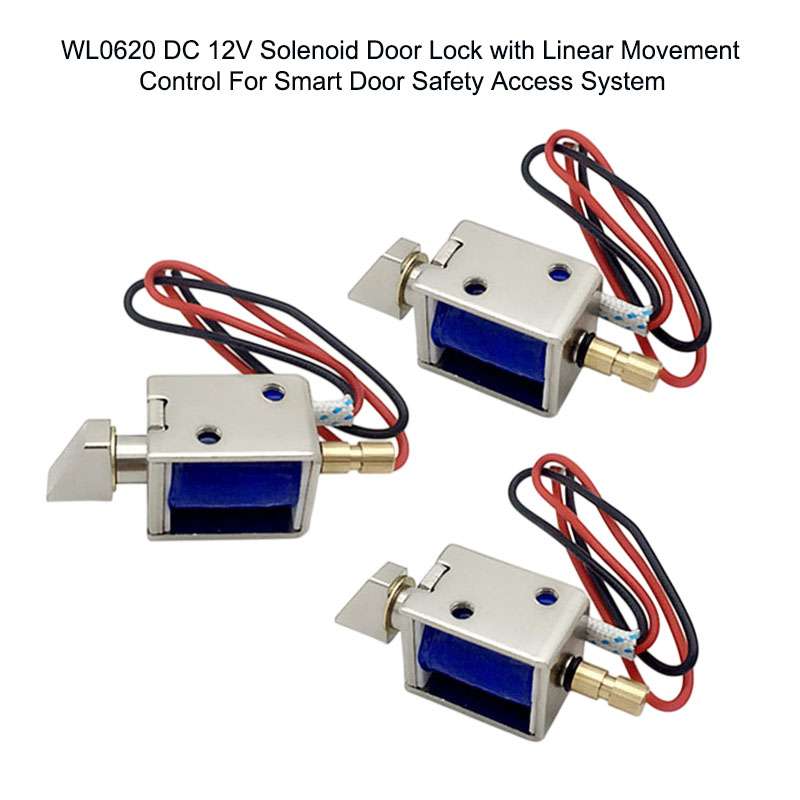
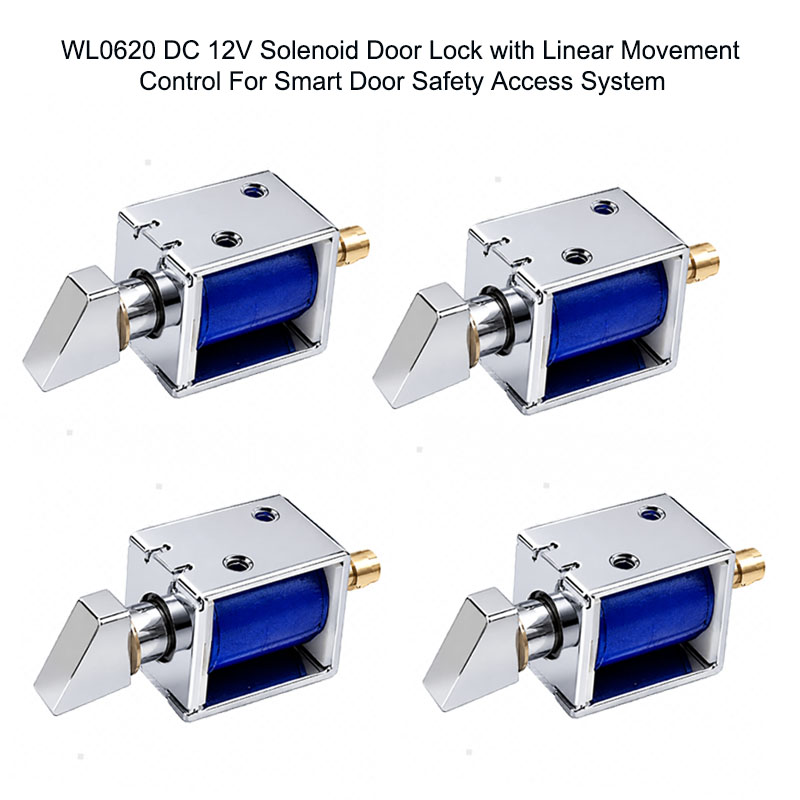
WL0620 DC12V Solenoid Lock for Access Safety Solutions

A 12V solenoid lock is a solenoid lock that is used to electronically control the locking of doors, cabinets, lockers, machines, access panels, and automated equipment at 12V. The 12V solenoid lock has a compact electromechanical design that converts electrical energy into linear plunger motion to allow a control system to lock/unlock the mechanism.

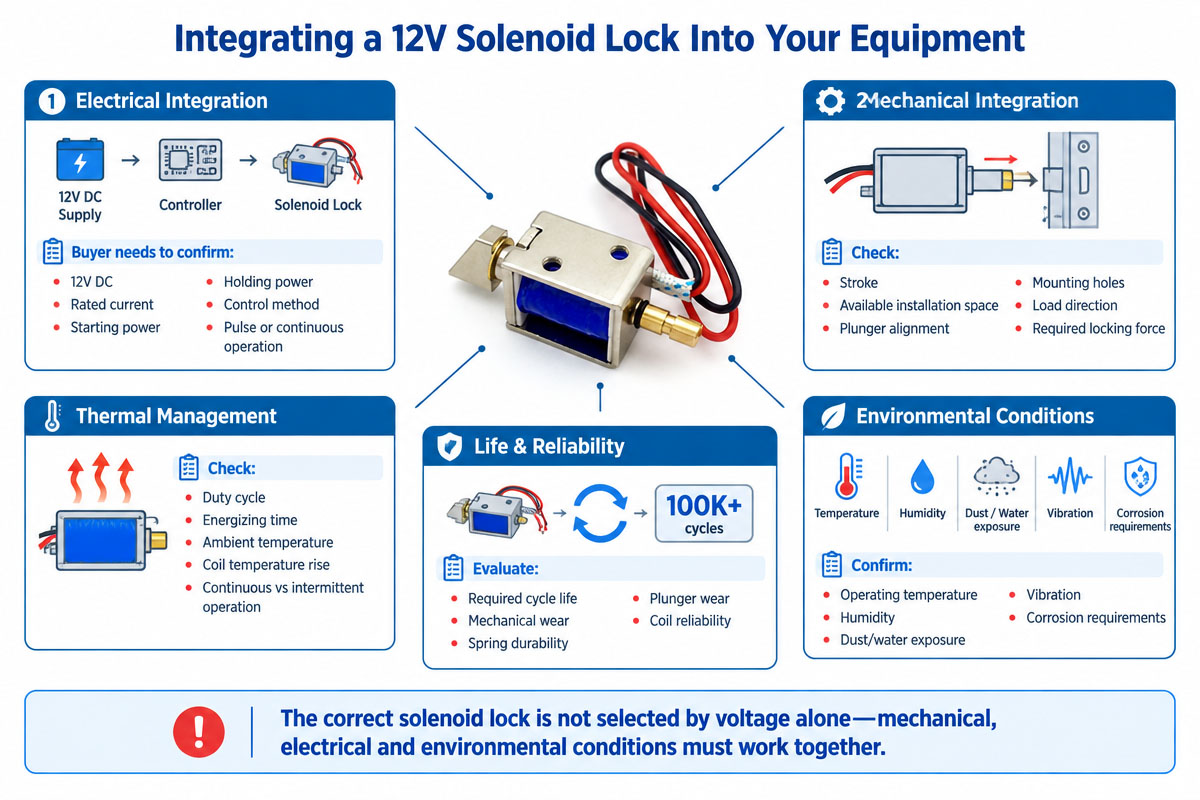
For OEM applications the 12V solenoid lock should be chosen according to the real mechanical load and electrical operating conditions, not voltage only. Key parameters include rated voltage (12V DC), operating current, stroke, locking force, holding force, duty cycle, response time, mounting dimensions, and expected operating cycles.

Customized 12V solenoid locks can be produced with various housings, mounting holes, plunger sizes, springs, connectors, wire lengths, and surface treatments. Correct integration allows avoiding problems such as insufficient locking force, coil overheating, mechanical interference, and wear. Thus, 12V solenoid locks are perfect for access and automation systems.

Custom DC 12V Solenoid Lock Product Overview

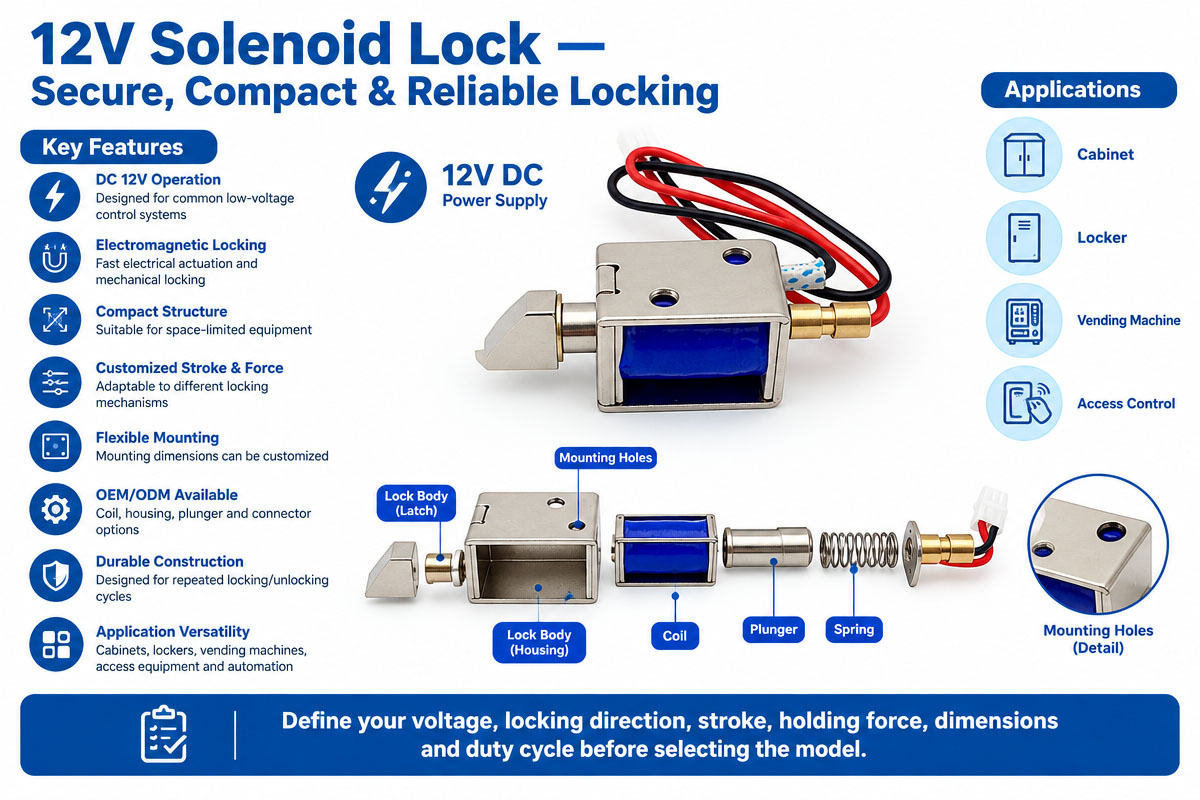
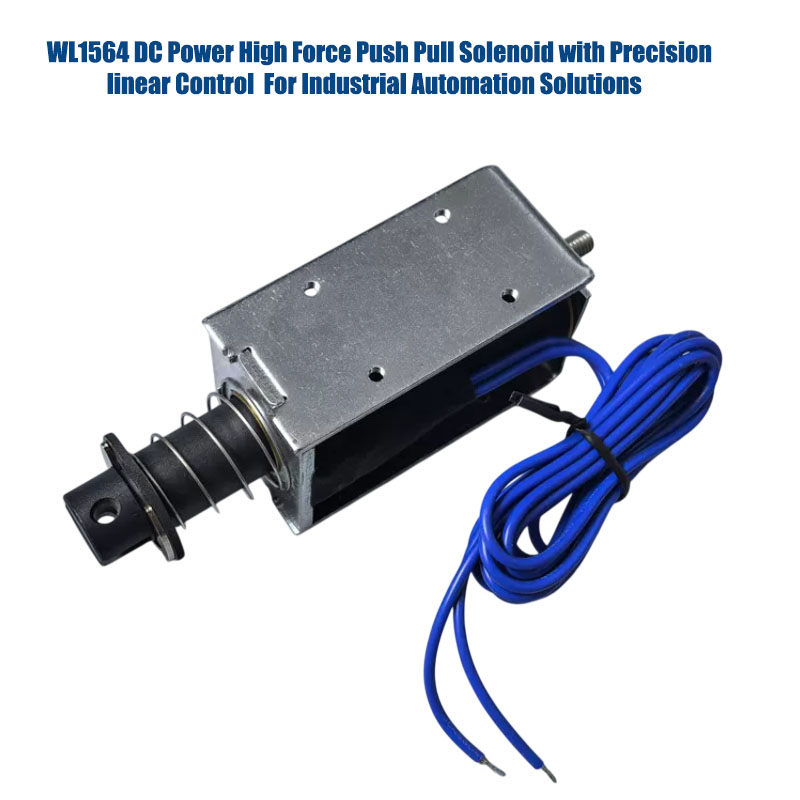
A 12V solenoid lock is an electro-mechanical locking device used for electrically controlled access applications. The typical design includes a coil, magnetic core, movable plunger, spring, and mechanical housing. While applying 12V DC, the electromagnetic field causes the plunger to move, causing the associated locking mechanism to engage or release.

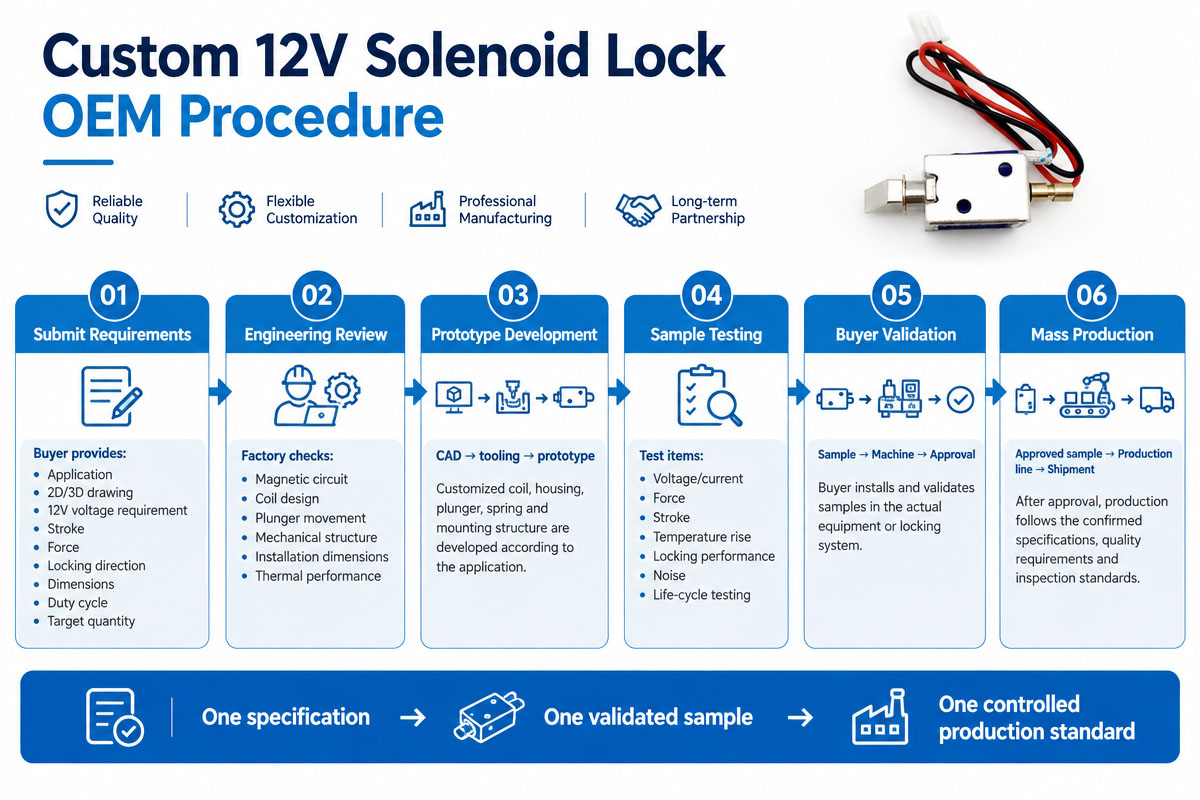
The design of a 12V solenoid lock can vary depending on installation space, locking direction, stroke, force, duty cycle, and environmental conditions. OEM manufacturers can customize dimensions, mounting holes, plunger design, spring characteristics, connector configuration, and wire length. Before approving the samples or mass production, buyers should request complete specifications for procurement, which include such key parameters as voltage, current, force, stroke, cycle life, temperature range, and mechanical interface.

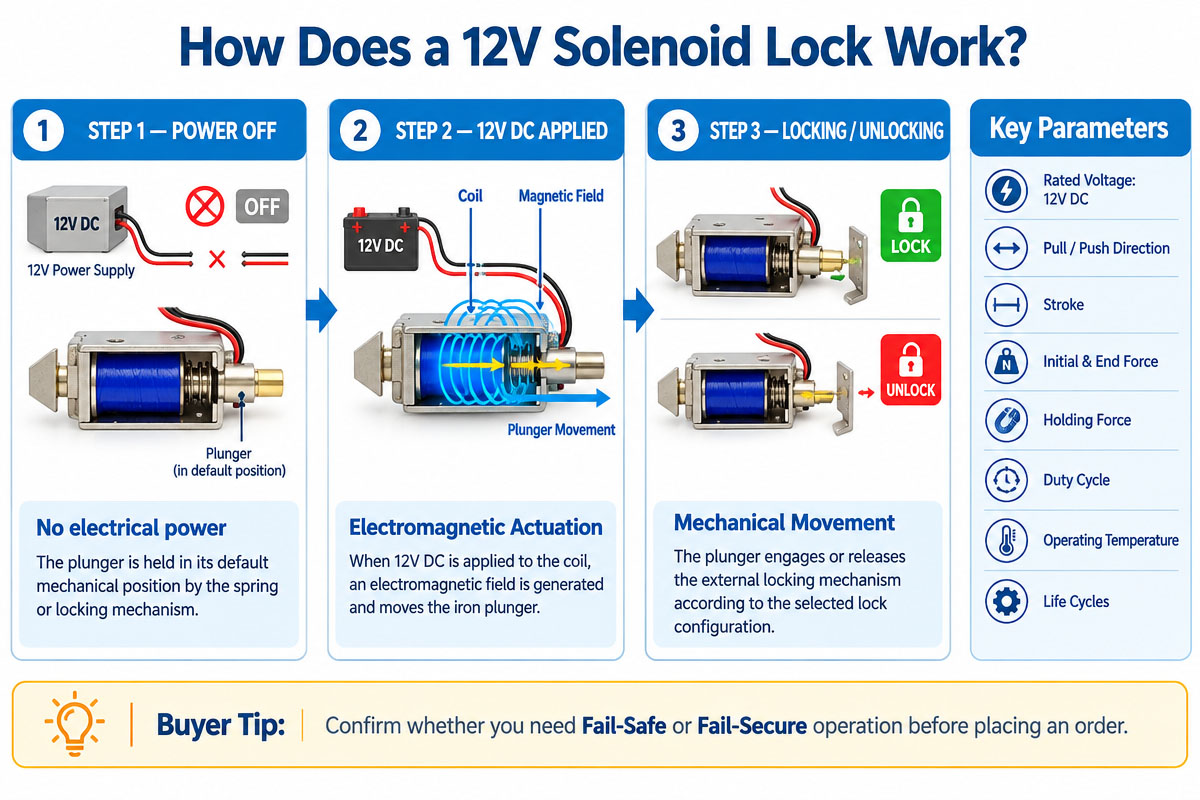
How does a 12V solenoid lock?

A 12V solenoid lock is activated due to the interaction between the electromagnetic coil and the movable ferromagnetic plunger.

Step 1 – 12V DC power supply

The control system supplies the 12V DC to the coil of the solenoid. This signal can be provided by a controller, relay, switch, PLC, access control board, or electronic circuit.

Step 2 — Electromagnetic Fields

Electromagnetic fields arise while the current passes through the coil. The magnetic circuit produces a force that moves the plunger.

Step 3—Plunger action

The plunger moves in the programmed stroke. Depending on the configuration, this action will lead to activation of a locking pin, releasing of a latch, or some other mechanical locking mechanism.

Step 4 – Mechanical locking

Afterwards, the movement of the plunger is transferred to the locking mechanism. And then the door, cabinet, or machinery mechanism can be locked or unlocked.

Step 5 – Removing the power

While removing the power, a spring or mechanical mechanism returns the plunger to its original position.

The actual sequence of operations depends on whether the product is normally locked, normally unlocked, fail-safe, or fail-secure.

Main features of a 12V solenoid lock

A 12V solenoid lock is compact and has mechanical movement, controlled electrically. Key features include 12V DC operation, fast electromagnetic actuation, defined plunger stroke, and adjustable locking force. Depending on the application, the design of a 12V solenoid lock can be made to operate in normally locked or normally unlocked mode. Engineers can use compact housings for integration of the 12V solenoid lock into cabinets, doors, lockers, and machinery. Various types of mounting holes, plunger sizes, springs, connectors, and wires can be customized to satisfy OEM equipment design. OEM engineers can specify duty cycle, operating temperature, life-cycle requirements, and environmental protection. Important selection criteria in industrial applications include dimensional consistency, coil reliability, mechanical durability, and locking performance repeatability.


Custom DC 12V Solenoid Lock Product Video

Custom DC 12V Solenoid Lock Detailed Display

Custom DC 12V Solenoid Lock Technical Datasheet

Brand Weilong Technology Model Number WL0620
Rated Voltage (V) DC 6-24V Rated Power (W) 5–10 W
Work Model PUSH-PULL Type Holding Force (N) 0.5–1 N
Stroke (mm) 1–5 MM Reset Time(s) 1 S
Service Life 300 Thousand Times Certification CE, RoHS, ISO9001,
Material Carbon Steel Housing with Zinc-Plated Coating Lead Wire Length (mm) 200
Install Style Adjustable Screw Tolerance of Dimension ± 0.1 MM
Water-proof None Insulation Class F 155 Cel. Degree
Hi-Pot Test AC 600V 50/60Hz 2s Non-excitation Holding Force 0
Working Temperature -10°C-100°C Duty Cycle 1-100%
Thread Depth (mm) / Payment Term TT, or LC at Sight
Sample Order Yes. Warranty 1 Year
MOQ 500 pcs Supply Ability 5000 pcs per week
Delivery Time 30 Days Port of Loading Shenzhen

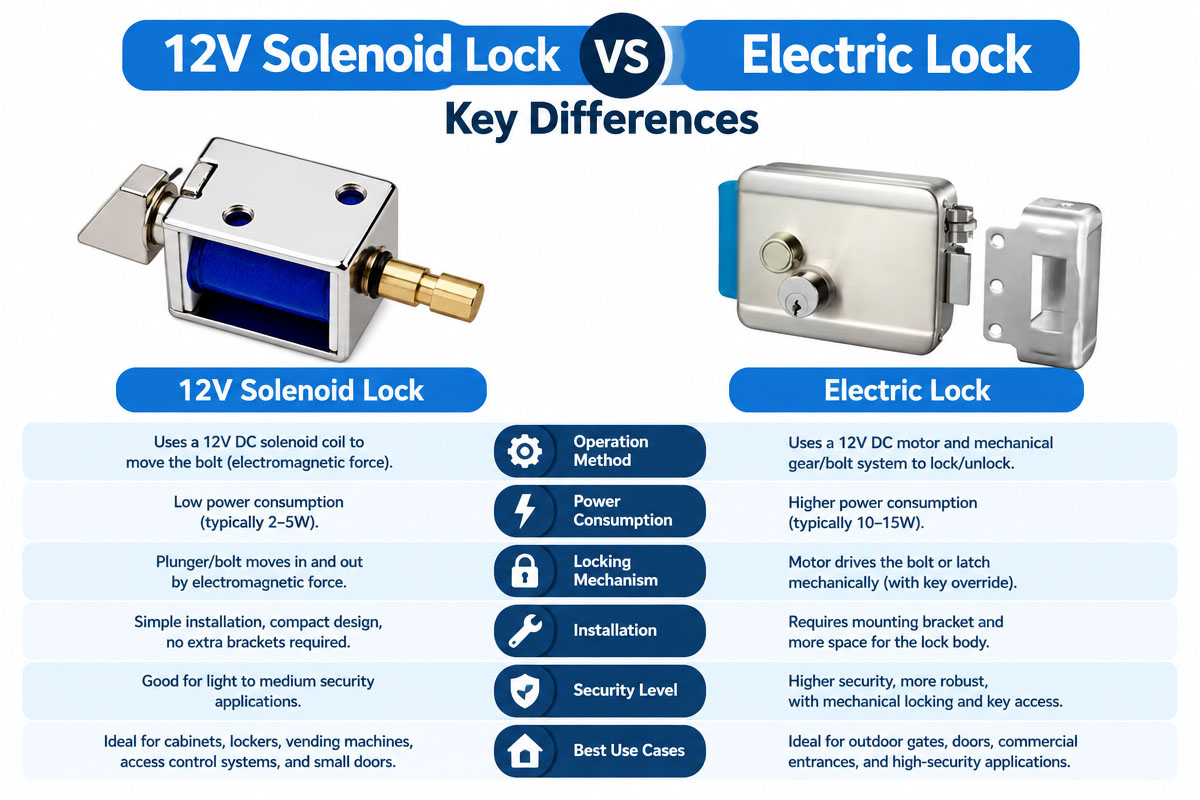
What is the difference between the 12V solenoid lock VS Elecric Lock

12V Solenoid Lock vs. Electric Lock Key Difference and Selection

There are two types of electrically controlled access, a 12V solenoid lock and a general electric lock, but they can be different in construction, activation, and integration. The right choice depends on the equipment architecture, mechanical interface, and operating conditions.

1. Define Actuation Method

A 12V solenoid lock creates a linear plunger movement using an electromagnetic coil. The plunger activates the latch or locking mechanism directly.

“Electric lock” is a general term and can consist of a solenoid, motor, electromagnetic mechanism, or any other electrically controlled mechanism.

Thus, electric lock term does not refer to locking technology.

2. Compare Mechanical Requirements

The solenoid lock buyer should determine:

Stroke 5.

Direction of pull or push

Starting force

[End force]

Holding power

Size of plunger

Dimensions for mounting

Direction of loading

If the equipment needs simple linear mechanical motion, a solenoid solution will fit into the mechanism easily.

If rotary motion is required or bolt movement is motorized, another electric locking mechanism will suit.

3. Compare Power Requirements

A 12V solenoid lock is developed for a 12V DC power supply. However, actual power consumption depends on coil design.

The buyer should compare:

Integration: Direct mechanical interface Depends on lock design

When designing the system, it is always important to check product specifications.

4. Duty Cycle Consideration

It is especially important in case of solenoid locks.

If the coil will work for a long time, heat dissipation will become an issue in design. Thus, the buyer should check that the chosen model supports the required duty cycle.

In case of frequent access applications, the manufacturer should evaluate the temperature of the coil, mechanical wear, and expected cycle life.

5. Fail-Safe or Fail-Secure Requirement Consideration

The designer must understand what will happen after power removal.

Fail-Safe: The locking mechanism unlocks upon a specified loss-of-power event.

Fail-Secure: The locking mechanism remains secure upon the specified loss-of-power condition.

Proper configuration depends on equipment, access requirements, applicable codes and standards, and system safety design.

6. Installation Space Consideration

A solenoid lock is suitable when there is enough space for the coil and linear plunger. Mechanical architecture requires a different form factor, so another electric lock will be more suitable.

Dimensions, including mounting holes, cable exit, plunger travel, and clearance, must always be compared.

7. Compare Life and Maintenance

In OEM projects, the estimated number of locking cycles should be considered. Repetitive mechanical movements lead to wear between the plunger, spring, and latch.

Tests should be done simulating actual application conditions and not unloaded laboratory cycling.

Buyers should compare:

Parameter 12V Solenoid Lock Other Electric Lock
Control voltage Typically specified as 12V DC Depends on design
Actuation Electromagnetic Solenoid, motor, magnet, etc.
Movement Commonly linear Linear or rotary
Control Switch, relay, PLC, controller Depends on electronics
Customization Coil and mechanical design Depends on construction
Integration Direct mechanical interface Depends on lock architecture

8. Which One Should You Choose?

It should be defined by necessary mechanical movement, force, stroke, duty cycle, power architecture, installation space, and failure mode.

If you need a small, electrically actuated linear lock, a 12V solenoid lock will be suitable as long as the force and duty cycle fall into the solenoid design range.

Another electric lock should be used in case of motorized motion, different locking geometry, electronics, or operating mechanism.


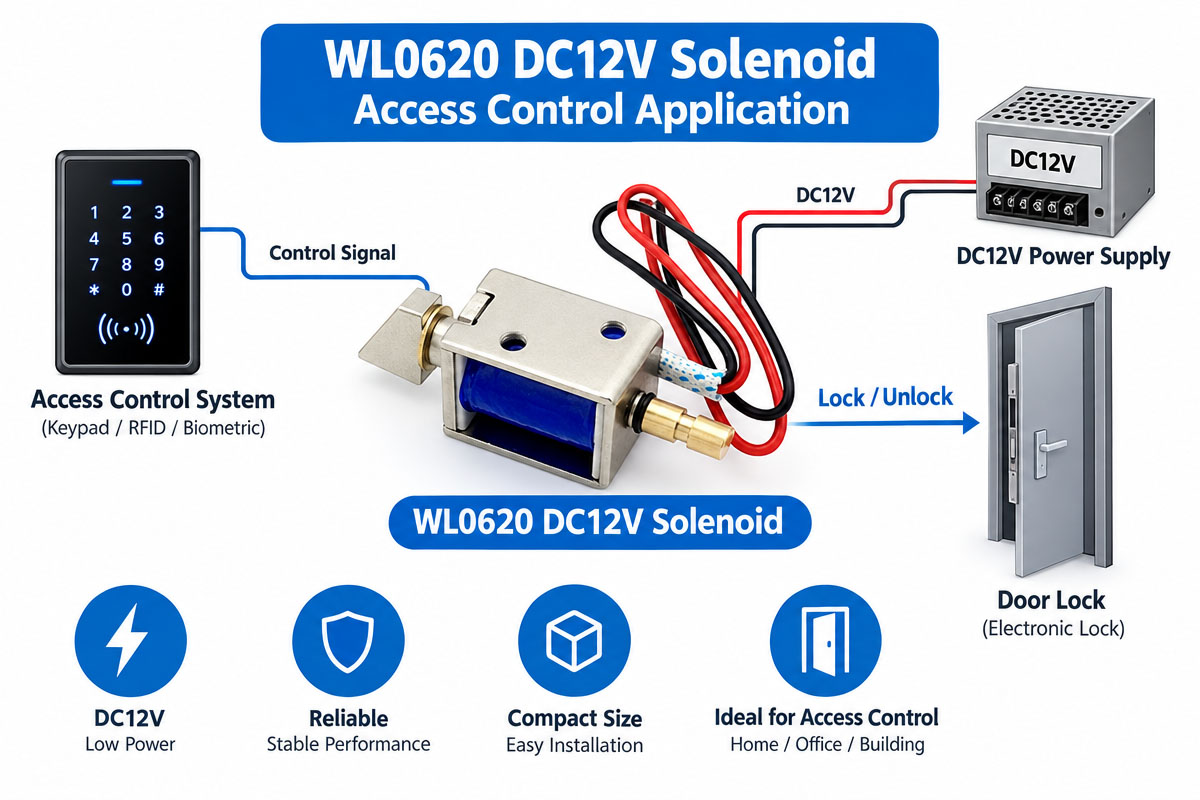
Ciststom DC 12V Solenoid Lock Access Control Application

DC12V Solenoid Lock Access Control Application

12V solenoid locks are widely used in cases where a control signal is needed to provide a reliable mechanical locking or unlocking action. 12V DC operation allows using them in many low-voltage control architectures.

Intelligent Door Systems

A 12V solenoid lock can be interfaced with an access control unit, keypad, RFID reader, fingerprint system, or any other electronic control unit.

Control Cabinets and Boxes

Solenoid locks can be installed on electrical cabinets, equipment enclosures, and control boxes to prevent physical access but allow electronic authorization.

Intelligent Lockers

Individual 12V solenoid locks are used in storage lockers, parcel lockers, and automated collection systems.

Vending Machines

The lock can be used to control access to service doors, product compartments, or maintenance areas.

Industrial Automation

Solenoids can be used to lock access panels or to control access to certain parts of a machine by automated machines.

Safety Interlock System

Using sensors and controllers, a solenoid mechanism can be used to coordinate access with machine operating conditions. However, the entire safety function should be engineered and validated as a system, not just the solenoid.

Commercial Equipment

Controlled access to ticket machines, payment equipment, kiosks, and automated cabinets can also be provided by 12V solenoid locks.

For OEM buyers, the final design should be according to the actual load, environment, operating cycle, and safety requirements.

Why is the 12V solenoid lock getting so popular for smart door lock systems?

A 12V solenoid lock is the best option for smart door lock solutions since they provide an interface between electrical control and mechanical actuation in one compact element.

Generally speaking, a smart access system consists of a reader/authentication device, controller, power supply, and locking mechanism. A 12V solenoid lock is an electromechanical interface between an electronic control signal and a physical lock.

Flexibility in control integration

The controller can activate the lock according to the access logic of the system. Solenoid locks can be integrated with RFID, keypad, biometric, mobile access, or other electronic authentication systems.

Compactness of mechanical design

The compact solenoid lock mechanism simplifies mechanical integration for doors, cabinets, and equipment enclosures with limited installation space.

Fast Response

Due to fast plunger movement, solenoid actuation is good in cases when controlled entry without a motorized mechanism is required.

Personalization

OEMs of smart doors have their own requirements in terms of stroke, force, mounting dimensions, connector positions, and mechanical interfaces. Custom solenoid development allows you to tailor the locking mechanism to the equipment.

12V DC Architecture

A 12V solenoid lock also simplifies power system integration if the access system works on 12V DC.

However, before choosing a solenoid lock, the manufacturer must take into account what will happen during power failure, emergency entry, thermal performance, mechanical load, duty cycle, and the whole safety architecture.


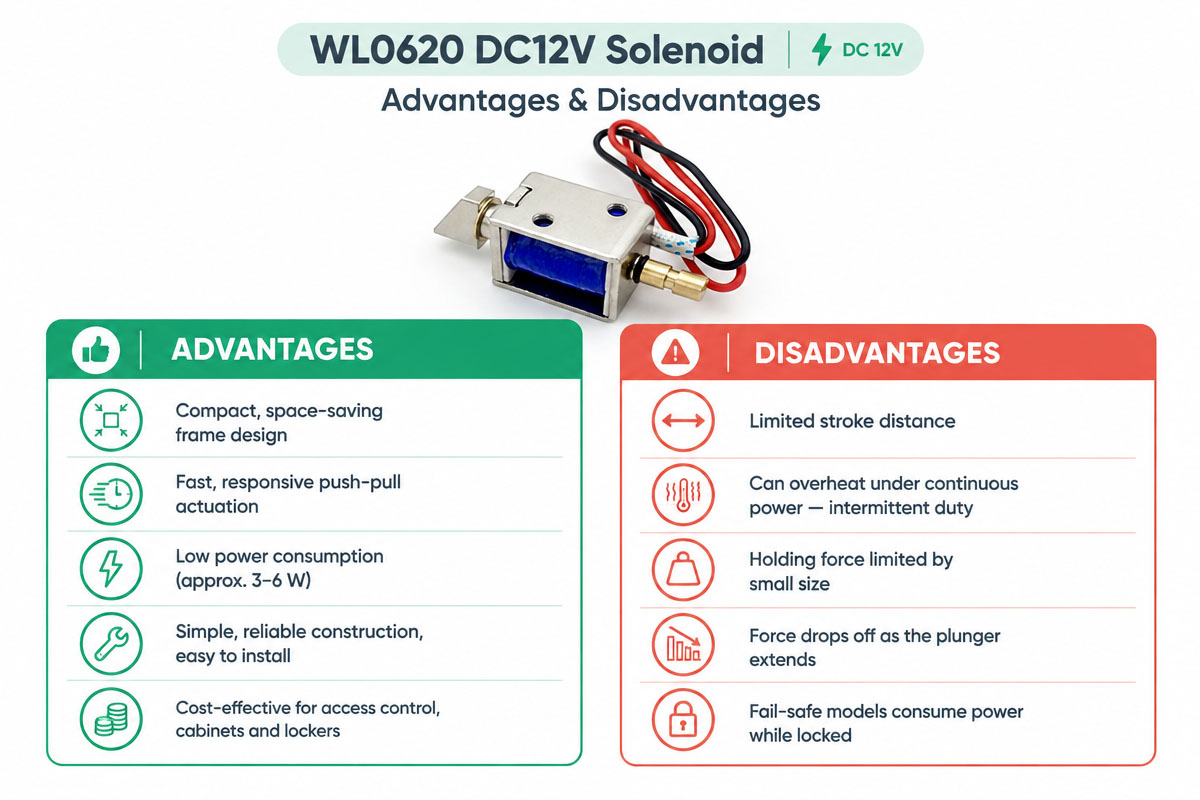
Custom DC12V Solenoid Lock Advantage and Disadvantage

Custom DC12V Solenoid Lock Pros & Cons Explained

The Pros of a 12V Solenoid Lock

There are many benefits of a 12V solenoid lock in the fields of electronic access and automation.

Pros

Simple control through electricity:

The lock can be controlled using a switch, relay, PLC, access controller, or electronic control board.

Compact design:

A solenoid lock can be installed in a smaller installation site.

Quick reaction:

In comparison with certain mechanical mechanisms, electromagnetic movement provides rapid locking or unlocking.

Flexibility in OEM:

Dimensions, force, stroke, mounting design, and electrical connections can be adjusted to suit specific equipment.

Simpler integration in system:

A DC 12V solenoid lock is a standard in control systems, and it is easy to integrate if the electrical architecture has already been set up at such voltage.

The cons of DC 12V solenoid locks

Coil heating:

If the product is meant to perform only in intermittent mode of duty, continuous energizing will cause the temperature to increase.

Power consumption:

Unlike a mechanical lock, an energized coil requires electric power.

Mechanical wear:

Due to repeated movements of the plunger, springs, and lock interface, mechanical wear occurs over time.

Limited locking force:

The locking force of a small solenoid cannot be unlimited. The available installation space and the magnetic circuit determine the performance.

Poor mechanical alignment:

Poor mechanical alignment leads to higher friction and lower reliability.

Therefore, customers must take into account the whole system and not only voltage.

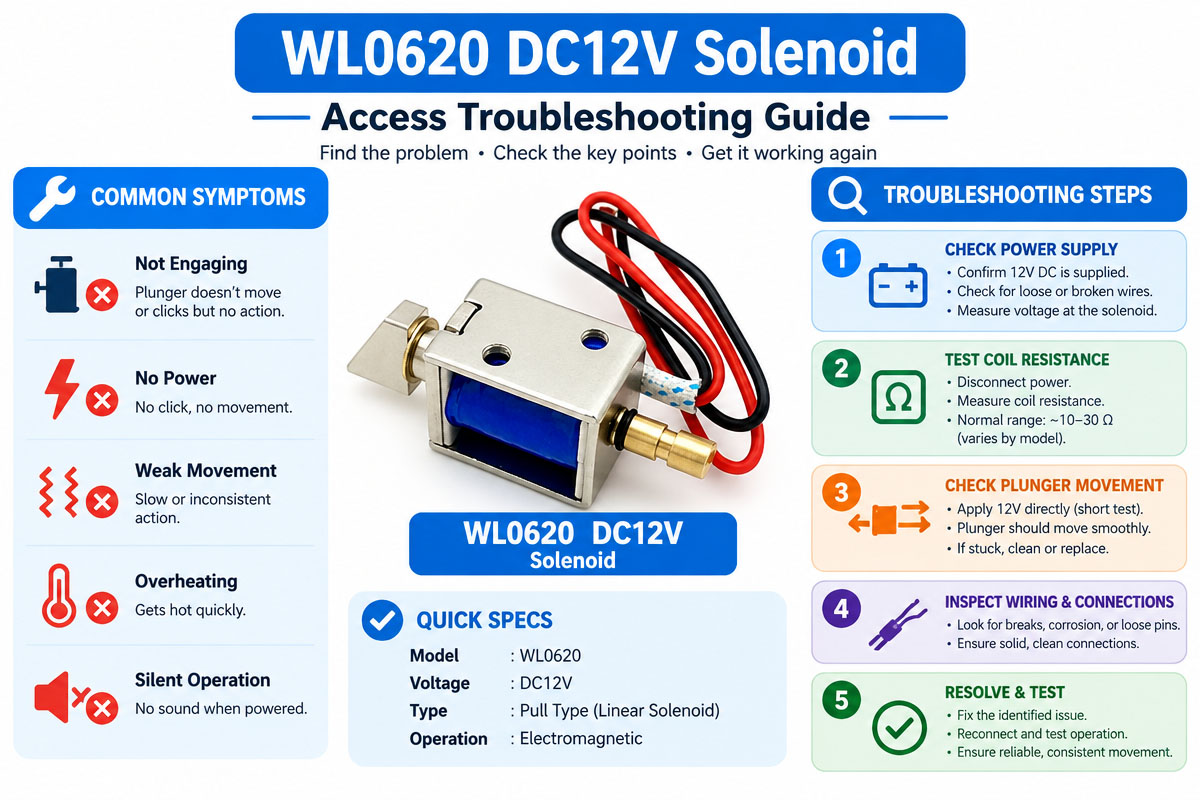
12V Solenoid Lock Troubleshooting Guide

Custom DC12V Solenoid Troubleshooting Guide

In case of malfunctioning of the 12V solenoid lock, electrical problems must be detected first and then mechanical ones.

Problem 1 – Lock Doesn’t Turn

You need to find out whether you have got 12V DC to the coil. Switch on the solenoid and measure the voltage at its terminals.

Problem 2 – Weak Plunger Movement

Weak force can occur due to low supply voltage, mechanical resistance, and wrong coil specifications.

Measure the voltage, current, stroke, friction, load, and plunger alignment.

Problem 3 – Overheating of Coil

Check the energizing time and duty cycle. Make sure actual supply voltage is within the specifications. The design may be meant for intermittent duty, and thus excessive temperature is produced.

Problem 4 – Lock doesn’t lock completely

Make sure the stroke is sufficient and the latch is installed correctly. Some pressure from the door or mechanical interference prevents complete engagement.

Problem 5 – Intermittent Functioning

Connectors, wires, controller output, and mechanical binding should be checked. Loose connection results in unstable operation.

Problem 6 – Too Much Noise

Unusual noise may be produced due to mechanical impact, loose mounting, or misalignment.

Problem 7 – Short Life Span

Review frequency, load, alignment, temperature, and lubrication needs. If the application operates beyond initial design conditions, a custom solenoid is required.

Troubleshooting Rules:

Voltage, current, force, stroke, and temperature must be measured and not visually inspected.

FAQs of 12V Solenoid Lock

1. What do I need to know when purchasing a 12V solenoid lock?

Buyers should pay attention to the locking force, stroke, holding force, dimension, mounting style, power consumption, duty cycle, operation temperature, response time, and life span. The 12V solenoid lock should also meet with the 12V DC power supply and mechanical configuration.

2. What is the force of a 12V solenoid lock?

The locking force of the solenoid lock depends on the solenoid design, plunger size, stroke, coil power, magnetic circuit, and mechanical load. The buyers can give the required mechanical load or holding force and stroke. The manufacturer can recommend the design of the solenoid lock.

3. Can a 12V solenoid lock work continuously?

No. Not all the 12V solenoid locks can work continuously. Continuous energization will cause heating and reduce the life of the coil. Therefore, buyers need to clarify the required duty cycle, frequency, and longest energized time. Buyers also need the suitable coil design and power-saving holding circuit.

4. What is the difference between fail-safe and fail-secure 12V solenoid lock?

Fail-safe design usually allows unlocking when power is cut off, but fail-secure design tends to remain locked when there is no power, depending on mechanical construction. In any case, the buyer must know what state the locking needs in the absence of power.

5. Can 12V solenoid lock be customized for OEM products?

Yes, customization includes overall dimensions, mounting holes, plunger design, stroke, force, connector, wire length, coil resistance, materials, surface treatment, and working parameters. For OEM projects, buyers can send drawings and mechanical and electrical specifications in order to get a proper solution from the manufacturer.

6. How long will 12V solenoid lock last?

The life span of the product is dependent on such factors as mechanical load, stroke, duty cycle, operating temperature, switching frequency, and installation. In case the solenoid works intensively, buyers must specify the number of operations—100,000, 500,000, 1 million, etc.—and require life testing accordingly.

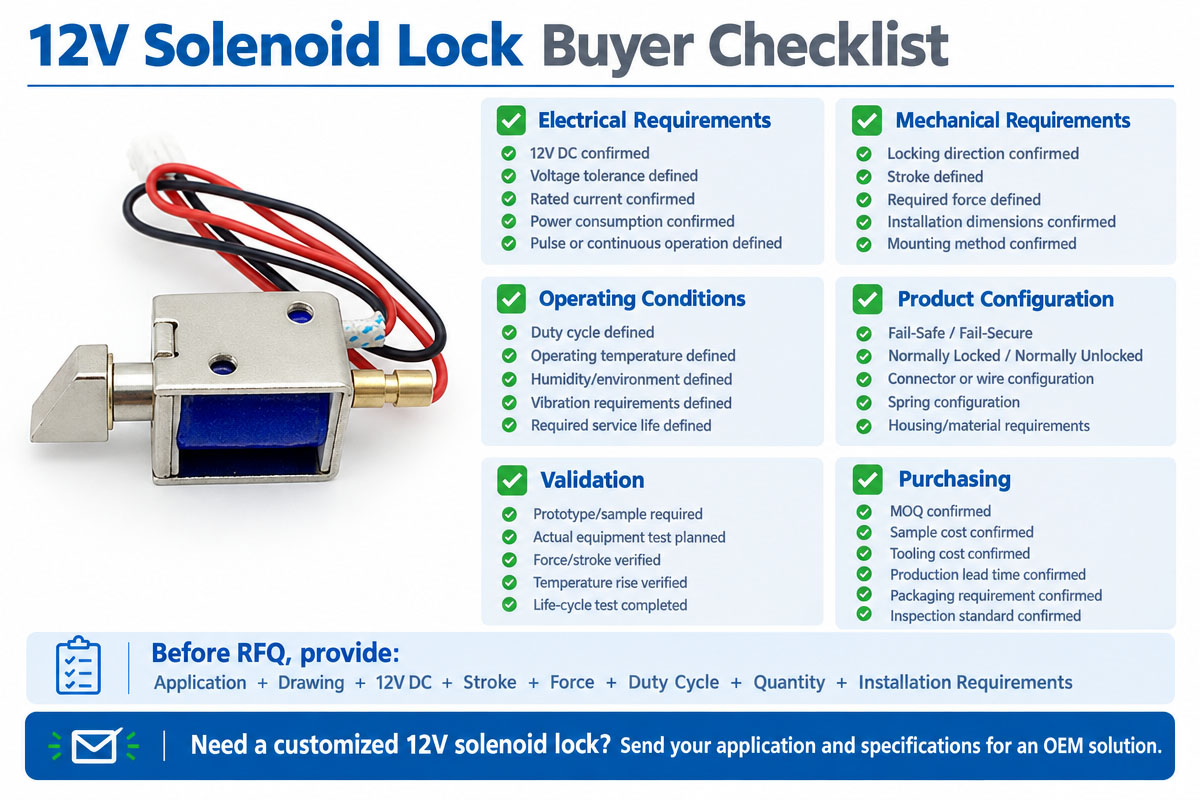
7. What information must I provide when requesting a 12V solenoid lock quotation?

In case buyers ask for a 12V solenoid lock quotation, they need to provide 12V DC voltage, required locking/unlocking force, stroke, size, duty cycle, operating frequency, installation space, operating temperature, connector or wire requirements, and quantity of orders. Buyers can provide a mechanical drawing, photo, or sample to receive a more precise quotation.

8. What quality and testing information must I request from the supplier?

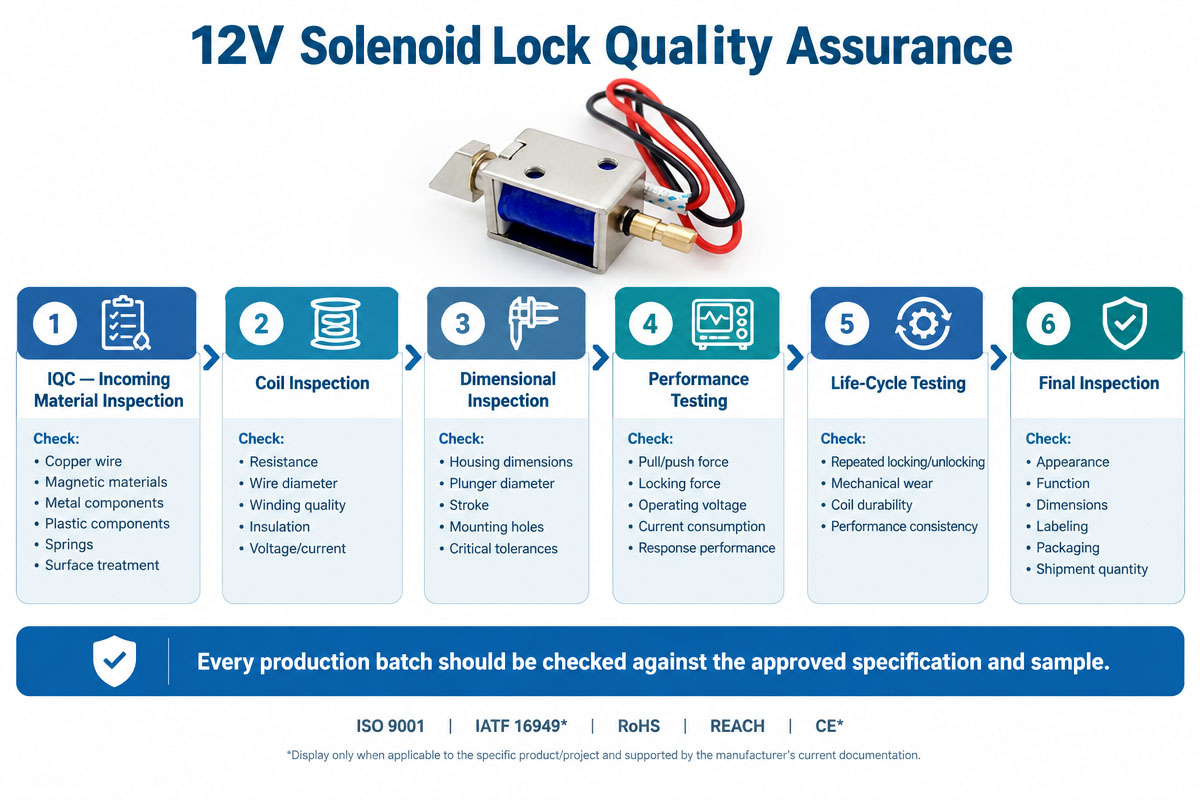
For an OEM project, buyers need to ask about electrical tests of a coil, verification of stroke and force, insulation tests, temperature rise, endurance/life tests, dimensional inspection, and incoming/outgoing quality control of 12V solenoid locks. Buyers can also ask for RoHS, REACH, CE documentation, material specifications, or inspection/testing reports.

How to select a 12V solenoid lock

When selecting a 12V solenoid lock, you need to consider not only the fact that the equipment is supplied by 12V DC. • Mechanical and electrical requirements should be defined together.

1. Check the Voltage

Start with the real control voltage. If the system requires 12V DC, check the allowable voltage range and voltage constancy during operation.

2. Definition of Locking Direction

Define whether the locking mechanism needs to be pushed or pulled. The direction of the plunger must correspond with the mechanical design.

3. Determine the Force

Define the force needed for movement and holding the locking mechanism. Consider friction, door pressure, spring resistance, misalignment, and any other loads that may occur.

4. Pick the stroke you need

The stroke must be sufficient for engaging or disengaging the locking mechanism. If the stroke is too small, the lock won’t be engaged completely. If the stroke is too large, the installation space will be larger.

5. Check the duty cycle.

Find out the number of locking cycles and duration of coil energization. The coil that is designed for intermittent service cannot be assumed to be suitable for continuous energization.

6. Current and Power Evaluation

Rated current, coil resistance, and power consumption must be checked. All controllers, wiring, connectors, and power supplies should be rated for the electrical load required.

7. Verify installation dimensions.

Check overall length, width, height, mounting holes, plunger position, and available installation space.

8. Set the environmental conditions.

Consider temperature, humidity, dust, vibration, corrosion, and potential water exposure. These conditions may influence material and sealing requirements.

9. Specify Life Requirements

Estimate the required number of locking cycles for the entire lifetime of the product. Request life testing if required.

10. Sample check

Test the samples in the real equipment before mass production. Test locking force, stroke, electrical performance, temperature rise, mechanical interference, and repeat operation.

Principle of the purchaser:

Select the 12V solenoid lock based on the application requirement and not just the “12V” label.

How to Avoid Common Mistakes When Designing 12V Solenoid Locks

Error 1 — Choosing Based on Voltage Alone

12V rating does not specify force, stroke, current, or duty cycle.

Avoid: List all major electrical and mechanical parameters.

Mistake 2 – Ignoring the real mechanical load

Door pressure may increase the required force. Friction and spring resistance may increase the required force.

Test the locking mechanism under real load conditions.

Mistake 3: Choosing the wrong stroke

The plunger may seem to operate properly but may not engage the latch completely.

Do not measure the real mechanical travel and add an appropriate engineering margin.

Mistake 4: Ignoring Duty Cycle

The product that is designed for intermittent operation can create excessive coil temperature while being continuously energized.

Avoid it: Define energizing time, frequency, and duty cycle at the RFQ stage.

Mistake 5 – Plunger Orientation Incorrect

Side loading increases friction and causes quicker mechanical wear.

Stay away from it: Create the mounting structure so that the plunger remains in proper orientation.

Mistake 6 — Not Releasing Manually

Some systems require emergency or maintenance access.

Don’t: Define if mechanical release or another access method is needed.

Mistake 7 – No Prototype Testing

The CAD integration will not find all of the real-world issues.

Do not do this: Test the samples in the final equipment before production approval.
Get A Free Quote Now

Contact Form

Related Products

Related News

Scroll to Top

Get A Free Quote Now !

Contact Form
If you have any questions, please do not hesitate to contact us.
Weilong Solenoid Company Culture