Qi Wireless Charging 2 Coils for Smart Phone Charging
Qi Wireless Charging 2 Coil Design for Smart device guide
Custom Qi Wireless Charging Coil for Smart Appliances
Qi Wireless Charging Coil Design for Mobile Devices Hub
Qi Wireless Charging 2 Coils for Device Integration Hub
Qi Wireless Charging Coil for Consumer Electronics Plus
Qi Wireless Charging 2 Coils for Smart Phone Charging
Qi Wireless Charging 2 Coil Design for Smart device guide
Custom Qi Wireless Charging Coil for Smart Appliances
Qi Wireless Charging Coil Design for Mobile Devices Hub
Qi Wireless Charging 2 Coils for Device Integration Hub
Qi Wireless Charging Coil for Consumer Electronics Plus

WL8346 Qi Wireless Charging Coil for Smart Phone solutions

Qi wireless charging coils are an integral component of wireless power transfer systems used for smartphones, wearables, smart appliances, and consumer electronics. The coil creates/receives a magnetic field, which enables wireless energy transfer without direct physical connection.

In applications for smart phones, the coil is typically designed for compact housing and efficient power transfer with acceptable temperature characteristics. In certain cases, the manufacturers can employ one or several coito to improve charging coverage and alignment.

In case of a 2-coil Qi wireless charging design, two charging coils are positioned according to the charging area and mechanical structure. This solution may provide additional flexibility if the transmitter and receiver are not well-aligned.

Custom coil design should take into account operating frequency, inductance, resistance, coil diameter, wire size, magnetic shielding, power requirements, installation space, thermal characteristics, and electronic compatibility.

wireless power charging coil Product Overview

A two-coil Qi wireless charging solution is one wireless power transfer system that includes two charging coils. The dual-coil design gives more flexibility for charging area coverage and mechanical integration than the single-coil design. The two coils can be positioned side by side, vertically, or in accordance with the product’s internal structure. The choice of the coil to operate can be made electrically depending on the position of the receiver and the system requirements. Coil diameter, inductance, resistance, wire size, operating frequency, spacing, shielding, power level, and thermal performance are important coil design parameters. Dual-coil solutions are especially good for charging pads, smartphones, smart appliances, docking stations, and multi-position wireless charging products.

How Qi Wireless Charging 2 Coils Works

Qi wireless charging 2-coil system: Two coils transfer power by means of electromagnetic induction.

The main steps in the process are

Input Power Charging Controller Coil 1 / Coil 2 Magnetic Field Receiver Coil Rectifier Battery

In the typical Qi wireless charging design, the transmitter electronics create AC current through the charging coil. This current generates an alternating magnetic field.

When placed in the magnetic field, a compatible receiving coil captures the electromagnetic induction that creates electrical voltage in the receiving coil. The energy captured by the receiver is rectified and regulated for the battery charging system.

Using two coils, the system can use coil selection, switching, or coordinated control, depending on the architecture. When the receiving device is above one coil, the system can activate the relevant coil to increase power transfer efficiency and charging coverage.

Main Features of Qi Wireless Charging 2 Coils

Qi wireless charging 2 coils are designed for flexible wireless power transfer solutions for smartphones, smart appliances, and consumer electronic devices. The key features of the Qi wireless charging 2 coils include increased charging area coverage, flexible device positioning, compact integration, and customizable coil geometry. The two coils can be arranged according to the mechanical layout and charging area. The electronics can select the correct coil depending on the receiver position and system design. Another important characteristic is controlled inductance, low electrical resistance, stable thermal performance, magnetic shielding, and electromagnetic compatibility. Custom coil design can be made based on available space, charging power, operating frequency, coil dimensions, wire specification, connector requirements, and the customer’s electronic design.

Qi Wireless Charging Coil Product Vidoe Presentation

Custom Qi Wireless Charging Coil Details Display

Custom Qi Wireless Charging Coil Technical Data Sheet

Brand Weilong Technology Model Number WL8346
Product Size: 83*46*1.0 * 10 TS * 6.5 UH Rated Power (W) 10 W or 15 W
Wire: 0.08 mm * 10 TS Holding Force (N) Nil
DCR 28.5 UH +/- 10% Reset Time(s) Nil
Service Life Nil Certification CE, RoHS, ISO9001,
Material copper wire Power Contact lead wire
Install Style adhered tape Tolerance of Dimension ± 0.1 MM
Water-proof None Insulation Class F
Hi-Pot Test AC 600V 50/60Hz 2s Non-excitation Holding Force 0
Working Temperature -10°C-100°C Duty Cycle 1-100%
Thread Depth (mm) 0.1 mm Payment Term TT, or LC at Sight
Sample Order Yes. Warranty 1 Year
MOQ 1000 pcs Supply Ability 5000 pcs per week
Delivery Time 30 Days Port of Loading Shenzhen

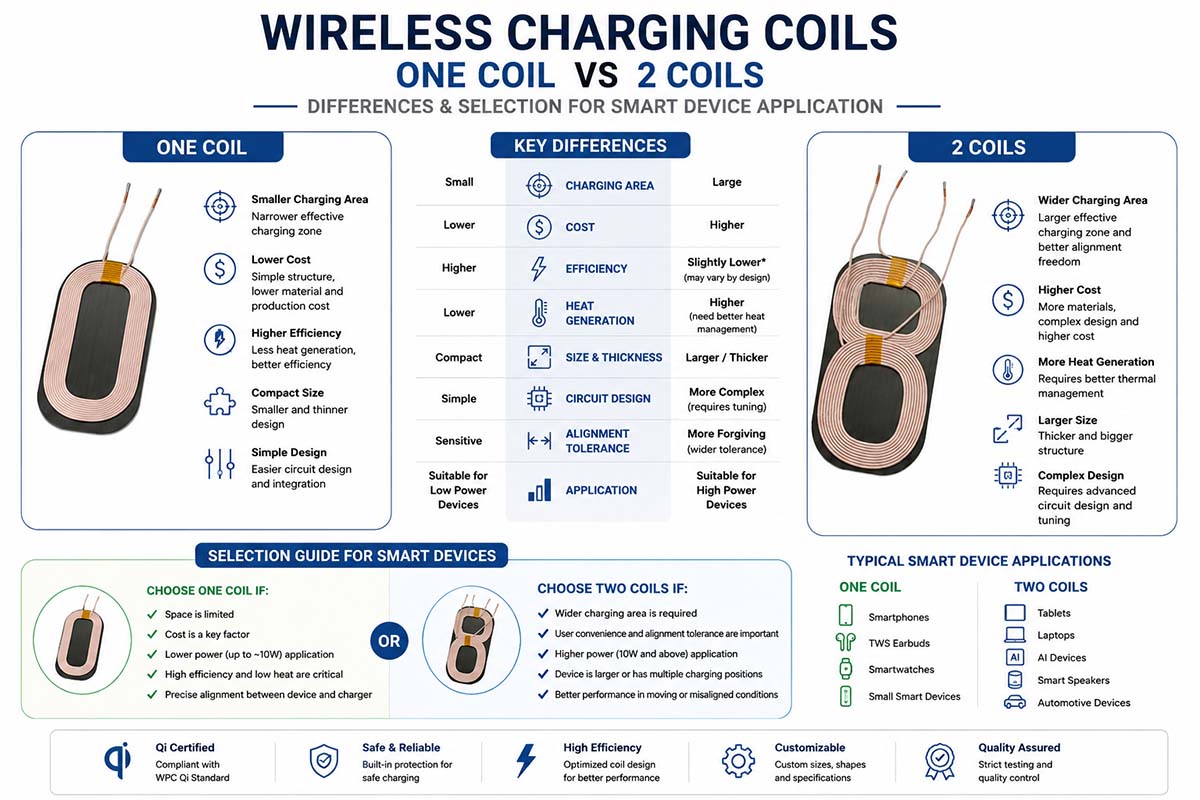
Wireless Charging Coils: 1 Coil vs. 2 Coils

Wireless Charging Coirl - 1 Coil VS 2 Coils different and selection

Feature 1 Coil 2 Coils
Charging coverage More limited Potentially wider
Positioning flexibility Moderate Better
Circuit complexity Lower Higher
Component cost Lower Higher
Installation space Smaller Larger
Control requirement Simpler More complex
Mechanical flexibility Good Very good
Thermal design Simpler More demanding
Charging surface Suitable for a focused area Suitable for a broader area
OEM customization Easy More flexible
Best use Compact charging zone Multi-position charging area
Design risk Lower Requires more system testing

1 Coil – When to Pick It

When receiver positions are predictable, installation space is limited and cost-effective product design is needed, a single Qi wireless charging coil is usually the best choice.

Typical applications are

Smart phone charging module.

Wearable battery chargers

Earbuds Bluetooth

Small electronic appliances

Dedicated charging stations

2 Coils—When to Choose It

The dual-coil design is preferable when the charging surface is larger or the user doesn’t always place the device in the same position.

Typical applications are

Wireless phone charging pad

Multi-position charging stations

Wireless charging stations for automotive

Smart furniture

Charging surfaces for smart appliances

Accessories for charging several devices

The Big Difference

The fundamental difference isn’t only in the number of coils. It is in the system architecture and charging area strategy.

The single-coil solution provides simplicity, lower cost, and easier integration.

The use of two coils provides greater flexibility in positioning and coverage of the charging area but requires additional engineering effort for coil spacing, control, thermal management, and electromagnetic performance.

The best choice for OEM development should be made depending on the actual product size, receiver position, charging power, cost, and user requirements, not because two coils are better.


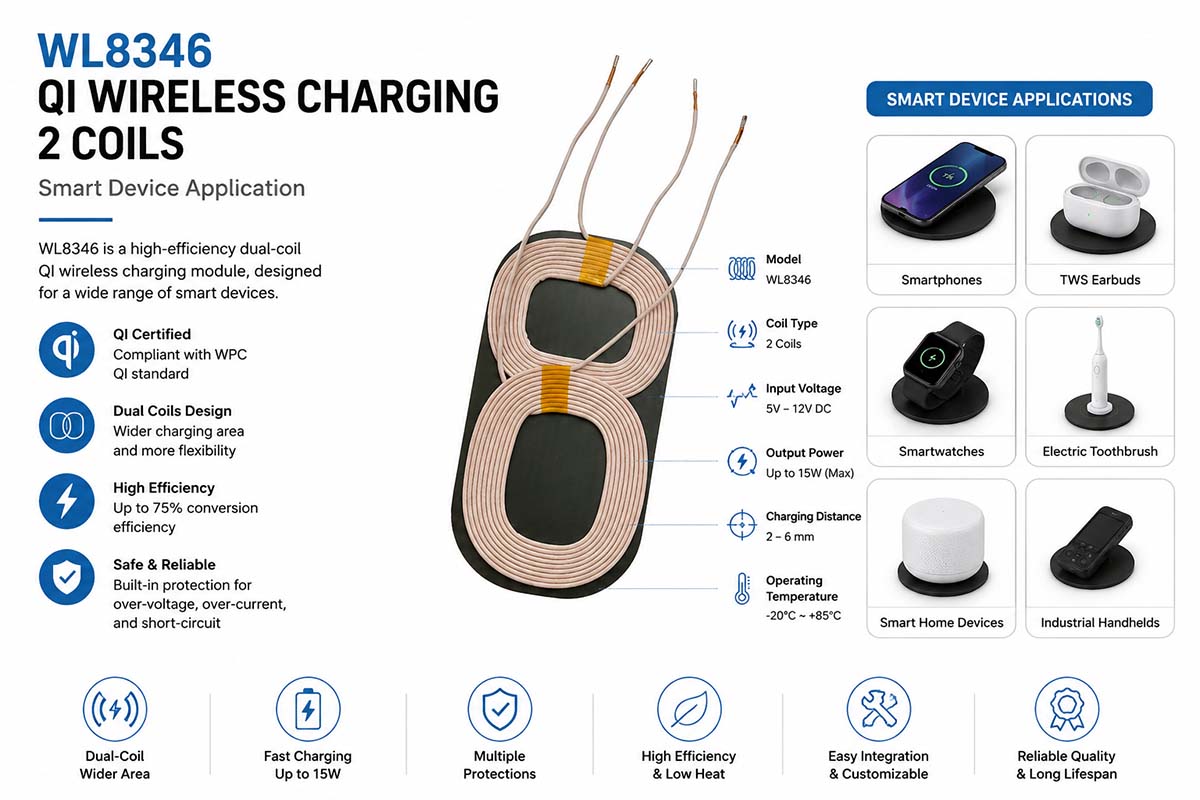
Custom Qi Wireless Charging Coil Smart Device Application

Wireless Charging Coir smart device applicationi

Qi wireless charging 2 coils are suitable for various charging systems of smartphones, consumer electronics, and smart appliances.

Mobile Phones

Two-coil charging designs can provide more flexible charging coverage in charging pads, stands, and docking systems. This may be advantageous when a user can put his/her phone in different positions.

Wearables & Smart Watches

Compact two-coil designs can be used in wearable charging stations and multi-device charging accessories.

Wireless Earphones

Two coils can support charging zones for left and right earbuds or provide flexibility in a small charging case.

Smart Home Products

Wireless charging can be integrated into smart speakers, control panels, smart furniture, kitchen appliances, and other products requiring convenient power transfer.

Automotive Electronics

Built-in wireless charging can be provided in vehicle center consoles, phone holders, and dedicated charging compartments.

Charging Stations for Consumers

Dual-coil designs can provide more than one charging surface and docking stations.

Industrial IoT Devices:

Wireless charging can reduce exposed electrical contacts for selected sensors, handheld equipment, and smart terminals.

For OEM applications, coil geometry, power level, thermal characteristics, shielding, mechanical tolerances, and electronic control should be considered as a whole, instead of selecting the coil independently.

Reasons for Choosing Smart Appliance Charging Using Qi Wireless Charging 2 Coils

Qi wireless charging 2 coibecoming increasingly popular due to the growing demand for convenient,nt and connector-free charging in smart products.

The traditional charging connector requires proper insertion of the cable. Qi charging doesn’t require physical connection and may provide a better seek the product. This way of charging makes interaction with users easier for smart appliances and docking stations or charging surfaces.

Dual-coil configuration provides another advantage—greater flexibility in positioning of the device. Instead of forcing the receiver to be above the center of one of the coils, two coils may be used to provide a larger charging area.

This solution is especially advantageous for:

Smart appliances for the home

Smartphones

Bluetooth earbuds

Wearable devices

Intelligent furniture

Vehicle charging stations

Smart speakers,

Charging points

IoT devices

Consumer electronics accessories

Qi charging is also a chance to make the product look better by reducing the number of visible connectors and openings.

But successful implementation of the technology requires good engineering. The coil geometry has to be optimized with inductance, resistance, shielding, operating frequency, thermal management, and electronic control.

For OEM products, a customized dual-coil charging solution can be a suitable choice.

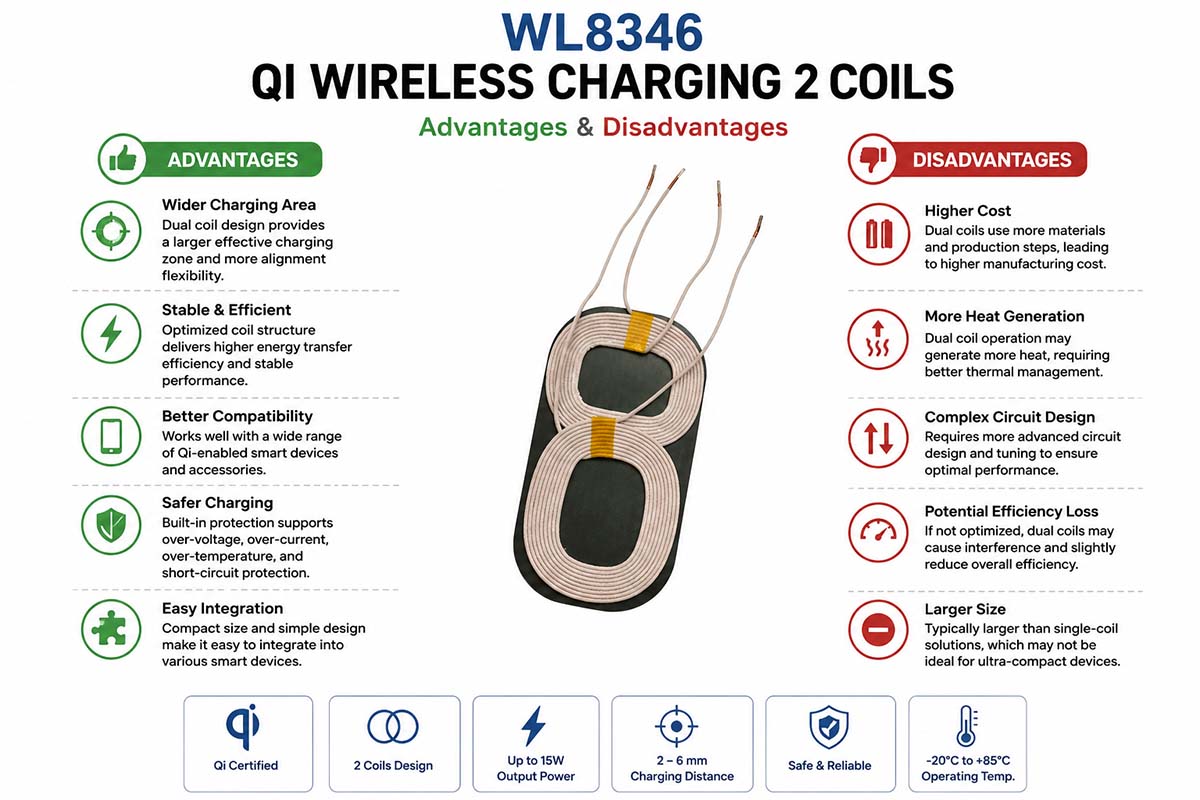
Custom Qi Wireless Charging Coil Advantage and Disadvantage

Wireless Charging Coir advantage and Disadvantage

There are several benefits to choosing a 2-coil Qi wireless charging solution for smart device charging applications.

Custom Qi Wireless Charging Coil Advantages

Large charging area: Two coils can cover a larger charging area.

Flexibility in positioning: Users can place their smartphone or device on a charging surface in different ways.

Mechanical flexibility: The internal structure of the product allows for positioning two coils.

Multi-position charging: Dual-coil configurations can be used in charging pads, docks, and smart appliance surfaces.

OEM customization: We can customize the coil size, spacing, winding, and mounting technique in accordance with your product.

Custom Qi Wireless Charging Coil Advantages and Disadvantages

Increased cost: Two coils require additional coil material and control electronics.

Increased complexity of electronics: Control logic may be needed to energize the right coil.

More space for positioning: Two coils will usually require more internal space than a single coil.

Possible heating problems: Several coils or changing of coils may increase heat generation.

Complicated testing procedure: Full system testing is necessary for coil selection, alignment, and electromagnetic performance.

So two coils aren’t necessarily better than one. It all depends on the charging area, product size, charging power, costs, and user experience.

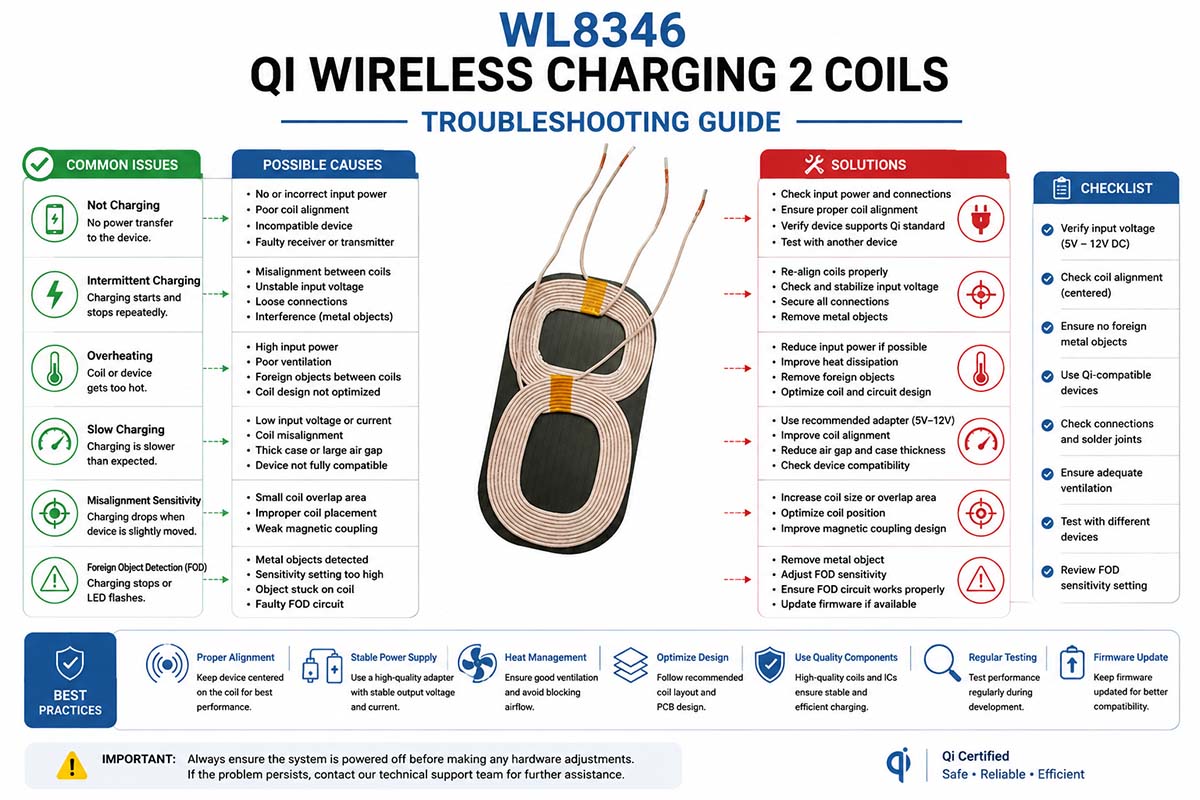
Qi Wireless Charging Coil Troubleshooting Guide

Wireless Charging Coir Trouble shooting Guide

If the Qi wireless charging 2-coil system isn’t working well, check the entire system for faults before replacing the coil.

Problem: Device Won’t Charge

Check the power supply of the transmitter, charging controller, coil connection, and receiver position. Check that the right coil is energized.

Problem: Intermittent Charging

Check coil alignment, coil spacing, connector quality, and electromagnetic interference. Metal objects between coils also decrease the coupling.

Problem: Slow Charging

Check input power, coil resistance, inductance, operating frequency, and receiver compatibility. The charging system may also limit power due to excessive temperature.

Problem: Coil Gets Hot

Check coil current and resistance. Check that the wire diameter is right and that there isn’t any metal next to it (such as magnetic shielding) that is adding losses.

Problem: One Coil Works, Other Doesn’t

Check the switching circuit, coil wiring, solder joints, and controller configuration. Measure the electrical characteristics of both coils.

Problem: Limited Charging Area

Check the diameter of the coil, alignment, position of the receiver coil, magnetic shielding, and distance between the transmitter and receiver.

Problem: Changes in Performance After Assembly

Always test the coil before and after its assembly. Electromagnetic performance may be affected by housing materials, batteries, metal supports, PCB components, and adhesive materials.

A thorough troubleshooting routine should include electrical parameters testing → coil operation → alignment testing → thermal behavior testing → overall system performance.


8 FAQs on Qi Wireless Charging 2 Coils

What Is Qi Wireless Charging 2-Coil System?

A Qi wireless charging 2-coil system includes two transmitter coils in one charging product. The coils are designed to provide more coverage of the charging area or different positions of the device. Wireless power transmission uses magnetic induction between transmitter and receiver coils.

2. What Is the Advantage of Having Two Coils Instead of One Coil?

The primary advantage is the possibility to position and cover the charging area with greater flexibility. Two coils can be positioned in a way to provide different positions for devices. This way of positioning is appropriate for charging pads, stands, automotive chargers, and smart appliances.

3. Does A 2 Coil Design Charge Faster Than 1 Coil?

Not always. The charging speed is provided by the whole system—transmitter, receiver, coil characteristics, alignment, power electronics, and thermal management. The addition of the second coil doesn’t necessarily give more power or efficiency of charging.

4. How Are the Two Qi Charging Coils Controlled?

In accordance with the product architecture, the system may use electronic control to determine which coil should be energized or how the coils should be controlled. Coil configuration, controller, and overall transmitter design should be developed together.

5. Can Two Coils Wireless Charging 2 Qi Improve the Tolerance to Misalignment?

They can improve the coverage of charging areas, but they won’t automatically solve the alignment problems. Magnetic coupling depends on the distance, coil size, shielding, and alignment.

6. What Are Suitable Applications For Qi Wireless Charging 2 Coils?

Typical applications are wireless charging pads for smartphones, charging stands, automotive wireless charging systems, smart appliances, smart furniture, wearable charging stations, earbuds, and other consumer electronic accessories.

7. What Specification Should Buyers Provide When Custom 2 Qi Coils?

For OEM development, buyers are to provide the required charging power, operating frequency, available installation space, coil diameter, coil thickness, inductance, resistance, receiver position, alignment tolerance, shielding requirements, and operating temperature. Eventually the complete assembly should be tested in the end product.

8. Does the Qi Charging Coil Have To Be Qi Certified?

The coil isn’t a Qi-certified product. The Wireless Power Consortium determines Qi compliance for a complete functional Qi transmitter or receiver, not for an individual coil. Housing material, coil position, shielding, and distance from the coil to the surface may affect integration performance and therefore compliance.

How to Select a Qi Wireless Charging Coil

Selecting the right Qi wireless charging coil is not only matching physical dimensions. The coil has to work correctly with the whole wireless charging circuit and the intended mechanical environment.

1. Qi Wireless Charging Coil Definition

First of all, determine how much charging power you need. Higher power requirements will influence coil size, wire selection, resistance, thermal performance, and magnetic design.

2. Check Qi Wireless Charging Coil Dimensions

Calculate the area of installation. Calculate the area of installation. Consider OD, ID, thickness, coil height, and what is around it. Smart phones and other compact consumer electronics will require a thin coil.

3. Determine the Qi Wireless Charging Coil Inductance

Required inductance has to be compatible with the charge controller and the whole circuit design. Incorrect inductance can lead to decreased system efficiency or even circuit malfunction.

4. Consider the Qi Wireless Charging Coil Resistance

Low resistance, in general, reduces copper losses and heat generation. Therefore, wire diameter, winding length, and coil construction have to be considered together.

5. Alignment Assessment

Determine the achievable positioning accuracy for the transmitter and receiver. If users can put devices anywhere in the relatively large area, the multi-coil configuration might provide better coverage.

6. Dual Qi Wireless Charging Coil vs. Single Qi Wireless Charging Coil

The single coil gives a simpler and more compact solution. Two coils provide more flexibility for positioning but require additional control, space, and design.

7. Magnetic Shielding Test

Magnetic shielding structures like ferrite may be needed to control the magnetic field and to minimize the interference with nearby components.

8. Thermal performance evaluation

Check the temperature rise at the expected charging power. Temperature depends on coil resistance, current, PCB design, shielding, and enclosure material.

9. Check Mechanical Integration

Consider adhesive, flexible PCB, connector, wire outlet, coil thickness, and mounting technique.

10. Test the whole Qi Wireless Charging Coil system.

Never approve a coil based on its datasheet. Test the coil with the real transmitter, receiver, enclosure, battery system, and operating conditions.

How to Avoid Typical Design Errors in a Qi Wireless Charging Coil.

The following mistakes can cause poor charging performance, overheating, or unstable system operation.

1. Don’t design the Qi Wireless Charging Coil yourself

The coil has to be designed with a transmitter, receiver, and charging controller.

2. Pay Attention to Coil Alignment

Two coils maprovideve better coverage, but their positioning and spacing should be carefully considered.

3. Don’t choose wire size based on its appearance

Wire diameter is proportional to resistance, current-carrying capability, heat, and efficiency.

4. Coil Thickness Cannot Be Ignored

The coil may be electrically appropriate, but it may not fit into the thin product.

5. Don’t Forget About Magnetic Shielding

Local metal parts may affect magnetic coupling and charging performance.

6. Don’t Assume That Two Coils Always Mean Better Efficiency

The dual-coil design can improve the coverage, but additional switching and control circuitry may introduce losses.

7. Don’t Test Only at Room Temperature

The charge should be tested at realistic temperature and enclosure conditions.

8. Re-check the Circuit Before You Change the Coil

Changes in inductance, resistance, or coil geometry can affect the whole charging system.

9. Don’t Overlook the Qi Wireless Charging Coil Tolerance

Define tolerances for coil dimensions, inductance, resistance, and positioning.

10. Always Build Engineering Qi Wireless Charging Coil Samples

To prove charging power and efficiency, temperature and alignment tolerance, and reliability of mass production, always build engineering samples.

Get A Free Quote Now

Contact Form

Related Products

Related News

Scroll to Top

Get A Free Quote Now !

Contact Form
If you have any questions, please do not hesitate to contact us.
Weilong Solenoid Company Culture
