Industrial Automation Magnetic Holder Secure Holding
Automation Magnetic Holder for Material Handling System
Automation Magnetic Holder for Industrial Workstations
Automation Magnetic Holder for Assembly Line Fixtures
Reliable Automation Magnetic Holder for Industrial Line
Automation Magnetic Holder for Automated Production
Industrial Automation Magnetic Holder Secure Holding
Automation Magnetic Holder for Material Handling System
Automation Magnetic Holder for Industrial Workstations
Automation Magnetic Holder for Assembly Line Fixtures
Reliable Automation Magnetic Holder for Industrial Line
Automation Magnetic Holder for Automated Production

WL4029 Automation Magnetic Holder for Factory Automation Needs

An automation magnetic holder is a magnetic workholding tool that holds, positions, or transports ferromagnetic metal components securely in the automated mode. It can be incorporated into a CNC machine, assembly machine, conveyor system, welding station, inspection machine, and material handling machine. It can be either a permanent magnet holder, an electromagnetic holder, or both, depending on its design.

It is mainly used to ensure reliable holding without the use of mechanical clamps or fixtures. The magnetic holder automation improves production efficiency by reducing the setup time, providing repeatable positioning, and enabling fast metal part handling. This is especially effective when it comes to repeated picking, positioning, transferring, or holding steel or iron components. The selection of the holder should be appropriate with respect to holding force, workpiece material, surface condition, operating temperature, mounting, duty cycle, and speed of the automation process.

Magnetic Automation Holder Description

An automation magnetic holder is a magnetic tool used in automated machinery for the holding, positioning, and transporting of ferromagnetic components. It creates magnetic attraction between the working surface of the holder and a ferromagnetic work piece of steel or iron. The holder can use permanent magnets to create continuous attraction or electromagnetics if there is a desire to use electrical power for activation and release. Automation magnetic holders are commonly used in robotic arms, CNC fixtures, assembly machines, conveyor systems, welding machines, and material handling systems. The holders can provide reliable positioning and eliminate thneed forof mechanical clamping of the part. They can improve the efficiency of automated production.

The Role of a Magnetic Automation Holder

An automation magnetic holder works by creating a magnetic field that attracts and holds ferromagnetic metals like steel and iron.

The process of operation is as follows:

Magnetic activation—the generation of magnetic attraction by the magnetic circuit.

Contact with the workpiece—the contact of the holder with the ferromagnetic surface of the workpiece.

Generation of the magnetic force—magnetic flux passing through the holder and the workpiece and creation of the magnetic force.

Positioning or handling—the automation process moves the part, positions it, assembles it, welds it, or processes it.

Mechanical or magnetic switches are used in the permanent magnetic systems. The electromagnets release the workpiece by switching electricity off or changing the magnetic circuit.

Repeat cycle – returning of the holder to the operating position to repeat the automated production cycle.

Holding performance depends on air gaps, material thickness, surface flatness, cleanliness, magnet design, and operating conditions.

Magnetic Automation Holder Video

Magnetic Automation Holder Detail Display

Magnetic Automation Holder Technical

Brand Weilong Technology Model Number WL4029
Rated Voltage (V) DC 12V or 24V Rated Power (W) 5-16 W
Work Mode: Power on, magnet on. Holding Force (N) 40 Kgs
working duty 100% Resistance 100 Ω
Service Life 100 Thousand Times Certification CE, ROHS, ISO9001,
Material Superior Magnet Carbon Steel Housing Lead Wire Length (mm) 250 MM
Install Style Screw Hole Tolerance of Dimension ± 0.1 MM
Water-proof None Insulation Class B
Hi-Pot Test AC 600V 50/60Hz 2s Non-excitation Holding Force 0
Working Temperature -10°C-100°C Duty Cycle 1-100%
Thread Depth (mm) / Payment Term TT, or LC at Sight
Sample Order Yes. Warranty 2 Years
MOQ 1000 pcs Supply Ability 5000 pcs per week
Delivery Time 30 Days Port of Loading Shenzhen

Why is the magnetic holder for automation so much in demand?

Manufacturers are seeking workholding solutions that are faster, simpler, and more flexible, and thus automation magnetic holders gain popularity.

The main advantage is the quick handling of work pieces. The magnetic attraction can hold them with suitable metal parts, avoiding the need for complex mechanical clamping devices. This may shorten the loading and unloading time of repetitive operations.

They are also very convenient for robotic automation. The robotic end effector can be equipped with the magnetic holder for picking up and transporting steel components.

Another advantage is simplifying fixtures. Magnetic holding may be suitable for some applications due to the elimination of some mechanical clamps and pneumatic components.

Automation magnetic holders also allow repeatable positioning, which is needed in CNC machining, welding, assembly, inspection, and automated material handling.

The electromagnetic holder is good for automated control, while the permanent magnetic one saves electrical energy during holding.

Since the development of smart factories and flexible manufacturing systems is developing rapidly, the demand for compact and reliable workholding components arises. Automation magnetic holders suit these needs.

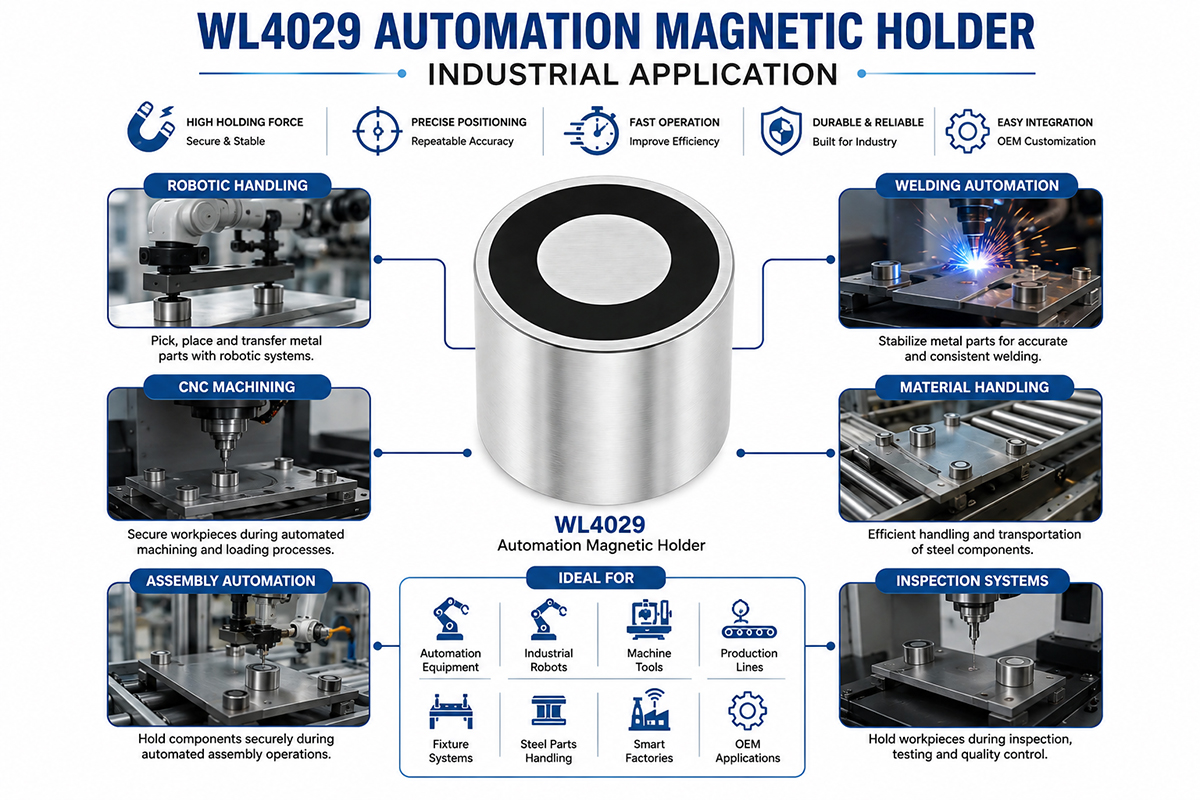
Magnetic Automation Holder Applications

Automation Magnetic Holder for CNC Machine Applications

Automation magnetic holders are extensively used in those places where ferromagnetic parts have to be securely held, positioned, transported, or processed.

Milling (CNC)

They can help to locate and clamp steel parts during automated machining and loading.

Robotics handling

The magnetic holder can be mounted to the robotic arm in order to pick up and transport steel plates, brackets, housings, and other metal parts.

Automation in Welding

They can be applied in automated welding stations for positioning workpieces and keeping parts in consistent locations.

Production Line

Assembly operations are performed using automated or robotic equipment. The metal components can be temporarily held using magnetic holders.

Material Handling

They are used for automated transportation of steel parts from one production station to another, to conveyors, to storage locations, and to processing machines.

System Inspection

Magnetic holders are used to keep metal parts in place during dimensional inspection, machine vision, testing, and quality control.

Stamping Equipment & Presses

They can be used to automatically feed and position compatible sheet metal parts.

Packaging & Sorting

Magnetic holders can be used for the automation of sorting and transferring ferromagnetic parts.

Industrial Light Fixtures

Good for installation in special fixtures where rapid loading and unloading of the workpiece is required.

Automation Equipment OEM

Custom magnetic holders can be developed for specialized machines having certain dimensions, forces, mounting and switching methods, or sensor interfaces.

Magnetic Automation Holder Adv. & Disadv

Automation Magnetic Holder for Smart Factory Systems

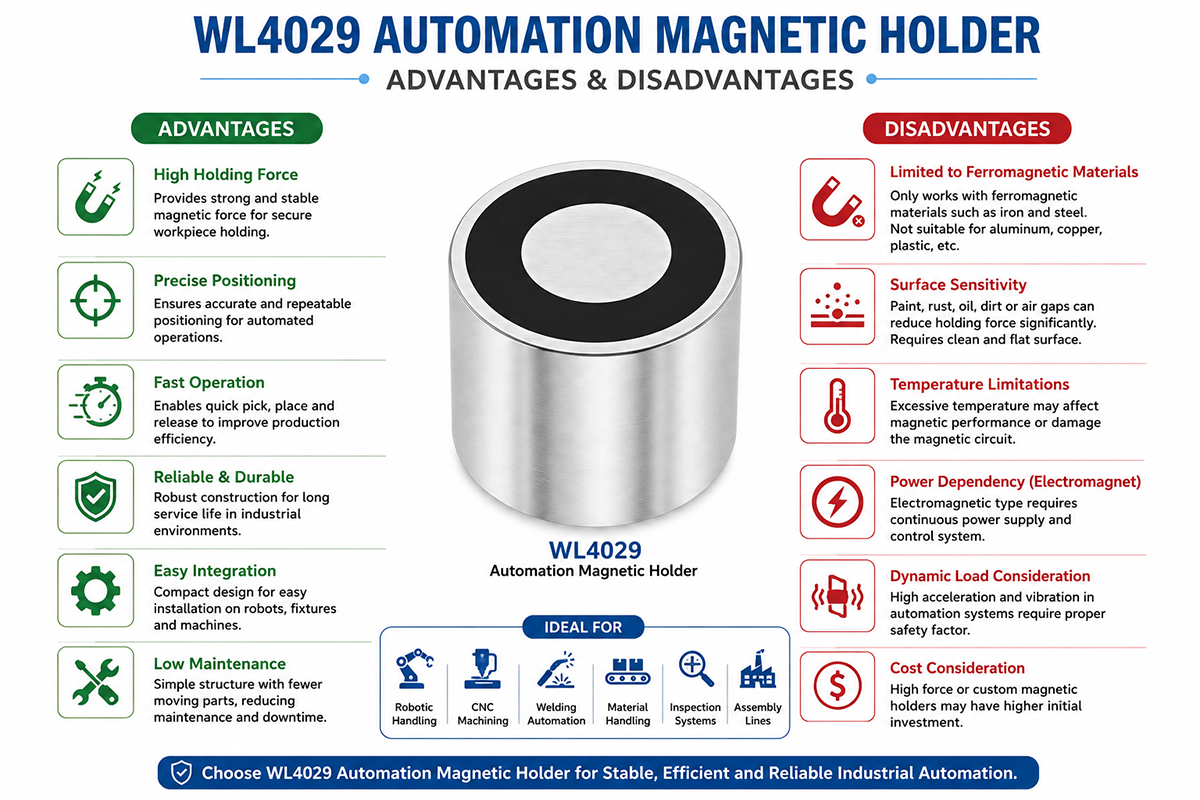
Advantages and Disadvantages of Automation Magnetic Holder

Pros

Quick operation: Magnetic attraction can hold suitable metal parts fast, which is beneficial for repetitive automation cycles.

Lower mechanical complexity: With suitable applications, magnetic holding can reduce the number of mechanical clamps and moving parts.

Easy integration: Magnetic holders are compact and easy to mount to robotic end effectors, fixtures, conveyors, and automated machinery.

Repeatable positioning: Well-designed magnetic circuits provide repeatable workpiece location.

Low maintenance potential: The permanent magnetic systems have fewer electric-powered parts during the holding stage.

Flexible handling: Sometimes one magnetic holder can hold several suitable steel parts with various geometries.

Improved productivity: Fast loading/unloading processes lead to high production efficiency for automation.

Disadvantages

Material limitations: Magnetic holders are suitable for ferromagnetic workpieces and are not appropriate for many nonmagnetic materials.

Surface Sensitivity: Rust, paint, oil, roughness, curvature, and air gaps reduce the holding force.

Temperature limits: Excessive heat degrades magnetic performance or damages electromagnetic parts.

Power dependency: Electromagnetic models require a proper electrical supply and control system.

Dynamic load problems: Safety margins of robotic acceleration and vibrations

Residual magnetism: Some applications may require demagnetization or secondary handling procedures after magnetic holding.

Automation Magnetic Holder Industrial Application Guide

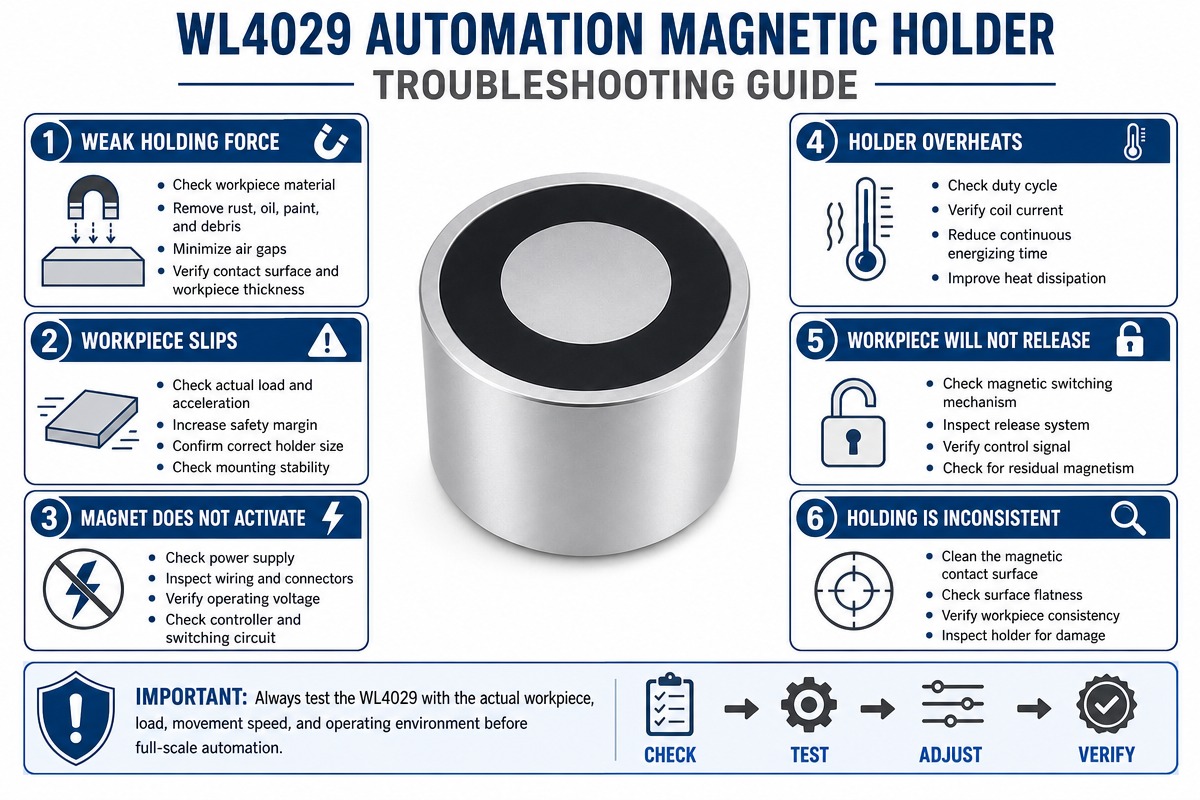
Troubleshooting Automation Magnetic Holder

Problem 1: Not Enough Holding Force

Check the material, thickness, surface condition, and contact area of the workpiece. Remove any excess rust, paint, oil, or debris and any unnecessary air gaps.

Problem 2: Workpiece slips when robot moves.

Check the real dynamic load, not just the static weight. Increase the safety factor. Improve magnetic contact or choose a stronger force holder.

Problem 3: Electromagnet Does Not Work

Check the fuse, switching circuit, controller, wiring, connectors, voltage, and power suPlease ensure thate sure the input voltage is correct.

Problem 4: Holder Gets Too Hot

Inthe casee of electromagnetic models, check the duty cycle, coil current, ambient temperature, and ventilation. Overheating occurs in case the rated duty cycle is exceeded by continuous energizing.

Problem 5: Workpiece does not release.

Check the magnetic switching mechanism, control signal, actuator, and mechanical release elements. Residual magnetism might also require checking.

Problem 6: Inconsistent Holdings

Check the magnetic pole surface for contamination or damage. Ensure uniform thickness and contact conditions of workpieces.

Problem 7: Unanticipated Release

Stop the automation system immediately and check the magnetic circuit, power supply, wiring, mounting, and safety controls. Check the holder’s suitability for the actual application.

Chronic problems may be solved by the test with the real workpiece and operating cycle.

FAQ

1. What is an automation magnetic holder?

An automation magnetic holder is an industrial instrument for holding, positioning or moving ferromagnetic parts during automated processes. Automation magnetic holders are popular in robots, CNC machines, assembly lines, welding equipment and material handling.

2. For what kind of material can the automation magnetic holder be used?

Magnetic holders for automation can be applied mainly to ferromagnetic materials like iron and many kinds of steels. Ordinary magnetic systems cannot reliably hold aluminum, copper, plastic and non-magnetic stainless steel.

3. How powerful should automation magnetic holder be?

Required holding force depends on weight, material and thickness of work-piece, workpiece surface, air gap, robot acceleration, vibrations and mounting position. Don’t forget to have some safety margins.

4. Is it possible to use magnetic holder for automation with robotic hands?

Yes. Robot arms are often equipped with magnetic holders for picking up, moving, placing, loading and unloading of metal parts. Before installation it’s necessary to make sure about mounting dimensions and dynamic holding requirements.

5. What is the difference between permanent and electromagnet holders?

Permanent magnetic holders generate magnetic force without continuous supply of electrical power while electromagnet holders generate magnetic field using electrical power. The latter type is useful for ON/OFF automation control.

6. Is an automated magnetic holder able to work through paint or rust?

Yes. However, paint, rust, dirt, oil, etc. form an air gap that decreases magnetic holding force. Performance is always better when clean and flat contact between workpiece and holder is guaranteed.

7. How do I select the appropriate automation magnetic holder?

Material of work-piece, its size and weight, thickness, surface state, required holding force, robot speed, duty cycle, operating temperature, mounting and control requirements. Specialized equipment can be more appropriate for OEM custom design.

8. What should I do if my magnetic holder doesn't hold anymore?

At first check the workpiece contact surface, air gap, magnet state, power supply, wiring and operating temperature. Also coil and control circuit for electromagnet holders. If problem persists try your holder with actual work-piece and operational conditions.

How to Choose an Automation Magnetic Holder

The choice of the correct automation magnetic holder is done with respect to the workpiece, machine, operating environment, and required magnetic force.

1. Identify the Material of the Workpiece

It is necessary to find out whether the component is ferromagnetic. As a rule, steel and iron are magnetic materials, but aluminum, copper, plastic, and many stainless steels are not.

2. Determine the Required Holding Force

Find out how much load the holder has to sustain during the lifting, acceleration, vibrations, and movement. The static weight of the part is not sufficient. Take into account the safety margin.

3. Surface condition check

Smooth and clean surfaces always provide better magnetic coupling. Any presence of paint, rust, oil, gaps, curvatures, and roughness reduces holding performance.

4. Electromagnetic or Permanent Operation

Use a permanent magnetic holdtor to reduce power consumption. Electromagnetic holders are useful when automatic electrical control of holder engagement and release is desired.

5. Consider the Speed of Automation

Accelerations, decelerations, vibrations, and abrupt direction changes in robots and other automation equipment cause additional stresses on the workpiece. The magnetic holder must ensure that it holds the workpiece throughout the entire process.

6. Verify mounting requirements

Prior to choosing the holder, consider the mounting holes, bolt pattern, dimensions, cable routing, actuator interface, and the available mounting space.

7. Assess Operating Environment

Take into account temperature, dust, moisture, oil, vibrations, welding sparks, and other environmental factors. Choose a construction suitable for the environment.

8. Consider Duty Cycle

For electromagnetic systems, calculate the operating voltage, current, energizing time, release time, and duty cycle to avoid overheating.

9. Safety Requirements Review

Choose the right safety factor and estimate the workpiece holding conditions in the event of power failure, emergency stop, and equipment malfunction.

10. OEM Customization

Automation equipment may require a custom magnetic circuit, mounting structure, dimensions, interface with sensors, or switching mechanism, which will perform better than the standard product.

Magnetic Holder Design Mistakes in Automation: Tips for Avoidance

Holding force is not calculated based only on workpiece weight.

Robotic movement causes accelerations and vibrations; don’t forget about them.

Not all stainless steel grades are supermagnetic.

Air gaps should be minimized between the magnetic pole and the workpiece.

Imagine paint, rust, oil, scale, and surface roughness.

Don’t save on the installation space using a small magnet.

Provide a safety factor for dynamic applications.

Check the heating of the electromagnetic coil when continuously working.

Check whether the power supply corresponds to the holder’s voltage.

Design proper mounting hardware and load paths.

Think of the emergency stop and power failure situations.

Don’t use the magnetic system under high temperatures if it is not designed for it.

Test the holder with the real production workpiece.

Check the holding performance under actual acceleration and vibration.

Think of sensors when automated workpiece holding confirmation is required.

Leave enough room for the robot to move and release the workpiece.

Protect cables and connectors from the industrial damage.

Make sure the magnetic holder won’t interfere with any nearby sensors or electronic devices.

Test the prototype prior to mass production.

Define mechanical, electrical, and performance specifications for OEM projects prior to design.

Get A Free Quote Now

Contact Form

Related Products

Related News

Scroll to Top

Get A Free Quote Now !

Contact Form
If you have any questions, please do not hesitate to contact us.
Weilong Solenoid Company Culture
