

Chapter 1: Introduction
The flat spiral coil is one of the most useful electromagnetic elements of today’s electronics. The tendency towards the reduction of size, weight, and efficiency of the majority of products in the various industries drives companies to replace cylindrical inductors with compact planar coils.
The flat spiral coil is used today in wireless chargers, RFID technology, induction heaters, medical equipment, sensors, automotive electronics, and industrial automation. Thanks to its compact construction, high-frequency characteristics, and PCB-friendly design, the flat spiral coil is considered to be a perfect solution for modern electronic products.
If you are an amateur in electronics or a professional engineer, product designer, or purchasing manager, knowing the principle of operation of the flat spiral coil may be really useful when choosing the proper element for your application.
Here is an all-inclusive guide to the flat spiral coil from the very basic aspects till the manufacturing process, materials, pros, cons, common mistakes, and FAQ.
Chapter 2: What is a Flat Spiral Coil
A flat spiral coil is an electromagnetic planar coil where the conductor is wound spirally on the flat surface. The conductor may be
Copper wire.
Copper sheet.
PC board (PCB) traces.
Conductors of Flexible PCBs.
Litz wire of high frequency.
Instead of the stacking of windings in a vertical manner (as it is usually in cylindrical inductors), the flat spiral coil spreads the windings in a horizontal way.
The distinctive geometrical feature of the flat spiral coil provides the following advantages:
Compact and ultra-low profile.
Easy PCB integration.
Reduced parasitic capacitance.
Improved performance at high frequencies.
Excellent heat dissipation.
Even distribution of the magnetic field.
Reduced electromagnetic interference (EMI).
These advantages allow considering the flat spiral coils as an optimal solution for wireless charging and other applications.
Chapter 3: Working Principle of a Flat Spiral Coil
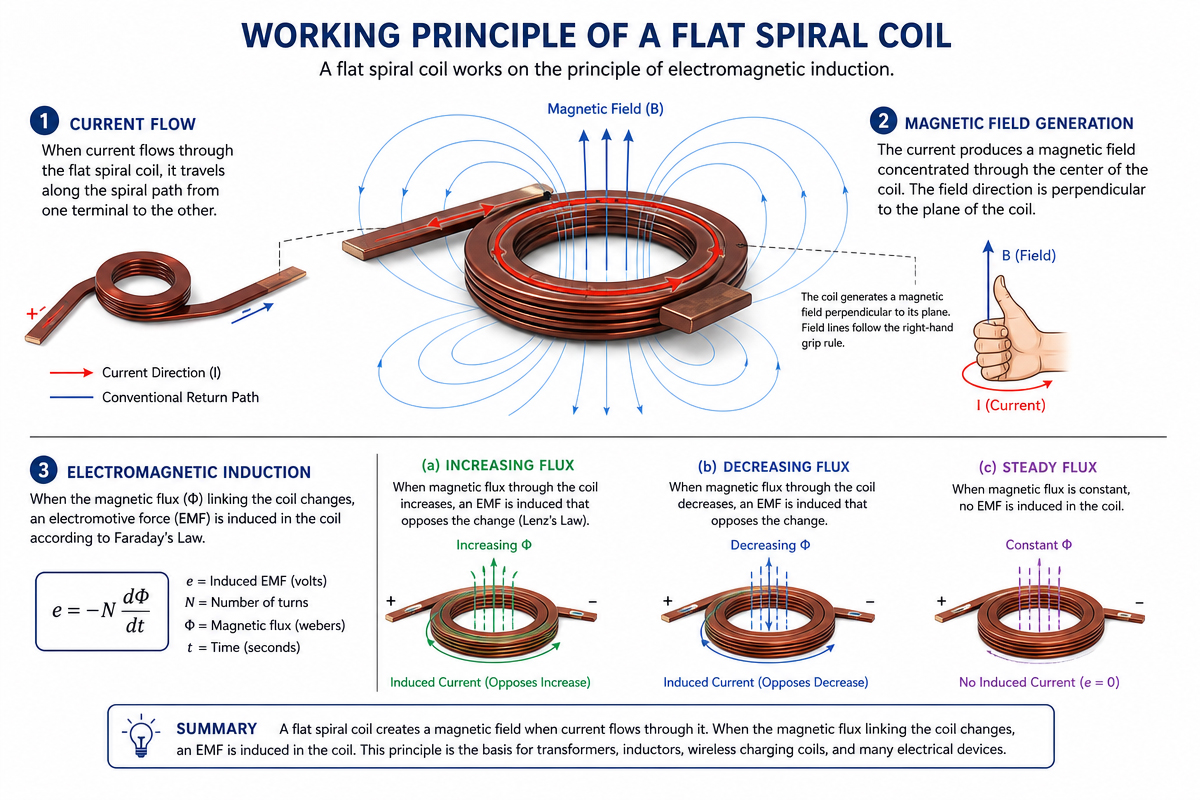
3.1 The principle of operation is based on the laws of Faraday and Ampere.
The coil is a spiral conductor where the electric current flows and generates the magnetic field perpendicularly to the plane of the coil.
The magnitude of the magnetic field depends on the following parameters:
# of Turns.
Inner diameter.
Outside diameter.
Track Width.
Trace Separation.
Now.
Frequency of operation.
The energy is stored in the magnetic field surrounding the coil.
In close proximity, the coils transfer energy through the magnetic flux in the form of mutual inductance, wirelessly.
3.2 This principle works in the following applications:
Charging wirelessly.
RFID Scanners.
Communication NFC.
Inductive sensors.
Resonant power transfer.
The inductance of the coil increases due to the following parameters:
The number of rounds.
Large diameters.
Higher magnetic permeability.
The reduction of inter-turn spacing.
But the increase of these parameters leads to an increase of resistance and parasitic capacitance. This should be optimized carefully.
Chapter 4: Various Types of Flat Spiral Coils
Various applications require various coil designs.
4.1 PCB Flat Spiral Coil.
This is the most common design.
Features:
Economical design.
Manufacturing with high uniformity.
Easy PCB integration.
Suitable for consumer electronics.
Applications: •
Wireless Charging, NFC, RFID, and IoT Devices.
4.2 Copper Wire Flat Spiral Coil
It consists of insulated copper wire, wound either by hand or by machine.
Pros:
High current capacity.
Customization flexibility.
Better range of inductance.
Uses:
Medical equipment.
Industrial equipment.
Custom sensors.
4.3 Copper Foil Spiral Coil
It consists of flat copper strips.
Benefits:
Low AC resistance.
Good heat dissipation.
High efficiency.
Uses:
High-power induction heating.
Wireless charging.
Power systems in the industry.
4.4 Flexible PCB for Spiral Coil
It is fabricated on flexible substrates.
Benefits:
Flexible.
Lightweight, low profile.
Uses:
Wearable electronics.
Medical instruments.
Bendable sensors.
4.5 Flat Spiral Litz Wire Coil
It uses many strands of insulation wire, woven together.
Pros:
Reduced skin effect.
Lowered AC resistance.
Higher efficiency.
Uses:
High-frequency power transfer, EV charging, and resonant converters.
Chapter 5: Choosing the right Materials for Flat Spiral Coil Making
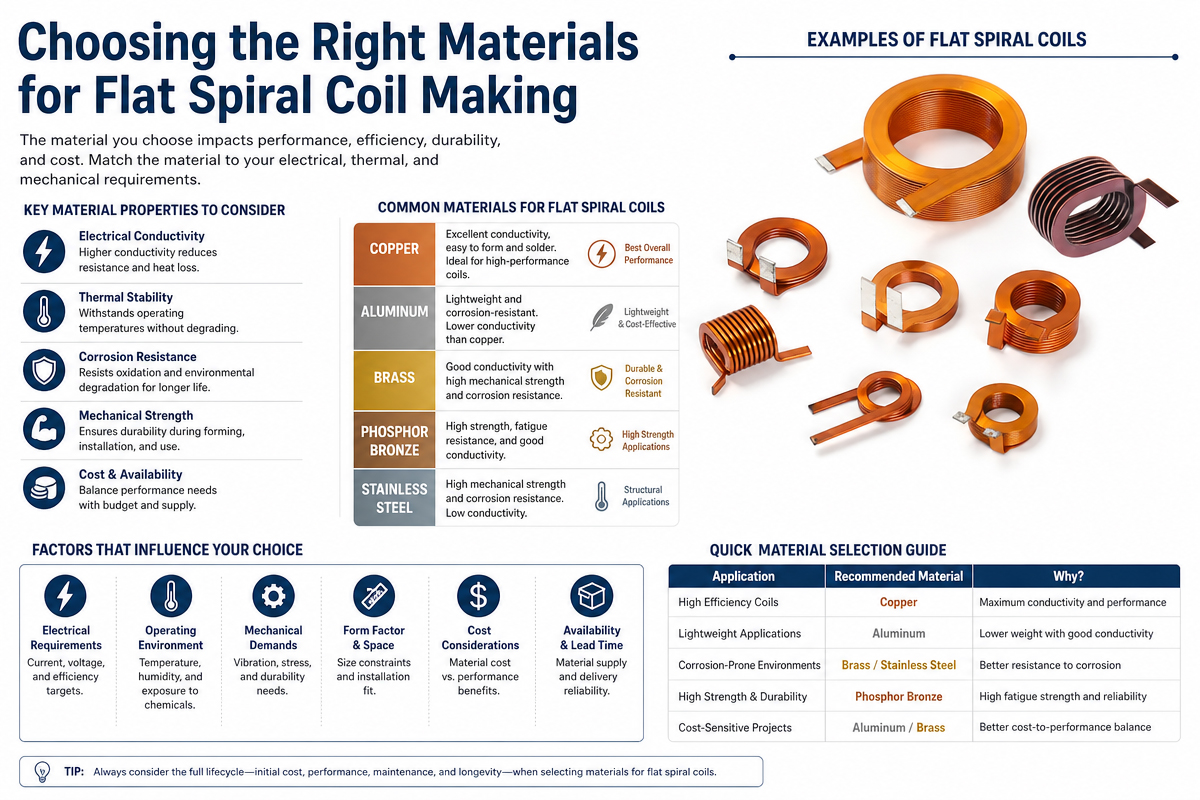
The choice of material has a big impact on the performance.
Copper
Standard for the industry.
Benefits:
High conductivity.
Inexpensive.
Simple processing.
Consistent performance.
Copper Foil
Ideal for high current applications.
Advantages:
Lowered resistance.
Improved cooling.
Uniform distribution of current.
Litz Wire
For high-frequency operation
Advantages:
Reduction of skin effect.
Higher efficiency.
Reduced power loss.
Ferrite plate
It is normally placed below the coil.
Advantages:
Magnetic flux focus.
Improved efficiency.
Reduced EMI.
FR4
Standard PCB material.
Advantages:
Economical.
Easy to manufacture.
Good mechanical properties.
Polyimide (PI)
It is used for flexible coils.
Advantages:
Flexibility, temperature resistance.
Lightweight.
Chapter 6: Application of Flat Spiral Coils
6.1 Wireless Charging
Probably the most famous use.
It is used in the
Smartphones
Smart watch.
Earbuds
Tablet
6.2 Electric Cars
Wireless charging systems using flat spiral coils.
Advantages include:
Higher efficiency.
Improved alignment.
Compact installation.
6.3 Radio Frequency Identification Systems
It is used on:
Access Control
Asset Monitoring
Inventory Control
6.4 Communication via NFC
It allows wireless interaction of the devices.
Famous examples of use:
Mobile Payment
Smart card.
eTickets
6.5 Medical Devices
The applications are:
Implantable devices
Test tools.
Surgical instruments
6.6 Inductive Sensors
The applications are:
Metal Detectors.
Position Detection.
Distance Measurement.
6.7 Industrial Automation
Flat spiral coils are used in:
Robots and Robotic Equipment.
Industrial Equipment.
Quality Inspection Systems
6.8 Induction Heating
Used for:
Metal working
Cooking Utensils.
Brazing and surface hardening.
Chapter 7: Design Tips for High-Frequency Flat Spiral Coils
The high-frequency design of the flat spiral coil is a trade-off between electrical, thermal, and mechanical parameters.
Optimize the number of turns
Too few turns lead to low inductance.
Too many turns increase resistance and parasitic capacitance.
Select the Right Track Width
The wider tracks have lower resistance.
The narrow tracks increase compactness.
Control Trace Separation
Smaller separation increases the inductance but also increases the parasitic capacitance.
Use Litz wire.
The skin effect becomes noticeable above about 100 kHz.
Litz wire makes a significant contribution to the efficiency.
Add ferrite shields.
Ferrite sheets:
Increase magnetic coupling.
Reduce EMI.
Increase charging efficiency.
Keep Coils in Alignment
The misalignment reduces the efficiency of wireless power transfer dramatically.
Thermal Management Consideration:
Copper Thickness.
Ventilation.
Heat sinks.
PCB Thermal Vias.
Chapter 8: Flat Spiral Coil Advantages and Disadvantages
8.1 Advantage
There are a lot of advantages of the flat spiral coils, which engineers appreciate.
Compact design
Suitable for thin electronic products.
Great high-frequency performance
Reduced parasitic capacitance leads to efficiency.
Easy PCB integration
Reduces the assembly cost.
Improved heat dissipation
The increased surface improves the cooling.
Magnetic field uniformity
Increases the coupling efficiency.
Highly accurate manufacturing
PCB manufacturing guarantees repeatable results.
Light Weight
Good for portable electronics.
Geometry Flexibility
Can be tuned to various frequencies.
8.2. Disadvantages of Flat Spiral Coil
While having a lot of advantages, the flat spiral coils still have some drawbacks.
Limited inductance
Not so good for the applications requiring high inductance.
Sensitive to Alignment
The misalignment of the coils leads to a decrease in the efficiency of wireless power transfer.
Increased complexity of Design
It requires the electromagnetic simulation.
Limitations of PCB manufacturing
The performance is limited by the minimum spacing and trace width.
The additional cost of materials
Ferrite sheets and litz wire add to the cost.
Chapter 9: Tips to avoid Common Mistakes When Selecting a Flat Spiral Coil
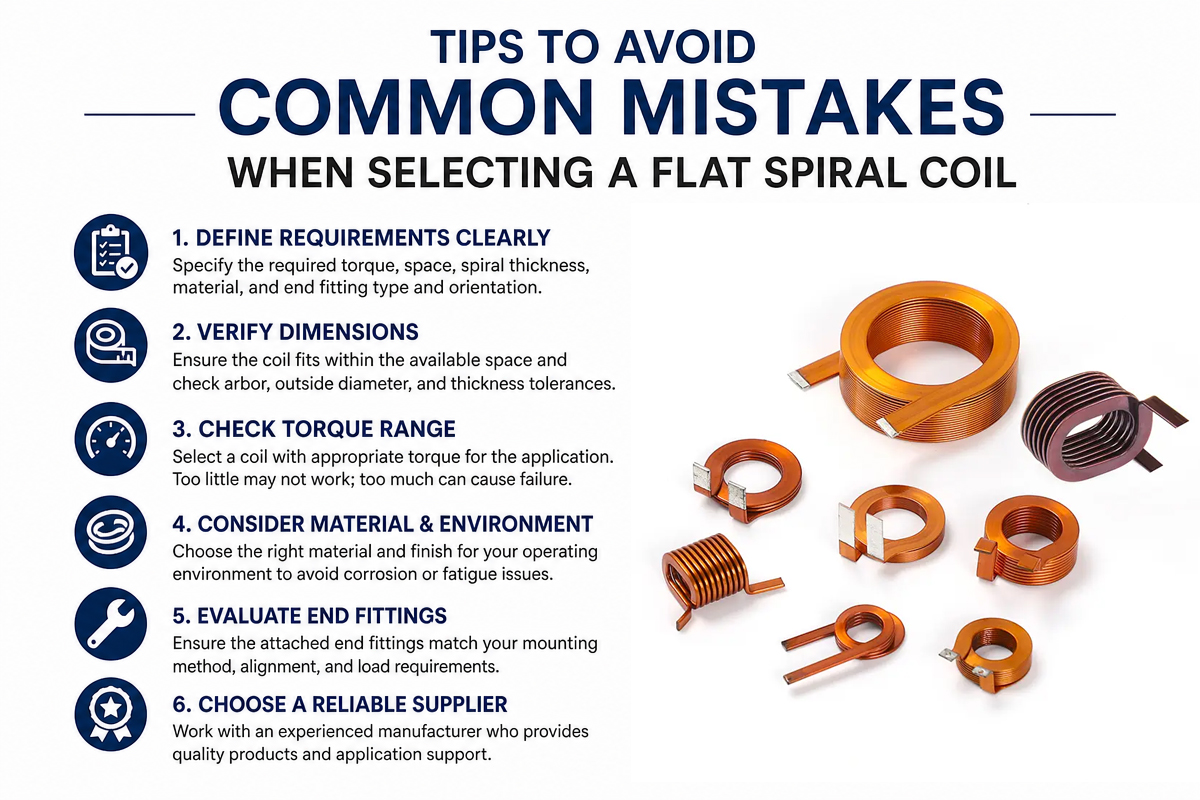
Many engineers make mistakes when selecting the coil.
Ignoring operating frequency
The coil optimized for 100 kHz doesn’t fit for 13.56 MHz.
9.1 Choosing wrong material
Sometimes the copper wire is simply not enough.
Litz wire is needed in the high-frequency system.
9.2 Ignoring thermal design
Cooling is required in the case of high-current coils.
9.3 Ignoring the EMI
The presence of metallic objects can degrade the performance dramatically.
Not satisfying inductance requirements
The following should always be checked:
Required inductivity.
“Q factor.”
Now rating.
Resistance level.
Resonant frequency.
9.4 Ignoring the mechanical tolerance
The performance varies considerably in case of small changes in dimensions.
Ignoring manufacturing quality
The poor winding accuracy reduces the consistency.
Always use the experienced manufacturer.
Chapter 10: Why Is the Flat Spiral Coil So Popular?
Several technological trends are contributing to the growing popularity of flat spiral coils.
10.1 Downsizing
Modern electronics require thin elements.
10.2 Growth of wireless charging
Wireless charging is becoming a standard in consumer products.
10.3 Electric cars
Wireless charging for EVs is gaining popularity.
10.4 Industry
Compact sensors for automation systems.
10.5 IoT growth
Inductive components are required for billions of devices.
10.6 Creative medicine
Implantable electronics are becoming smaller and smaller.
10.7 Better manufacturing technology
Modern PCB manufacturing allows producing very precise planar coils with competitive pricing.
Chapter 11 : Why Weilong Technology’s Flat Spiral Coils Are So Popular Among Many USA and European Customers
Selecting the right manufacturing partner is no less important than selecting the right coil design. For many years Weilong Technology has earned the confidence of customers from the USA and Europe, supplying them with the high-performance flat spiral coils for demanding industrial applications.
11.1 Extensive experience in manufacturing
Weilong Technology has many years of experience in the manufacturing of electromagnetic components and knows the problems of design and manufacture of precise flat spiral coils in various industries.
11.2 Custom Design Assistance
Instead of providing the regular products, the engineering team develops custom solutions for the customer from the following:
Inductance requirements.
Frequency of operation.
Coil size.
Existing capacities.
Increased demands.
Environmental conditions.
Modern manufacturing machinery
Modern automated production lines provide the following:
Consistency of winding accuracy.
Precision in dimensions.
Consistency of electrical performance.
High yield.
11.3 Rigorous Quality Control
All coils are tested for the following:
Inductance test.
Measurement of Resistance.
Hi-pot testing (if required).
Appearance Check.
11.4 Functional verification.
This quality-first approach helps to minimize the failures in the field and improve product performance.
11.5 Rapid Prototyping
Weilong Technology provides rapid prototyping services for new product development and helps customers to verify their designs and bring them to market faster.
11.6 International experience in export
We have a lot of experience dealing with customers from North America and Europe and know very well the requirements to quality, documentation, and logistics in these regions, which will help to facilitate global cooperation.
11.7 Responsive Technical Support
The engineering team provides technical support throughout the entire cycle of development and mass production, helping to optimize performance and solve application issues efficiently.
Chapter 12: Troubleshooting Guide of Flat Spiral Coils: Common Problems, Causes, and Solutions
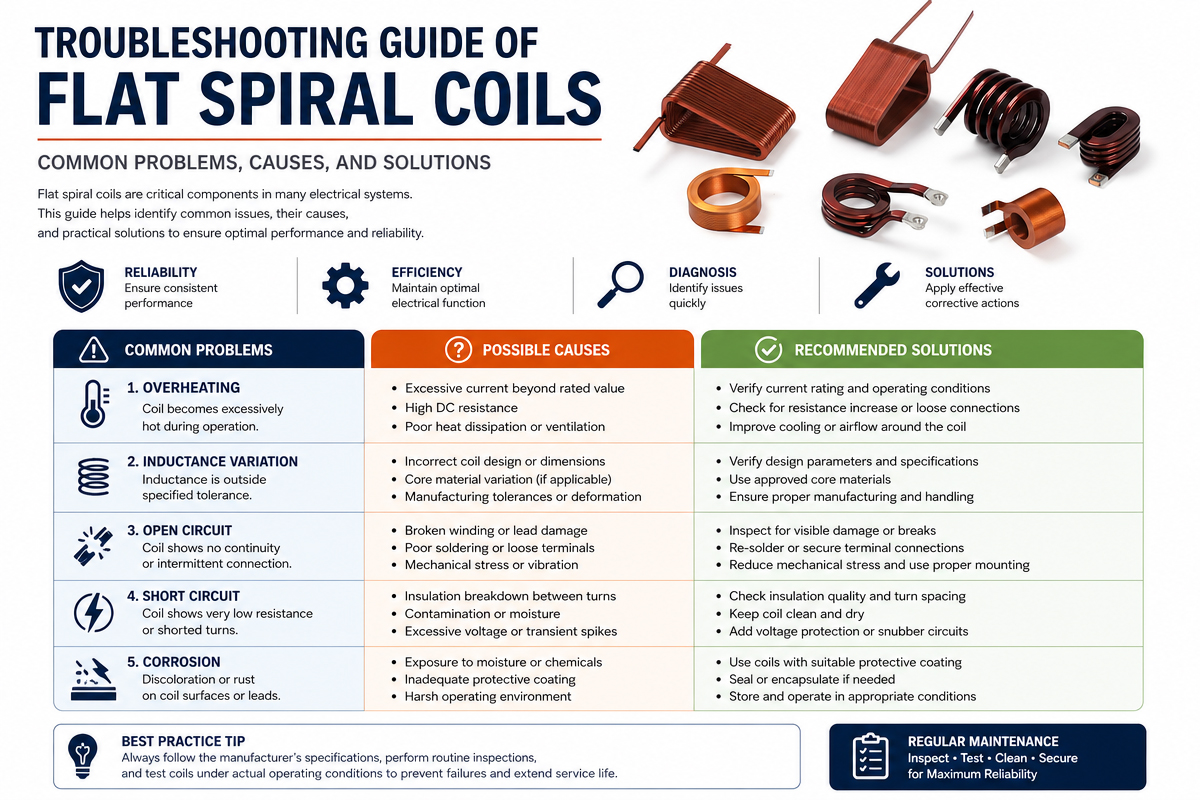
Flat spiral coils are commonly used in applications such as wireless charging, RFID, NFC, induction heating, medical devices, and industrial electronics. Despite their reliability, certain design flaws, installation issues, or unfavorable operation conditions may cause malfunctions in them. The following troubleshooting guide helps to quickly identify common problems, find out their causes, and fix them. 1. Flat Spiral Coil Has Too Low Inductance
Symptoms
12.1 Flat Spiral Coil Troubleshooting Chart
| Problem | Possible Causes | Recommended Solution |
| Low Inductance | Too few turns, incorrect dimensions, damaged winding | Verify coil specifications, increase turns, inspect for physical damage |
| Coil Overheating | Excessive current, poor ventilation, high resistance | Reduce operating current, improve cooling, use thicker conductor or Litz wire |
| Weak Magnetic Field | Low input current, incorrect coil spacing, ferrite missing | Increase current (within rating), optimize spacing, install ferrite backing |
| High AC Resistance | Skin effect, unsuitable conductor material | Replace with Litz wire or wider copper conductor |
| Low Wireless Charging Efficiency | Coil misalignment, improper resonance, metal interference | Improve alignment, tune resonance circuit, remove nearby metal objects |
| High EMI (Electromagnetic Interference) | Poor shielding, improper PCB layout | Add ferrite shield and optimize grounding and trace routing |
| Coil Vibration or Noise | Loose winding, mechanical resonance | Secure coil with adhesive or encapsulation |
| Open Circuit | Broken conductor, damaged solder joints | Measure continuity and repair or replace the coil |
| Short Circuit Between Turns | Insulation failure, manufacturing defect | Replace the damaged coil and improve insulation quality |
| Unstable Inductance | Temperature changes, mechanical deformation | Use high-quality materials and maintain stable operating conditions |
12.2 Inductance is not in accordance with the specification.
Decrease in wireless charging range.
Decreased sensitivity of sensors.
Causes
Not enough turns in windings
Wrong dimensions of the inner or outer diameters
The spacing between windings is too big
Damage to the conductors
Wrong dimensions of PCB traces
Fixes
Check the design calculation.
Add more turns.
Reduce spacing if possible.
Replace the damaged coil.
Check the manufacturing precision of the PCB.
12.3 Coil Heating Problem
Symptoms
Rapid rise in the temperature of the coil surface.
Appearance of burn marks on PCB.
Reduced efficiency.
Causes
Operating current is too high
High value of DC resistance
Insufficient cooling
Losses at high frequencies
Bad solder joints
Fixes
Operate within the rated current.
Increase the width of the conductors.
Use thicker copper foil.
Use Litz wire in case of high-frequency applications.
Cooling improvements or adding heat sinks.
12.4 Weak Magnetic Field
Symptoms
Decreased efficiency of wireless power transfer.
Reduction in the distance of sensor detection.
Weak inductive coupling.
Causes
Low supply current
No ferrite shield
Large air gap between coils
Damages to the coil
Wrong resonant frequency
Fixes
Make sure that the supply voltage is right.
Install the ferrite shield.
Reduce the air gap.
Check the continuity of the windings.
Tune the resonant circuit.
12.5 Low Wireless Charging Efficiency
Symptoms
Low charging speed
Power losses
Increased temperature of the receiver
Causes
Misalignment of the coil
Frequency mismatch
Metallic objects near the coil
Poor Q factor
Wrong resonant capacitor
Fixes
Align the transmitting and receiving coils.
Match the resonant frequency exactly.
Remove metallic objects around the coil.
Optimize the capacitance values.
Improve the Q of the coil.
12.6 High AC Resistance
Symptoms
Unusual power losses
High temperature
Reduced system efficiency
Causes
Skin effect
Proximity effect
Thinness of the conductor
Poor quality of the conductor
Fixes
Replace solid wire with Litz wire.
Increase the width of the conductors.
Try to operate on a lower frequency if possible.
Improve the winding layout.
12.7 Electromagnetic Interference (EMI)
Symptoms
Errors in communication
Unreliable operation of sensors
Interference with radio
Causes
Bad grounding
No ferrite shield
Bad layout of the PCB
High switching noise
Fixes
Add ferrite backing.
Improvement of PCB grounding.
Reduction of length of high current traces.
Increase the spacing between sensitive parts of circuits.
Using EMI filter.
12.8 Coil Humming or Vibration Noise
Symptoms
Humming sound
Vibration
Causes
Loose windings
Magnetic resonance
Bad installation
Fixes
Glue the coil.
Install it tightly.
Reduce vibrations using additional mechanical support.
12.9 Open Circuit
Symptoms
Infinite resistance
No magnetic field
Complete failure of the device
Causes
Breaks in the conductor
Damaged PCB trace
Bad solder joints
Fixes
Measure the resistance with a multimeter.
Repair the solder joints.
Replace the damaged coil.
12.10 Short Circuit between Windings
Symptoms
Extremely low resistance
Overheating
Burned parts
Causes
Damaged insulation
Bad manufacturing process
Mechanical compression
Fixes
Replace the coil.
Increase the quality of the insulation.
Avoid excessive mechanical strain during installation.
12.11 Unstable Inductance
Symptoms
Irregular measurements
Changing performance in charging
Sensor drift
Causes
Temperature changes
Deformation
Nearby metallic object movement
Bad manufacturing consistency
Fixes
Use temperature-stable materials.
Provide mechanical support.
Keep away from the metallic objects.
Choose an experienced manufacturer of the coil.
12.12 Tips on Preventive Maintenance
For maximum life and performance of your flat spiral coil:
Regularly check the coil for any damage or discoloration.
Keep the coil clean from dust, moisture, and corrosive substances.
Keep the operating current and voltage within the design limits.
Make sure that the coils are properly aligned in wireless charging systems.
Verify solder joints during preventive maintenance.
Avoid excessive mechanical strain to the flexible coils.
12.13 Recommended Test Equipment
Use the following instruments to diagnose flat spiral coil issues:
| Test Equipment | Purpose |
| LCR Meter | Measure inductance, capacitance, and resistance |
| Digital Multimeter | Check continuity and DC resistance |
| Oscilloscope | Analyze resonant waveforms and signal quality |
| Network Analyzer | Measure Q factor and resonant frequency |
| Thermal Camera | Detect overheating and hot spots |
| Gauss Meter | Measure magnetic field strength |
| Impedance Analyzer | Evaluate AC characteristics over frequency |
| Infrared Thermometer | Monitor operating temperature |
12.14 Control the operating temperature to prevent overheating.
Regularly measure inductance and resistance to detect failures early. Best Practices for Flat Spiral Coil Reliability
Correct selection of the conductor material (copper, copper foil, or Litz wire depending on the operating frequency).
Optimization of the number of windings, trace width, and spacing considering the required inductance.
Ferrite backing for improved magnetic coupling and less EMI.
Proper alignment of the coils in wireless charging systems.
Design with effective thermal management for avoiding overheating.
Selecting coils from an experienced manufacturer ensures good electrical performance and a long lifetime.
Following these troubleshooting tips and preventive measures, one will be able to easily solve the majority of problems with flat spiral coils.
Chapter 12: Commonly Asked Questions (FAQ)
12.1 Where are the flat spiral coils used for?
The flat spiral coils are used in wireless charging, RFID systems, NFC communication, inductive sensors, induction heating, medical devices, and industrial automation.
12.2 What is the best material for the flat spiral coil?
The most commonly used material is copper, which is a good conductor of electricity. In the high-frequency systems, Litz wire is often used, as it reduces the skin effect and AC losses.
12.3 What measures the inductance?
The inductance is determined by the number of turns, inner and outer diameters, conductor width, spacing, and magnetic properties of the surrounding materials.
12.4 What are the benefits of the flat spiral coils in wireless charging?
They are planar and allow for good magnetic coupling; they are compact and easy to integrate in electronic devices, which makes them perfect for wireless power transfer.
12.5 Can flat spiral coils work at high frequencies?
Yes. With the proper design (conductor dimensions, spacing, and material such as Litz wire), the flat spiral coil can operate well at high frequencies.
12.6 What is the major disadvantage of the flat spiral coil?
The flat spiral coils usually have lower inductance for the same footprint than the traditional cylindrical inductors and require precise alignment in wireless power applications.
12.7 How to Increase the Efficiency of the Flat Spiral Coil?
To increase the efficiency of the flat spiral coil, use good quality copper or Litz wire, optimize the number of turns and spacing, add ferrite shielding, and take care of the heat management and precise alignment of coupled systems.
12.8 Can the flat spiral coil be customized?
Of course. The dimensions, conductor type, inductance, frequency of operation, and mounting style can be selected by the manufacturer according to application requirements.
Chapter 13: Conclusion
The flat spiral coil has been the basic element in modern electromagnetic design for some time and provides a compact, efficient, and very versatile solution for today’s electronic systems. Thanks to the compact structure, high-frequency characteristics, and PCB compatibility, the flat spiral coil is irreplaceable in the applications from wireless charging, RFID, and medical devices to electric vehicles and industrial automation.
However, in order to have high efficiency, careful consideration should be given to the conductor material, number of turns, trace geometry, operating frequency, heat management, and electromagnetic compatibility. Knowing these design principles and avoiding common mistakes of selection can help to achieve maximum efficiency, reliability, and long product life.
The demand for smaller, smarter, and more energy-efficient electronics is continuously increasing, and the flat spiral coils will gain importance in the future of wireless power transfer, sensing technologies, and advanced industrial systems. Even working with an experienced manufacturer like Weilong Technology can guarantee the customized design and consistent quality of flat spiral coils.


