SMT Air Core Coil for High Frequency Devices
Precision SMT Air Core Coil Manufacturer
Advanced SMT Air Core Coil for Circuits
Custom SMT Air Core Coil for RF Circuits
Durable SMT Air Core Coil Manufacturer
Efficient SMT Air Core Coil for RF Boards
High Frequency SMT Air Core Coil OEM
High Q SMT Air Core Coil for Electronics
Industrial SMT Air Core Coil Solutions
OEM SMT Air Core Coil Manufacturing Service
Professional SMT Air Core Coil Factory
SMT Air Core Coil for Smart Electronics
SMT Air Core Coil for High Frequency Devices
Precision SMT Air Core Coil Manufacturer
Advanced SMT Air Core Coil for Circuits
Custom SMT Air Core Coil for RF Circuits
Durable SMT Air Core Coil Manufacturer
Efficient SMT Air Core Coil for RF Boards
High Frequency SMT Air Core Coil OEM
High Q SMT Air Core Coil for Electronics
Industrial SMT Air Core Coil Solutions
OEM SMT Air Core Coil Manufacturing Service
Professional SMT Air Core Coil Factory
SMT Air Core Coil for Smart Electronics

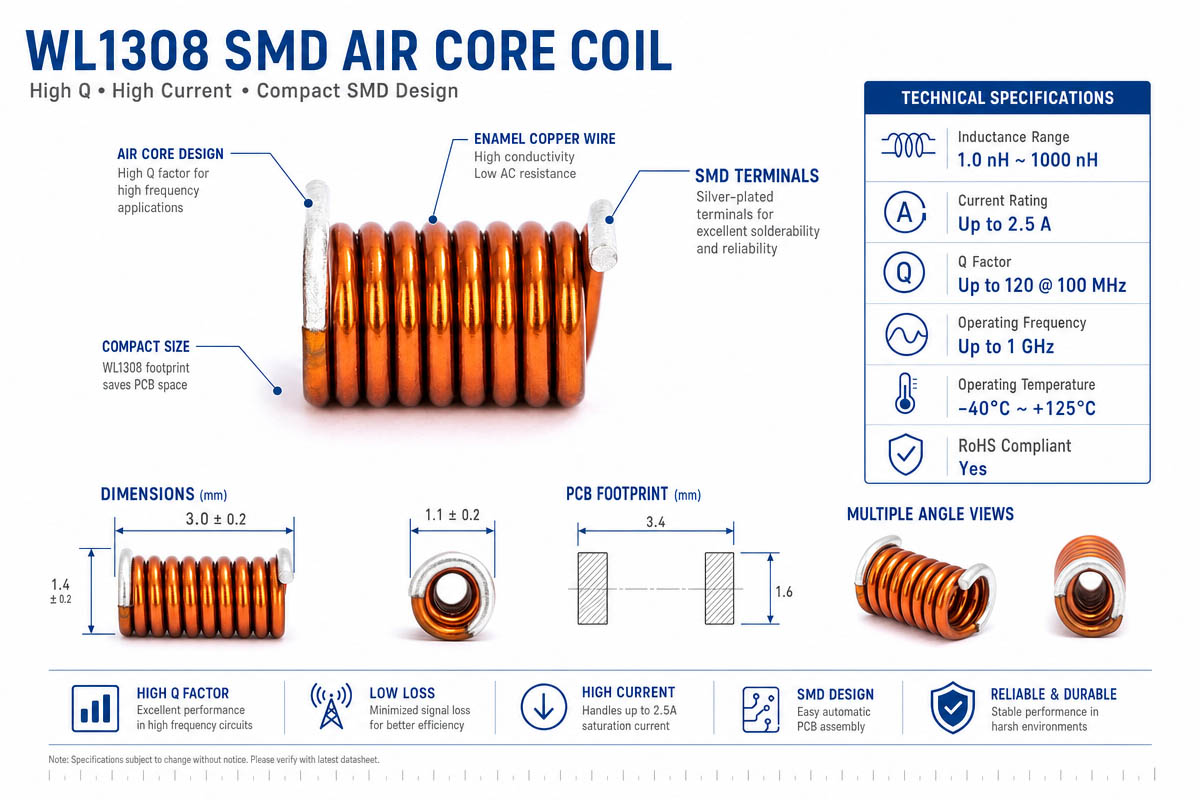
WL 1308 SMD Air Core Coil for Industrial Using Guide

SMD air core coil is a surface mount electronic component without a magnetic core. It consists of copper wire windings and mounted on the surface of the PCB with the help of SMD technology. Unlike ferrite-core coils with the air magnetic path, The SMD air core coil has improved performance, higher frequency response, and stable inductance value. These components are used in various RF circuits, wireless communication devices, medical electronics, antennas, and IoT applications. The SMD Air core Coil is small, lightweight and provide precise performance, making them the best solution for miniaturized electronics.

SMD Air Core Coil Main Features

SMD Air Coils have good high frequency performance without any magnetic core loss and stable inductance. There are no ferrite cores in such coils, and there will be no magnetic saturation. The structure of the device allows you to achieve high signal linearity. You can find many inductance values in such coils with various sizes and wires, which can be used for your custom SMT project. SMT air core coils are characterized with high Q-factor, low resistance, fast signal response and thermal stability. Due to their compact lightweight and fine winding technology, they are the best components for RF communication systems, wireless energy transfers and IoT devices.

Compact SMD Air Core Coil Product Overview

SMD Air Core Coil – Small Surface Mount Inductors for High Frequency Circuits

A SMD Air Core Coil is made using the fine copper winding technology, ensuring stable inductance, high Q factor and low energy loss. As a result of this, the air core magnetic structure does not create any magnetic saturation and improves the performance of the RF signal. SMD Air Coils are widely used in wireless communication devices, IoT electronics, antennas, wireless charging pads and industrial electronics. We have various options for inductance values, wire diameters and custom dimensions and provide possibility for automated surface mount assembly and PCB manufacturing processes.

Compact SMD Air Core Coil Video

Company SMD Air Core Coil Product Details Display

Compact SMD Air Core Coil Datasheet

Item Description
SMD Air Core Coil Enameled copper wire
Wire Diameter 0.1 (AWG options available)
Winding Type Single-layer round or sectional  winding
Core Material Air (non-magnetic) Copper wire
Footprint length 10-15 mm
Encapsulation Optional varnish, epoxy, or coating
Mounting Through-hole / Custom

Electrical Specifications (Typical)

Parameter Description
Inductance Range 0.1 µH – 100 µH (customizable)
Inductance Tolerance ±2%, ±5%, ±10%
DC Resistance (DCR) Custom
Q Factor High Q, optimized for frequency range
Self-Resonant Frequency High, application-dependent


Operating Frequency kHz to MHz range
Rated Current Custom per design
Insulation Resistance ≥100 MΩ

How Does SMD Air Core Coil Work?

As you already know, SMT Air Coil operates based on the principle of electromagnetic induction. The electric current causes formation of magnetic field around the copper wire windings. This coil has no ferrite or iron cores, but only the air as a magnetic medium. In this way, the coil operates effectively at high frequency.

In an electronic circuit, when current changes its magnitude, magnetic flux changes as well causing inductance and managing the current flow, filtering of the signal, energy storage, etc. Such coils are very effective in RF circuits due to their high-frequency stability and lack of any saturation.

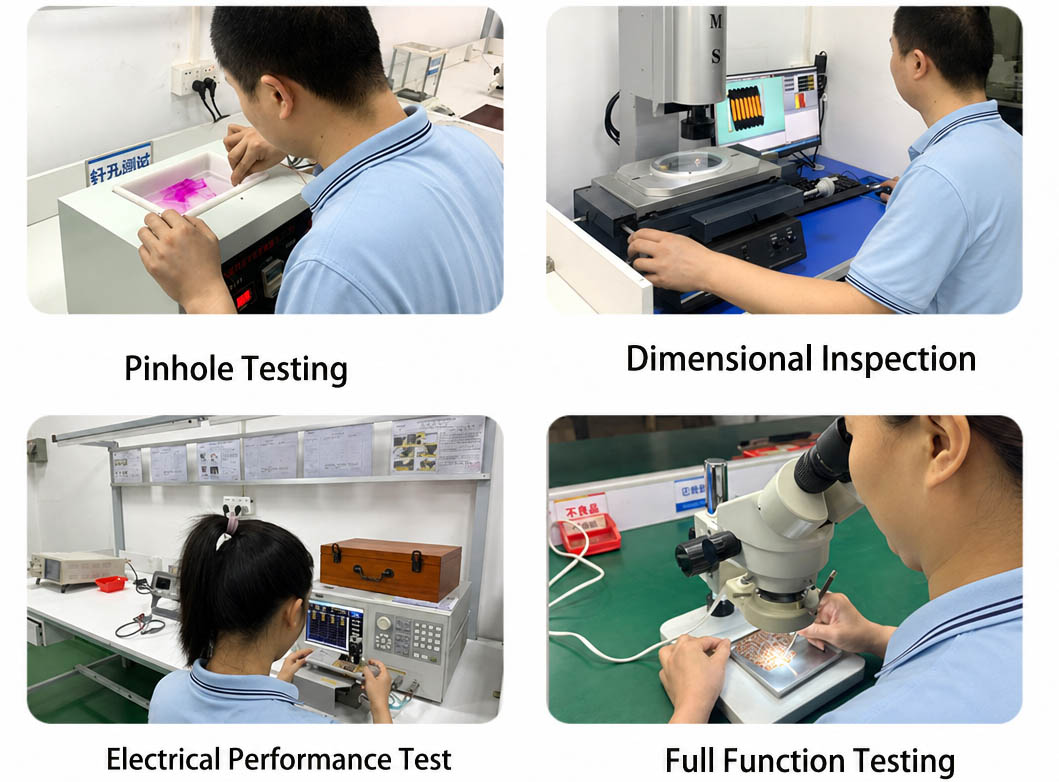
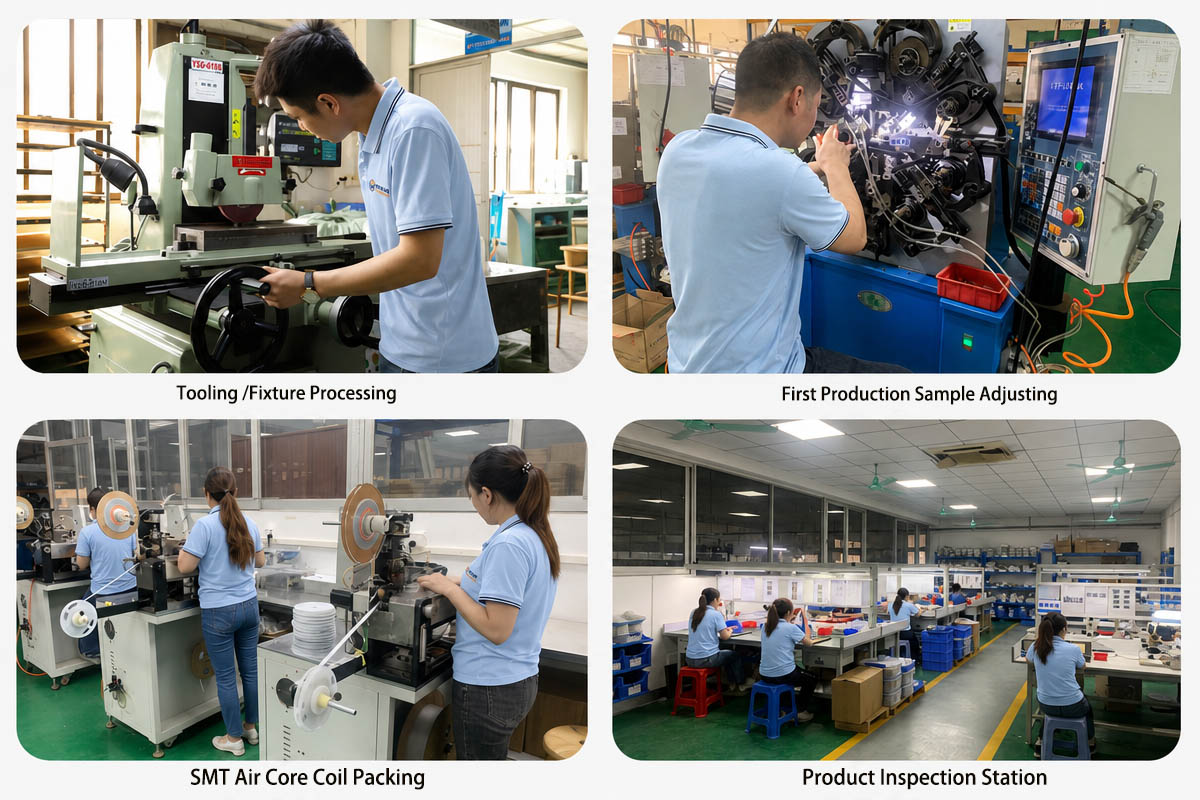
SMT Air Core coil full product Inspection SMT Air Core Core Production Processing

Compact SMD Air Core Coil Industrial Application

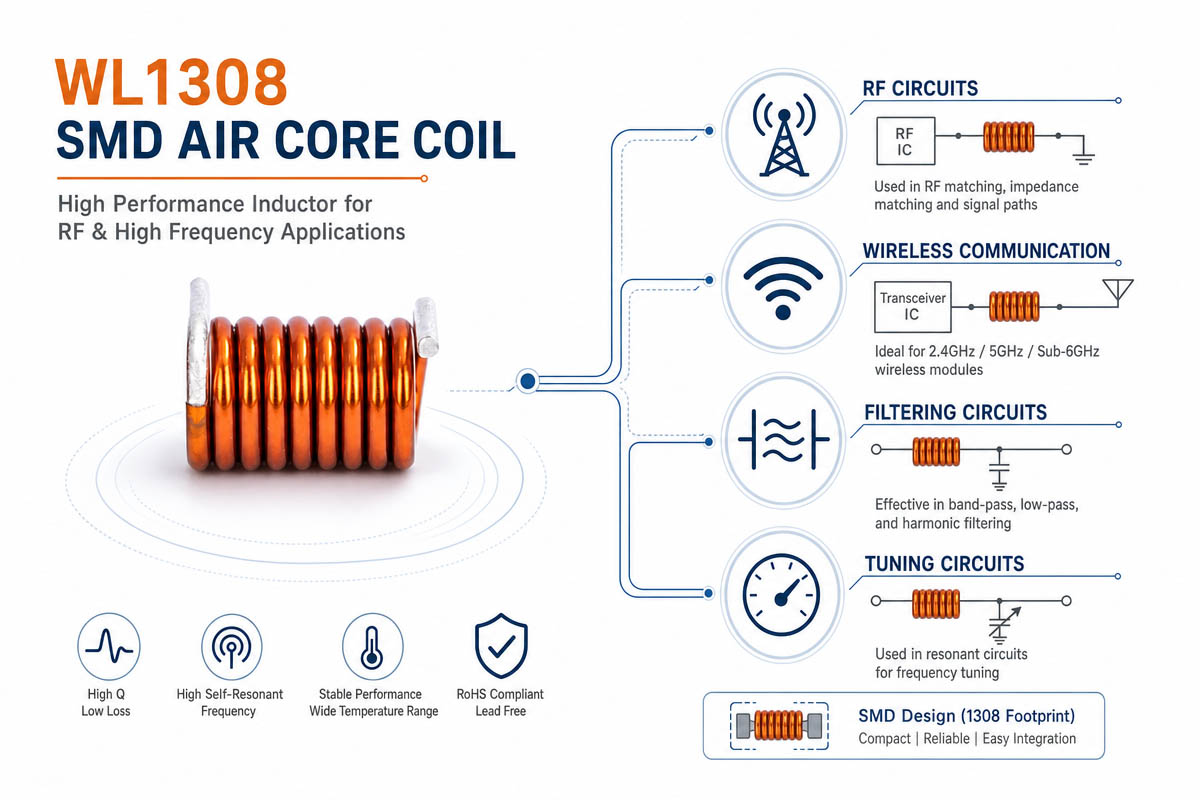
SMD Air Core Coil Industrial Application

Today, SMT Air Core Coils are widely used in modern electronic and industrial applications due to their high frequency characteristics and compact surface mount construction. The first application area is RF communication devices such as antennas, RF signal amplifiers, RF modules and wireless transmitters. The purpose of such coils in those systems is an increase of stability of the signal transferring and elimination of interferences.

Wireless charging devices also have an ability to operate with the help of SMT Air Coils. It makes it possible to improve energy transferring between charging pads and portable devices. In addition, SMT air core coils are widely used in IoT devices, Bluetooth modules, Wi-Fi systems, GPS units and smart wearable devices due to their compact and light construction and low energy consumption.

Finally, such coils can be used in various sensors, testing devices and precision control systems for industrial electronic equipment. Also, these coils are used in medical electronics including monitoring devices and imaging systems with electromagnetic performance. Finally, they can be used in automotive electronics, aerospace communications systems, high frequency filters and impedance matching circuits.

Company SMD Air Core Coil Advantage and Disadvantage

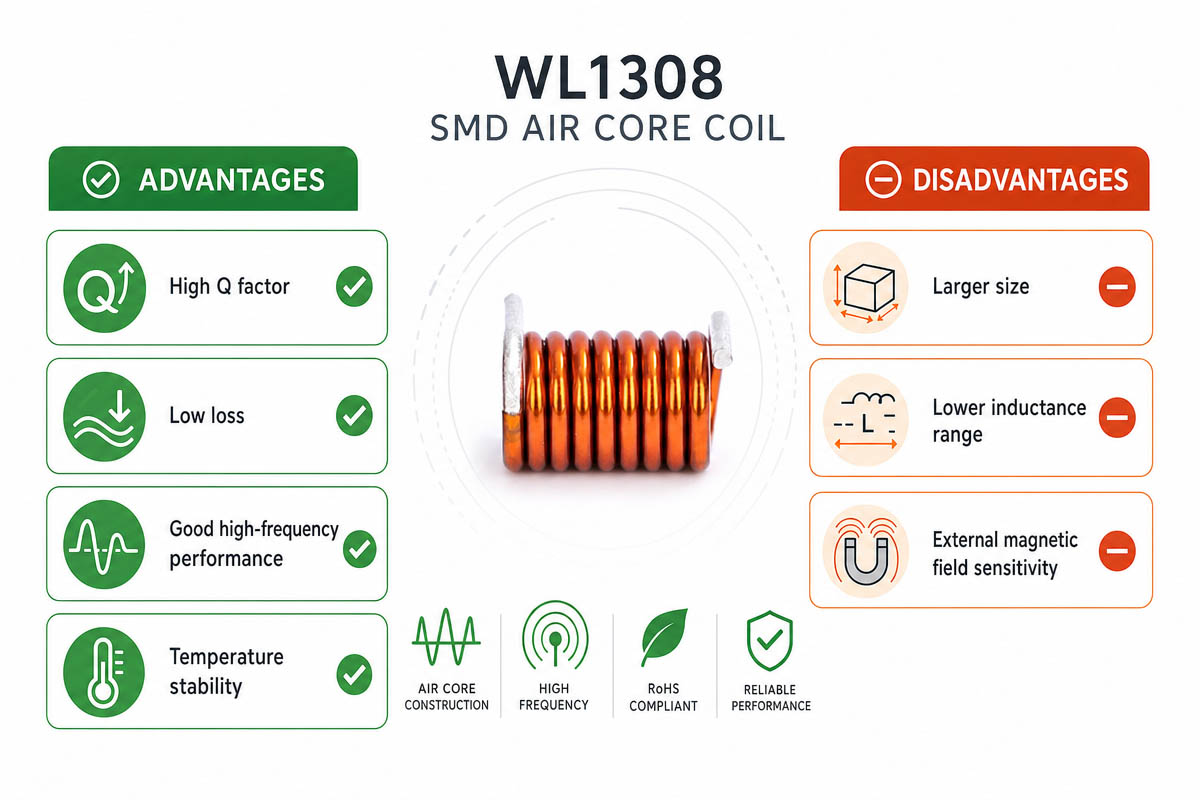
SMD Air Core Coil Advantage and Disadvantage

SMD Air Coils have various advantages in their application in high frequency electronics. For example, the absence of magnetic core losses increases efficiency of the coils and the signal as well. The absence of ferrite core and saturation makes them very effective in RF and precision circuits. Their high Q-factor allows improving frequency response and decreasing signal distortion. Due to their compactness and compatibility with automated SMT assembly, they provide higher production efficiency.

Other advantages include their good linearity and fast response to electromagnetic fields. In addition, thanks to the absence of ferrite core, inductance becomes stable in all operating conditions. Finally, they show lower hysteresis losses in high-frequency applications.

However, there are disadvantages as well. Air has lower magnetic permeability than ferrite material, so SMD Air Core Coil cannot reach the inductance level of ferrite-core inductors. Therefore, you will need to have more turns in order to obtain required inductance level and increase their size. Moreover, in power electronics, air core inductors may provide lower magnetic field concentration and energy storage capacity.

SMD Air Core Coil Troubleshooting

SMD Air Core Coil Technical Specification

SMT Air Coils have various potential problems that can occur during manufacturing, SMT assembly or Electronic Operation. Proper troubleshooting will help you to increase the reliability of the product and improve performance of the circuits.

The first problem is unstable inductance value. Usually, this issue occurs because of incorrect number of turns, wire deformations and improper soldering process during SMT assembly. Therefore, you should always check your winding specification and solder joint properly.

The next possible issue is overheating. In this case, the problem is usually related with too much current passing through the coil or poor thermal design of the PCB. How can you solve this problem? Try to select the right component and improve the heat dissipation near the device.

Too close coils to each other can lead to RF signal interferences. Thus, try to separate coils better or optimize the PCB layout in terms of electromagnetic interference.

One more potential issue relates to the mechanical damage of coil. The deformation of the coil can happen due to any external pressure during transportation or mounting in SMT. In this way, the manufacturer should use proper packaging and optimized pick and place setting.

Poor soldering process can also affect the quality of connections and work of the element. To avoid such issues, manufacturers should have proper temperatures and PCB cleaning during soldering.

Finally, sometimes bad circuit match and unstable frequency response can be caused by inappropriate selection of the inductance value. During product design, make sure that you take all necessary parameters into account.

Commonly Asked Questions about SMT Air Core Coils

1. What Is An SMD Air Core Coil and Its Main Advantages ?

It is an inductor which uses air as core instead of the usual ferrite or iron core. Air core inductors are wound on nonmagnetic material such as ceramic or plastic. Their main advantage is zero core losses (no hysteresis or eddy currents). Air core inductors also provide high efficiency (high Q factor), high-frequency performance and no saturation effects which distort the signal in magnetic cores.

2. What Are Disadvantages or Limitations of Air Core Inductors ?

Their advantages are evident. Air core inductors are great for high frequency applications, however they have a few disadvantages. First, their inductance is much less than ferrite cores – usually up to hundreds of nano-Henries. To increase inductance, the size of coil should be larger. Also air core inductors are more sensitive to the magnetic field (EMI interference), have smaller energy storage and more expensive for high precision applications.

3. How To Properly Mount SMT Air Core Inductors on PCB?

Proper mounting requires taking into account the PCB layout design and soldering technology. Footprint on the board should be identical to the data sheet provided by the manufacturer. Use wide tracks for track routing in order to minimize the impedance. Pay special attention to orientation and spacing of inductors in order to avoid overheating and short circuits. Reflow soldering is the best and recommended way of soldering SMT components, although wave or manual soldering is also possible.

4. Can SMT Air Core Inductors be Used in Battery Operated Devices Such As Cell Phones?

Yes, they are very well suited for some applications in battery-powered devices. They provide excellent Q factor and low core losses, reducing power dissipation to extend the battery life. SMT air core inductors are widely used in RF circuits (Wi-Fi, Bluetooth, 5G), wireless chargers and audio circuits (headphones) where the signal fidelity is required. They are not usually used for the main power converter (DC-DC).

5. Why Thermal Management Should Be Considered for SMT Air Core Inductors?

Heat generation occurs due to the resistive losses (I^2 * R) in the copper wire. Increasing of the temperature can increase the resistance in the wire, thus, decreasing performance and damaging the insulation of the wire over time. There are several solutions, including correct choice of the wire diameter (minimizing the resistive losses), proper design of the PCB with thermal pads to dissipate heat from hot spots and using natural/forced convection of air.

6. Are SMT Air Core Inductors Suitable for Aerospace Applications?

Yes, however, they have to meet very strict requirements for aerospace application. They are widely used in Aerospace and defence electronics in such systems as Radars, Satellite Communication and Missiles. Requirements include high accuracy inductance value, wide operating temperature (-55°C to +125°C), radiation hardness and high vibration/shock resistance. It involves special packaging and high-level quality assurance.

7. What is The Effect Of External Magnetic Field and Nearby Components On Performance of Air Core Inductors?

Air core inductors have an open magnetic field which is extended far in the surrounding environment. They are sensitive to any adjacent inductors which produce their own magnetic fields. The presence of other inductors leads to the phenomenon called mutual inductance, affecting inductance value and performance. Designers should provide proper spacing of inductors, orientation at right angles from each other and no magnetic material nearby

8. How Does SMT Air Core Coil Differ From Ferrite Core Inductor?

The difference lies simply in priorities for applications. Choose air core inductor if you require high frequency (RF applications), no distortion, high Q factor, no core saturation effects and can accept inductance up to hundreds of nH. Otherwise choose ferrite core inductor which can provide high inductance in small size for power supply filtering, energy storage etc.

How to Select an SMD Air Core Coil?

SMD Air Core Coil should be chosen wisely because stability of operation and long product life span highly depend on the choice. The value of inductance is the first parameter. Engineers should select appropriate inductance depending on frequency, signal requirement and impedance matching in circuits.

Operating frequency plays an important role. SMT air core coils were specially designed to work at high frequencies, however the user should pay attention to Q factor and frequency characteristic before selection.

Existing capacity should be evaluated carefully. Overload causes overheating or even instability of performance. It is possible to increase the durability using appropriate wire diameter and heat resistance of the coil.

Physical dimensions are important to make sure that coils can fit in the available PCB layout space. The designer should confirm the space for mounting, the dimension of the solder pad and requirements of SMT assembly.

Resistance should be considered. Low DC resistance leads to higher efficiency of the circuit by minimizing power loss in the circuit.

Environmental factors should be taken into account as well. Check the temperature and vibration resistance as well as long-term reliability performance in industrial or automotive application.

Quality assurance is also an important parameter. Good suppliers provide RoHS, electrical testing and traceability in production of SMT air core coils.

Finally, customization is essential in OEM products. Professional manufacturers offer to customize inductance value, wire diameter, coil geometry and packaging.

Don’t Do That! Mistakes to Avoid when Packaging SMT Air Core Coil

SMT Air Core Coils should be properly packed. Insufficient mechanical protection is a frequent mistake. The performance of the inductor may be affected by the outer pressure because of the open winding structure of the SMT air core coils, causing deformation of the coil shape. Using foam protection and proper packaging with antistatic carrier tapes solves the problem.

Insufficient protection from moisture is another error. Moisture in humid environment causes oxidation of copper and decreases the solderability. SMT air core coils should be vacuum packed and placed in moisture-proof bag for shipment and warehousing.

Improper spacing in reeling is harmful for the performance of automatic assembly process. Manufacturers have to use standard reels for surface mounting technologies and avoid errors in spacing the coil to prevent problems with picking and placement.

Proper electrostatic discharge protection is very important. Using antistatic packaging prevents from electrical discharge in transit or during PCB assembly.

In addition, some suppliers do not take care about labeling. Good product labeling provides part number, inductance value, quantity, manufacturing batch and verification status.

Last, but not least, inappropriate stacking of SMT coils may be harmful for transportation. Use sturdy export cartons with sufficient inner protection from vibration and shock damage during transport.

Get A Free Quote Now

Contact Form

Related Products

Related News

Chapter 1: Introduction of Air Core Inductor Calculation Precise air core inductor calculation is crucial in designing radio-frequency circuits, NFC […]

Scroll to Top

Get A Free Quote Now !

Contact Form
If you have any questions, please do not hesitate to contact us.
Weilong Solenoid Company Culture
