

You wake up in the morning and grab a drink from your refrigerator. Next, you take a shower and drive to your workplace. All this time, you use a set of automatic devices, most of which work due to the existence of a solenoid.
1. What is a solenoid?
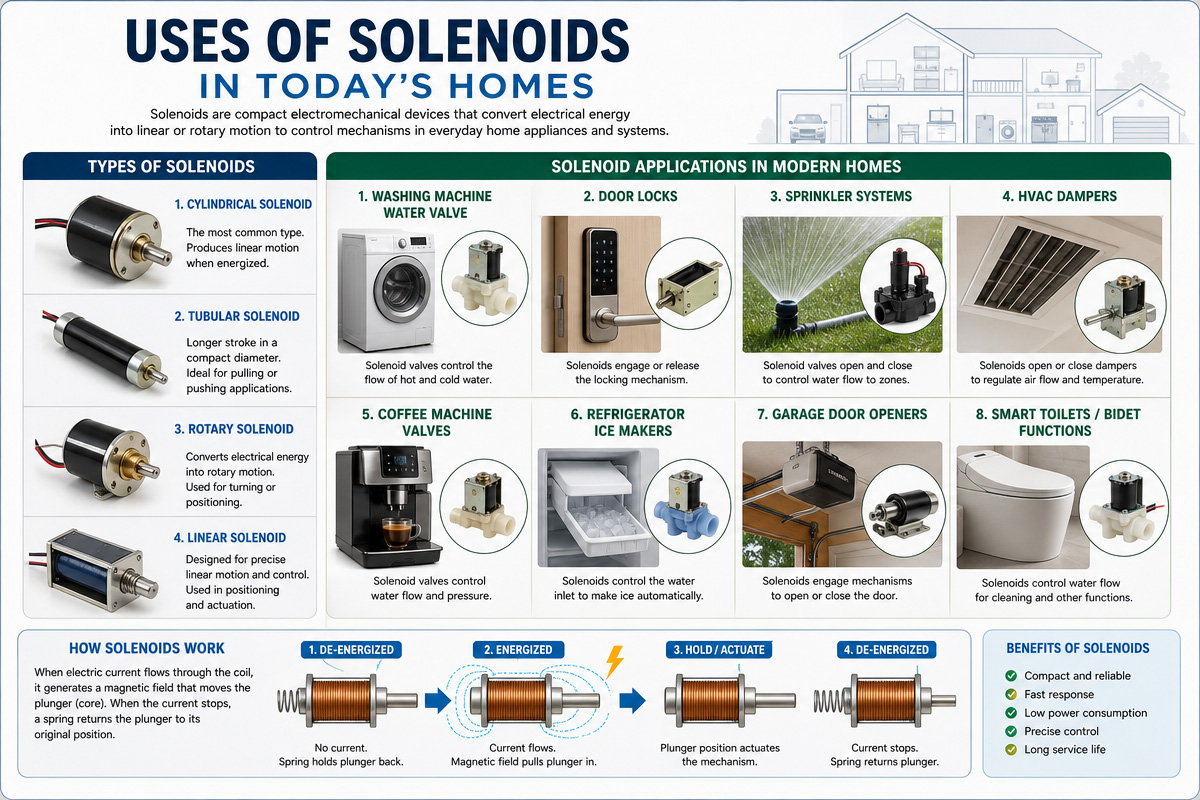
A solenoid is a type of electromechanical device that turns electrical energy into mechanical movement. In most cases, it consists of a coil, a housing,, and an armature or piston. An electric current flows through the coil and produces a magnetic field that attracts or repels the armature. Such a device helps activate and deactivate various components of automated systems.
At present, solenoids find application in modern households, automotive systems, household appliances, HVAC systems, gaming devices, and industrial automation.
2. Definition of a Solenoid
As it has been already mentioned above, a solenoid is a device that converts electrical energy into motion using the principle of electromagnetism. Once the coil of the device gets energized, the magnetic field acts on a plunger that pulls it.
In the case of power loss, a spring or magnetic force returns the plunger to its original position.
Owing to their fast response time, reliability, and compactness, solenoids are widely used in:
Intelligent door locks
Fridges
Washing machine
Dryer.
HVAC systems
Irrigation systems
Controllers in games
Circuit breaker
Car starters.
Electromagnetic solenoid is very useful in automation due to their instantaneous switching on and off and low power consumption.
3. Uses of Electromagnet in Today’s Homes
3.1 Solenoid Starters
The solenoid is important for starting cars. Starter solenoid can be regarded as relays that close an electrical circuit between the battery and the starter motor.
Once the key is turned on or the start button pushed, an electric current activates the solenoid. The contacts become closed due to the magnetic field, and the solenoid allows plenty of current flow to reach the starter motor and start the car’s engine.
Without a starter solenoid, a car cannot be started.
3.2 Door Bell Chime
Doorbells represent a very popular example of the use of solenoids.
Once a person pushes the doorbell button, electricity is directed to a solenoid. As a result, a piston hits a tone bar and makes a famous “ding-dong” sound.
The majority of contemporary doorbells still use mechanical solenoid chimes because they are more reliable and make louder sounds.
3.3 Intelligent Door Locks
Modern intelligent locks and security systems rely on latching solenoid.
Once a door is closed, a latching solenoid stops working and consumes minimal energy. Once someone uses a fingerprint recognition or mobile phone, the solenoid receives energy and unlocks the lock.
Latching solenoid consume low energy because they are switched on and off.
3.4 Gaming & Simulation Equipment
Advanced video games and driving simulators use solenoid in order to create a feeling of touch and resistance.
In this way, the majority of simulation devices use latching solenoid to keep controls in place when they aren’t used. Such solenoids are used in order to create a sensation of real resistance when turning the wheel.
Latching solenoid consume lower energy than constantly powered actuators owing to low-energy-consumption DC power.
3.5 Automatic Sprinklers Systems
Sprinkling systems rely on solenoid valves in order to direct water to the appropriate area.
When the sprinkler timer gives a signal to the solenoid valve, the latter is turned on,, and water starts flowing from the sprinklers. ers. Valves are automatically closed once the sprinkling process finishes.
A solenoid is being applied in sprinkling systems in order to save water without damaging your lawn.
3.6 HVAC Equipment
Modern HVAC systems use solenoids in order to switch refrigerants, air flows, and hot water.
Pilot-operated solenoid valves are widely used in HVAC equipment because of their ability to provide high flow rates in small sizes. Valves open and close automatically to keep temperature controlled in different parts of the house.
It is worth noting that modern zoned HVAC systems wouldn’t work without solenoids.
3.7 Refrigerators
Some solenoid is used in modern refrigerators.
3.8 Control of Compressor
Solenoid is responsible for the regulation of the compressor’s pressure and refrigerant flows.
3.9 System of Ice Dispersers
Solenoid is also used in ice-dispensing units. There is a lever on the side of the dispenser that, once pulled, opens a gate allowing cubes of crushed ice to to flow through the dispenser.
These systems guarantee proper operation of modern refrigerators.
3.10 Automatic Ironing Machine
Modern steam ironing systems also use a solenoid to control flows of steam.
Once someone presses the button, the solenoid opens a valve allowing steam to flow through the iron’s nozzle. It helps to control steam properly without overheating.
3.11 Solenoids Dryers
Solenoid valves used in dryers help control evaporator temperature and airflow. They regulate the temperature in hot gas bypass systems, thus increasing energy efficiency and stability.
3.12 Floor Cleaning Appliances
Modern vacuum cleaners use solenoid valves in order to regulate flows of water and detergent to the cleaning device.
Once a user turns on the valve, it delivers cleaning fluid precisely and prevents wasting of water.
3.13 ThermoelectricHeaters
Solenoids are also used in thermoelectric heaters in order to regulate hot and cold water.
One valve regulates a flow of cold water inside the heater, and another one directs the flow of warm water through pipes in order to deliver it to radiators, bathrooms,, and kitchens.
In case of leakage, solenoid valves immediately stop the flow of water.
3.14 Circuit Breakers
Circuit breakers protect your house against electrical overload.
When there is a huge current passing through the system, a magnetic field generated inside the solenoid breaks the circuit.
Unlike ordinary fuses, solenoids can be restored once an electric current is reduced and the circuit becomes safe.
4. Advantages of Using Solenoids
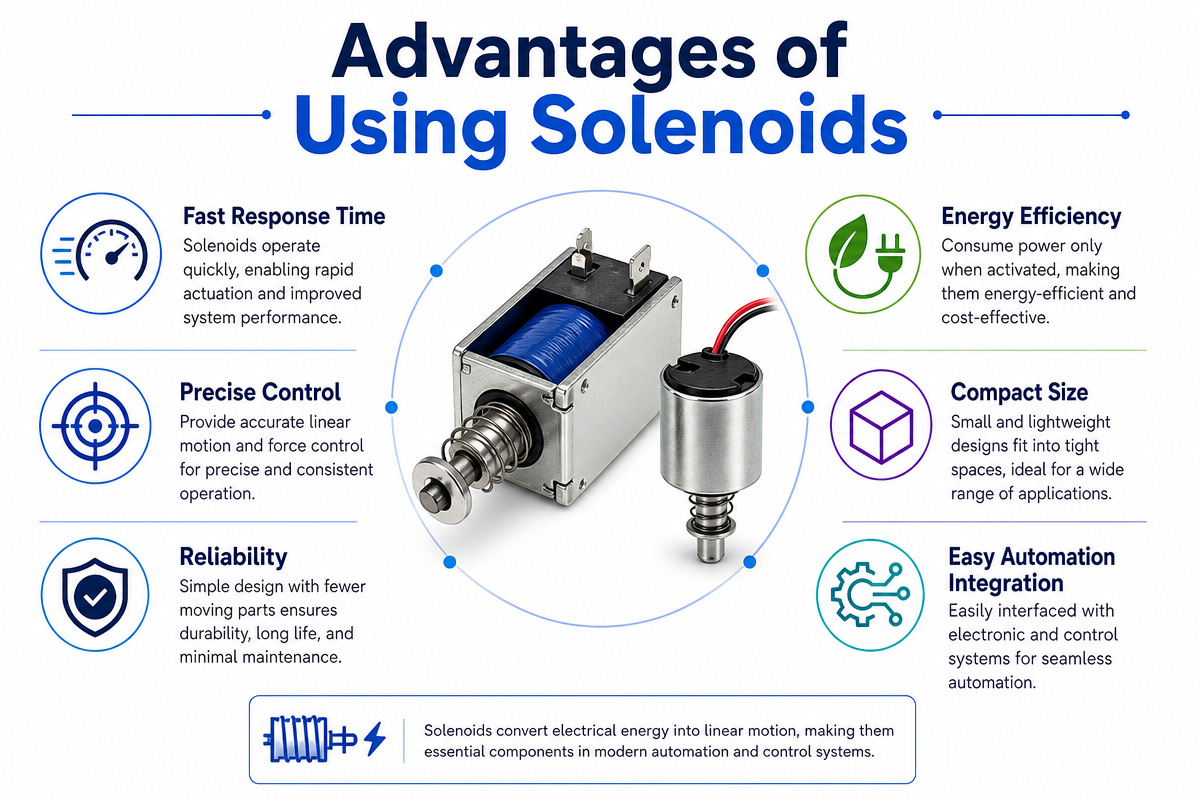
Modern solenoids have several important advantages.
Fast response time
Compact structure
Reliable service
Minimal requirements for maintenance
Energy-saving
Easy incorporation into automation systems
Long-lasting operation
Accurate control of motion
This is why solenoids are widely used in both home and industrial automation systems.
5. How to Choose a Solenoid Supplier
Choosing a reputable solenoid manufacturer means making sure that solenoids you purchase are reliable and durable. Therefore, the following factors should be considered when choosing a supplier.
5.1. Customizing Possibilities
Each application has its requirements for:
volts
stroke length
force
duty cycle
heat resistance
growing dimensions.
In this case, you need to buy customized solenoids offered by a professional solenoid manufacturer.
5.2. Testing
An experienced manufacturer will test all products for the following:
life cycle
measuring force
measuring volts
temperature analysis
vibration and noise analysis
Before purchasing, make sure that the company follows strict quality control standards. ________________________________________
5.3. Industry Experience
Choose a company that works in such fields as:
home automation systems
automotive electronics
medical devices
automation equipment
security systems…
home devices.
A professional manufacturer can help to optimize your design and avoid mistakes in production.
5.4. Manufacturing Capabilities
The capacitycity of the company is critical for large projects. Make sure that the supplier is capable of:
prototyping
small production
mass production
timely delivery
5.5. Technical Support
With the help of an engineering team, it is possible to:
increase magnetic energy
improve energy efficiency
reduce noise
increase durability
Solve problems of installation.
Technical support is important in the early stages of production.
5.6. Compliance with Standards
Check if the manufacturer offers certification for:
ISO9001
UL (if needed)
Such conformity guarantees safe and effective products.
5.7. Cost Effectiveness
It is important to focus on the following issues:
reliability
dependability
durability
technical support
engineering support
long-term costs
Purchasing high-quality solenoids will save you money on maintenance.
6. Why Choosing Weilong Solenoid
Weilong Solenoid is a manufacturer of customized solenoid and solenoid valves for both commercial and industrial applications.
With 20 years of experience, Weilong Solenoid can produce the following products:
special push-pull solenoid
latching solenoid
rotary solenoid
tubular solenoid
Automotive solenoid
Electromagnetic Clutches
All kinds of the solenoid valve
Whether you need special solenoids or solenoid valvess for your lock or powerful industrial solenoids, Weilong will offer you customized solutions accordingly.
7. Trends in Development of Solenoid
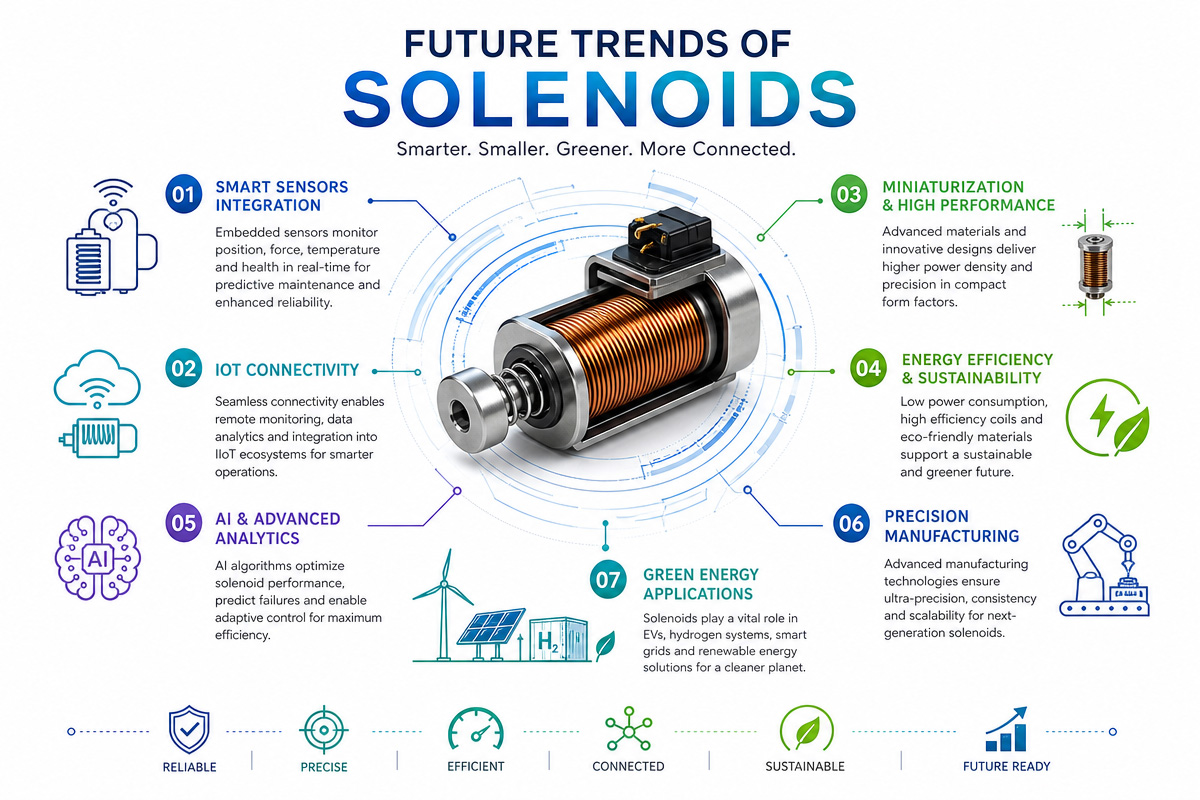
A solenoid is widely applied in many industries, including the automobile industry, medical applications, and and consumer electronics. However, as more and more intelligent systems appear, development in the solenoidnoid field becomes more innovative. Now manufacturers are producing smaller, faster,, and more reliable solenoids. It means that the future of solenoids lies ahead.
One of the significant future trends in solenoid development relates to miniaturization. Nowadays manufacturers of all sorts of electronics, wearable equipment, and robotics are trying to make their products as compact as possible. Thus, it became necessary to produce solenoids that would occupy minimum space but provide maximum performance. Miniature solenoids find their application in numerous devices, including lab equipment, smart lock mechanisms, medical pumps, and various valves. Further development will rely upon lighter material, more precise winding, and higher-performance magnets.
Energy saving is another major trend in future solenoid development. Classic solenoids consume power constantly and generate heat during the process. In order to avoid such problems, most modern solenoids utilize latching and permanent magnet principles, thus consuming minimal power during switching operations. Such innovations greatly decrease energy costs and help in improving battery life of mobile devices. Furthermore, low-power solenoids become a must for environmentally friendly functioning in smart homes and electric cars.
Innovative solenoids will have to be smarter. With the emergence of Industry 4.0, it became important to integrate the latest technological trends into manufacturing processes. Therefore, smart automation in the form of monitoring of position, temperature, or other operational parameters is expected. Smart solenoids are able to cooperate with sensors and electronic modules, providing the information necessary for further analysis by manufacturers.
Another growing market of advanced solenoids is the automotive industry. As the number of cars running on electricity is rapidly increasing, the demand forr solenoids that operate efficiently in electric cars becomes ever larger. Solenoids are applied in battery management systems, locking mechanisms, thermal regulation systems,, and brake fluid management. Automotive solenoids should be highly durable and operate fast while withstanding vibration and high temperatures. Additionally, they must be light-weighted and efficient.
The solenoid is also gaining popularity in the medical and healthcare industry. Advanced electromechanical actuators are widely applied in all sorts of diagnostic equipment, surgical equipment, and various pumps due to their precision and quiet operation. Medical solenoids of the future are going to be produced with emphasis on low noise level, light weight, precision, and strict safety requirements for materials. Solenoids will have to feature biocompatibility.
Nowadays, environmental sustainability becomes an essential aspect of manufacturing any kind of products. There are lots of new technologies that allow for reducing energy consumption and waste production. Most companies pay close attention to recycling possibilities and utilization of recyclable materials in their products. Moreover, manufacturers comply with such requirements as RoHS and REACH. The automated manufacturing process becomes an increasingly popular way to achieve better results and higher precision.
Finally, customized solutions for manufacturers are becoming more and more widespread. Nowadays, customers prefer to order customized solutions, taking into consideration various requirements regarding voltage, stroke, mounting, force, and duty cycle. Custom-made solenoids are highly desired by manufacturers.
8. FAQ about Solenoid
8.1 What Is a Solenoid?
A solenoid is an electromagnetic device that changes electrical energy into linear motion.
8.2 Where Are Solenoids Used?
There are multiple applications of solenoids, for example, in door locks, car starters, HVAC systems, refrigerators, medical devices, vending machines, and industrial automation systems.
8.3 What is the Difference Between a Regular Solenoid and a Latching One?
While regular solenoids require constant powering, latching solenoids use power only while switching.
8.4 Is Solenoid Energy-Saving Devices?
Most modern solenoid can be regarded as energy-saving because they use a low amount of power. In particular, latching solenoids save energy.
8.5 How Long Will a Solenoid Work?
Under good conditions, a solenoid may operate for millions of cycles.
8.6 Can a Solenoid Be Customized?
Yes. You can choose voltage, force, stroke length, installation structure, duty cycle, and operating environment.
8.7 What Applications Does a Solenoid Have?
A solenoid is used in such industries as the following:
automotive,
medical,
smart homes,
industrial automation,
aerospace,
consumer electronics.
8.8 Which Solenoid is Suitable for My Project?
When selecting a solenoid, you have to consider the following:
Dimension
voltage
required force
stroke length
duty cycle
environmental parameters
installation print
reply rate
Lifespan
9. Conclusion
The solenoid is invisible workhorses of many modern devices that make our lives easier and more comfortable. Electromechanical devices help automate our home.
Due to increasingly intelligent and energy-saving homes, the need for solenoids grows. Choosing a good solenoid manufacturer, you make your devices last longer and operate better.
For further information about customized solenoid, please visit Weilong Technology Solenoid’s official website. www.smartsolenoid.com or get in contact with us today.


