Benefits of Electromagnetic Clutch Brake Systems
Reliable Electromagnetic Clutch Brake Solutions
Electromagnetic Clutch Brake for Automation Use
Electromagnetic Clutch Brake Efficiency Guide
High Performance Electromagnetic Clutch Brake
Compact Electromagnetic Clutch Brake Design
Benefits of Electromagnetic Clutch Brake Systems
Reliable Electromagnetic Clutch Brake Solutions
Electromagnetic Clutch Brake for Automation Use
Electromagnetic Clutch Brake Efficiency Guide
High Performance Electromagnetic Clutch Brake
Compact Electromagnetic Clutch Brake Design

WL6324 Electromagnetic Clutch and Brake System Guide

Electromagnetic clutch and brake systems use electromagnetic force to engage and disengage power transmission and stop rotating members for motion control purposes. It combines the functions of both a clutch and a brake, meaning joining the driving shaft and driven shaft while rapidly and accurately stopping the movement. An electric current passing through a coil creates a magnetic field, resulting in the engagement of friction surfaces in torque transmission or braking. They are popular in industrial machinery, automation, and robotics due to their quick response, high precision, and reliability in controlling rotational motion.

The features of an electromagnetic clutch and brake

Electromagnetic clutch and brake solutions guarantee quick response time, high precision, and reliable performance. It ensures smooth engagement and disengagement with minimum vibrations and noise during operation. Also, it offers flexibility since the system can fit different machinery owing to its compact design and low maintenance needs, thereby minimizing operating costs.

It provides remote and automated control options, perfect for modern industrial applications. In addition, they guarantee high torque transmission capabilities and consistent braking performance. Electromagnetic clutch brakes have excellent durability and energy efficiency, making them suitable for continuous and high-speed operation, stable performance, and extended service life.


Electromagnetic Clutch and Brake Product Overview

Electromagnetic clutch and brake solutions are complex motion control devices that effectively manage torque transmission and stopping functions. They employ electromagnetic force to achieve quick engagement and disengagement, ensuring accurate control in industrial processes.

The electromagnetic clutch and brake have become widespread in automation and manufacturing owing to their compactness, reliability, and easy integration. They reduce mechanical wear and improve efficiency over traditional systems. With the increasing demands for precision and automation, electromagnetic clutch brakes have become important components in modern machinery, ensuring superior performance, flexibility, and durability.

WL6324 Electromagnetic Clutch and Brake Video

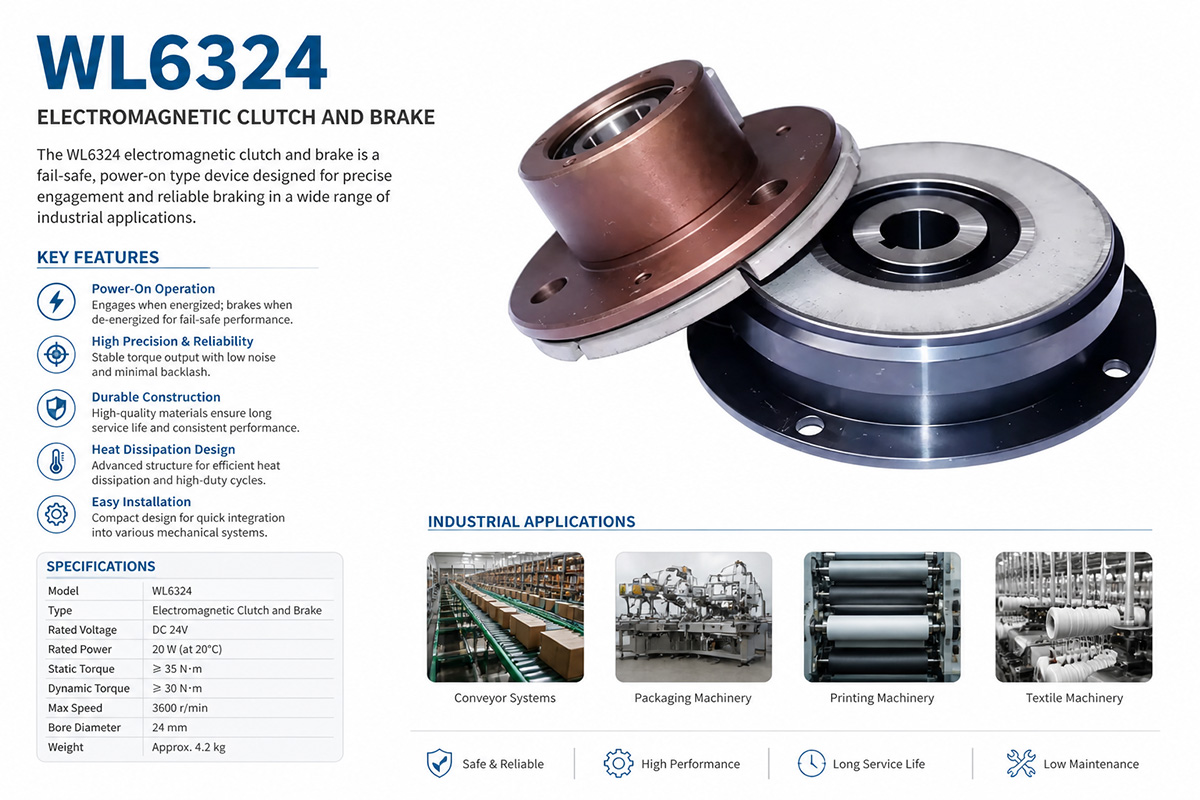
WL6324 Electromagnetic Clutch and Brake Detailed Display

Electromagnetic Clutch and Brake Technical Data Sheet

WL6324 Electromagnetic Clutch and Brake Technical Data Sheet
Brand Weilong Technology Model Number WL6324
Rated Voltage (V) DC 24V Rated Power (W)  45 W
Static Torque 175 nM Rated Torque (nM)  175 NM
RPM  6000 RPM Responding Time(s) < 30 MS
Service Life 100,000 cycles Certification CE, RoHS, ISO9001,
Material Carbon Steel Housing with Teflon-Plated Coating Lead Wire Length (mm) 200
Install Style Adjustable Screw Tolerance of Dimension  +/-  0.1 MM
Water-proof  None Product Name: CF2 Electromagnetic Power On Clutch with Bearing Built-In Hub
Hi-Pot Test AC 600V 50/60Hz 2s Non-excitation Holding Force 0
Working Temperature -10°C-100°C Duty Cycle 1-100%
Dynamic Friction Torque 5.0~320Nm Payment Term TT, or LC At Sight
Sample Order Yes Warranty 1 Year
MOQ 100 pcs Supply Ability 1000 pcs per Week
Delivery Time 30 Days Port of Loading shenzhen

How to Test the Coil Voltage of an Electromagnetic Clutch and Brake?

Below is a guide on how to measure the coil voltage of electromagnetic clutch and brake systems effectively and safely.

First one ;

Acquire a digital multimeter and set it to the DC voltage range corresponding to the clutch/brake rated voltage. For safety reasons, turn off the power to the equipment and locate the two coil terminals of the electromagnetic clutch or brake system.

Second Step:

Switch on the equipment in its normal working condition. Ensure the multimeter probes adequately contact the two coil terminals. Measure the actual working voltage indicated by the meter. Compare the measured voltage to the rated voltage on the nameplate. Too low voltage indicates an unstable power supply, loose wiring, or poor contact.

If the voltage reading is abnormal or zero, examine broken wires, defective switches, or coil open circuits. During measurement, always avoid contact with live metal parts.


Electromagnetic Clutch and Brake Industrial Application

Electromagnetic Clutch and Brake Industrial Uses

Electromagnetic clutch and brake solutions have numerous applications in industrial machinery. It helps automate motion control systems to regulate the motion of conveyor belts, robotic arms, and assembly lines to ensure accurate positioning and synchronization.

Additionally, it assists in accurate starting and stopping of packaging machinery to maximize production efficiency and minimize wastage. In printing machines, they help control precise paper feeding and alignment for high-quality prints. Electromagnetic clutch brakes are significant in textile machinery, where constant speed control and rapid stopping is critical.

Moreover, it regulates accurate control of the spindle movement in machine tools like lathes and milling machines. It finds usage in various industries, including medical equipment, office automation devices, and automotive testing machines. Therefore, its quick response and reliable performance suit high-speed and high-precision environments.

In conclusion, electromagnetic clutch and brake systems are essential for increasing productivity, enhancing safety, and guaranteeing reliable performance in contemporary industrial machinery.

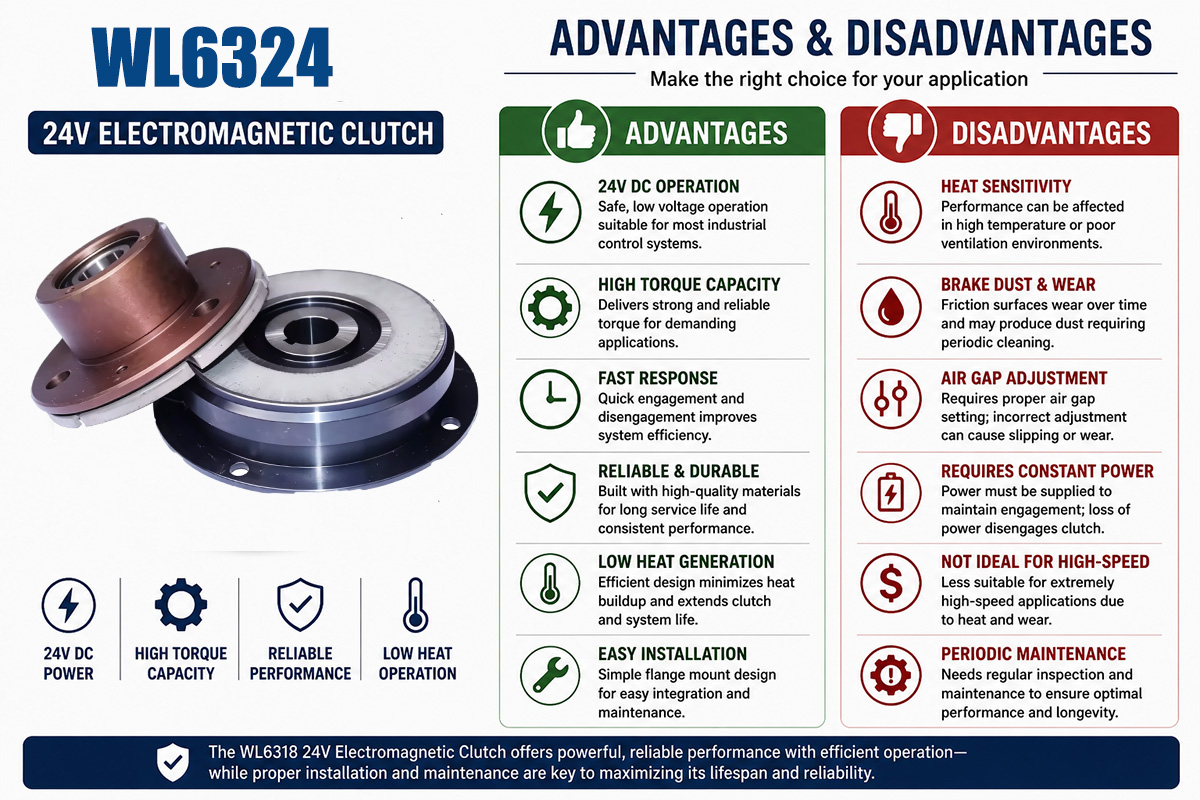
Advantages and Disadvantages of Electromagnetic Clutch and brake

WL6324 Eletromagnetic Clutch and Brake advantage and disadvantage

Electromagnetic clutch and Brake Pros

Electromagnetic clutch and brake systems are highly appropriate for industrial applications and come with numerous advantages. Quick response and accurate control ensure precise engagement and stopping. Their compact design ensures seamless integration into diverse machines, and their low maintenance needs reduce operating costs. They also ensure automation and remote control, which enhances efficiency and flexibility.

Another critical advantage is their smooth operation, which lowers vibrations and noise. In addition, they offer reliable performance and high durability, suitable for continuous use.

Electromagnetic clutch and Brake Cons

However, there are some disadvantages to watch out for. Electromagnetic systems require a constant power supply, leading to high energy consumption. Heat generation during operation might affect performance. High-load applications may cause excessive wear on friction components over time.

There could be higher initial costs compared to traditional mechanical systems. Nevertheless, despite these disadvantages, the advantages of accuracy, speed, and automation often outweigh the drawbacks, making electromagnetic clutch brakes a preferred choice in modern industry.

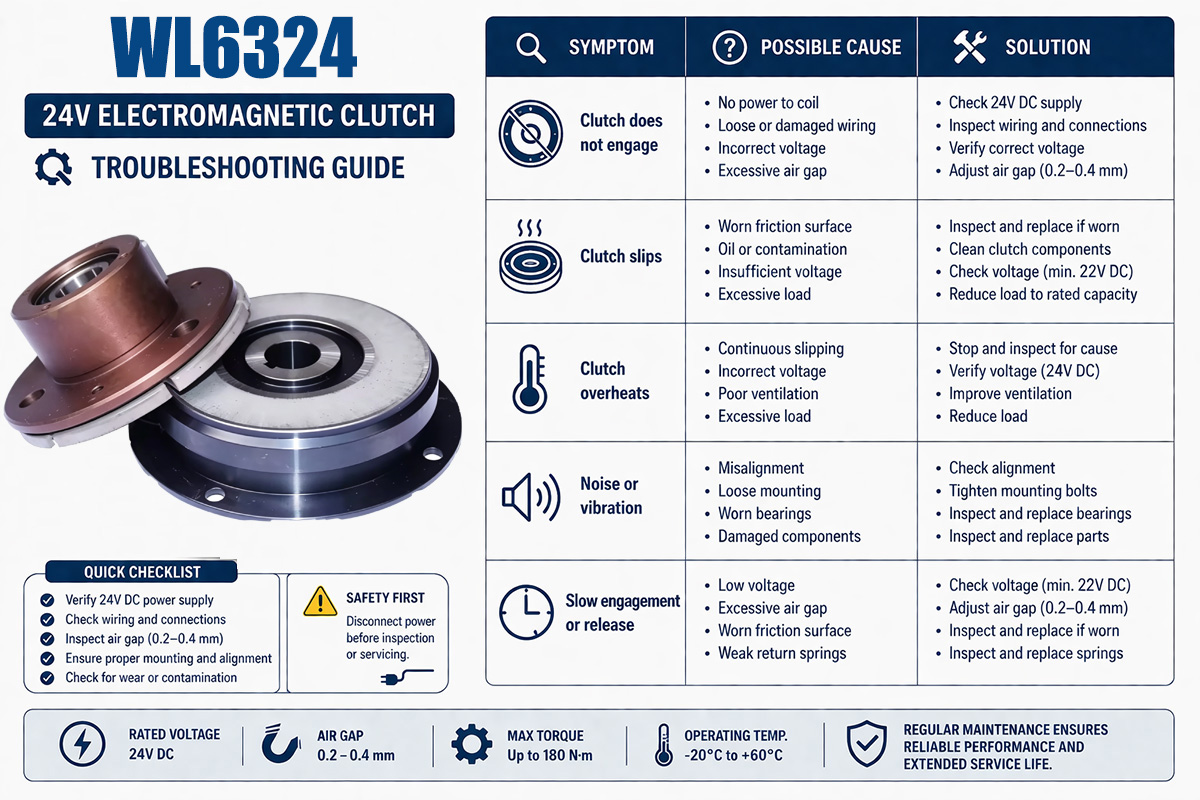
Tackling Troubles with Electromagnetic Clutches and Brakes

WL6324 Eletromagnetic Clutch and Brake Troubleshooting Guide

First one:

Troubleshooting electromagnetic clutches and brakes starts by determining whether the fault is either mechanical or electrical in nature. Here are four common problems faced by users. These include failure to engage, failure to disengage, slipping, and strange sounds.

Voltage Test: Using a multimeter, test whether the coil is receiving the appropriate amount of voltage (12V or 24V DC). Low voltage leads to slipping.

Test the Coil: Measure the coil’s resistance. The “open” circuit has infinite resistance. This indicates that the coil is broken. When it reads “short” or zero, the coil is burned. One of them needs a new coil.

Wiring Test: Inspect for damaged, pinched, or corroded wiring. Furthermore, confirm that the earth connection is intact.

🛠️ Step 2: Inspection of the Mechanical Parts and Air Gap

When there are no electrical issues, it must be mechanical.

Air Gap Test: This refers to the distance between the rotor and the armature. Too wide an air gap leads to failure to engage. If it is too narrow, the components may drag each other or not disengage.

Contamination Test: The presence of oil, grease, or dust on the friction surfaces reduces the holding torque considerably. Burnish and clean the surfaces using a solvent.

Mechanical Wearing: Disassemble the machine and examine the rotor and armature. Any deep scores, cracks, or blue/burned marks indicate that it has overheated or “galled” due to severe slippage.

🔧 Step 3: Remedy Steps

Burnishing (Bedding In): Friction surfaces should be “burnished” (engaged/disengaged under load with reduced torque). Failure to do so results in slippage immediately.

Adjusting the Air Gap: Most units have nuts or screws that allow for adjustment of the air gap. The thickness required is specified in the owner’s manual (often measured using a feeler gauge).

Replacement of Components: When the coil is shorted or open, or the friction faces are severely galled, you will have to replace the defective component. Remember to purchase one that matches the voltage and torque specifications.

🦺 Safety Precautions

⚠️ Turn Off Power: Switch off the battery or disconnect the power source.

Heat Warning: The rotor and coil may be dangerously hot in case of slippage. Cool them down before handling.

FAQs of Electromagnetic Clutch and Brake

1. Why doesn't my electromagnetic clutch or brake engage?

It might be an electrical or mechanical issue.

Electrical Issues: Using a voltmeter, confirm if the coil has received the appropriate voltage. If yes, measure its resistance using an ohmmeter. An “open” (infinite resistance) or “short” (zero resistance) indicates a faulty coil

Mechanical Problem: The air gap between the rotor and armature could be too wide. No magnetic force can cover the gap to facilitate friction. Therefore, you need to reduce it to the manufacturer’s specification

2. Why does it fail to disengage when the power is disconnected?

It is a mechanical problem.

The most common reason is the switch that continues to supply voltage to the coil despite being faulty. Check for the voltage in the clutch when it is supposed to be switched off.

Galling: This is a condition where the friction surfaces overheat, causing microscopic welding of the surfaces. While it doesn’t lock the unit entirely, it requires replacement of some parts. Afterward, the new parts need to be burnished.

3. Why does it slip? How can I fix it?

This problem arises due to insufficient torque transmission.

Contamination: This is Enemy #1. Oil, grease, or even dust on the steel on steel friction surfaces significantly lowers the coefficient of friction, resulting in slippage and rapid heat accumulation.

Low Voltage: The machine receives inadequate voltage from a weak battery or poor contact, reducing the magnetic clamping force. Consequently, it slips under normal load.

New Units: They require burnishing. New friction surfaces are relatively smooth and need a controlled burnishing process to make them adhere. Immediately using them at full load results in slippage and permanent damage.

4. Why is my machine overheating? Is it harmful?

Heat is a major contributor to malfunction and the primary symptom, but it isn’t the root cause.

Continuous Slipping: If it slips for too long (overloaded or output stopped), it generates heat that melts the bearing seals, burns the wire insulation, and warps the parts.

Electrical Problem: Overvoltage (for example, connecting a 12V coil in a 24V system) or supplying AC power when it needs DC quickly burns the coil.

5. Why is it producing scraping and grinding noises?

This usually results from physical interference or bearing failure.

When not engaged, it pings or scrapes. The air gap is too small. The armature is in light contact with the rotating rotor. Increasing the air gap solves the problem.

Rumbling or Grinding: This is a classic symptom of bearing failure. Lack of lubrication or contamination causes it. The remedy is the replacement of the bearing or unit.

6. How Do I Detect a Faulty Electromagnetic Coil?

A multimeter is your best tool.

Resistance Test: Disconnect the coil and measure its resistance. OL indicates an open circuit (broken wire). Infinity shows that the circuit is closed. A reading of zero or very low ohms suggests that the coil has experienced a short circuit. Both indicate a coil failure.

Visual Inspection: If the coil is cracked, melted, or has blackened epoxy coating, it is severely overheated and burned.

7. What Happens When Oil Falls on the Friction Surfaces?

This is a critical mistake. Oil contamination leads to clutch slippage.

Loss of Torque: The oil, being a lubricant, removes friction necessary for torque transmission. Clutch brakes on PTOs are also safety equipment, and once contaminated, they may not halt a blade fast enough, posing a danger.

Solution: If it happens soon after, you can try cleaning the surfaces and burnishing them. However, if it has overheated and slipped, the damage is permanent, necessitating replacement.

8. What is Galling and How Can I Prevent It?

It is a destructive wearing process that takes place when friction surfaces fuse.

Causes: The severe slippage produces excess heat. The smooth friction surfaces move, causing bits of metal to break off. Trapped under extreme pressure and heat, they melt and “spot weld” the armature to the rotor, locking the unit.

Preventive Measures: Proper sizing of the unit to suit the load, proper voltage, burnishing of new units, and keeping the friction surfaces free of oil.


How to Choose Electromagnetic Clutch and Brake

Selecting the correct electromagnetic clutch and brake system requires a thorough assessment of several technical factors to ensure optimal performance and reliability.

1.  Estimate the necessary torque capacity

The system must be able to handle maximum loads without slipping or overheating. Always maintain a safety margin to compensate for any unanticipated load changes.

2. Consider the speed of operation and response time.

When dealing with high-speed applications, fast engagement and disengagement are vital, necessitating the selection of a model with fast response characteristics.

3. Evaluate the duty cycle.

If you require continuous or frequent operation, pick a model designed for heavy-duty use and can dissipate heat efficiently. Overheating dramatically shortens the lifespan and performance of the clutch/brake.

4. Confirm voltage and power requirements.

Make sure it aligns with your current power supply, whether it is 12V, 24V, or other specifications. And consider energy efficiency to save on operating costs.

5. Take into account size and mounting constraints.

Compact models are ideal for applications with limited space, and proper alignment ensures smooth operation and minimizes wear and tear.

6. Be mindful of the environment.

If operating in harsh environments with dust, moisture, or high temperatures, choose a model with protective features such as sealing or corrosion resistance.

Lastly, verify maintenance needs and product quality.

Picking a reputable brand with quality standards ensures longevity and consistent performance.

By thoroughly analyzing these factors, you will select the appropriate electromagnetic clutch and brake system for your application, maximizing efficiency, reliability, and longevity.

Get A Free Quote Now

Contact Form

Related Products

Related News

This guide will help the reader understand the functioning, types, selection criteria, specifications and maintenance practices of electromagnetic clutches and […]

Scroll to Top

Get A Free Quote Now !

Contact Form
If you have any questions, please do not hesitate to contact us.
Weilong Solenoid Company Culture
