12V DC Solenoid Lock for Secure Access Systems
Compact 12V DC Solenoid Lock for Smart Cabinets
High Performance 12V DC Solenoid Lock Device
Reliable 12V DC Solenoid Lock for Locking Needs
12V DC Solenoid Lock for Industrial Applications
Durable 12V DC Solenoid Lock for Door Control
12V DC Solenoid Lock for Secure Access Systems
Compact 12V DC Solenoid Lock for Smart Cabinets
High Performance 12V DC Solenoid Lock Device
Reliable 12V DC Solenoid Lock for Locking Needs
12V DC Solenoid Lock for Industrial Applications
Durable 12V DC Solenoid Lock for Door Control

WL0620 12V DC Solenoid Lock For Locking Guide

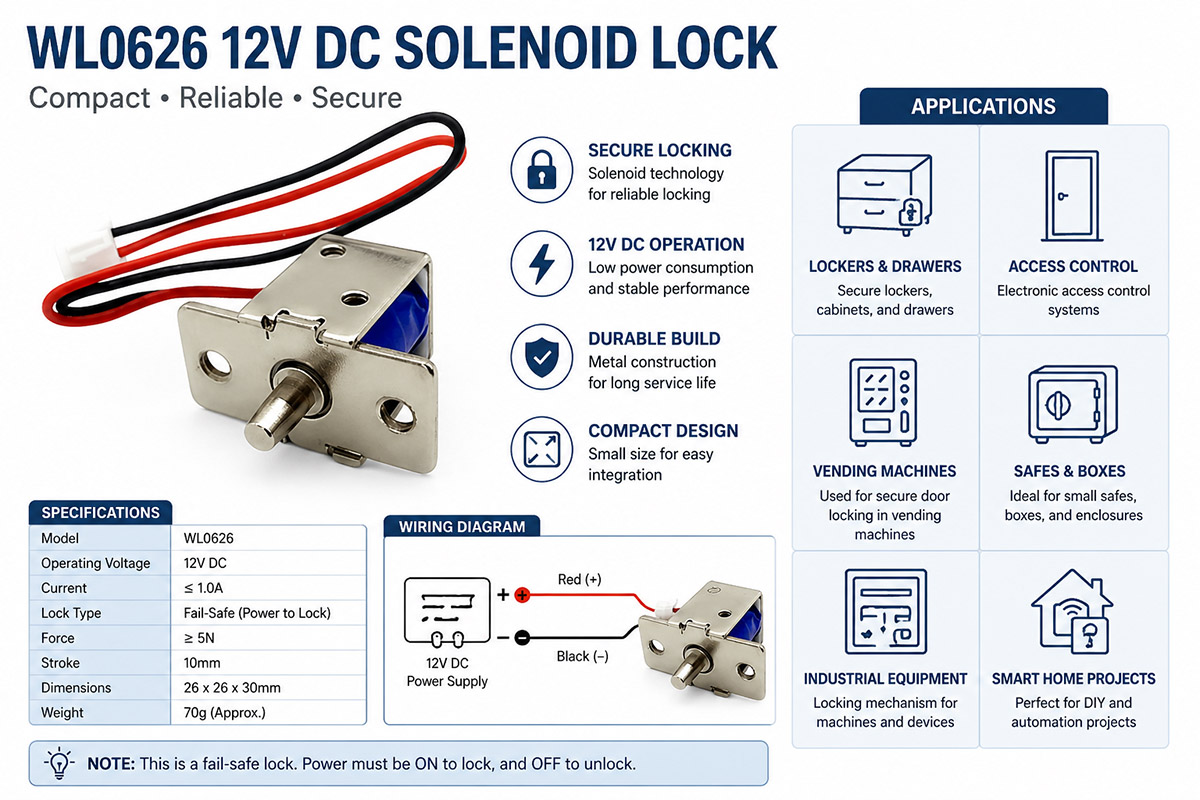
The 12V DC solenoid lock is a device designed to mechanically control access using electromagnetic force. Under the power supplied by a 12V DC source, the solenoid coil creates an electromagnetic field that drives a bolt or plunger. Depending on the design, such a locking mechanism opens or closes depending on whether it operates in the fail-safe or fail-secure mode. The 12V DC solenoid lock’s main applications for these locking mechanisms include cabinets, lockers, vending machines, and access control systems. They are a perfect choice for home or business automation and smart security due to their small size and rapid operation

Unit Features of 12V DC Solenoid lock

This 12V DC solenoid lock device works with 12V DC electricity, which makes it safe and efficient. High-quality materials are used to ensure durability. It can be installed either as a fail-safe or fail-secure mechanism to provide necessary safety. Easy installation and wiring allow it to be used in various situations. Besides, it operates flawlessly, quietly, and interacts with access control systems, becoming the ideal choice for smart home security and automation.

12V DC Solenoid Lock Product Overview

The 12V DC solenoid lock is a compact electromechanical device aimed at safe and automatic locking mechanisms. Its operation is controlled by a 12V DC power source producing electromagnetic fields to drive the locking bolt. It includes durable materials ensuring prolonged usage of the locking device and excellent performance. Thanks to its compactness, it can be easily installed in various cabinets, lockers, or electronics. Its high responsiveness and low power consumption create good compatibility with a lot of things. You can easily customize the lock by choosing either a fail-safe or fail-secure mechanism according to your security requirements.

WL0620 12V DC Solenoid Lock Video

Industrial 12V solenoid locking device Detailed Display

12V DC Solenoid Lock Technical Datasheet

Brand WeiLong Technology Model Number WL0620
Rated Voltage (V) DC12V Rated Power(W) 3-6W
Work Mode Push and Pull Holding Force (N) 50 Gf
Stroke(mm) 2-5 MM Customized Working Duty Continuous
Service Life 200 Thousand Times Certification CE,ROHS,ISO9001,
Material Superior Magnet Iron Lead Wire Length(mm) 200 MM
Install Style Screw Tolerance of Dimension  +/-  0.1 MM
Water-proof  None Insulation Class B
Hi-Pot Test AC 600V 50/60Hz 2s Non-excitation Holding Force 0
Working Temperature -10°C-100°C Duty Cycle 1-100%
Thread Depth(mm) / Payment Term TT, or LC At Sight
Sample Order Yes Warranty 1 Year
MOQ 1000 pcs Supply Ability 5000 pcs per Week
Delivery Time 30 Days Port of Loading shenzhen

A Brief Summary of 12V DC solenoid lock

The 12V DC solenoid lock represents a compact electronic locking mechanism widely used in modern security systems. Thanks to electromagnetic principles of operation, it allows you to open and lock the locking bolt rapidly and efficiently. This lock is widely used in cabinets, drawers, lockers, vending machines, and access control systems.

These products are excellent for use in automation and smart devices due to their simplicity of operation and installation. You can choose a solenoid lock with either fail-safe or fail-secure modes according to your needs. It should be noted that engineers prefer them for their low power consumption, longevity, and high responsiveness.

12V DC Solenoid Lock Application

12V DC Solenoid Lock Application

Various industries use the 12V solenoid lock due to its reliability and small size. They are installed in cabinets, drawers, and lockers to ensure the safe storage of your belongings. Moreover, a 12V DC solenoid lock plays a crucial role in smart home systems to enable remote or automatic control of doors or other mechanisms.

A 12V DC solenoid lock finds many uses in the retail sector and vending companies as a convenient way to control access to vending machines, kiosks, and parcel lockers. They prevent unauthorized entry and make working with such devices comfortable and convenient.

Moreover, control panels, equipment enclosures, and automated machines are some applications where safe access plays a vital role for both safety and maintenance. Access control systems, including those with RFID, fingerprint, or keypad readers, can be equipped with them.

Finally, these locks are extensively applied in various logistics and smart delivery systems, including storage cabinets and parcel lockers. They are designed to work continuously and efficiently even in harsh conditions thanks to their rapid response and resistance to wear.

12V DC solenoid lock advantate and Disadvantage

12V DC Solenoid Lock Advantage and Disadvantage

 12V DC Solenoid Lock Benefits & Drawbacks Explanation
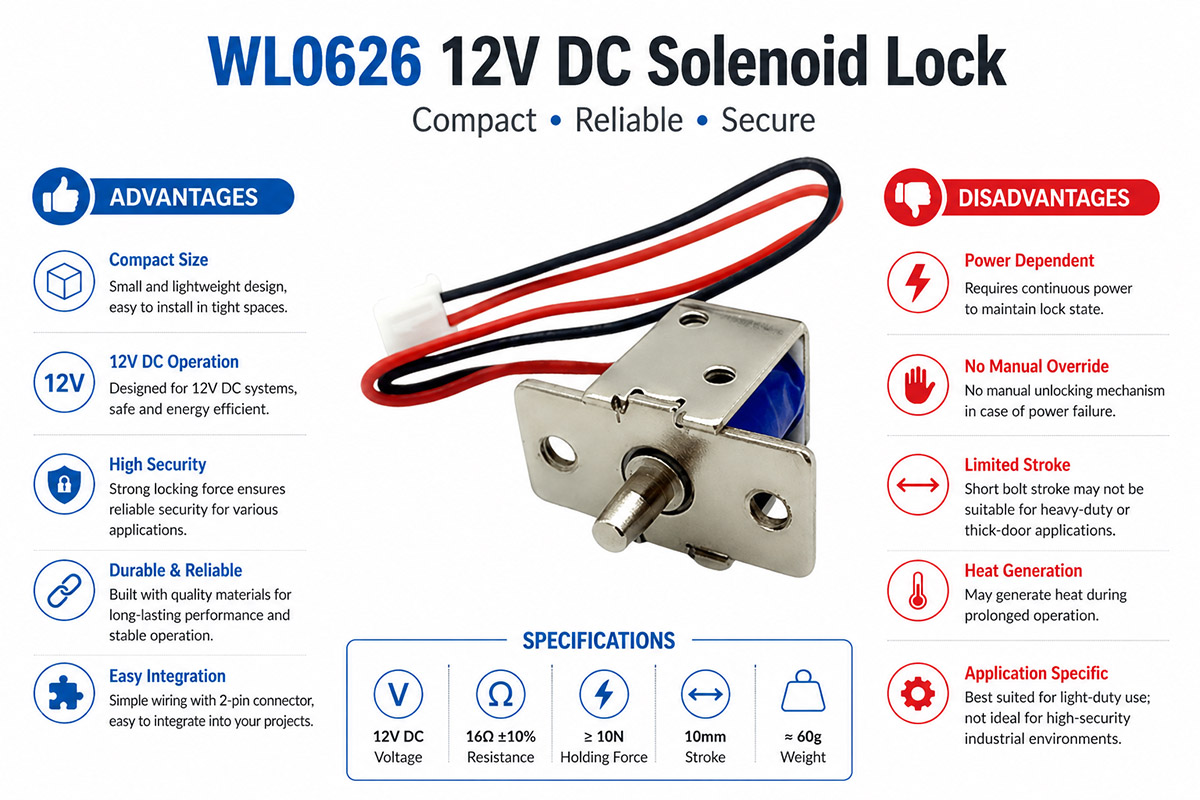
✅12V DC Solenoid Lock Benefits

1. Basic Design & Economic

Simple coil + plunger structure
Cheaper to fabricate
Affordable for mass production
Good for OEM and built-in usage
👉 Suitable for budget-oriented projects.

2. Easy Setup & Compatibility

Works with 12V DC current
Works well with:
Microcontrollers (Arduino, Raspberry Pi)
Access control systems
Smart devices
👉 Universal installation in electronics.

3. Quick Response

Instant electromagnetic action
Fast unlock/lock cycle (milliseconds)
👉 Best for:
Vending machines
Smart lockers
Automatic cabinets

4. Compact Dimensions

Small size
Lightweight construction
👉 Perfect for space-constraint installations such as:
Package lockers
Cabinet locks
Medical cabinets

5. Customizable Control Modes

Can work in:
Pulse locking
Continous power locking/unlocking modes
👉 Convenient to use in any logic system.

6. Low Starting Current Demand

Needs only 12V DC power source
Powered easily with battery or adapter
👉 Great for portable and non-grid systems.

❌ 12V DC Solenoid Lock Drawbacks
1. Continuous Power Usage

Many models (fail-safe type) need power flow all the time
Consequences:
High energy usage
Heat generation
👉 Not good for energy-sensitive systems.

2. Heating Effect

Prolonged operation causes the coil to heat up
Results:
Decreased lifespan
Performance degradation
👉 Thermal design needed.

3. Less Holding Power

As compared to magnetic locks, less locking power
Can break open if exposed to an exterior impact force
👉 Unsuitable for security doors.

4. Mechanical Friction

Causes friction due to the moving plunger
Results in:
Mechanical wear
Maintenance is needed
👉 Requires maintenance if used in many cycles.

5. Operation Noise

Creates a “click” noise during operation
👉 Doesn’t fit for:
Quiet spaces
Expensive smart home systems

6. Sensitivity to Voltage Variation

Dependent on stable 12V power input
Less voltage -> weaker actuation
More voltage -> overheating
👉 Needs constant current power supply.

⚖️7. Pros & Cons (Comparision Chart)

Aspect Performance
Cost ⭐⭐⭐⭐⭐ Low
Installation ⭐⭐⭐⭐⭐ Easy
Speed ⭐⭐⭐⭐⭐ Fast
Power Efficiency ⭐⭐ Poor (continuous use)
Durability ⭐⭐⭐ متوسط
Security Level ⭐⭐ Basic

🎯 Optimal Application Areas
Smart locker
Vending machine
File cabinet
Delivery parcel box
DIY IOT locking
⚠️ NOT Good for:
Securing heavy security doors
Safety-rated doors
External harsh environment

12V DC Solenoid Lock Disadvantages


Fixing problems with 12V DC solenoid lock

12V DC Solenoid Lock Troubleshooting Guide
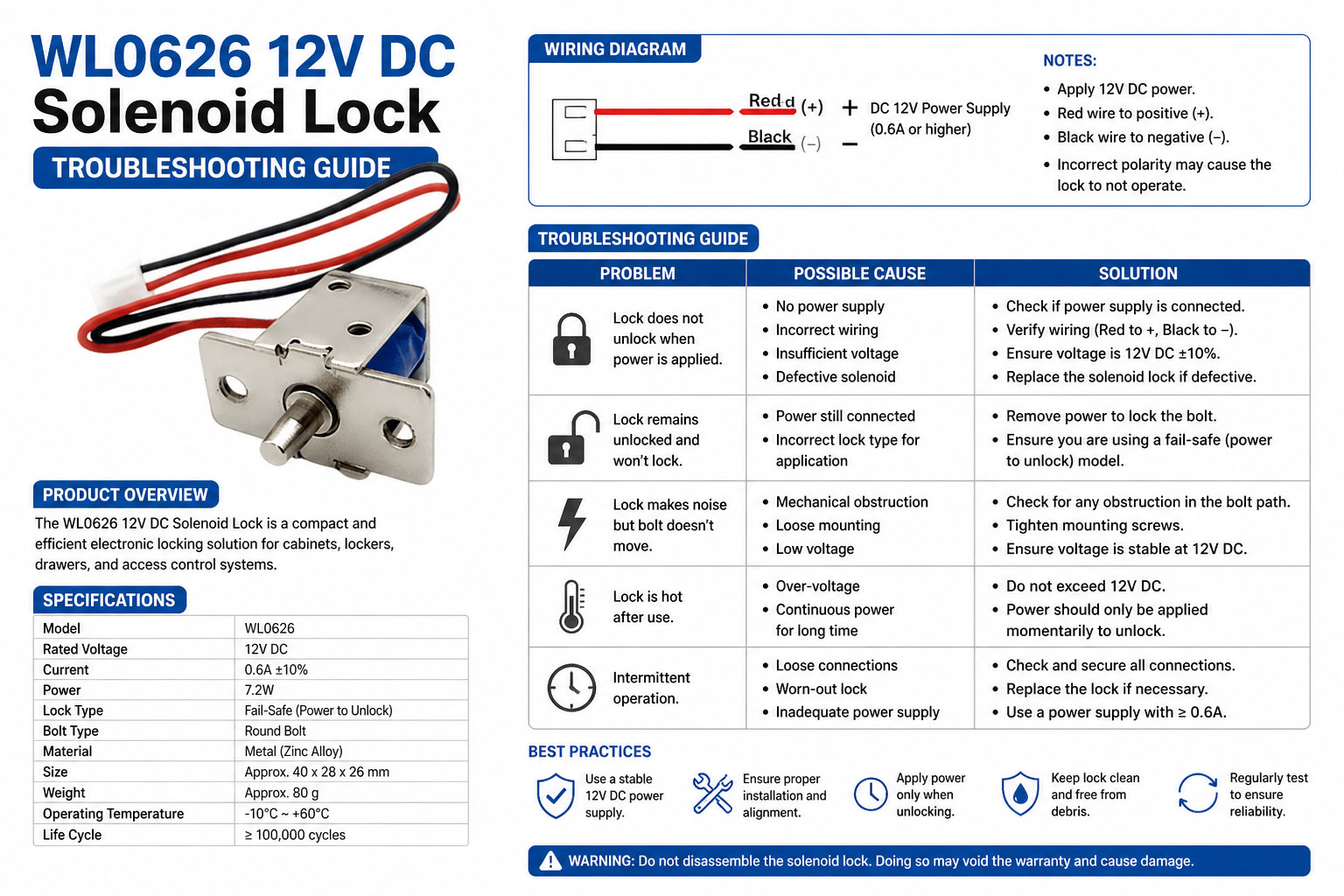
When you troubleshoot a 12V DC solenoid lock, you look for common problems with the power supply, wiring, and how the lock works mechanically. One of the most common issues is that the lock won’t open when power is turned on. Most of the time, this happens because the voltage is too low, the wiring is wrong, or the power supply is broken. Make sure that the input voltage is always stable at 12V DC and that the red wire is connected to the positive side and the black wire is connected to the negative side.
If the solenoid clicks but the bolt doesn’t move, there may be a problem with the installation alignment or something getting in the way of the mechanical parts. Look for trash, misalignment, or loose screws that could be getting in the way of the plunger’s movement.
Another problem is overheating, which is often caused by a power supply that is always on and goes beyond its rated duty cycle. Solenoid locks are usually made for short periods of use, so keeping the coil energized for a long time can damage it.
Loose connections, worn parts, or unstable power sources can all cause intermittent operation. Make sure that all of the electrical connections are secure and that the power supply can provide enough current.
To keep things running smoothly, you need to check them regularly, install them correctly, and use the right voltage.


FAQs of 12V DC Solenoid Lock

1. How much voltage does a 12V DC solenoid lock need?

It needs a steady 12V DC power source. Changes in voltage can cause problems or make things work poorly.

2. What is the difference between fail-secure and fail-safe?

When powered, fail-safe unlocks, and when unpowered, fail-secure locks. The choice depends on how safe you need to be.

3. What is wrong with my 12V DC solenoid lock?

Some common reasons are wrong wiring, low voltage, not enough current, or a broken coil.

4. Is it possible for the solenoid lock to work all the time?

Most models are meant to be used only now and then. Overheating and a shorter lifespan may happen if the power is always on.

5. How much power does a 12V solenoid lock need?

Usually between 0.5A and 1A, but it depends on the model and what it needs to do.

6. Is it hard to install?

No, installation is easy as long as you have the right wiring (positive and negative) and the right mechanical alignment.

7. Is it safe to use outside?

Standard models are meant to be used inside. For outdoor use, you need waterproof or sealed versions

8. What kinds of uses are good?

They are commonly found in lockers, cabinets, vending machines, and systems that control who can get in.

9. How to customize a 12V DC solenoid lock?

Making a 12V DC solenoid lock “customizable” can be a very wide concept – starting from modifying the hardware to making a fully customized control circuit. The first approach is not used anywhere because you do not want to machine your hardware parts manually.

Here are two different directions you can choose depending on what customization stands for.

🧲 Path 1: Customizing the Hardware Itself (OEM Manufacturer)
When you deal with creating a ready-for-sale product for large-scale manufacturing, such companies as Dr. Solenoid or KERONG give you a chance to modify the hardware part of the device.

Hardware Modifications: You can customize the stroke length, holding force, and position of mounting holes to suit the exact requirements for your door or cabinet.

Functional Features: Sometimes, you may define the lock mode – Fail-Safe (locks when power failed) vs. Fail-Secure (unlocks).

Please note that this method implies very big MOQs and will not help you with a simple DIY lock.

💡 Path 2: Customizing Your Control Circuit (DIY)
The vast majority of people refer to customization meaning using an Arduino, ESP32, or any other type of microcontroller to make their device operate. Here are the steps you should take to make a working connection between your solenoid lock and the controller.

How to Connect a Solenoid Lock Safely
You cannot simply hook your lock up to the power source—solenoids are different from bulbs. They are inductors that create huge voltage spikes when turned off. To avoid frying your microcontroller, you definitely need a flyback diode.

List of Components Needed:

12V DC power supply (make sure that its power consumption exceeds at least 1A). Do not even think of using a 9V battery – it is too weak.

Relay Module/MOSFET Switch (the microcontroller cannot power the solenoid by itself).

1N4007 Flyback Diode (essential for safe functioning).

12V solenoid lock.

Schematics for Connecting the Arduino to the Solenoid
The picture below shows how you need to connect your components.

Powering Components:

Lock VCC → 12V power supply (+) .

Lock GND → MOSFET drain/relay COM.

Power supply GND → MOSFET/source/relay GND.

Protecting Components (Very Important!):

Install the 1N4007 diode right between the two pins of the solenoid lock.

Diode Cathode (marked by black band) → Power supply +.

Diode Anode → MOSFET/source side.

Control Pin (Solenoid Signal):

MOSFET Gate/Relay IN → Microcontroller pin (e.g., GPIO5).

Microcontroller GND → Power supply GND (they must have common ground).

How It Works
Lock: Send the signal ‘HIGH’ (5V or 3.3V) to the MOSFET/relay from the microcontroller. It opens a contact between the lock’s ground wire and the negative terminal of the power supply, locking the lock.

Unlock: Set the pin to ‘LOW.’ The transistor closes its contacts and stops powering the lock. The lock’s spring unlocks it.

🔧 Helpful Hints for Successful Working
Humming Issue: A solenoid cannot sustain being powered for a long time—it overheats and burns out. Remember that the device was created for intermittent operation (locking/unlocking pulses). In your code, always leave a pause of 1 second.

Resetting Issue (Noise): A solenoid uses about 0.8A of power while locking/unlocking. Due to the sharp pulse, it can create electrical noise that resets the Arduino’s board. Make sure to install a large capacitor (100uF to 470uF) at the 12V input near the lock.

Checking Wiring Logic: Though many solenoids do not care whether it is negative or positive, your flyback diode surely matters. Installing it on the wrong side makes your solenoid create a short circuit, burning the power source immediately.

Choosing a 12V DC Solenoid Lock

Choosing an appropriate 12V DC solenoid lock requires considering many technical and practical parameters.

No. 1:

To start with, consider the type of your locking device. Decide whether you need a fail-safe mechanism that is unlocked by current or a fail-secure mechanism that operates in the opposite manner. This decision should be based on the necessary safety and availability of power in an emergency.

No. 2:

Then, determine power requirements. The first thing to pay attention to is compatibility with a 12V DC power supply. Also, consider current requirements, as the power supply must be stable and sufficient to ensure reliable performance.

NO. 3:

Next, decide on its size and mount. The device must be compatible with the location where it will be installed. Besides, it should be compatible with the door or cabinet it will interact with. Compact enclosures require compact solutions.

No. 4:

Then, consider the stroke length and holding force. These characteristics indicate the performance level and the extent of bolt displacement, helping you choose a locking mechanism that meets your needs in terms of loads.

No. 5:

Pay attention to the material and durability. Using high-quality metal guarantees high service life, especially in industrial environments.

Next, consider the duty cycle and overheating. Some solenoid locks are designed to operate occasionally, while others may be used continuously. Overheating significantly reduces service life.

No. 6:

Please remember to choose a model that withstands various climatic conditions, including temperature, humidity, and dust. This will provide reliable protection of your property even in harsh conditions.

At last, consider compatibility with access control boards, microcontrollers, or smart home systems. Convenient wiring and installation are also essential for easy installation and further maintenance.

Why is the 12V DC solenoid lock getting so popular in access control systems?

There is a reason why a 12V DC solenoid lock is used extensively in access control systems. This type of lock combines all the benefits that are necessary to ensure proper functioning and reliable performance in terms of protection and safety. Let us look at the main reasons for using such locks in access control systems.

1. Integration with Modern Electronics

Almost all of the access control devices, such as RFID readers, keypads, and even biometric scanners, work on low-voltage DC power supplies. Therefore, 12V DC solenoid locks can be used without additional voltage conversion and modifications.

2, Safe Operation

Since these locks require only a low voltage, they are safer to work with and install than high-voltage AC solenoid locks. In particular, their safe operation is required in residential buildings, offices, schools, and hospitals.

3, Fast Response

When energized, solenoid locks actuate almost immediately, which is essential for high-traffic access points and automated doorways.

4. Cost Efficiency

12V DC solenoid locks are not expensive to produce since they have a simple design consisting of two components, namely coil and plunger. This simplicity provides an advantage for large-scale deployment, e.g., in apartment buildings and commercial structures.

5. Control Possibilities

Modern 12V DC solenoid locks can be controlled by various systems, including access control panels, remote control systems, smart home solutions, and microcontrollers (Arduino boards).

6. Compact Size

Solenoid locks are relatively small and lightweight; therefore, they can be installed almost everywhere, including cabinets, lockers, vending machines, and parcel delivery stations.

7. Options for Locking Mode

It should be noted that the locking mode of the 12V DC solenoid lock can be selected from the following options:

Fail-safe: unlocks when the lock is powered off;
Fail-secure: keeps the lock in the locked position in case of power loss.

Such versatility enables choosing the best solution depending on the needs of customers and end-users.

8. Power Consumption Reduction Options

Standard solenoid locks require constant power to maintain the locked position. However, modern designs are equipped with pulse controllers and holding current circuits to reduce power consumption.

9. Conclusion

Thus, we see that the growing popularity of 12V DC solenoid locks can be attributed to several factors, including compatibility with electronic devices, low cost, ease of implementation, fast response time, and low power consumption.

Get A Free Quote Now

Contact Form

Related Products

Related News

Chapter 1 : What is a Metal Stamping Die? Metal stamping die (also called stamping tool, press tool or metal die) […]

Scroll to Top

Get A Free Quote Now !

Contact Form
If you have any questions, please do not hesitate to contact us.
Weilong Solenoid Company Culture