High-Performance AC Linear Solenoid for Machinery
AC Linear Solenoid Applications in Factory Systems
Reliable AC Linear Solenoid for Industrial Control
AC Linear Solenoid Solutions for Automation Lines
Industrial Grade AC Linear Solenoid for Equipment
AC Linear Solenoid for Packaging Machine Systems

WL0829 AC Linear Solenoid for Industrial Use

An AC linear solenoid is an electromechanical device that converts alternating current (AC) electrical energy into linear motion. It consists of a coil, a movable plunger, and a fixed iron core. When AC power is applied, a magnetic field is generated, pulling or pushing the plunger along a straight path. Unlike DC solenoids, AC solenoids are designed to operate directly with AC power and often include shading coils to reduce vibration and noise. They are widely used in industrial automation, machinery, and control systems where rapid, repetitive linear actuation is required with reliable performance.

AC Linear Solenoid Features

AC linear solenoids offer reliable and efficient linear motion with simple constructions. They operate directly on AC power without the need for rectifiers, making installation easier and cost-effective. Key features include fast response time, strong initial force, and stable operation with shading coil technology to reduce noise and vibration. They are available in various stroke lengths and force ratings to suit different industrial needs. AC solenoids are designed for long service life, with robust construction for continuous or intermittent duty cycles. Their compact size allows easy integration into machinery and automation systems across multiple industries.

WL0829 AC Linear Solenoid Description

AC linear solenoids are versatile electromechanical actuators designed for industrial and commercial applications. They are built with high-quality copper coils, durable iron cores, and precision-engineered plungers to ensure consistent performance. These solenoids support various voltage ratings and can be customized for stroke length, force output, and mounting configurations. Many models include shading coils for smooth and quiet operation.

Designed for durability and efficiency, the AC linear solenoid is suitable for continuous or intermittent duty cycles. Their compact design and straightforward integration make them ideal for automation systems, control devices, and machinery requiring reliable linear motion.

WL0829 AC Linear Solenoid Video

WL0829 AC Linear Solenoid Detailed Display

WL0829 AC Linear Solenoid Technical Data Sheet

Brand Weilong Technology Model Number WL0829
Rated Voltage (V) AC110V or 208V Rated Power (W)  30–33W
Work Model C  Frame Pull  Type Holding Force (N) 300 Gf
Stroke(mm) 6-8 MM Reset Time(s) 20 Ms
Service Life 300 Thousand Times Certification CE, RoHS, ISO9001,
Material Carbon Steel Housing with Zinc Plated Coating Lead Wire Length (mm) 200
Install Style Adjustable Screw Tolerance of Dimension  +/-  0.1 MM
Water-proof  None Insulation Class  F   155 Cel. Degree
Hi-Pot Test AC 600V 50/60Hz 2s Non-excitation Holding Force 0
Working Temperature -10°C-100°C Duty Cycle 1-100%
Thread Depth(mm)  / Payment Term TT, or LC At Sight
Sample Order Yes Warranty 1 Year
MOQ 500 pcs Supply Ability 5000 pcs per Week
Delivery Time 30 Days Port of Loading shenzhen

WL0829 AC Linear Solenoid Application

WL0829 AC Linear Solenoid Application

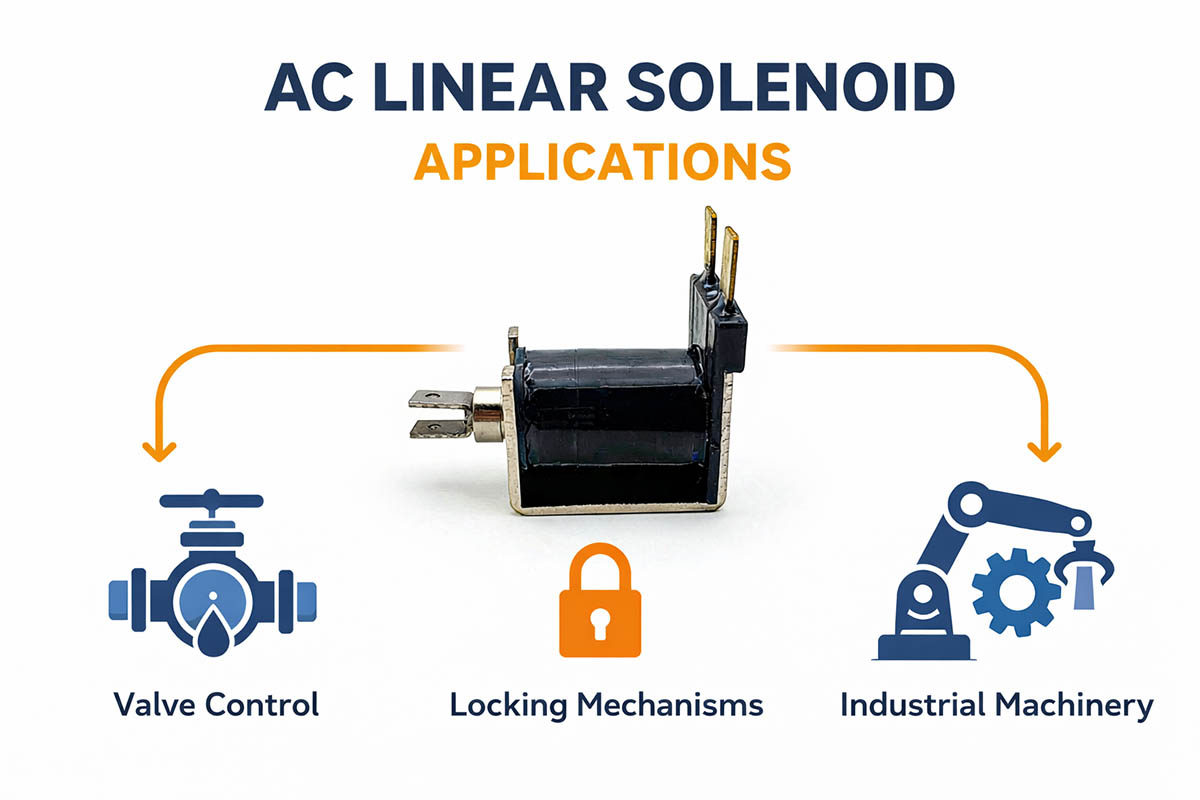
The AC linear solenoid is widely used across various industries due to its reliability and fast actuation. In industrial automation, they are commonly applied in sorting systems, conveyor belts, and packaging machinery where quick and repetitive motion is required. They play a critical role in valve control systems, enabling precise opening and closing in fluid and gas handling applications.

In vending machines and ticketing systems, AC solenoids are used for dispensing mechanisms and locking controls. They are also found in household appliances such as washing machines, coffee machines, and air conditioning systems for switching and control functions. In the medical field, they are used in diagnostic and laboratory equipment where consistent and controlled motion is essential.

Additionally, an AC linear solenoid is applied in door locking systems, textile machinery, and printing equipment. Their ability to operate continuously with stable performance makes them suitable for high-duty-cycle environments. With customizable designs, they can be tailored to meet specific force, stroke, and mounting requirements, making them a versatile solution for modern electromechanical applications.


WL0829 AC Linear Solenoid Advantage and Disadvantage

WL 0829 AC Linear Solenoid Adv. and Disadv.

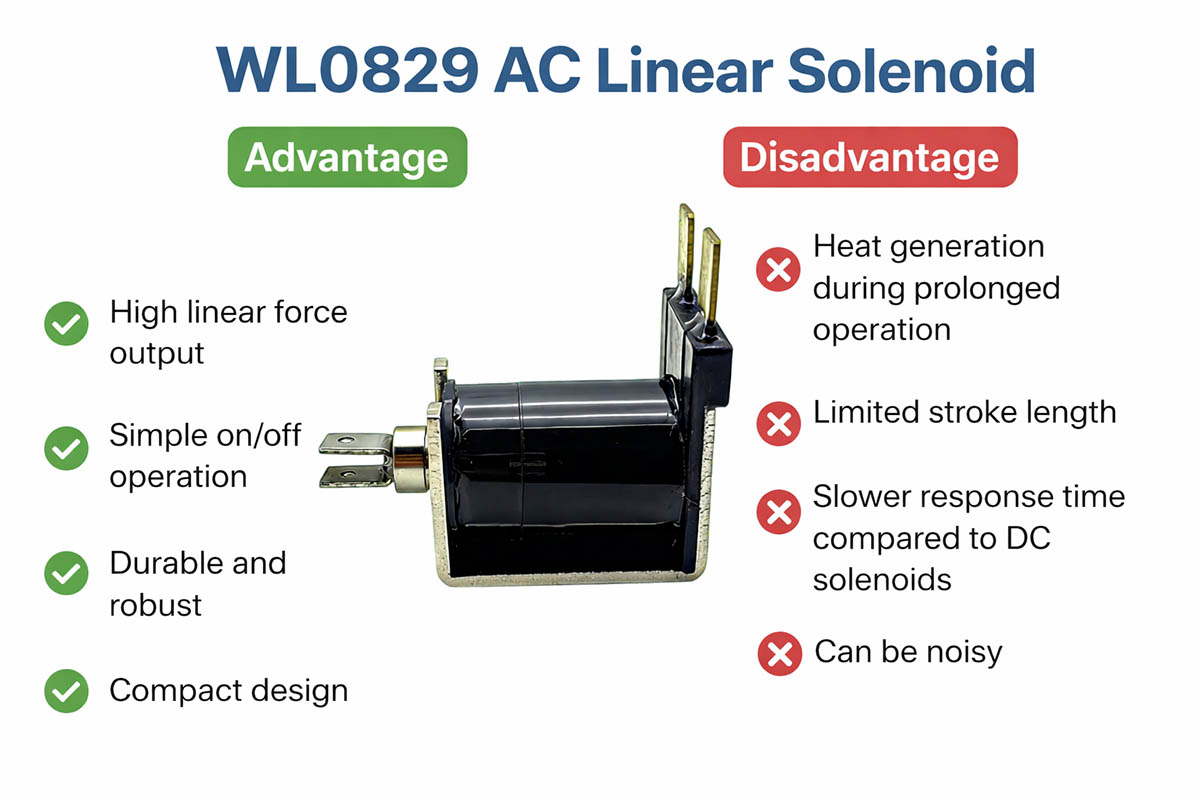
AC Linear Solenoid Advantages

Direct AC operation (no rectifier needed)

Strong initial pulling force

Fast response and high-speed operation

Durable and long service life

Simple structure and easy installation

Cost-effective for industrial use

AC Linear Solenoid Disadvantages

Higher noise compared to DC solenoids (without shading coil)

Heat generation during continuous operation

Less precise control compared to DC solenoids

Vibration may occur if poorly designed

Limited efficiency in some low-power applications

AC Linear Solenoid Troubleshooting Guide

WL0829 AC Linear Solenoid Trouble Shooting

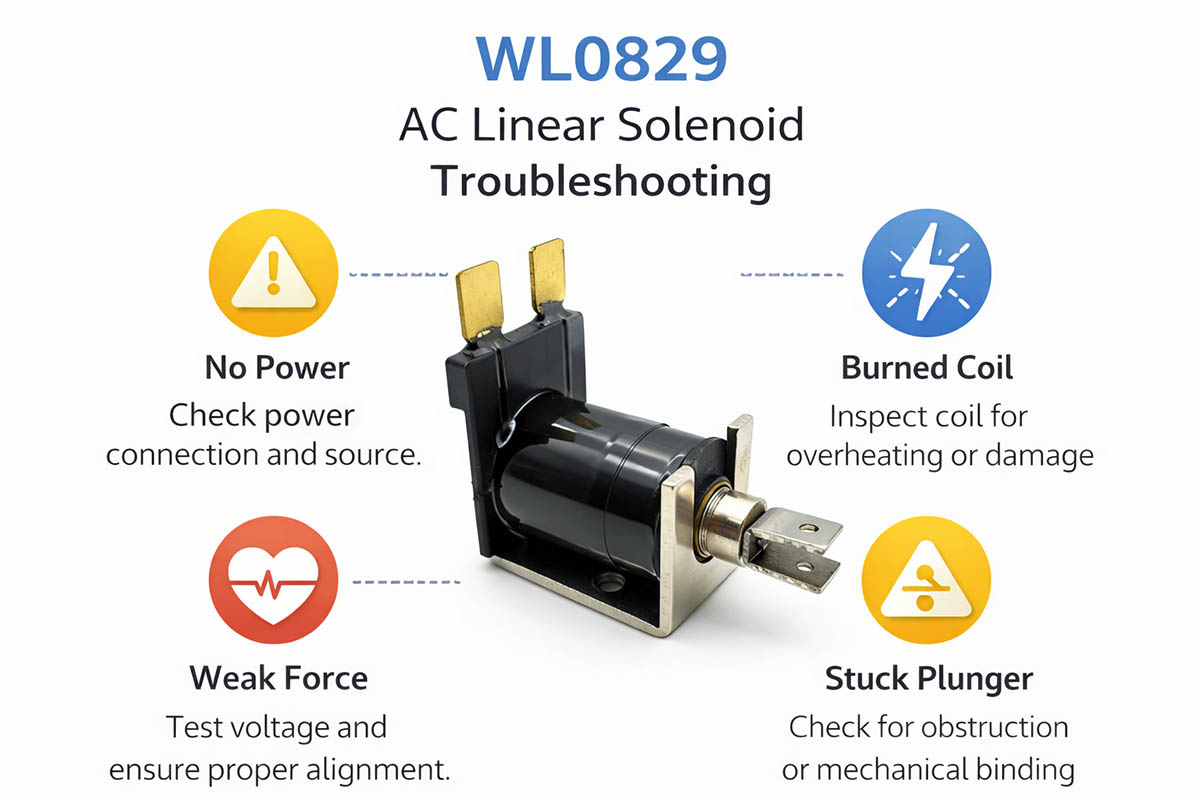
1. Solenoid Not Working (No Movement)

Possible Causes:

No power supply or incorrect voltage

Loose or broken wiring

Coil burnout (open circuit)

Internal plunger stuck

Solutions:

Check AC power supply and confirm correct voltage

Inspect wiring connections and terminals

Measure coil resistance with a multimeter

Clean and lubricate plunger if jammed

2. Weak or Insufficient Force

Possible Causes:

Low voltage or unstable power

Coil overheating

Excessive load beyond design limit

Air gap too large

Solutions:

Ensure proper rated voltage is applied

Allow cooling or improve ventilation

Match solenoid force with load requirements

Adjust installation to reduce air gap

3. Overheating Issue

Possible Causes:

Continuous duty beyond rating

Poor ventilation

High ambient temperature

Incorrect voltage input

Solutions:

Use intermittent duty model if needed

Improve airflow or add cooling

Verify correct voltage supply

Choose higher duty-rated solenoid

4. Noise or Buzzing Problem

Possible Causes:

Missing or damaged shading coil

Loose mounting

AC frequency mismatch

Worn internal components

Solutions:

Check shading coil condition

Tighten mounting screws

Confirm correct frequency (50/60 Hz)

Replace worn parts

5. Slow or Delayed Response

Possible Causes:

Dirt or debris inside

Weak return spring

Low voltage supply

Coil aging

Solutions:

Clean internal components

Replace return spring

Stabilize power supply

Replace solenoid if aging

6. Plunger Sticking or Not Returning

Possible Causes:

Rust or contamination

Misalignment during installation

Damaged spring

Excessive side load

Solutions:

Clean and apply light lubrication

Reinstall with proper alignment

Replace spring

Avoid side force on plunger

7. Coil Burnout (Frequent Failure) Possible Causes:

Overvoltage or voltage spikes

Continuous energizing without rest

Poor insulation quality

High ambient temperature

Solutions:

Use correct voltage and surge protection

Follow duty cycle specifications

Use higher quality or upgraded coil

Improve cooling conditions

✅ Quick Maintenance Tips

Regularly clean dust and debris

Check wiring and connections periodically

Ensure proper voltage and frequency

Avoid overloading or continuous overuse

Store in dry, non-corrosive environments

FAQ sections about AC Linear Solenoids

1. What is an AC linear solenoid?

An AC linear solenoid is a kind of electromechanical device that turns alternating current (AC) electricity into linear motion. It usually has a coil, an iron core, and a plunger (armature) that can move. When powered, it creates a magnetic field that moves the plunger back and forth.

2. What does an AC linear solenoid do?

When AC voltage is applied, the coil makes a magnetic field that changes. A shading ring keeps the magnetic flux from moving around and vibrating. This lets the armature move in a straight line without any bumps.

3. What makes solenoids that work with AC and DC different?

The main difference is the power source and how well they work:
AC solenoids: respond faster, have more initial force, and might make noise.
DC solenoids: work better, are quieter, and can be used all the time.

4. What causes an AC solenoid to make noise?

The changing magnetic field in AC solenoids can make a humming noise. A shading ring can help lessen this vibration, but some noise is still normal, especially in designs that aren’t very good.

5. What is a shading ring, and why is it important?

A shading ring, which is made of copper, is put on part of the core. It makes a magnetic field that is out of phase, which makes things run more smoothly and cuts down on vibration. This keeps the armature from opening and closing too quickly.

6. Can AC solenoids work all the time?

Yes, but only if they have to work all the time (100% duty cycle). If not, the device could get too hot. Always check the duty cycle rating before using.

7. What should you keep in mind when picking an AC solenoid?

Things that are important are:
Rated voltage, like 110V or 220V AC
Length of the stroke
Need for strength
Duty cycle
The conditions in which it operates (temperature, humidity)
The size and limits of the mount

8. Things that are important are: Rated voltage, like 110V or 220V AC Length of the stroke Need for strength Duty cycle The conditions in which it operates (temperature, humidity) The size and limits of the mount

People use AC solenoids a lot in:
Tools that make factories run on their own
Things like coffee makers and washing machines that you use at home
Things that machines sell
Tools used in medicine
Locks and systems for opening and closing doors

How to Select an AC Linear Solenoid

Choosing the right AC linear solenoid requires evaluating several key technical parameters to ensure reliable and efficient performance.

1. Define Force Requirements

The first step is to determine the required pull or push force.

Calculate load weight and friction

Add a safety margin (typically 20–50%)

Consider starting force vs holding force

👉 Tip: AC solenoids usually have high initial force, which decreases over stroke.

2. Determine Stroke Length

Define how far the plunger needs to move (mm)

Match solenoid stroke to your application

Avoid using full stroke unless necessary (reduces lifespan)

3. Select Voltage and Frequency

Choose correct AC voltage (e.g., 24V, 110V, 220V)

Match frequency (50Hz or 60Hz)

Ensure stable power supply

👉 Wrong voltage/frequency can cause overheating or poor performance.

4. Duty Cycle (Working Mode)

Continuous duty (100% ON)

Intermittent duty (e.g., 25%, 50%)

👉 Important to prevent overheating.

5. Response Time Requirement

Fast switching needed?

Check pull-in and release time

👉 AC solenoids are ideal for rapid, repetitive actions.

6. Installation Space & Mounting

Check size constraints (length, width, height)

Choose mounting type:

Frame type

Tubular type

Open frame

7. Operating Environment

Consider:

Temperature range

Humidity / dust conditions

Vibration or shock

👉 For harsh environments, choose sealed or protected designs (IP rated).

8. Noise and Vibration

AC solenoids may produce humming noise

Ensure shading coil design is included

👉 Important for medical or indoor equipment.

9. Lifespan & Reliability

Check expected cycle life

Choose high-quality materials (copper coil, iron core)

Consider maintenance requirements

10. Customization Requirements

If standard models don’t fit, consider:

Custom stroke length

Special voltage

Mounting brackets

Connector type

11. ✅ Quick Selection Formula (Engineering Reference)

Force requirement can be approximated as:

F ≥ Load + Friction + Safety Margin

12. ✅ Common Mistakes to Avoid

❌ Choosing based on size only
❌ Ignoring duty cycle → leads to burnout
❌ Using DC solenoid for AC application (or vice versa)
❌ Not considering heat dissipation
❌ Underestimating required force

13. ✅ Simple Selection Checklist

✔ Required force (N)
✔ Stroke length (mm)
✔ Voltage & frequency
✔ Duty cycle (%)
✔ Mounting size
✔ Environment conditions
✔ Noise requirement

Get A Free Quote Now

Contact Form

Related Products

Related News

Chapter 1 : What is a Metal Stamping Die? Metal stamping die (also called stamping tool, press tool or metal die) […]

Scroll to Top

Get A Free Quote Now !

Contact Form
If you have any questions, please do not hesitate to contact us.
Weilong Solenoid Company Culture
