Rotary Solenoid Valve Working Principle Explained
Industrial Rotary Solenoid Valve Overview Guide
Rotary Solenoid Valve Design and Application Guide
Rotary Solenoid Valve Features and Benefits
Rotary Solenoid Valve vs Linear Solenoid Valve
Tips for Choosing the Right Rotary Solenoid Valve
Rotary Solenoid Valve Working Principle Explained
Industrial Rotary Solenoid Valve Overview Guide
Rotary Solenoid Valve Design and Application Guide
Rotary Solenoid Valve Features and Benefits
Rotary Solenoid Valve vs Linear Solenoid Valve
Tips for Choosing the Right Rotary Solenoid Valve

WL0835 Rotary Solenoid Valve: Complete Guide

What is a rotary solenoid valve?

A rotary solenoid valve refers to an electromagnetic devicethath transforms electrical energy into controlled rotary motion in the process of opening or closing the path for the flow of gas or fluid. Unlike the normal solenoid, the solenoid valve rotates the armature or shaft by a certain angle in the process of opening or closing the valve. The parts of the solenoid valve include the coil, armature, shaft, spring, and valve body. The operation of the solenoid valve occurs when the coil produces a magnetic field which, on the flow of electric current, turns the armature, thus opening or closing the valve and allowing the flow of gas or liquid through the valve. Because of their small size, high rate of response, and reliability, the solenoid valves are used in many industrial processes, medical, automotive, and precision control devices.

Rotary solenoid valves are small and effective in rotation control. The main feature of the rotary solenoid valve is its capability to transform electrical energy into precise rotary motion. Rotary solenoid valves react quickly and have a simple mechanical structure compared to traditional valve actuators. They work well and don’t need much maintenance. They are small and thus best suited for use in places with limited space. They are long-lasting and can work for millions of cycles. They are commonly used in automated systems that need precise and reliable control of fluids because they can be set to specific rotation and voltage levels

WL0835 Rotary Solenoid Valve Description

The Overview of Rotary Solenoid Valve

A rotary solenoid valve is a small electromagnetic device that rotates to control fluid flow. This valve combines both electromagnetic and mechanical valve control to offer fast response time, reliability, and precise control of fluid flow. As a result of their efficiency, reliability, and compactness, rotary solenoid valves are widely used in modern automation and fluid control applications.

WL0835 Bistable Rotary solenoid Valve Video

Rotary Solenoid Valve for Precision automation Control

WL0835 Rotary Solenoid Valve Technical DataSheet

Brand Weilong Technology Model Number WL 0835
Rated Voltage (V) DC 12V , 16V or 24V Rated Power(W) 38.5–45W
Work Model Rotation Type Holding Force (N)  150 GF-200 GF
Stroke(mm) 2 MM or Customized Reset Time(s) 1 S
Service Life 1,000Thousand Times Certification CE,ROHS,ISO9001,
Material Sofety Iron Lead Wire Length(mm) 200
Install Style screw Tolerance of Dimension  +/-  0.1 MM
Water-proof  None Insulation Class B
Hi-Pot Test AC 600V 50/60Hz 2s Non-excitation Holding Force 0
Working Temperature -10°C-100°C Duty Cycle 1-100%
Thread Depth(mm) / Payment Term TT, or LC At Sight
Sample Order Yes Warranty 1 Year
MOQ 1000 PCS Supply Ability 5000 pcs per Week
Delivery Time 30 Days Port of Loading shenzhen

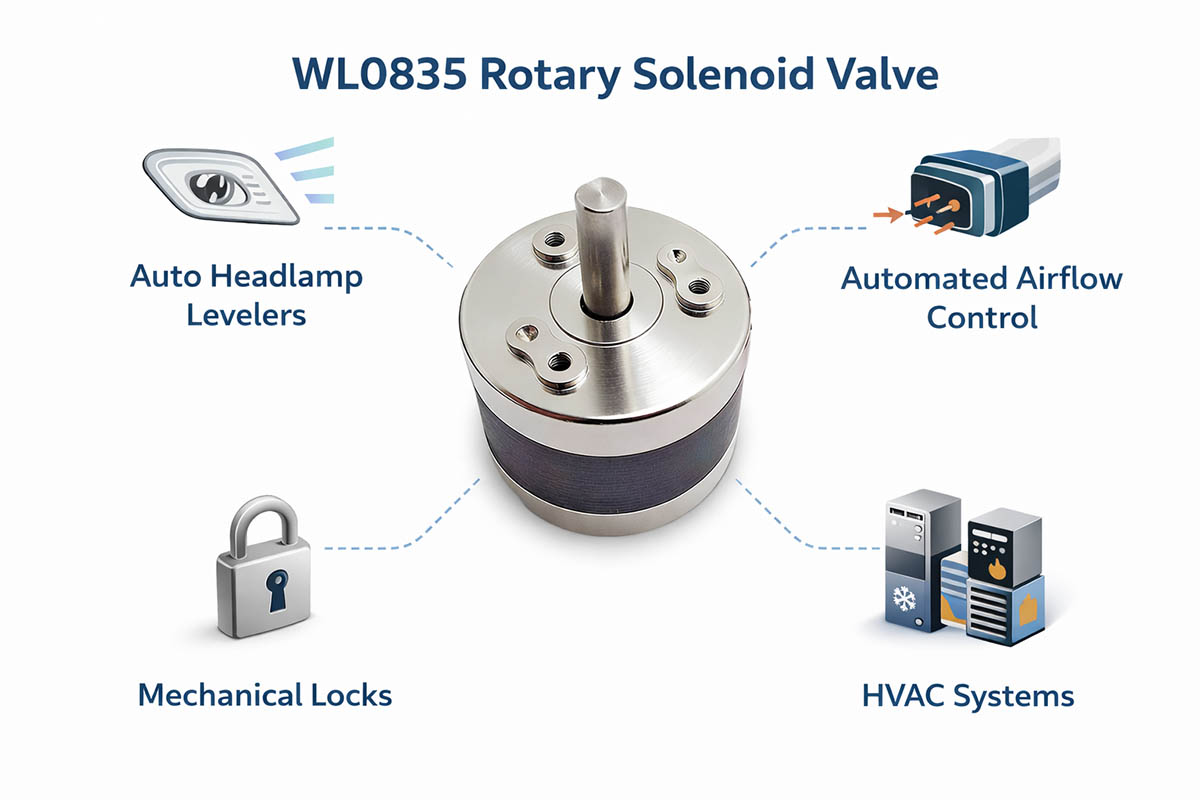
WL0835 Rotary Solenoid Valve Application

WL0835 Rotary Solenoid Industrial Application

Rotary solenoid valves are used in many industries and technical fields because they are small and can control things with high precision.

Rotary solenoid valves are used in automated production systems to control the flow of air, gas, or liquid. They react quickly, and the system works better and more precisely.

The car industry uses the rotary solenoid valve in its systems, which control fuel, emissions, and the flow of fluids. They work well, and their reliability ensures they work well even in tough conditions.

The medical equipment industry also uses the rotary solenoid valve, which is useful in diagnostic machines, laboratory automation, and the control of the flow of fluids, among other uses.

Rotary solenoid valves control water flow in irrigation and water management systems. It is through this control that water is utilized optimally.

Rotary solenoid valves find extensive use in smart appliances, beverage machines, chemical processing equipment, and pneumatic control systems. It is through engineering that engineers have been able to design small reliable fluid control systems. This is because they have been able to control the rate at which things spin.

Rotary solenoid valves play an important role in fluid control technology. This is because they are flexible and reliable.

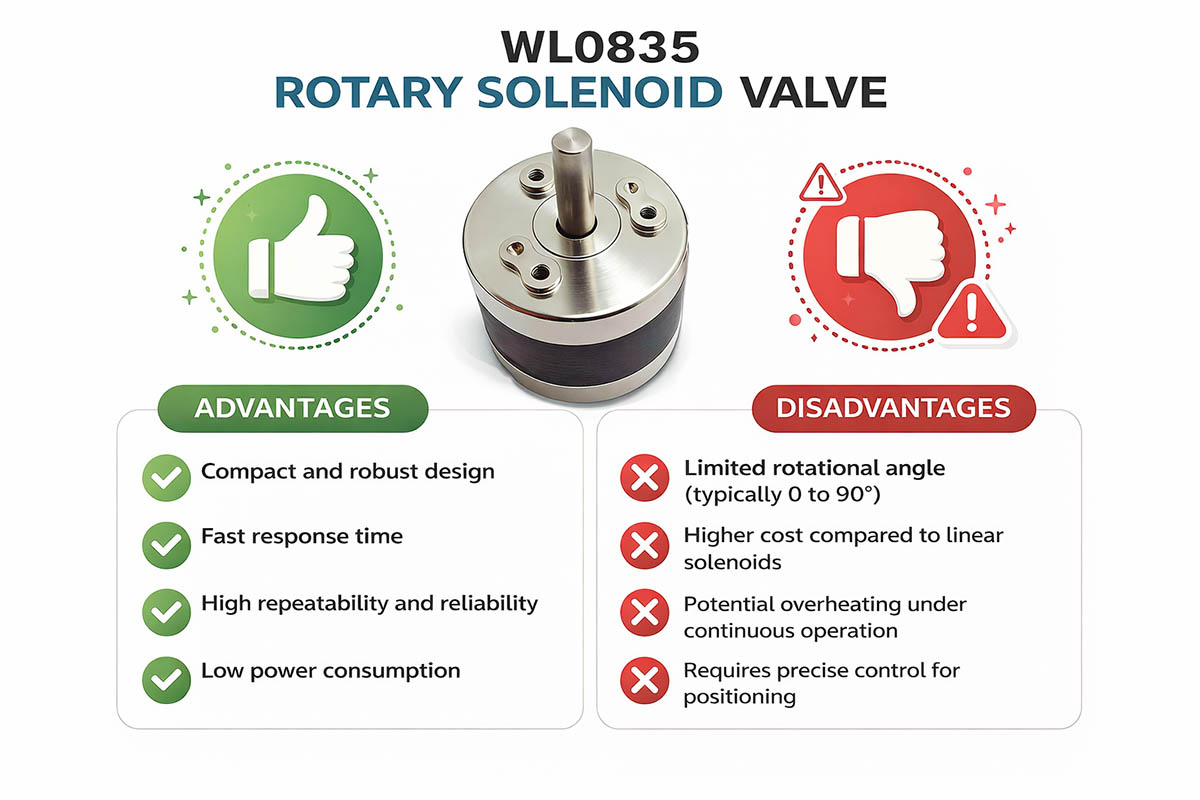
Advantages and Disadvantages of Rotary Solenoids Valve

WL0835 Rotary Solenoid Valve Advantage and Disadvantage

Pros

One of the best things about rotary solenoids are that they can control rotation with great accuracy. It is through this accuracy that rotary solenoids can control valves with controlled angular movement. It is through this accuracy that rotary solenoid valves have proved to be more accurate compared to linear solenoids.

Another advantage is that rotary solenoids respond very fast. It is through this response that rotary solenoid valves have been able to respond to electrical signals very fast. It is through this response that rotary solenoid valves have proved to be very reliable. Another advantage is that rotary solenoid valves are very strong and reliable. It is through this strength that rotary solenoid valves have been able to operate for millions of cycles.

Cons

Rotary solenoids have a number of drawbacks. Despite all the good things associated with rotary solenoid valves, there is a drawback. It is through this drawback that rotary solenoid valves have been able to find use. One of the drawbacks is that rotary solenoid valves only allow rotation to a very small extent. It is through this drawback that rotary solenoid valves have been able to find use. Another drawback is that rotary solenoid valves may get hot if used all the time.

Additionally, the rotary solenoid valves may not be able to handle as much torque as the motor-driven actuators, and this makes them less useful for applications that involve a lot of weight.

In general, they are best used for applications that require precise control and moderate torque.


FAQ of WL0835 Rotary Solenoid Valve

1. What are the usual angles of rotation for rotary solenoid s?

Most rotary solenoid valves are only able to rotate at certain angles, such as 30°, 45°, 60°, or 90°. The exact angle will depend on the design and needs of the valve. Some manufacturers also allow for custom angles for certain applications.


Most rotary solenoids are only able to rotate at certain angles, such as 30°, 45°, 60°, or 90°. The exact angle will depend on the design and needs of the valve. Some manufacturers also allow for custom angles for certain applications.

Most rotary solenoid valves are only able to rotate at certain angles, such as 30°, 45°, 60°, or 90°. The exact angle will depend on the design and needs of the valve. Some manufacturers also allow for custom angles for certain applications.


3. What kind of businesses use rotary solenoid valves?

There are many different applications for rotary solenoid valves, such as:

Automation for factories

Fluid control for cars

Tools for the lab and medical industry

Water and irrigation control

Control devices for air and water

Food and drink products

This is because they are so small and require such accurate control.

4. How long does a Rotary Solenoid VS usually last?

The longevity of a well-designed rotary solenoid valve will depend on its working conditions. For instance, it is believed that high-quality rotary solenoid valves can last more than 1 million cycles under normal conditions. By controlling the voltage and keeping it cool, it is likely to last for a longer period of time.


5. What should you think about when choosing a Rotary Solenoid Valve?

Some of the things to consider when selecting a rotary solenoid valve include:

Voltage for operation

Torque output requirement

Angle of rotation

Time to respond

Duty cycle

Temperature of operation

Compatibility with fluids and gases

Size of installation and mounting

Considering all these factors is crucial to ensure that it works well.


6. Is it possible to change the settings on rotary solenoid valves?

Yes, it is believed that many companies that manufacture rotary solenoid valves offer custom designs. For instance, custom designs may include custom rotation angles, voltage for operation, torque output, and mounting. This ensures that it meets all the requirements of the equipment and its working conditions.


How to Choose the Right Rotary Solenoid Valve

The choice of a suitable rotary solenoid valve is critical in ensuring that your system is not only efficient but also durable and performs well. Rotary solenoid valves are electromagnetic-to-rotary converters that are widely used in fluid control, automation, locking, and switching applications.

This is a great guide for engineers to choose the appropriate rotary solenoid valve for your system.

1. Set the Application Requirements

The first step in choosing a rotary solenoid valve is to identify the function of the valve in your system.

Important Questions to Ask:

Is it used to control fluids, air flow, or mechanical switches?

Is it normally closed (NC) or normally open (NO)?

Does it have to work all the time, or only sometimes?

Does it have to work in places with lots of dust, moisture, and vibration?

Some of the devices are:

Automation in industry

Devices for health care

Systems for locking up security

Systems for controlling fuel

Mechanisms for satellites and space travel

2. Find the angle of rotation that is required

Rotary solenoids are only able to turn through a limited angle.

They can turn between:

15° and 30° for small switches

30° and 45° for opening and closing the valve

45° and 90° for mechanical indexing

So, it is important to get this right to ensure that the valve can be opened and closed without too much stress on the valve.

3. Check the Torque Requirements

Torque is one of the most important requirements.

You have to work out just how much torque is required to operate the valve mechanism.

Key factors:

Friction within the valve

Resistance to load

Force of spring return

30-50% more torque is usually allowed as a safety factor.

Solenoids with high torque requirements usually have larger coils.

4, What kind of power and voltage should we use?

There are different voltage requirements for rotary solenoid valves.

Some of the standard voltage requirements are:

5V / 12V / 24V DC

AC 110V / 220V

This depends on the power supply available.

Consider:

What kind of power it consumes

Making heat

Efficiency of energy

Low power and bistable rotary solenoids are usually best suited to battery-powered systems.

5, Make a choice between monostable and bistable types.

There are two types:

Rotary solenoid with one stable state

It goes back to its original state when there is a power outage.

Has spring return

Suitable for constant control

Rotary solenoid with two states (latching)

Does not lose place without power

Efficient in terms of power

Suitable for long-distance control, aerospace, and battery-powered devices

6. Consider response time

Some apps have to respond quickly.

Average response times:

10 to 50 milliseconds if it is to be used in apps that require a lot of speed

50 to 200 milliseconds if it is to be used in industry in general

Inrush current, which is the amount of current required to get into a circuit, has to be high.

7, Consider the state of the environment

Solenoids are affected significantly by their environment.

Consider these:

Suitable range of temperatures

Resistant to humidity

Suitable IP rating

Resistant to vibration

Protected from rust

For extreme conditions:

Cases are sealed

Shaft is made of stainless steel

Insulation is provided if it is to be exposed to high temperatures

8.Consider cycle life and duty cycle

Cycle life ratings vary between solenoid valves.

Ratings:

500,000 cycles if it is to be used lightly

1 to 5 million cycles if it is to be used in industry

10 million or more cycles for systems with high reliability

Also, look at the duty cycle:

Duty all the time

Duty that comes and goes

Operation of the pulse

9. Check the mounting and size limits

People often forget about mechanical integration.

Look:

Positions of the mounting holes

Diameter of the shaft

Total size

Weight

Medical and electronic devices often need compact rotary solenoids.

10.Look over the options for customizing

Most rotary solenoid valves need to be designed specifically for the job at hand.

Some common ways to customize are:

Design of the shaft is special

Angle of rotation that can be changed

Housing that is sealed or waterproof

Type of connector

Voltage for special coils

Working with a manufacturer who has been around for a while can help you make the best design.

Checklist for Choosing Keys

Before you finish your rotary solenoid valve, make sure of the following:

Angle of rotation needed

Necessary torque output

Voltage for operation

How much power it uses

How fast you respond

Protection of the environment

Duty cycle and how long it will last

Size of the machine

✅ Conclusion

When choosing the right rotary solenoid valve, there are several factors to consider, such as the torque, the angle of rotation, the use of power, and the environment. This makes sure that it works consistently, requires little maintenance, and lasts for a long time. Before choosing a rotary solenoid valve for their system, engineers should always look at both electrical and mechanical factors.

Get A Free Quote Now

Contact Form

Related Products

Related News

Chapter 1 : What is a Metal Stamping Die? Metal stamping die (also called stamping tool, press tool or metal die) […]

Scroll to Top

Get A Free Quote Now !

Contact Form
If you have any questions, please do not hesitate to contact us.
Weilong Solenoid Company Culture
