Tubular Push Pull Solenoid for Industrial Use
Reliable Tubular Push Pull Solenoid Solutions
Precision Tubular Push Pull Solenoid Design
High Performance Tubular Push Pull Solenoid
Durable Tubular Push Pull Solenoid Systems
Tubular Push Pull Solenoid for Automation
Tubular Push Pull Solenoid for Industrial Use
Reliable Tubular Push Pull Solenoid Solutions
Precision Tubular Push Pull Solenoid Design
High Performance Tubular Push Pull Solenoid
Durable Tubular Push Pull Solenoid Systems
Tubular Push Pull Solenoid for Automation

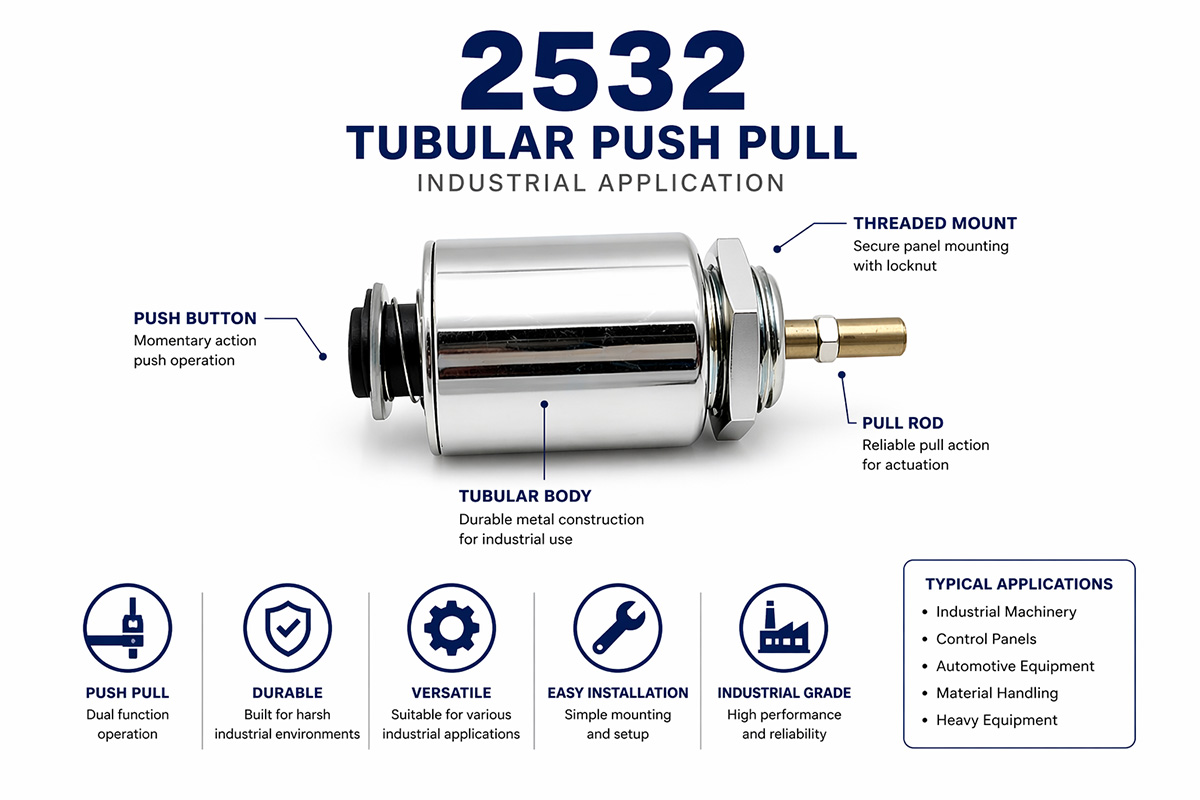
WL2532 Tubular Push Pull Solenoid Manufacturer

What does a tubular push pull solenoid mean? It’s a small electromagnetic device which turns electrical energy into linear motion. It consists of a coil, a plunger, and a housing. When the coil gets electrical energy, it produces a magnetic field in the tube, which forces the plunger to move towards the coil (pull) or away from the coil (push). Once the coil loses its electricity, a spring returns the plunger to its former position. These compact devices have improved protection, increased force, and enhanced longevity compared to frame solenoids. Tubular push-pull solenoids are widely used in automation, locking devices, medical equipment, and industrial machines.

Main characteristics of tubular push pull solenoid

Small, tubular shape with high efficiency ; High force output with low losses; Quick reaction and precise straight motion; Durable design resistant to any external factors ; Stable performance and long service life ; Adjustable stroke length, voltage, and force; Quiet operation

WL2532 Tubular Push Pull Solenoid Product Overview

This small but powerful electromagnetic unit transforms electrical energy into mechanical linear motion. The main difference is that it is enclosed in a tubular housing, which gives an opportunity to obtain high efficiency, high force output, and minimal energy losses. Push and pull functions, good protection, and fast reaction time make it the best solution for many types of jobs. It’s mainly used in industrial facilities, the automotive industry, medical applications, vending machines, automation devices, etc. Tubular push-pull solenoids are preferred by engineers and designers due to their efficiency, reliability, and durable exploitation.

WL2532 Tubular Push Pull Solenoid Video

WL2532 Tubular Push Pull Solenoid Detailed Display

Tubular Push Pull Solenoid Product Datasheet

Brand Weilong Technology Model Number WL2532
Rated Voltage (V) DC12V  or 24V Rated Power (W) 7-10 W
Work Mode Push and Pull Holding Force (N) 300 Gf
Stroke(mm) 2-5 MM Customized Working Duty Continuous
Service Life 200 Thousand Times Certification CE,ROHS,ISO9001,
Material Superior Magnet Iron Lead Wire Length(mm) 200 MM
Install Style Screw Tolerance of Dimension  +/-  0.1 MM
Water-proof  None Insulation Class B
Hi-Pot Test AC 600V 50/60Hz 2s Non-excitation Holding Force 0
Working Temperature -10°C-100°C Duty Cycle 1-100%
Thread Depth(mm) / Payment Term TT, or LC At Sight
Sample Order Yes Warranty 1 Year
MOQ 1000 pcs Supply Ability 5000 pcs per Week
Delivery Time 30 Days Port of Loading shenzhen

Tubular Push Pull Solenoid Industrial Application

Tubular Push Pull Solenoid Industrial Application

How it works

This small electromagnetic unit works according to the simplest physical laws of magnetism. If electricity passes through the coil, it creates a magnetic field. That magnetic field attracts the ferromagnetic material which constitutes a plunger. According to its design, it moves either to the center of the coil (pulls in) or moves away from it (pulls out). When electricity stops, the return spring brings back the plunger to its original position. Thus, it provides quick reactions, precise motions, and repeatability.

Fields of application

Due to its compactness and excellent properties, tubular push-pull solenoids are widely used in industrial, medical, and automotive industries. In automation, such solenoids serve as drives for moving parts in machines, providing fast positioning, sorting, and other tasks. The automotive industry utilizes tubular push-pull solenoids in door locks, fuel systems, and other parts that require quick actions and precise movements. Medical devices also employ them for diagnostic purposes or control systems. Moreover, they are widely used in vending machines, office equipment, smart locking systems, and many other products that require fast reactions and precise operations.

Advantages and Disadvantages of Tubular Push Pull Solenoid

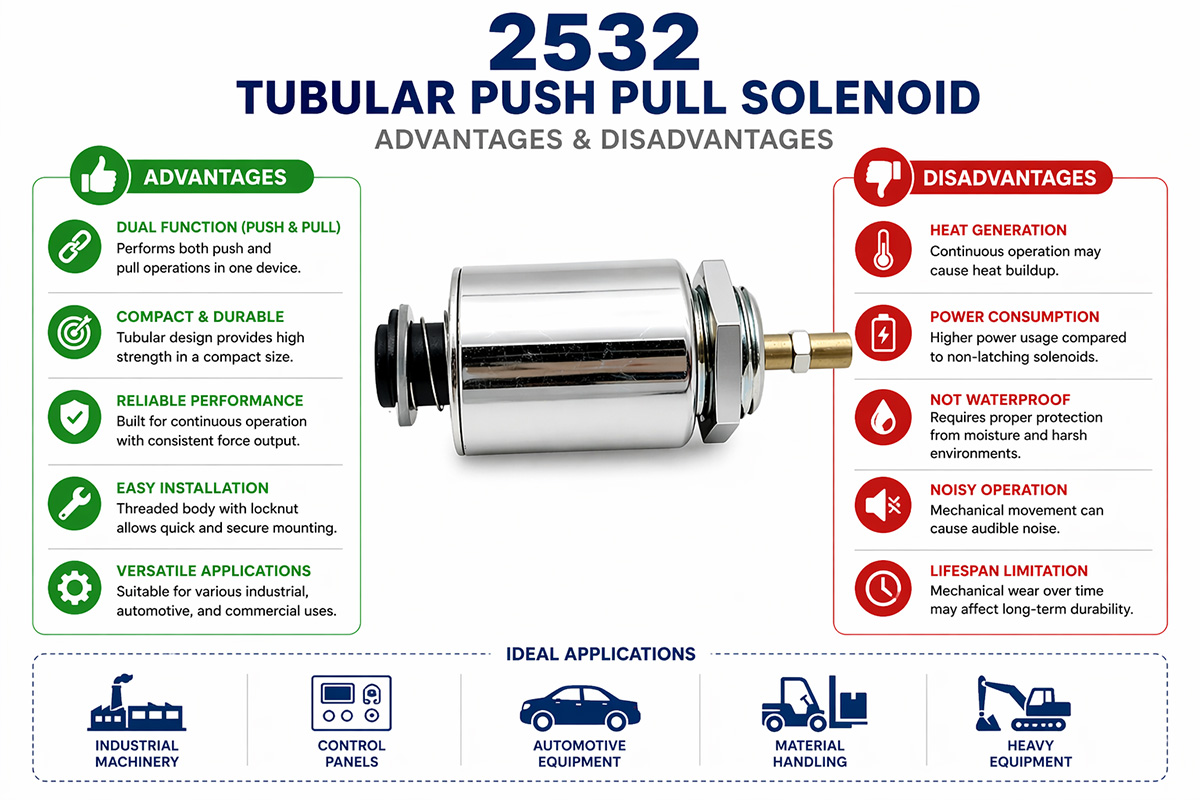
WL2532 Tubular Push Pull Solenoid Advantage and Disadvantage

Tubular Push Pull Solenoid Advantages:

– High efficiency due to magnetic circuit and high force output with minimal energy consumption

– Small, compact form which takes up less space

– Protection from dust and any external factors that increase longevity

– Fast responses and linear movement that makes them ideal actuators

– Customization options

Tubular Push Pull Solenoid Disadvantages:

– Maximum force is produced only at the beginning of the movement and gradually drops

– Excessive heat generation due to improper design of the duty cycle

– More expensive than simple open-frame solenoids

– Needs careful choosing regarding stroke, voltage, and required force output

All in all, tubular push-pull solenoids are useful units in proper industrial settings.’

Tubular push-pull solenoid troubleshooting guide

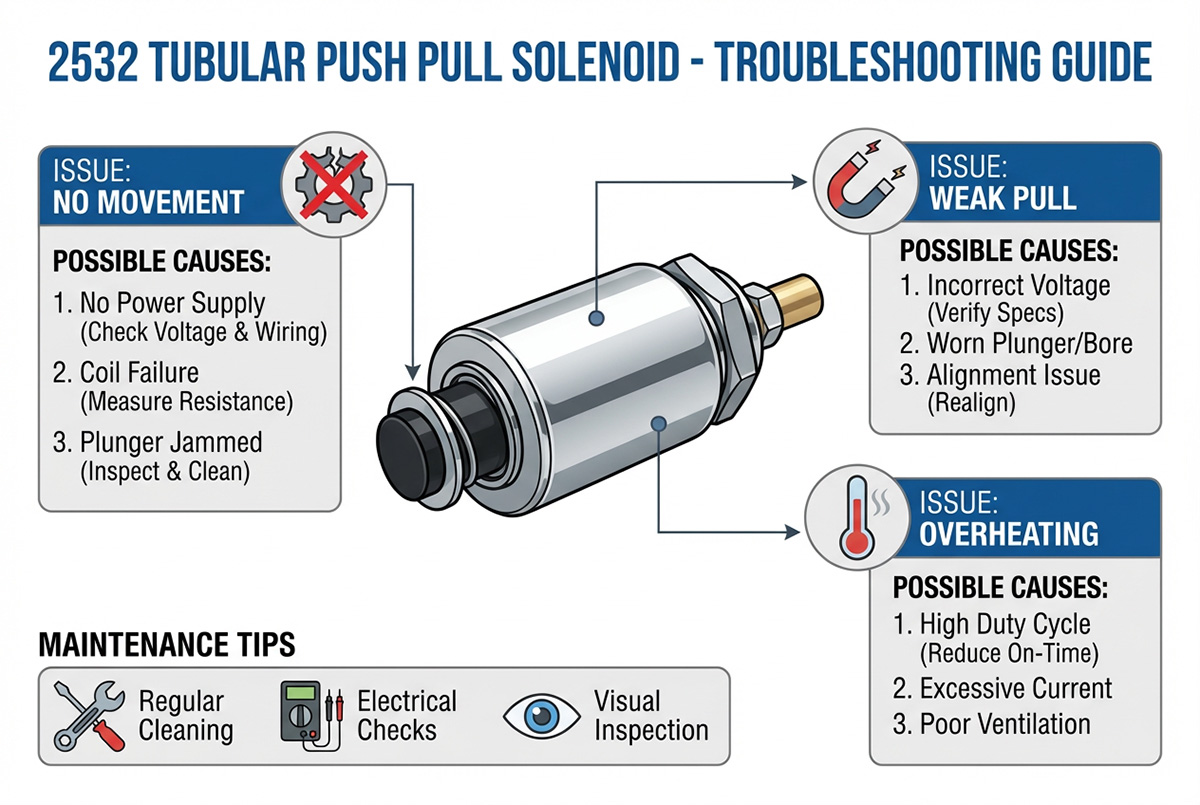
WL2532 Tubular Push Pull Solenoid Troubleshooting Guide

In repairing a tubular push-pull solenoid, you need to identify and address the most common issues in a structured and systematic manner. Not operating is one such common issue. This may result from lack of enough voltage, inadequate electrical connections, or damage to the coil. Start by testing the power supply and ensuring the wiring is up to the required standards.

Weak or inconsistent force may be attributed to low input voltage, overloading, or wear and tear. It is necessary to establish if there is an excess load demand for the specific solenoid. Dust or any other dirt around the plunger needs to be checked, as it affects the movement.

Overheating is yet another major problem. This may emanate from operation outside the recommended duty cycle. Operate the solenoid according to the recommended duty cycle. In cases where constant operation is expected, a continuously operational solenoid is necessary.

Unusual sound or stuck components point to misalignment or wear and tear. This should be confirmed through checking the mountings as well as the alignment of the plunger.

To get optimum performance from solenoids for years, you need to keep them serviced regularly, choose the correct model to use, and mount it the proper way.


FAQs Of Tubular Push Pull Solenoid

1. What is a tubular push pull solenoid, and how does it work?

A tubular push pull solenoid is a type of solenoid that uses the concept of electromagnetism. It is coiled in a steel tube forming a good magnetic circuit.

– A tubular push pull solenoid of Pulling: In this design, the plunger is attracted to the coil when current is passed.

– A tubular push pull solenoid of Pushing: Here, the plunger moves out of the coil body when current is applied. Such types of solenoids are used when releasing parts.

2. How does it differ from open-frame solenoid?

The main difference is the presence of the metal housing, which not only protects the solenoid but also increases performance.

– Better magnetic efficiency: Due to the enclosed design, it directs the magnetic field, giving increased force output in comparison to the size.

– Durable: They can last longer compared to open frames since they are more protected from the environment.

– Reduced noise: They produce less noise than open frames.

3. How do I select the right stroke and force?

In selecting a solenoid, there is always trade-off between stroke and output. Force changes as a function of stroke. The force exerted decreases as stroke increases.

– For shorter strokes (2-5mm): These provide strong holding force and are used where there is repeated operation.

– Longer strokes (10-30mm): Are ideal for larger displacements, although the force exerted is low.


4. What is duty cycle, and why is it significant?

Duty cycle refers to the ratio of energized time to total time of operation. If a solenoid is energized for 1 seconds and de-energized after 3 seconds, the duty cycle is 25%.

– Continuous duty (100%): Can be run for any duration without overheating but heat control is important.

– Intermittent duty (1-50%): Provide higher power and force with intervals for cooling.

Warning: Running a solenoid outside its recommended duty cycle causes overheating that may lead to coil insulation breakdown, resulting in burnout.

5. What are the common requirements?

Solenoids mostly fall under standard ratings although special designs are available.

– Voltage: 12V DC, 24V DC, and 24V AC are the common voltages used.

– Power consumption: Is dependent on size as well as type. From a few watts to over 90W.

– Polarity: Can work with any polarity of DC supply except in bistable type which uses permanent magnet.


6. Do tubular solenoids have a spring?

They don’t normally have a spring. The plunger remains fixed in the place it settles once de-energized. There is a need for an external spring to allow it go back to original place.


7. Why is my solenoid getting too hot or malfunctioning?

The two leading reasons are related to electrical or mechanical problems.

– Coil burnout (hot or not moving): Mainly results from running outside the duty cycle, wrong voltage rating, or short circuit. A multimeter can help in confirming this problem, and then replacement is needed.

– Incorrect wiring (intermittent): This issue is mostly due to loose connections or broken terminals. Tightening the connection fixes the problem.

– Loose iron core (weak): Internal components may move due to vibration. Replacing is necessary.


8. How should I mount and maintain it?

Proper alignment of the plunger and the load prevents additional load due to misalignment, reducing friction thus providing consistent force output. It may even last 20% longer if well aligned. Rust-free nuts are preferable, and mounting surfaces should be smooth. For electrical wires, 18 AWG is sufficient for 12V/3A solenoids.


Choosing the Best Tubular Push Pull Solenoid

To ensure smooth performance and longevity of your tubular push pull solenoid, you need to take several important parameters into account. First, it is necessary to evaluate the required amount of force that will allow the device to move a load during operation. This factor takes into account possible safety margins, the load weight, and friction effects.

It is also important to consider the stroke length. This parameter is necessary because a correct choice allows the device to work properly and does not cause undue strain.

The power supply and the type of voltage are crucial. Choose a tubular push pull solenoid with the same voltage as your system (AC or DC). Incorrect voltage leads to poor performance and overheating of the device.

A duty cycle is an essential criterion. In case of continuous usage, it is better to have a solenoid with the possibility of a long duty cycle; otherwise, it is possible to consider a device with intermittent work but high force.

Environment plays an important role. For harsh conditions, it is necessary to choose models that will protect against moisture, dust, and extreme temperatures.

Fast response is crucial for automation systems. With a high speed of the process, the efficiency of the production line increases.

Size restrictions and mounting capabilities should also be taken into account. The advantages of tubular models are evident, but size is still important.

Lastly, choose a good tubular push pull solenoid manufacturer who will offer customized models and excellent technical assistance. It is recommended to order a sample and evaluate its performance.

Get A Free Quote Now

Contact Form

Related Products

Related News

Chapter 1:  What is a Tubular Solenoid? Tubular solenoids are miniature electromagnetic actuators which convert electrical energy into accurate linear […]

Scroll to Top

Get A Free Quote Now !

Contact Form
If you have any questions, please do not hesitate to contact us.
Weilong Solenoid Company Culture
