Micro Tubular Solenoid for Industrial Use
Industrial Micro Tubular Solenoid Solutions
High-Precision Micro Tubular Solenoid
High-Precision Mini Tubular Solenoid factory
Compact Micro Tubular Solenoid for Industry
Micro Tubular Solenoid for Smart Devices
Micro Tubular Solenoid for Industrial Use
Industrial Micro Tubular Solenoid Solutions
High-Precision Micro Tubular Solenoid
High-Precision Mini Tubular Solenoid factory
Compact Micro Tubular Solenoid for Industry
Micro Tubular Solenoid for Smart Devices

WL0916 Micro Tubular solenoid Guide

Micro Tubular solenoid is an electromagnetic actuator with small dimensions that converts electrical energy to precise linear motion. Micro Tubular solenoid is different from other solenoids. This distinction is because it has an uninterrupted, seamless, high-nickel steel shell that contains copper coil windings, a movable plunger, or armature, and a return spring assembly. The tubular solenoid’s design helps the magnetic flux function better. This means it is capable of producing more force for its size than other solenoids. These solenoids are used where space is limited, but precise motion is necessary. The solenoid’s copper coil is usually powered, causing it to attract the plunger. This means that the plunger will always move straight. The solenoid will return to its original position by a return spring built inside.

 The features of micro tubular solenoid

  • Small size: The diameter can range from 6mm to 20mm, making it perfect for small designs.
  • Small force density: This solenoid is different from other solenoids. This advantage is because it is capable of producing a smaller force for its size than other solenoids.
  • Custom stroke length: The stroke length can range from 2mm to 5 mm.
  • Voltage: The solenoid can function at either 6V, 9V, 12V, or 24V. This voltage can have an accuracy of ±10%.
  • Duty Cycle Flexibility: It can run continuously or only sometimes with any desired on/off times.
  • Quality of the material: The plunger is made of stainless steel with anti-friction coating. It resists high temperatures (Class F 155°C).
  • Protecting the environment: IP40 to IP67 rating for harsh environments.
  • Long operational life: It is designed for 1 million cycles or more under various conditions.

WL0916 Micro Tubular Solenoid Overview

A micro tubular solenoid is a precise actuator that is designed to move in a straight line in a cylindrical tube. The design of this solenoid prioritizes magnetic efficiency and is capable of producing a large force despite its small size, with diameters starting at 8 mm.

This solenoid consists of a high-carbon steel case containing a precision-wound copper coil, a moving plunger typically made of stainless steel with an anti-friction coating, and a return spring. The coil produces a magnetic field when an electric current is applied to it, and this field attracts the plunger into the tube and causes it to move in a straight line. The spring returns the plunger to its normal position when the power is turned off.

All these parts may be provided in either a push or pull version, and the stroke, voltage (3V to 24V DC), duty cycle (continuous or intermittent), lead wire type, and environmental sealing to IP40 to IP67 may also be varied. The solenoids are designed to ISO 9001 and are 100% electrically tested and traceable to their materials. This solenoid may be used in medicine, cars, industrial applications, and even in space travel.

WL0916 Micro Tubular Solenoid Video

WL09176 Micro Tubular Solenoid Detailed Description

WL0916 Micro Tubular solenoid For Automation Actuators

 Size: φ9.5 * 16mm

Plunger: φ 2.8  mm

Voltage: DC 9V

Stroke: 2.7 mm

Force: 10 gf

Power: 1.3 W

Current: 0.15 A

Working Duty: continuous

Resistance: 60 Ω

Life: ≥200,000 times

Working Cycle: 0.3 s On, 0.3 s Off

WL0917 Micro Tubular solenoid Application

WL0916 Micro Tubular Solenoid Application

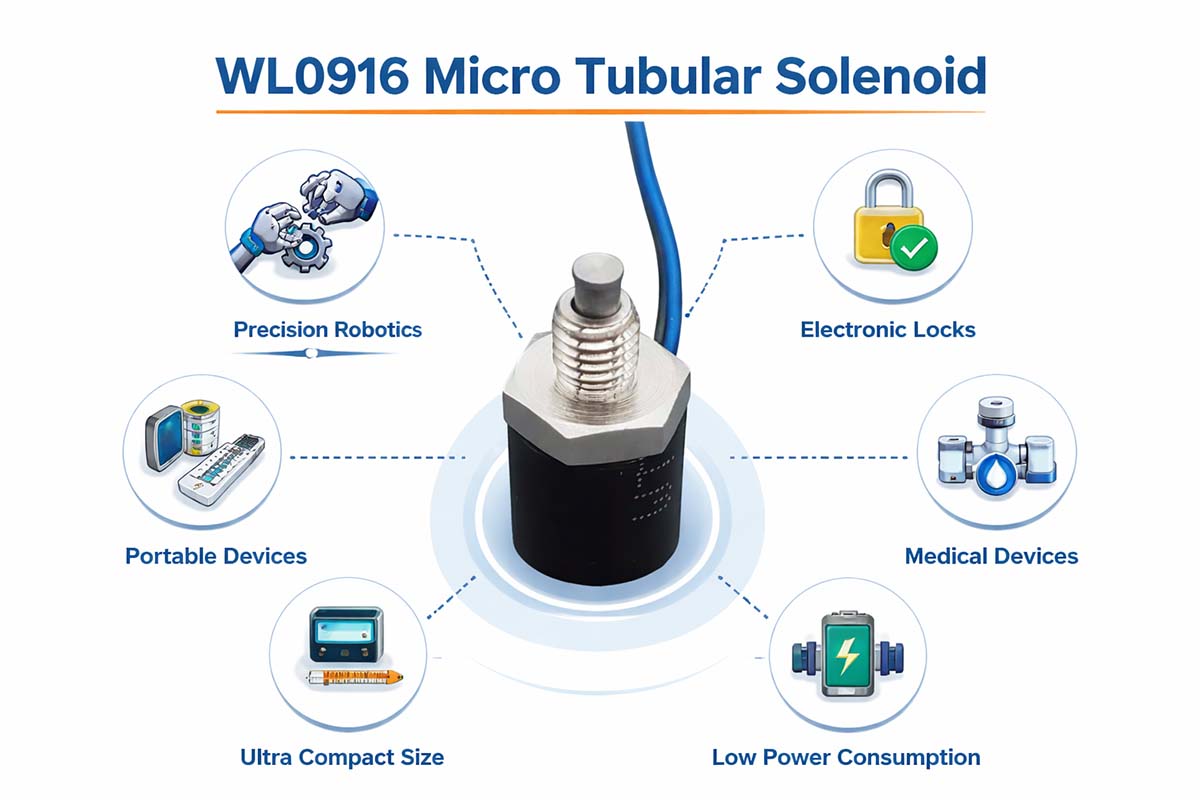
Micro tubular solenoid is very important in various fields where linear motion is required to be provided in small spaces.

Medical Devices: Micro tubular solenoid is very important in infusion pumps. In infusion pumps, the flow of fluids is controlled perfectly with the use of micro tubular solenoids. In addition to this, they are used in surgical devices, ventilators, automation devices, and diagnosis devices where reliability and easy cleaning are required.

Industrial Automation: In factories, tubular solenoids are used for controlling pneumatic valves, safety gate locks, automatic sorting, picking, and placing. Because of their small size, they are used in crowded spaces where there is a need for automation.

Automotive Systems: In automotive systems, tubular solenoids are used for door lock actuators, fuel injection systems, transmission controls, locking mechanisms for EV charging stations, and active suspension systems. They are used in automotive systems where high temperatures and vibrations are involved.

Aerospace and Defense: In the defense industry, tubular solenoids are used for satellite deployment systems, avionics cooling valve controls, and cockpit instrumentation actuators where weight is a factor.

Security Systems: These are employed in electronic locks, safe deposit boxes, and access control systems to ensure that the operation of the lock and unlock functions is always successful.

The customization options such as the sealed housings for washdown applications, terminations, and the non-magnetic material of the plungers are advantageous in the use of these solenoids in specialized scientific and industrial instruments

Advantages and Disadvantages of Micro Tubular Solenoid

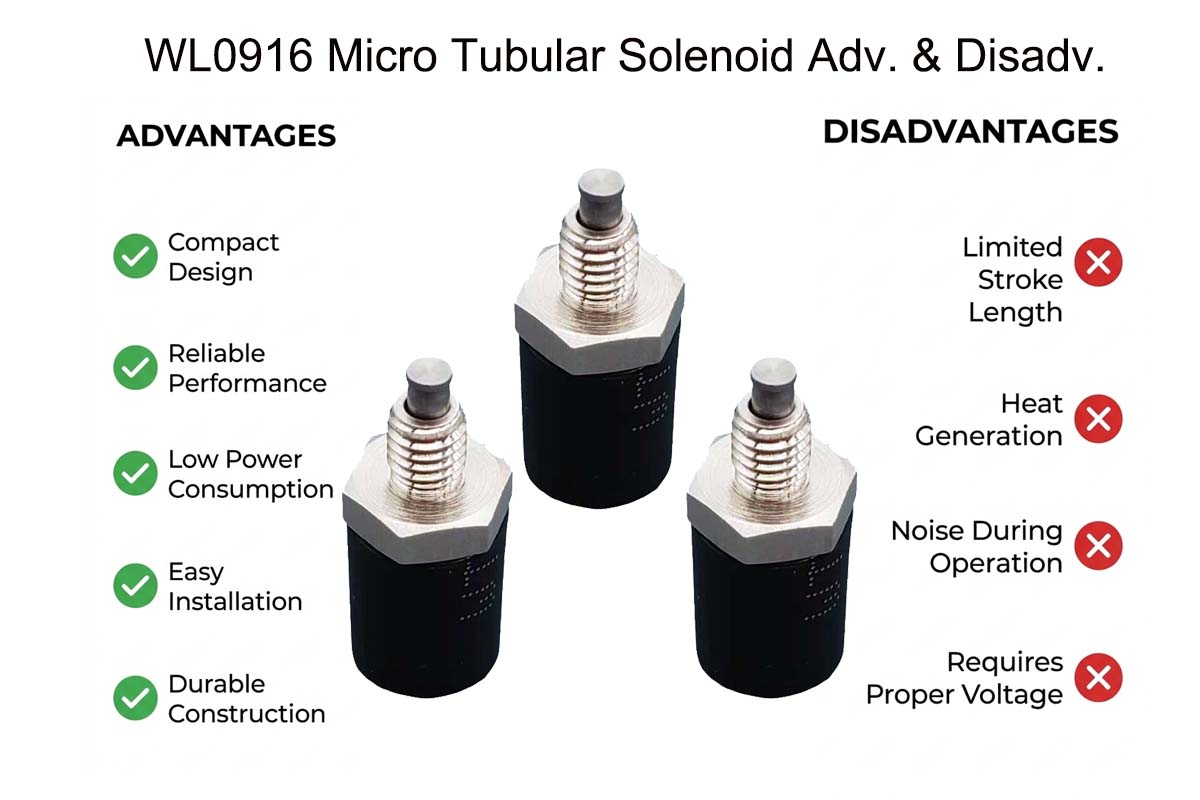
WL0916 Micro Tubular Solenoid Adv. and Disadv.

Pros and cons of Micro Tubular solenoid

Pros of Micro Tubular solenoid

Improved Force-to-Size Ratio: Tubular magnetic circuit design provides better flux concentration compared to frame-type solenoids, resulting in more force in a more compact package.

Precise Control: Stroke length is very consistent and can be duplicated, which is advantageous in precise control applications.

Increased Operating Life: Micro tubular solenoids are capable of providing more than 1 million cycles if the duty cycle is correctly managed.

Materials: High-temperature insulation, corrosion-resistant housings, and sealed housings are advantageous in the application of the solenoids in harsh environments.

Less Power Consumption: Magnetic design is very efficient and requires less power in comparison to other actuation technologies.

Cons of  Micro Tubular solenoid

Limited Stroke Length: Tubular solenoids have a shorter stroke length, usually not more than 15mm, which is not advantageous in comparison to other actuation technologies such as pneumatic cylinders and linear motors.

Heat Generation: Tubular solenoids are prone to heat generation if they are continuously operated and if the proper management of the duty cycle is not achieved.

Force Degradation over Stroke Length: Force is degraded as the plunger is extended from the core.

Magnetic Interference: Despite the fact that it is shielded, magnetic interference may still come from ferrous materials not inside the solenoid.

Noise that can be heard: The noise it produces is a clicking sound, and this may not be desirable in places where noise is a problem.

Fixing problems with the Micro Tubular Solenoid
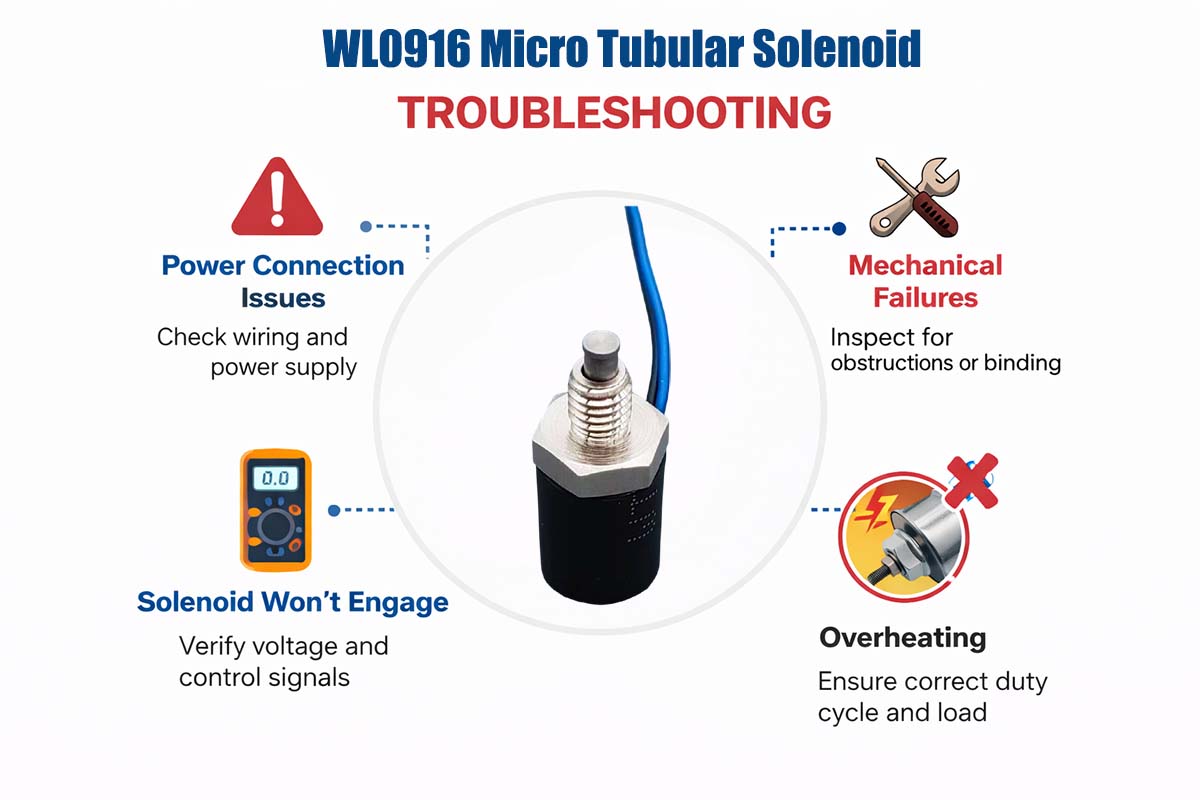
WL0916 Micro Tubular Solenoid Trouble Shooting

The Micro tubular solenoid is used extensively in industrial automation, precision devices, and small control devices. However, unless it is used correctly or unless the weather is right, it may not function to its full potential. Here is a step-by-step guide on how to fix problems with it:

1. The solenoid is not functioning at all (i.e., there is no movement).

Possible Reasons

There is no power supply or wrong voltage • There is loose or damaged wiring • The solenoid coil is burnt out • The plunger inside is stuck Solutions

Use a multimeter to measure voltage • Check wiring and connectors • Check resistance in coil (infinite = burnt coil) • Check plunger for blockages

2. The coil is getting too hot or is burnt out.

The power is left on after the duty cycle • The voltage is too high (wrong) • The plunger and spring are not inside • There is not enough heat dissipation Solutions

Use the right voltage rating and follow the duty cycle provided (e.g., 10%, 25%, 100%) • Use the right voltage rating • Make sure plunger and spring are in place • Improve ventilation or use a heat-resistant coil.

3. Weak force or not enough stroke.

Possible Reasons

Unstable voltage or low voltage • Air gap is too wide • Plunger is worn out or not aligned correctly

Load is more than the rated force Solutions

Ensure the voltage supply is stable • Reduce the distance of the stroke

Ensure everything is in line and change the parts • Ensure you choose one with extra force in case you need it

4. Slow response or delayed action Possible causes

Low voltage at the input • Friction and dirt in the tube

Weak spring for the return motion • Too high a temperature in the room Solutions

Ensure the voltage is at the right level • Clean the tube and the plunger inside • Change or improve the spring • Ensure the cooling is good 5. Noise or Vibration Possible Causes

Mounting not tight • AC power causing objects to vibrate • Parts inside the tube worn out • Plunger not in line Solutions

Ensure the mounting screws are tighter • Ensure you are using DC power • Ensure you change the parts • Ensure everything is in line correctly

6. The plunger is stuck or will not go back. Here are some possible causes.

Inside the tube, dirt, dust, trash, etc. • Spring is broken or weak • Rust and not enough oil • Side load is applied to the plunger Solutions

Ensure regular maintenance is done • Ensure you change the spring • Ensure you apply the right lubricant (if possible) • Ensure you don’t apply lateral force to the plunger

7. Intermittent Operation: Possible Causes

  • A power supply that is not stable • Electrical connections that are not tight
  • The coil is partially broken
  • Triggering of overheating protection

Solutions

Use a steady power supply • Check the wiring again

Check the consistency of the coil resistance

Let it cool down or change the duty cycle ________________________

🧰 Tips for Preventive Maintenance

  • Always operate it within the rated voltage and duty cycle • Don’t operate the power supply without the plunger in place
  • Ensure the solenoid is clean and devoid of dust.
  • Don’t apply too much side load or misalign it.
  • Check the coil’s resistance and temperature from time to time

✅ Quick List for Buyers

  • Check the voltage (DC/AC) and power rating. • Check the stroke and force requirements • Check the duty cycle – is it continuous or intermittent?
  • Ensure there is enough space for installation and cooling.
  • Select the degree of protection required—IP rating


FAQs Of WL0916 Micro Tubular Solenoid

1. How long does a micro tubular solenoid usually last?

Micro tubular solenoids usually last more than 1,000,000 cycles when they are used correctly and within their rated specifications. Lowering the operating frequency and protecting the environment properly can help things last longer.

2. Is it possible to use micro tubular solenoids in continuous operation?

Yes, there are continuous duty (100%) solenoids, but they need careful thermal management. Models for continuous operation are made with lower power density or built-in ways to get rid of heat. Always check the duty cycle before you use it.

3. What is the difference between push and pull setups?

When energized, the plunger in a push configuration moves outward. When set up to pull, the plunger moves back in. Both come with a spring that returns them to their default position when they are turned off.

4. Can micro tubular solenoids be used in water?

IP40 is the standard model (it is resistant to dust but not water). For applications that need protection from being submerged in water, being washed down, or being outside, there are sealed versions with an IP67 rating.

5. How do I figure out the right duty cycle?

Duty cycle = (On Time / Total Cycle Time) × 100%. For instance, 10% duty cycle means 0.5 seconds on and 4.5 seconds off. Going over the rated duty cycle makes the coils overheat and fail.

6. Is it possible to change the length and force of the stroke?

Yes, most companies will make custom designs for you. For OEM applications, you can change the stroke length, force output, voltage, and physical size. For fully custom designs, there may be minimum order quantities

7. What kinds of certifications are there?

We can make micro tubular solenoids that meet the standards set by ISO 9001, RoHS, REACH, and UL. There are medical-grade versions of Class I and II medical devices that are made with biocompatible materials and can be fully traced.

8. What is the best way to check if my solenoid is working?

Use a multimeter to check the coil’s resistance and compare it to the specifications. Set the voltage to the right level and watch the plunger move. Listen for a clean actuation that doesn’t buzz. Check for too much heat after the operation. Check for coil breakdown by doing an insulation resistance test (500V DC).

How to Choose a Micro Tubular solenoid?

Step 1: Set the mechanical needs
• Stroke Length: The distance that needs to be traveled (usually between 2mm and 15mm).
• Force Output: The amount of force needed at the end of the stroke (keep in mind that force decreases as the stroke gets longer). • Setting: Push (the plunger goes out) or pull (the plunger goes back).

• Mounting: threaded, with a bracket, or with a custom mounting interface.


Step 2: Find out the electrical settings.

• Voltage: The usual choices are 3V, 6V, 12V, and 24V DC. • Duty Cycle: Continuous (100%) or intermittent (for example, 10% on and 90% off). • Power Use: Find a balance between the force needed and the heat that needs to be managed.


Step 3: Look at the state of the environment.

• Temperature Range: Standard (from -20°C to +85°C) or high-temperature (up to 155°C).

• IP40 for clean environments and IP67 for environments with dust, moisture, or washdown.

• Resistant to corrosion: The case is made of stainless steel so it can be used in marine or chemical environments.


Step 4: Set the Terminations

• Bare leads (normal)

• Connectors, like JST, Molex, and custom

• Pins for mounting PCBs


Step 5: Go over the quality requirements

• Certification from ISO 9001
• Following the path of materials
• Testing the life cycle (1M+ cycles)
• Certifications: REACH, RoHS, and UL


Step 6: Ask for help from engineering
Please provide the manufacturer with a completed specification sheet so they can review the custom design and the samples.


Get A Free Quote Now

Contact Form

Related Products

Related News

Scroll to Top

Get A Free Quote Now !

Contact Form
If you have any questions, please do not hesitate to contact us.
Weilong Solenoid Company Culture