Skip image slider
Small Solenoid Pump for Automated Dosing Equipment
Electric Solenoid Micro Pump for Small Fluid Volumes
Solenoid Micro Pump for Precise Fluid Control Systems
Solenoid Micro Pump for Laboratory Fluid Handling
Durable Solenoid Micro Pump for Industrial Machinery
Solenoid Micro Pump for OEM Equipment Integration

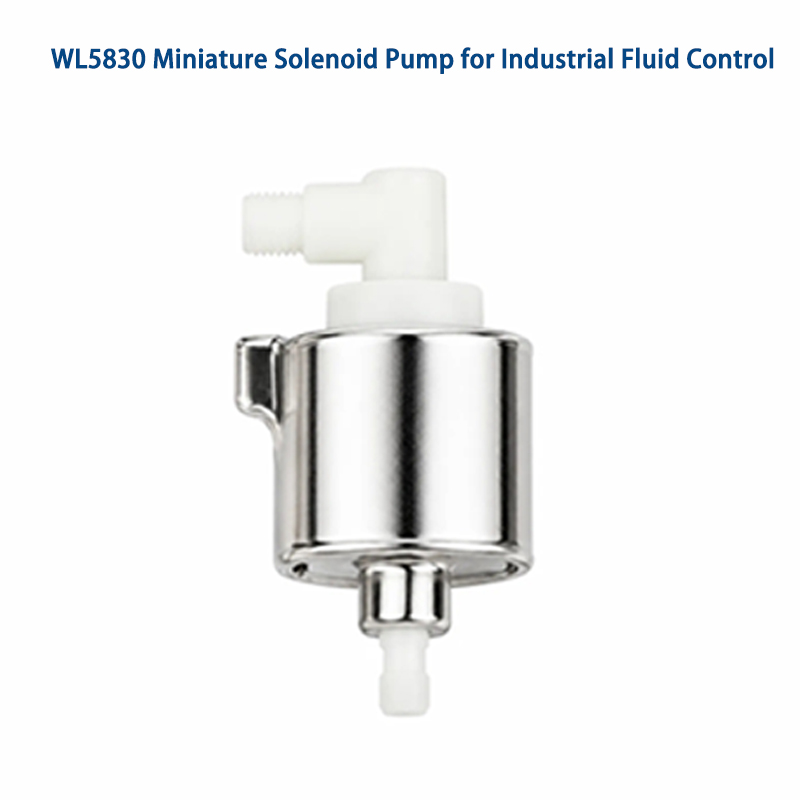
WL5830 Energy Efficient Solenoid Micro Pump for Fluid Systems

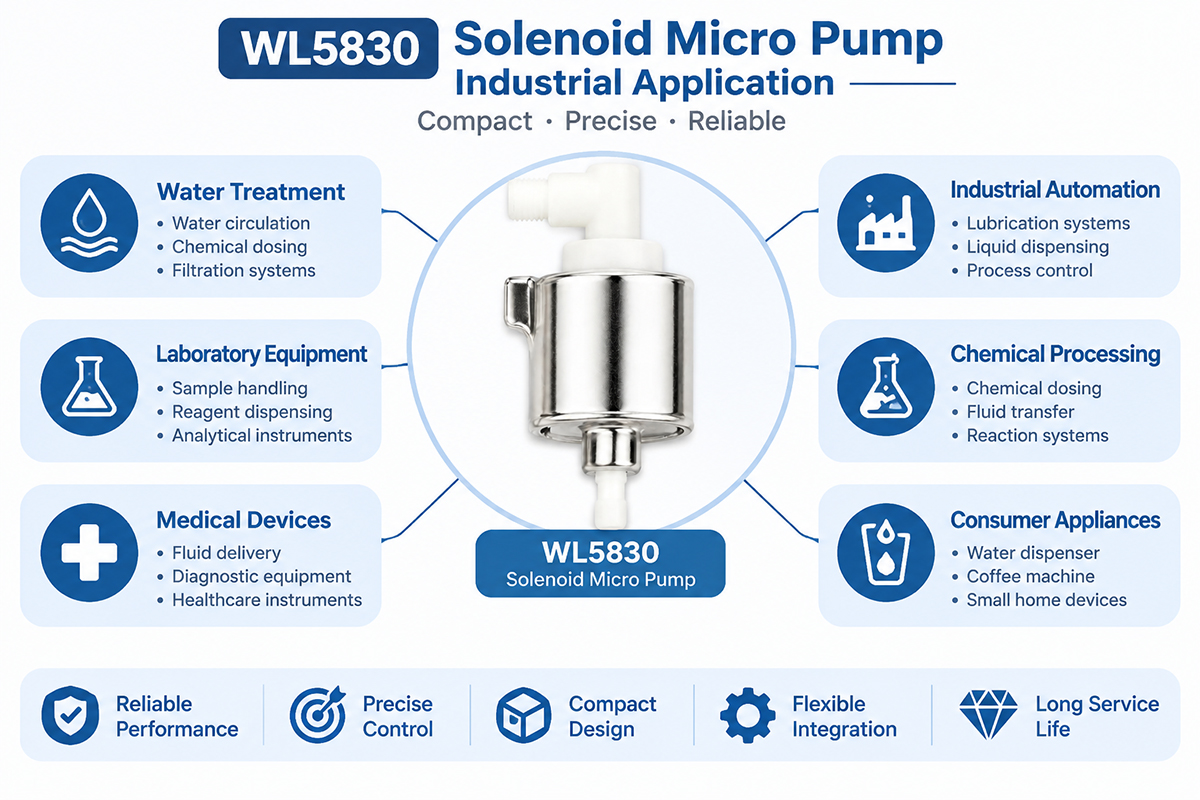
The solenoid micro pump is a miniature fluid handling system which is capable of transferring precise amount of liquids for applications requiring precise pumping capabilities. The actuator of the pump operates based on electromagnetic force which transforms electrical energy to mechanical motion to drive the fluid through the pumping chamber. Because of the miniaturized design, the pump can be used in the equipment where the installation space is limited and it is required to deliver the liquids precisely. You will find solenoid micro pumps used in laboratory equipment, medical devices, chemical dispensers, analytical systems, beverage dispensers and industrial automation. Depending on the design, the solenoid micro pump can operate with a variety of liquids and different flow and pressures requirements. The important selection criteria are pump capacity, voltage, power consumption, fluid compatibility, temperature range and service life. Due to the proper choice of materials and optimized construction, the solenoid micro pump can be performed effectively, operated electrically and integrated into the equipment. This gives an effective solution for equipment manufacturers requiring precise liquid management.

Solenoid Micro pump Description

What is a Solenoid Micro pump?

Electric micro pump is an electrically powered pump which uses electromagnetic force to produce mechanical motion and pump small amount of liquids. The electrical current which energizes the electromagnetic coil creates a magnetic field and this acts on an internal mechanism to change the volume of the pumping chamber or move a pumping element. These actions cause pressure difference that draws liquid into the chamber and pushes it out through the outlet. The solenoid micro pumps are developed for small equipment which requires a controlled flow of fluid. They are used widely in laboratory instrumentation, medical devices, chemical dosing equipment and liquid dispensing systems.

How do Solenoid micro pump manufacturer work?

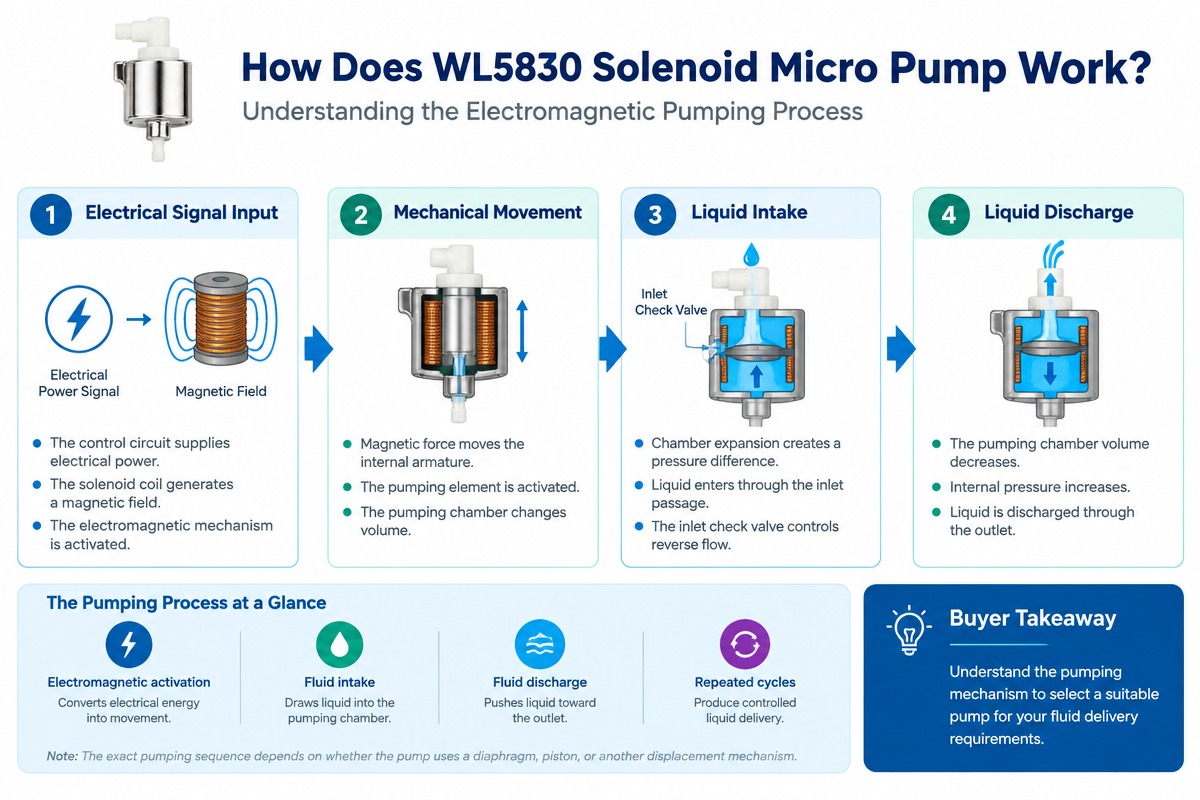
Solenoid micro pump operates by transformation of electrical energy to mechanical energy in order to pump the liquid through the miniature pump system.

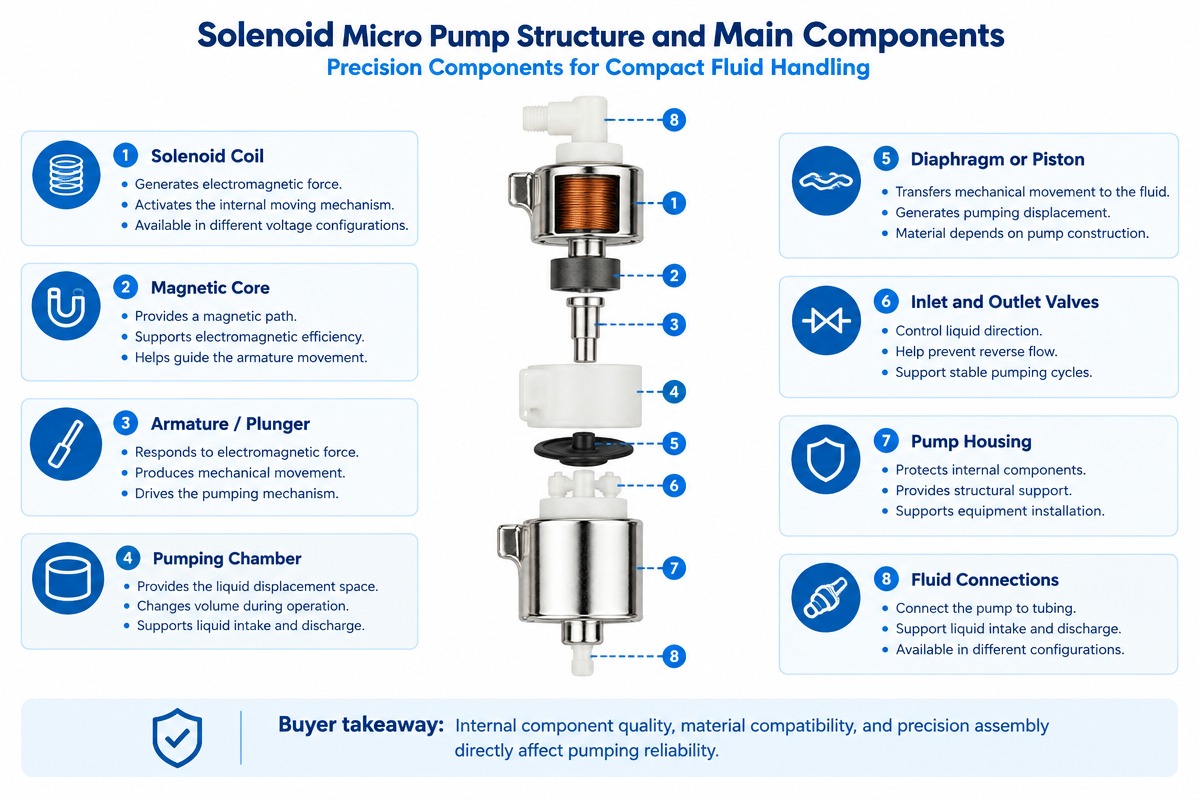
It consists mainly of the following elements: electromagnetic coil, movable armature or plunger, pumping chamber, inlet passage, outlet passage and valve elements. The exact construction depends on the pump design.

Step1: Input of electrical signal

Once the control circuit supplies electrical current to the solenoid coil, the electromagnetic field is created and it activates an internal mechanism.

Step2: Motion by Electromagnetic Force

Movable armature or plunger moves because of magnetic attraction. Depending on the design, it drives a diaphragm, piston or another pumping element.

Step3: Fluid Inlet

The volume of the pumping chamber changes which creates pressure difference and liquid is drawn into the chamber. If there is an inlet check valve, then it lets the fluid to enter the chamber but not flow out.

Step4: Liquid Ejection

The pumping mechanism moves in the opposite direction and reduces the volume of the pumping chamber, creating pressure and driving the liquid out through the outlet.

Step5: Cycle Repetition

This activation and release cycle repeats due to the electrical control circuit. As a result, there is a continuous or intermittent liquid flow, depending on pump design and control frequency.

Flow rate can be varied by means of suitable electrical control, frequency of operation and pump design. The actual flow performance depends on the viscosity of the liquid, back pressure, voltage, stroke parameters and design.

Solenoid Micro pump Video

Solenoid Micro pump Detail Display

Solenoid Micro pump Data Sheet

Brand

Weilong Technology

Model Number

WL5830

Rated Voltage (V)

DC 12V or 24 V

Rated Power(W)

ย 3-18W

Work Model

2 Ways Valve

Water Flow Rateย  (N)

0.05-0.2 L/ Per Minute

Resistance

144 ฮฉ

Reset Time(s)

0.3 Sec. On, ย 0.3 ย Sec. Off

Service Life

I Millioin Times

Certification

CE,ROHS,ISO9001,

Material

Carbon Steel Housing with Telfon Plated Coating

Lead Wire Length(mm)

58

Install Style

Adjustable Screw

Tolerance of Dimension

ย +/- ย 0.1 MM

Water-proof

ย None

Insulation Class

F ย ย 155 Degree

Hi-Pot Test

AC 750V 50/60Hz 2s

Non-excitation Holding Force

0

Working Temperature

-15ยฐC-180ยฐC

Duty Cycle

1-100%

Thread Depth(mm)

/

Payment Term

TT, or LC At Sight

Sample Order

Yes

Warranty

1 Year

MOQ

1000 pcs

Supply Ability

5000 pcs per Week

Delivery Time

30 Days

Port of Loading

shenzhen

Why The Solenoid Micro Pump Is So Popular?

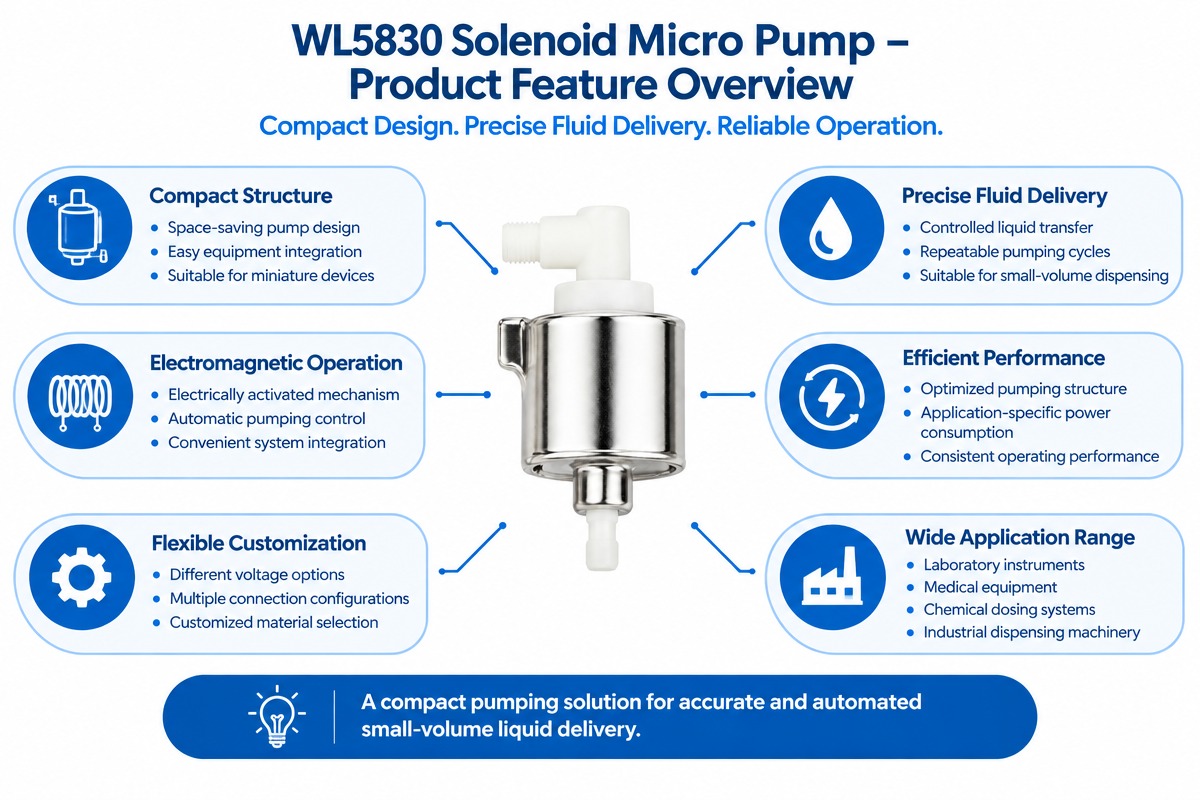
The solenoid micro pumps become increasingly popular as modern equipment requires more compact, accurate and effective fluid delivery solutions.

First, they have compact design. Large pumping systems are not applicable to many of the industrial and electronic devices due to the limited internal space. Solenoid micro pumps can be effectively applied to fluid handling in miniature applications.

Second, the electrical control. They operate based on electromagnetism and can be connected with electronic controllers, sensors, timers and automated equipment. Thus, they can be applied to those applications requiring programmable liquid delivery.

Third, the precision. Often, the small volume fluid transfer is required in laboratory instruments, analytical equipment, chemical dosing systems and dispensing machines and needs to be repeatable. This requirement can be met by properly designed micro pumps.

Finally, manufacturers appreciate the installation options flexibility. Various voltage ratings, connection options, materials and pumping capacities allow for integration into a wide range of OEM products.

The advances in medical technology, laboratory automation, smart appliances, chemical analysis, and industrial automation increase the demand for miniature pumps.

In addition, improvements in electromagnetic components, sealing technologies and manufacturing continue to improve pump performance.

The solenoid micro pumps give equipment manufacturers a combination of compact size, electrical control, flexible integration and fluid handling capability.

Solenoid Micro pump Applications

Solenoid Micro Pump for Small Scale Fluid Applications

Solenoid micropumps have extensive applications in industries requiring compact design and precise fluid delivery.

1.Medical Devices

Specialized micro pumps can be installed in medical instruments and equipment to achieve controlled fluid delivery. There are some special requirements for material compatibility, purity and safety for the application.

2.Laboratory Apparatus

Micro pumps are used in laboratory analyzers and testing equipment to transfer samples, reagents and other liquids. The compact size contributes to the space-saving instrument design.

3.Chemical Injection Packages

In analytical and dosing equipment, micro pumps are able to deliver small amount of chemical liquids. When handling corrosive or reactive materials, appropriate materials should be used.

4.Industrial Automation

Automated production equipment uses micro pumps for lubrication, liquid dispensing, cleaning and transfer of small amount of fluid.

5.Beverage Equipment & Food

Compact pumps are applied to beverage machines and food processing equipment to move water, flavoring liquids, and other compatible fluids. You should consider the requirements for food-contact materials.

6.Printing Equipment

Micro pumps are applied to printing and ink delivery systems to deliver ink and other specialized liquids in a controlled flow.

7.Water Testing Equipment

Small pumps are used in water testing instruments to transfer samples and reagents through analytical paths.

8.Consumer Electronics

Solenoid micro pumps can be applied to compact household equipment for controlled liquid delivery, e.g. cleaning devices and dispensing machines.

In all these applications, solenoid micro pumps allow equipment manufacturers to create compact equipment which is electrically controllable and able to handle fluids.

Solenoid Micro pump Adv. & Disadv

Advanced Solenoid Micro Pump for Precision Flow Control

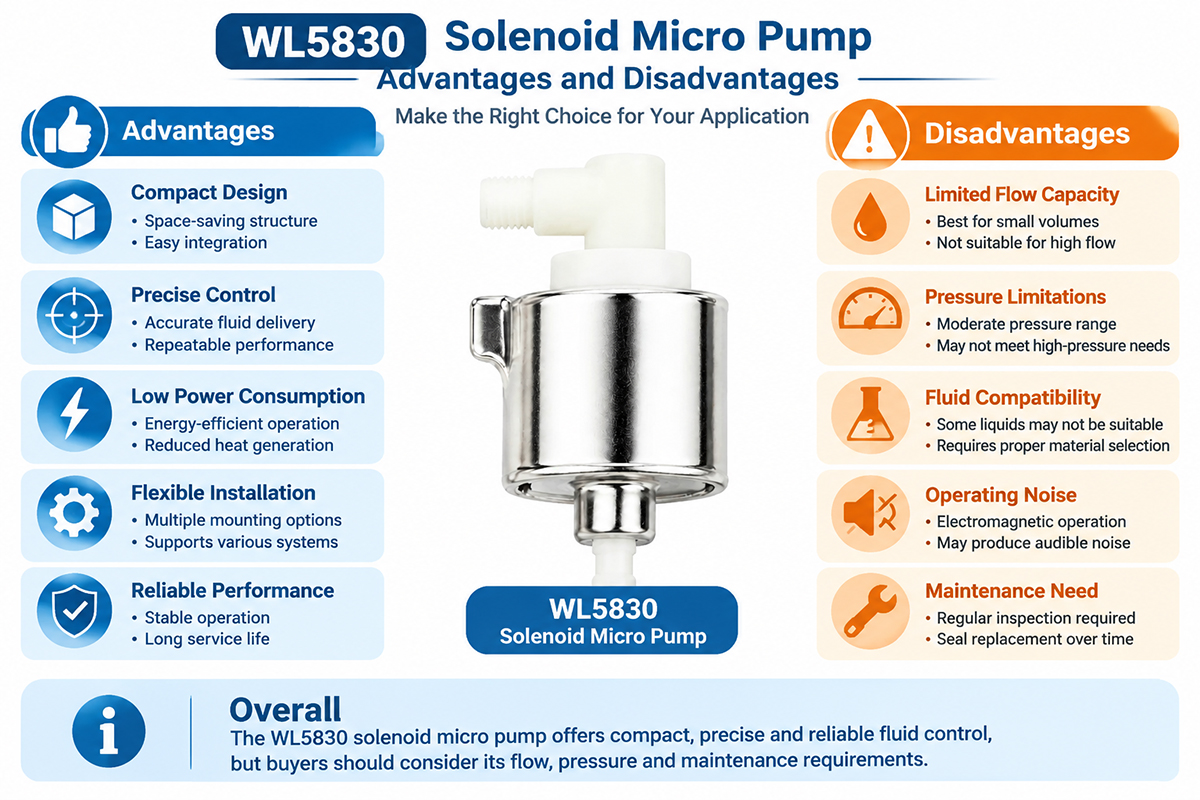
Solenoid Micro Pump Advantages and Disadvantages

There are a lot of advantages of the solenoid micro pumps for compact fluid handling applications. But buyers should know their limitations as well.

Benefits

1.Compact Construction

As they are miniaturized, they can be installed in equipment where the installation space is limited.

2.Electrical Regulation

As they operate based on electromagnetism, they can be easily connected with electronic controllers, sensors and automation systems.

3.Controlled Liquid Delivery

Reproducible low volume liquid delivery for dosing and dispensing applications can be provided with proper designs.

4.Flexibility of Integration

Various voltage ratings, mounting options, and connections support OEM equipment development.

5.Reduced Installation Space

Comparing with large pumping systems, compact micro pumps can save space.

6.Convenient Automation

Synchronization of pumping cycles with other equipment operations can be done by electric actuation.

Disadvantages

1.Low flow capacity

Usually, micro pumps are designed for smaller flows of fluids and may be inappropriate for high flow applications.

2.Pressure Limitations

The maximum discharge pressure of the pumps depends on internal mechanism and the construction.

3.Requirements for Fluid Compatibility

Inappropriate materials can lead to corrosion, seal failure or shortened service life.

4.Dependence on Electricity

For solenoid operation an appropriate electrical power and control circuit is needed.

5.Possible Noise & Vibration

Repeated electromagnetic movement can produce operational noise or vibrations.

6.Maintenance Requirements

Some internal parts and seals may need periodical inspection or replacement.

Buyers should be aware of these limitations to make the right choice of the micro pump.

Solenoid Micro Pump for Precise Dosing and Metering

Troubleshooting of Solenoid Micro Pump

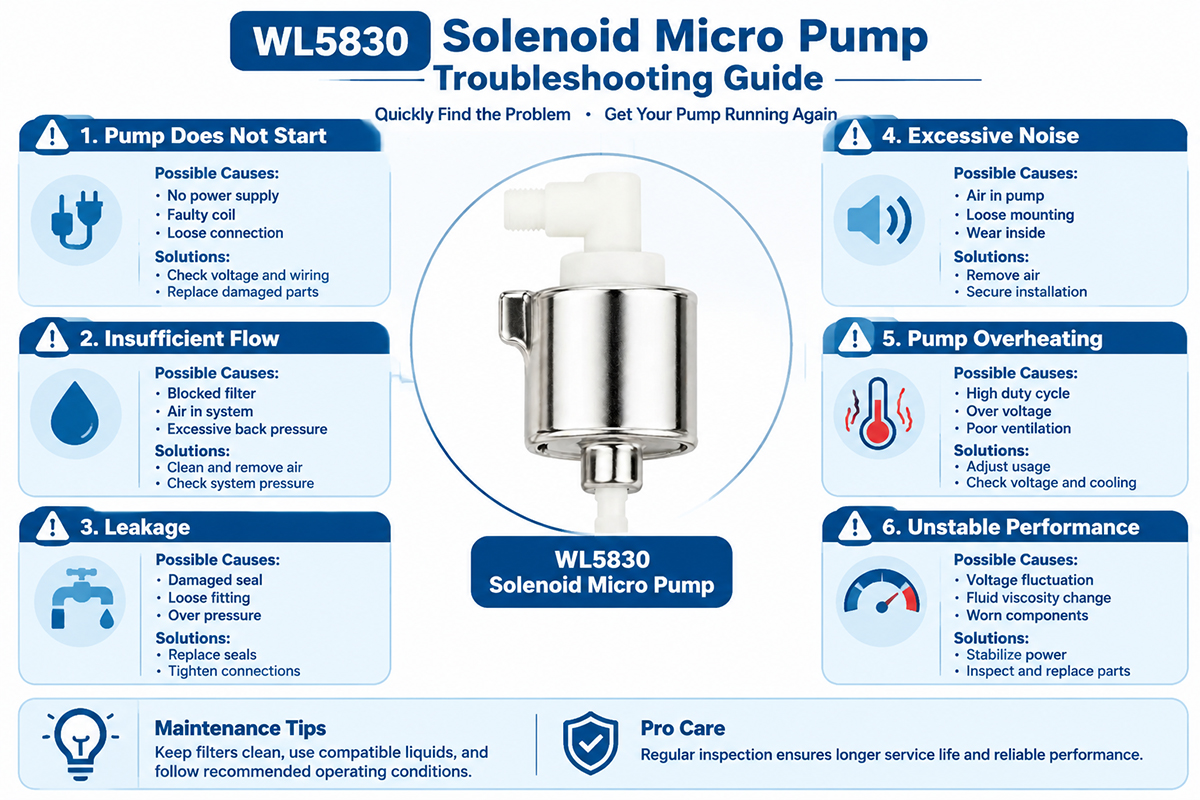
Problems with solenoid micro pumps can be caused by electrical malfunctions, blocked fluid passage, damaged seals, or inappropriate operating conditions. Hereโ€™s a troubleshooting guide to help you recognize some common problems.

1.Pump Doesnโ€™t Start

Possible causes:

– Insufficient power supply

– Ruptured electromagnetic coil

– Electrical malfunctions

– Bad control circuitry

Solutions:

Check voltage, wiring, coil resistance and control circuit. Replace faulty electrical components.

2.Not enough liquid flow

Possible causes:

– Clogged inlet filter

– Limited tubing

– Trapped air in the pumping chamber

– Too much back pressure on the outlet

Solutions:

Clean the filter, check tubing, bleed air according to manufacturer’s instructions and check the operating pressure.

3.Unstable Pumping

Possible causes:

– Variable power supply

– Incorrect operating frequency

– Viscosity of the fluid is variable

– Internal wear

Solutions:

Check electrical stability . Check control settings. Check pumping mechanism .

4.Liquid Leakage

Possible causes

– Damaged seals

– Loose links

– Excessive operating pressure

– Inappropriate sealing materials

Solutions:

Check connections and replace damaged seals. Check materials compatibility.

5.Too loud or vibrating

Possible causes could be:

– Loose mount

– Incorrect operating voltage

– Mechanical friction

– Air in the fluid channel

Solutions:

Check if the pump is securely mounted. Check voltage. Check internal components. Check fluid supply .

6.Overheated Pump

Test the voltage on coils duty cycle ventilation operating temperature Ensure that the pump is running within the specified parameters of the manufacturer.

Maintenance Tip: Disconnect from the electrical source and fluid supply before starting with the inspection. Perform all maintenance activities according to the manufacturer’s guidelines and replace faulty components with matching ones.

FAQ for Solenoid Micro pump

1. What is a solenoid micropump?

A solenoid micropump is a miniature pump driven by electricity that uses magnetic force to transfer liquid in minute quantities. The pump is designed for applications that require precise fluid delivery, compact installation and automatic operation. Examples include laboratory apparatuses, medical devices, chemical dosing systems and industrial dispensers.

2. How does a solenoid micro-pump work?

The solenoid micro pump converts the electric energy into mechanical action. With the excitation of the electromagnetic coil, magnetic force acts on the armature or plunger and produces movement inside the solenoid. The movement creates a pumping element (diaphragm or piston) that changes the volume of the pumping chamber. Due to the difference in pressure, liquid enters from the inlet and exits from the outlet.

3. What are the typical applications of solenoid micro pumps?

Typical applications of solenoid micro pumps include laboratory analyzers, medical devices, chemical dosing machines, liquid dispensers, water analysis systems, printing machines and industrial automation devices. These pumps are especially suitable for applications where it is important to deliver a small quantity of liquid accurately.

4. How to select the correct solenoid micro pump?

When selecting the right pump you need to consider such parameters as flow rate, operating pressure, fluid viscosity, chemical compatibility, voltage, power consumption and operating temperature. You should also take into account the size of the installation, connection type, pumping accuracy and service life. If you are considering an OEM application, make sure the company is capable of working with your specific requirements.

5. Which liquids can be used in a solenoid micro pump?

The solenoid micro pump can be produced to operate with water, chemicals that are compatible with the pump, oil, ink and other industrial liquids (depending on materials and design). You should make sure that the pump body, diaphragm, seals and other elements inside the pump are compatible with the working medium. Always consult the manufacturerโ€™s chemical compatibility table before using.

6. What are the advantages of a solenoid micro pump?

Among the key advantages of these pumps there is their compact size, electromagnetic drive, simple electrical control, flexible installation and the possibility to deliver small amounts of fluid accurately. Due to these characteristics solenoid micro pumps are widely used in automatic equipment, portable devices, laboratory equipment and dispensing applications.

7. Why does a solenoid micro pump lack sufficient flow?

There are several reasons for the lack of sufficient flow: clogged inlet filter, obstructed tubing, trapped air, high outlet pressure, unstable electrical supply and damaged internal elements. You should investigate the fluid path, electrical supply, operating pressure and pumping mechanism to detect the problem.

8. How to increase the service life of a solenoid micro pump?

To ensure reliable operation you should perform regular maintenance. To do so you need to clean inlet filters, inspect tubing and connections, monitor electrical performance and check for leaks and abnormal noises. Use the fluids, pressure and temperature as recommended and donโ€™t exceed the specified duty cycle.

Choosing a Electric micro pump

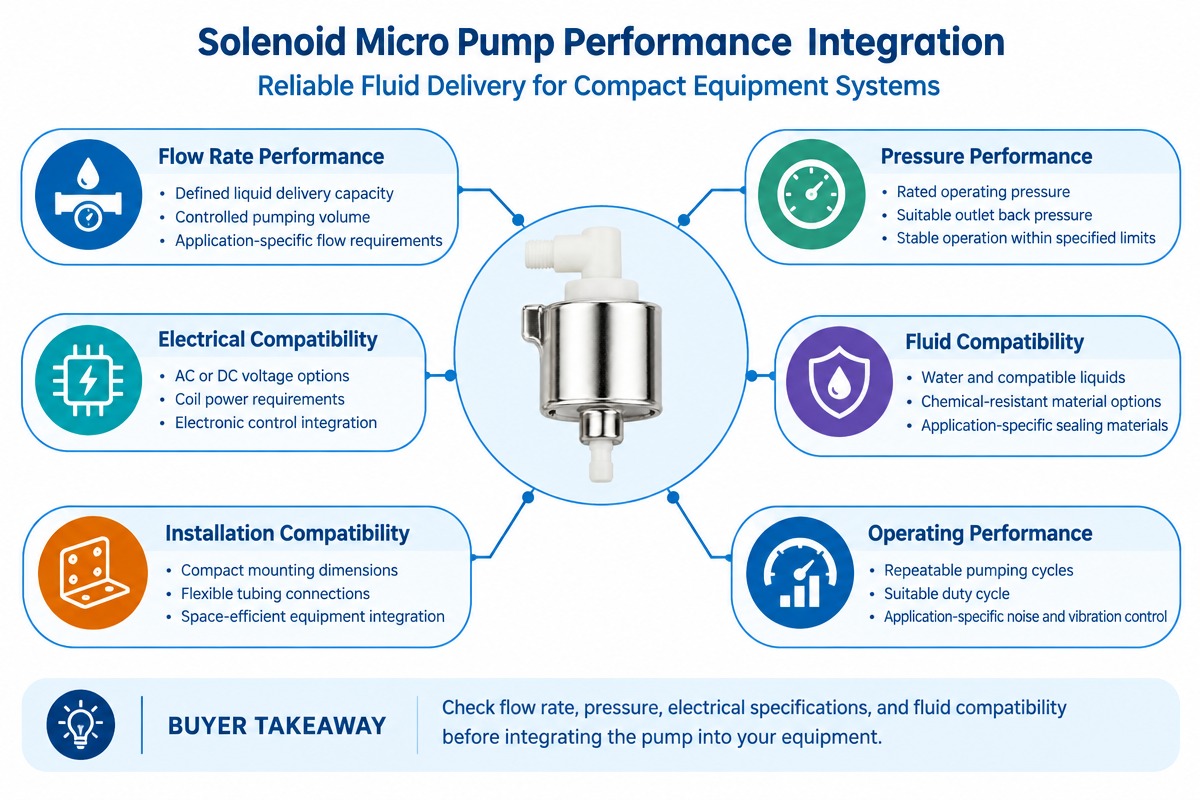
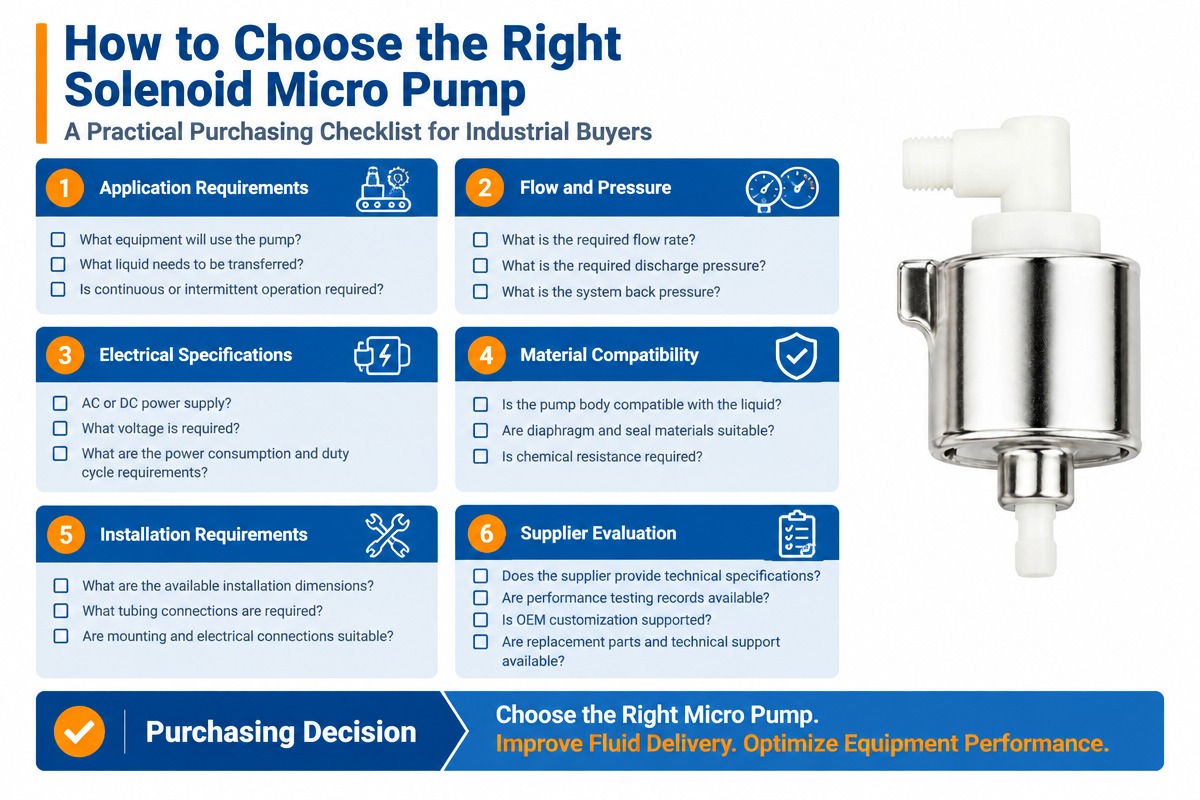
It is important to choose the right solenoid micro pump to ensure the accurate liquid delivery, stable performance and reliable operation of the equipment. Some technical factors that buyers need to consider when choosing a pump are as followsโ€”

1.Calculation of Required Flow Rate

Calculate the amount of liquid to be pumped per minute or per operation cycle. Is the application a continuous pumping, intermittent liquid delivery or precise small-volume dispensing? Choose the pump having the required capacity for the real working conditions.

2.Checking Working Pressure

Calculate the back pressure of the system and the required discharge pressure. The pump should be able to create the sufficient pressure to overcome the resistance of tubes, filters, valves and other downstream equipment. Always verify the rated pressure and maximum allowable operating conditions.

3.Checking Fluid Compatibility

Determine the working fluid, its viscosity, composition, temperature and possible presence of particles. Choose appropriate materials for the pump body, diaphragm, seals and internal elements to avoid corrosion, swelling or early wear.

4.Evaluating Electrical Requirements

Check the required voltage, AC or DC power supply, current consumption and control signal. Make sure the electrical specifications match the equipment power system. Also pay attention to operating frequency and duty cycle.

5.Pump Accuracy Evaluation

Repeatability and flow consistency are crucial for the laboratory equipment and chemical dosing and precision dispensing equipment. Make sure that the pump has the required accuracy of the delivery at actual operating pressure and fluid conditions.

6.Size and Installation Evaluation

Measure the available installation space and check the mounting dimensions, inlet and outlet locations, tube connections and electrical terminal arrangement.Compact design should fit well into the equipment.

7.Noise and Vibration Evaluation

The quiet operation is required for some applications, especially laboratory, medical and consumer equipment. Test noise and vibration characteristics during the operation.

8.Service Life and Maintenance Evaluation

Ask about expected operating cycles, component life, cleaning and replacement parts. A good supplier should give you technical documentation and recommendations on maintenance.

9.OEM Customization Evaluation

For specific equipment, contact the manufacturer regarding customizing the pump voltage, connections, materials, dimensions and performance parameters.

Considering these factors, buyers will be able to choose the solenoid micro pump that will best fit the application, improve fluid delivery performance and reduce the maintenance cost.

Tips to Avoid Common Mistakes in Solenoid Micro Pump Design

When designing the solenoid micro pumps, it is important to take into account electromagnetic performance, fluid characteristics, mechanical structure and electrical control. Avoid these common mistakes.

1.Inappropriate pump capacity selection

Inappropriate pump capacity selection may result in under-delivery of liquid or excessive energy use. First of all, determine the volume per cycle and the total operation flow to choose the pump.

2.No Attention to Fluid Compatibility

Fluids affect pump body materials, diaphragms and seals differently. Always check the fluid compatibility to avoid corrosion, swelling and leakage.

3.Poor Electromagnetic Design

Bad design of the coil can result in creation of insufficient magnetic force or excess heat. Optimize coil winding, electrical resistance, magnetic materials and voltage.

4.Incorrect Pressure Requirements

Poor pumping performance can be the result of neglect of inlet pressure and outlet back pressure. โ€“ Make sure that the pump is rated for the actual pressure range of the system.

5.Neglect of Sealing Performance

Bad sealing leads to leakage, reduced pumping efficiency and contamination . Choose proper sealing materials and evaluate critically the connection points.

6.No Attention to Power Consumption

Excess electricity consumption raises operating costs and creates unnecessary heat. Calculate coil efficiency and operating frequency.

7.Poor Inlet and Outlet Designs

Bad design of ports or incorrect tubing configuration results in increased flow resistance. Streamline the fluid passages to make the fluid flow smoothly.

8.No Proper Testing

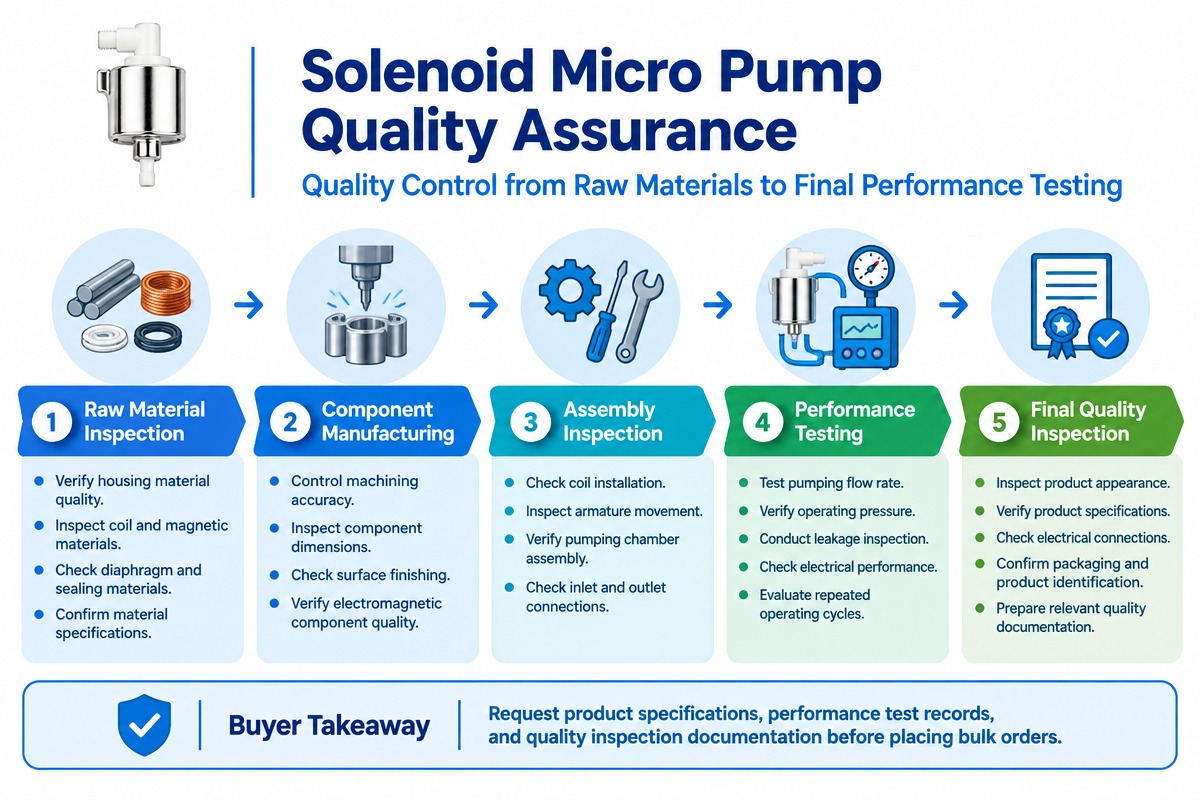
Always test flow, pressure, leakage, electrical and endurance under representative operating conditions before mass production.

A well-designed solenoid micro pump must combine compact size, electromagnetic efficiency, fluid compatibility, pumping accuracy and durability.
Get A Free Quote Now

Contact Form

Related Products

Related News

Scroll to Top

Get A Free Quote Now !

Contact Form
If you have any questions, please do not hesitate to contact us.
Weilong Solenoid Company Culture