Tubular Solenoid for Industrial Control
Industrial Tubular Pull Solenoid Guide
Tubular Pull Solenoid Applications Guide
Compact Tubular Pull Solenoid Solutions
Heavy Duty Tubular Pull Solenoid Uses
WL4297 Tubular Pull Solenoid for Machinery
Tubular Solenoid for Industrial Control
Industrial Tubular Pull Solenoid Guide
Tubular Pull Solenoid Applications Guide
Compact Tubular Pull Solenoid Solutions
Heavy Duty Tubular Pull Solenoid Uses
WL4297 Tubular Pull Solenoid for Machinery

WL4297 Tubular Pull Solenoid for Industrial Use

A tubular pull solenoid is a solenoid that pulls a plunger into a coil when activated and causes the plunger to move in a straight direction. It is composed of a cylindrical coil, a ferromagnetic housing, and a plunger or core that is movable. As electricity flows through the solenoid’s coil, a magnetic field is created, which causes the plunger to be pulled into the coil and to move in a straight direction.

On the other hand, tubular solenoids have a closed-type design, which is stronger and provides stability and consistency to the solenoid compared to open-frame solenoids. Tubular solenoids are commonly used in factories and need to move in a straight direction in small areas.

Generally, people prefer tubular pull solenoids because of their high power output and their quick and long-lasting responses to their applications. These solenoids are essential in modern equipment and are commonly used in factories due to their application in automation systems, locking mechanisms, and control devices.


An Overview of the Tubular Pull Solenoid Product

A tubular pull solenoid is a type of electromagnetic device that is designed to pull something linearly. It is a compact device that offers protection against the elements. Therefore, it is more efficient and effective. It has a cylindrical body that offers protection against the elements. In addition, it is available in various sizes and voltages to suit different requirements. Therefore, it can be employed in OEMs and customized applications.

Important specifications of tubular pull solenoids include stroke length, pulling force, duty cycle, and response time. It is highly effective in medical devices, locking systems, automation systems, and industrial machines. It forms a significant part of modern industrial control systems and motion control systems. It is effective, efficient, and long-lasting. It can also be customized to suit different requirements.

WL4297 Tubular Pull Solenoid Video

WL4297 Tubular Pull Solenoid Engineering Guide

WL4297 Tubular Pull Solenoid Technical Datasheet

Brand Weilong Technology Model Number WL4297
Rated Voltage (V) DC 12 V or 24V Rated Power(W)  80—-150 W
Work Model Tubular Pull Push Type Holding Force (N) 2.45 kgs
Stroke(mm) 5-10 MM Reset Time(s) 0.1
Service Life 300 Thousand Times Certification CE,ROHS,ISO9001,
Material Carbon Steel Housing with Zinc Plated Coating Lead Wire Length(mm) 200
Install Style Adjustable Screw and Cap Tolerance of Dimension  +/-  0.1 MM
Water-proof  None Insulation Class F
Hi-Pot Test AC 600V 50/60Hz 2s Non-excitation Holding Force 0
Working Temperature -10°C-100°C Duty Cycle 1-100%
Thread Depth(mm) / Payment Term TT, or LC At Sight
Sample Order Yes Warranty 1 Year
MOQ 1000 pcs Supply Ability 5000 pcs per Week
Delivery Time 30 Days Port of Loading shenzhen

WL4297 Tubular Pull Solenoid Industrial Application

WL4297 Tubular Pull Solenoid Industrial Application

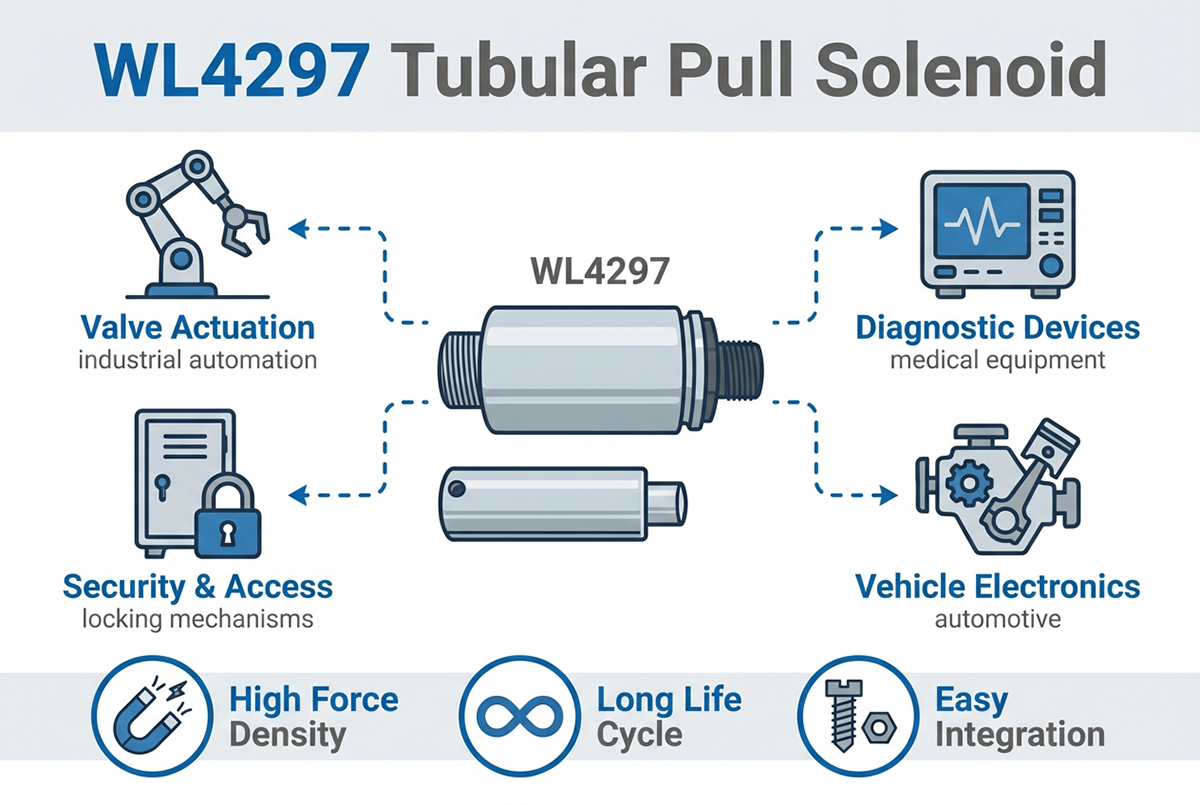
Due to the small size and effectiveness, a tubular pull solenoid has various uses in different industries. They are used in automation systems to control levers, valves, and switches. This allows you to have precise control over mechanical movements. Because of their quick reactions, they are also utilized in high-speed equipment. They are used in vending machines and access control systems to ensure security by locking and unlocking various items. They are also used in medical equipment that requires precise movement to function effectively. They are used in car door locks, the fuel system, and the transmission system. They are also used in various printing machines, copiers, and other office automation equipment. They are also used in packing machines and textile machines. They are also good in small designs used in current industrial equipment due to their ability to function in tight spaces. In conclusion, tubular pull solenoids are very important in enhancing the efficiency of industrial operations

Advantages and Disadvantages of Tubular Pull Solenoid

WL4297 Tubular Pull Solenoid Advantage and Disadvantage

Tubular Pull Solenoid Pros and Cons

Pros of Tubular Pull Solenoid

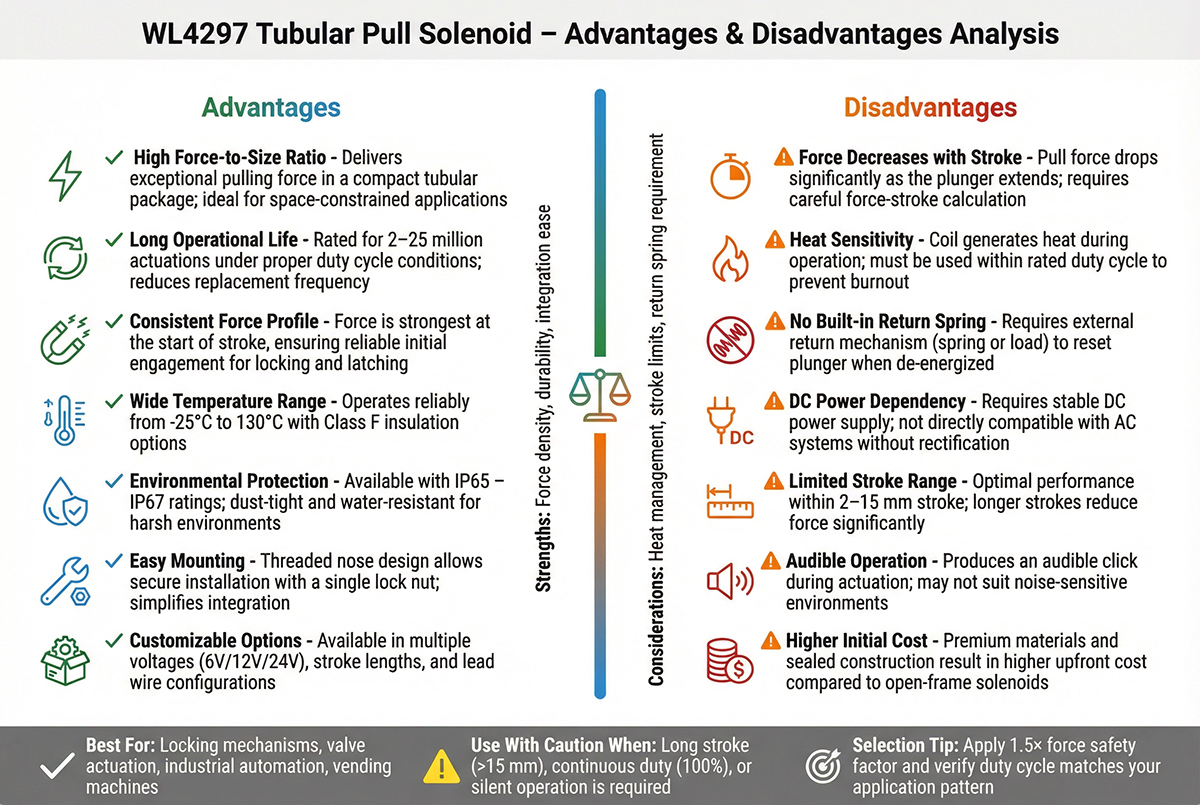
There are many advantages to tubular pull solenoids, such as their compactness and their ability to generate a lot of force for their size. The closed environment ensures dust, moisture, and mechanical damage are not transferred to the internal parts of the solenoids, making them long-lasting. Since they move in a straight direction quickly and are quick to react, they are best used in high-speed automation systems.

Their low noise and energy efficiency also make the entire system work better. In addition, they can be added to other uses of industry and made to suit unique requirements such as voltage, stroke, and force.

Cons of Tubular Pull Solenoid

Tubular pull solenoids are faced with a number of problems despite the advantages associated with them. To begin with, the longer the stroke length of the solenoid, the lower the force it is able to pull. Therefore, it might not be effective for long-stroke applications. In addition, anything that operates continuously tends to get hot. Therefore, one would need to regulate the duty cycle or find a means of cooling it down.

They also require a constant supply of power to operate effectively at all times. In addition, the linear pulling action of the solenoid is limited. Therefore, it might not be effective in applications where complex motion is a requirement.

Guide to Fixing Tubular Pull Solenoids

Tubular pull solenoids usually work well most of the time. However, there might be some problems if the solenoid is not installed properly, there is an electrical problem, or the weather is not good. This is a step-by-step guide on the possible causes and the solution to the common problems you might encounter with the solenoid.

1.The solenoid is not working (no movement).

Possible Causes:

No power supply or the voltage is not correct • Cable is damaged or the electrical connection is bad • Burn out of the coil (open circuit) • Control signal is bad

Solution:

Make sure the voltage is correct and matches the solenoid. Check the cable and the connection to see if there is a damaged cable or a bad connection. Check the coil by measuring the resistance with a multimeter. An infinite reading means the coil is open. Check the control signal.

2. Weak Pulling Force

Possible Causes:

Not enough voltage or current • Stroke is too long • Air gap is too big • Magnetic interference or alignment is bad

Solution:

Make sure the voltage is correct and the power supply is stable. Make the stroke shorter or choose a solenoid with more force. Move the plunger to the right place to reduce the air gap. Make sure the solenoid is straight and there is no interference.

3. Problem with Overheating

Possible Causes:

Continuous energizing beyond the duty cycle • High temperature outside • Overvoltage • Not enough heat dissipated

Solution:

Work within the rated duty cycle (e.g., 25%, 50%, 100%) • Add a cooling system/Ventilation Check that the voltage input is correct. • If needed, use a solenoid designed for continuous duty

4. Slow response or action that takes too long

Possible Reasons:

Low voltage supply—Friction or dirt on the machine Weak spring for return • The coil gets worse over time. Solutions:

heck and stabilize the power supply

Clean the inside parts and make sure they move smoothly. • Change or modify the spring If performance diminishes, replace the old solenoid.

5. Noise or Vibration Possible Causes:Mounting that isn’t tight

AC electricity makes things shake (50/60 Hz hum) • Parts inside that are worn out • The plunger is not lined up correctly. Solutions:

Make the mounting hardware tighter • For AC systems, use a DC solenoid or add a rectifier.

Check and replace items that are worn out

Make sure everything is lined up correctly when you install it

6. The plunger is stuck or jammed

Possible Reasons:

Dust, dirt, rust – Not enough lubrication (if needed) – Changing the shape of the machine Side load on plunger Solutions:

Keep it clean and in good shape. • Use the right lubricant (if the design allows)

Replace the defective part • Make sure it does not have any force acting on it from the side; it must only move in one direction.

7. Operation, but only from time to time

Possible Reasons:Loose electrical connections • Inconsistent power supply • Bad control signal • Partly defective coil Solutions:• Verify all electrical connections • Verify the reliability and consistency of the power supply • Verify the output of the control system • Verify the coil’s resistance for defects.

8. Burnout of the coil

Possible Reasons: Too high voltage • Running continuously • Short circuit in the coil • Bad heat dissipation solutions: • Always use the rated voltage. • Always use the correct duty cycle • Replace the defective solenoid • Improve the heat dissipation.

9. Tips for Preventive Maintenance•

Regular checkup • Regular cleaning • Verify the voltage supply and duty cycle • Verify it does not get overworked or overstroked • Verify all the parts are in the right position during installation. • Protective housing to be used if it’s to be installed in a dusty, moist area.

10. Quick Troubleshooting Checklist

✔ Verify the power supply •

Verify the voltage/current •

Verify the wiring •

Verify the coil’s resistance •

Verify the mechanical movement

• Verify the duty cycle

• Verify the temperature

FAQs Of Tubular Pull Solenoids

Frequently Asked Questions About Tubular Pull Solenoid

The most important things to think about when choosing a tubular pull solenoid include the solenoid’s mechanical needs, its electrical needs, the environmental conditions in which it is to operate, and its physical needs. The solenoid’s force is greatest when the plunger is just starting to move and becomes weaker as the plunger is extended. A safety factor of 1.5 should be added to the load calculation.

2. What is the difference between pull-type and push-type solenoids?

The main difference is the direction in which the solenoid pulls the plunger. A pull-type solenoid pulls the plunger in when the solenoid is activated. This is useful for latching and locking, as well as for valve control. A push-type solenoid pushes the plunger out. This is useful for ejecting objects and for switch control. Some solenoids have a combination of both, for applications in which the plunger is to move in both directions.

3. What is the effect of stroke length on the solenoid's force output?

The stroke length and the solenoid’s force output do not have a direct relationship. A longer stroke means a weaker force, and vice versa. In high-frequency applications, the stroke range is 2 to 5 mm. In applications involving larger devices, the stroke can be as long as 30 mm. The solenoid’s force is the greatest when the plunger is just starting to move and becomes weaker as the stroke progresses.

4. What voltage and duty cycle should I choose?

The most common DC voltage is 6V, 12V, and 24V.

The duty cycle is the ratio of “on” time to total cycle time.

100% (Continuous): For operation that doesn’t stop.

25-50% (Intermittent): For use from time to time.

10% (Pulse): For quick bursts of high power.


5. How can I keep the solenoid from getting too hot?

Make sure that the solenoid is being used within a rated duty cycle to ensure that it does not get too hot. If you want them to work all the time, consider models rated for 100% ED (Continuous Duty). Pulse Width Modulation (PWM) or Pulse Hold reduces the current after being activated, which reduces the amount of heat that is created. It is also a good idea to ensure that there is a good ventilation system.


6. What are some frequent faults people make when installing?

Some common faults people make when installing are the following:

Lack of proper alignment: If not properly aligned, up to 20% of efficiency can be lost.

Wiring not correct: Incorrect wiring may cause overheating and failure.

Lack of proper mounting: If not properly secured, vibration may cause early failure.

Lack of return spring: If a tubular type of solenoid is being used, a return spring must be supplied by the application.

7. What's the best way to pick a solenoid for rough conditions?

Solenoids with IP ratings are best for use in damp or dusty conditions:

IP54: Protects against dust and water splashes.

IP65: Water jets cannot penetrate the solenoid, nor can dust.

IP67: Good for short-term immersion.

If the temperature exceeds 100°C, it is recommended to look for coils rated for 155°C or higher insulation. In cases where the device will be subjected to vibrations, it is recommended to use materials that will not rust, such as stainless steel or zinc coating.

8. How long will tubular solenoids last, and what must you do to keep them in good working order?

The lifespan varies from 2 million to 25 million, depending on the design and usage. To live longer, you must:

Clean the surface often to remove dust and other materials that tend to stick to the surface.

Inspect the coils to see if they are getting too hot or if the insulation material is deteriorating.

Inspect the device for signs of rust or loose connections.

Inspect the iron core and screws to ensure they are tightened.


How to Choose the Tubular Pull Solenoid?

To choose the right tubular pull solenoid, you have to ensure the mechanical and electrical specifications match the needs of your application. These types of solenoids are popular because they have high force density and an efficient magnetic circuit. These are the four steps you will need to follow to choose the right one for you.

1. Set the mechanical needs: stroke, force

The first step is to determine the two main mechanical needs for your tubular pull solenoid.

Force: You have to determine the force you will need to move your object. It’s recommended to include a 1.5 times safety factor in your calculation (e.g., the solenoid needs to be able to deliver at least 1.5 N of force for every 1.0 N load). Note that the force produced by the solenoid will be the greatest at the start of the stroke, tapering off as the plunger extends.

Stroke: The stroke is the distance the plunger will extend. The longer the stroke, the less force will be produced. The range for the strokes varies from 2 mm to 30 mm.

2. Match the power supply to the duty cycle

The next step is to match the power supply to the duty cycle.

Select the DC voltage you will need for your application, such as 6V, 12V, or 24V. In industrial settings, 24V DC is commonly used because it’s simple, reliable, and efficient.

Duty Cycle: The duty cycle is the fraction of the overall cycle during which the system will be on. To avoid overheating the solenoid, you will need to choose one rated for the appropriate duty cycle:

Continuous (100%): For activation that lasts forever.

Intermittent: For tasks that need to be done for 1 minute and then stopped for 3 minutes.

Pulse: For very short activations (like 100 ms on and 900 ms off).

3. Consider how the environment and durability will affect the item.

Ensure that the solenoid is capable of handling the conditions it will be placed in when it is used.

If it will be dusty or wet, look for a solenoid with an IP rating, such as IP65 for dust-tight and water-jet-protected.

Temperature: Select models with high-temperature insulation (such as Class B, 130°C) if you want to use it in an environment with a lot of heat.

Check the product’s lifespan to ensure how many cycles it will last. A good quality tubular solenoid has a lifespan of 25 million or more cycles.

4. Ensure the integration is physical.

Lastly, ensure that the physical attachment of the solenoid fits with your design.

Size: Ensure that the length and diameter of the body of the solenoid are appropriate for the space you have set aside.

Mounting: When mounting an object, a threaded nose is a good option because it provides a lock nut to ensure it does not come off. Ensure that the mounting thread is correct for your equipment.

You are sure to make a good choice of a tubular pull solenoid that will work well and efficiently by considering these four factors: mechanical needs, electrical needs, environmental factors, and physical factors.

Get A Free Quote Now

Contact Form

Related Products

Related News

Scroll to Top

Get A Free Quote Now !

Contact Form
If you have any questions, please do not hesitate to contact us.
Weilong Solenoid Company Culture
