Electric Rotary Solenoid for Industrial Automtation Machine
Compact Electric Rotary Solenoid Solutions
Industrial Electric Rotary Solenoid Design
Precision Electric Rotary Solenoid Systems
Fast Response Electric Rotary Solenoid Solution
Electric Rotary Solenoid for Smart Devices
Electric Rotary Solenoid for Industrial Automtation Machine
Compact Electric Rotary Solenoid Solutions
Industrial Electric Rotary Solenoid Design
Precision Electric Rotary Solenoid Systems
Fast Response Electric Rotary Solenoid Solution
Electric Rotary Solenoid for Smart Devices

WL3635 High Torque Electric Rotary Solenoid Guide

The electric rotary solenoid is a mechanical device that changes electrical energy to rotating mechanical energy. While linear solenoids perform a push or pull operation, rotary solenoids perform rotational operations up to a certain degree. In addition, this type of solenoid consists of components such as a copper coil, magnetic armature, a shaft, a return spring, and a housing. When electric energy passes through the device, the produced magnetic field makes the inner armature rotate.

Electric rotary solenoid is used in industrial automation, automotive, smart lock, medical devices, vending machines, and other devices which require precision control of rotation within a confined space.

Feature of Electric Rotary Solenoid

Electric rotary solenoids are defined by a small size, quick response time, precise and stable rotary motion, and long service life. Electric rotary solenoids guarantee repeatable rotary movement and can be used in automation and precision systems. Moreover, rotary solenoids have a simple construction and require low maintenance.

In addition, various voltage options, torque output, and adjustable rotation angle allow flexible integration. Electric rotary solenoids are also characterized by a durable construction, high thermal resistance, and stable electromagnetic performance. Compact installation saves a lot of space in equipment and provides high efficiency and stability of work.

Precision rotary solenoid Product Overview

The electric rotary solenoid has many uses in automotive systems due to their fast response time, compactness, and reliable performance. Rotating motion is provided by automotive rotary solenoids for door lock systems, fuel control unit, transmissions, HVAC systems, and headlights.

Automotive rotary solenoids are used in harsh operating conditions with vibration, variations in temperature, humidity, and prolonged periods of operation. Thanks to customization options, voltage and torque values allow rotary solenoids to be incorporated into automotive systems.

Custom electric rotary solenoid Video

Custom electric rotary solenoid Detailed Display

Long life industrial rotary solenoid Data Sheet

Brand Weilong Technology Model Number WL3635
Rated Voltage (V) DC 12V, 18V, or 24V Rated Power (W) 15–25 W
Work Model Rotation Torque Force (Nm)  0.01 —– 0.02 N.m
Rotating Angle 25 degree only Working Duty 10%—100%
Service Life 500 Thousand Times Certification CE, RoHS, ISO9001,
Material Carbon Steel Housing Lead Wire Length (mm) 200
Install Style screw Tolerance of Dimension  +/-  0.1 MM
Water-proof  None Insulation Class B
Hi-Pot Test AC 600V 50/60Hz 2s Non-excitation Holding Force 0
Working Temperature -10°C-80°C Duty Cycle 25 %
Thread Depth(mm) / Payment Term TT, or LC At Sight
Sample Order Yes Warranty 1 Year
MOQ 1000 PCS Supply Ability 5000 pcs per Week
Delivery Time 30 Days Port of Loading shenzhen

How Does Electric Rotary Solenoid Work?

The electric rotary solenoid works on the electromagnetic principle. As soon as an electric current goes through the copper coil of the solenoid, a magnetic field is formed inside the housing. Then, the magnetic force pulls the inner armature that turns through the mechanical structure. In addition, the angle of rotation passes to the output shaft producing controlled angular movement.

However, when electrical power stops, the return spring resets the armature and shaft back to their original positions. The angle of rotation could be preset and customized, depending on application requirements. Most rotary solenoids rotate either clockwise or counterclockwise. Meanwhile, some rotary solenoids rotate bi-directionally.

Due to its fast response time and high accuracy of the rotation, electric rotary solenoid can be used in automation systems for rotating movement.

Compact DC rotary solenoid Industrial Application

Electric Rotary Solenid Industrial Application

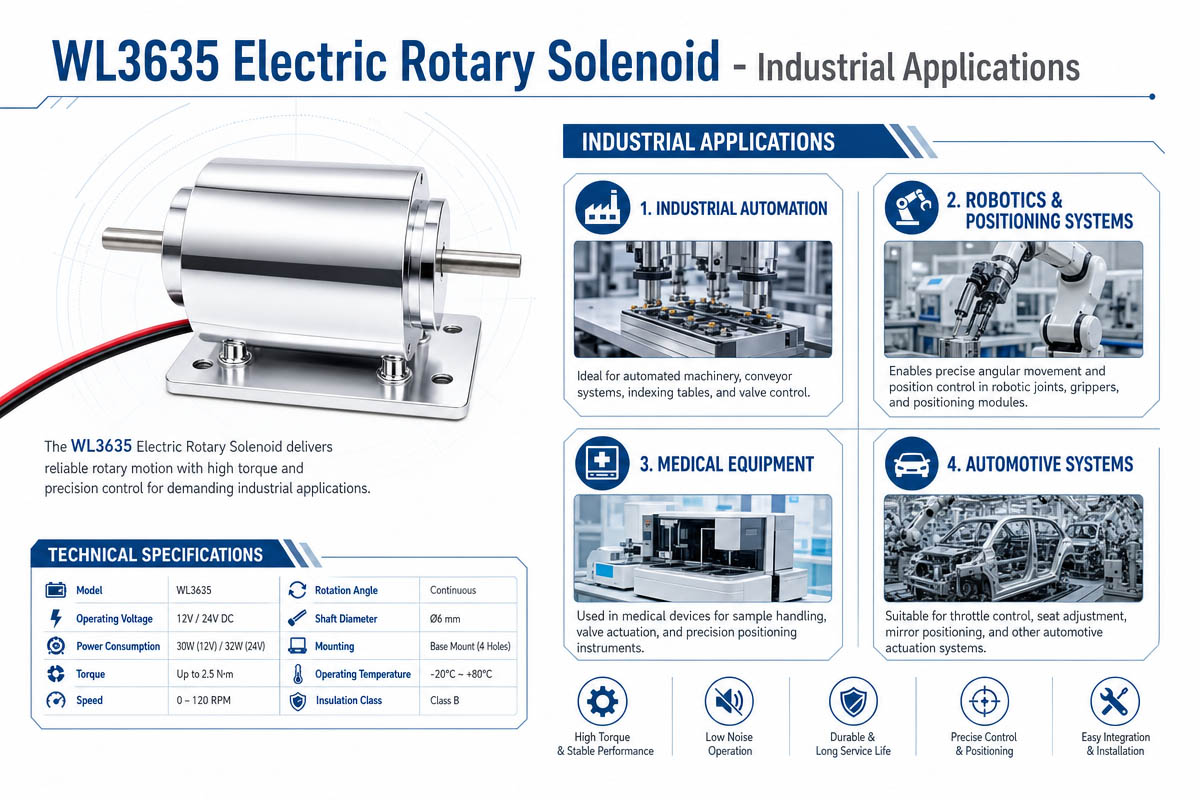
Due to their stability and compact size, rotary solenoids have many uses in industrial and commercial fields. Electric rotary solenoids are used in various applications like sorting systems, packaging systems, robot arms, valve control systems, and automation systems for fast and accurate rotary movement.

In the automotive industry, electric rotary solenoids are used in door lock systems, fuel control systems, transmission systems, headlight adjustment systems, and HVAC control modules. With the help of rotary solenoids, automotive systems become fast and reliable.

Also, electric rotary solenoids are used in the smart lock systems and security systems for controlling the actions of locking and unlocking. Moreover, electric rotary solenoids control dispensing and positioning of vending machines and self-service kiosks.

Laboratory automation, diagnostic equipment, and healthcare equipment are benefited by the accurate rotary movement of the device. Lastly, electric rotary solenoids are used in household appliances like coffee machine, smart switches, and other appliances.

High torque electric rotary solenoid advantage and Disadvantage

Electric Rotary Solenid Advantage and Disadvantage

High torque electric rotary solenoid Advantage

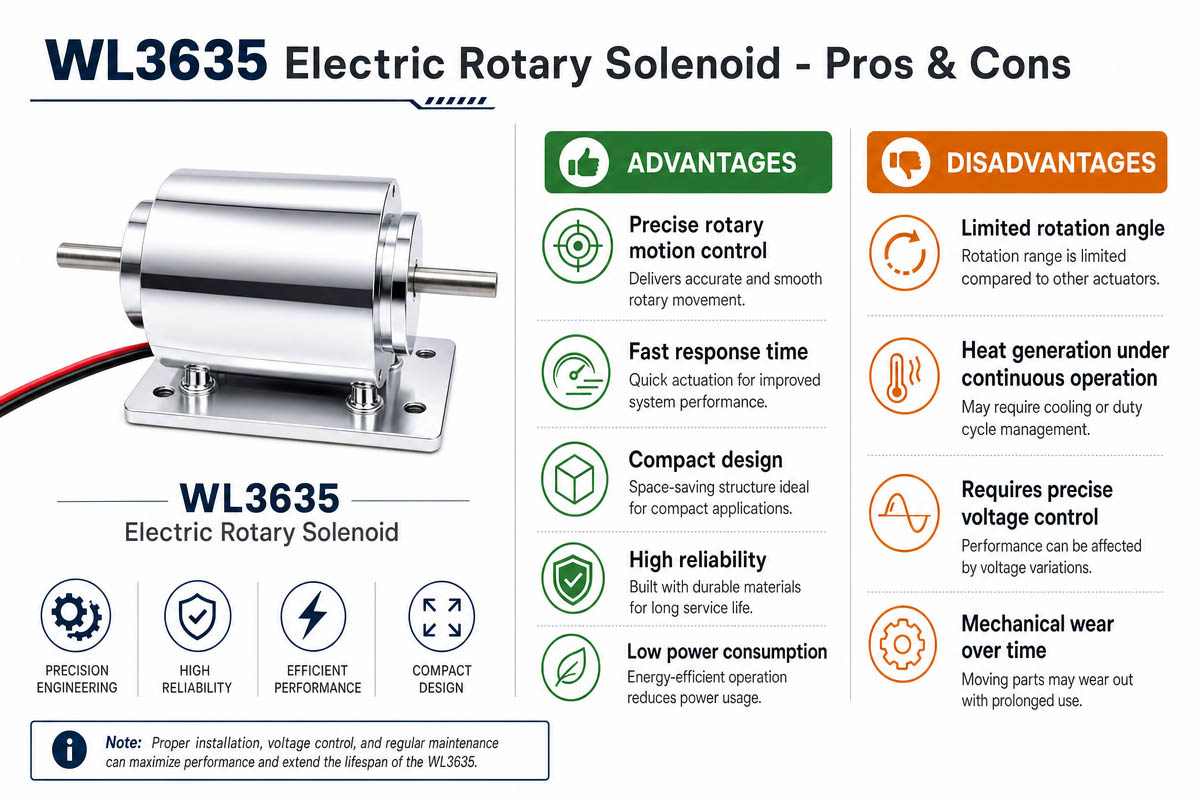
The electric rotary solenoid has many benefits for industrial applications. They have a small size, which allows easy installation in a limited space. Fast response time and precise rotary movement allow using rotary solenoids in automation systems. In addition, this kind of solenoids is characterized by a simple design, reliability, low power requirement, and stability of performance.

Long service life is achieved thanks to durable construction and stability under continuous operation. Due to low power requirements and a wide range of customization options, electric rotary solenoids allow flexible OEM application.

Moreover, rotary solenoids act quicker and easier controlled than motorized systems. Electric rotary solenoids are better suited for applications that involve short-angle rotation and repeated operations.

High torque electric rotary solenoid Disadvantage

Although there are advantages, there are also disadvantages associated with electric rotary solenoids. One of the major disadvantages is limited rotation angle, which is inappropriate for constant rotation. Motorized solenoids have lower torque for big mechanical loads compared to rotary solenoids.

In addition, rotary solenoids can overheat due to the continuous energy supply and cause degradation of performance. Certain applications can require precise positioning, which is possible only with more complex control systems.

Wrong voltage and duty cycle increase heat and reduce the longevity of electric rotary solenoids.

Electric Rotary Solenoid Troubleshooting Guide

Electric Rotary Solenid Troubleshooting Guide

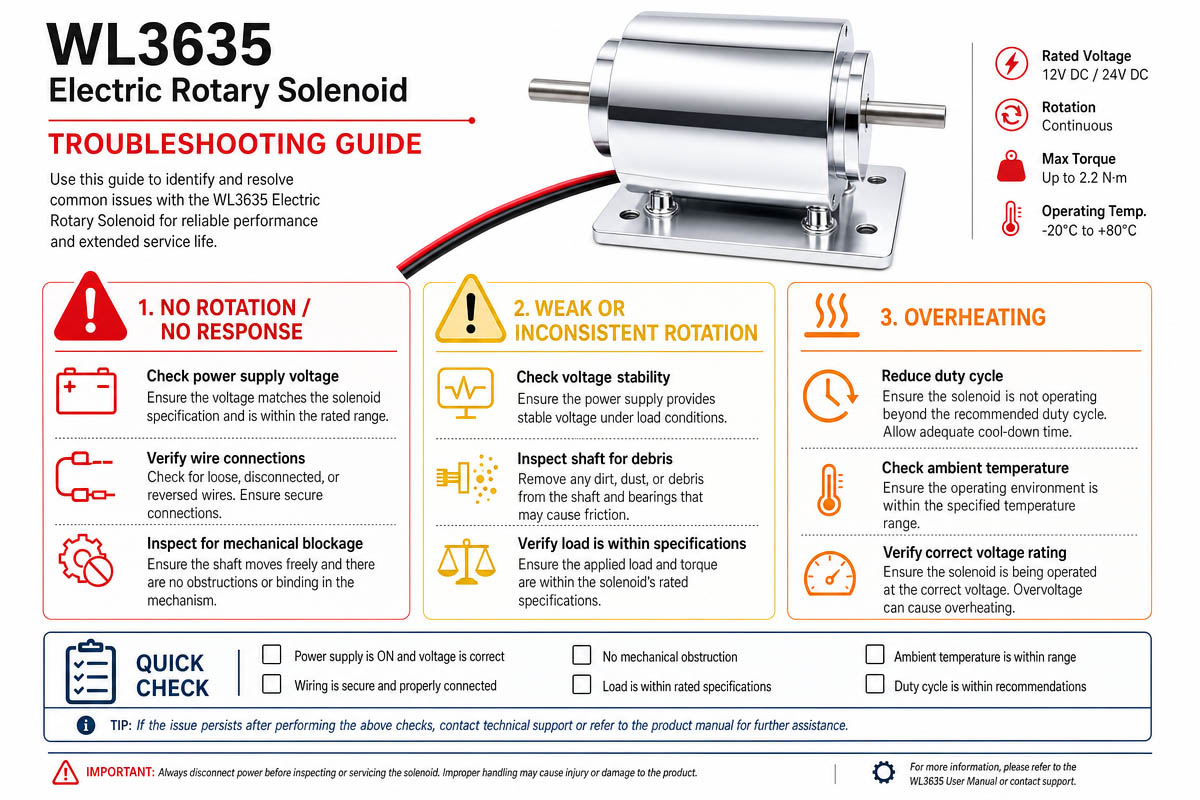
If an electric rotary solenoid does not operate properly, there are several reasons for the malfunction. Lack of voltage supply is one of the common problems causing insufficient magnetic field formation. Voltage supply and wire connection is checked first of all during electric rotary solenoid troubleshooting.

Secondly, overheating occurs because of excessive energy supply and improper duty cycle settings. Insulation can be damaged, and service life shortened due to incorrect voltage choice and thermal control. Another reason for the malfunction can be mechanical blockage. Accumulated dust particles and debris may limit rotation of the solenoid armature.

Degradation of coil insulation and magnetic material as well as incorrect power conditions lead to the reduction of torque output. It is determined by coil resistance measurements and magnetism.

Unsteady operation, noise emission, and wear may occur due to worn out bearing and other mechanical parts.

Proper selection, testing, and maintenance prevent the malfunction of the solenoid.

Hight Torque Electric Rotary Solenoid FAQs

1. What is the use of the electric rotary solenoid?

Electric rotary solenoids transform electrical energy to rotary motion. They are widely used in industrial automation, smart lock, medical devices, automotive applications, vending machines, and robotics.

2. What is the working principle of an electric rotary solenoid?

Electric rotary solenoid creates a magnetic field after electric power application. It turns the internal armature of the solenoid by a specified angle.

3. What rotation angles are possible?

Standard angle of rotation is 25°, 35°, 45°, and 90°. However, custom rotation angles are possible in OEM projects. But each model are not the same.  For your own project applicaiton, do contact the sales team to double confirm.

4. What voltage options are available?

Available voltage options are DC 6V, 12V, and 24V depending on application and system needs.

5. Are electric rotary solenoids continuous duty?

They are available in continuous and intermittent types. Special coils and energy control are necessary for continuous duty use.

6. Application of rotary solenoids?

They have wide applications in industrial automation, automotive, robotics, diagnostics equipment, and vending machines.

7. What influences the torque performance?

Torque output is influenced by voltage, mechanical load, coil design, and material of the magnetic core.

8.How to prolong the life of a rotary solenoid?

The most frequent causes of early failure are:

Overheating of the coil.
* Overvoltage
Mechanical overstrain.
Bad lubrication
Pollution
Duty cycle incorrect
Dislocation
Operation above and beyond specification

Knowledge of these factors prevents unwarranted damage.

The life of a rotary solenoid can be extended with proper selection, operation and maintenance. Temperature control , overload avoidance , clean operating conditions and duty cycle specifications can all be used to improve reliability greatly and help reduce maintenance costs .

With proper engineering and preventive maintenance, a high quality rotary solenoid can operate millions of cycles in harsh industrial environments.

How to Avoid Common Mistakes When Choosing Electric Rotary Solenoid

Mistakes in electric rotary solenoid selection can lead to the malfunction, overheating or system failure. First of all, many people neglect the torque value of rotary solenoids.

For calculating mechanical torque output, buyers need to measure mechanical torque required for the application. The second mistake is connected with wrong voltage choice or duty cycle settings.

Coils of rotary solenoids used for continuous and intermittent duties are different in design and characteristics. Consequently, inappropriate voltage or duty cycle cause overheating and shortened life of the solenoid.

Furthermore, most buyers forget about environmental conditions for rotary solenoids such as high temperatures, humid air, vibration, and dusty environment. For industrial environments, it is necessary to apply special protection.

Wrong rotation angle causes malfunctions of the rotary solenoid in the system. Before selection, buyers need to find out the precise value of rotation angle.

Last mistake is the disregard of installation dimensions and shaft requirements. In order to avoid this problem, buyers should study technical drawings before purchase.

The final point is choosing manufacturers according to their price offers only. For the correct purchase, the manufacturing capability, engineering service, and customization ability of manufacturers need to be estimated.

How to Choose an Electric Rotary Solenoid

When choosing electric rotary solenoids, it is important to pay attention to a number of electrical, mechanical, and environmental criteria. Firstly, rotation angle and torque output must be determined for further choosing of rotary solenoids. The solenoid has to have the necessary torque output for reliable actuation without being overloaded.

Next, voltage type is very important. It usually comes in DC 12V and 24V. However, voltage used must be the same as voltage supply of the system. In addition, it is important whether the application will be operated in continuous or intermittent duty mode.

Then, response time and life are important parameters of rotary solenoids in the case of automation equipment. High repeatability is required for high-speed automated systems. Long service life is necessary for industrial applications.

Environmental parameters are important for outdoor applications. For example, high temperatures, humidity, vibration, and dust are hazardous for solenoids. Special protection should be used.Installation dimensions must be compatible with equipment structure. The size of shaft, mounting structure, connector, and cable must be measured for further rotary solenoid selection.

Finally, customization is necessary in case of OEM projects. Technical information, torque curves, and samples should be asked before choosing suppliers. Engineering service and customization capability must be considered.

Get A Free Quote Now

Contact Form

Related Products

Related News

Scroll to Top

Get A Free Quote Now !

Contact Form
If you have any questions, please do not hesitate to contact us.
Weilong Solenoid Company Culture
