Direct-Acting Medical Solenoid Valve for Medical Systems
Direct-Acting Medical Solenoid Valve for Medical Devices
Direct-Acting Medical Solenoid Valve for Fluid Switching system
Direct-Acting Medical Solenoid Valve for Medical device Guide
Direct-Acting Medical Solenoid Valve for Medical OEM Use
Direct-Acting Medical Solenoid Valve for OEM Design Tips
Direct-Acting Medical Solenoid Valve for Medical Systems
Direct-Acting Medical Solenoid Valve for Medical Devices
Direct-Acting Medical Solenoid Valve for Fluid Switching system
Direct-Acting Medical Solenoid Valve for Medical device Guide
Direct-Acting Medical Solenoid Valve for Medical OEM Use
Direct-Acting Medical Solenoid Valve for OEM Design Tips

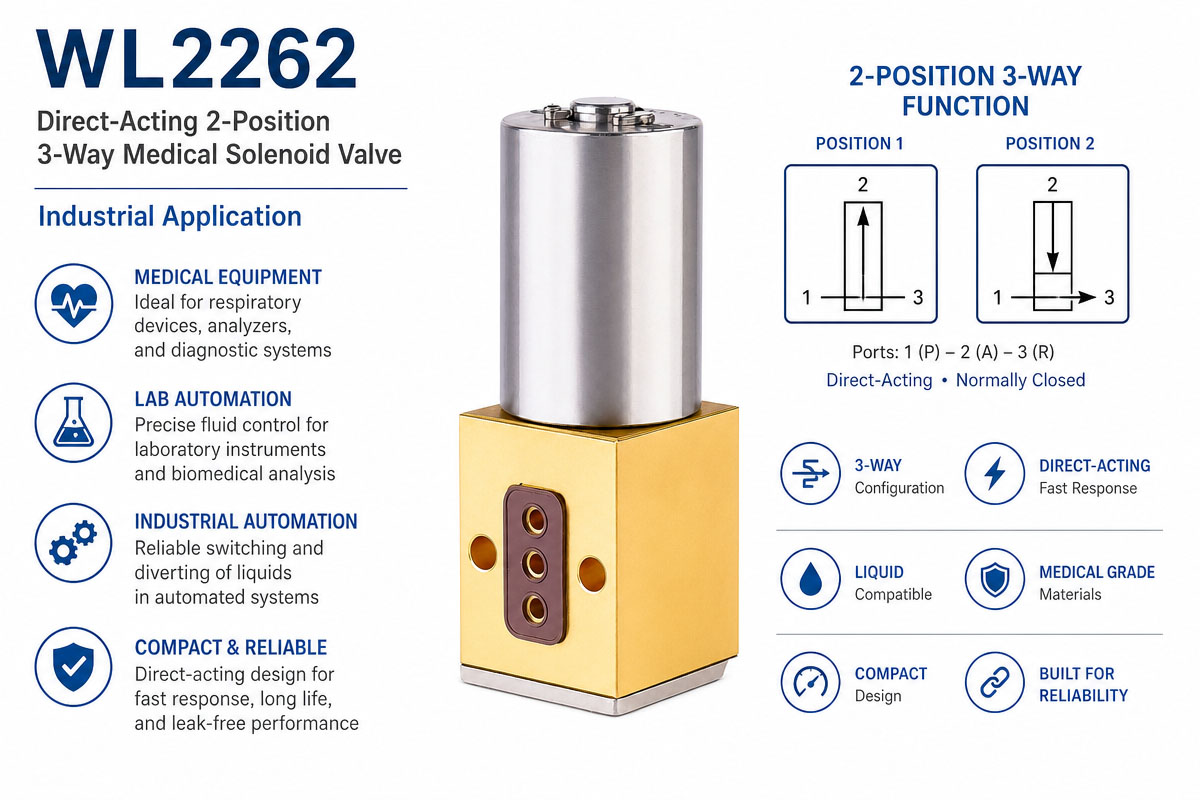
WL2262 Direct-Acting Medical Solenoid Valve for Medical Devices Solution

The Direct-Acting Medical Solenoid Valve is a compact flow control device for medical equipment, analytical instruments, diagnostic systems, laboratory equipment, and other precision fluid control applications. The principle of direct-acting electromagnetic operation allows the valve to function reliably at low pressure or vacuum.

A three-way arrangement provides the capability to switch between inlet, normally closed, and normally open flow paths. Key factors affecting valve performance are leakage, pressure rating, vacuum performance, media compatibility, temperature resistance, electrical consumption, and switching reliability.

For example, the WL2262 has a coil of 24 VDC, 4 W, with a leakage of less than 0.002 ml/min, a vacuum of -0.095 MPa, and port sizes from 0.8 mm to 2.0 mm. Valve bodies made from SUS316/brass and FKM seals can perform well in difficult fluid-control environments provided that compatibility with the application is confirmed.

Direct-Acting Medical Solenoid Valve Product Overview

Direct-acting medical solenoid valves are precision electromechanical valves for controlling gases or liquids in medical and analytical equipment. The valve is a compact assembly for flow control consisting of an electromagnetic coil, plunger, spring, valve seat, seals, and body. An energized coil generates a magnetic field that moves the plunger and changes the internal flow path. The direct-acting design is especially useful in low-pressure or vacuum applications, as the operation does not depend on the minimum pressure differential. Three-way valves provide flexible switching between different flow paths. The most important design criteria are leakage, pressure, flow, materials, temperature, electrical characteristics, mechanical dimensions, reliability, and system integration.

How a Direct-Acting Medical Solenoid Valve Works

The operation principle is quite straightforward:

Step 1: Electrical Signal

The equipment controller sends voltage to the solenoid coil.

Step 2: Field Magnetic

Electrical current running through the coil creates an electromagnetic field.

Step 3 – Plunger Movement

The magnetic field pushes/pulls the internal plunger against the return spring/mechanical resistance.

Step 4: Replace the Valve

A plunger changes the position of the internal sealing element or valve seat.

Step 5: Flow Path Change

The valve directs the flow to one of three ports.

For a two-position, three-way valve, there are two states of operation:

State 1: Port A to Port B

State 2: Port A to Port C

The exact flow direction depends on whether the valve is normally closed, normally open, or has some special configuration.

Why Direct Action Is Important

The valve is moved directly by the actuator so that high differential pressure of the upstream is not needed to start the movement of the valve. The valve is especially suitable for low-pressure gas circuits, vacuum systems, sampling systems, and analytical equipment.

The Main Features of Direct-Acting Medical Solenoid Valves

Direct-acting medical solenoid valves offer precise electromagnetic flow control in a compact design. Important features of the valve include direct electromagnetic actuation, high-speed operation, low leakage, small port sizes, flexible two-position/three-way configurations, and robust operation at low pressure. Depending on the model, the valve can accommodate air, water, oil, or any other compatible media. For example, the WL2262 valve has port sizes from 0.8 to 2.0 mm, vacuum to -0.095 MPa, and leakage below 0.002 ml/min. 24VDC, 4W coil makes the valve easy to integrate electrically into the equipment controller. Various SUS316/brass body options, FKM seals, IP65 protection, and wide temperature range make the valve capable of working in challenging environments.


Direct-Acting Medical Solenoid Valve Video

Direct-Acting Medical Solenoid Valve Detailed Display

Direct-Acting Medical Solenoid Valve Technical Datasheet

Brand Weilong Technology Model Number WL 2262
Rated Voltage (V) DC 24V Rated Power (W) 4W
Work Mode Air or Liquid Control Valve Working Pressure (MPa) 0.1 MPa
Air Flow Rate 1 L/minute Reset Time(s) 1 S On, 1 S Off
Service Life 200 Thousand Times Certification CE, ROHS, ISO9001,
Pipe Gate Outside Dia.: 0.8 Type 3 Ways
Install Style Flanker Tolerance of Dimension ± 0.1 MM
Water-proof IP65 Insulation Class B
Hi-Pot Test AC 600V 50/60 Hz 2s Non-excitation Holding Force 0
Working Temperature -10°C-100°C Duty Cycle 1-100%
Thread Depth (mm) / Payment Term TT, or LC at Sight
Sample Order Yes. Warranty 1 Year
MOQ 1000 pcs Supply Ability 5000 pcs per week
Delivery Time 30 Days Port of Loading Shenzhen

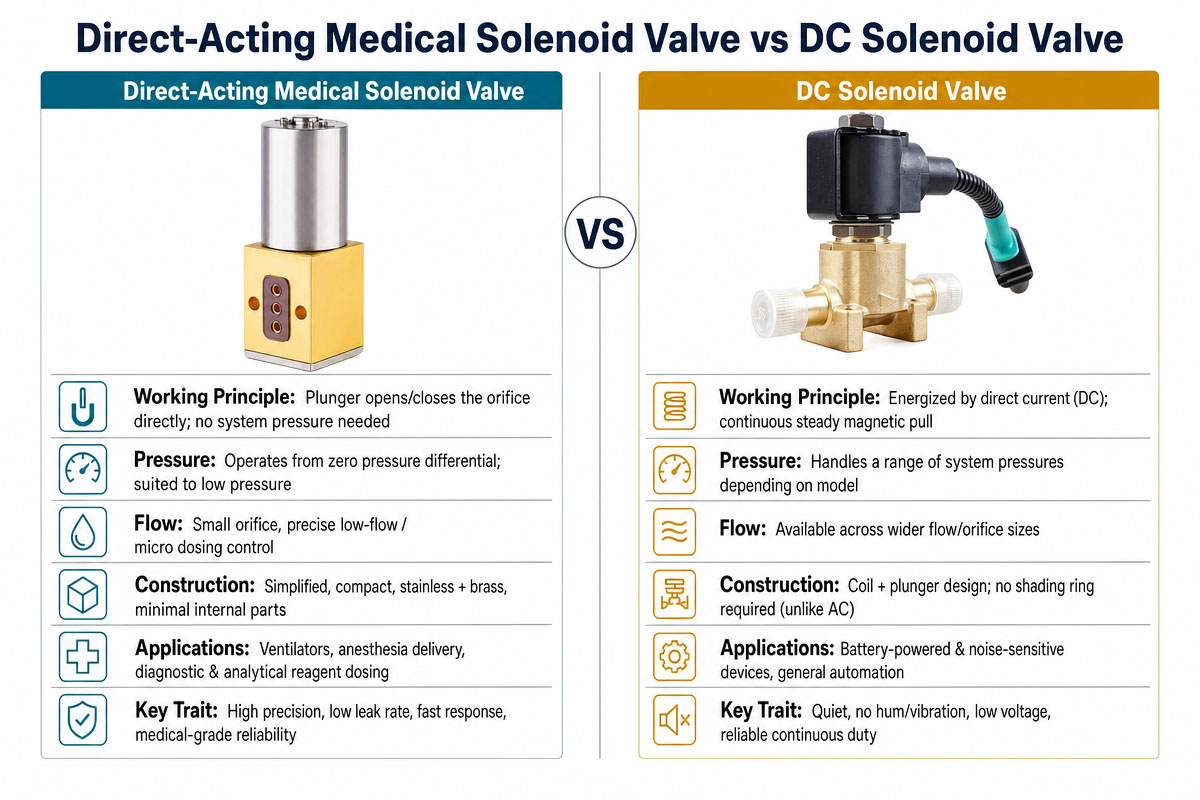
Direct-Acting Medical Solenoid Valve vs. DC Solenoid Valve

Direct-Acting Medical Solenoid Valve vs DC Solenoid Valve

The two terms are related, but they describe different characteristics.

Feature Direct-Acting Medical Solenoid Valve DC Solenoid Valve
Main description Valve operating principle + application Electrical operating type
Actuation Direct electromagnetic actuation Electromagnetic actuation
Electrical supply Can use DC or AC depending on design Designed for DC supply
Typical use Medical/analytical fluid control General industrial actuation/control
Pressure dependency Direct acting does not require pilot pressure. Depends on valve construction
Flow configuration Often 2-way or 3-way May be 2-way, 3-way, or other
Application focus Medical equipment and analytical systems Broad industrial applications
Key priorities Leakage, cleanliness, materials, compactness, reliability Voltage, force, stroke, duty cycle, power

The key difference is in the definition of the term “direct-acting.”

It relates to the mechanical action of the valve.

‘DC’ is the electrical power to the electromagnet.

So a valve can be:

Direct-Acting + DC + Medical + 3-Way

For example.

WL2262 Direct Acting 2-Way 3-Way Medical Solenoid Valve

Rated voltage: DC 24V

Coil power: 24V = 4 W

So it is not really an apples-to-apples comparison between “direct-acting medical solenoid valve” and “DC solenoid valve.” One defines the type of the electrical supply, and the other defines the actuation architecture/application.

Conclusion recommendation

Direct-acting medical solenoid valve—this is a specialized type of fluid-control valve that is designed for use in medical or analytical equipment. DC solenoid valve—this is a general term for any solenoid-operated device that runs on direct current. A direct-acting medical valve can be a DC solenoid valve as well when it is working with a DC coil, for example, a 24VDC configuration.

Direct-Acting Medical Solenoid Valve Industrial Application

Direct-Acting Solenoid Valve Industrial Application

The direct-acting medical solenoid valve is widely used in medical and analytical systems, where a controlled and repeatable switching of the gas or fluid flow is required.

The valves are used in respiratory systems, oxygen-related equipment, anesthesia systems, diagnostic equipment, and other fluid-control assemblies in medical equipment. The valves are direct-acting and useful when available pressure is low or where the system requires reliable switching regardless of pressure differential.

These valves are used in analytical instrumentation for sample-gas routing, calibration-gas switching, purge cycles, venting, and controlled fluid pathways. In gas analyzers and laboratory systems, three-way valves are used for switching between a sample line and a calibration or purge line.

The valves used in laboratory equipment are capable of controlling water, air, oil or other compatible media used in testing and preparation systems.

Compact solenoid valves can provide automated pneumatic circuits, reagent management, fluid isolation, and process-control functions in industrial medical equipment.

For OEM applications, when selecting a valve, consider pressure, vacuum, flow rate, port size, media compatibility, leakage, voltage, duty cycle, response time, temperature, installation space, and life expectancy.

Why the Direct Acting Medical Solenoid Valve is getting so popular in Medical Equipment Solutions

The growing application of the direct-acting medical solenoid valve is connected with the changing needs of modern medical and analytical equipment.

Modern devices become smaller, more automated, electronically controlled, and more fluid-path intensive. Engineers need valves that provide reliable switching and predictable performance in a compact package.

Direct-acting technology has several advantages in this environment.

First of all, it can perform well in low-pressure applications, which is crucial for many gas and fluid circuits.

Second, the compact actuator architecture can be easily integrated into the space-constrained equipment.

Third, the direct electromagnetic control is easy to integrate with electronic control systems, PLCs, embedded controllers, and automated diagnostic equipment.

Fourth, the low leakage and controlled flow switching are desirable features for applications where the integrity of the gas or fluid path is crucial.

Also, it is valuable for analytical instruments when it is needed to automatically switch between sample gas, calibration gas, purge gas, and exhaust paths.

One more big advantage for the manufacturers is the design flexibility. The valve manufacturers offer the opportunity to customize port size, body material, seals, coil voltage, mounting structure, connector type, and flow configuration in accordance with the equipment architecture.

Direct-acting solenoid valves are a good solution for compact, highly integrated medical equipment.


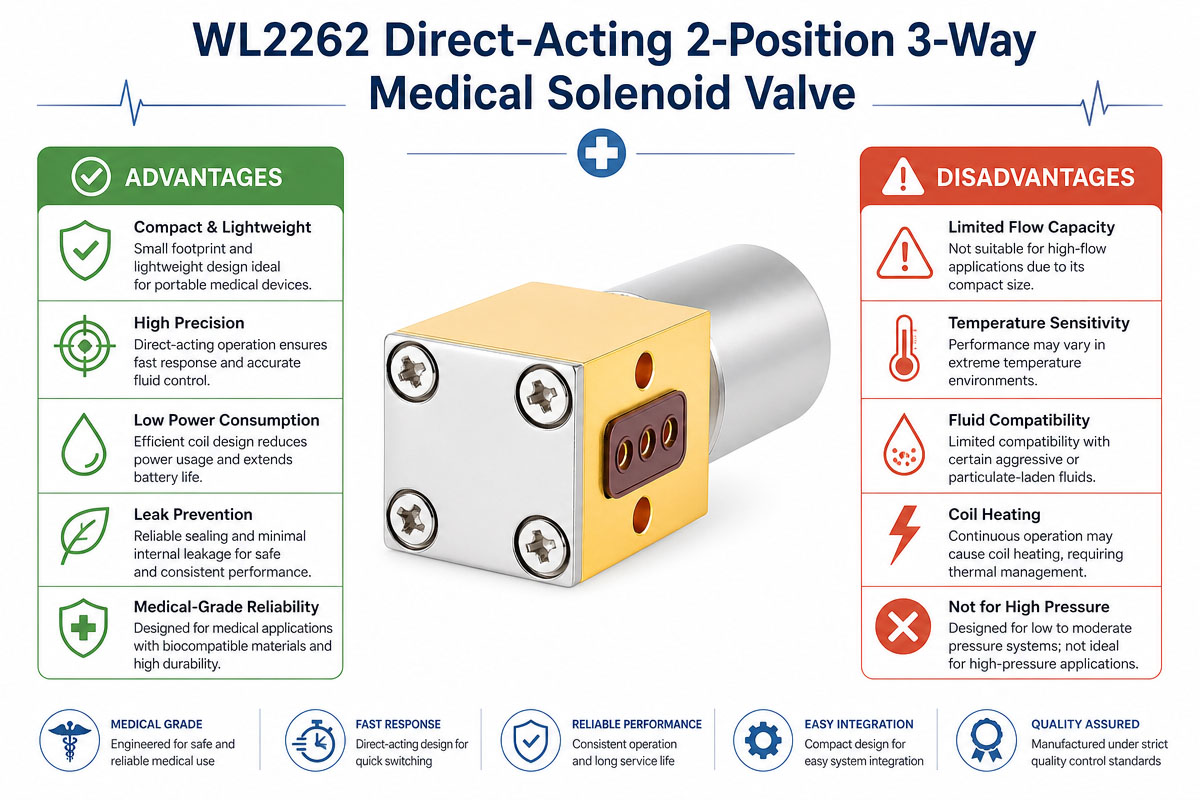
Direct-Acting Medical Solenoid Valve Advantage and Disadvantage

Direct-Acting Solenoid Valve Advantage and Disadvantage

Direct-Acting Medical Solenoid Valve Pros

The main advantage of the direct-acting medical solenoid valve is that it operates regardless of the minimum pressure differential. Therefore, this valve is good for low-pressure, low-flow, and vacuum applications. Additionally, the construction is relatively simple, which may allow for quick switching and a compact design.

The advantages for medical and analytical equipment include precise flow-path switching, minimal leakage potential, flexible two-position/three-way configurations, and the possibility to be controlled by automated electrical control systems. Small port sizes allow for a compact design.

Direct-Acting Medical Solenoid Valve Cons

Direct-acting valves have certain disadvantages. Namely, the electromagnetic force of the solenoid should be powerful enough to move the valve element directly against pressure and mechanical resistance. The electromagnetic force may vary dramatically with the growth of the pressure or required orifice size.

It may result in higher coil power, increased heat generation, or a larger solenoid package.

Another disadvantage is that direct-acting valves may have limited pressure-flow relations compared to some pilot-operated designs. For high-flow applications, a pilot-operated valve might scale better.

Therefore, direct-acting technology is great for compact, low-flow, and high-precision applications, while higher-flow systems should be evaluated carefully in terms of pressure, force, heat, and space requirements.

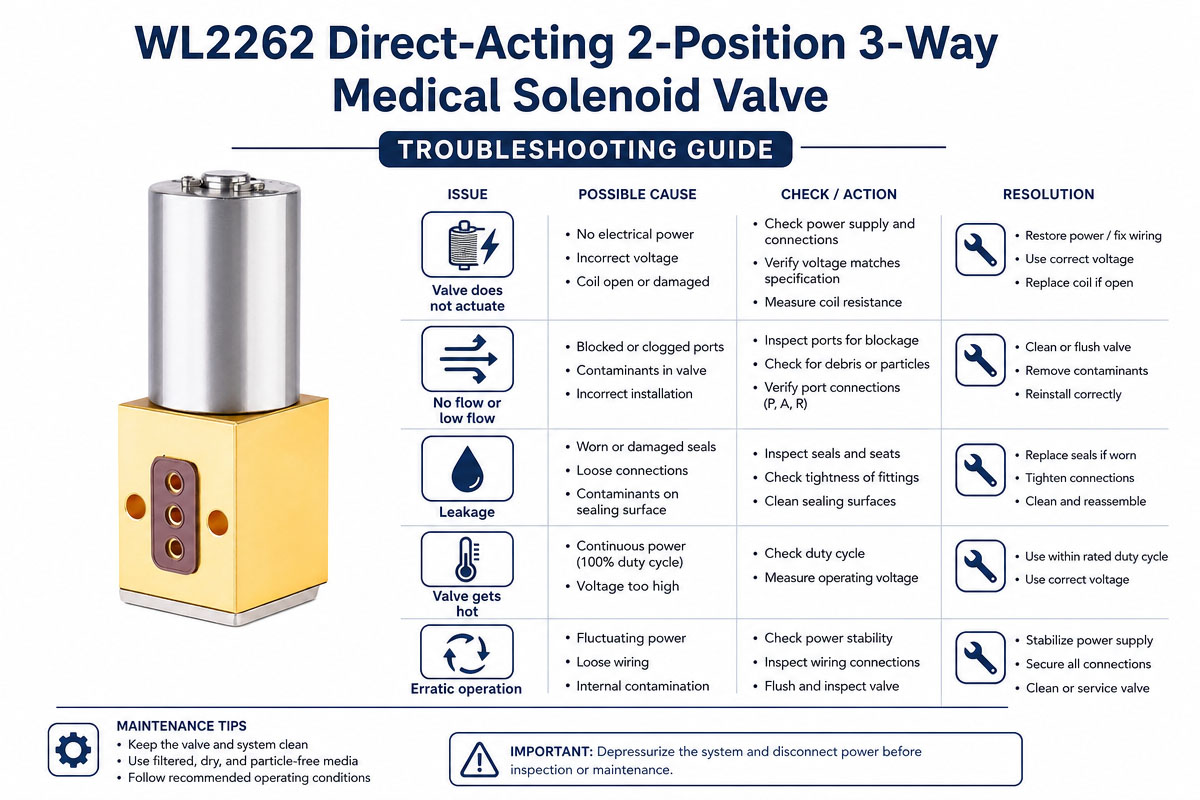
Direct-Acting Medical Solenoid Valve Troubleshooting Guide

Compact Direct-Acting Solenoid Valve Troubleshooting Guide

Valve Fails to Open

At first, make sure the electrical supply is correct. Check rated voltage, wiring, connector condition, coil resistance, and controller output. In case the coil is damaged or is not properly energized, the plunger won’t move.

Valve Doesn’t Seal Correctly

Check the valve seat, plunger, spring, and sealing surfaces. Contamination or particles in the fluid path can prevent proper sealing.

Excessive Leakage

Make sure the valve is used in accordance with the pressure specifications. Also, check the seal, valve seat, and assembly alignment. Seal deformation and leakage can occur because of media incompatibility.

Low flow rates

Check port size, pressure differential, tubing, fittings, and flow restrictions elsewhere in the system. Small ports may not provide sufficient flow to meet high-demand circuits.

Too Much Noise

Check electrical voltage and mechanical installation. Strange noise may be the sign of the problem with plunger movement, contamination, excessive mechanical vibration, or an electrical issue.

Coil Gets Too Hot

Check voltage, current, duty cycle, ambient temperature, and installation conditions. Over-energization and insufficient heat dissipation may lead to coil overheating.

Intermittency

Check wiring, connector reliability, controller output, plunger movement, spring condition, and contamination.

If you have recurring problems, consider the solenoid valve’s total electrical, mechanical, fluid, and thermal operating environment, not only the solenoid valve.


8 FAQs of Direct Acting Medical Solenoid Valve

1. What Is Direct Acting Medical Solenoid Valve?

The Direct-Acting Medical Solenoid Valve is an electrically operated valve for medical equipment, analytical instruments, lab systems, and precision fluid-control applications. The internal plunger or valve element is moved directly by the electromagnetic coil to open, close, or switch the flow path. Unlike pilot-operated valves, it doesn’t require a minimum pressure differential for basic operation. It is therefore suitable for low-pressure, small-flow, and vacuum applications.

2. What is the difference between direct-acting and pilot-operated medical solenoid valve?

Direct-acting valve The valve element is actuated directly by the electromagnetic force of the coil. The system pressure in a pilot-operated valve helps the process of opening and closing. Generally, for low-pressure, low-flow, and vacuum applications, direct-acting valves are preferred, while pilot-operated valves can be advantageous for higher flow rates and larger orifices when sufficient pressure differential exists.

3. Where Direct Acting Medical Solenoid Valves are most commonly used?

They are often used in:

Medical gas control apparatus

Respiratory and Ventilating Systems

Anesthesia machine

Oxygen apparatus

Analyzers, blood, and diagnostic

Gas Analyzers

Laboratory equipment

Fluid control system

Sampling and calibration systems

They are especially valuable when the equipment should be small, switching should be reliable, leakage should be low, and flow-path control should be exact.

4. Can a Direct-Acting Medical Solenoid Valve be used for vacuum application?

Yes. One benefit of direct-acting design is that it can be used in applications with very low or negative pressure differentials. The WL2262 is specified to have the vacuum capability of about -0.095 MPa. However, real vacuum performance should always be checked under the conditions of media, temperature, flow, and duty cycle of the customer.

5. What voltage does a medical solenoid valve use?

The voltage depends on the equipment control system and valve design. 12VDC and 24VDC are common configurations. For example, the WL2262 specification is a 24VDC coil that uses 4W of power, which means it will draw about 0.17A. . Before choosing the valve, engineers should verify voltage, current, power, duty cycle, connector type, and controller compatibility.

6. How to select the right Direct-Acting Medical Solenoid Valve?

Start with the actual system requirements, not with the valve dimensions. Okay. Confirm:

Media → Flow rate → Pressure/vacuum → Port size → Leakage → Voltage → Duty cycle → Temperature → Materials → Installation size

For example, the WL2262 is available in port sizes ranging from .8 mm to 2.0 mm. The allowable pressure depends on the port size and the function of the port, so the valve should be selected according to the complete operating condition.


7. What are the materials that can be used for medical solenoid valves?

Material selection depends on the fluid or gas, temperature, pressure, cleanliness requirements, and expected service life. Common materials are SUS316 stainless steel, brass, engineering plastics, and specially formulated elastomers. According to the WL2262 specification, the valve body can be made of SUS316/brass, and the seal is FKM (fluororubber). The compatibility with the actual media should be verified before use, especially for medical and analytical applications.


8. What should I check before I order a custom medical solenoid valve?

In the case of an OEM project, please provide as much application information as possible, including:

Port size and configuration, media, pressure, vacuum, flow rate, leakage requirement, voltage, power, response time, duty cycle, temperature range, materials, mounting dimensions, connector type, and expected operating life.

You also need to test engineering samples before mass production. Tests should include flow, pressure, leakage, switching performance, temperature rise, electrical characteristics, and mechanical integration.


How to Select a Direct-Acting Medical Solenoid Valve

Choosing a proper direct-acting medical solenoid valve should start with application, not valve size.

1. Define your media

Identify exactly what will pass through the valve:

air, water, oil, oxygen, nitrogen, chemicals, or other liquids.

The media defines required valve body and seal materials. Chemical compatibility of the valve should always be checked before production.

2. Determine Flow Requirements

Flow rate and port diameter directly affect valve performance. A larger port does not always mean that the valve is better. It should be compatible with the required flow, pressure, and available space for installation.

For example, the WL2262 valve is available in port sizes from 0.8 mm to 2.0 mm.

3. Verify Pressure and Vacuum

Check:

max inlet pressure,

NC Pressure,

NO Pressure,

operating pressure at minimum,

vacuum (stage).

The allowable pressure will vary significantly depending on port size and flow direction.

4. Electrical Configuration Confirmation

Confirm:

rated voltages,

AC or DC,

Now,

power of coil,

duty cycle,

connector or lead wire type.

For example, the WL2262 valve is DC24V and 4W.

5. Check Temperatures

Consider both of them:

ambient temperature and media temperature.

The valve seal, body, coil insulation, and surrounding materials should operate within the specified temperature range.

6. Leakage Requirements Check.

Leakage is a very important issue for medical and analytical systems. Determine the allowable leakage and choose the valve.

The example specification says:

Leakage < 0.002 ml/min

7. Mechanical Integration Check:

dimensions and weight,

orientation of ports,

holes for mounting,

tube link,

installation clearance,

orientation of coil

8. Verify Switching Requirements

Discover:

turnaround time,

frequency switching,

life span,

noise specification,

time to keep,

duty cycle

9. Get Engineering Samples

Check before mass production:

system integration + temperature + switching + flow + leakage + pressure

The best valve is not always the cheapest one but the one providing stable performance in the entire equipment operation range.

How to Avoid Common Mistakes in the Design of Direct-Acting Medical Solenoid Valves

Mistake #1: Choosing a Valve Based On Port Size Only

The port size doesn’t mean the valve is good just because it’s of a certain diameter. Other factors are pressure, flow, media, leakage, and response requirements.

Mistake 2: Not considering the direction of pressure

Different ports of a three-way valve may have different allowable pressure ratings. Always check IN, NC, and NO pressure ratings.

Mistake 3: Choosing the wrong seal material

Compatibility of the seal depends on the actual media and temperature. FKM material can be suitable for many applications, but each case should be checked separately.

Mistake #4: Incorrect calculation of coil temperature

A solenoid is the device that converts electrical energy into magnetic force and heat. Calculate coil temperature using the actual duty cycle.

Mistake #5: Upgrading to a higher-power coil without checking heat.

Higher electrical power doesn’t mean better valve performance. Excessive power results in higher temperature, higher energy consumption, and additional strain on the surrounding components.

Mistake 6: Not considering vacuum performance

The valve designed for positive pressure applications may fail in vacuum applications.

Mistake 7: Not Checking For Leaks

Sometimes valve switches correctly but fail to meet equipment requirements due to excessive leakage.

Error 8: Not designing Valve taking installation into account

Mechanical design freeze. Consider tubing, mounting holes, orientation, connector position, and space available.

Mistake 9: Going from design to high-volume production

Don’t approve production tooling and large quantities until you have engineering samples and validation testing.

Error 10: Not Defining the Application with Supplier

The application specification allows the manufacturer to optimize the coil, plunger, spring, seal, port, and valve structure for the application rather than supply a standard off-the-shelf model.


Get A Free Quote Now

Contact Form

Related Products

Related News

Scroll to Top

Get A Free Quote Now !

Contact Form
If you have any questions, please do not hesitate to contact us.
Weilong Solenoid Company Culture