Proportional Valve Controller Manufacturer Solutions
Smart Proportional Valve Controllers for Automation
Industrial Proportional Valve Controller Solutions
Reliable Proportional Valve Controller Equipment
Intelligent Proportional Valve Control Technology
Proportional Valve Controller for Fluid Regulation

WL2004 High Precision Proportional Valve Controller System

The proportional valve controller is a type of electronic device that controls proportional valves with precise electric signals. It transforms input signals from automation systems, sensors or PLCs into controlled output signals to control the flow rate, valve position and pressure. Compared to the traditional valve control solutions, proportional valve controllers provide smoothness, accuracy and efficiency. They are widely used in hydraulic equipment, pneumatic systems, robotics, industrial automation and process control. Advanced proportional valve controllers provide digital calibration, feedback control, overload protection and system integration. Proportional valve controllers help manufacturers to achieve accurate fluid control, save energy and increase machine productivity with adjustable parameters and reliable performance.

Precision Proportional Valve Description

What is a Proportional Valve Controller?

The proportional valve controller is an electronic control unit that controls proportional valves by adjusting the electrical output signals. It takes input signals from control systems and generates precise current, voltage or PWM signals to control the valve movement. This controller provides an alternative solution to simple ON/OFF operation and allows for continuous adjustment of fluid flow, pressure and actuator speed. It includes signal processing circuits, power drivers, feedback control and protection. Proportional valve controllers are the key elements in hydraulic, pneumatic and industrial automation systems that require precise and reliable fluid control. They improve the performance and precision of the machine.


How do proportional valve controllers work?

The proportional valve controller takes an input signal from a PLC, sensor, joystick or automation system and turns it into an output signal.

It takes the input signal and changes the current going to the proportional valve coil. Electromagnetic force generated by the current flowing through the coil moves the valve opening.

The controller controls the output signal continuously according to the necessary flow or pressure value. In advanced systems, feedback sensors monitor the performance and provide information to the controller for correction.

The control loop guarantees the stability of operation, precise regulation and increased response speed. Proportional valve controllers allow for precise control of hydraulic and pneumatic systems with electronic control.

Precision Proportional Valve Video

Precision Proportional Valve Detail Display

Precision Proportional Valve Data Sheet

Brand Weilong Model Number WL 2004
Rated Voltage (V) DC12V or 24V Rated Power (W) 7.2W
Work Mode Air Control Valve Working Pressure (MPa) 0.2 MPa
Airflow Rate 1-2.5 L/minute Reset Time(s) 1 S On, 1S Off
Service Life 200 Thousand Times Certification CE, ROHS, ISO9001,
Material Superior Magnet Iron Lead Wire Length (mm) 200 MM
Install Style Screw Tolerance of Dimension ± 0.1 MM
Water-proof None Insulation Class B
Hi-Pot Test AC 750V 50/60Hz 2s Non-excitation Holding Force 0
Working Temperature -10°C-90°C Duty Cycle 1-100%
Thread Depth (mm) / Payment Term TT, or LC at Sight
Sample Order Yes. Warranty 1 Year
MOQ 1000 pcs Supply Ability 5000 pcs per week
Delivery Time 30 Days Port of Loading Shenzhen

Why Are Proportional Valve Controllers So Popular?

The proportional valve controller becomes more and more popular due to higher automation, precision and efficiency required in modern industries. The proportional controller provides intelligent, ongoing control and allows for the smooth adjustment of advanced machinery that is not possible with traditional valve systems.

Industry 4.0, robotics and smart manufacturing increase the demand for accurate electronic valve control. These controllers are designed for integration with PLC systems, sensors and digital networks, increasing production efficiency.

Their ability to optimize energy consumption and to reduce mechanical stress makes them useful in hydraulic and pneumatic systems. Advanced protection features and programmable settings improve reliability.

Smart industrial equipment has triggered the popularity of proportional valve controllers as critical components in motion control and automated fluid management.

Precision Proportional Valve Applications

Proportional Valve Controller Industrial Application

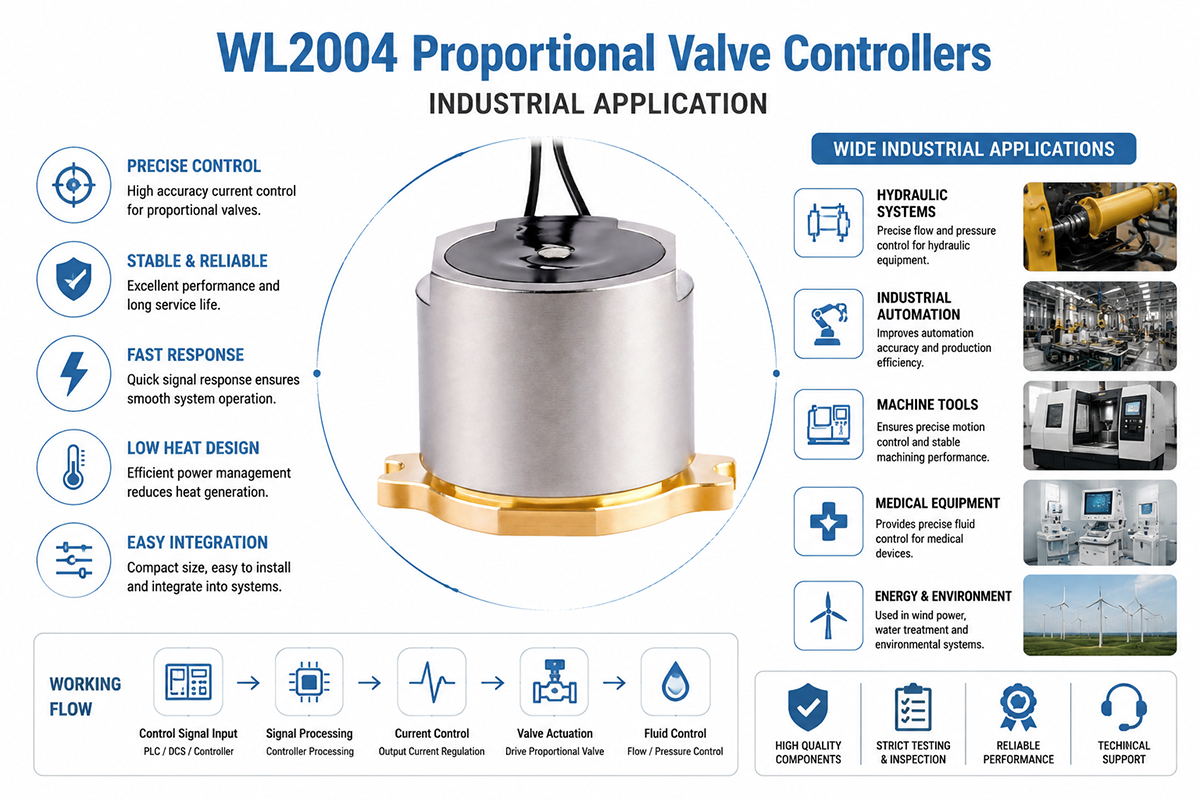
Proportional valve controllers are widely used in industries where there is a requirement for accurate control of fluids and motion.

They control proportional valves in hydraulic systems for cylinders, motors and actuators. Precise regulation of pressure and speed is a great advantage for construction machinery, injection molding equipment and industrial presses.

Pneumatic automation controllers control airflow for robotic systems, assembly machines and production lines. They increase positional accuracy and stability.

Proportional valve controllers are used in robotics applications to provide smooth movement control and to improve energy efficiency. The medical devices also rely on precise valve control to regulate gasses and fluids.

These controllers are used in automotive manufacturing industry to support automated production systems, test equipment and precision machinery.

Proportional valve controllers are also used in agriculture, mobile machinery and process control systems for better performance and reduced energy consumption.

As modern industrial automation systems become more and more advanced in terms of communication and intelligent control, proportional valve controllers play a more and more important role.

Precision Proportional Valve Adv. & Disadv

Proportional Valve Controllers for Smart Machines

Advantages and Disadvantages of Proportional Valve Controllers

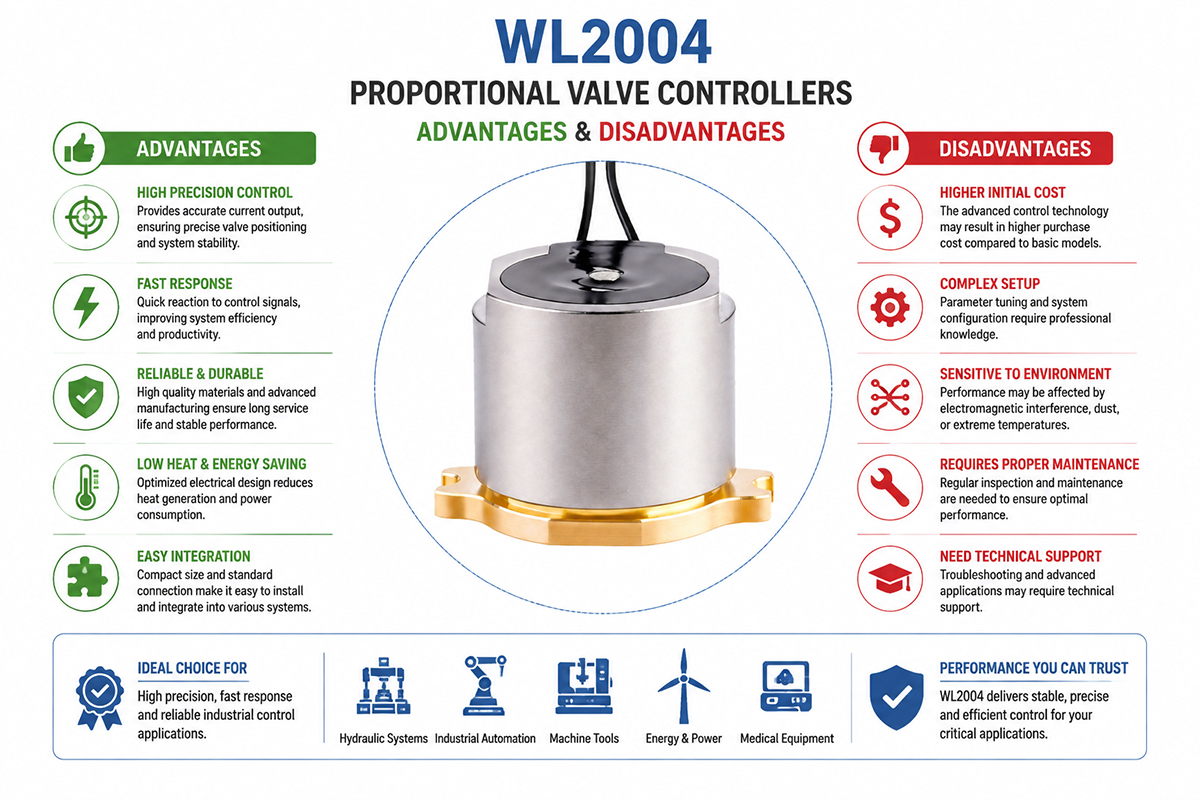
Advantages

The proportional valve controllers provide precise electronic control of pneumatic and hydraulic valves. Their main advantage is a precise adjustment of the flow, pressure and speed of movement. They optimize the valve operation and reduce unnecessary energy consumption, increasing system efficiency.

They support the integration of automation with PLC’s, sensors and digital networks. Programmable settings provide flexibility of tuning for various applications.

Enhanced protection features increase reliability and minimize the downtime of equipment. Compact designs provide easier installation.

Drawbacks

The main drawback is price which is higher compared to simple valve control devices. Their sophisticated electronics and software make the manufacturing more difficult.

Proportional valve controllers require technical calibration and configuration for optimal performance. Incorrect settings may lead to instability of operation.

They are also sensitive to electrical interference, wrong wiring and improper environmental conditions. May require professional knowledge for maintenance and troubleshooting.

Despite these drawbacks, the proportional valve controller provides numerous advantages in applications requiring precision, automation and intelligent control.

Proportional Valve Controller Maintenance Guide

Troubleshooting Proportional Valve Controllers

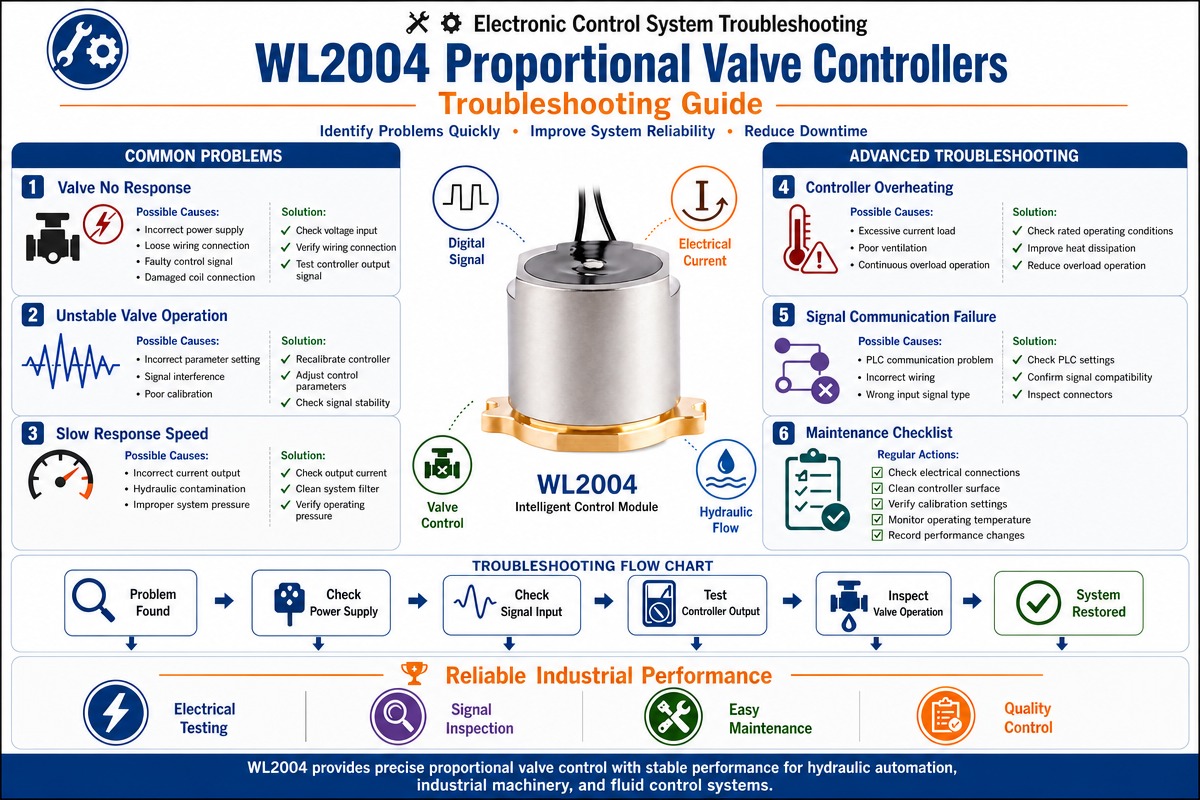
Proportional valve controllers could exhibit issues related to electrical, mechanical or control system problems. Common issue is the malfunctioning of valve that doesn’t operate properly. Possible reasons for such failure might include incorrect input signal, wrong wire connections or insufficient power supply. Ensure controller voltage, current and signal calibration correspond to valve specifications.

The malfunctioning of proportional valve should be investigated for possible physical damage or loose contacts in the coil, actuator and controller connections. The incorrect setting of flow or pressure could be also due to incorrect control parameters or faulty feedback sensor. In most cases the proper function of proportional valve can be restored through re-calibration and checking command signal.

Contamination, clogged passages in the valve, improper hydraulic pressure or inappropriate settings of controller parameters could cause a sluggish response or erratic flow. The performance of proportional valve controller system can be improved by means of cleaning, filtration and appropriate parameter setting.

Typically, the overheating of proportional valve controller is caused by overcurrent, improper cooling or continuous operation at excessive values. Ensure proper working conditions and correct cooling.


Problems and frequent malfunctions could be prevented by means of proper installation and calibration, maintenance, examination of electrical connections and monitoring of working temperature. Proper and systematic troubleshooting process helps to ensure high reliability, extends life time and maintains precise control.

FAQ

1. What does 'proportional valve driver' mean?

The proportional valve controller is an electric controller that sends accurate electrical output signals to proportional valves. It converts the commands from PLCs, sensors or other control systems into regulated current, voltage or PWM signals for the valve control. Compared with traditional ON/OFF valve control, the proportional valve controllers allow for a smooth regulation of flow, pressure and actuator movement. These devices are often used in hydraulic systems, pneumatic equipment, robots, automation machinery and other devices that require precise fluid control and good performance.

2. What is the proportional valve controller? How does it work?

Control system input signal is delivered to the proportional valve controller and through the electronic circuit. The controller sends a proportional current or voltage signal to the valve coil. Electrical signal in the proportional valve produces the electromagnetic force that determines the movement of the spool and adjusts the opening of the fluid passage. Controller changes the output signal continuously to control the flow rate, pressure or speed. More sophisticated controllers measure the performance against the target value using feedback sensors and automatically make the adjustments to stabilize the operation.

3. What are the advantages of the proportional valve controllers?

The advantages of the proportional valve controllers are high accuracy, fast response, energy saving and flexible control. Instead of simply opening and closing the valves, proportional controllers give a fine adjustment of the valve, increasing the precision of the machine and eliminating pressure variations. These controllers can be integrated with PLC systems, sensors and industrial networks for automatic control . These devices also have parameter tuning, calibration and control customization options. Proportional valve controllers maximize the performance of hydraulic or pneumatic devices to save energy, increase efficiency and extend equipment lifetime.

4. Where are the proportional valve controllers used?

The proportional valve controllers are used in industries where a high precision in controlling fluids and motion is necessary. Typical applications are hydraulic machines, injection molding machines, CNC machines, robots, automation lines, mobile machinery, medical equipment and process control systems. They are used in hydraulics to control the pressure and flow to cylinders and motors. They control compressed air in pneumatic systems to enable accurate movement of the actuators. These devices are suitable for modern manufacturing systems that require high precision and repeatability as they offer intelligent electronic control.

5. Choosing the right proportional valve controller

When choosing the right proportional valve controller, you should take into account the following factors:


Valve compatibility: check if the output of the controller matches the requirements of the valve coil.

Type of control signal: determine whether the system is 0-10V, 4-20mA, PWM or Digital Communication .

Output current range: check that the controller provides enough current to control the valve properly.

Response requirements: in high-precision applications, fast response and feedback control may be required.

Environmental conditions: temperature, humidity, vibration and protection level.

Communication requirements: choose PLC, CAN bus, or industrial network capable controllers.

Correct controller will improve both machine performance and accuracy of the system.

6. Why does a proportional valve controller fail?

The common reasons of the proportional valve controller failure are wrong connection, unstable power supply, wrong parameter settings, overheating, electrical interference and wrong valve pairing.

Common problems are:

Power or circuit problems resulting in lack of output signal

Wrong calibration that causes incorrect valve movement

Signal interference and unstable operation

Overheating caused by high load/ poor ventilation

Communication errors due to wrong settings

Failure rate can be reduced and reliability of controllers increased with regular inspection, proper installation, calibration and compliance with the manufacturer’s specifications.

7. Differences between proportional valve controller and standard valve driver?

The standard valve driver is usually used for simple on/off control, so that the valve can only be opened or closed. The electrical output of the proportional valve controller can be continuously modulated to the control value.

Differences are shown in the table below:

Feature | Traditional Valve Driver | Proportional Valve Controller —|—|— Control Mode | ON/OFF | Continuous adjustment Accuracy: Normal – High Normal – High Business logic Integration of automation Application flow control Configurable Limited Simple Basic Advanced Switching Industrial Control Systems

Proportional valve controllers are ideal for applications that require precise control of motion, pressure and flow.

8. How to get long lifetime of the proportional valve controller?

The proportional valve controller should be installed properly and maintained regularly to ensure its long lifetime.


The recommended maintenance practices are the following:

Regular inspection of electrical connections

Keeping controller dry, wiping it

Good ventilation and heat dissipation

Checking of operating voltage and current levels

Inspection of communication cables and connectors

Regular calibration check

Prevention of electrical interference to the system

With proper power source, right parameters and avoidance of overload, capability to achieve stable operation and minimizing unexpected downtime in industrial applications can be reached.

How to Choose a Proportional Valve Controller?

The proportional valve controller to be used must be chosen according to valve specifications, control requirements and operating environment.

First, determine the valve type and electrical requirements. Each proportional valve has its own control currents, voltages and power levels. The controller should meet the specifications in order to provide stable operation of the valve coil.

Second, choose the type of input signal. There are common control signals 0-10V voltage, 4-20mA current, PWM signals and digital communication protocols. The controller should be compatible with your PLC, sensor or automation system.

Third, consider the control accuracy and performance. Controllers that provide high-resolution output, feedback control and adjustable parameters are needed for applications requiring precise movement or pressure regulation.

Environmental conditions should be taken into account. For industrial applications choose controllers equipped with suitable protection features, temperature and vibration resistance, electrical protection.

Another important thing to consider is the communication ability. Modern systems may require CAN bus, RS485 or other communication interfaces for smart factory integration.

You also need to check the power supply compatibility. Make sure the controller voltage range is suitable for your power source.

For OEM applications, customization ability is important. The professional manufacturer will provide custom software settings, housing design, connectors and control functions.

Finally, consider the supplier reliability, testing standards, technical support and after sales services. The good proportional valve controller can provide the stability of the system and minimize the maintenance of the equipment.

Tips to avoid the common mistakes in the design of proportional valve controllers

1.Wrong Current Mismatched

Do not use controllers with output current range that is too high or too low. This may lead to the valve coil damage or low accuracy.

2.Ignoring Feedback Control

Without feedback control the system will not have stability of output and precision.

3.No Electrical Protection

The protection against overvoltage, overcurrent and short circuit is necessary.

4.Wrong Signal Selection

Make sure that the controller input signals are compatible with your machine control system.

5.No Proper Thermal Design

Continuous industrial operation requires proper heat dissipation.

6.Environmental Conditions Ignored

Humidity, vibration, temperature and electromagnetic interference should be considered.

Get A Free Quote Now

Contact Form

Related Products

Related News

Scroll to Top

Get A Free Quote Now !

Contact Form
If you have any questions, please do not hesitate to contact us.
Weilong Solenoid Company Culture
