


How to Pick the Right Bistable Rotary Solenoid for a Money Counter
Picking the right bistable rotary solenoid for a money counter is of great importance since it has to perform its task of moving millions of banknotes fast, accurately, and with great reliability. Rotary solenoids are used in money counters to control gates that ensure the correct placement of banknotes, sorting mechanisms, and diverter gates.
The following are the main things engineers need to consider when choosing the right bistable rotary solenoid for the money counter.
1. Angle of Rotation
The angle of rotation is essential since it has to match the way the sorting gate or the diverter flap mechanically moves in the money counter.
Some of the common angles of rotation are as follows:
25°-30°—for a small diverter gate
– for gates that sort banknotes
60°-90°—for bigger mechanical switches
Most bistable rotary solenoids can move up to ±55°, depending on the manufacturer.
2. Torque
The solenoid has to make sufficient torque to move the mechanical load fast enough.
Some of the common torque requirements are as follows:
Small sorting gates—0.05-0.2 Nm
Medium gates—0.2-0.5 Nm
Heavy diverter gates—0.5-1 Nm
Depending on their size, bistable rotary solenoids can make up to 0.4-0.5 Nm of torque.
3. How fast it switches
The money counters can process up to 800-1500 banknotes in a minute, and thus the solenoid has to switch fast enough.
Some of the suggested time requirements are as follows:
Time to switch—less than 10 ms
fast pulse activation
Bistable rotary solenoids can do this in less than 10 milliseconds.
4. How much power it uses
Energy efficiency is important since the device is always running.
Bistable solenoids are great because:
It simply requires a quick burst of current.
It holds its place even when there is no electricity.
It greatly minimizes the heat and electricity consumption.
5. How long it lasts and how strong it is
Money counters can operate millions of times per year.
Recommended specifications:
>10 million switching cycles
Structure of the ball bearing rotor
Strong metal case
Some solenoids can last tens of millions of cycles because they have low friction.
6 Size and Space for Installation
Small solenoids are best used in money counting machines since they do not have much space inside.
Look:
Diameter (usually between 7 and 50 mm)
Shaft position
Holes for mounting
How much it weigh?
Miniature rotary solenoids can be used in ATMs and money sorting devices.
7 Voltage and Driving Method
Typical coil voltages:
12 volts of direct current
24V DC
5V DC (for small gadgets)
The driver circuit must be able to handle pulse control and polarity reverse.
8 Noise and Vibration
Money counting machines must be used in offices and banks.
Optional design features:
Ferrofluid damping
Soft mechanical end stops
Balanced rotor design
Example Recommended Specifications for Money Counter Solenoids
Parameter: Typical Value
Voltage: 12V / 24V DC
Rotation Angle 30°–45°
Torque 0.1 – 0.4 Nm
Response Time <10 ms
Cycle Life >10 million cycles
Control Pulse drive with polarity change
Engineering Tips
For high-speed banknote sorting machines:
Use bistable solenoids instead of standard rotary solenoids to reduce heat.
Use position sensors (Hall sensors) for feedback if high precision is required.
Balance the mechanical load to reduce friction and increase speed.
✅ Summary
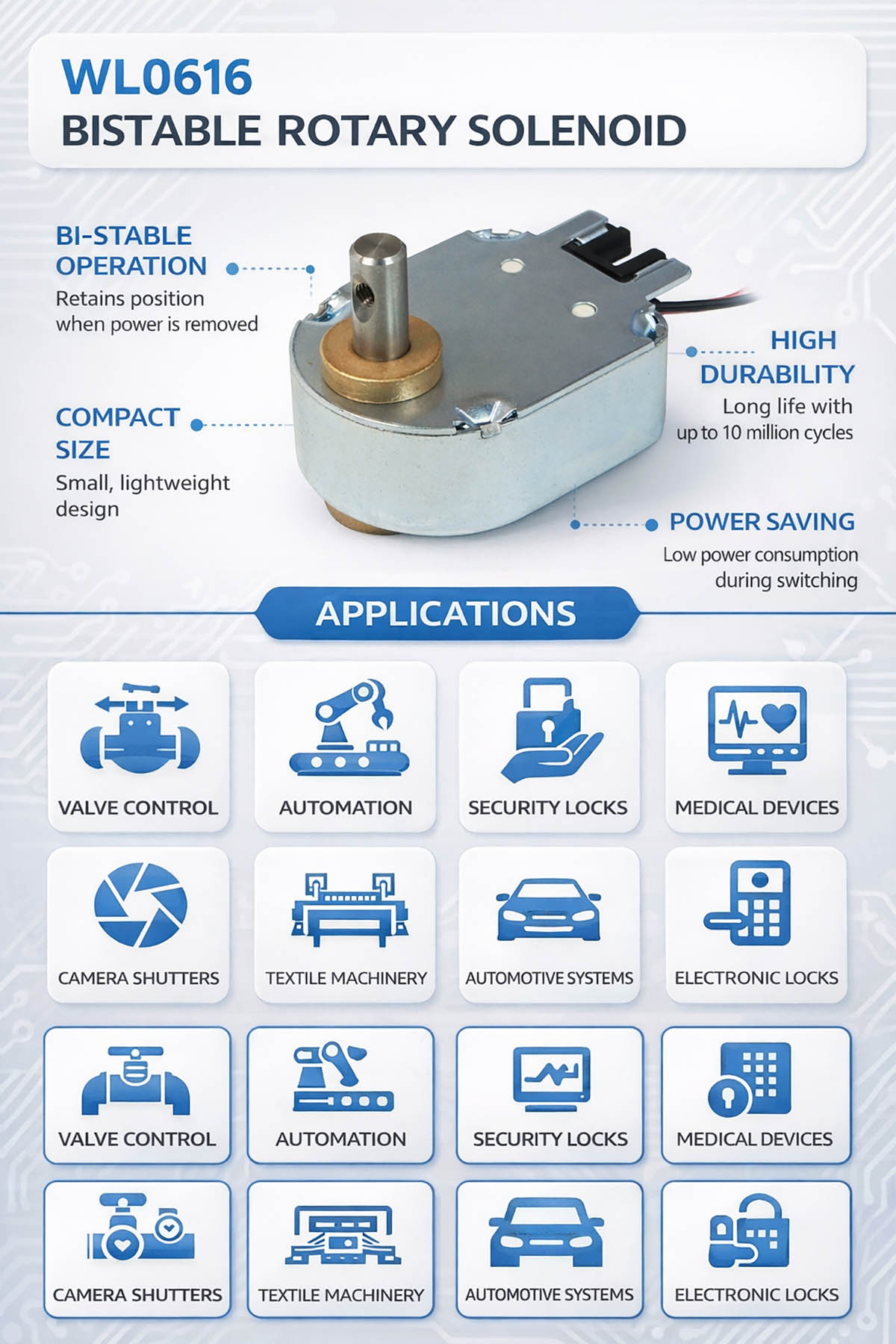
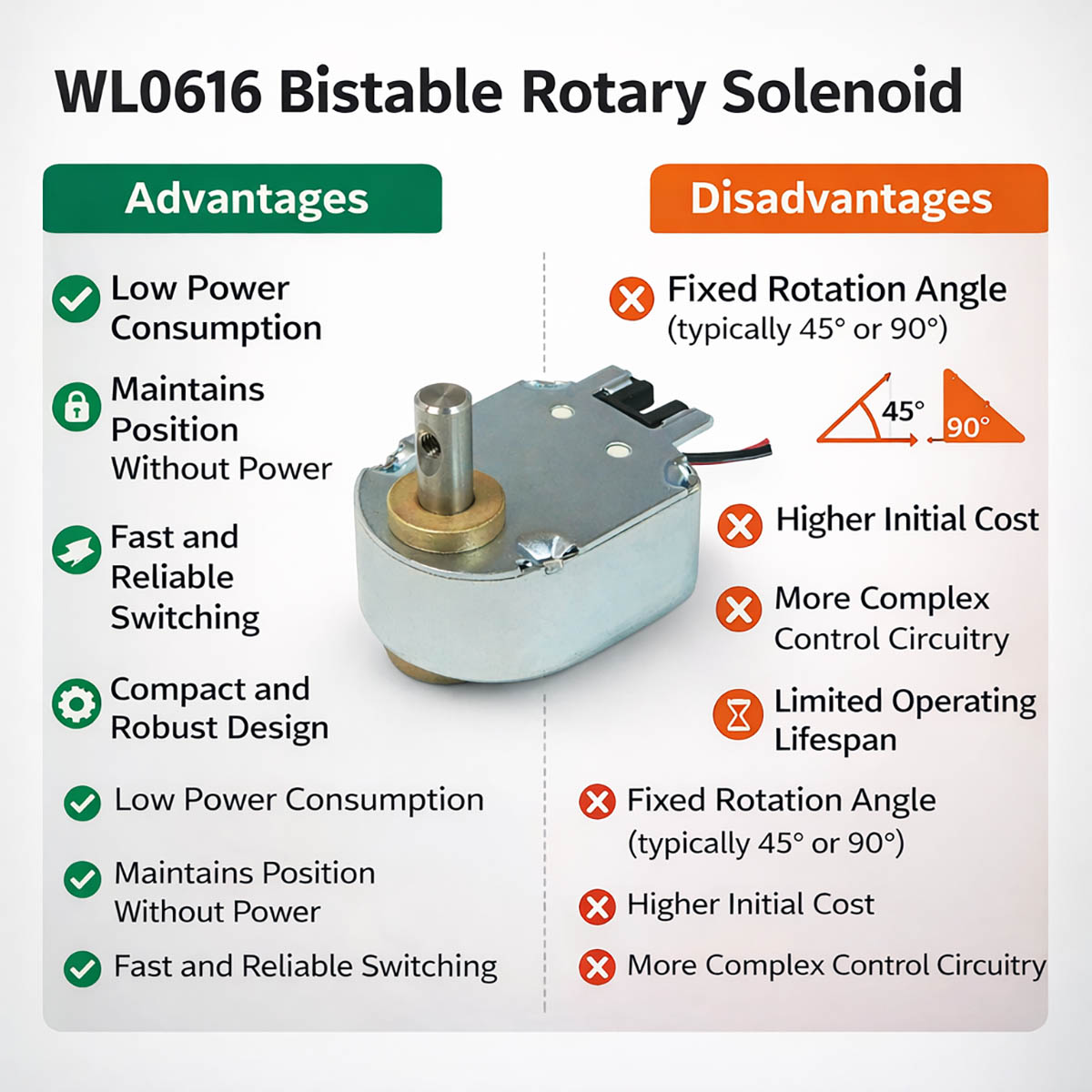
For money counting machines, a bistable rotary solenoid needs to have high-speed switching, sufficient torque, a compact design, and durability. Key characteristics include rotation angle, torque, response time, voltage, and cycle life. For the Weilong WL0616 Bistable Rotary Solenoid, this solenoid has been offered all over the world in the past decade for customer projects. If you have a project in hand for the banknote counting machine, you are welcome to contact our engineer at any time.


