High Torque Rotary Solenoid for Industry Use
urable High Torque Rotary Solenoid Systems
High Torque Rotary Solenoid for Automation
Industrial Rotary Solenoid High Torque Design
Precision High Torque Rotary Solenoid Units
eavy Duty High Torque Rotary Solenoid Tech
High Torque Rotary Solenoid for Industry Use
urable High Torque Rotary Solenoid Systems
High Torque Rotary Solenoid for Automation
Industrial Rotary Solenoid High Torque Design
Precision High Torque Rotary Solenoid Units
eavy Duty High Torque Rotary Solenoid Tech

WL700 Industrial High Torque Rotary Solenoid Guide

A high torque rotary solenoid is an electromechanical device created to convert electric energy into rotary motion, characterized by very high torque compared to its relatively small size. Contrary to common solenoids that create linear force, the particular rotary variant rotates a disc or shaft over a fixed angular stroke between 25° and 95° when activated. The innovative design of this special solenoid incorporates a ball bearing or an inclined plane within a spiral frame, which allows to use the magnetic field to apply torque rather than a straight force.

Main Features Of High Torque Rotary Solenoid

High torque rotary solneoid in proportion to the size:creates powerful rotational force in a relatively compact design.Predefined rotation angle: typically 25° to 95° with high precision and repeatability.Ball bearing or roller design: minimal friction reduces wear and increases longevity.Bi-directional rotation: clockwise or counterclockwise rotation (available per customer request).  Minimal power requirements: high torque can be achieved via pulse action without sustained currents.Instantaneous reaction time: response rate within the range of 10 to 50 ms.Internal spring return: returns back to the neutral position upon deactivation.Wide voltage range: operates with voltages up to 240 volts AC/DC.Flexible duty cycle ratings: available in intermittent and continuous versions.

WL700 High Torque Rotary Solneoid Product Overview

A high torque rotary solenoid is a compact angular actuator intended to be used in binary angular motion applications. The basic construction of high torque rotary solenoid includes a coil, a ferromagnetic shell, a rotating armature (rotor) with inclined ball races and a return spring. Upon activation, magnetic flux applies axial force to the rotor, which is translated into angular motion thanks to the ball bearings. Torques range between about 0.5 N.m and  0.8+ N.m, depending on the size and voltage. Standard stroke lengths include 25°, 35°, 45°, 65° and 90°, while there is an option of choosing other angles.  Directions of rotation: clockwise and counterclockwise (the former being default setting). Additional options are: diode protection, shaft seals and mounting options (flanged or studs). Duty cycles are either intermittent with up to 25% on-time or continuous with lowered voltage. The operating temperature is from -40° to +120°. Terminal types: flying wires, Faston tabs and plugs. Common part numbers have the following format (examples: Ledex 6E, Saia U83): Torque / Stroke / Voltage. Expected lifetime – over 10 million cycles. Possible certifications: RoHS, UL, CE.

WL700 High Torque Rotary Solenoid Video

WL700 precision rotary solenoid Detailed Display

WL700 High Torque Rotary Solenoid Technical Datasheet

Brand Weilong Technology Model Number WL700
Rated Voltage (V) DC 12V ,18V or 24V Rated Power(W) 100-150W
Work Model Rotation from 25 to 90 degrees Holding Torque Force (N)  0.17 —– 0.72 N.M
Stroke(mm) 1-3 MM or Customized responding Time(s) < 30 ms
Service Life 500 Thousand Times Certification CE,ROHS,ISO9001,
Material Carbon Steel Housing Lead Wire Length(mm) 200
Install Style screw Tolerance of Dimension  +/-  0.1 MM
Water-proof  None Insulation Class B
Hi-Pot Test AC 600V 50/60Hz 2s Non-excitation Holding Force 0
Working Temperature -10°C-100°C Duty Cycle 1-100%
Thread Depth(mm) / Payment Term TT, or LC At Sight
Sample Order Yes Warranty 1 Year
MOQ 1000 PCS Supply Ability 500 pcs per Week
Delivery Time 30 Days Port of Loading shenzhen

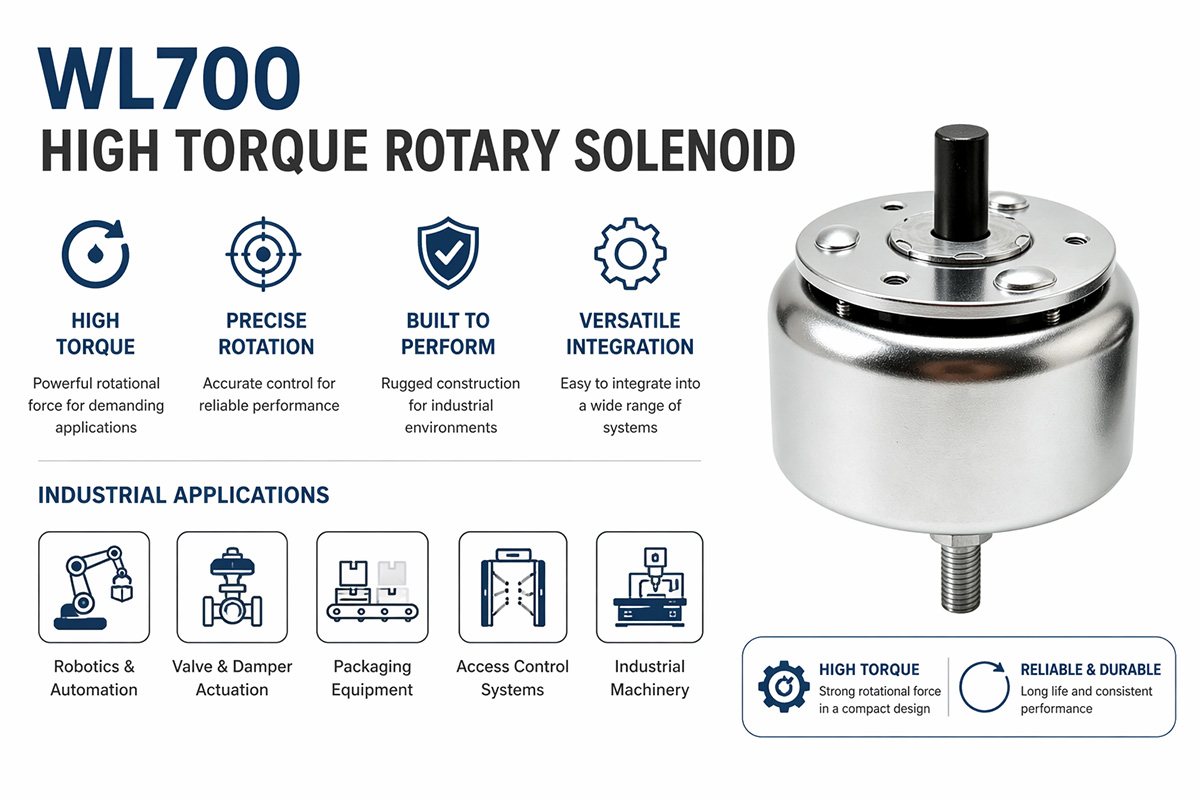
WL700 High Torque Rotary Solneoid Application

WL700 High Torque Rotary Solenoid Application

High torque rotary solenoid is highly useful wherever there is a need for quick angular positioning of high force. The automotive industry utilizes them in fuel cutoff valves, door locks, turbo charger waste gates, and automatic transmission oil flow valves. They are also widely used in industrial automation for sorting gates, label dispensers, clamp release mechanisms, and rotary indexing tables. Medical applications include surgery staples and dialysis machine valves, while in aerospace equipment they perform various rotary functions like cockpits’ airflow control, drone payloads release, and safe-arm switches. High-end printers incorporate them to perform paper path re-routing, vending machines for diverter gates, and smart locking system controls. In agriculture, they operate for seeding machines metering plates, and actuate hydraulic valves. Robotics applies them to enable gripper fingers or changing robotic arms’ tools. Compared to motors with gears, they are much more cost-efficient with easier control and increased shock resistance and, therefore, can replace pneumatic rotary actuators where compressed air is not available. For battery-driven devices, pulse action ensures less consumption of energy. For instance, 25° high torque solenoid provides fast enough motion for diverter gate control (in about 30 ms) without additional power to maintain the position due to the mechanical latch. Therefore, a snap-action feature makes this type of actuator perfectly reliable in applications such as emergency fuel shut-off, gas release control or fire damper releases.

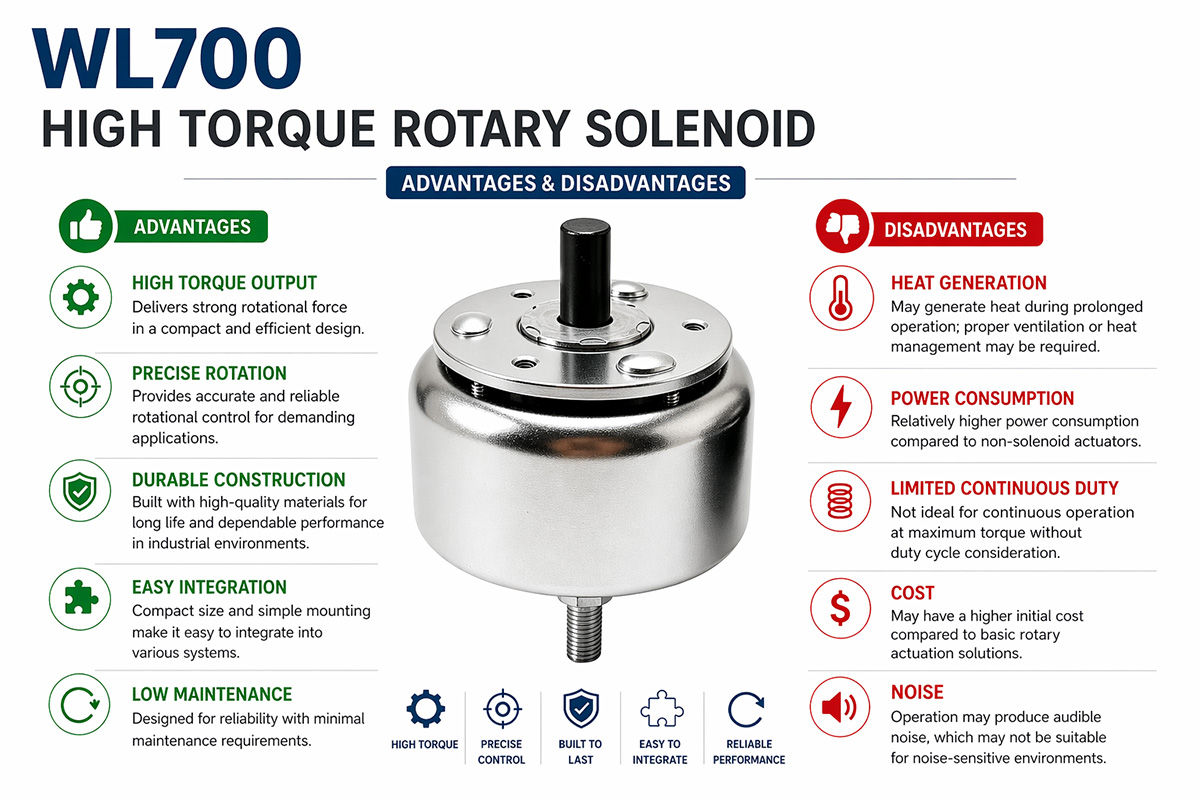
Advantage and Disvantage of High Torque Rotary Solenoid

WL700 High Torque Rotary Solenoid Advantage and Disadvantage

High Torque Rotary Solenoid Advantages:

– High torque in a small volume; superior to linear solenoids even with linkages.

– Easy control with simple switch or relay, not requiring encoders or drivers.

– Fast response time with rotation occurring within 10 to 60 ms.

– No holding power necessary – return with the help of a spring.

– Lower price than stepper motors and rotary actuators.

– Ruggedness, no brushes or few moving parts; long lifetime – 25 million operations or more.

– Bi-directional rotation capability (clockwise or counter-clockwise – by altering the polarity).

High Torque Rotary Solenoid Disadvantages:

– Defined stroke angle cannot be modified after installation (as opposed to the motor).

– Binary operation, only two states can be achieved (fully rotated/returned).

– Limited rotation angle (not exceeding 95°) preventing continuous rotations.

– Vulnerable to overheating due to a relatively low thermal mass.

– Resistance from the return spring to rotation decreases the actual output torque.

– Audible snap sound during action in quiet environment (unless AC powered).

– Torque reaches maximum value during the beginning of rotation.

– Requires pulse action – otherwise, continuous use can result in coil burnout.

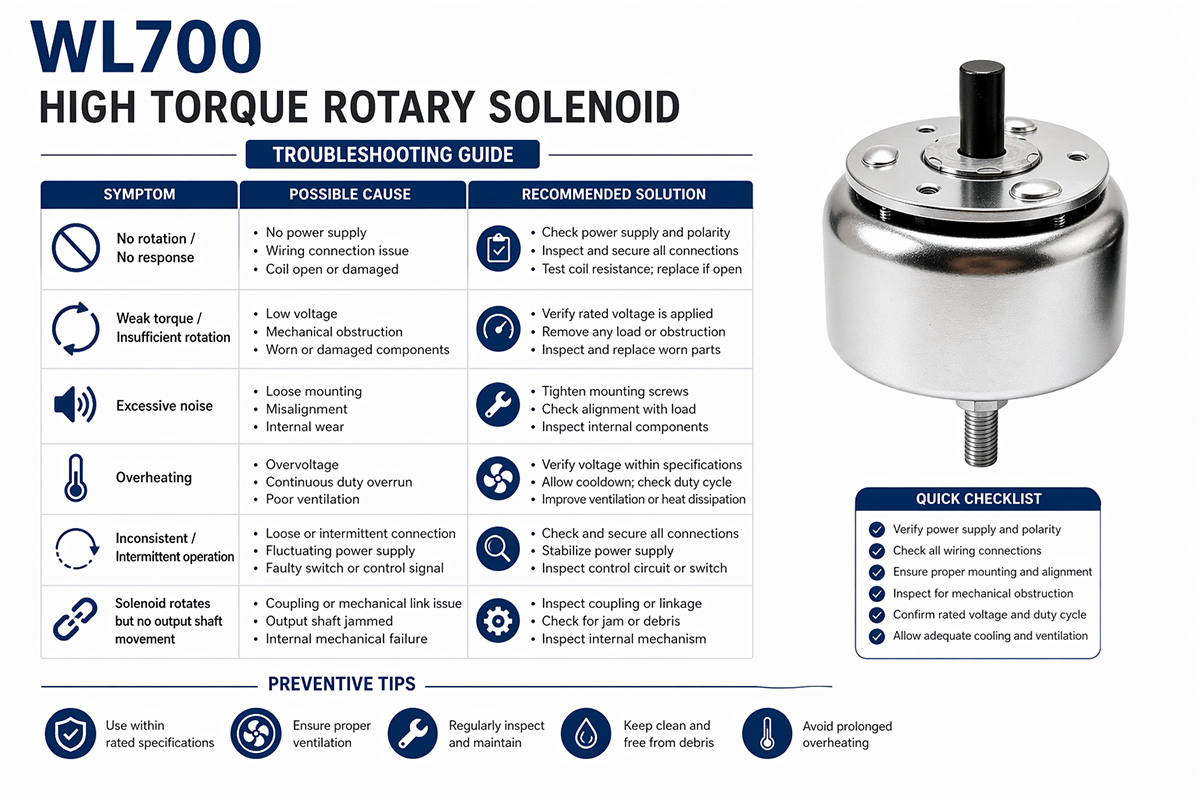
High Torque Rotary Solenoid Troubleshooting Guide

WL700 High Torque Rotary Solenoid Troubleshooting

1. ❌ Non-operational Solenoid (No Rotation)

Causes:

– Lack of power supply or improper voltage.

– Damaged winding (short circuit).

– Bad wiring.

– Signal problems from the controller.

Solutions:

– Verify whether the input voltage matches the rated one (AC/DC).

– Measure the resistance of the coil with ohmmeter.

– Check wiring.

– Inspect control signals on PLC.

 2. ⚠️Insufficient Torque

Causes:

– Insufficient voltage level or instability.

– Coil overheating.

– Mechanical overload.

– Improper usage of the solenoid.

Solutions:

– Ensure proper power source.

– Verify whether the temperature exceeded the allowed values.

– Lighten the load (verify torque requirement).

– Proper usage based on duty cycle ratings (ED).

3. 🔊Excessive Noise (Buzzing/Cracking)

Causes:

– Poor mechanical mounting or components’ fixation.

– Vibrations at the AC frequency.

– Wear of inner components (spring, plunger).

– Air gap mismatch.

Solutions:

– Fix the solenoid securely.

– Use DC power supply where possible.

– Inspect the condition of inner components.

– Make sure the moving parts are properly aligned.

4. 🔥Overheating issue of high torque rotary solenoid

Causes:

– Overloading the solenoid with excessive energizing.

– Too high voltage level.

– Inefficient heat dissipation.

– High ambient temperature.

Solutions:

– Follow the suggested duty cycle (e.g., 25%, 50% or 100%).

– Make sure the voltage is correct.

– Enhance cooling system or install heat sink.

– Use coils with higher temperature rating.

 5. 🛑Slow Response / Delayed Activation

Causes:

– Insufficient voltage level.

– Aging of the coil.

– Friction of moving parts due to wear or contaminations.

– Worn-out return spring.

Solutions:

– Check voltage supply.

– Clean the inside of the mechanism.

– Lubricate inner components where needed.

– Replace the worn-out spring or the entire solenoid.

 6. 🔄Malfunction (Sticking)

Causes:

– Mechanical obstruction.

– Misalignment of the shaft/load.

– Load exceeds the allowable torque.

– Components’ wear and contamination.

Solutions:

– Eliminate any obstacles outside of the unit.

– Adjust the shaft’s position and couplings.

– Make sure torque is matched to the load.

– Clean and inspect the internal mechanism.

 7. ⚡ Burnt-out Coil / Short Circuit

Causes:

– Voltage spike.

– Exceeding the operational parameters.

– Insulation damage.

– Wrong power applied (AC or DC).

Solutions:

– Install protective diode or varistor.

– Verify appropriate usage.

– Check insulation resistance.

– Install replacement with proper specifications.

 8. 🔌Intermittent Operation

Causes:

– Loose electrical connections.

– Unreliable power supply.

– Thermal overprotection activates.

– Erratic signals from controller/PLC.

Solutions:

– Make sure all wiring is securely fixed.

– Improve stability of power supply.

– Verify whether overheating protection was triggered.

– Examine controller/PLC operation.

9. 🧠 Pro Tips for Industrial Applications

– Always check whether the torque can handle the load.

– Apply appropriate duty cycle to avoid overheating.

– Include the flyback diode for DC models.

– Conduct regular inspections and cleaning.

– Consider IP-rating when purchasing.

10. 📋 Quick Diagnostic Checklist

– Are voltages correct?

– Normal coil resistance?

– Is load torque below the limit?

– Correct duty cycle?

– Proper mechanical alignment?

– Temperature within the limit?

Note: Do not attempt to open sealed solenoids.

High Torque Rotary Solenoid Table List of the troubleshooing

Symptom Possible Cause Solution
No rotation when powered Coil open circuit Check continuity with multimeter; replace solenoid.
Voltage too low Measure supply voltage; must be ≥85% of rated.
Mechanical jam Inspect load linkage for binding or debris.
Weak or slow rotation Undervoltage or poor connections Verify wiring gauge and voltage drop under load.
Worn ball bearings Replace solenoid; bearings are not field-serviceable.
Excessive load torque Reduce external load or use larger model.
Overheating coil Duty cycle exceeded Reduce ON time; add cooling or switch to continuous-duty model.
Applied voltage too high Regulate voltage to rated value.
Rotates but won’t return Return spring broken Replace solenoid (spring internal).
Debris in air gap Clean with compressed air; avoid oil.
Residual magnetism Degauss or use AC model (self-demagnetizing).
Intermittent operation Loose terminal connection Tighten or resolder.
Worn plunger stop Excessive stroke angle; adjust mechanical stop.
Erratic rotation angle Worn ball race Replacement required.
Excessive noise Missing lubrication Use dry lubricant (graphite); never wet oil.

Always power off before inspection. For sealed units, replacement is the only repair.


FAQs of High Torque Rotary Solenoid

1) Can a high torque rotary solenoid rotate 360 degrees?

No, standard high torque rotary solenoids come with limited stroke ranging from around 25° to 95°. Continuous rotation is possible only with stepper motors or rotary actuators.

2) Can a high torque rotary solenoid hold torque without power?

Yes, only for spring-return type. Latching type keeps the torque even when unenergized, meaning it will keep its rotated position.

3) What’s the difference between a high torque rotary solenoid and a linear solenoid?

Linear solenoids displace a core inside in a linear direction. A high torque rotary solenoid generates angular displacement due to the conversion of magnetic forces acting on ball bearings, for example.

4) Is a high torque rotary solenoid adjustable?

Some types provide mechanical stops adjustment whereas most solenoids come with a fixed stroke angle. Exceeding rated stroke angle will damage the internal ball race.

5) At what speed it can rotate?

Standard solenoid stroke duration varies from about 10 ms to 50 ms depending on the load inertia and applied voltage. Smaller loads provide faster action time.

6) Can we apply AC power?

Yes, but it will increase sound and lower torque capacity compared to DC versions. You should use a bridge rectifier circuit in that case.

7) What’s the safe duty cycle?

Intermittent duty cycle is up to around 10% (say, 1 sec on and 9 sec off). However, in continuous mode, the available torque is reduced by 50-70% compared to intermittent duty cycle operation. Always refer to datasheets.

8) How can I prevent coil burnout?

Use a series resistor to limit current in continuous-duty or pulse-width modulation mode. A flyback diode across the DC coils is always necessary to suppress voltage spikes.

How to Select a High Torque Rotary Solenoid

The selection of a rotary solenoid involves the careful matching of various electrical, mechanical, and environmental requirements with the requirements of your application. Follow these tips to find the right solenoid for your application.

1) Torque requirement of high torque rotary solenoid

First of all, measure the torque necessary to overcome the load, friction, and inertia, at precisely the stroke angle you intend to use. Please note that torque capacity decreases as you extend the stroke to reach its end and is maximum near the beginning of the stroke. Thus, the torque rating should exceed your load by a safety factor of about 50% or even more (minimum torque greater than maximum torque * 1.5). In case you require 10 lb-in at 45°, then select a solenoid having a rating of at least 15 lb-in at 45°.

2) Stroke angle of high torque rotary solenoid

Choose among the available stroke angles of 25°, 35°, 45°, 65°, or 90°. Don’t exceed the rated stroke angle since that would damage the internal mechanical stops limiting the stroke. Non-standard stroke angles such as 30° are also available in many cases.

3) Supply voltage and power

Commonly, available DC voltages are 6V, 12V, 24V, and 48V. Some AC solenoids can also be found but are usually larger in size compared to similarly rated DC versions. During evaluation, consider separately the inrush power requirements and holding torque power requirement. Transient overdrive can be achieved during pulsed operation to momentarily apply twice as much power (apply 24V to a 12V solenoid, for instance). The duty cycle could be typically 5% to 25% for intermittent and 100% for continuous operation. For intermittent use, try to use PWM technique to reduce holding power.

4) Direction of high rorque rotary solenoid

Specify if CW, CCW, or both directions are required. In order to provide bi-directional rotation, a model that allows polarity change is required and should be provided with appropriate reversing flyback protection in your drive circuitry.

5) Return mechanism of high torque rotary solenoid

A spring-return mechanism provides a fail-safe function in that it returns back automatically to its original position when power is released. Latching (or permanent magnet) type holds the rotated position indefinitely but requires an opposite pulse to return.

6) Form factor and size

Take a look at available solenoid types such as box-type, cylindrical type, and enclosed types. Determine how much room is available in your mechanical assembly. Decide on mounting features such as mounting flanges, studs, brackets, and types of shaft such as round, D-shaped, or slotted shaft.

7) Environmental conditions

If dust or moisture is a problem, choose an environmentally-sealed unit of class IP54 or better. Typical working temperatures of standard units are from −20°C to +70°C whereas high-temperature versions go as far as +120°C. Preferably, avoid environments where corrosive gases are present.

8) Expected life cycles

The typical life span of a standard rotary solenoid is about 5-10 million cycles. High life expectancy versions with ball bearing construction can reach over 25 million cycles. Extremely fast actuation rate exceeding 100 cycles/min will necessitate a continuous-duty version.

9) Electrical connections

Various electrical interfaces are flying leads, fasten terminals, or connectors. In case of DC solenoids, a suppression diode should be used in addition to providing protection for driving transistors against the inductive spike at the instant of power release.

10) Certifications

UL, CE, and RoHS certifications are necessary for commercial applications whereas MIL specs are required for defense applications.

Always make sure of the performance with your actual load and duty cycle. A datasheet featuring torque vs stroke curve will help.

what is the different between a high torque rotary solenoid and a comment rotary solenoid

There are several differences between the high torque rotary solenoid and the regular (common) rotary solenoid, and they depend on the torque output, design structure, and applications. The following is a comparative list of important differences:

1. Torque Output (the major difference):

A hight torque rotary solenoid designed for generating higher torque output
Capable of handling heavy loads or resistive mechanisms, Suitable for harsh working conditions in the industry
A common rotary solenoid Provides low or medium torque
Applied to the switching or positioning of light loads
Inappropriate for mechanical loads

2 Design Structure

Hiigh torque rotary solenoid has additional coils and magnetic field strength
Optimized magnetic circuit
Fitted with ball bearings, powerful shafts, or multi-pole design
Durable and massive
A common type
Has a simpler design
Includes smaller magnetic and coil parts
Compact and lightweight
Cheaper

3. Work Performance

High torque rotary solenoid
Higher energy consumption
Stability when loaded
Durability when working in heavy-duty cycles
Maintains torque at wide rotation angles
Common rotary solenoid
Lower energy consumption
Rapid response when dealing with light loads
Fast decrease of torque when encountering resistance

4 Typical Rotation Angle and Control

High torque rotary solenoid Works with larger angles (25° – 90° or above)
Higher precision when loaded
Common rotary solenoid  Only certain angles are available (e.g., 25°, 35°, or 45°)
Instability when the load is changing
Situations in which It Should Be Used
High torque rotary solenoid
Automation tools for the industry
Robots and engines
Locking devices requiring higher clamping force
Valves or mechanical indexing control systems
Common rotary solenoid
Office equipment
Miniature locks
Camera parts
Light switching devices

5  Size and Cost

High torque
Larger dimensions
Expensive
Complex manufacturing process
Small and cheap
Simple analogues for integration

An analogy can be given in the following way:
The high torque rotary solenoid is an industrial actuator functioning like a motor.
A common rotary solenoid is a compact switching actuator.

Get A Free Quote Now

Contact Form

Related Products

Related News

Scroll to Top

Get A Free Quote Now !

Contact Form
If you have any questions, please do not hesitate to contact us.
Weilong Solenoid Company Culture
