Solenoid Rotary for Industrial Motion Control Use
High Torque Rotary Solenoid for Automation Systems
Compact Rotary Solenoid Actuator for Precise Motion
Rotary Solenoid Applications in Modern Machinery
Fast Response Solenoid Rotary for Smart Devices
Solenoid Rotary for Industrial Motion Control Use
High Torque Rotary Solenoid for Automation Systems
Compact Rotary Solenoid Actuator for Precise Motion
Rotary Solenoid Applications in Modern Machinery
Fast Response Solenoid Rotary for Smart Devices

WL340 Solenoid Rotary For Automation Guide

The solenoid rotary actuator devices change linear movement into rotary displacement within the limits of a certain angle from 25° to 95°. Unlike linear solenoids that push or pull, these actuator elements use a specifically shaped pole piece and ball bearing raceway to generate rotary movement. Depending on the model, the rotor rotates either clockwise or counterclockwise and returns to its initial position once the electric impulse is cut off via the action of the internal return mechanism, typically spring-loaded. Rotary solenoids are known for producing high torque, fast operation times (as short as 5-50 milliseconds), and excellent repeatability. Their use case scenarios involve simple tasks like actuating shutters, sorting gates, or locking mechanisms.

Main Features of Solenoid Rotary

Some characteristic features of rotary solenoids include limited rotary motion of approximately a 25°-95° angle, high torque in relation to physical dimensions, and the possibility of using bidirectional rotation (clockwise and counterclockwise) in one model. Rotary solenoids operate on DC or AC voltages ranging from 6 to 110 volts. Duty cycle of up to 100% is possible when the actuator operates intermittently. A fast response of only 5–50 milliseconds is also possible. Other notable characteristics include a built-in return spring (allowing a reset to the default state), a low holding current after rotation (reducing power consumption), and a mechanical life above 20 million cycles. Most rotary solenoids feature dust-proof housing (IP40), waterproofing level IP67, silent operation, and immunity to electrical noise. Dimensions may range from roughly 16 to 60 millimeters in diameter. Some of the most common optional features include custom rotation angles, flanged mounting, and extended temperature operating range of coils. No encoders for precise positioning are needed because of fast response.

WL340 Solenoid Rotary Actuator Product Overveiw

A solenoid rotary is an electromechanical device that produces limited-angle rotary motion (30°-90°). Such a motion results from axial magnetic attraction applied to a rotor with inclined raceways or ball bearings. Upon activation, the rotor rotates until reaching its predetermined angle. The deactivation results in returning the rotor to its original position. Key advantages include the following: High torque density, fast response (from 5-50 milliseconds), low power consumption due to the absence of holding currents after rotation, long service life (above 20 million cycles), availability in 12/24/other voltages, and capability of being unidirectional or bidirectional.

WL340 Solenoid rotary actuator video presentation

Wl490 Solenoid Rotary Actuator Detailed Display

WL340 Solenoid Rotary Actuator Datasheet

Brand Weilong Technology Model Number WL340
Rated Voltage (V) DC 12V, 18V, or 24V Rated Power (W) 20–90 W
Work Model Rotation Torque Force (Nm)  0.01 —– 0.04 N.m
Rotating Angle From 25, 45, 60, or 70 degrees Working Duty 10%—100%
Service Life 500 Thousand Times Certification CE, RoHS, ISO9001,
Material Carbon Steel Housing Lead Wire Length (mm) 200
Install Style screw Tolerance of Dimension  +/-  0.1 MM
Water-proof  None Insulation Class B
Hi-Pot Test AC 600V 50/60Hz 2s Non-excitation Holding Force 0
Working Temperature -10°C-100°C Duty Cycle 1-100%
Thread Depth(mm) / Payment Term TT, or LC At Sight
Sample Order Yes Warranty 1 Year
MOQ 1000 PCS Supply Ability 5000 pcs per Week
Delivery Time 30 Days Port of Loading shenzhen

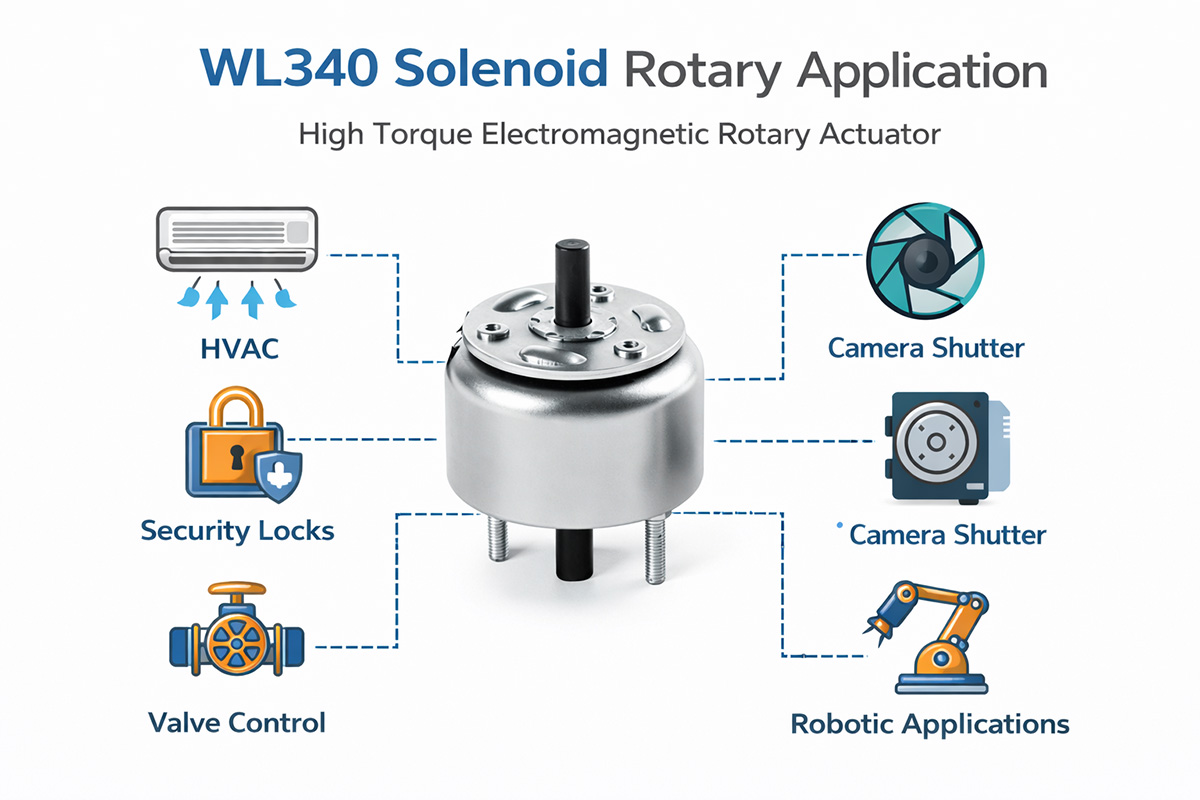
WL340 Solenoid Rotary Actuator Application

WL340 Solenoid Rotary Industrial Application

Solenoid rotary Short Description

The solenoid rotary is a compact actuator capable of limited-angle rotary motion using an electrical impulse as an energy source. Instead of simply pushing or pulling, a rotary solenoid acts as a rotary switch that converts linear magnetic force into angular displacement via a mechanism involving inclined ball bearings and slots in the rotor surface. This produces rotary motion ranging from 25° to 70° in a specific direction. The return spring mechanism ensures reset upon the removal of power. The benefits include extremely fast response time (5-50 milliseconds), low hold current after rotation, which reduces power consumption, and a very high mechanical lifetime (>25 million cycles). A solenoid rotary operates silently. They can work with various voltages (6, 12, 18, or 24 volts). Depending on the model, torque values can vary from 0.1 to more than 0.05 Nm. Since rotary solenoids do not require continuous power to keep rotating, they are energy efficient. Common applications include door locks of vending machines, optical filter wheels, industrial sorters, medical valves, and car door latches.

How does a solenoid rotary work?

A solenoid rotary converts axial magnetic force into rotation. At that, an axially aligned coil generates magnetic force on a rotor containing inclined ball bearings or slots in the form of helical raceways. Once activated by an electric impulse, a coil produces a field and attracts the rotor axially toward the stator. While the rotor moves linearly in that process, it starts rotating along a helical line thanks to ball bearings or slots. The extent of rotation is determined by the slope angle and displacement in millimeters. Typical values are 30°, 60°, or 70°. During rotation, the return spring stores potential energy. Once deactivated, a solenoid releases the stored energy and rotates the rotor to restore its original position, thus reversing its rotation. The direction of rotation is predefined depending on the ball bearing orientation (clockwise or counterclockwise). Rotary motion occurs within a certain limited angle and features a high repeatability rate. Response time typically falls between 5 and 50 milliseconds.

The Application of Solenoid Rotary

A solenoid rotary is used in various industrial sectors that require simple and repeatable limited-angle rotation. In industrial automation, they are widely employed as diverters, gate sorters, or actuated indexers. To give a specific example, rotary solenoids rotate dividers to direct items on conveyor belts. The same devices perform the function of gate actuators in security devices. In the healthcare sector, rotary solenoids are used in medical ventilators, dialysis machines, and surgical instruments. For consumer electronics, they rotate camera lens filters, optical zoom elements, and projectors’ shutter gates. Automotive rotary solenoids can perform the task of actuating door latch release and fuel cap locks. Furthermore, rotary solenoids control air conditioning and heating vents, gear selectors, and other components. Vending machines use rotary solenoids for dispensing products by rotating sort dividers. Optical and laser equipment includes rotary solenoids in mirrors, optical attenuators, and filter wheels for high-speed switching. Robots employ them as end-effector gripper rotation actuators or tool-changing mechanisms. In aerospace engineering, rotary solenoids function as cockpit controls and de-icing valve actuators. Unlike electric motors that require continuous power to retain a position, rotary solenoids rely on a spring and operate without power consumption. IP67 rotary solenoids can operate in wet environments typical of the food-processing industry due to sealing. Mechanical life above 25 million operations makes them preferable to pneumatic actuators as rotary mechanisms.

Advantages and Disadvantages of Solenoid Rotary

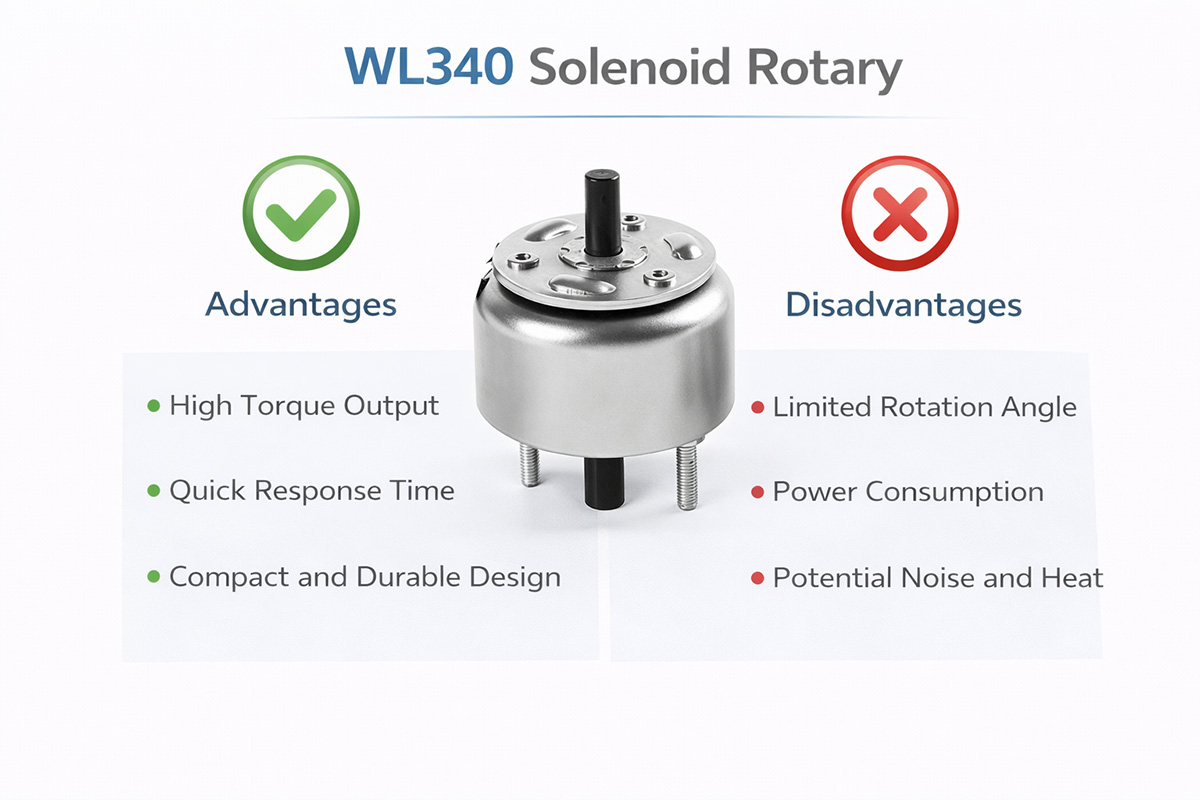
WL340 Solenoid Rotary Advantage and Disadvantage

Advantages  of Solenoid Rotary Actuator

A rotary solenoid is a small electromagnetic actuator converting electric power into rotary motion of limited amplitude. They are extensively used in automation, locking, and other industries.

Advantages:

  • Extremely fast response time thanks to the electromagnetic nature of the device, providing instant actuation that can be used to perform rapid switches.
  • Small and compact structure making it easy to fit even in space-limited equipment.
  • Reliable operation at predetermined angles such as 25°, 45° or 70°, thus being ideal for repetitive operations with guaranteed results.
  • High torque for the small size, especially in rotational short-stroke applications.
  • Durable construction and low maintenance.

Disadvantages of Solenoid Rotary Actuator

  • Limited range of rotations, as they provide limited angular motion.
  • High power consumption while holding their position, unless they are equipped with latching mechanisms.
  • Generation of heat in case of continuous duty cycle operation.
  • As compared to motors, they lack in precision regarding speed control and precise positioning.
  • Gradual wear occurs due to mechanical components.

Conclusion

Rotary solenoids are perfect for quick, reliable, and compact actuation; however, they are not suited to applications requiring continuous motion or variable control.

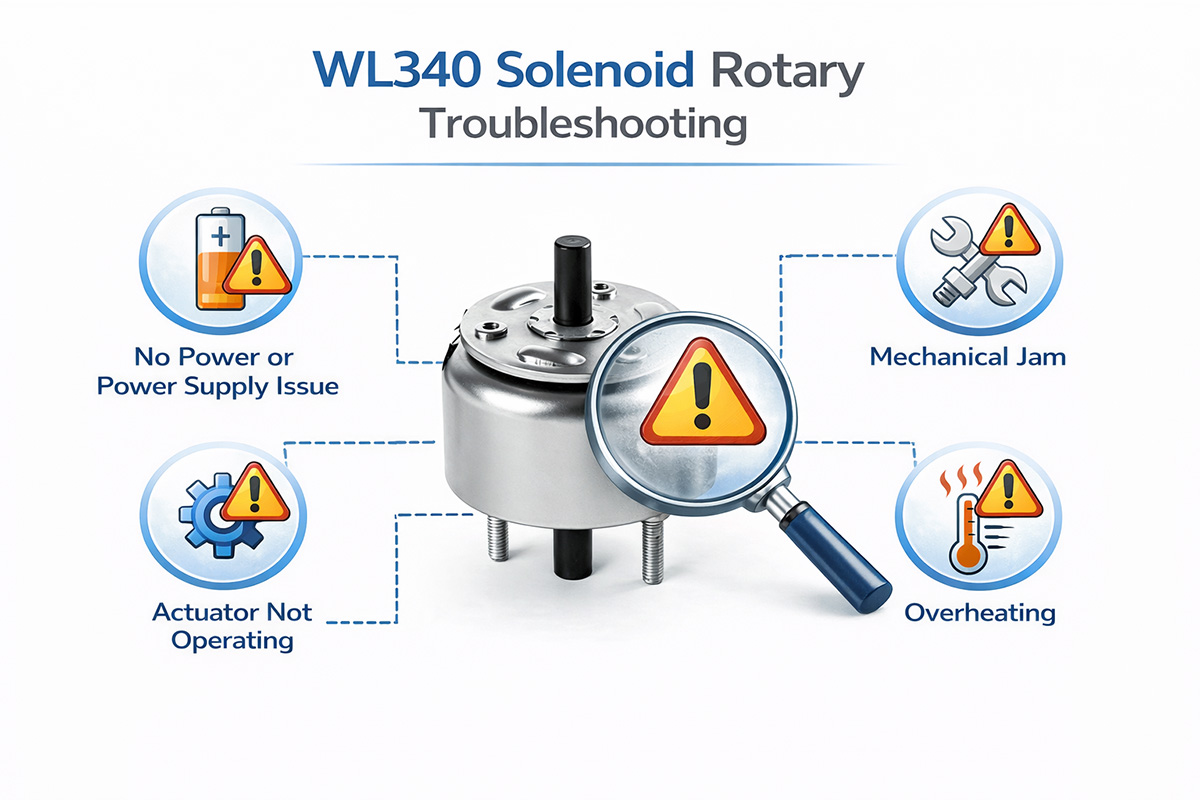
Advanced Troubleshooting Guide for Rotary Solenoid

WL340 Solenoid Rotary Troble shooting guide

  1. ❌ Not Working / No Rotation

Causes

  • Lack of input power or improper voltage level to the specified rated one.
  • Connections to the actuator are not tight enough or loose.
  • Burnt coils are unable to produce the magnetic field anymore.

Solutions

  • Verify that the input voltage matches the specification for the actuator.
  • Inspect wire connections and terminal points for any signs of looseness, damage or breakage; repair them if any.
  • Test the coil resistance and change the faulty coil.
  1. ⚡ Poor Torque / Low Rotation

Causes

  • Voltage level is too low or unstable.
  • The load exceeds the solenoid’s capability in terms of torque.
  • Wear and magnetic loss reduce performance of the device.

Solutions

  • Provide a steady and rated supply voltage to the actuator.
  • Reduce the load or choose a product with better specifications to reach desired performance.
  • Check for wear of internal parts or replace the whole actuator in case of necessit
  1. 🔥 Overheating

Causes

  • Device is energized too much in time exceeding recommended duty cycle.
  • Operating temperature is high, which prevents efficient cooling.
  • Damage to coils insulation.

Solutions

  • Follow the recommended duty cycle and use intermittent operation if needed.
  • Increase cooling capacity by adding ventilation or other means.
  • Replace coil or its insulation
  1. 🔄 Delays or Slow Actuation Speed

Causes

  • Presence of contaminants or wear that creates friction in moving parts.
  • Insufficient or unstable supply of power.
  • Weakened return spring.

Solutions

  • Disassemble the device, clean all moving parts, and remove dust, debris, and foreign bodies.
  • Check that provided voltage and current values satisfy requirements.
  • Change spring or improve its strength.
  1. ⚙️ Mechanically Jammed / Moving Parts Sticking

Causes

  • Contaminants obstruct movement of the moving parts.
  • Misalignment in the process of installing the solenoid.
  • Worn parts produce more friction.

Solutions

  • Disassemble the actuator and clean and remove all contaminants.
  • Make sure correct installation with appropriate alignment is done.
  • Replace worn parts with new ones.
  1. 🔊 Vibrations or Noise

Causes

  • Loose mounting screws.
  • AC voltage causes vibration in some configurations.
  • Worn moving parts generate vibrations and noises.

Solutions

  • Tighten all mounting screws and check that the mounting system holds the actuator firmly.
  • Use DC voltage or damp the vibrations by using appropriate damping materials.
  • Check condition of moving parts and replace worn parts.
  1. ⚠️ Short Life Span / Failures

Causes

  • High-voltage operation exceeding specified limits.
  • Fast switching cycles cause wear faster.
  • Dust and humidity accelerate deterioration in poor conditions.

Solutions

  • Provide correctly regulated power supply at the proper voltage level.
  • Stick to recommended cycle limitations.
  • Protect the device from moisture and dust by using additional housing.

✅ 8. Tips to Prevent Problems

  • Ensure compatibility in terms of voltage and torque ratings.
  • Work in dry environments free from dust and other contaminants.
  • Do routine maintenance inspections.
  • Do not energize continuously unless recommended by design.


FAQs Of WL340 Solenoid Rotary actuator

1. What is a solenoid rotary?

It is an electromagnetic actuator providing limited angular motions in the range of 25-70°.

2. How does it work?

An electromagnetic field generated by an energized coil produces rotary motion in the inner parts of the device.

3. What kind of applications can I use them for?

Valves, locks, medical equipment, camera lenses, heating and ventilation control equipment, and industrial automated devices.

4. What rotation angles are offered?

The most popular angles are 25°, 30°, 45°, 60°, and 90°.

5. Which voltage sources do they support?

They are commonly designed for DC power supplies such as 6V, 12V, or 24V.

6. Can it be used continuously?

Mostly they are designed for intermittent operation and may overheat running continuously.

7. What factors affect torque performance?

Voltage level, coil design, duty cycle, and loads affect torque produced by the solenoid.

8. How to increase service life?

Proper voltage, avoiding overloads, providing cooling, and doing routine maintenance.

How to Select the Solenoid Rotary Actuator?

Choosing the rotary solenoid depends on six criteria: angle, torque, voltage, duty cycle, mounting type, and environmental protection.

1. Solenoid rotary Angle

Available rotation angles vary from 30° to 90°. Select the option that corresponds to the desired angular displacement produced by the solenoid-operated mechanism. For unusual angles (e.g., 45°, 75°), consult the manufacturer.

2. Required torque of solenoid rotary

A solenoid specification typically states a value of torque generated at a given angle. Determine load torque, including friction, inertia, and spring forces. Add a safety margin of 30-50%. Typical torque amounts to 0.1-5+ Nm. Torque diminishes as the solenoid approaches the final rotation point.

3. Voltage and Power

Common DC voltage values include 6, 12, 24, 48, 110 volts. Pick the one matching the application requirements. Higher voltage leads to faster response, increased losses, and heating. Battery-powered devices require 12V or 24V and pulsed operation to preserve energy. Analyze the inrush and hold current of solenoids because some decrease power usage after rotation.

4. Duty cycle of Solenoid Rotary

Intermittent duty cycle up to 25% permits generating maximum torque without overheating. A continuous duty cycle means a torque derating. The formula looks as follows: (on-time/time) * 100%. For high cycles per minute above 100, choose solenoids featuring intermittent duty below 25%.

5. Solenoid rotary direction

There are two options here: unidirectional (fixed clockwise or counterclockwise) or bidirectional (dependent on polarity or coil).

6 Environmental conditions and life

Normal operating temperatures include 0-40°C, while high-temperature units have operating temperatures of up to 120°C. IP rating varies from IP40 (clean indoor conditions) to IP65 (dust tight and water jets) and IP67 (complete submergence). A mechanical lifetime exceeds 10, 25 or even 50 million cycles.

7. Mounting & dimensions

Examine the required mounting options (e.g., bracket-mount), shaft diameter, and footprint. Request datasheets with torque vs. rotation angle and response times, and try sample units under actual loads and cycles per minute. In case of high-cycle applications, consider overvoltage, but be ready to monitor temperature increases.

How to Choose the Solenoid Rotary vs. Step Motor

There is one main question that will help you decide between a solenoid rotary and a stepper motor: Do you need to hold a position firmly without power, or do you need to stop exactly at many different points along a full rotation?
The short answer is
If you need to position something very precisely at multiple points while it is rotating continuously, like a robotic arm, a 3D printer axis, or a camera pan-tilt mechanism, choose a stepper motor.
If you need a simple, super-fast “flip-flop” motion between two fixed angles, like a sorting gate, a lock mechanism, or a shutter, choose a rotary solenoid.

The table below breaks down their core differences side-by-side.

Feature Stepper Motor Solenoid Rotary
Motion Type Continuous rotation (360°+) or precise steps Limited oscillation (typically 30°–90°) between two positions
Positioning Extremely precise, open-loop control; can stop at hundreds of positions per revolution Only two fixed end positions (e.g., “open” and “closed”)
Power & Holding Needs continuous power to hold a position (holding torque) Bistable: Holds position firmly with zero power (magnetic latch)
Speed Moderate; speeds vary with load and driver Extremely fast (< 10 ms switching time)
Control Requires a driver and sequential pulses (2-4 wires) Simple: just reverse DC polarity to change state (2 wires).
Lifespan High, limited by bearings Very high (100+ million cycles); no brushes

How to Pick: A Useful Guide

To choose, compare the strengths of the actuator to the needs of your project.
If you want to use a stepper motor,
You have to hold your ground while fighting against a force. When power is applied, a stepper motor’s “holding torque” keeps it in place.
You need more than one place to stop. Steppers are excellent for doing things in steps that are separate and repeatable, like moving a CNC gantry or positioning an antenna. You need to keep rotating. A stepper is the best choice for any job that needs a full 360° spin or more.

If you want a Bistable Rotary Solenoid,

Your app runs on batteries or is sensitive to heat. It only uses power when it changes states, so it uses almost no energy while holding a position. You need “blazing fast” switching. A stepper motor can’t keep up if you need to move a gate or diverter in less than 10 milliseconds. You need a simple ON/OFF rotary action. Solenoids are a much simpler and stronger way to control electronic locks, shutter controls, or sorting flaps than a full motor controller.

💡 A Quick Note About “Holding Torque”

You might think that a stepper motor’s “holding torque” spec works like a solenoid’s latch. But to keep that hold, a stepper motor needs a steady supply of electricity, which makes heat and drains batteries. A bistable solenoid uses magnets to physically latch into place, so it doesn’t need large amounts of electricity to stay put.

Get A Free Quote Now

Contact Form

Related Products

Related News

Chapter 1 : Introduction on Solenoid Vs. Electromagnetic Coil Electromagnetic technology plays a significant role in modern automation industry, electronics, […]

Scroll to Top

Get A Free Quote Now !

Contact Form
If you have any questions, please do not hesitate to contact us.
Weilong Solenoid Company Culture
