Rotary Solenoid Motor for Industrial Automation
High Torque Rotary Solenoid Motor Applications
Precision Rotary Solenoid Motor for Machines
Compact Rotary Solenoid Motor for Automation
Fast Response Rotary Solenoid Motor Systems
Rotary Solenoid Motor for Industrial Automation
High Torque Rotary Solenoid Motor Applications
Precision Rotary Solenoid Motor for Machines
Compact Rotary Solenoid Motor for Automation
Fast Response Rotary Solenoid Motor Systems

WL590 Rotary Solenoid Motor Solutions Guide

An electromechanical rotary solenoid motor converts electrical energy into rotational movement along a certain angle. Angular displacement created by a rotary solenoid ranges from 25° to 90°. Linear solenoids generate linear displacement. The interaction of the magnetic field generated by the passage of electric current through the coil with the rotor produces torque and rotation.

This rotary solenoid motor is widely used in industrial automation due to its high speed and reliability. Generally, rotary solenoids have a return spring or bi-directional operation. It allows users to control the motion and return the solenoid to its initial position. They provide reliable and repeatable positioning with minimal backlash. Such devices are ideal for industrial operations where accurate positioning is required.

Main Features Of Rotary Solenoid Motor

People know about the compactness, rapid response, and torque output of rotary solenoids. These devices reliably perform accurate angular displacement. That is why they are ideal for automation tasks. Their simple mechanical structure provides durability and reduced wear.

The rotary solenoid motor is also capable of performing either single or double-directional rotations. The rotary solenoid motor also has a built-in return spring. They operate efficiently, consume a minimum amount of energy, and require minimum maintenance. Furthermore, they demonstrate exceptional reliability in harsh industrial environments characterized by elevated temperatures and continuous duty cycles. Their ability to perform angular displacements ensures precise positioning and control.

WL590 Rotary Solenoid Motor Product Overview

The rotary solenoid motor is a miniature, yet powerful actuator capable of controlling accurate angular displacement in industrial settings. They include a robust housing, an electromagnetic coil, and a rotor mechanism that ensures constant torque output.

A rotary solenoid motor is available in different sizes and torque ratings. Thus, they can be customized according to the requirements of the application. They feature various mounting options and shaft configurations, facilitating installation and integration with existing systems. These motors serve automation, robotics, and control applications due to their rapid and reliable operation.

Engineered to be durable, the rotary solenoid motor guarantees high performance and reliability even in harsh conditions. Contemporary industrial solutions prefer them due to their high precision, fast response, and compactness.


WL590 Rotary Solenoid Motor Video

industrial rotary solenoid motor supplier

WL590 Rotary Solenoid Motor Technical Datasheet

Brand Weilong Technology Model Number WL590
Rated Voltage (V) DC 12V or 24V Rated Power(W) 80–100 W
Work Model Rotation Holding Force (N)  0.05 —– 0.08 N. m
Rotating Angle From 25, 45, 60 or 90 degrees Working Duty 10%—–100%
Service Life 500 Thousand Times Certification CE, RoHS, ISO9001,
Material Carbon Steel Housing Lead Wire Length(mm) 300 mm
Install Style screw Tolerance of Dimension  +/-  0.1 MM
Water-proof  None Insulation Class B
Hi-Pot Test AC 600V 50/60Hz 2s Non-excitation Holding Force 0
Working Temperature -10°C-100°C Duty Cycle 1-100%
Thread Depth(mm) / Payment Term TT, or LC At Sight
Sample Order Yes Warranty 1 Year
MOQ 1000 PCS Supply Ability 5000 pcs per Week
Delivery Time 30 Days Port of Loading shenzhen


WL590 Rotary Solenoid Motor Application

WL590 Rotary Solenoid Motor Application


A brief description of rotary solenoid motor

The rotary solenoid motor is a small and compact actuator that transforms electrical energy into controlled angular displacement. They achieve controlled motion through the generation of magnetic fields using coils. They rotate a rotor or armature along a particular angle. Rotary solenoid motors are widely used in industrial automation systems due to their rapid response and high torque.

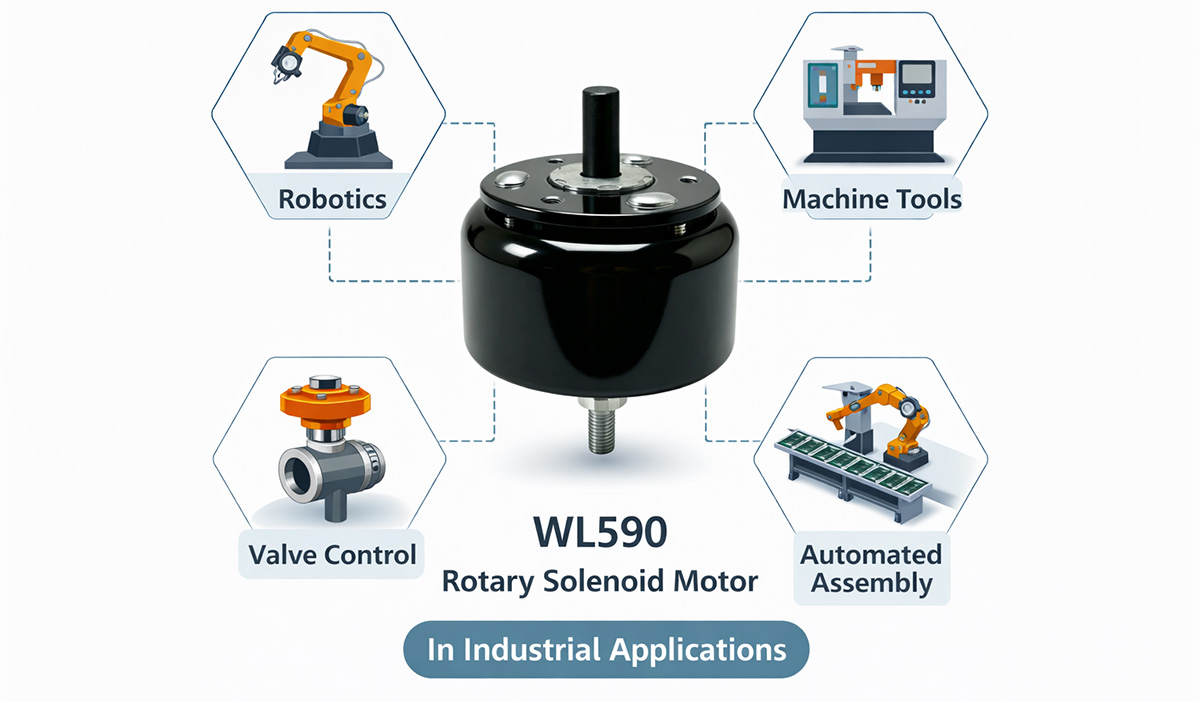
People apply rotary solenoids for controlling valves, robots, packaging machines, and automated assembly lines. Their rugged construction ensures their proper operation in extreme conditions. They have a simple structure and few moving parts. Thus, they have a long service life and require minimum maintenance.

The rotary solenoid motor is a miniature, yet powerful actuator capable of controlling accurate angular displacement in industrial settings. They include a robust housing, an electromagnetic coil, and a rotor mechanism that ensures constant torque output.

Rotary Solenoid Motor Application

Due to their ability to perform precise and rapid angular displacement, rotary solenoid motor finds wide application in multiple industries. They are crucial components of automation systems for controlling mechanical movements such as opening and closing mechanisms, positioning, and initiating movements on assembly lines.

Regarding robotics, rotary solenoid motor serve to operate gripping systems, joint movement, and generating small-scale movements. Due to their size and fast response, they are suitable for usage in robotic arms and automated tools. They are applied in valve control systems for switching and regulating gas or fluid flow in pipelines and processing equipment.

Also, rotary solenoid motor are being applied  extensive application in packaging machines, where they serve for sorting, sealing, and labeling products. Their repeatability ensures product handling consistency and improves production efficiency. Besides, rotary solenoids are often found in printing equipment, textile machinery, and medical devices for accurate motions.

Generally, rotary solenoid motor improves the reliability of systems and increase productivity. They minimize manual involvement and are essential components of modern industrial automation and control systems.


Advantages and Disadvantages of Rotary Solenoid Motor

WL590 Rotary Solenoid Motor Advantage and Disadvantage

The Pros of Rotary Solenoid Motor

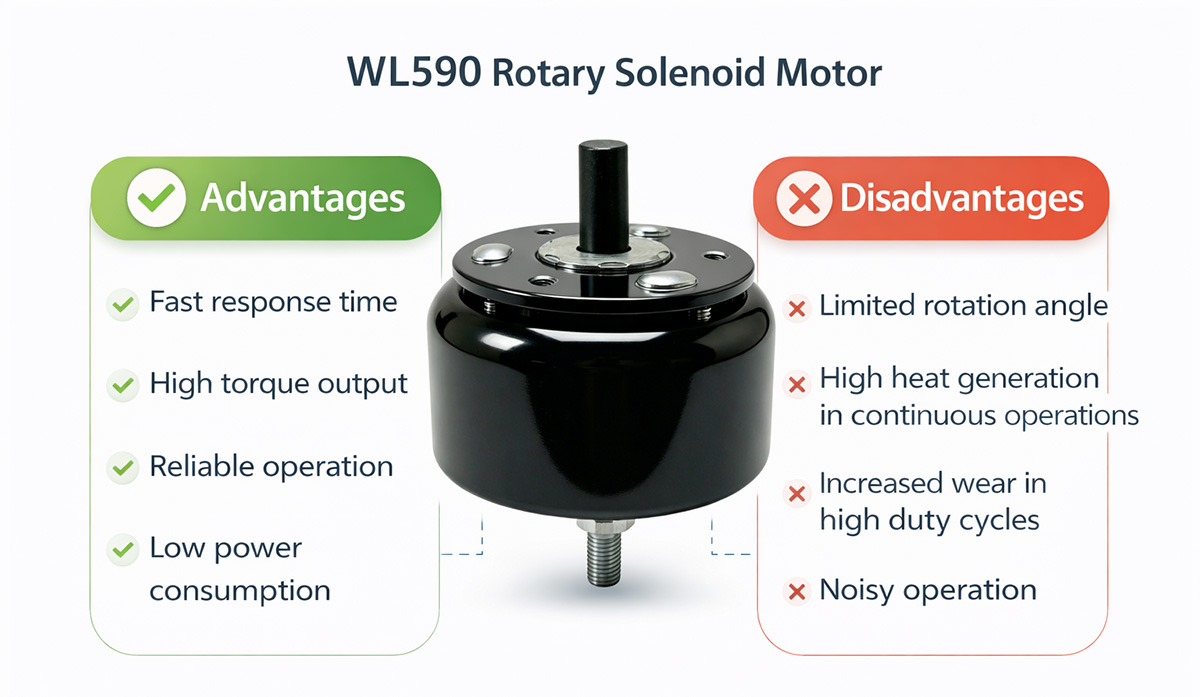
Rotary solenoids are notable for numerous advantages. Firstly, they offer a fast response and significant torque output in a compact structure. Their simple mechanical design reduces complications, ensuring minimum maintenance and extended service life. Secondly, rotary solenoids perform angular displacement with high precision and repeatability. They ensure high durability and stable performance in harsh industrial environments. Moreover, their capability to switch rapidly increases the efficiency of the system.

Cons of Rotary Solenoid Motor

Despite having several advantages, rotary solenoids have several drawbacks. Firstly, they can perform angular displacement in a limited angle, usually less than 90 degrees. Consequently, rotary solenoids cannot be applied in applications requiring continual rotation. Secondly, they can become overheated due to prolonged operation and continuous duty cycles, especially in high-duty cycles. Thus, they require proper thermal management. Besides, mechanical wear may occur in applications with high frequencies. Moreover, rotary solenoids tend to produce noise during operation compared to alternative actuators. To ensure optimal operation and longevity, rotary solenoids should be selected and installed properly.

A Guide to Fixing Problems with a Rotary Solenoid

Motor

WL590 Rotary Solenoid Motor Troubleshooting Guide

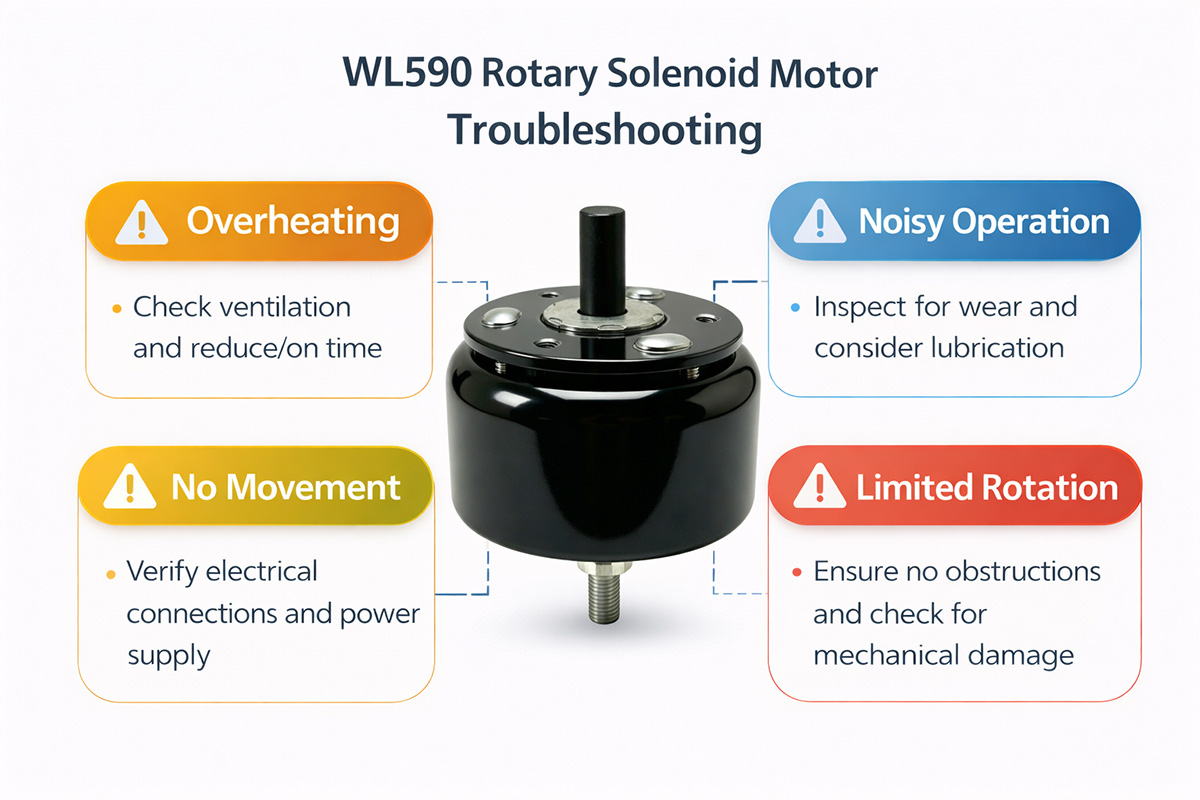
  1. ❌ No Movement / No Rotation Possible Reasons:

– Lack of power supply or incorrect voltage

– Loose or damaged wiring connections

– Damaged or burned-out coil

– Signal failure for control

Solutions:

– Ensure that the input voltage equals the rated value

– Verify the safety of all electrical connections.

– Check the coil resistance (in case of an open circuit, the coil is broken)

– Check the output signal of the controller/driver

  1. 🔥 Overheating

Possible Causes:

– Prolonged operation without pauses

– Too high voltage was supplied

– Insufficient air ventilation and heat dissipation

– Excessive external temperature

Solutions:

– Reduce the duty cycle or operate in short intervals.

– Ensure the correct values of the voltage and current inputs.

– Improve air ventilation or install heat sinks.

– If needed, select a model with higher duty rating

  1. Loud Operation

What could be wrong:

– Wearing and loosening of mechanical parts

– Insufficient lubrication

– Misalignment during installation

– Impact shock at the final position

Solutions:

– Tighten bolts of mechanical components and the housing.

– Use adequate lubricant

– Realign the shaft and its mounting surface

– Install a damping or cushioning mechanism

  1. ⚙️ Limited or incomplete rotation

Possible Reasons:

– Obstruction inside the apparatus

– Insufficient input power

– Fatigue of the internal spring

– Excessive torque requirement

Solutions:

– Remove any obstruction and verify the clearance.

– Ensure appropriate values of voltage and current inputs.

– Replace old springs

– Make sure the load does not exceed rated torque

  1. ⏱️ Slow response time

Possible Reasons:

– Unstable and low-voltage power supply

– Coil wear or partial damage

– High inertia of the mechanical load

– Incorrect electrical control timing

Solutions:

– Maintain the stability of the power supply and increase the voltage gradually.

– Evaluate the condition of the coil and replace if needed.

– Decrease mechanical load

– Optimize timing of the control signal

  1. 🔄 Unstable or erratic operation

Possible Reasons:

– Variable voltage supply

– Electrical interference

– Poor control circuit

– Wear and tear of internal parts

Solutions:

– Utilize regulated voltage supply

– Install grounding or shielding

– Evaluate and optimize the control system

– Perform maintenance or replacement of worn-out parts

  1. ⚡ Burnout or short circuit in the coil

Possible Reasons:

– Excessively high voltage or permanent power

– Failure of insulation

– Rapid temperature rise

Solutions:

– Ensure appropriate values of voltage and duty cycle

– Install protective circuits, e.g., fuse, driver.

– Replace damaged coil immediately

✅ Tips for Preventive Maintenance

– Check wiring and connections regularly

– Maintain cleanliness

– Monitor operating temperature

– Lubricate mechanical components periodically

– Operate within rated voltage and duty cycle

FAQs Of Rotary Solenoid Motor

1. How is a rotary solenoid motor different from a regular motor?

The main difference is the kind of motion they make. A standard electric motor spins all the time, which is great for things like fans and driving wheels. A rotary solenoid, on the other hand, is made to move in a certain way, usually between 25 and 95 degrees. When you need a quick, accurate, and strong “twist” to a fixed position instead of continuous rotation, this is the right choice.

2. What does it mean for a rotary solenoid motor to be "bistable" or "latching"?

These words explain how the solenoid stays in place.

Standard (Spring Return): When the solenoid is powered, it turns in one direction. When the power goes out, an internal spring automatically brings it back to its “home” position.

Bistable (or Latching): This type has two stable positions and uses permanent magnets to keep its last position even when there is no power. You need a pulse of current to switch between states, and you need to change the polarity to change the direction of rotation. This makes it very energy-efficient for things that run on batteries.

3. What is the duty cycle, and why is it so important?

The duty cycle is the percentage of time that the solenoid is “on” compared to “off” in a cycle. It’s an important specification because solenoids get hot when they are powered on, and the duty cycle tells you how much power you can safely use.
Continuous (100%): Low force; can stay on forever.
Intermittent (for example, 25%): A lot more force, but only for short bursts.
A basic idea is the power trade-off: a lower duty cycle means more power is possible.A solenoid that can handle 4.4W of continuous use can handle 17.6W at a duty cycle of 25%. You can get a lot more torque from a smaller, cheaper device if your application only needs short “on” times.

4. How do I pick the right coil for my power supply?

Choosing the coil (voltage and resistance) means making sure that your power supply can handle your torque and duty cycle needs. It’s easy to do:
Use the manufacturer’s “Torque vs. Duty Cycle” graph to find the torque you need.
Look in the coil specification table to find your supply voltage, which could be 12V or 24V DC.
Choose the coil’s AWG (American Wire Gauge) number based on the voltage and duty cycle you need. A smaller AWG number means the wire is thicker, has less resistance, and draws more current, which gives it more torque. A higher AWG number means that the wire is thinner, has more resistance, and carries less current for applications with less heat.

5. Is it possible to use a rotary solenoid motor for a "control" or "proportional" job?

This is completely dependent on how the inside is set up.
Standard rotary solenoids (ON/OFF): These are made so that they snap into place. They have a “increasing torque characteristic,” which means they can’t be used for precise, proportional control.
Proportional rotary solenoids: These are a special, more advanced type. They have a “flat torque characteristic,” which means that the torque stays about the same during the whole rotation. You can hold the shaft at any angle by changing the voltage or current, which makes them good for tasks that require servo-like control. Some even have built-in rotation sensors for accurate feedback loops.

6. How long do solenoids with a rotary motion last?

Hey, they last a long time. The lifespan is usually measured in the number of cycles (rotations) that can be completed before mechanical wear starts to be a problem. The number depends on the type of bearing:
Ball bearings: up to 5 million cycles
Metal bearings with oil in them: About 1 million cycles

7. How do I turn on a bi-stable (2-wire) rotary solenoid?

You can’t just flip a switch to turn it on and off. To make a bi-stable solenoid turn the other way, you have to change the voltage. This is because the solenoid needs current polarity to figure out which way to go. A DPDT relay (or two SPDT relays) wired as an H-bridge is the most common way to do this. This lets you change the direction of the voltage that goes to the two wires.

8. My rotary solenoid motor isn't working. How do I fix it?

A methodical approach will help you find the problem quickly. Start with the electrical side, since that’s often the problem.

Check the coil: Unplug the solenoid and use a multimeter to check the resistance between its leads.
Infinite (OL): The coil has burned out (open circuit) and needs to be replaced.
Zero: The coil is broken.
A reasonable amount of resistance, like hundreds of ohms: The coil is probably fine. Go on to the mechanical checks.
Look at the mechanics: You can turn the shaft by hand or with a tool. Does it move smoothly through its whole range, or does it feel stuck, gritty, or like it’s binding? If something feels rough, it means there is a mechanical problem.
Check your drive circuit: If the coil is good and the mechanics feel smooth, make sure that when you tell the control circuit (relay, transistor) to do something, it really sends the right voltage and polarity to the solenoid leads.


Rotary Solenoid Motor Factory Advice for Buyers and Engineers

A rotary solenoid might not be the best choice if your application needs to rotate all the time or has long duty cycles. Instead, you should look into stepper motors or servo motors. They will last longer and work better.
You need to find a balance between the mechanical needs (torque and angle) and the electrical limits (voltage and duty cycle) when choosing a rotary solenoid. This guide shows you the most important settings you need to make in order to find the best fit for your needs. 1. Find out what you need mechanically.

First, you need to know what the solenoid needs to do in the real world.
What angle does the shaft need to turn? For instance, 25°, 45°, or 95°? You can use external end-stops to stop rotation, but standard angles are more common. For bistable solenoids, rotation is usually measured as an angle from the center.
Required Torque: This is the amount of force you need to move your load. The supplier’s “starting torque” is usually the same as the gross torque. The load can only use the gross torque minus the spring’s resistance if the solenoid has a return spring.

Important: The torque changes depending on how far you turn it. In the datasheet, you can find the graph called “Torque vs. Angle.”
Speed of operation: How fast does it need to spin? Some models can switch in less than 5 milliseconds, but this depends a lot on how much power and load they have.

1. What kind of movement

Unidirectional (Standard): When the power is on, the shaft turns in one direction and then goes back to where it started.
Bidirectional (Bistable): Uses permanent magnets to keep two stable states, like open and closed, even when there is no power. The electrical pulse’s polarity makes it go in a different direction.

⚡ 2.  Check out your electrical environment.

The type of coil you can use depends on the power supply you have.
Duty Cycle (ED%): This is the amount of time the solenoid is “ON” and “OFF” during a cycle.
Continuous (100%): Low force; it runs forever.
Intermittent (25–50%): Medium force.
Pulse (<10%): A lot of power for a short time.
Key Insight: You can get a lot more torque if your application lets you have a short on-time (for example, 90W at 10% duty cycle vs. 9W at 100% duty cycle).
Supply Voltage: Most standard options work with common DC voltages, such as 12V and 24V. Manufacturers give you a “Coil AWG” table to help you pick the right wire size for your voltage and duty cycle.
Temperature Rise: Solenoids heat things up. Most of the time, the data comes from a 20°C environment with a specific heat sink. If the temperature in your area is higher, you should check the coil temperature rise to make sure the insulation doesn’t melt. It usually lasts up to 120–155°C.

3. Consider the limits of the environment and the machine

Space and Mounting: Measure the length, width, and height of your space. Check the datasheet to find out what kinds of mounting options (like flange mounts and threaded studs) and shaft changes (like D-cut and cross-hole) are available.
Environment: If the air is humid or dusty, you probably need a sealed enclosure or dust cover to keep the ball bearings and raceways clean.
Check the rated cycles to see how long it will last. Standard units can last between 2 and 5 million cycles, while high-quality or long-life units can last more than 50 million cycles.

4. Final Selection List

When you call a supplier or look at a datasheet, be ready to answer these questions:
Angle of Rotation Needed: (for instance, 45°)
Required Torque: (for example, 0.15 Nm at the start of the turn)
Duty Cycle and Supply Voltage: (for example, 24V DC, 25% duty cycle, 1 second on, 3 seconds off)
Clockwise, counterclockwise, or both are the directions of rotation.
The room’s temperature, dust, and humidity are all factors that affect it.
A flange mount with a D-cut shaft is one of the things that mounting and shaft needs.

If you need to stay in one place without using power or making heat, a bistable rotary solenoid is the best choice. A standard rotary solenoid is probably the best choice if you only need to turn something on and off and a spring can return the load.
What specific purpose are you using this solenoid for? You can figure out the torque and angle needs by knowing what kind of device or machine it is.

5. A Quick Comparison: Standard Rotary Solenoid Motor vs. Bistable Rotary solenoid

Feature Standard (Unidirectional) Bistable (Bidirectional)
Power State Needs power to hold position; spring returns when off. Requires no power to hold either end position.
Movement Rotates one way (spring returns). Rotates both directions based on polarity.
Heat Generates heat during the “ON” time. Generates very little heat (short pulses only).
Best For Valve actuation, locking mechanisms. Low-power-operated devices, optical shutters, and sorting gates.

Get A Free Quote Now

Contact Form

Related Products

Related News

Scroll to Top

Get A Free Quote Now !

Contact Form
If you have any questions, please do not hesitate to contact us.
Weilong Solenoid Company Culture
