Skip image slider
Mini Rotary Solenoid for Industrial Uses and Benefits
Mini Rotary Solenoid for Industrial Automation Systems
How Mini Rotary Solenoids Work in Industrial Equipment
Mini Rotary Solenoid Selection Guide for OEM Engineers
Custom Mini Rotary Solenoids for Compact Industrial Uses
Mini Rotary Solenoid Applications in Modern Automation

WL1520 Mini Rotary Solenoid for Industrial Automation Guide

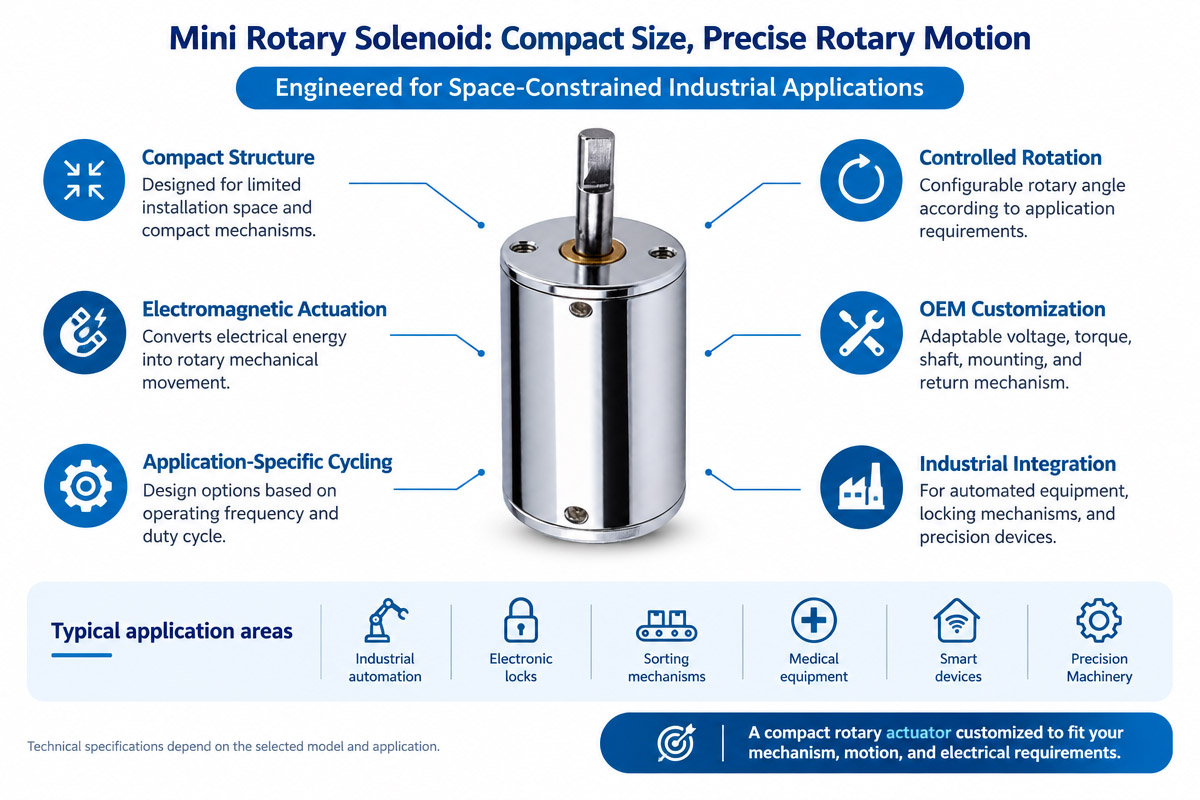
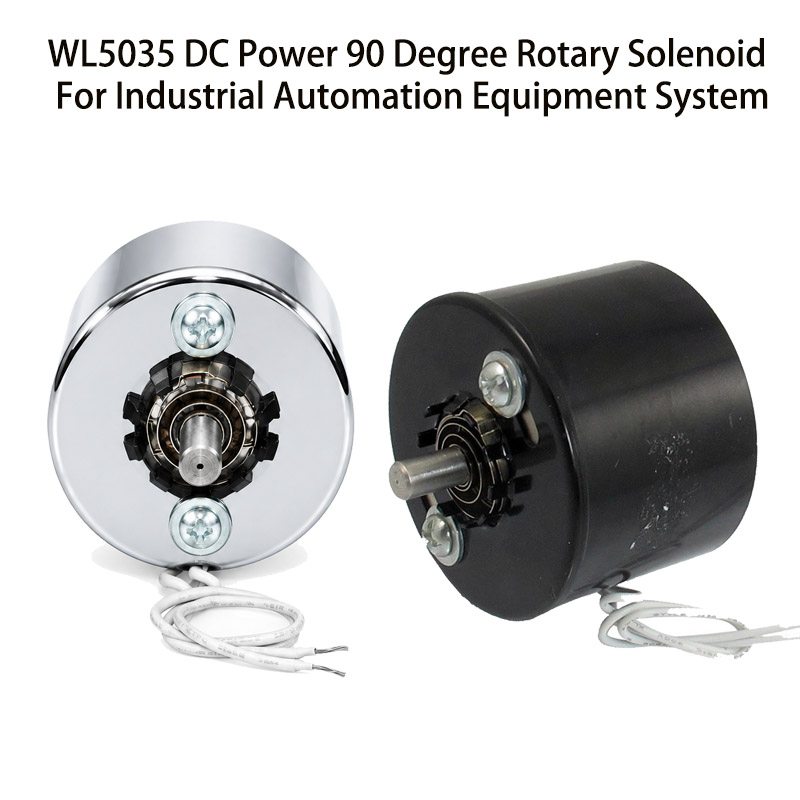
Mini rotary solenoid is an electromechanical component that provides limited angle of rotation to a machinery. Usually it consists of a coil, magnetic system, rotor, mechanical return mechanism and a mounting body. The electrical energy is supplied to the coil to create the magnetic field. This magnetic field is responsible for the rotary action of the mechanism. The resulting movement is used to operate the lock, switching, selection, shutter or valve mechanisms.

Mini rotary solenoids are especially useful when there is a need for limited rotation in a machine and not for continuous rotation provided by a motor.

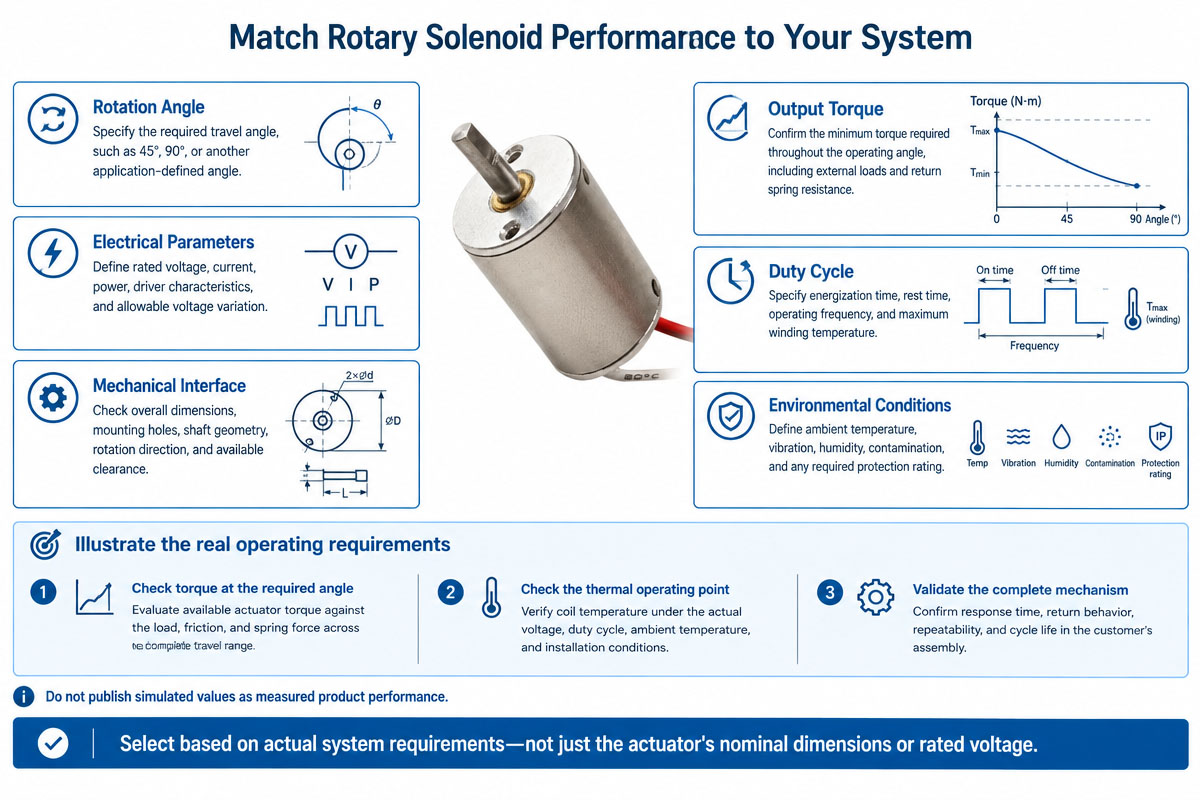
Depending on the design there are different options for angles of rotation, working voltages, torque and return mechanisms. In the design phase it is recommended to consider the parameters such as torque of load, resistance of the spring, duty cycle, response time, temperature and installation space. A mini rotary solenoid of custom design can be a good solution for OEM application.

Mini Rotary Solenoid Product Feature Overviews

We develop mini rotary solenoids for applications requiring compact and electrically controlled angular rotation. The available configurations may include various rotation angles, coil voltages, torques, shaft arrangements, and return mechanisms. Depending on the application, a model may be designed for intermittent operation, for switching back and forth or for a specific positioning function. In the selection process, the whole operating environmentโ€”mechanical load, installation space, temperature, and frequency of operationโ€”should be taken into account. For OEM applications, the customization may be required to fit an existing mechanism or product enclosure. Technical review and prototyping tests are useful to ensure that the selected mini rotary solenoid meets the desired performance requirements.

How does a mini rotary solenoid work?

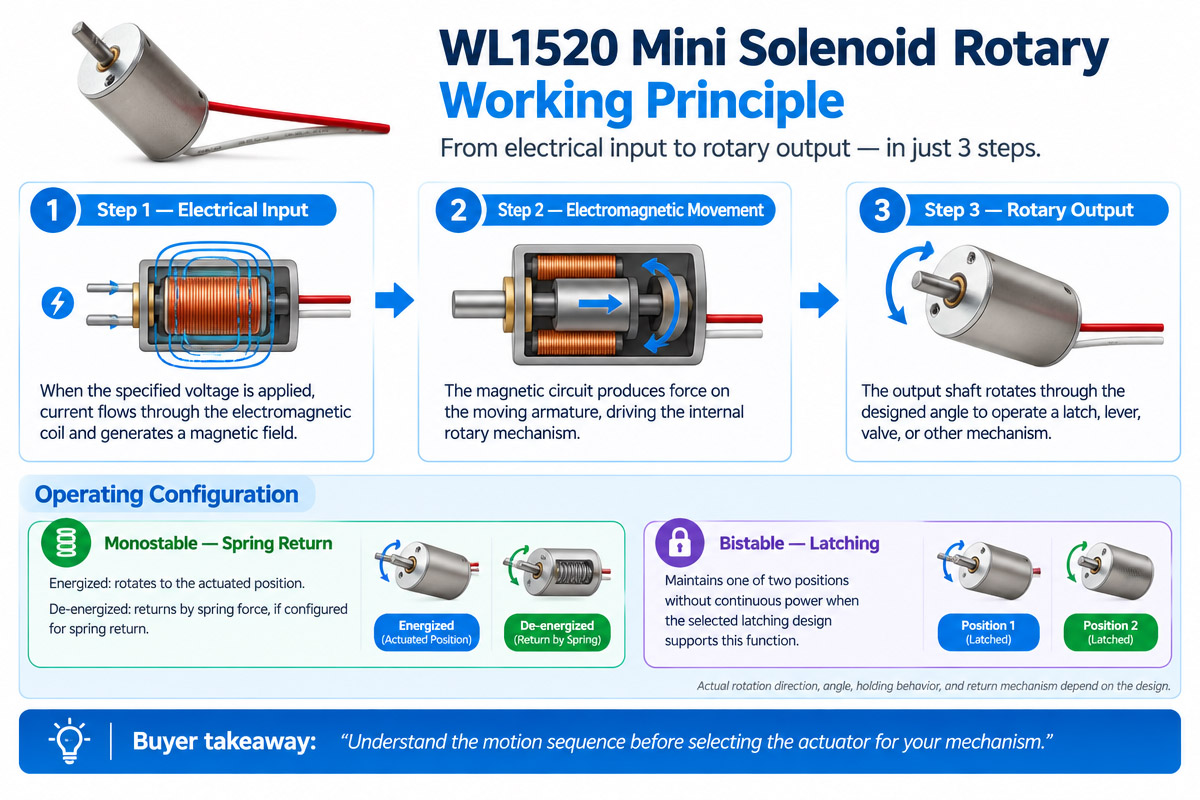
The mini rotary solenoid is working according to the principle of interaction between the electromagnetically created field and the specially designed mechanical system. There are few phases that describe the principle of work depending on the product architecture.

Electric energization: When the rated voltage is applied, the current flows through the coil and produces the magnetic field.

Force/torque generation: The magnetic system directs the magnetic field to create force/torque on the internal moving parts.

Rotational movement. The rotor or armature rotates through the designed angle and drives the connected shaft/mechanism.

Action: As a result of rotation, the desired action occurs, e.g., releasing a lock, moving a selector, or actuating a switch mechanism.

Return or Position Holding: In case of spring return design, the removal of the power supply returns the mechanism. In the case of a bistable design, the mechanism stays in its position without the energy supply.

The exact torque and rotation angle depend on the magnetic system, geometry, electrical input, mechanical load, and spring resistance. “Engineers should check performance at the expected load and not just at no load movement.

Key Features of Mini Rotary Solenoid

Mini rotary solenoids are combining compact size with electrically driven rotation. Quick switchability, easy electrical control, and integration into a small machine are the key features of the rotation angles. There can be different rotation angles, spring return, or bistable positioning in some models. There are also customized shaft arrangements and different DC voltages depending on the design. Model and application dependent: torque, response time, power consumption, and duty cycle. An appropriate design should satisfy the required mechanical load and operating frequency while keeping the temperature of the coil within an acceptable range. Customized mounting dimensions and mechanical interfaces can simplify integration of the OEM product. A performance test should be performed on an application-specific basis prior to the production approval.

Mini Rotary Solenoid Product Feature Video Presentation

Mini Rotary Solenoid Product Detailed Display

Mini Rotary Solenoid Product Technical Datasheet

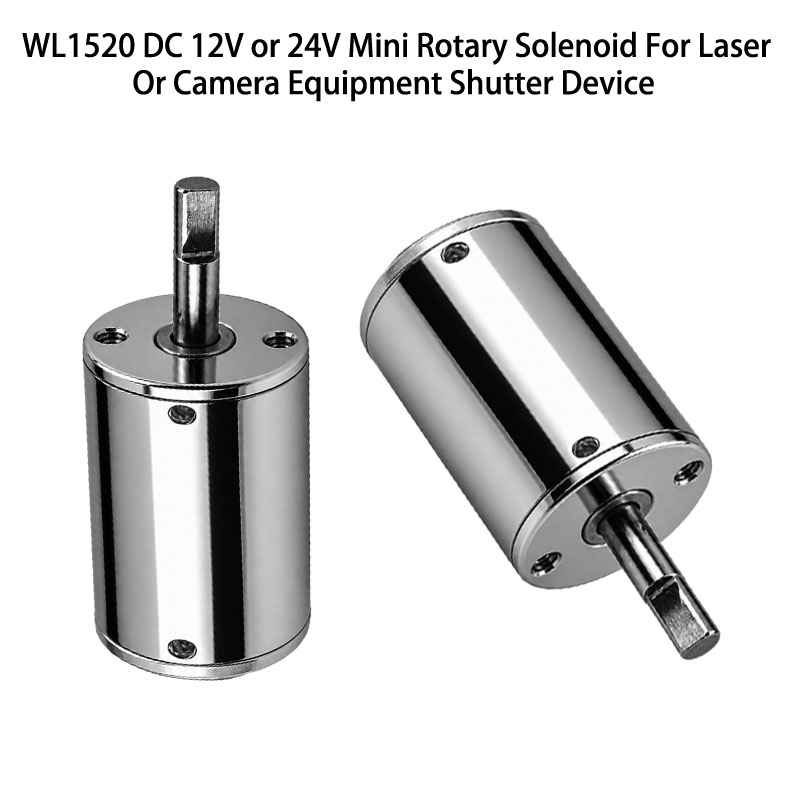
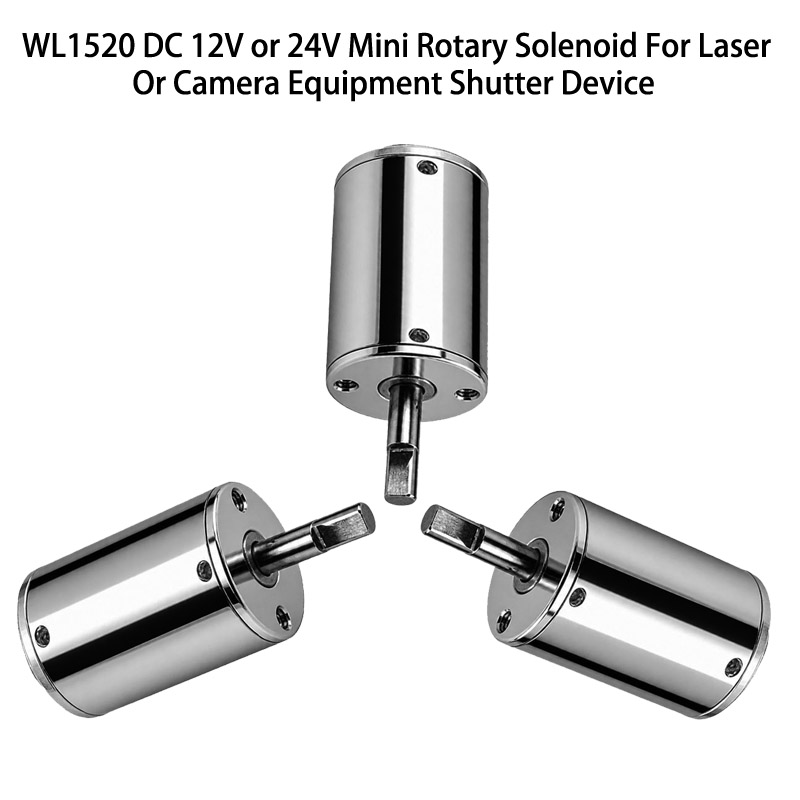
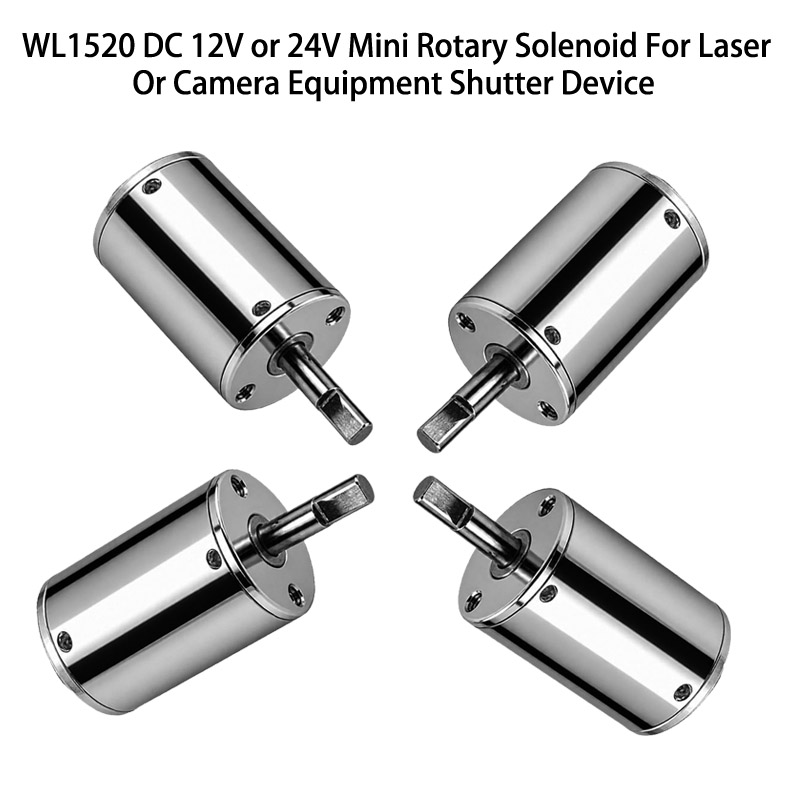
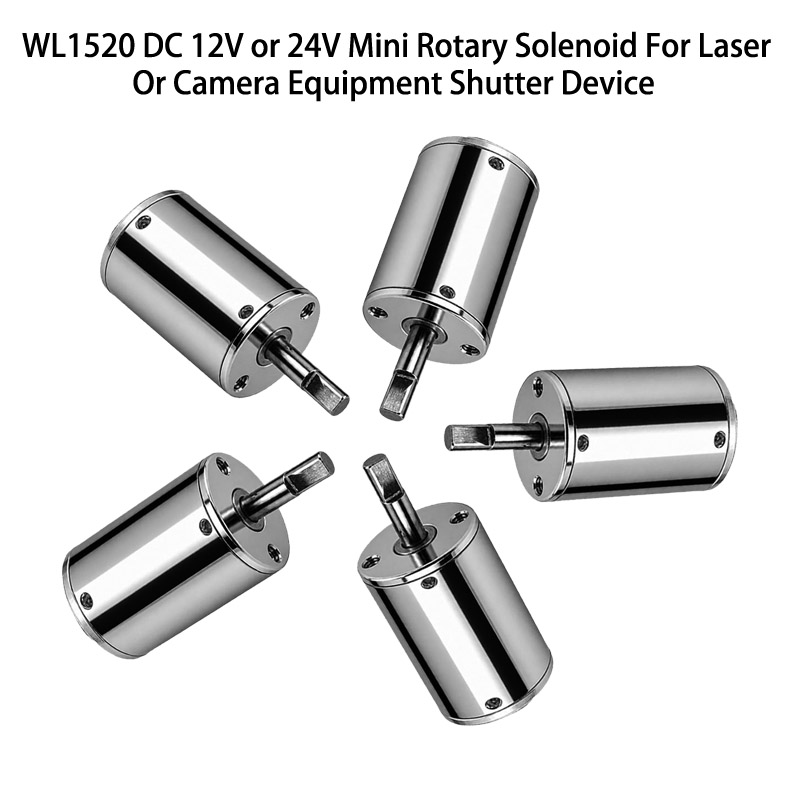
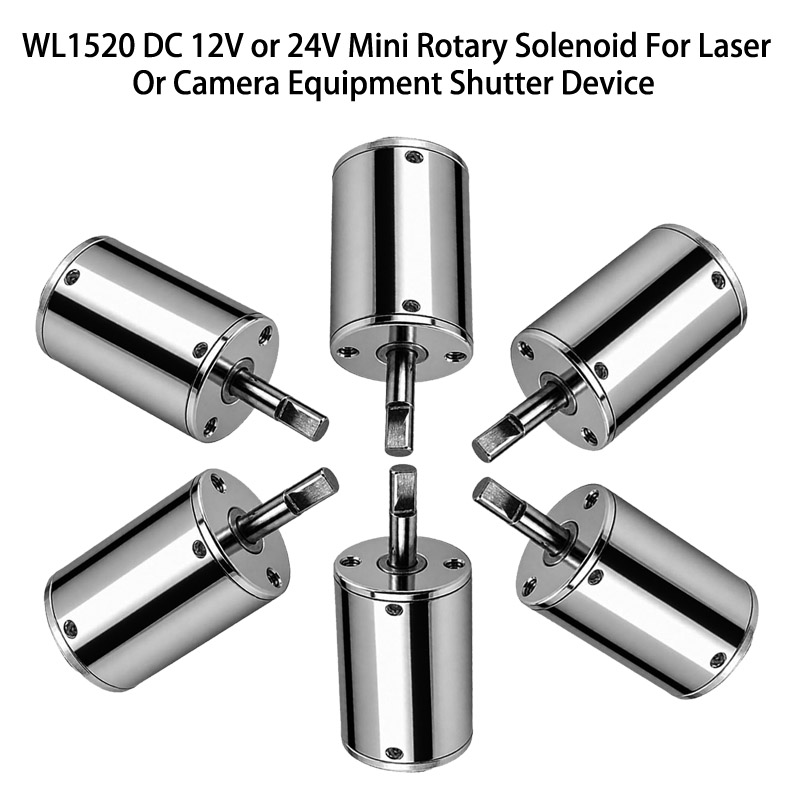
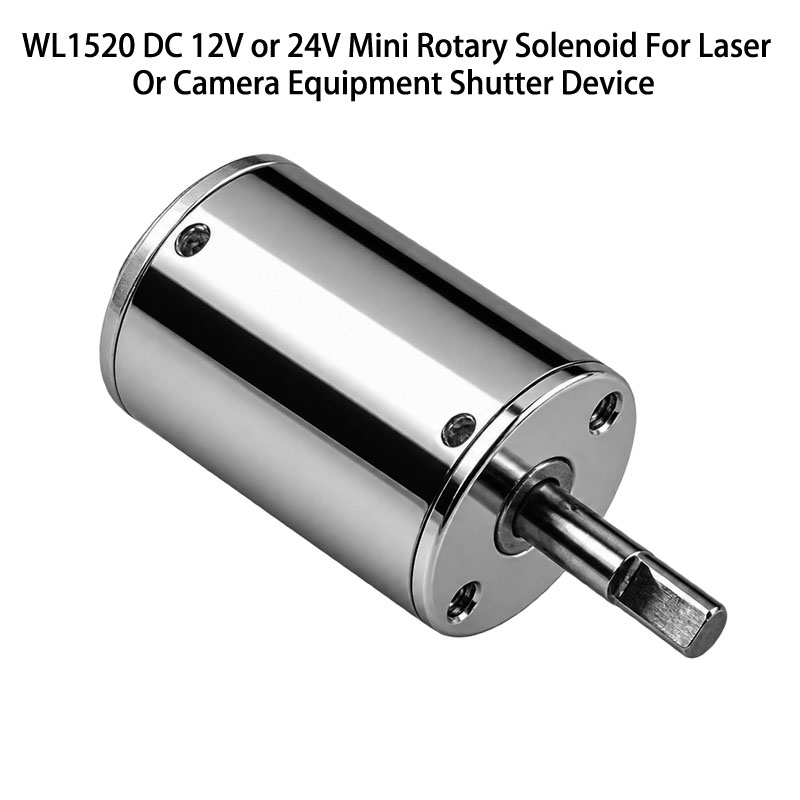
rand Weilong Technology Model Number WL 1520
Rated Voltage (V) DC 12V or 24V Rated Power (W) 5-10 W
Work Model Rotation Type Torque Force (N) 10 GF-30GF
Stroke (mm) ย Customized Reset Time(s) 10S
Service Life 200,000 cycles Certification CE, ROHS, ISO9001,
Material Safety Iron/Carbon Steel Lead Wire Length (mm) 200
Install Style screw Tolerance of Dimension ยฑ 0.1 MM
Water-proof None Insulation Class B
Hi-Pot Test AC 600V 50/60Hz 2s Non-excitation Holding Force 0
Working Temperature -10ยฐC-100ยฐC Duty Cycle 1-100%
Thread Depth (mm) / Payment Term TT, or LC at Sight
Sample Order Yes. Warranty 1 Year
MOQ 100 PCS Supply Ability 5000 pcs per week
Delivery Time 30 Days Port of Loading Shenzhen

Rotary Solenoid vs. Pneumatic Rotary Actuator: Which One Do You Need?
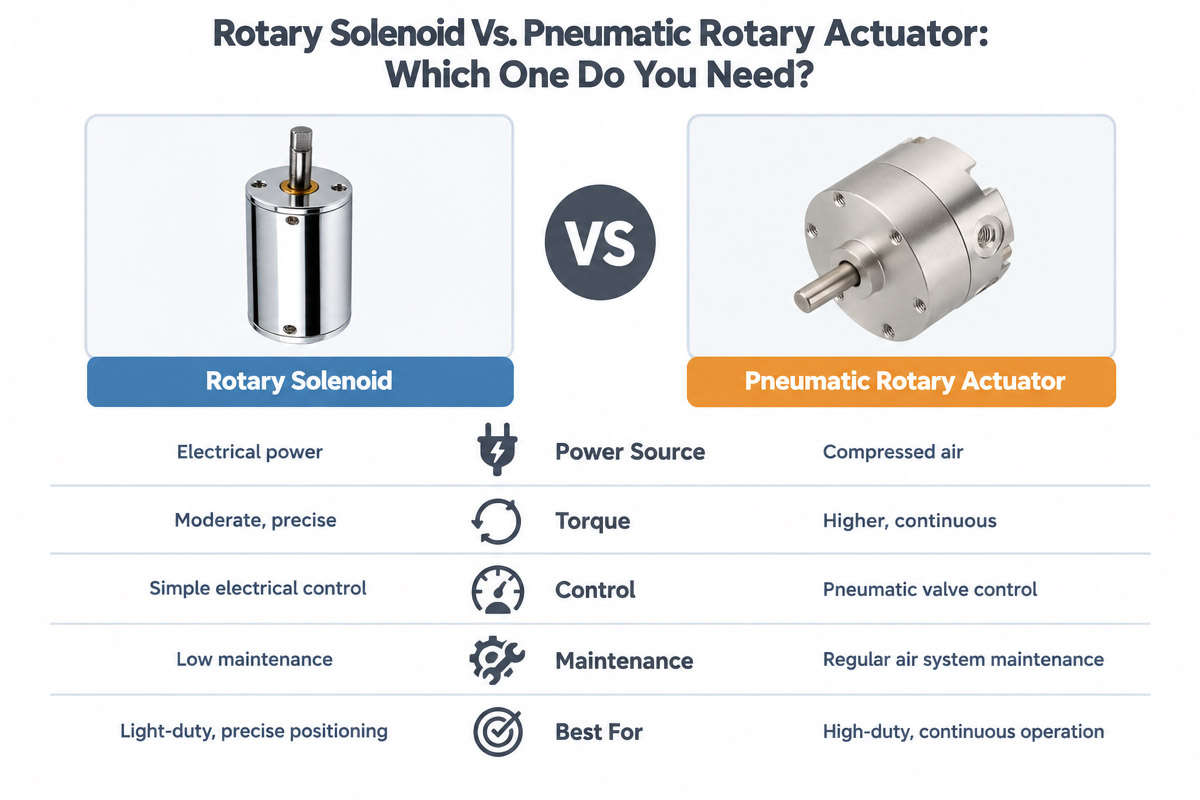
Rotary Solenoid vs Pneumatic Rotary Actuator Whick one you need

The choice between the rotary solenoid and the pneumatic rotary actuator depends on the kind of movement, the energy source, torque, response time, installation space, and the operating conditions. These two technologies may create rotational movements but in different ways and for different kinds of machines.

By understanding the differences between the two technologies, the OEM engineers may choose the actuator, which satisfies the functional requirements without increasing the complexity and the cost.

What is a rotary solenoid? โ€“

A rotary solenoid is the electromechanical device that converts the electrical energy into limited-angle rotational motion. The energized coil generates the magnetic field, which provides the force to turn the internal mechanism.

The design of the actuator may allow the solenoid to return to the rest position or to provide the bistable mechanism to keep the solenoid in position without continuous energizing.

The mini rotary solenoids are especially useful in compact equipment requiring electrical switching, mechanical release or indexing, and positioning through a limited angle.

What Is a Pneumatic Rotary Actuator?

The pneumatic rotary actuator is the device that converts the compressed air into the rotational motion. It may use the vane mechanism, rack-and-pinion arrangement, or some other pneumatic converting mechanism.

These actuators are widely used in industrial automation to operate valves, rotate fixtures, position workpieces, and handle materials. They may be good for the applications, which require high torque or repetitive mechanical operations.

However, they may need the suitable compressed-air supply, control valves, and pneumatic connections.

1. System Complexity and Installation Space

The mini rotary solenoid may be useful for the applications, which require small rotational movement and have small installation space.

It uses the electrical power and thus may be free from the necessity to install the pneumatic lines and control valves for the actuator installation. Thus, it may be useful to simplify the layout of the equipment, especially in the small machines or self-contained products.

Although there are compact versions, pneumatic rotary actuators may require additional space around the actuator and additional connections. The integration would be easy if there is already the pneumatic infrastructure in the factory.

In case the installation space is the main factor, choose the mini rotary solenoid. If your application and infrastructure allow pneumatic power, then choose the pneumatic actuator.

2ใ€‚ Mechanical load and torque

Torque is an important selection criterion. The mini rotary solenoid may be suitable for small latch, selector, gate, or release mechanisms. As for the torque, it depends on the design and the size of the solenoid.

If you have to rotate bigger fixtures, operate the industrial valves or move heavy mechanical loads, then the pneumatic rotary actuator may be a better choice.

Don’t compare the actuators by size alone. Take into account the actual torque required for the movement, friction, inertia, spring resistance, and external load.

In case the actuator is a rotary solenoid, request torque-angle data, if possible. In the case of a pneumatic actuator, take into account the rated torque at the desired pressure and the mechanical load.

3. Response Time and Frequency of Operation

Both technologies may be suitable for rapid automation cycles, but the actual response times depend on the actuator design and the control system.

The rotary solenoid reacts directly to the electrical command; thus, it is good for short switching or release operations. The response time of the coil depends on the coil characteristics, mechanical load, spring force, and the control circuitry.

The pneumatic actuators are affected by air pressure, valve characteristics, tubing, air volume, load, and exhaust conditions.

In case of frequent switching, make the test of the whole system in the working conditions; don’t assume that one technology is always faster.

4. Energy use and efficiency

The rotary solenoid consumes the electrical power when its coil is activated. The energy consumption depends on the coil power and operating cycle. Where it is possible, the bistable design of the actuator may reduce the energy consumption.

The pneumatic actuator uses the compressed air from the factory air system. The compressor efficiency, air leakages, pressure settings, and operating frequency affect the energy consumption.

“Neither technology is always more energy-efficient. Compare the total system consumption during the expected operating cycle, including the support equipment.”

5. Maintenance & Reliability

The rotary solenoid contains the electrical and mechanical parts, which may cause the heating, wear-out, or change in performance over time. It is important to pay attention to the proper voltage, duty cycle, installation, and load for reliable operation.

Key Differences Between the Two Technologies

Comparison factor Mini rotary solenoid Pneumatic rotary actuator
Energy source Electricity Compressed air
Movement Typically limited-angle rotation Limited-angle or other configurations, depending on design
Installation Often compact Requires actuator space and pneumatic connections
Control Electrical switching Pneumatic valves and control signals
Torque Depends on size and electromagnetic design Can provide substantial torque, depending on size and pressure
Infrastructure Electrical supply and control circuit Compressed-air supply and pneumatic control
Positioning Usually defined movement or positions Depends on actuator and control configuration
Maintenance Coil and mechanical components require evaluation. Seals, air quality, and pneumatic components require maintenance.
Best-fit applications Compact switching and release mechanisms Industrial positioning and heavier mechanical operations

The pneumatic actuators need the suitable air quality and may require attention to seals, lubrication (where required), valves, and air leaks.

In both cases, the reliability of the system depends on the correct choice of the actuator and maintenance according to the manufacturer recommendations.

6. Pricing and Customization

The total cost of the solution includes the actuator, the support equipment, installation, control components, maintenance, and service life.

The mini rotary solenoid may be useful to implement the small electrically controlled mechanism at a reasonable cost, especially when it is incorporated directly into the existing circuit.

In case the compressed air is already available in the application or the torque is more suitable for pneumatic actuation, the pneumatic actuators may be more economical.

The custom rotary solenoids may be produced to fit the specific shaft dimensions, rotation angle, torque profile, and installation dimensions. However, the customization may incur the engineering and tooling costs.

7. What Type Should You Go For?

Choose the mini rotary solenoid if you need a small size, limited angle motion, electrical actuation, and relatively simple integration.

Choose the pneumatic rotary actuator if the application requires the torque; it is more suitable for the pneumatic actuation and compressed air is available.

In the case of evaluating OEM projects, make the decision taking into account the actual load, angle, response time, operating cycle, installation space, and lifetime cost. In case the required motion or torque goes beyond the range of options, the suitable motorized actuator or some other motion control technology should be chosen.

The best solution is the one that satisfies all the application requirements at the acceptable cost, complexity, and reliability.

 

Mini Rotary Solenoid Industrial Application

Mini Rotary Solenoid For Industrial Application

Mini rotary solenoids are used in industrial machinery that requires compact and controlled rotation. They can only operate through a limited angle, so they are very useful for mechanisms where a regular motor is too bulky or complex.

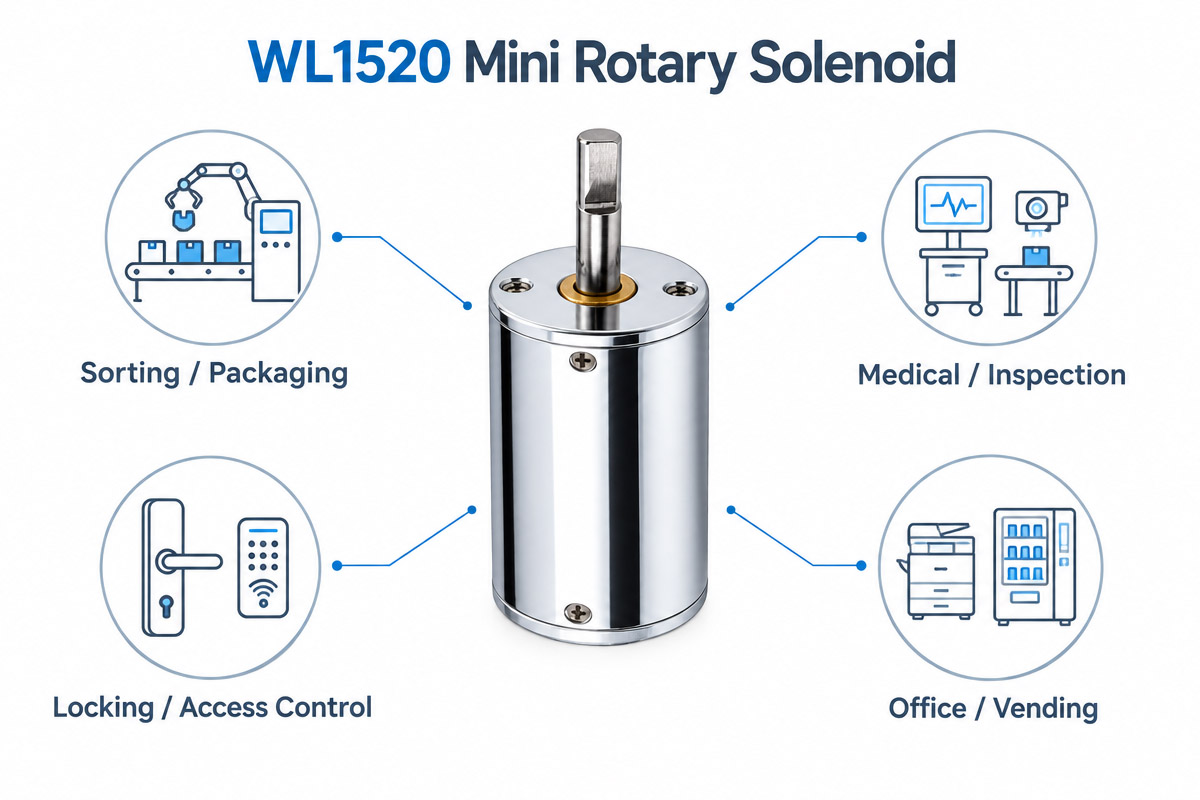
Industrial automation: Mini rotary solenoids are used to control mechanical selectors, indexing systems, shutters, locking mechanisms, etc. They control gates, guides, and material handling parts in packaging and printing machines. The electrically driven rotation also makes them very useful for automated assembly machines where movement should be synchronized with sensors and programmable controllers.

In access control and security equipment, the mini rotary solenoid can rotate a lock or release mechanism when being triggered by an electrical impulse. Compact rotary actuators are useful for rotating the internal parts in laboratory instruments and special measuring equipment without a large drive assembly.

The other potential applications include vending machines, document handling equipment, textile machinery, robotic systems, and custom OEM equipment. Suitability depends on the required torque, rotation angle, operating frequency, and environmental conditions.

In the case of shuttle systems, a mini rotary solenoid can be considered for the defined switching, locking, or positioning function, provided that the torque and response time meet the mechanism requirements. The engineers should evaluate the real load, return behavior, and operating cycle before choosing the model for

production equipment.

Why mini rotary solenoids are becoming more popular in shuttle system solutions

Shuttles are applied in different kinds of automated equipment to move, index, sort, or position parts from one place to another. Although the exact requirements of different sectors may vary, many shuttle systems depend on repeatable mechanical switching and small actuation.

In case you need a limited angle motion for your shuttle mechanism to operate a selector, latch, stop, gate, or locking feature, then the mini rotary solenoid would be a good choice. The compact design of the actuator may help designers to integrate it in small spaces, and electrical activation makes it possible to coordinate the movements with sensors and machine controllers.

For example, the rotary solenoid may be activated by the controller in case the shuttle has reached the specified position. If the mechanism is designed to do it and the solenoid has enough torque, it may rotate the mechanical stop or unlock some locking feature.

There may be a number of advantages of using the mini rotary solenoids in the shuttle system solutions:

Space efficiency: Small actuators may help to pack small mechanisms

Repeatable switching: A limited angle of rotation may allow for reliable mechanical operations.

Electrical Integration: Activation may be coordinated with the sensors, PLC, and other control signals.

Mechanical simplicity: Some angle functions may be limited and may be realized without the large rotary drive system.

OEM customization: Mounting dimensions and shaft arrangement, angle of rotation, and return characteristics may be customized according to the design.

However, the mini rotary solenoid may not be the best choice for all the shuttle systems. The engineers have to check the load, the cycle frequency, the response time, the shock and vibration conditions, and the service life of the mechanism. If the mechanism needs continuous rotation or prolonged high torque, the other actuator may be more suitable.

The best choice of the actuator depends on the actual shuttle mechanism and its performance requirements.


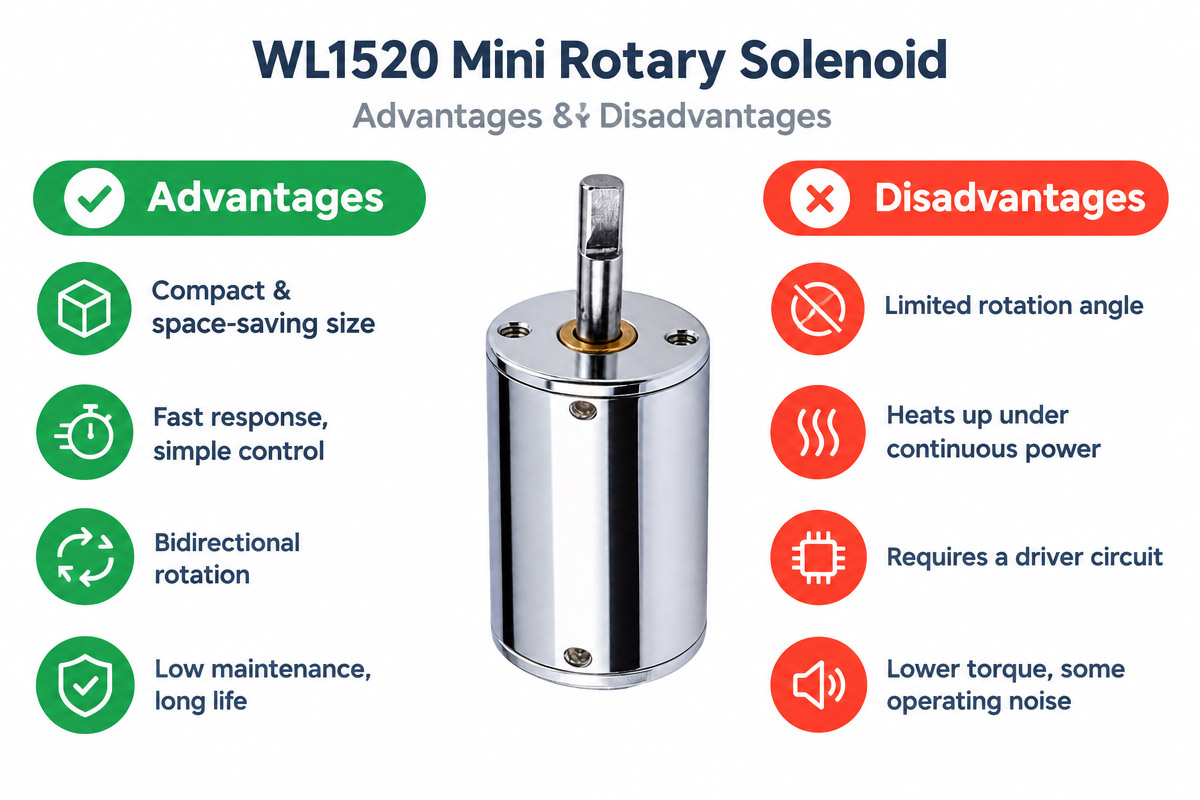
Mini Rotary Solenoid Advantage and Disadvantage

Mini Rotary Solenoid Advantage and Disadvantage

There are several advantages and disadvantages of mini rotary solenoids.

Miniature rotary solenoids have many advantages for compact automation systems, but they are not the best solution for all types of motion-control applications.

Mini Rotary Solenoid Advantage

Compact design: Their compact design makes them suitable for machinery with limited installation space.

Direct angular actuation They provide limited-angle rotation without the need for a motor, gearbox, and transmission mechanism.

Simple electrical control: They are easily controlled by an electrical control circuit and can be integrated into relays, sensors, and PLC-based systems.

Fast switching ability: Many designs are able to switch quickly from one position to another. This makes them suitable for repetitive switching and release actions.

Custom options: The torque, rotation angle, installation space, shaft configuration, and return mechanism can be customized depending on the manufacturer.

Mini Rotary Solenoid Disadvantages

Limited rotation: Traditional mini rotary solenoids are designed for moving a certain distance and not for continuous rotation.

Finite torque. The available torque may be insufficient for heavy loads and high-friction mechanisms.

Heat generation: The temperature of the coil can increase in case of extended energization or frequent operation.

Limited positioning flexibility. Most designs have defined movement, not continuously adjustable positioning like in a servo system.

Mechanical wear: Springs, bearings, contact surfaces, and connected mechanisms can wear out over time depending on the design.

To conclude, mini rotary solenoids are suitable for compact and limited-angle actuation. Motors or other actuator technologies may be preferable if continuous rotation, heavy loads, or precise positioning is required.

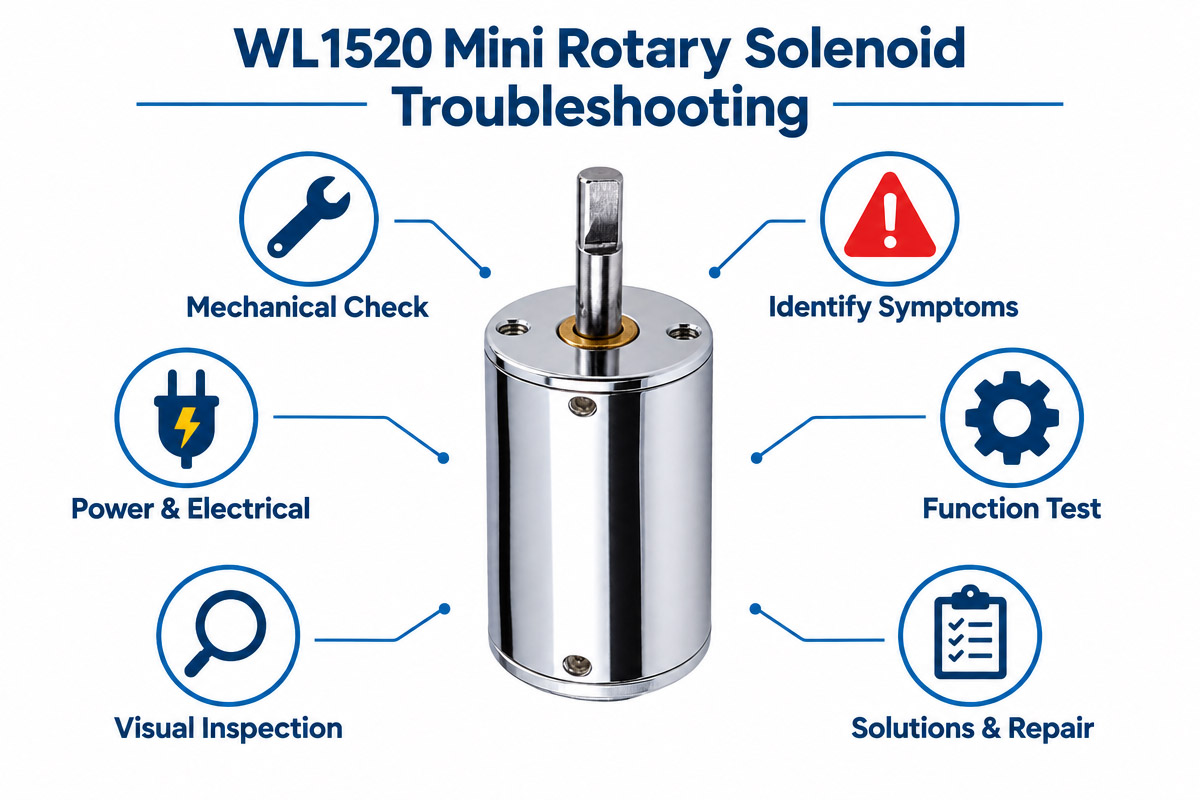
Troubleshooting of mini rotary solenoid

ustom Mini Rotary Solenoid Troubleshooting Guide

In case the mini rotary solenoid does not operate properly, you should investigate the electrical supply, the mechanical load, the installation, and the operational cycle.

Problem 1: Not turning the solenoid

Check the continuity of supply voltage, wiring, connectors, the control signal, and the coil. Make sure that the controller is capable of generating the required current. In case the electrical supply is fine, make sure that there is no mechanical obstruction or overload of the actuator.

Problem 2: Not achieving the full rotation

There may be either the torque of the load too high or the spring too strong. Also, it may be a mechanical problem. Make sure that there is no rubbing or misalignment. Compare the rotation with torque-angle specifications of the manufacturer.

Problem 3: Overheated coil

Make sure that there is no error in the rated voltage, the real current, the energizing period, and the duty cycle. The overheating may be caused by too high switching frequency, wrong supply voltage, or a long energizing period. Turn it off in case the temperature exceeds the specified one.

Problem 4: Not resetting the mechanism

In the case of the spring return type, check the spring, the external resistance, shaft alignment, and mechanical obstruction. Make sure that the design of the mechanism is supposed to return after de-energizing.

Problem 5: Inconsistent performance

Make sure that there are no loose mountings, voltage fluctuations, load variations, worn parts, or wrong control timing.

Check the operating voltage, current, temperature, rotation angle, and the load. In case the problem is not solved, contact the manufacturer providing test results and specifications of the product. Follow all the relevant safety procedures and disconnect the power supply before making any mechanical checks.

FAQs on Custom Mini Rotary Solenoids

1. How to select the suitable mini rotary solenoid for my application?

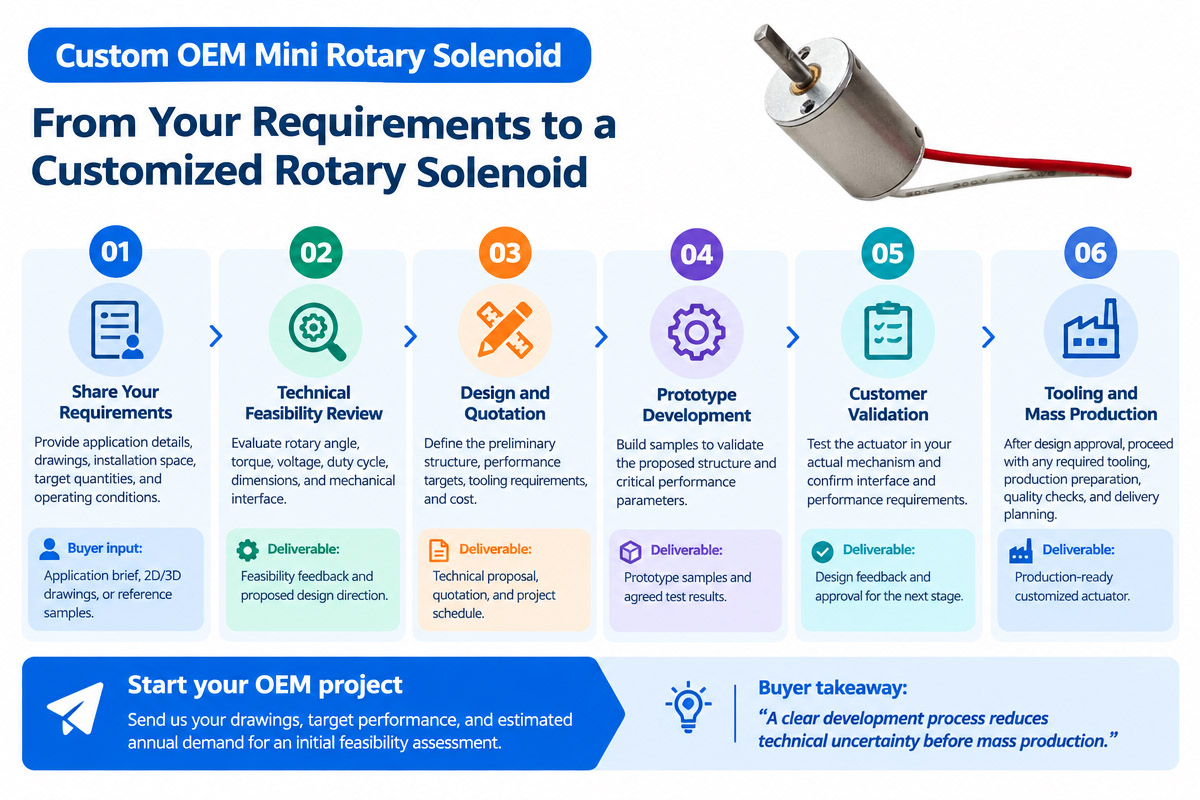
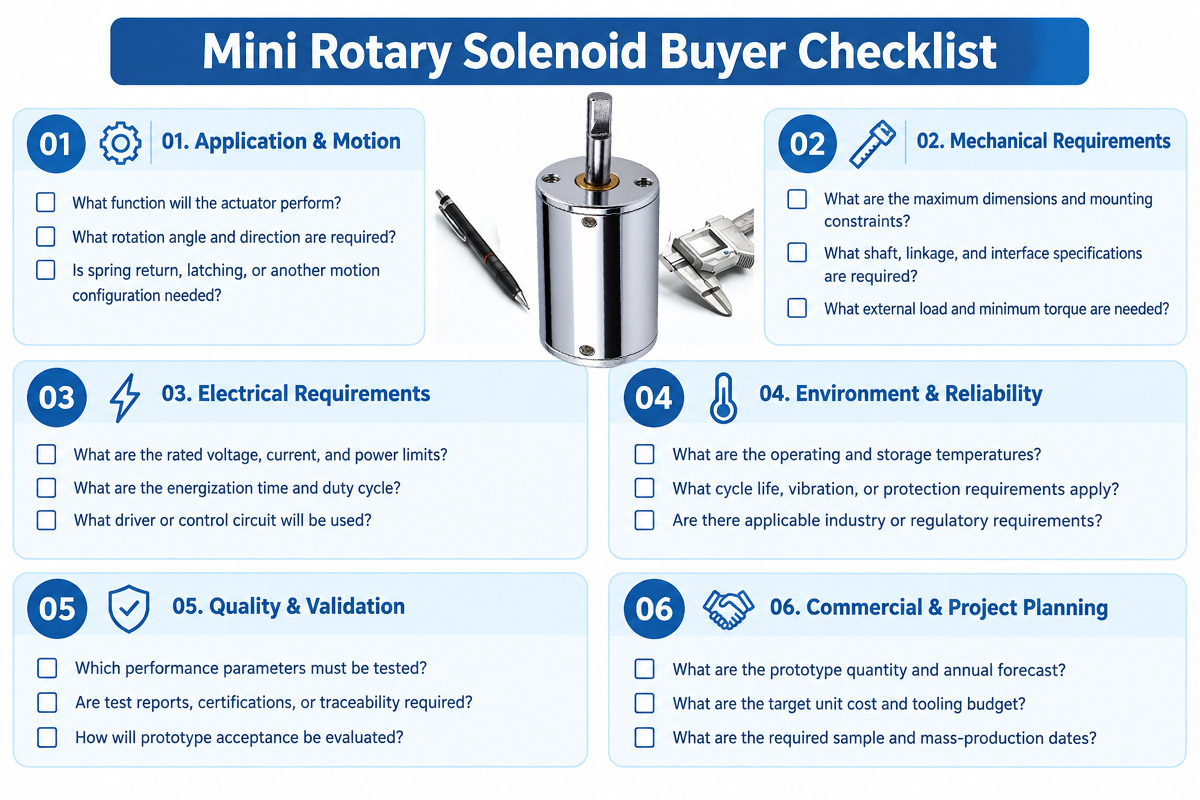
You define the required rotation angle, torque, operating voltage, current, duty cycle, response time, and installation dimensions. Take into account the mechanical load, the return mechanism, operating temperature, and expected service life. In case the standard configuration is not suitable, contact the manufacturer for the custom mini rotary solenoid for your OEM application.

2. How much does a mini rotary solenoid cost?

The cost of the solenoid depends on its size, torque, rotation angle, coil specifications, materials, customization requirements, and quantity of order. The standard configurations are usually cheaper than the custom ones, requiring the new tooling and engineering. When requesting a quotation, please provide the technical specifications and estimated annual demand to find the most appropriate solution.

3. Can I order a custom mini rotary solenoid according to my drawings or existing sample?

Yes, some manufacturers with custom engineering capabilities may be able to develop a mini rotary solenoid according to your technical drawings, 3D CAD files, or existing sample. Provide the voltage, the required angle of rotation, torque, mounting dimensions, and operating cycle. Prototype testing and engineering review would guarantee the feasibility before mass production.

4. What is the rotation angle of the mini rotary solenoids?

The typical choices are 45ยฐ, 90ยฐ, and 180ยฐ; however, what you have will depend on the manufacturer’s design capabilities. When choosing the solenoid, take into account the actual rotation angle under load, direction of rotation, start and finish positions, and the presence of a return spring. Custom angles may be available after the feasibility study.

5. Is it possible to use a mini rotary solenoid continuously?

Not all mini rotary solenoids are designed for continuous energization. Some are designed for the short pulses or intermittent duty. Some may allow longer energization within specified thermal limitations. Before buying, check with the supplier the duty cycle, rated voltage, current, temperature rise limitations, and switching frequency.

6. What's the minimum order quantity (MOQ) for mini rotary solenoid custom made?

Minimum order quantity depends on the manufacturer and design. Prototype samples may be available in small quantities, but the customized mass production may require the minimum order because of the tooling, material procurement, and assembly costs. Request the supplier to quote the prototype, small-batch, and mass production quantities separately to estimate the total cost of development.

7. What is the time frame for getting samples and starting mass production?

The time it takes depends on whether we can adapt the existing design or have to develop the new product from scratch. The custom projects may include engineering evaluation, tooling, prototype manufacturing, and performance testing before production approval. Confirm the schedule before placing your order. Request the separate schedule for samples, tooling, design revisions, and mass production.

8. Why I choose Weilong to be my mini rotary solenoid manufacturer?

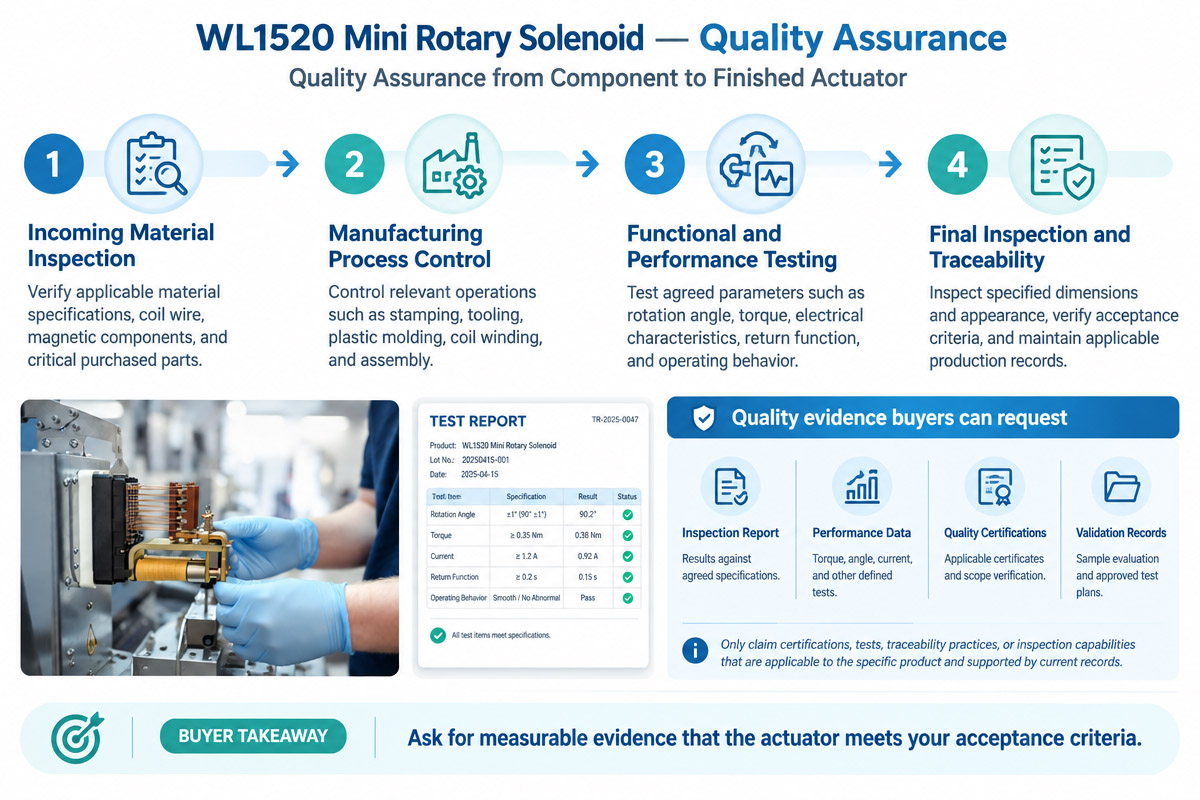
Weilong Intelligent Technology (Dongguan) Co., Ltd. was founded in 2007 and specializes in solenoids and inductor coils. The manufacturing capabilities include metal stamping, tooling development, plastic injection molding, CNC machining, coil winding, assembly, and laboratory testing. For the customers of OEM, Weilong can evaluate the application requirements and provide the customized electromagnetic component solutions. Buyers are advised to check the torque, rotation angle, electrical characteristics, duty cycle and sample performance of the proposed design before approving the mass production.

How to Select a Mini Rotary Solenoid

In selecting a mini rotary solenoid, you need to consider the mechanical function, electrical supply, installation constraints, and the lifetime you expect from it. The following factors help the engineers to select a proper design.

1. Specify the angle of rotation

Specify if the mechanism requires 45ยฐ, 90ยฐ, 180ยฐ, or another angle of rotation. Specify the start and end positions, rotation direction, and whether the angle of rotation should be mechanically limited.

2. Determine the required torque

Calculate the torque to rotate the attached load. Account for the friction, spring resistance, gravity, and any external forces acting on the mechanism. Consider torque throughout the angle of rotation, not just at the end point.

3. Choose the operating voltage

Verify the available power supply, allowable current, and control circuit requirements. 12V and 24V DC voltages are common, but the right rating depends on the coil design and performance. Do not assume two models of the same voltage produce the same torque.

4. Determine the duty cycle

Estimate the duty cycle and the frequency of operation of the solenoid. For how long is the solenoid on in each cycle? High frequency switching can raise the temperature and affect the service life. Check the duty cycle and thermal ratings specified by the manufacturer.

5. Select the return mechanism

Spring-return design will return the mechanism to its resting position when the power is removed. A bistable design can hold either of two positions without continuous energization. Select the return mechanism corresponding to the machine logic of operation.

6. Check the installation sizes

Check the overall dimensions, shaft geometry, mounting points, connector locations, and clearance available. To request a custom design, please provide a drawing or 3D CAD file.

7. Consider the environment

Operating temperature, vibration, dust, and moisture, as well as any applicable protection requirements.

8. Test with a prototype

Test the selected solenoid with the real load. Measure the rotation angle, torque, response time, current, temperature rise, and repeat accuracy.

For OEM applications, a manufacturer with experience in customized electromagnetic components can help determine the feasibility before tooling and production.

Mistakes to Avoid When Designing a Mini Rotary Solenoid

Design errors can lead to insufficient torque, overheating, inconsistent rotation, premature wear, or excessive development costs. Here are some mistakes to avoid in your design and product development

Underestimating load torque: Calculate the torque required to operate the whole mechanism, including friction, springs, and any external forces.

Angle of Rotation specified only: 90-degree rotation requirement is not complete without torque, response time, load, and return-position requirements.

Ignoring the duty cycle: A solenoid designed for short pulses can overheat if powered too long or switched too often.

Choosing the voltage without checking the current. Check the resistance of the coil, current limits, power consumption, and compatibility with the controller.

Ignoring the spring resistance In spring return design, the actuator should overcome the spring and the external load for the desired rotation.

Insufficient space for installation: Check the shaft, mounting points, wiring, and any neighboring moving parts.

Testing the mechanism only at no-load conditions: the performance of the mechanism at no-load conditions may be different from the performance at real operating conditions.

No endurance testing: Wear, inconsistent positioning, or thermal issues may appear after repeated operation but not during a short test.

Specifying changes too late: If possible, try to fix major mechanical and electrical requirements before approving the tooling.

Get A Free Quote Now

Contact Form

Related Products

Related News

Scroll to Top

Get A Free Quote Now !

Contact Form
If you have any questions, please do not hesitate to contact us.
Weilong Solenoid Company Culture