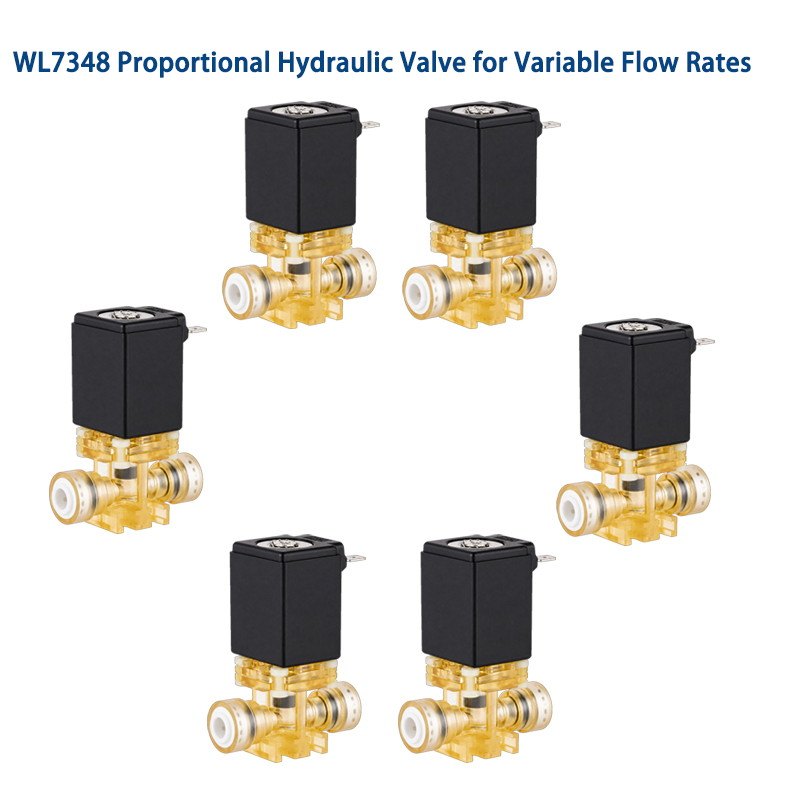
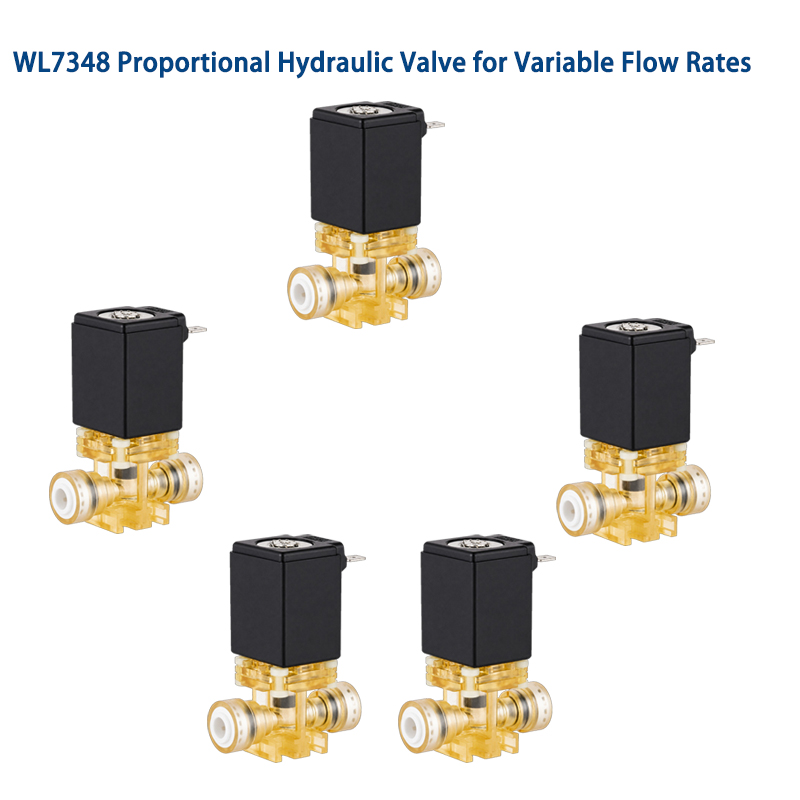
Skip image slider
Proportional Hydraulic Valve for Efficient Hydraulics
Proportional Hydraulic Valve for Hydraulic Presses
Proportional Hydraulic Valve for Reliable Operation
Proportional Hydraulic Valve for Industrial Machines
Proportional Hydraulic Valve for Process Efficiency
Proportional Hydraulic Valve for Accurate Pressure

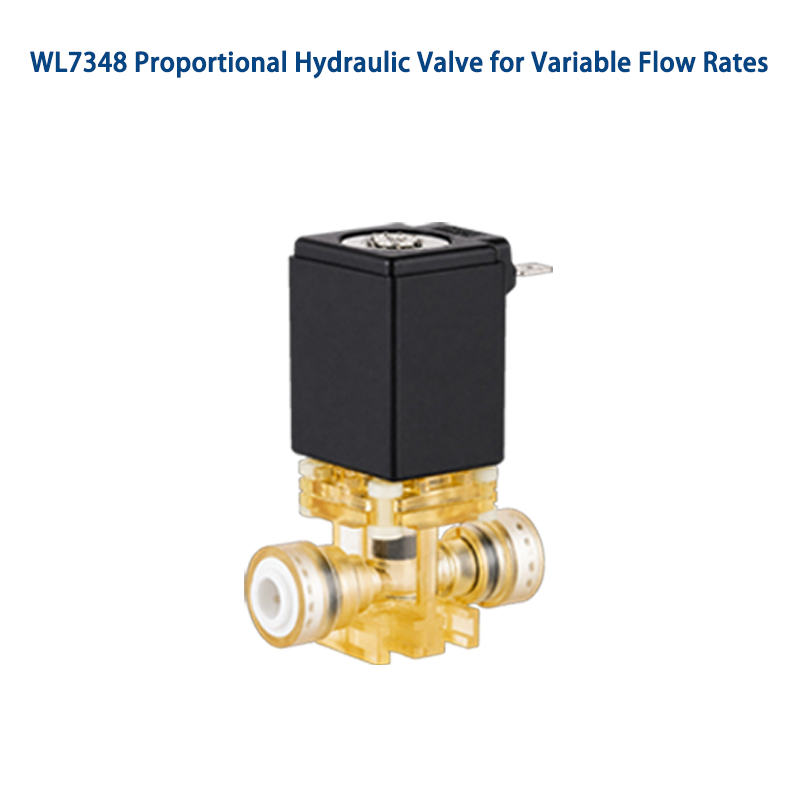
WL7348 Proportional Hydraulic Valve for Advanced Flow Control

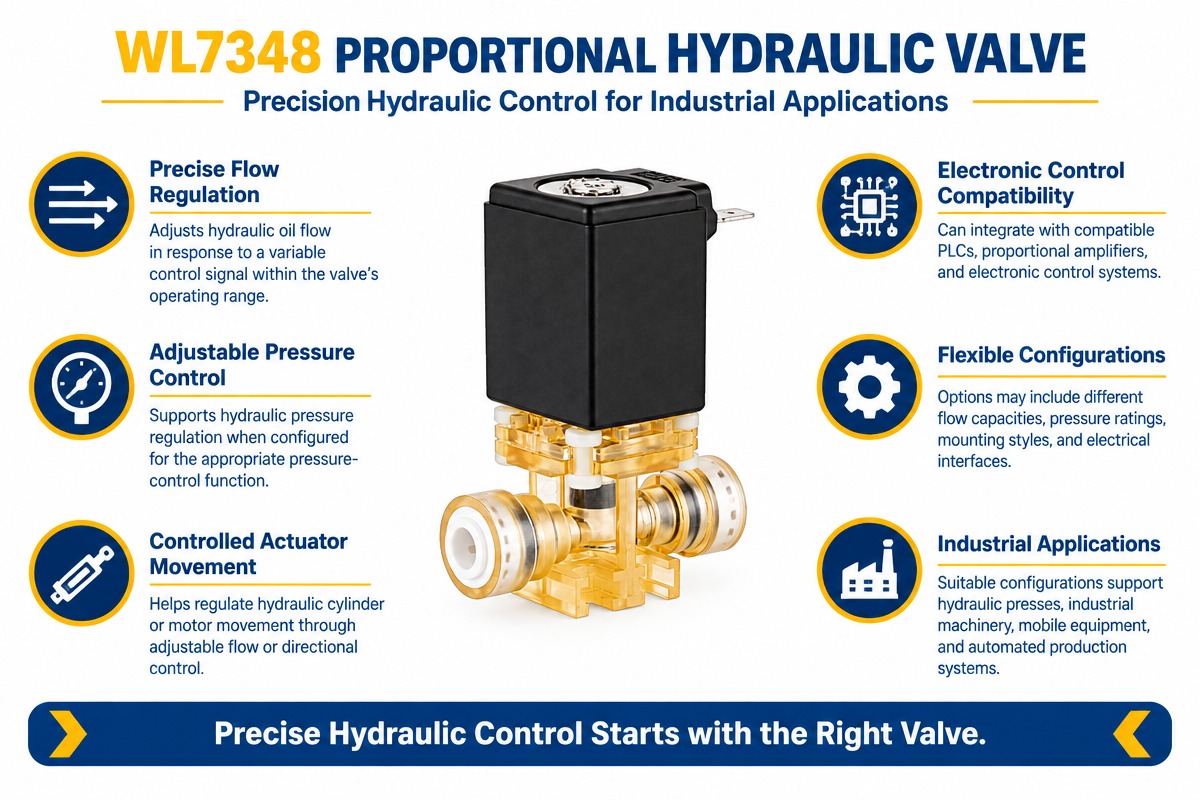
A proportional hydraulic valve is an essential element of hydraulic systems that need flow, pressure or direction control. The valve reacts to a variable electrical signal and thus the hydraulic circuit regulates the actuator movement and the working conditions with greater precision than traditional on/off valves. The valve could be designed to control hydraulic cylinders, motors or other hydraulic devices. Typical applications include industrial machinery, hydraulic presses, mobile equipment, manufacturing systems and automated production lines. Flow, rated flow, operating pressure, pressure drop, response time, control signal, oil cleanliness and mounting configuration are selection factors. Some proportional valves could work with electronic amplifiers. Advanced systems use sensors and feedback for closed-loop control. Proper sizing, proper filtration and proper controller calibration are prerequisites for reliable performance. Proportional hydraulic valves provide adjustable hydraulic output, improving motion control, process consistency and operational flexibility for demanding industrial applications as well as enabling efficient integration with modern automation systems.

Proportional Hydraulic Valve Description

What Is a Proportional Hydraulic Control Valve?

A proportional hydraulic valve is a hydraulic component that varies hydraulic flow, pressure or direction according to a variable control signal. The valve uses an electrically controlled actuator for moving the spool or regulating element into one of the intermediate positions. Proportional hydraulic valves are commonly used in industrial machinery, mobile equipment, hydraulic presses and automated production systems. They control actuator speed, force or movement according to the design. Valve performance is determined by valve characteristics, operating pressure, flow demand, oil cleanliness and controller settings. Proper selection contributes to reliable and responsive hydraulic operation.

How a Proportional Hydraulic Valve Works?

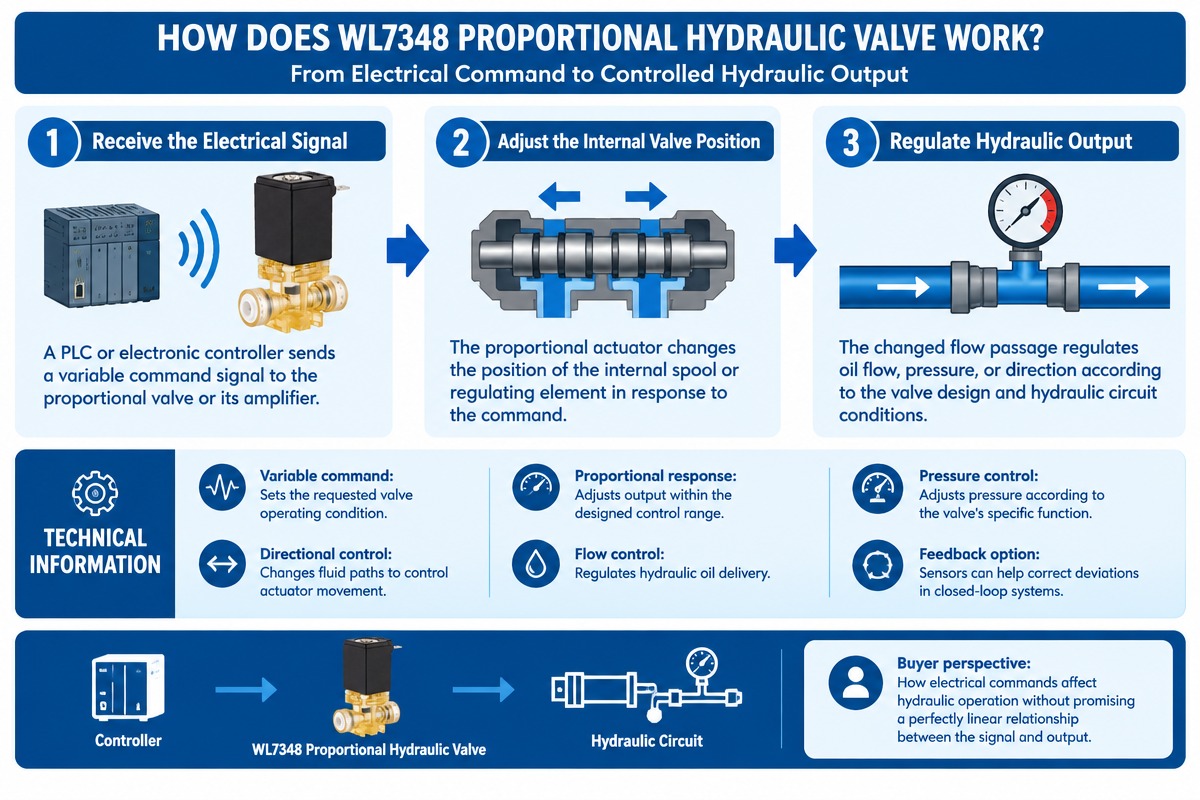
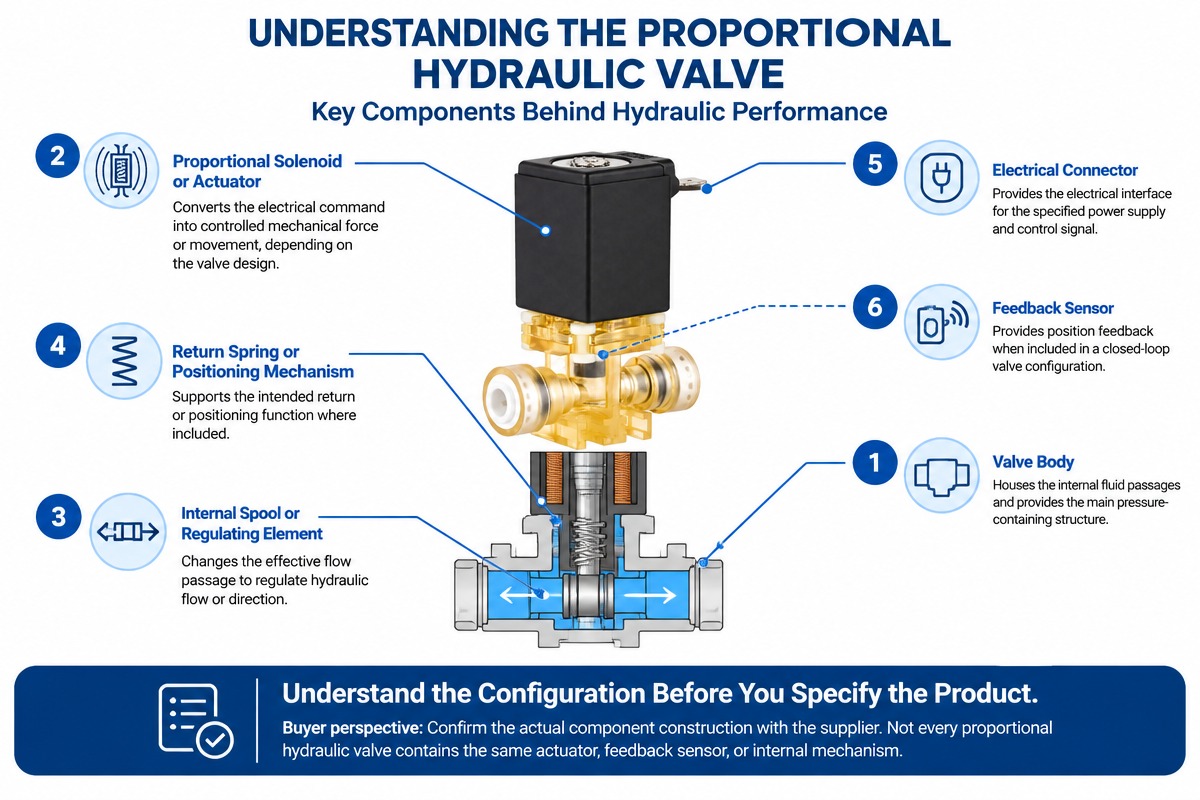
A proportional hydraulic valve converts a variable electrical command to a controlled hydraulic output. The command is provided by a programmable logic controller (PLC), electronic control unit or proportional valve amplifier.

Once the electrical signal reaches the proportional solenoid or actuator, a force appears which moves the spool or regulating element inside the valve. This way, the passage opening changes and controls the amount of hydraulic fluid that flows through the valve or hydraulic flow direction.

In case of a proportional directional valve, the connection between the pressure, actuator and return ports depends on the spool position. In this manner, a hydraulic cylinder or motor works in a specific direction or with a certain speed. Pressure valves (regulated in their special way) are proportional; flow valves are proportional flow valves.

Valve design, load pressure, oil temperature, flow characteristics and system configuration affect the relation between the command signal and hydraulic output. It is not always a linear relation.

Some systems use open loop control. The controller issues the command but does not monitor the results. Other systems use closed loop control with position, pressure or flow sensors to compensate deviations.

Reliable operation requires proper valve sizing, proper hydraulic filtration, compatible electronics and proper controller calibration.

Proportional Hydraulic Valve Video

Proportional Hydraulic Valve Detail Display

Proportional Hydraulic Valve Technical

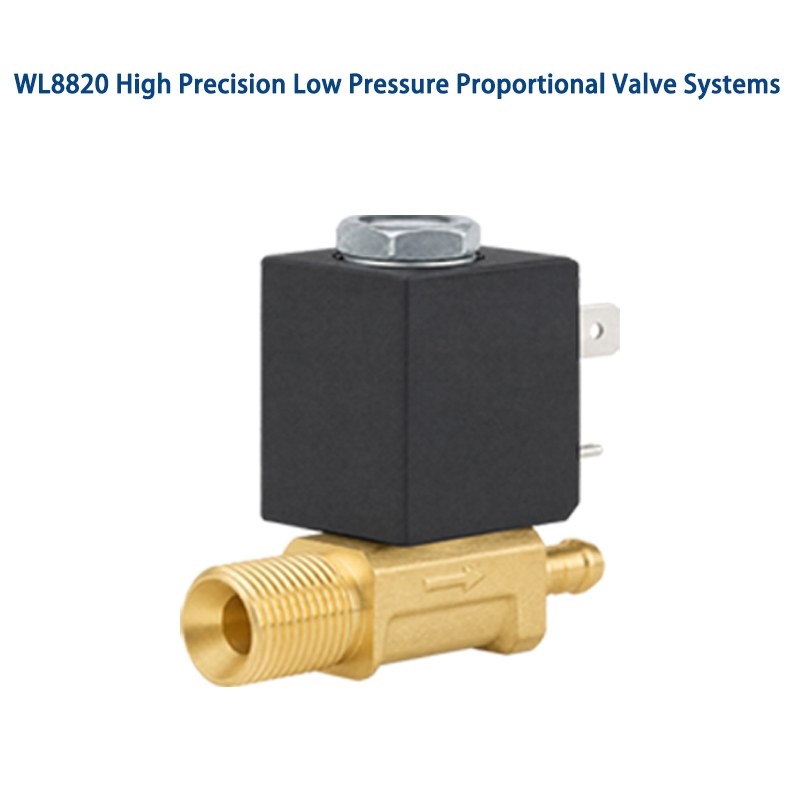
Brand Weilong Model Number WL 7348
Rated Voltage (V) DC12Vย  or 24V Rated Power (W) 7.2W
Work Mode Air or Liquid Control Valve Working Pressure (MPa) 290 kPa
Air-Flow Rate 0 L/minute Reset Time(s) 0.25 S On, 0.25 S Off
Service Life 200 Thousand Times Certification CE, ROHS, ISO9001,
Pipe Gate ย inside: 4.8 mm Lead Wire Length (mm) 73 MM
Install Style Screw Tolerance of Dimension ยฑ 0.1 MM
Water-proof None Insulation Class B
Hi-Pot Test AC 600V 50/60 Hz 2s Non-excitation Holding Force 0
Working Temperature -30ยฐC-180ยฐC Duty Cycle 1-100%
Thread Depth (mm) / Payment Term TT, or LC At Sight
Sample Order Yes. Warranty 1 Year
MOQ 1000 pcs Supply Ability 5000 pcs per week
Delivery Time 30 Days Port of Loading Shenzhen

Why Is the Proportional Hydraulic Valve So Popular?

Manufacturers are increasingly requiring flexible, accurate and automated control of hydraulic power, and therefore proportional hydraulic valves are becoming more and more popular in industrial equipment. On/off valves can be used for simple switching. Proportional valves can vary the hydraulic output according to a variable command. This allows to control the machine operation.

Firstly, this allows better control of the motion. Proportional directional valves control the motion of hydraulic actuators and allow equipment designers to vary the speed and direction of movement. This is helpful in cases when gentle acceleration, positioning or varied operating speeds are required.

Compatibility with automation is another factor increasing the demand for proportional valves. Proportional valves can interface with PLCs, electronic amplifiers, sensors and machine controllers. Such connections allow for programmable machine movements and system integration into modern manufacturing systems.

Secondly, this increases operational flexibility. Without the need for mechanical adjustments, the machine could have various settings for different loads or production tasks.

Proportional control could also increase energy utilization in the proper hydraulic system design by better matching fluid delivery to operating requirements. Energy savings depend on the pump type, circuit design, load conditions and control strategy.

Industrial presses, injection-molding machines, mobile equipment, material handling equipment and automatic production lines use proportional hydraulic valves.

However, they are more expensive than conventional valves and require proper electronics, clean hydraulic oil and correct calibration. The increased popularity of these valves reflects the need for flexible machine control but successful application depends on the proper valve selection for the particular application.

Proportional Hydraulic Valve Applications

Proportional Hydraulic Valve for Manufacturing Lines

Proportional hydraulic valves are widely used in industrial and mobile hydraulic systems that require variable flow, pressure or directional control. They are suitable depending on the valve design, pressure rating, flow capacity and control requirements.

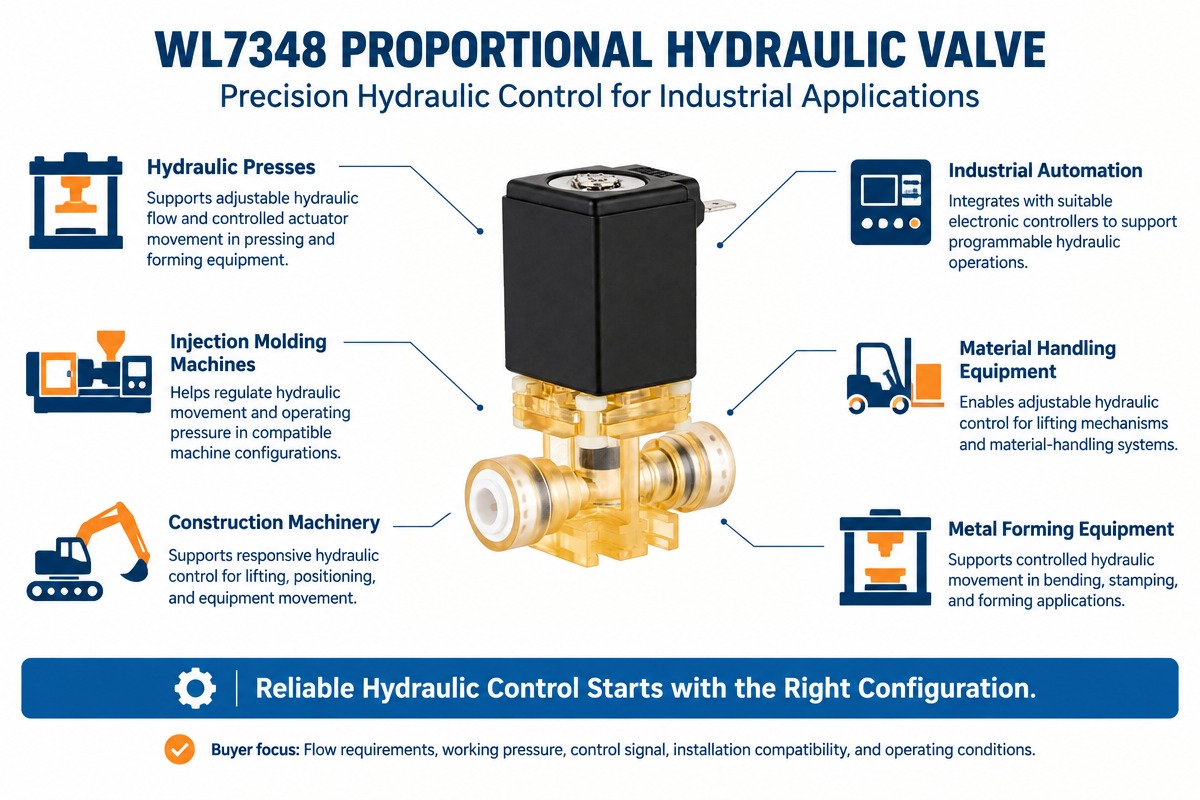
Hydraulic presses: Proportional valves control the actuator movement and, if proper configuration is used, pressure during the forming, pressing and clamping operations.

Injection molding machines: Depending on the machine design, proportional valves control hydraulic movements related to injection, clamping and mold operations.

Construction Equipment : Proportional hydraulic controls are used in excavators, loaders and other mobile equipment to regulate actuator motion and improve operator control.

Agricultural machinery: Suitable valves are used for the control of hydraulic implements, lifting mechanism and other functions powered by fluids.

Material handling systems: Industrial lifting equipment, handling machinery and automated transfer systems use proportional valves for controlled hydraulic movement.

Metalworking equipment: Proportion valves can be used on presses, benders and forming systems to control motion and pressure according to production needs.

Factory automation Hydraulic production lines use proportional valves along with controllers and sensors to enable programmable machine movements and repeatable operation.

Test benches: Components are tested under varied operating conditions on proportional flow or pressure controlled hydraulic test benches.

Industrial machinery: Proportional valves are used in machine tools and specialized production equipment which require variable hydraulic output.

Right sizing, proper filtration and electrical compatibility are important in all of these applications. Engineers should consider the actual operating requirements and manufacturer’s specifications prior to selecting a valve.

Proportional Hydraulic Valve Adv. & Disadv

Proportional Hydraulic Valve for Load Control Systems

Proportional Hydraulic Valves Advantages and Disadvantages

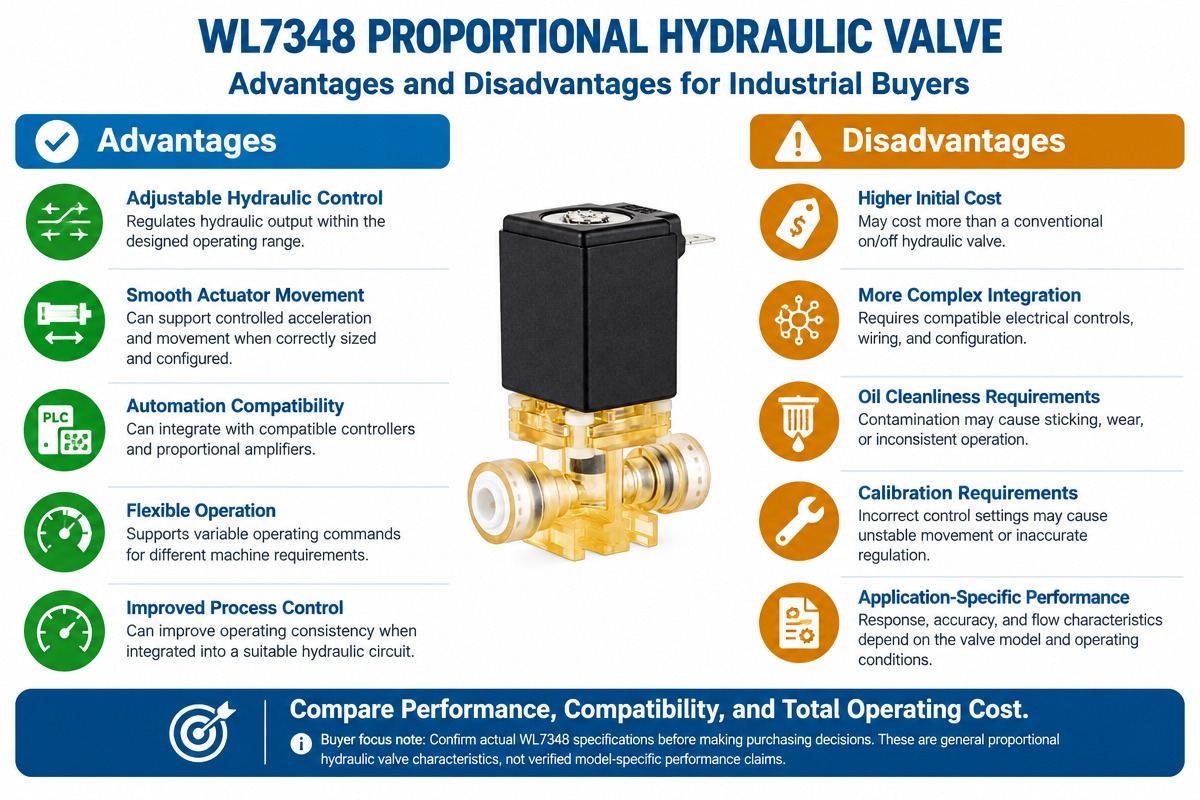
Proportional hydraulic valves offer flexible ways to control hydraulic power. They have many advantages but these should be considered along with cost, complexity and maintenance requirements.

Advantages

1.Adjustable hydraulic output: These valves regulate flow, pressure or direction within the operating range, providing more versatility than simple on/off valves.

2.Improved motion control: It is possible to set up the smooth actuator movement and varying speeds.

3.Automation compatibility: Most models are compatible with PLC, electronic amplifiers and feedback sensors.

4.Flexible machine operation: With the help of variable commands, it becomes possible to change machine settings according to production needs and operating loads.

5.Possible energy savings: With proper hydraulic system design, unnecessary fluid delivery is minimized and energy utilization is enhanced.

Disadvantages

1.Increased cost: Proportional valves and related electronic controls are generally more expensive than conventional hydraulic valves.

2.Complexity: Installation, wiring, controller setup and calibration require more technical knowledge.

3.Sensitivity to contamination: Dirty hydraulic oil leads to sticking, wear and inaccurate control.

4.Maintenance: Reliability of the valves is affected by electrical problems, internal wear and improper settings, which requires troubleshooting

5.Limitations in performance: Response time, hysteresis, deadband and control accuracy depend on the valve model and operating conditions.

Proportional hydraulic valves are used generally in the cases when hydraulic control requires adjustability and responsiveness. Conventional valves are more suitable if the switching is required.

Proportional Hydraulic Valve for Motion Regulation

Troubleshooting Proportional Hydraulic Valves

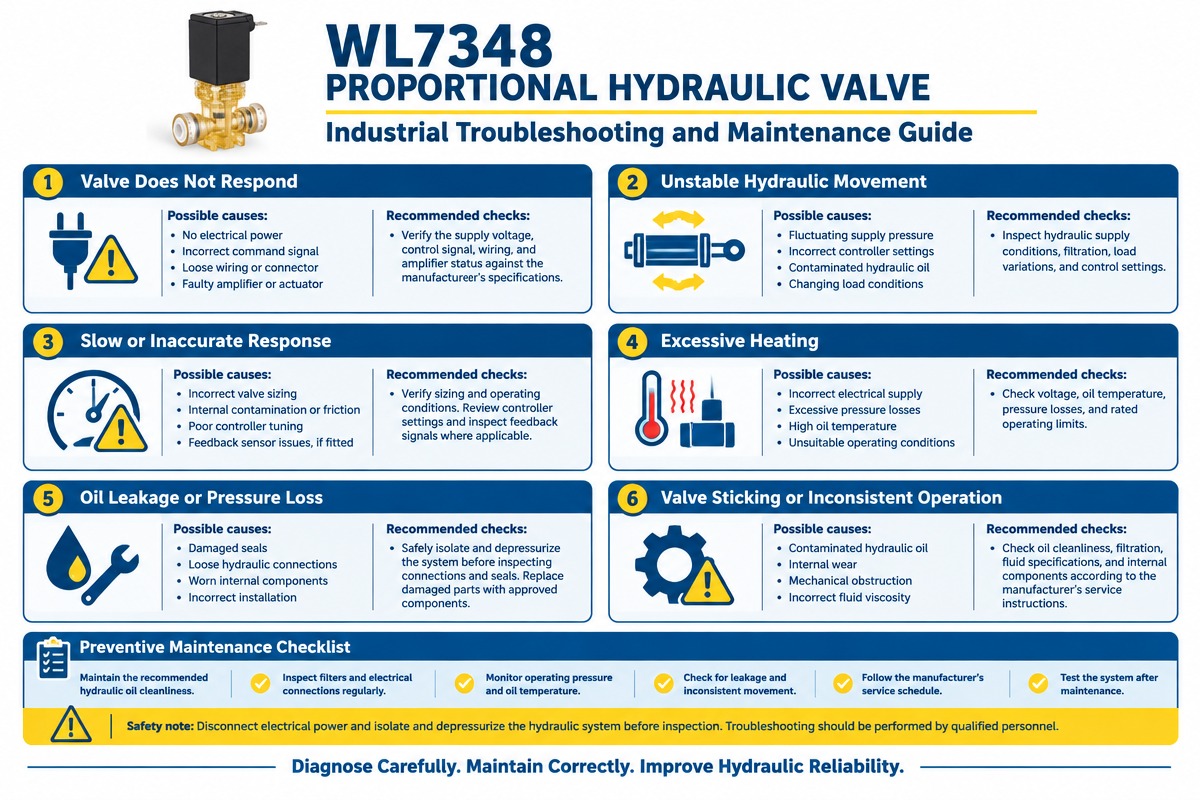
Proportional hydraulic valve troubleshooting requires systematic checking of the electrical supply, hydraulic circuit, control settings and valve condition. Manufacturer’s safety procedures should be followed before the inspection.

1.Valve is not responding. Check power supply, wiring, command signal, amplifier and coil. Make sure the controller generates the proper signal.

2.Unstable actuator movement: Check hydraulic supply pressure, oil cleanliness, valve sizing and controller tuning. Unstable movement may be caused by changing loads or improper control settings.

3.Slow response: Contamination, spool friction, improper control parameters and improper operating conditions. Check the given response characteristics.

4.Incorrect flow or pressure. Check valve selection, pressure setting, command signals, sensor readings and hydraulic circuit design.

5.Overheating: Check oil temperature, pressure drops, supply voltage and operating conditions according to component specifications.

6.Valve sticking – Check filtration and oil cleanliness. Internal wear or contamination may cause spool sticking.

7.Excessive leakage: Check connections, seals and internal components for wear or damage. Repair defective components according to approved procedures.

8.Electrical problems: Check connectors, wiring continuity, supply voltage and amplifier status according to the manufacturer’s instructions.

After repairs, test the entire hydraulic system under controlled conditions before returning the equipment into service. If the problem persists, contact a qualified hydraulic technician or the valve manufacturer.

FAQ

1. What is Hydraulic Proportional Valve ?

Hydraulic proportional valve is a fluid power element providing proportional control of hydraulic flow, pressure or direction in response to variable electrical control signal. In contrast to ordinary on/off valve it can vary its output within designed operating range. This valve is commonly used in industrial machines, hydraulic presses, mobile equipment and automated manufacturing processes requiring adjustable hydraulic control.

2. What is Proportional Hydraulic Valve?

The proportional hydraulic valve takes variable electrical control signal from the controller or proportional amplifier. It drives internal actuator changing position of the valve spool or regulating element controlling flow, pressure or direction of hydraulic oil flow. In some systems there are feedback sensors to increase accuracy and compensate changes of load or working conditions.

3.What are the main types of proportional hydraulic valves?

The main types of these valves are: Proportional directional control valves. Proportional flow control valves. Proportional pressure control valves. Directional valves control direction of flow and movement of the actuator. Flow valves control delivery of oil. Pressure valves control pressure according to design. The type of the valve is chosen considering hydraulic circuit and control function.

4. Why should we use proportional hydraulic valves?

Using proportional hydraulic valves we get adjustable hydraulic output, smoothness of operation of actuators and compatibility with electronic control system. We get greater flexibility of the machine, consistency of the process and motion control. When used in proper hydraulic circuit, proportional hydraulic valve can help to reduce useless energy consumption.

5. How should we choose appropriate proportional hydraulic valve?

We should think about: Required control function. Flow rate. Working pressure. Pressure drop. Type of hydraulic oil. Viscosity and temperature of the oil. Electrical signal. Supply voltage. Requirements for the amplifier. Response characteristics. Mounting dimensions. Also we should pay attention to fluid cleanliness, accuracy of control and usage of feedback sensors. We always should consult the specifications with the manufacturer.

6. What is the difference between proportional hydraulic valve and normal hydraulic valve?

Normal hydraulic valve can provide simple switching or fixed control functions according to design. The proportional hydraulic valve can vary its output in proportion to variable command signal providing more flexible way to control flow, pressure or direction. The proportional valve is especially useful in case of adjustment of actuator speed or machine movement.

7. What problems may appear in case of using proportional hydraulic valves?

The most common problems are: Erratic actuator movement. Slow response. Inaccurate flow or pressure control. Sticking of the spool. Oil leakages. Electrical malfunctions. Possible reasons: Dirty hydraulic oil. Incorrect valve sizing. Wiring problems. Incorrect control settings. Worn parts. Troubleshooting helps to find reason of malfunction and restore reliable operation of the system.

8. How do I maintain proportional hydraulic valve?

We should take care of: Hydraulics oil cleanliness. Filters. Electrical connections. Pressure and temperature of operation. 1. We should follow manufacturer’s maintenance schedule. 2. We should check for oil leaks, abnormal noises or nonconsistency of movements. Using approved replacement parts helps to keep reliable operation of the equipment.

Choosing a Proportional Hydraulic Valve

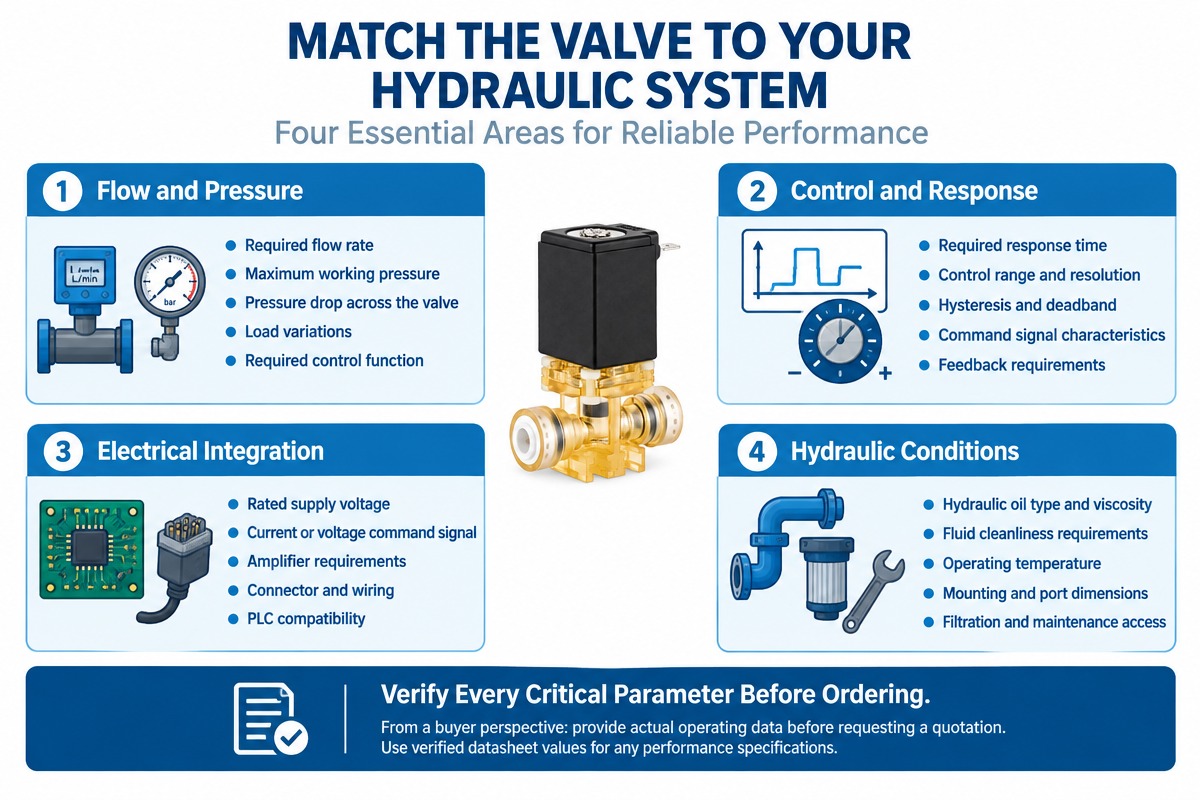
Selection of a proportional hydraulic valve requires knowledge of the machine operating conditions, control objectives and hydraulic circuit design. Right valve will improve controllability, reliability and performance of the equipment.

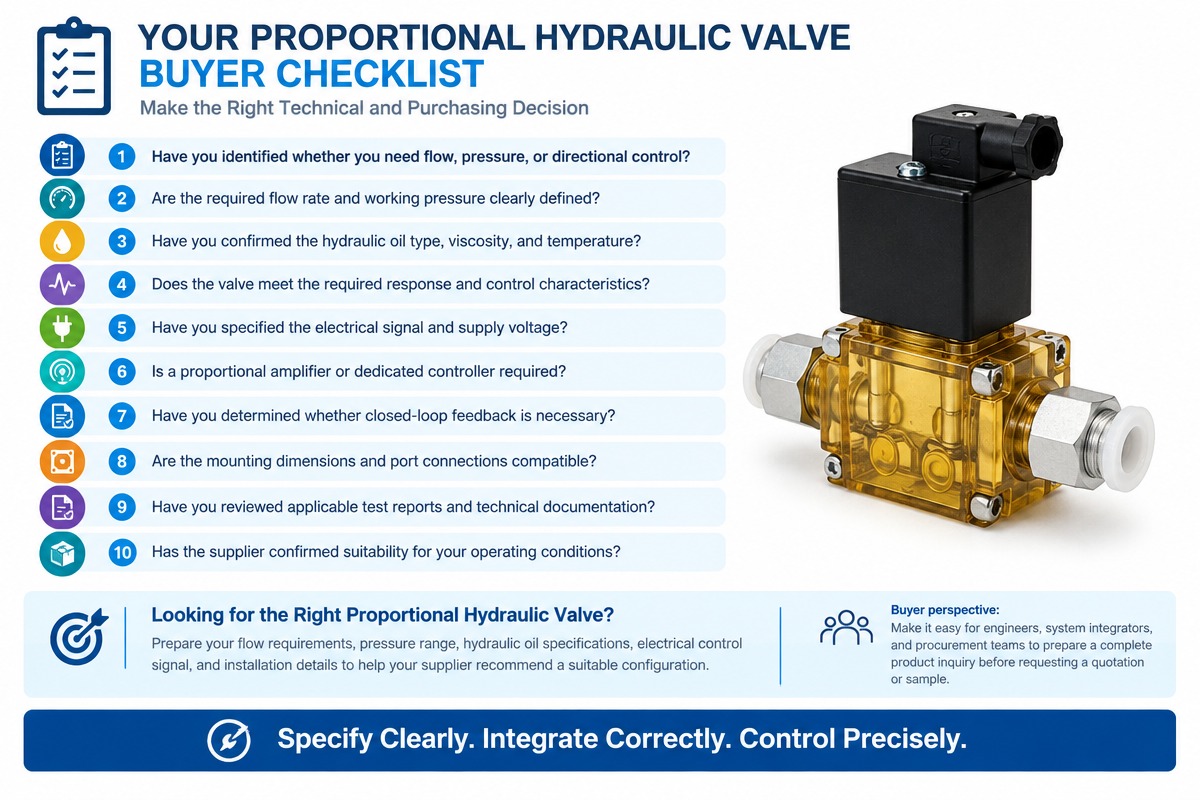
1.Control function specification. Determine if the system requires directional control, flow control, pressure control or any combination of these controls. “Each type of valve is for a different purpose.”

2.Determination of flow requirements. Determine the required flow rate, the operating range, the actuator speed and the pressure drop. Select a valve with the correct flow capacity rating. Oversized valves limit the control of low flow rates and undersized valves limit performance.

3.Pressure ratings check. Check the maximum working pressure, pressure differentials acting on the valve, changes in load and possible pressure surges. Operate within manufacturer’s specified operating conditions.

4.Check the hydraulic oil. Check oil type, viscosity, temperature range and oil cleanliness requirements. Make sure that the internal materials and seals of the valve are suitable for the specified fluid.

5.Electrical control system match. Check supply voltage, command signal, connector, wiring and amplifier requirements. Make sure the valve is compatible with the PLC or electronic controller.

6.Assessment of response and accuracy. Check response time, hysteresis, deadband, repeatability and control range. More advanced control characteristics might be required for applications requiring accurate positioning or quick movement.

7.Description of feedback requirements. Open-loop control is sufficient for simpler applications. Closed loop systems use proper sensors to measure position, pressure or flow and to compensate deviations, if any.

8.Check valve compatibility with your installation. Check mounting dimensions, port configuration, connection standards, space availability and accessibility. Make sure the valve is compatible with the hydraulic manifold or circuit.

9.Considerations regarding filtration and maintenance. Consider the service and replacement part requirements and the technical support level. Follow manufacturer’s recommendations concerning oil cleanliness.

10.Check the entire system. Review the data sheet and test the valve together with its controller and hydraulic circuit under representative operating conditions.

Before requesting a quote, let the supplier know what function, flow rate, pressure range, fluid, electrical interface and installation details you require. This information will help to recommend a more accurate product.

Common Design Mistakes in Proportional Hydraulic Valve Systems: Tips to Avoid

Proportional hydraulic valve system design requires a precise coordination of hydraulic components, electrical controls and machine requirements. By avoiding the common mistakes, system stability can be enhanced, maintenance minimized and service life prolonged.

-Wrong valve size: Determine the required flow rate and pressure drop before selecting the valve. Oversizing may decrease the controllability while undersizing limits actuator speed.

-Malfunctioning of the valve: Distinguish between proportional directional, flow control and pressure control valves. Select the design providing the required hydraulic function.

-Ignoring pressure conditions: Check the working pressure, load variations, pressure spikes and return line backpressure against the component ratings.

-Poor hydraulic cleanliness: Contamination may cause sticking, wear and unstable performance. Proper filtration and maintaining the specified oil cleanliness level is required.

-Incompatible electrical controls: Check the voltage, current or voltage command signals, amplifier requirements, connectors and controller compatibility.

-Poorly tuned controllers: If not properly tuned, this may result in oscillation, overshoot, slow response and erratic actuator motion. Tune the system in representative conditions.

-Ignoring fluid temperature: Oil viscosity, leakage and valve response can all vary with temperature. Check the operating range.

-Lack of feedback: In case the precise positioning or pressure regulation is required, proper sensors and closed loop control is required.

-Ignoring installation requirements: Check mounting dimensions, port connections, orientation and accessibility for maintenance.

-Skipping the system test: Before normal production, verify the valve operation, leakage, response and pressure stability.

Accurate hydraulic calculations, compatible electrical controls and clear operating requirements are the foundation for successful design. Consult with the valve manufacturer at the design stage to avoid costly modifications and increase reliability of the system.
Get A Free Quote Now

Contact Form

Related Products

Related News

Scroll to Top

Get A Free Quote Now !

Contact Form
If you have any questions, please do not hesitate to contact us.
Weilong Solenoid Company Culture