Skip image slider
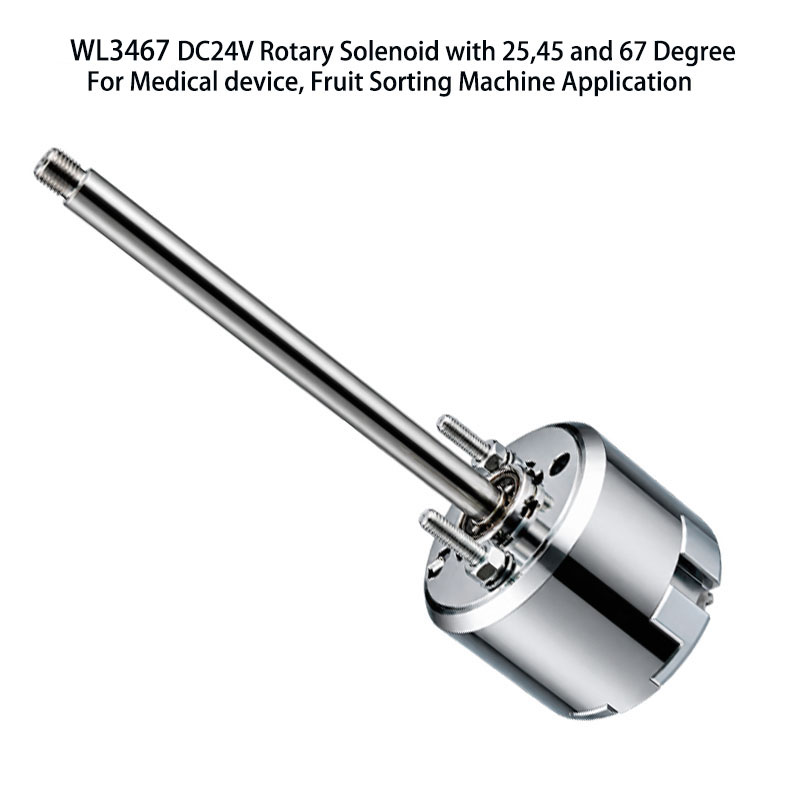
24V Rotary Solenoid for Efficient Industrial Automation
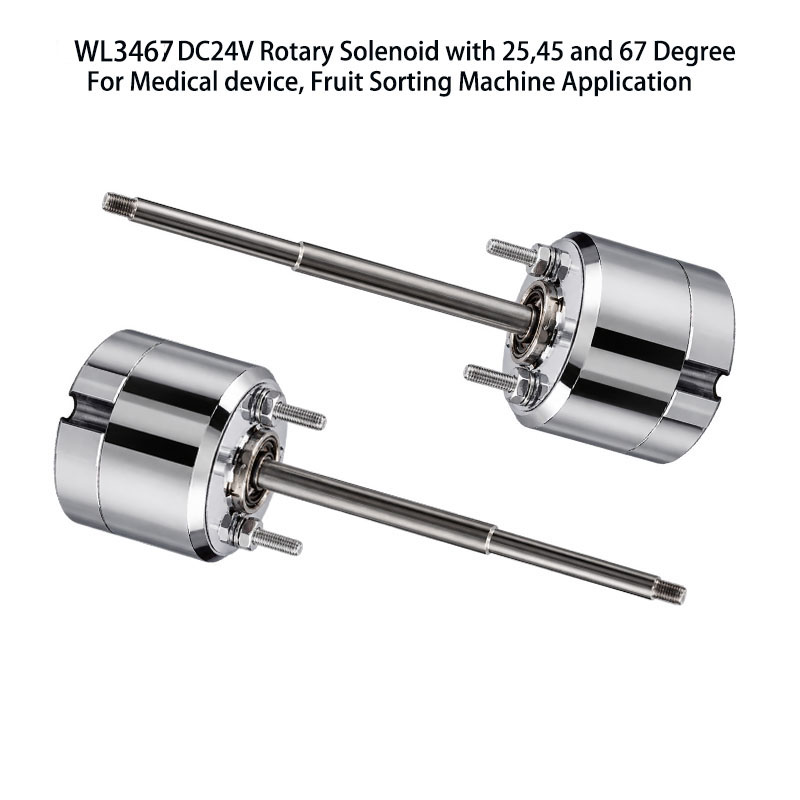
24V Rotary Solenoid for High-Speed Sorting Applications
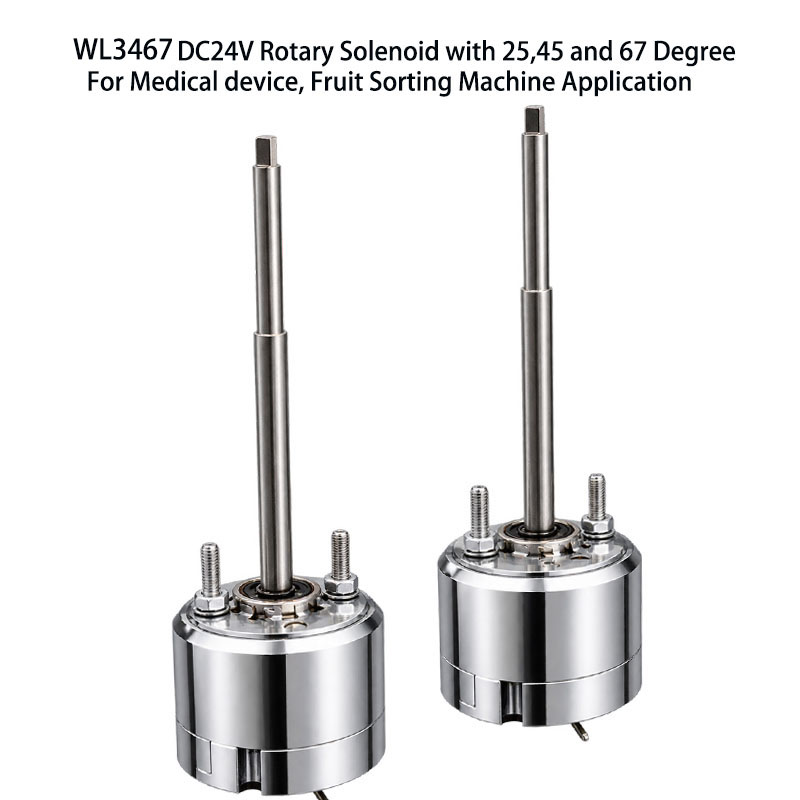
24V Rotary Solenoid for High Speed Industrial Equipment
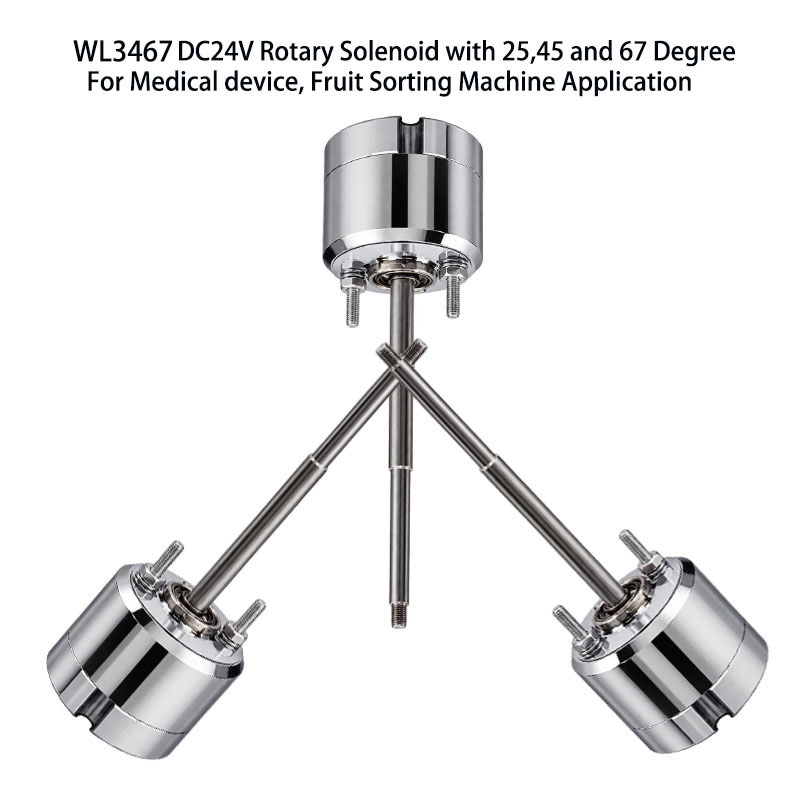
24V Rotary Solenoid for High-Speed Packaging Automation
24V Rotary Solenoid for High-Cycle Machine Applications
24V Rotary Solenoid for High-Cycle Industrial Actuation

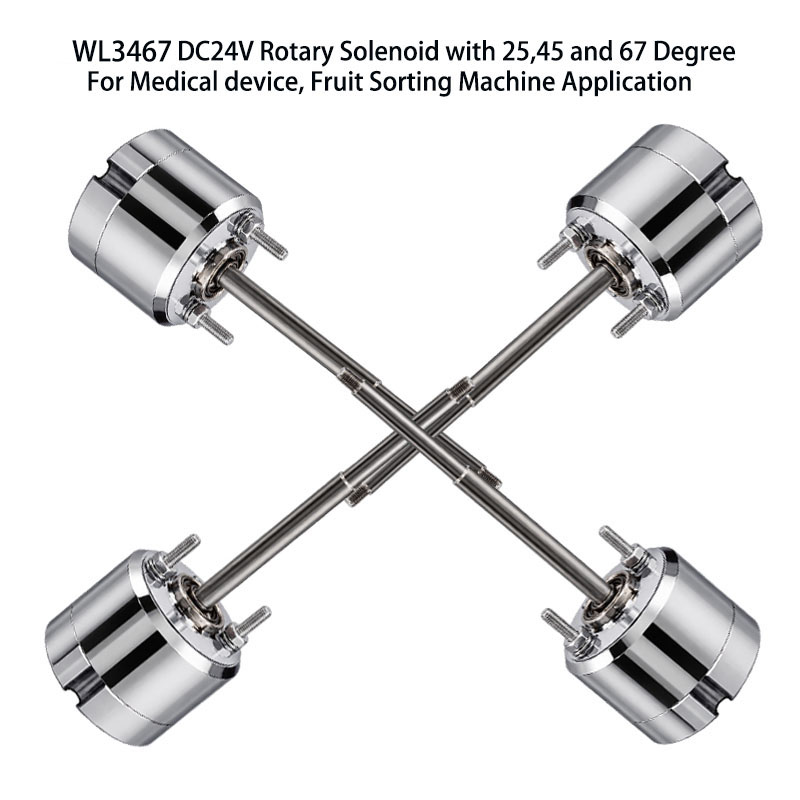
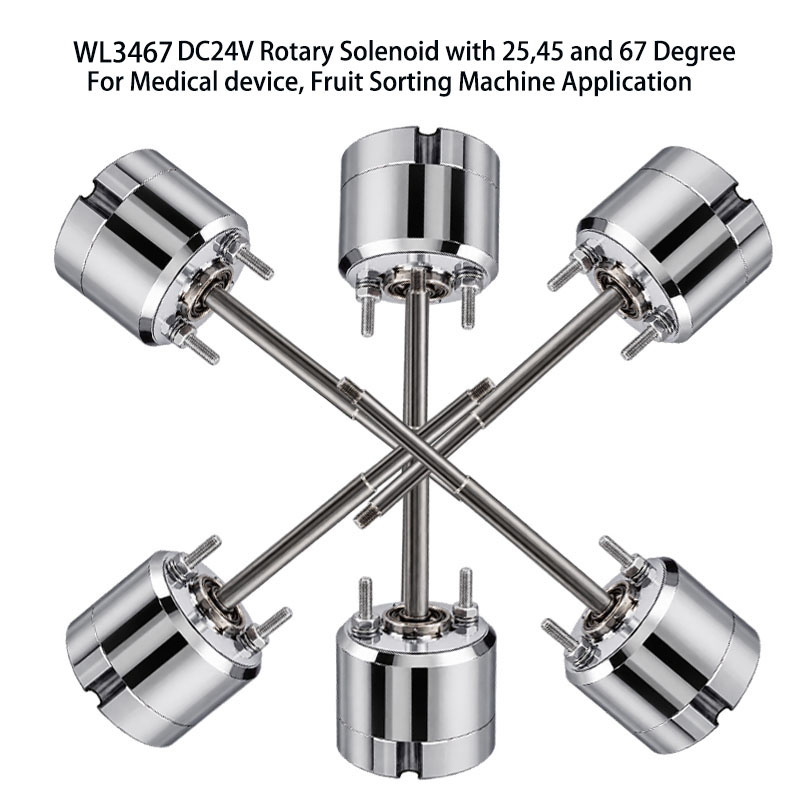
WL3467 24V Rotary Solenoid for Industrial Automation Solutions

The 24V rotary solenoid is a miniature electromechanical actuator that produces a fast and accurate rotary motion from a standard 24V DC power source. The solenoid is suitable for industrial automation where space is a constraint and a short angular stroke is required. Depending upon the design, the solenoid is capable of rotating either clockwise or counterclockwise using a spring return mechanism or double coil drive system or any other mechanism.

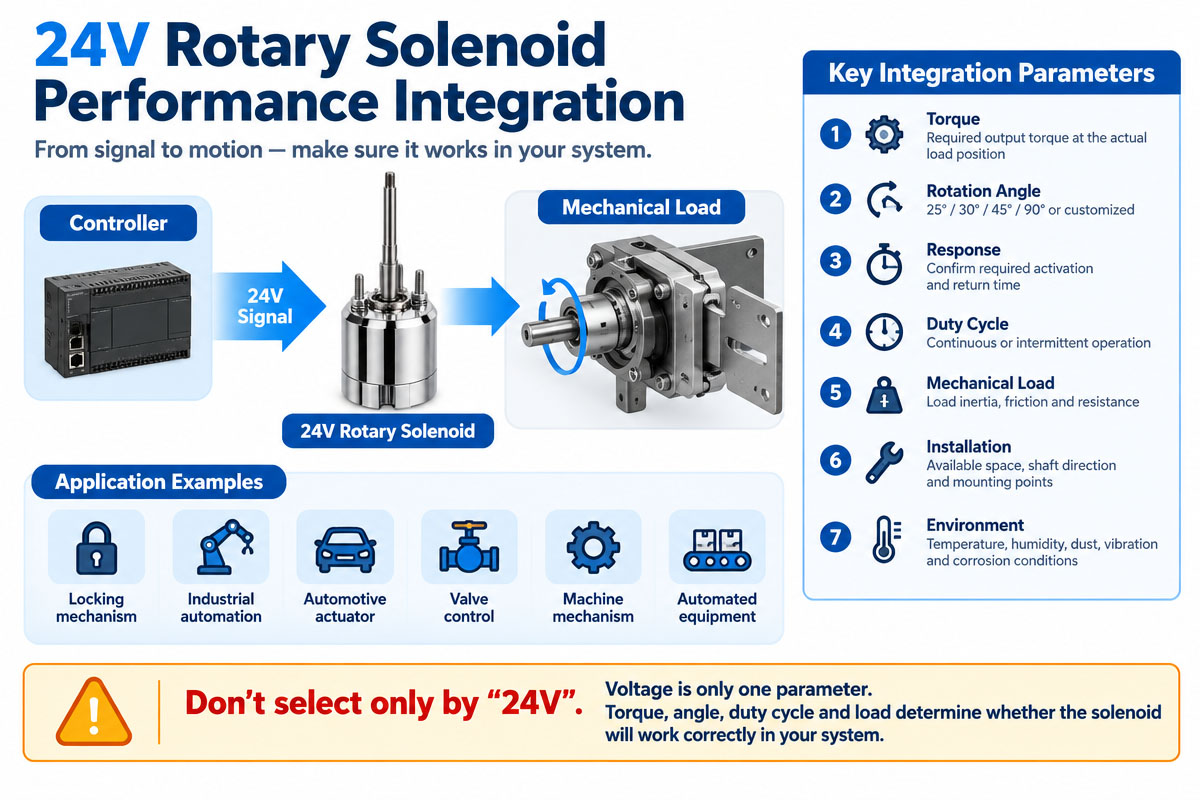
Typical uses include sorting gates, latches, indexing mechanisms, shutter actuation, valves, safety interlocks, medical devices, packaging machines, fruit grading machines, etc. The most important parameters to consider in the selection process include rotation angle, torque available, response time, duty cycle, coil temperature, mounting, shaft interface, electrical connections, and environmental protection. The solenoid can offer a simple on/off actuator with fewer control needs as compared to the motors. During design and production validation testing, it is essential to test load inertia, return torque, voltage tolerance, operating frequency, and service life of the actuator for optimal performance.

Custom DC 24V Rotary Solenoid Product Overview

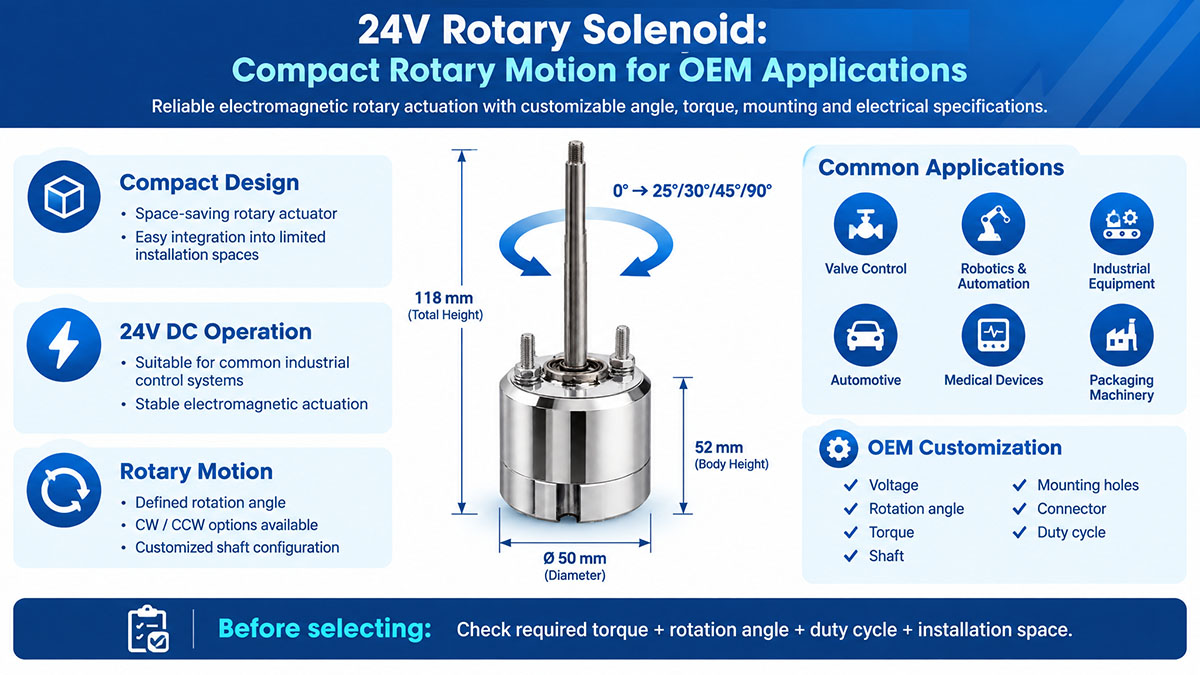
The 24V rotary solenoid is ideal for applications where there is a need for fast and controlled angular rotation from a small actuator. The typical configuration of the 24V rotary solenoid includes an electromagnetic coil, magnetic core, rotor or armature, shaft, bearings, return mechanism, and mechanical stops. When 24V DC is applied to the actuator, the coil is energized, and it creates torque to rotate the shaft a certain angle.

The product configurations vary in torque, direction, stroke angle, duty cycle, mounting styles, shaft geometry, lead wires, and environmental seals. It helps with OEM integration customization. For the proper functioning of the actuator, buyers have to compare rated torque, energizing time, coil temperature, return torque, life expectancy, and installation constraints before purchasing.

How This 24V Rotary Solenoid Works

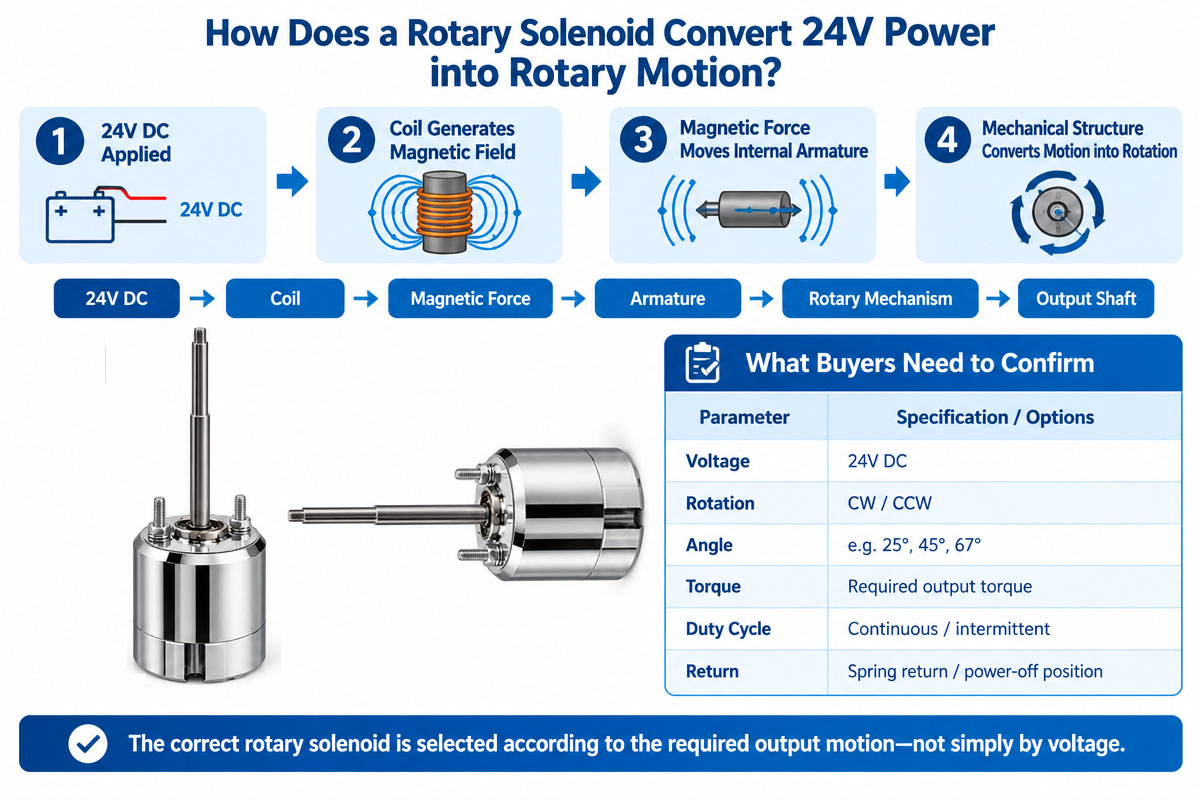
The 24V rotary solenoid works by converting electrical energy into a magnetic field, which further produces rotational motion. A 24V DC voltage is applied to the coil of the solenoid, and it produces a current that generates a magnetic field in the actuator. This magnetic field tries to attract the armature into a low reluctance position. A rotary solenoid translates the force of attraction into rotation of the rotor or shaft through the use of some geometric shapes like helical, ball ramp, etc.

It rotates to a limited angle until it reaches a mechanical or magnetic equilibrium position. Based on the model, a spring return mechanism, external load, or reverse drive can help the shaft to go back to its initial position when power is cut off.

The actual torque and response time of the actuator depend on coil current, angle of rotation, load inertia, friction, supply voltage, energization time, and temperature. Duty cycle is an important parameter as the actuator gets heated during repeated operations. In addition, the driver circuit has to include flyback suppression for protecting the switching electronics from the inductive voltage of the coil when power is cut off.

24V Rotary Solenoid Main Features

The 24V rotary solenoid offers quick rotation of the shaft, a small package, DC electrical control, and high torque for short-time operations. They are basically characterized by a limited angle of rotation (clockwise or counterclockwise), spring return, repeatable end positions, low voltage operation, and ease of connection with PLCs, relays, and transistor drivers.

The industrial rotary solenoids are usually designed with reinforced bearings, durable shafts, heat-resistant coils, and protective housing, apart from custom lead wires and connectors. The performance of these actuators can be designed for intermittent or high-cycle operation. Moreover, it is possible to specify the mounting geometry, return torque, energization time, mechanical stops, and environmental protection in order to match them accurately with the machine, load, and operating condition.

Custom DC24V Rotary Solenoid Product Video

Custom DC24V Rotary Solenoid Product Detailed Display

Custom DC 24V Rotary Solenoid Data Sheet

Brand Weilong Technology Model Number WL 3467
Rated Voltage (V) DC 12V or 24V Rated Power (W) 38.5โ€“100W
Work Model Rotation Type Torque Force (N) 30 GF-60GF
Stroke (mm) 2 MM or Customized Reset Time(s) 1 S
Service Life 200,000 cycles Certification CE, ROHS, ISO9001,
Material Safety Iron/Carbon Steel Lead Wire Length (mm) 200
Install Style screw Tolerance of Dimension ยฑ 0.1 MM
Water-proof None Insulation Class B
Hi-Pot Test AC 600V 50/60Hz 2s Non-excitation Holding Force 0
Working Temperature -10ยฐC-100ยฐC Duty Cycle 1-100%
Thread Depth (mm) / Payment Term TT, or LC at Sight
Sample Order Yes. Warranty 1 Year
MOQ 100 PCS Supply Ability 5000 pcs per week
Delivery Time 30 Days Port of Loading Shenzhen

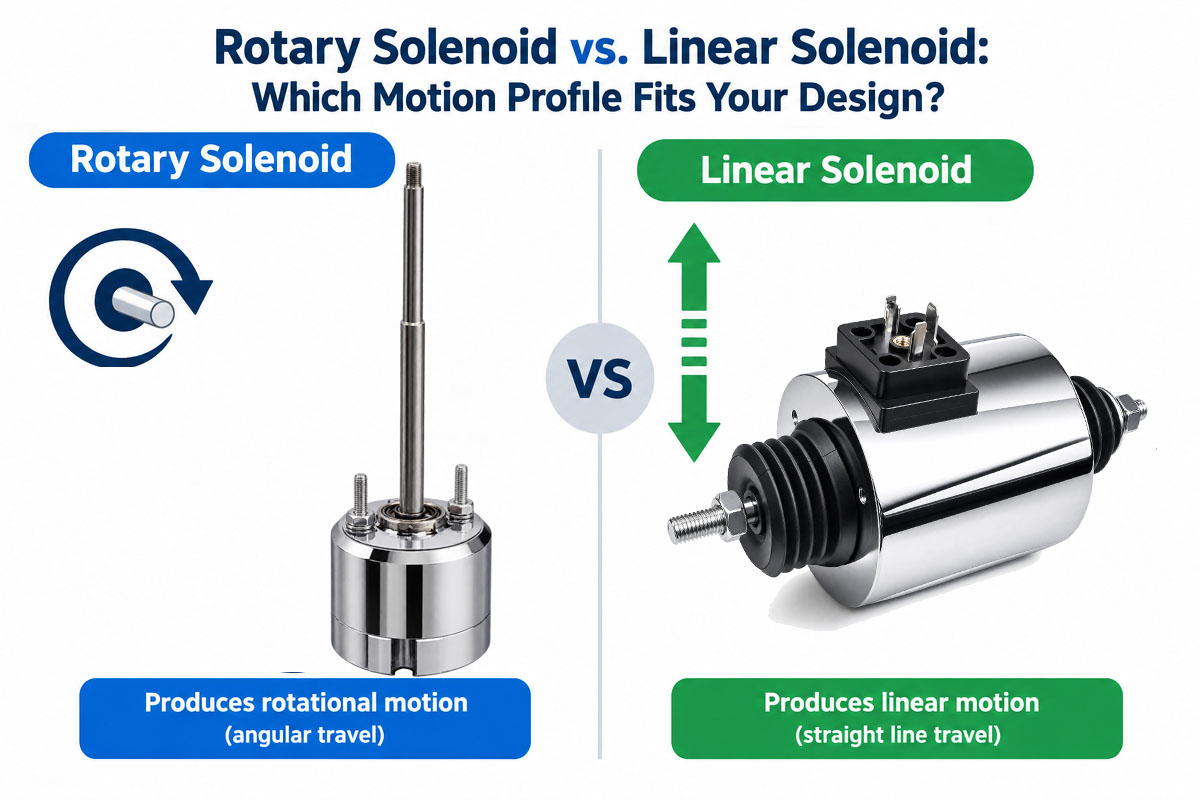
24V Rotary Solenoid vs. Linear Solenoid: Which Motion Profile Fits Your Design?

Rotary Solenoid vs Linear Solenoid Which is better for your solution

A linear solenoid and a 24V rotary solenoid are built on the same principle but offer different types of motion. The choice between them should start with the motion profile of the load and not its size or price of the actuator.

What is a rotary solenoid?

A rotary solenoid provides limited angular movement of an output shaft. It is perfect for use in diverter gates, shutters, latches, indexing arms, valve levers, locking devices, and sorting flaps. Output is rotating, so linkage often can be direct. Thus, the number of pivots, bell cranks, and other parts to convert motion is reduced, and a small rotary actuator helps to save packaging and response in the equipment with limited mechanical space

What is a linear solenoid?

A linear solenoid makes linear movement of a plunger. It is natural for push, pull, release, lift, pin insertion, direct valve actuation, and latch motion. If the load to be moved is linear, a linear solenoid is usually preferred to avoid unnecessary motion conversion. But if the load needs to rotate, the designer should use an additional lever, cam, rack, or other linkage. These parts may introduce backlash, friction, clearance, and wear.

Force

One should also compare force and torque correctly. Rotary solenoids are usually characterized by torque and angle, and linear solenoids by force and stroke. The output of neither actuator is constant along its travel. The designer should check the torque or force available at the worst point of the motion, taking into account friction, return spring force, acceleration, and margin.

Speed depends on electrical drive, moving mass, load inertia, stroke, return mechanism, and mechanical shock. Both actuators can reach the required speed quickly. A rotary solenoid is good for applications where you have a light arm, which only has to rotate a certain angle. A linear solenoid is usually more efficient when the load moves in the direction of the plunger.

Both actuators are critically dependent on duty cycle. Powering a coil results in heat generation, and repeating switches can lead to increased temperature of the coil. Check the ratings, maximum on-time, frequency of switching, ambient temperature, and cooling conditions. 24V supply voltage does not mean continuous-duty operation.

Comparing the Motion Profiles

Design Requirement Linear Solenoid Rotary Solenoid
Motion Straight line Angular rotation
Main output Force Torque
Key parameter Stroke Rotation angle
Typical mechanism Push/pull Rotate/turn
Mechanical conversion Often direct Often direct or linkage-based
Installation Axial space required Angular/rotational space required
Typical use Locking, valves, pushing Flaps, switches, rotating locks

How to Choose the Right Type

Choose a linear solenoid when the driven component naturally moves along a straight path and you can define the required stroke and force.

Choose a rotary solenoid when the mechanism requires controlled angular movement and the key performance requirement is torque over a specific rotation angle.

However, mechanical layout can sometimes change the decision. A linear solenoid combined with a linkage can create rotary movement, while a rotary actuator may simplify a mechanism that otherwise requires several mechanical components.

What Should Buyers Specify?

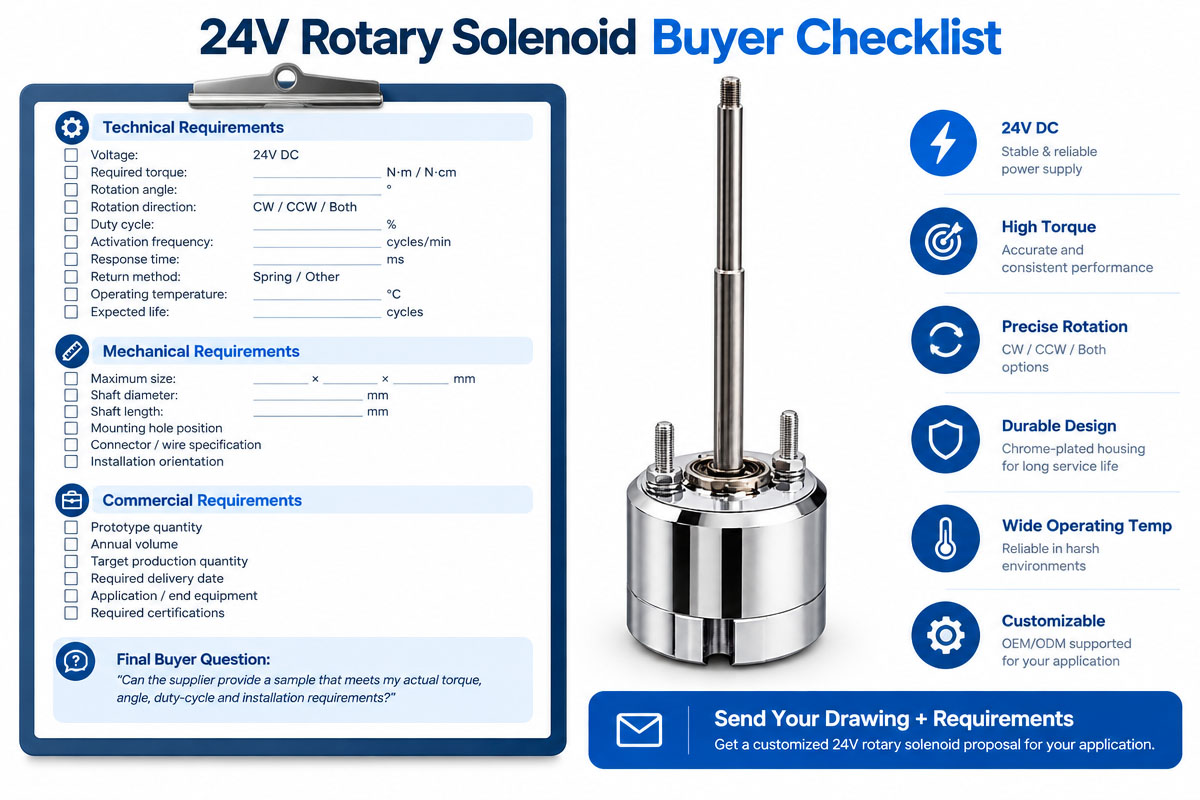
Before requesting a customized solenoid, provide the manufacturer with the voltage, current or power, required force/torque, stroke or rotation angle, operating frequency, duty cycle, installation space, load, operating temperature, and expected service life.

For OEM projects, the manufacturer’s engineering team can then evaluate the magnetic circuit, coil design, plunger or rotor structure, materials, and thermal performance.

In short, linear solenoids are designed around force and stroke, while rotary solenoids are designed around torque and angular movement. Matching the actuator’s motion profile to the mechanical requirement is the first step toward a reliable and cost-effective design.

Custom 24V Rotary Solenoid Industrial Amplification

Custom DC24V Rotary Solenoid Industrial Application

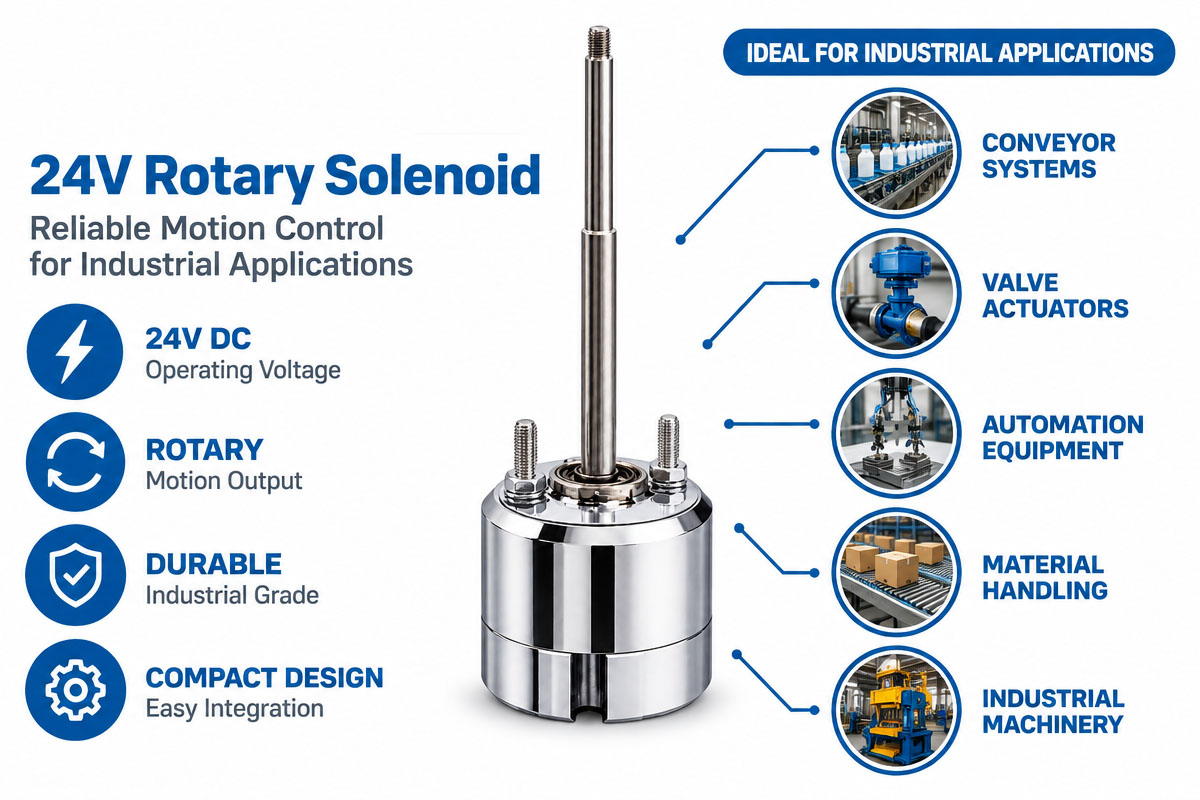
The 24V rotary solenoids are employed wherever there is a requirement of quick rotary motion without the complexity of a motor and gear box in a machine. These can be used for controlling latches, shutters, diverter gates, indexing mechanisms, release mechanisms, small valves, safety interlocks, and material handling components in industrial automation.

The 24V Rotary Solenoid can be used in packaging machinery for product routing, flap control, rejection stations, and quick mechanical switching. If the selected component matches the safety and cleanliness requirements of the application, then rotary solenoids can be used in medical and laboratory equipment for actuating covers, sample routing, cartridge locks, reagent handling systems, shutters, and compact fluid handling systems. Fast response of these actuators for directing individual products to different lanes or reject stations is useful for fruit sorting and grading machines.

The 24V rotary solenoid is used in optical sorters, food processing equipment, vending machines, access control devices, textile machines, printing equipment, and automated test fixtures. The manufacturers usually design these actuators using a 24V supply, as it is common in industrial control cabinets, and can be driven using relays, PLC outputs, and transistor circuits. The suitability of the 24V rotary solenoid depends on the requirements of torque, rotation angle, duty cycle, speed, temperature rise, load inertia, mechanical shock, vibration, ingress protection, and service life. Proper sizing can guarantee consistent actuation without unnecessary heat, noise, wear, and power consumption in tough production environments.

Why Are 24V Rotary Solenoid So Popular in Medical Devices and Fruit Sorting Machines?

Rotary solenoids are widely used in medical devices and fruit sorting machines, as these applications require compact, fast, repeatable motion, controlled by low-voltage electronics. Industry control architecture commonly uses a 24V DC supply, and the solenoid is easily controlled by PLC output, relay, MOSFET, or driver without positioning electronics of a servo system.

In medical and laboratory equipment space is often limited, and the motion is quite simpleโ€”opening or closing a shutter, locking a cartridge, rerouting a sample, switching a valve, releasing a disposable component, or indexing a compact assembly. These short angular motions can be made with rotary solenoids having fast response and compact mechanical structure. One can also choose spring-return or custom-made designs to ensure the fail state of the motion. Nevertheless, the applicability of the solenoid to a medical device depends on its whole design, risk management, material selection, cleanroom capability, electrical safety, validation, and applicable regulations.

Sorting machines have different environments but require similar motion. Sorting systems with optical sensors detect fruits and then require a gate, flap, or diverter to rotate quickly at the right moment. A rotary solenoid rotates this mechanism directly, and there is no need for conversion of motion. Fast actuation, limited angular travel, simple electrical control, and high-cycle configurationโ€”these are the features that can be used to design rapidly sorting systems.

So, the main reason for the applicability of the technology to both applications is not just “24V.” It is the combination of compact rotary motion, fast on/off control, simple integration, repeatable mechanical motion, and the possibility to customize torque, angle, return method, mounting, shaft geometry, and connectors for OEM equipment.


Pros and Cons of a Custom 24V Rotary Solenoid

Custom DC 24V Rotary Solenoid Advantage and Disadvantage

Pros of a Custom 24V Rotary Solenoid

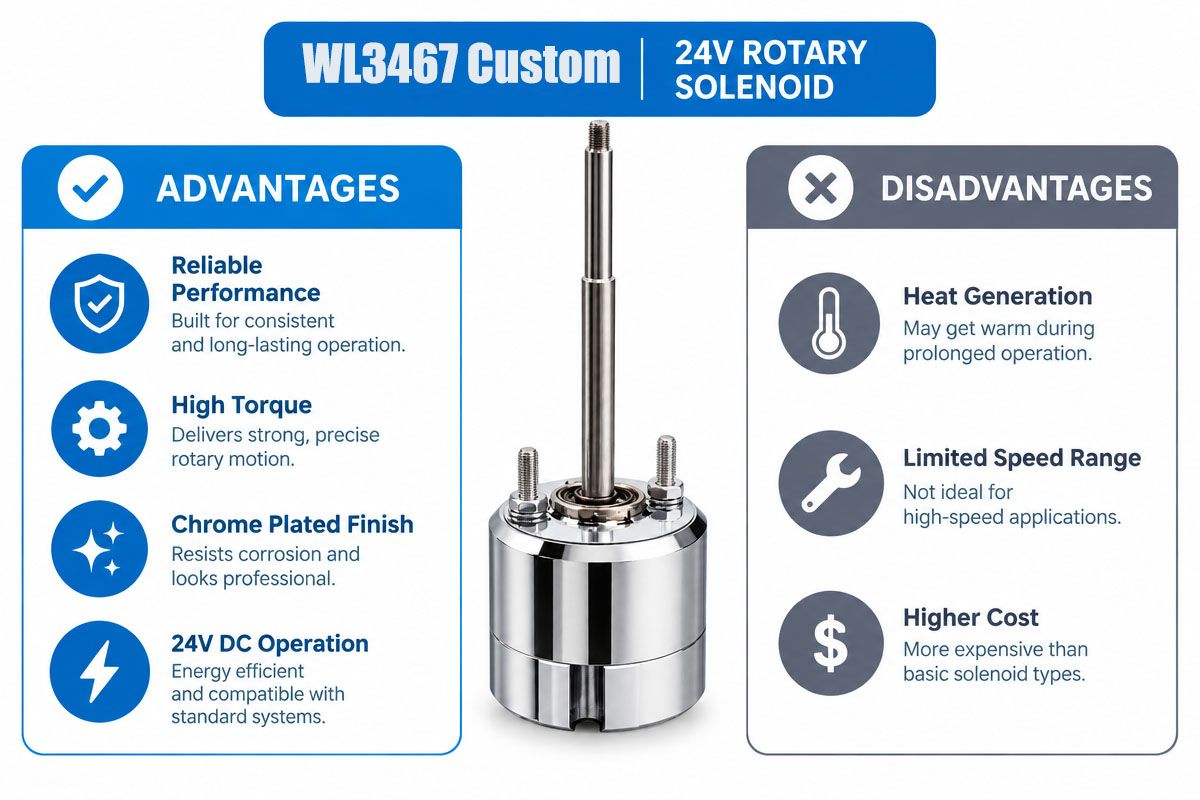
There are several advantages of using a 24V rotary solenoid in automation systems. They provide angular movement directly without requiring a motor, gearbox, and complex motion control system. Fewer parts are needed, and simplified wiring with less installation space is achieved. It is also usually responsive and a good piece of equipment for sorting, diversion, locking, shutter control, and other short-travel operations. In addition, a 24V DC supply is commonly used in industry, so integration with PLC-controlled machinery is easy. Rotating solenoids have repeatable end positions, easy on/off control, and the capability to customize angles, shafts, springs, connectors, and mountings.

Cons of a Custom 24V Rotary Solenoid

However, there are some cons of rotating solenoids as well. Usually, they do not rotate continuously but make a certain angle of rotation only. Torque is varied along the travel and is decreased by higher temperature and lower supply voltage. Frequent energization causes heating. Duty cycle and maximum ON time should be considered. Poor damping can result in mechanical shock at the end stop and produce noise and wear. Large peak currents can be caused by a solenoid in some motorized mechanisms. A servo motor or a stepper motor is more appropriate for precise speed control, multi-position control, continuous rotation, and closed-loop positioning. Anyway, proper application tests should be done before production release.

The Custom 24v Rotary Solenoid Troubleshooting Guide

ustom DC 24V Rotary Solenoid Troubleshooting Guide

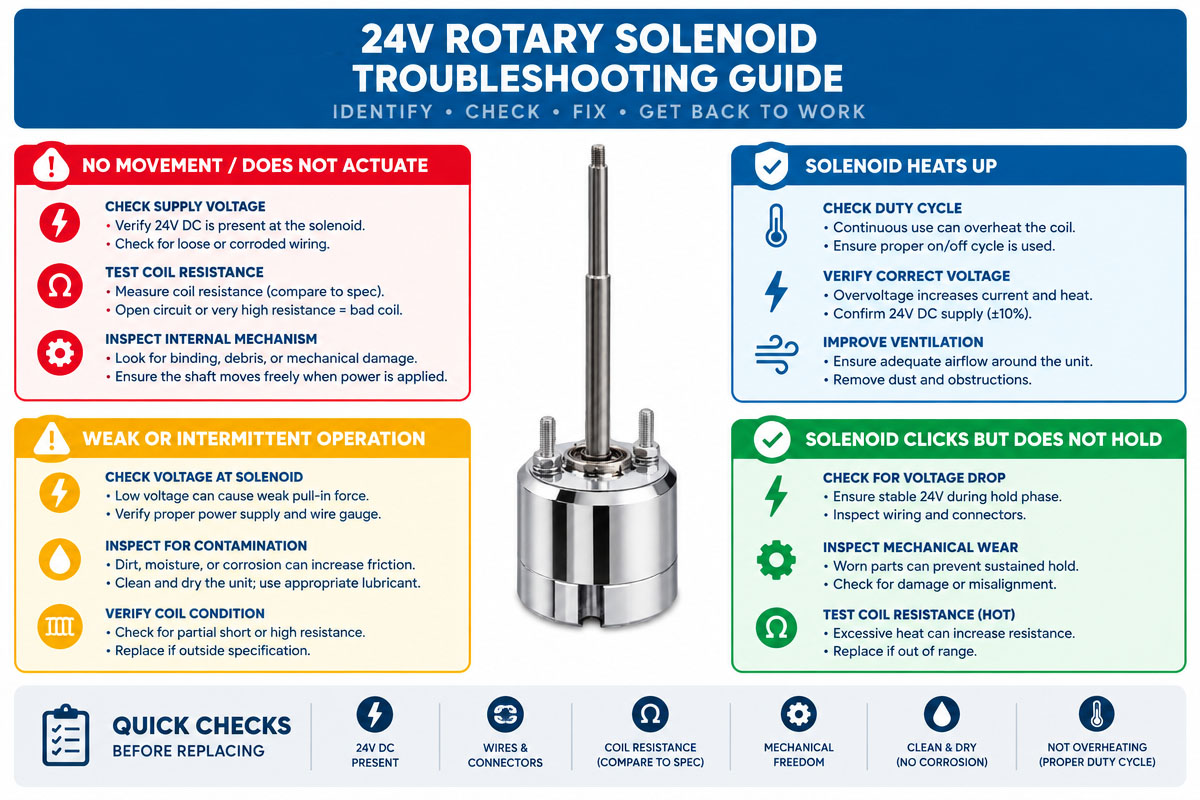
So, if your 24V rotary solenoid does not work, start with checking the power supply. You need to measure voltage at the solenoid while it is energized. Not just at the power supply, but at the solenoid itself. Low voltage, undersized wiring, poor connections, weak drivers, or too long a cable can reduce coil current and torque. If the unit does not move, you need to check the continuity of the check coil, connector polarity (if present), mechanical obstruction, misaligned shaft, and load torque larger than the actuator torque rating.

Slow or partial rotation. Check for friction, return-spring force, geometry of linkage, contamination, worn bearings, and excess load inertia. Check that the required torque is sufficient for the rotation angle. If the coil is hot, check duty cycle, maximum on-time, switching frequency, ambient temperature, and supply voltage. A solenoid rated for intermittent use will overheat if operated continuously.

Check impact from end stops, loose mountings, backlash, and absence of damping for noisy operation. If the solenoid does not pull back after a power cut, check the return spring, residual mechanical load, binding, and magnetic latching of the unit. Intermittent faults should be tested under realistic hot conditions and repeat cycles. Voltage, current, temperature, actuation time, and mechanical position should be measured. The cause should be identified before replacement of parts.


FAQs ON Custom DC 24V Rotary solenoid

1. How to select the best 24V rotary solenoid for my application?

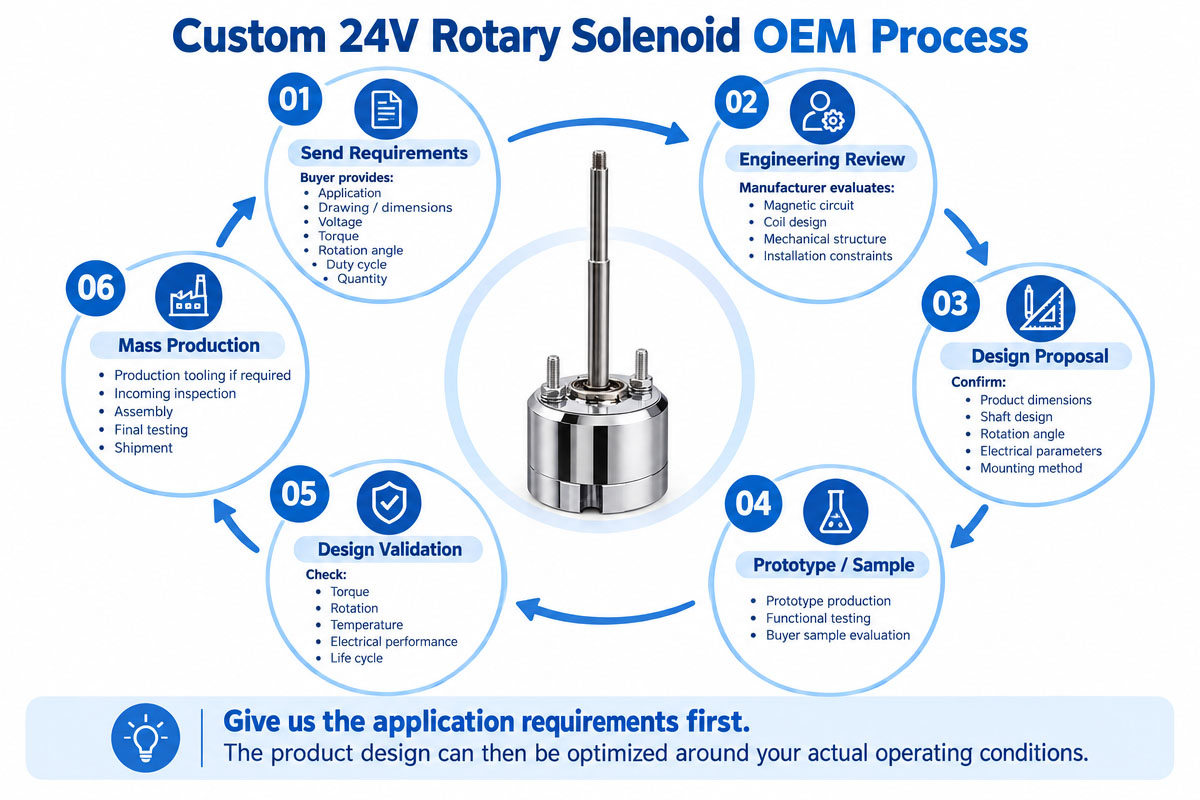
The first step is to identify the required angle of rotation, torque, direction of operation, response time, duty cycle, load inertia, space for mounting, and expected service life. Buyers should also take into account ambient temperature, vibration, dust, moisture, and electrical connection requirements. Response time and cycle life are especially important for high-speed applications, such as sorting machines. If you can provide drawings, load data, operating frequency, and application information to the supplier, they will help to find the most appropriate model.

2. What kind of torque should I expect from a 24V rotary solenoid?

The torque necessary depends on mechanical load, rotation angle, friction, return spring force, and acceleration. Buyers should never select a solenoid based on maximum or holding torque only. You should get the torque-angle characteristics from the supplier and check that torque is available at all points of the travel. Besides, it is advisable to put a proper margin for the effects of temperature variation, voltage variation, wear, and production batch variability.


3. Can a rotary solenoid run continuously at 24V?

Not all 24V rotary solenoids are designed for continuous-duty use. The majority of them is designed for intermittent use, as the energization causes temperature increase. Buyers should check the duty cycle, maximum ON time, operating frequency, ambient temperature, and permissible temperature of the coil. If the application requires frequent or long energization, ask about a continuous-duty coil, reduced holding voltage, PWM control, or another thermal management solution.

4. What are the rotation angles for a 24V rotary solenoid?

Rotation angles depend on the manufacturer and the product design. In typical applications relatively small angular motion may be used for locking, diversion, indexing, shutter control, valve operation, or product sorting. Custom rotation angles can be available as well. Prior to order, buyers should specify starting position, required end position, clockwise or counterclockwise rotation, mechanical stops and, if necessary, automatic spring return.

5. Is the 24V rotary solenoid customizable for OEM equipment?

Yes, many rotary solenoid suppliers can offer customization depending on the volume of production and technical requirements. Standard customization options can be shaft diameter, mounting holes, rotation angle, torque characteristics, return springs, lead wire length, connectors, coil resistance, housing design, and mounting brackets. In case of a custom solution, buyers need to provide drawings, installation dimensions, electrical specifications, working conditions, and estimated annual volume.

6. How long does the 24V rotary solenoid last?

The service life depends on operating frequency, load, rotation angle, impact on the end stop, temperature, duty cycle, shaft loading, and contamination. A solenoid operated under moderate conditions may have a completely different cycle life compared to the same one operated in a high-speed sorting machine continuously. Buyers should request life-test data under conditions similar to their actual application and, for critical projects, conduct their own life testing before mass production.

7. What details should I provide to get a quote?

To receive an accurate quote, buyers should provide voltage, rotation angle, torque, direction of operation, duty cycle, operating frequency, response-time requirement, installation dimensions, shaft or linkage details, ambient conditions, connector or lead-wire requirements, and estimated order volume. Drawings or 3D installation data can be useful for customized projects. In case of providing the end application, like a medical device, fruit sorting machine, packaging system, or automation unit, the supplier can recommend a more suitable configuration.

8. Should I request samples prior to ordering in volume?

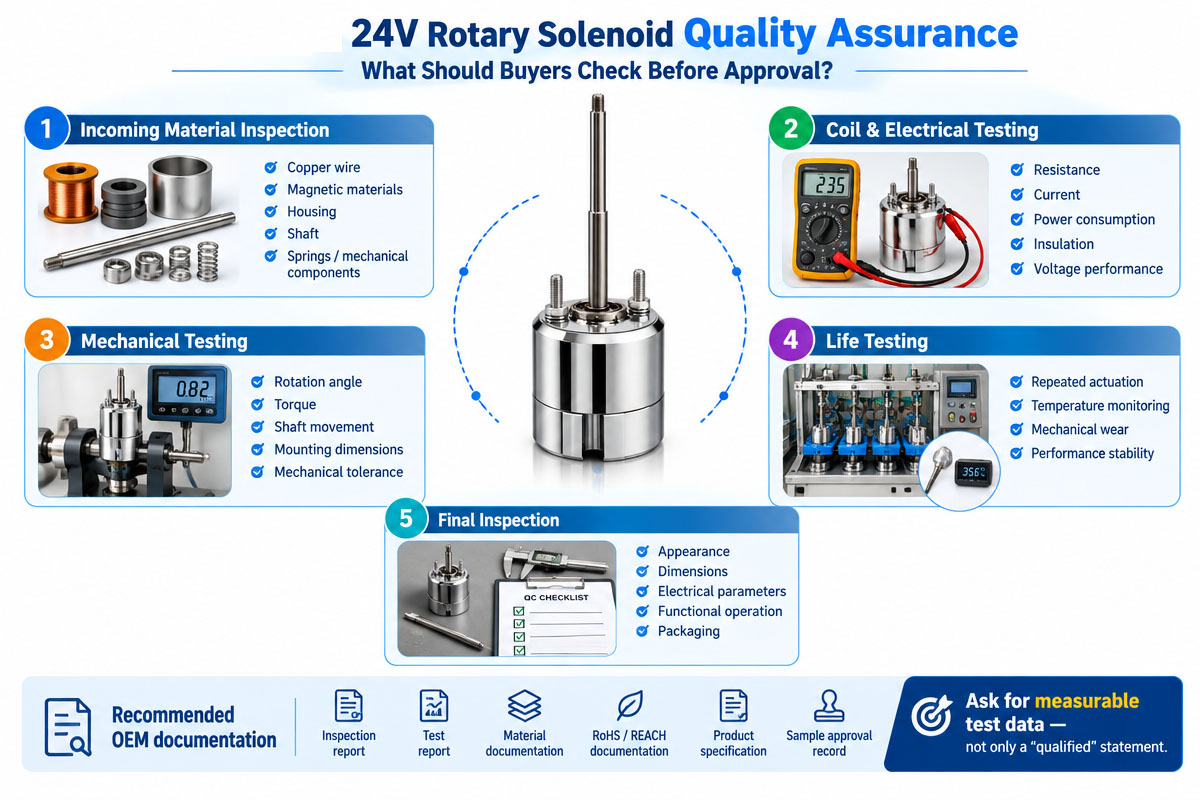
Yep. Sample testing is strongly recommended, especially for OEM and high-cycle applications. While ordering, check torque, response time, rotation accuracy, temperature rise, return action, noise level, current consumption, and mechanical fit and performance under actual load conditions. Testing should include minimum and maximum supply voltage, hot and cold temperatures, repeated operating cycles, and worst-case mechanical loads. Successful sample testing can prevent performance problems at the beginning of tooling, customization, or volume production.

How to Select a 24V Rotary Solenoid?

The selection process of the 24V rotary solenoid starts with the desired mechanical action. Firstly, find out the angle of rotation, direction of rotation, installation space, shaft interface, accuracy of end positions, and whether the load has to rotate automatically when power is cut off. Then find out the torque that is required at the shaft of the solenoid. Consider the load, friction, spring force, acceleration demand, and engineering margin. Do not rely on the static holding torque; instead, consider the available torque in the complete rotation angle.

Then, find out the operating speed and duty cycle. A solenoid that rotates after a few seconds has completely different thermal requirements compared to one that is operated in quick succession in a high-speed sorter. Check the maximum energization time, cycle frequency, coil temperature rise, ambient temperature, and any cooling provided by the equipment. During the operation of the 24V supply, it should remain within the manufacturers’ specified limits.

Find out the load inertia and torque. A light gate can rotate quickly, but a heavy lever can slow down the response time and hit the end stop hard. The design of the actuator should take place hand-in-hand with the design of the mechanical stops, damping, return springs, and linkage geometry.

For industrial integration, check the mounting holes, shaft dimensions, connector type, lead length, electrical polarity, insulation class, vibration resistance, ingress protection, and expected mechanical life. At the system level, the medical, food, or clean equipment can have extra material, cleanliness, documentation, and regulatory requirements.

Finally, prototype the solenoid under realistic conditions. Test the minimum and maximum supply voltage, hot and cold temperatures, worst-case load, continuous production cycles, shock, vibration, and fault conditions. By measuring the current, temperature, actuation time, and return behavior, the buyer can find out whether the selected model has adequate performance margin without excess size, heat, cost, and power consumption.

If noise is a concern, consider the end-stop impact and switching acoustics. For long-life applications, verify the bearing wear, spring fatigue, insulation aging, and replacement access.

How to Avoid Common Mistakes When Designing With a 24V Rotary Solenoid

The most common design mistakes are those committed in the sizing of the solenoid based on voltage or peak torque alone. Instead, a more holistic approach will consider the complete mechanical and thermal system.

Do not forget about the torque curve. Check the available torque in the complete rotation angle, especially at the weak point.

Consider load inertia. A heavy lever requires more torque for acceleration and may hit the end stop hard.

Respect the duty cycle. Even a 24V coil can overheat if it is active for too long a period or switched too often.

Check the real voltage supplied to the actuator. Cable losses, undersized drivers, and power-supply droop can affect performance.

Offer temporary protection. An inductive coil produces a voltage spike when switched off. Use an appropriate flyback or suppression circuit and consider its impact on release speed.

Prevent bad shaft alignment and side loads. Alignment affects the friction, bearing wear, and uneven movement.

Design mechanical stops with care. Excessive impact causes noise and deformation, reducing the life.

Do not make the return spring too big. Working torque at energization will be affected.

Operating environment matching. Think dust, moisture, washdown, temperature, vibration, corrosion, and cleaning agents.

Validate control strategy. Check driver current capability, switching frequency, wiring, connectors, polarity requirements, and fault behavior.

Prototype in worst-case conditions. Test the actuator under hot and cold temperatures, minimum supply voltage, maximum load, and repeated cycles.

Verify application-specific requirements. Do not consider that the actuator itself makes the machine compliant.
Get A Free Quote Now

Contact Form

Related Products

Related News

Scroll to Top

Get A Free Quote Now !

Contact Form
If you have any questions, please do not hesitate to contact us.
Weilong Solenoid Company Culture