Fluid Proportional Valve Applications in Heavy Equipment
Fluid Proportional Valve for Advanced Flow Management
Fluid Proportional Valve for Industrial Automation Systems
Fluid Proportional Valve for Precision Flow Regulation
Fluid Proportional Valve for Automated Fluid Control
Fluid Proportional Valve Applications in Automation
Fluid Proportional Valve Applications in Heavy Equipment
Fluid Proportional Valve for Advanced Flow Management
Fluid Proportional Valve for Industrial Automation Systems
Fluid Proportional Valve for Precision Flow Regulation
Fluid Proportional Valve for Automated Fluid Control
Fluid Proportional Valve Applications in Automation

WL9902 Fluid Proportional Valve for Precision Hydraulic Systems

A fluid proportional valve is an industrial valve component that regulates flow, pressure, direction, or speed of actuator based on an input signal. A valve is variable control rather than on-off control valve. Fluid proportional valves are commonly used in industrial automation, hydraulics, pneumatics, process control, manufacturing, mobile equipment. Depending on the type of proportional valve its design will be controlled by electrical, electronic, or pneumatic proportional input signal. Fluid proportional valve controls fluid flow or pressure parameters and can be used in places where the precise motion and control of pressure and flow is required. Modern proportional valves can work with sensors, programmable logic controllers (PLCs), and control systems. Proper functioning of proportional valve depends on correct sizing, materials of construction, fluid cleanliness, correct pressure ratings and control signal.

Fluid Proportional Valve Description

A fluid proportional valve is an industrial valve that regulates fluid flow or pressure according to an input command signal. The input command signal can be electrical current, voltage, pneumatic, or other signal. A valve is able to be in intermediate positions between fully open and fully closed positions. Fluid proportional valves provide the precise control of hydraulic oil, air, water, and other compatible fluids. Fluid proportional valves are used extensively in industrial automation, hydraulics, manufacturing equipment, process systems, robotics, and motion control.

Operation of a Fluid Proportional Valve

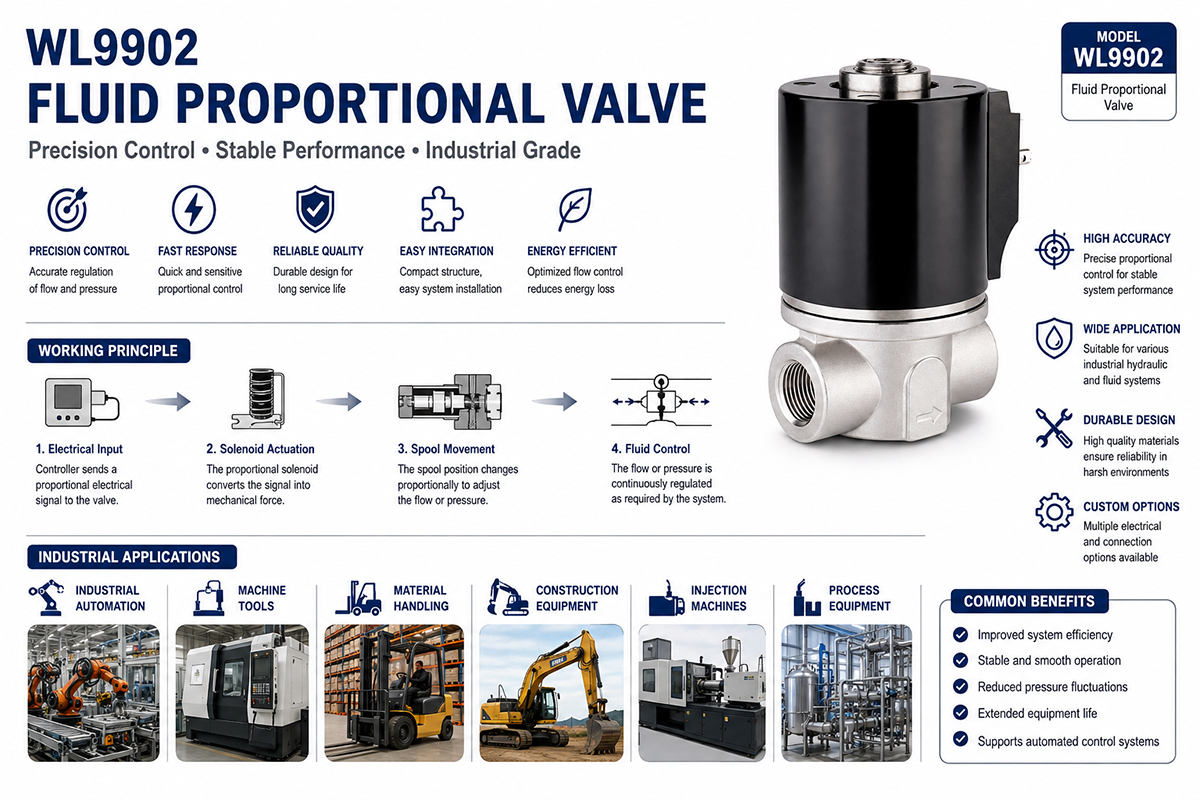
A fluid proportional valve operates using an electric signal to control the flow rate and pressure of the fluid. When the controller sends current or voltage to the proportional solenoid, the current causes the formation of a magnetic field, which causes movement of the spool inside. By moving the spool, the area of the passage for the flow is increased or decreased depending on the strength of the signal sent. The stronger the electric signal sent to the valve, the more the spool moves; thus, the flow is increased. Fluid proportional valves are used in various applications, including automation, robotics, hydraulics, and other machinery.

Fluid Proportional Valve Video

Fluid Proportional Valve Detail Display

Fluid Proportional Valve Technical

Brand Weilong Model Number WL 9902
Rated Voltage (V) DC12V or 24V Rated Power (W) 7.2W
Work Mode Air Control Valve Working Pressure (MPa) 0.2 MPa
Airflow Rate 0.1-2 L/minute Reset Time(s) 1 S On, 1S Off
Service Life 200 Thousand Times Certification CE, ROHS, ISO9001,
Material Superior Magnet Iron Lead Wire Length (mm) 200 MM
Install Style Screw Tolerance of Dimension ± 0.1 MM
Water-proof None Insulation Class B
Hi-Pot Test AC 750V 50/60Hz 2s Non-excitation Holding Force 0
Working Temperature -10°C-90°C Duty Cycle 1-100%
Thread Depth (mm) / Payment Term TT, or LC at Sight
Sample Order Yes. Warranty 1 Year
MOQ 1000 pcs Supply Ability 5000 pcs per week
Delivery Time 30 Days Port of Loading Shenzhen

Why are fluid proportional valves becoming so popular?

Fluid proportional valves have become more popular recently because of the demand for precise, flexible, and automated control of modern industrial equipment. Conventional on/off valves are suitable for simple switching but not for precise regulation.

The engineers can use a proportional valve for precise control of the flow or pressure of the fluid according to production requirements. This ability makes fluid proportional valves useful for the machines that need variable actuator speed, controlled force, precise positioning, or stable process conditions.

Another important factor is the development of industrial automation. The PLCs, electronic controllers, sensors, and feedback systems can be integrated with proportional valves that are suitable for smart manufacturing and automated equipment.

The energy efficiency is another reason for the adoption of proportional valves. The appropriate system design can increase the operating efficiency and reduce unnecessary fluid flow

Moreover, modern proportional valves are available in compact, reliable, and customizable designs. They can be used in the custom OEM equipment, advanced hydraulics, pneumatics, robotics, and process control.

Fluid Proportional Valve Applications

Fluid Proportional Valve Applications in Metal Processing

Fluid proportional valves are used in many industries requiring variable flow, pressure,, or actuator control. They are used in industrial automation to control pneumatic or hydraulic actuators to ensure controlled machine motion and operation. The proportional valves in production equipment can control clamping force, cylinder speed, tooling movement, and production processes.

Fluid proportional valves are used to regulate the flow and pressure of oil in hydraulics of construction machinery, material handling equipment, machine tools, presses, and industrial power units. The pneumatic proportional valves are used to regulate the flow and pressure of compressed air in automatic assembly, gripping, positioning, and testing processes.

Another important application of proportional fluid valves is robotics. The proportional fluid control allows the realization of smooth motion and controlled force in the case of hydraulic or pneumatic actuation.

In process industries, proportional valves can control the compatible fluids in the systems of dosing, mixing, cooling, heating, and circulation. The proportional valves are used in packaging machinery, automotive production equipment, food-processing machinery, textile equipment, and energy systems if the valve materials and specifications are appropriate for application.

OEM machine builders use proportional valves when the equipment needs variable control rather than simple switching. If appropriately sized, filtered, and electronically controlled with feedback, these valves can ensure better precision, repeatability, automation capability, and process efficiency.

Fluid Proportional Valve Adv. & Disadv

Fluid Proportional Valve for Industrial Process Optimization

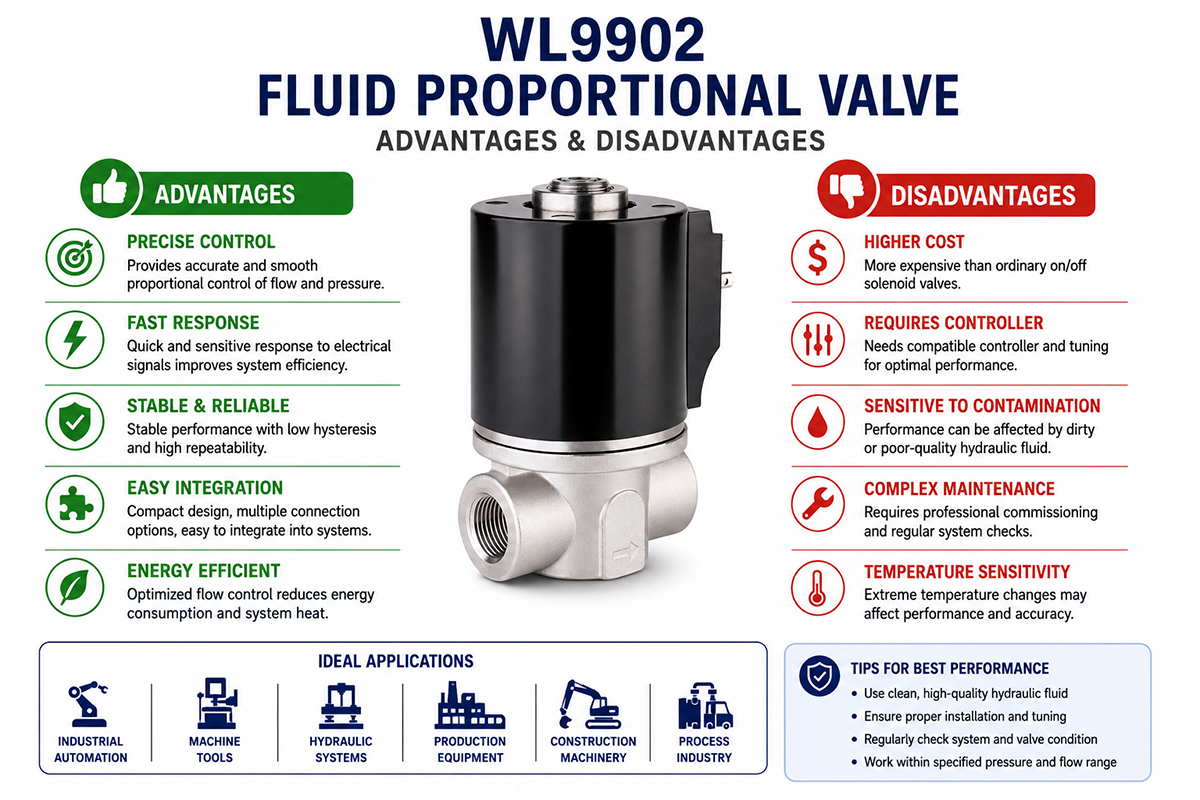
Advantages & Disadvantages of Fluid Proportional Valves

Benefits

Precise Variable Control:

Fluid proportional valves allow you to continuously regulate flow or pressure to run the machine more smoothly and accurately.

Compatibility with Automation:

They are compatible with PLCs, sensors, controllers, and industrial automation systems.

Smooth actuator movement:

The variable valve positioning helps soften sudden starts and stops in hydraulic and pneumatic systems.

Flexible Operation.

A single valve can be used at different levels depending on different control signals.

Improved Process Consistency:

Good regulation helps keep production conditions repeatable.

Potential Energy Savings

Good system design can increase the efficiency and reduce the unnecessary flow of fluids.

Shortcomings

Higher Initial Cost:

Proportional valves and their electronic drivers are generally more expensive than simple on-off valves.

More Complex Control:

What is required is the right electronics, calibration, and control programming.

Vulnerable to Contamination:

Contaminated fluids can cause valve sticking, unstable operation, or early wear.

Troubleshooting Difficulties:

There may be problems with the valve itself, the controller, the wiring, the sensors, or the hydraulic/pneumatic system.

Heat Generation:

Depending on the system design, the throttling and continuous electrical operation can cause heat generation.

Design Requirements:

Proper performance depends on appropriate sizing, signal matching, filtration, pressure control, and feedback.

Fluid Proportional Valve Industrial Selection and Applications

Fluid Proportional Valve Troubleshooting

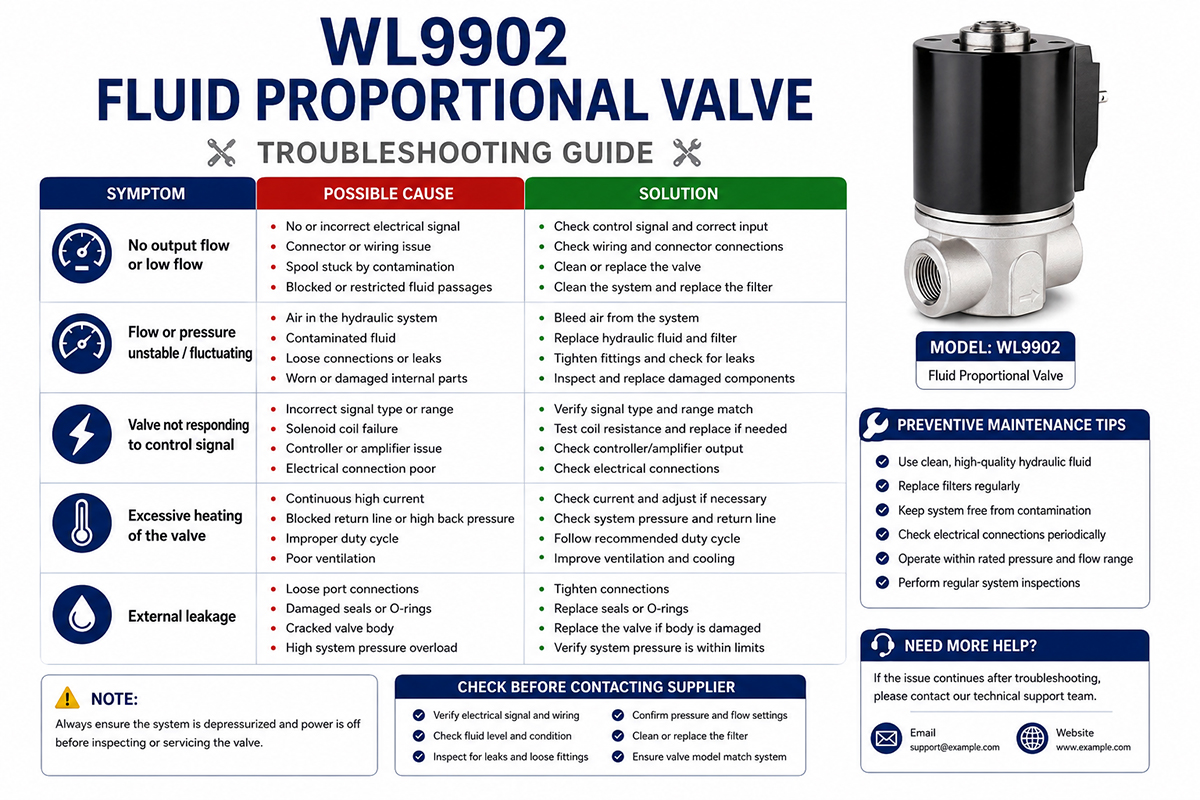
If the fluid proportional valve is malfunctioning, it is necessary to troubleshoot the whole control circuit and fluid system.

No Response from Valve:

Check power supply, controller output, wiring, connector, coil, and input signal. Ensure the control signal to the valve.

Low Flow:

Check valve sizing, supply pressure, filters, fluid viscosity, restrictions, and pressure differential. The flow may be limited by a clogged filter or undersized valve.

Unstable Flow

Check for contamination of fluid, presence of air, unstable supply pressure, electrical noise, improper grounding, and controller tuning.

Valve Sticking:

Check for fluid contamination, damaged seals, mechanical particles, temperature, or wear of internal components. Clean or replace components according to manufacturer instructions.

Incorrect Pressure:

Check pressure setting, sensor calibration, relief valve operation, and control signal. Also check that the valve is properly rated for application.

Too Fast or Too Slow Actuator Movement:

Signal scaling. Valve flow capacity. Load conditions. Controller parameters. 9.1.4 Proportionally Review.

Extreme Heat:

Continuous electrical loading, pressure drop, throttling losses, ambient temperature, and flow conditions.

Preventive Maintenance

Maintain good filtration, check electrical connections, monitor pressure and temperature, and check valve response and calibration periodically.

If the problems persist, test the valve independently from the controller and compare the performance with manufacturer specifications.

FAQ

1. Fluid proportional valve - what is it?

A fluid proportional valve is a type of control valve enabling fine tuning of flow rate, pressure, or direction in response to an external signal. It provides variable control rather than simple on/off action and is intended for use in automation, hydraulic, pneumatic, and process control applications.

2. How does a proportional valve operate?

The proportional signal is applied to the valve, which changes its position via actuation of a spool, poppet, or regulator element. The valve opening is adjusted to control the flow or pressure according to the specified value.

3. What fluids are regulated by a fluid proportional valve?

Fluids regulated by proportional valves include hydraulic oil, compressed air, water, coolant, and many other suitable liquids or gases. The valve materials, sealability, pressure, and temperature rating depend on the specific fluid.

4. Fluid proportional valves are commonly used in such applications;

They are widely utilized in industry, automation, hydraulics, pneumatics, machine tools, robots, manufacturing systems, material handling equipment, process control systems and OEM equipment where variable control of fluid is required.

5. What are the key benefits of a fluid proportional valve?

Among the principal benefits there are precise flow and pressure control, accurate motion of actuators, versatile operation, capability of automation, increased process uniformity, and potentially higher efficiency.

6. How do I select proper fluid proportional valve?

While choosing a valve, it is necessary to consider such factors as the type of fluid, flow rate, pressure and peak pressure, temperature, control signal, response speed, port size, mounting configuration and environment. Proper valve sizing is particularly critical in stable proportional control.

7. Why is the flow through a fluid proportional valve unstable?

It may happen due to the presence of contamination in the fluid, air in the system, unstable pressure of supply, wrong control parameters, electrical interference, improper wiring, insufficient filtration, or inappropriate valve sizing. A complete check of fluid and control system is advised.

8. What do I need to do to ensure the efficient operation of a proportional valve?

It is essential to use clean and properly filtered fluid and monitor the condition of connections, seals, filters, wiring, and operating conditions. Attention should be paid to pressure, temperature, and performance of the valve.

How to Choose a Fluid Proportional Valve—Approx.

When choosing the right fluid proportional valve, one shouldn’t look only at the valve size but at the whole system it operates in.

1. Choose the Fluid

Decide whether the valve will control hydraulic oil, compressed air, water, coolant, gas, or some other medium. Consider the viscosity, temperature, chemical compatibility, fluid cleanliness, and seal materials.

2. Identify Flow Requirements

Determine the minimum, normal, and maximum required flow. Choose a valve that can handle peak flow requirements without too much pressure drop. An oversized valve can reduce control precision, while an undersized valve will limit the system performance.

3. Verify the operating pressure.

Check normal and maximum system pressure. Choose the valve for possible pressure spikes. The valve pressure rating should provide safety margin.

4. Determine the Control Function

Decide if the application requires flow control, pressure control, directional control, or any combination. Match the actuator and process requirements with the valve capabilities.

5. Match the Incoming Signal

Typical control signals are voltage and current inputs. Check that the valve driver, PLC, controller, and proportional electronics work with compatible signal ranges.

6. Consider Response and Accuracy

Response time and hysteresis are the parameters to consider when designing high-speed automation, robotics, and precision motion. Closed-loop feedback may be considered when extremely accurate control is needed.

7. Check Installation and Connection Requirements

Consider port size, thread, mounting pattern, manifold configuration, electrical connection, and installation space.

8. Consider Environmental Conditions

Consider the ambient temperature, vibration, moisture, dust, corrosion, and electromagnetic conditions. Choose the appropriate materials and protection.

9. Check Maintenance Needs

Choose a design with serviceable parts, appropriate seals, filtration requirements, and replacement parts availability.

10. Consider Vendor Assistance

For OEM applications, choose the vendor for customization, technical support, testing, documentation, delivery, and quality control.


Fluid Proportional Valve Design – Tips to Avoid Common Mistakes

Do not oversize the valve. The oversized valves decrease control precision and make proportional control difficult.

Do not undersize the valve. The undersized valves result in excessive pressure drop and performance decrease.

Select the right fluid compatibility. Seal and body materials should be compatible with the operating medium and temperature.

Design for pressure spikes. Not for the normal operating pressure.

Match the electronic signal. Consider voltage/current ranges between valve and controller.

Consider deadband and hysteresis. It may affect accuracy in demanding applications.

Use appropriate filtration. Contaminated hydraulic or pneumatic fluid can cause sticking and unstable control.

Consider heat dissipation. Electrical coils and fluid throttling (when in continuous operation) can generate heat.

Do not install upside down or with unsupported piping. Mechanical stress can decrease valve reliability.

Plan for feedback when you need it. For precise applications, flow, pressure, or position feedback is required.

Test the whole system. The valve performance is determined by the pump, actuator, controller, fluid, piping, and load.

Provide the safety margin. The pressure, temperature, flow, and electrical ratings should match the actual conditions.

Get A Free Quote Now

Contact Form

Related Products

Related News

Scroll to Top

Get A Free Quote Now !

Contact Form
If you have any questions, please do not hesitate to contact us.
Weilong Solenoid Company Culture
