Magnet Charging Coil for Smart Appliance Charging Guide
Magnet Charging Coil for OEM Device Charging Technology
Magnet Charging Coil for Industrial Equipment Solutions
Industrial Magnet Charging Coil for Smart Devices Guide
Custom Magnet Charging Coil for Smart Devices Solutions
Custom Magnet Charging Coil for Industrial Devices guide
Magnet Charging Coil for Smart Appliance Charging Guide
Magnet Charging Coil for OEM Device Charging Technology
Magnet Charging Coil for Industrial Equipment Solutions
Industrial Magnet Charging Coil for Smart Devices Guide
Custom Magnet Charging Coil for Smart Devices Solutions
Custom Magnet Charging Coil for Industrial Devices guide

WL1430 Magnet Charging Coil for Smart Appliance Charging Guide

A magnet charging coil is a small electromagnetic element used to conduct electrical energy in modern charging systems effectively. It transforms electrical current into a controlled magnetic field, and it may be coupled with a receiving coil to conduct power. The magnets included in the coil can allow automatic alignment, positioning, and stabilization of the connection of the charging components.

Magnetic charging coils are applicable in smart household appliances, industrial automation machinery, handheld devices, electronic devices, robotic systems, sensors, and other intelligent equipment. The coil can be designed considering application to have certain voltage, current, power, inductance, dimensions, winding structure, wire type, and temperature.

Selection of the coil is very important in industrial applications since charging efficiency, operating temperature, magnetic positioning, space, and duty cycle have a great impact on the reliability of the system. A well-designed magnet charging coil offers a compact design, repeatable charging performance, stable power transfer, and flexible incorporation into the OEM product.

Custom Magnet Charging Coil Product Overview

A magnetic charging coil is an electromagnetic charging component used in compact power transfer systems. It can be produced in various designs of shapes, winding structures, sizes, and electrical specifications to meet the needs of applications. Depending on the architecture of the system, the coil can be used as a transmitting or receiving part. The features of magnetic positioning are incorporated into the charging assembly to improve alignment and repeatability. The standard customization parameters are as follows: inductance, resistance, wire diameter, number of turns, dimensions of coil, operating frequency, voltage, current, power, and temperature rating. The coil can be incorporated in plastic housing, PCB assembly, charging dock, smart appliances, industrial machinery, and automated charging systems for OEM projects.

How Does a Magnet Charging Coil Work?

The magnet charging coil operates based on the principle of electromagnetic induction and magnetic field coupling.

The transmitting coil generates an alternating or controlled electrical current to create the changing magnetic field. By putting a receiving coil in the magnetic field, the changing magnetic flux causes the generation of electrical voltage in the receiving coil.

The basic mechanism is shown as follows:

Electrical Energy > Transmitting Coil > Magnetic Field > Receiving Coil > Electrical Energy

The magnets can facilitate the mechanical aspect of the system by allowing automatic alignment of two charging components. Better alignment normally results in better magnetic coupling and reduction in the energy transfer losses.

In industrial applications, the engineers usually consider:

Inductance of Coil

Number of Turns

Wire Thickness

Operating Frequency

Input Voltages

Power Output

Spacing Between Coils

Magnetic Bearing

Temperature Rise

Space to Install

The efficiency of the final charging is determined not only by the coil but also by the complete design of electrical, magnetic, mechanical, and thermal aspects.

Main Features of Magnet Charging Coil

Magnetic charging coils offer a combination of compact mechanical integration and electromagnetic performance. The main features are as follows: coil size and shape, number of turns, inductance, wire size, voltage, current, and temperature. The magnetic positioning also helps in maintaining consistent alignment of the charging components. The coil can be designed for various installation options, including mounting with adhesive, PCB assembly, plastic housing, metal structure, and a dedicated charging module. According to the application, manufacturers can optimize winding density, resistance, magnetic coupling, and thermal performance. High-quality materials and a controlled winding process contribute to improvement in electrical stability and consistency in production. The coil can be customized by the OEM to satisfy specific space, power, mechanical, and environmental requirements.


Custom Magnet Charging Coil Product Video

Custom Magnet Charging Coil Product Detail Display

Compact Magnet Charging Coil Product Datasheet

Brand Weilong Technology Model Number WL1430
Product Size: 14*30*2 * 9 TS * 6.5 UH Rated Power (W) 5 W or 10 W
Wire: 0.08 mm * 9 TS DC Power Source DC 5 V
DCR 28.5 UH +/- 10% Reset Time(s) Nil
Service Life Nil Certification CE, RoHS, ISO9001,
Material copper wire Power Contact lead wire
Install Style adhered tape Tolerance of Dimension ± 0.1 MM
Water-proof None Insulation Class F
Hi-Pot Test AC 600V 50/60Hz 2s Non-excitation Holding Force 0
Working Temperature -10°C-100°C Duty Cycle 1-100%
Thread Depth (mm) 0.1 mm Payment Term TT, or LC at Sight
Sample Order Yes. Warranty 1 Year
MOQ 1000 pcs Supply Ability 5000 pcs per week
Delivery Time 30 Days Port of Loading Shenzhen

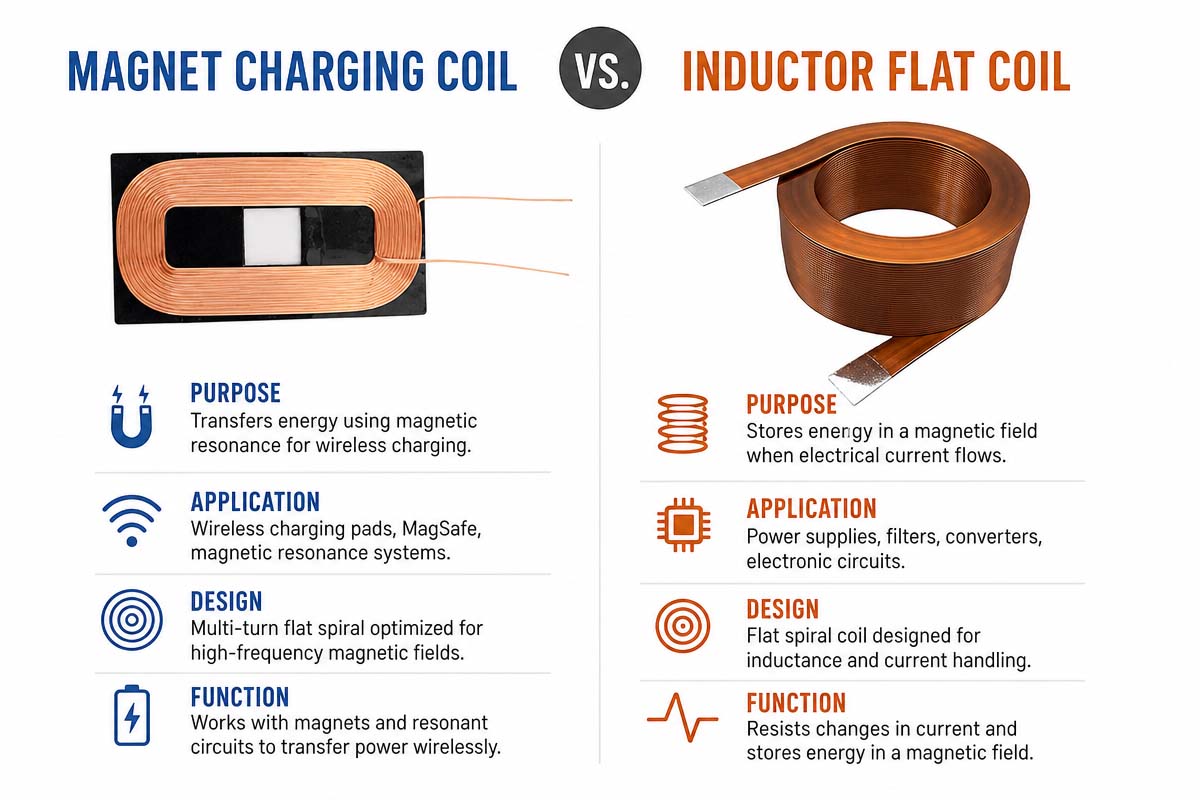
Magnet Charging Coil vs. Inductor Flat Coil

Magnet Charging Coil vs Inductor Flat Coil

Comparison Magnet Charging Coil Inductor Flat Coil
Main purpose Energy transfer and charging Energy storage/filtering
Typical application Wireless/magnetic charging Power electronics and signal circuits
Magnetic coupling Often designed for coupling with another coil Usually operates as an individual inductor
Magnets May use magnets for alignment Normally does not require positioning magnets
Main parameter Coupling, inductance, power, efficiency Inductance, current, saturation, resistance
Operating system Often part of a charging system Usually part of an electronic circuit
Mechanical design Optimized for charging interface Optimized for PCB or circuit integration
Typical products Smart appliances, charging docks, robots DC-DC converters, filters, power supplies
Design priority Power-transfer efficiency and alignment Energy storage, filtering, and current handling
Customization Coil geometry, power, frequency, alignment Inductance, current, size, core structure

Key Difference

Difference in Function

The basic difference between the two products is in their functions.

The charging coil of the magnet is meant to be part of an energy transfer system, where there is magnetic coupling between the coils that allows electrical energy to be transferred from one point to another through the magnets that could also ensure proper mechanical alignment.

The inductive flat coil of the inductor is mainly meant for being an inductive element in the electrical circuit for the purposes of energy storage, filtering, impedance, and other electromagnetics-related tasks.

Thus, while both the devices are made using wound conductor and have a magnetic field around them, they have different electrical functions and design requirements.


The key distinction is function.

A magnet charging coil is designed to operate as part of an energy transfer system, whereby magnetic interaction between coils allows electrical energy to flow from one side to another. The magnets could also help with mechanical alignment.

The flat coil inductor is an inductor in an electrical circuit used for energy storage, filtering, current smoothing, impedance control, or electromagnetic purposes. The inductor flat coil may not necessarily transfer power to another coil.

Thus, even though both devices have wound conductors and produce magnetic fields, there is a difference in terms of electrical function, systems design, requirements, and performance.

In the case of smart appliances or industry charging applications, the coil selection process depends on the whole energy transfer system and not merely on the comparison of inductance value.


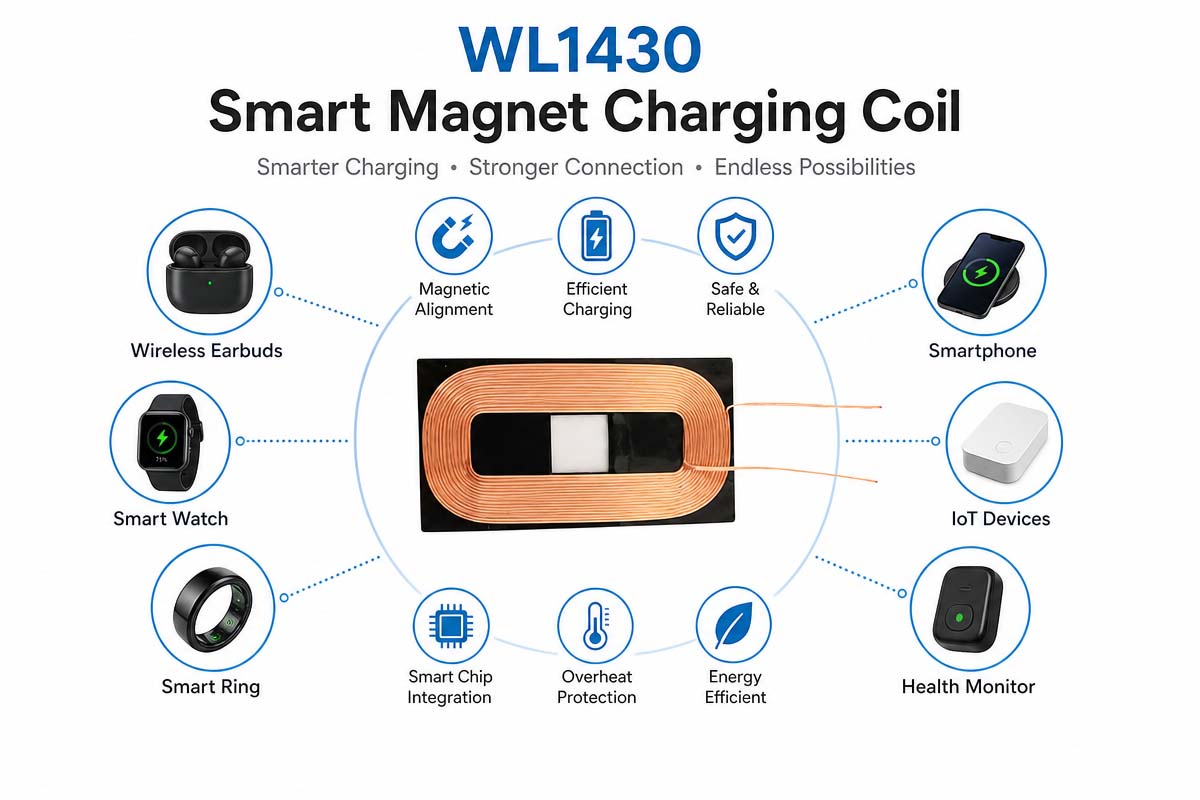
Compact Magnet Charging Coil Smart Device Application

WL1430 Smart Charging Coil appliance device guide

Magnetic charging coils are used in many industrial and smart device applications to provide compact and reliable power transfer. They can be used as charging interfaces for handheld controllers, cleaning equipment, sensors, smart locks, kitchen appliances, and other smart products in smart appliances.

Charging coils can be incorporated in autonomous machines, mobile robots, inspection systems, sensors, electronic tools, and automated workstations in industrial automation. With the help of its magnetic positioning, the device can locate the optimal charging position repeatedly without the complicated manual connection.

Magnet charging coils can also be useful in consumer electronics and portable equipment. Compact coil structures are advantageous in wearable devices, smart accessories, handheld terminals, small medical or monitoring equipment, and intelligent devices.

The coil can be customized for specific voltage, current, frequency, power, distance, and environmental requirements for industrial wireless power transfer. Customized coil geometry can be particularly helpful when there is limited space for installation.

Other possible applications include:

Intelligent Household Appliances

Sensors in Industry

Robotics Technology

AGVs (automated guided vehicles)

Portable Electronic Devices

Smart Locks

Battery-Operated Device

Charging Dock

Device of IoT

Electronic Control Units

Monitoring Instruments in Industry

Intelligent Mobile Device

Finally, the coil design must be adapted to the overall charging system.

Why is the magnet charging coil becoming popular for smart appliance charging?

The application of magnet charging coils for smart appliance charging becomes more popular due to the appearance of modern products that require a compact, convenient, automated, and reliable charging interface.

Traditional connectors require precise physical contact and become worn out after numerous usages. Magnetic charging can help with the positioning of charging components and improve the user convenience. It is especially convenient for smart appliances, since these products are often docked or returned to charging stations.

“Another benefit of the technology is design flexibility. Charging coils can be made to order depending on product size, available installation space, required power, charging distance, and electrical architecture.

The magnetic alignment is especially useful in smart products when the device itself has to find the position for charging. The solution can be used for robotic equipment, automated cleaning devices, smart sensors, portable tools, and other battery-powered products.

Thus, the rising popularity of smart appliances is increasing the demand for smaller, more efficient, and application-specific charging coils.

For OEM manufacturers the key opportunity is not only to choose the off-the-shelf coil but also to create the whole charging assembly designed specifically for the product.

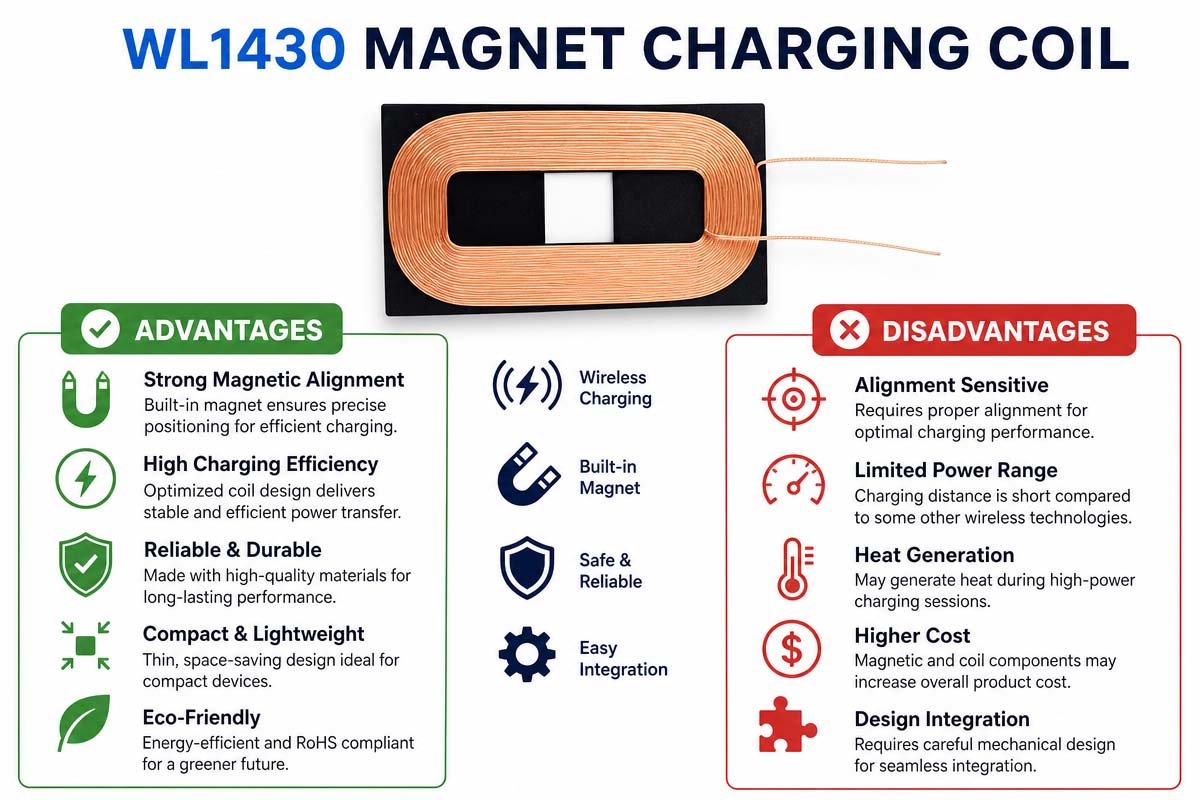
Compact Magnet Charging Coil Advantage and Disadvantage


WL1430 Magnet charging coil advantages and disadvantages

Advantages of Magnet Charging Coils

Magnet charging coils offer a number of advantages to modern charging systems. Firstly, their compactness allows their integration into small-sized products. Secondly, magnetic positioning helps users to position the charging components automatically. Finally, the absence of electrical connections usually included in the traditional systems can give the advantage of neat product aesthetics and mechanical connector wear reduction.

Custom coil sizes and electrical parameters also help the industrial equipment designer to create a charging system that fits the product’s power and size requirements. Magnet charging coils can also provide automated charging suitable for robots, sensors, portable equipment, and intelligent appliances.

Compact Magnet Charging Coil Disadvantages

The main drawback is that the charging performance greatly depends on the coil alignment, distance, frequency, and design. Misalignment decreases the efficiency of energy transmission. Moreover, the resistance of the coil can generate heat.

Moreover, magnetic fields can be influenced by metal parts in proximity, resulting in losses. High-power systems can require advanced thermal management and electronic control circuits.

Very custom dimensions, special materials, strict electrical tolerances, and dedicated tooling can also influence the manufacturing costs of your project.

Thus, magnet charging coils are highly efficient when designed properly, but you should consider them as part of the charging system, not as an individual component.

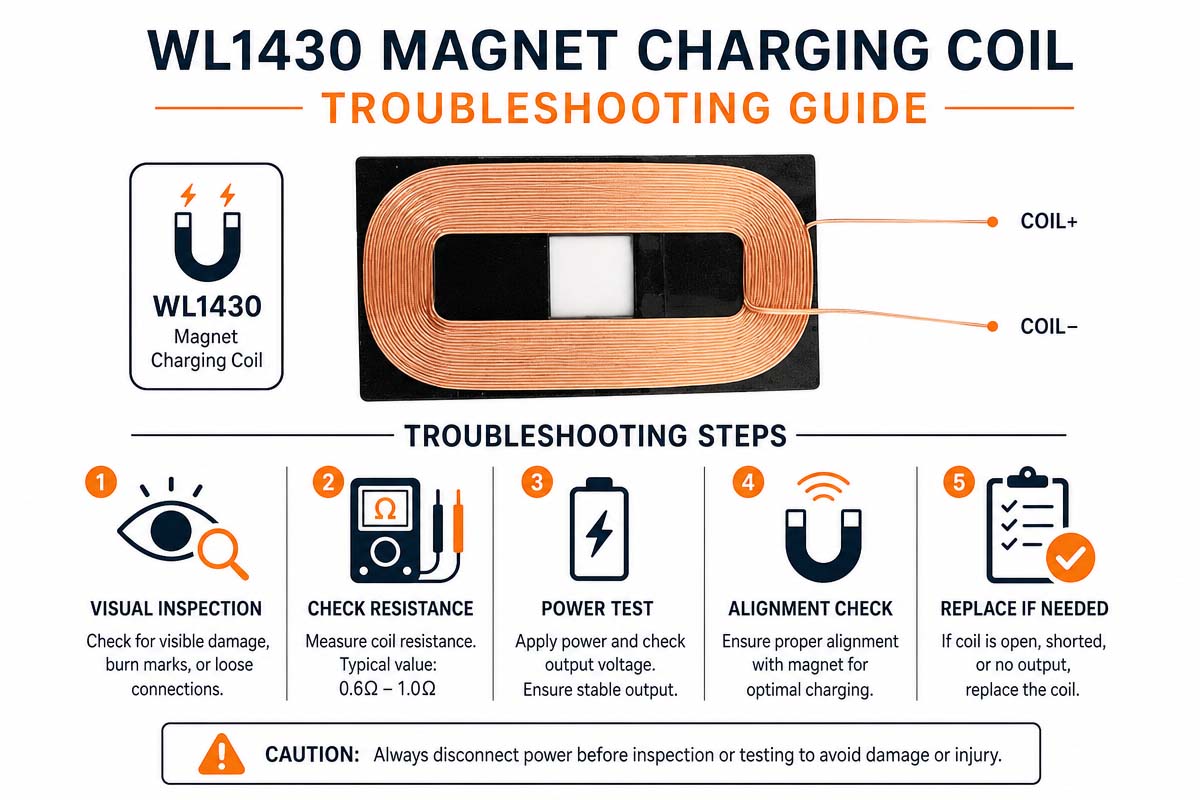
Magnet Charging Coil Troubleshooting Guide

WL1430 Magnet charging coil troubleshooting guide

The troubleshooting process should begin with mechanical and electrical checks if the magnet charging coil fails to provide the required charging performance.

Problem 1. Charging doesn’t start.

Check input voltage, wiring, connectors, and charging control circuitry and coil continuity. Any damaged wire and open winding can disable the charging process.

Problem 2: The charging power is too low.

Check coil alignment, charging distance, inductance, frequency, and loading requirements. “Too much distance between the transmitting and receiving coils can significantly reduce coupling.

Problem 3: Coil overheating.

Check operating current, winding resistance, duty cycle, ambient temperature, and cooling conditions. The overheating can be caused by excessive current or undersized wire.

Problem 4: Intermittent charge

Check magnetic positioning and mechanical clearances. The unstable coupling can be caused by vibration and misalignment.

Problem 5: High electrical loss.

Check actual coil resistance and inductance against specifications. Check surroundings for metal parts that could induce eddy current losses.

Problem 6. Charging performance changes after assembling

Test the coil in the finished product. Housing material, magnets, screws, shields, PCB components, and mounting structures can affect the electromagnetic performance.

In case of serious problems, measure the prototype against the original design specifications and check the whole charging circuit, magnetic structure, and mechanical assembly as a single unit.


Frequently Asked Questions on Magnet Charging Coil

1. What is a magnet charging coil?

The magnet charging coil is an electromagnetic coil that can transfer the electrical energy through magnetic coupling with the receiving coil without electrical connection. The magnets can be installed in the charging device to make good alignment and connection. It is widely applied in smart appliances, industrial equipment, robots, sensors, portable products, charging docks, and so on.

2. How does a magnet charging coil work?

It uses the principle of electromagnetic induction to charge. As the electrical current flowing through the transmitting coil produces a magnetic field. The receiver coil catches the energy and generates electrical current again. The efficiency of charging can be determined by the design of coils, frequency of operation, alignment, distance, inductance, power level, and electronic control circuits.

3. What are the main applications of magnet charging coils?

The magnet charging coils are often used in smart appliances, robotic equipment, industrial automation systems, portable devices, smart sensors, IoT devices, charging docks, smart locks, handheld equipment, automated charging stations, and so on. These charging coils will be beneficial when the product requires a small-sized charging element, repeat positioning, and less dependence on electrical connection.

4. Can a magnet charging coil be customized?

Yes. The magnet charging coils can be customized by voltage, current, power, inductance, resistance, frequency of operation, dimension, wire diameter, number of turns, winding structure, temperature, and the way of installation. Also, the OEM manufacturer can customize the structure of magnetic alignment, housing, terminals, adhesive, and so on.

5. How can I improve magnet charging coil efficiency?

The efficiency of charging can be increased by optimization of coil alignment, reduction of distance between transmitter and receiver coils, choosing proper inductance and frequency of operation, controlling of winding resistance, and reduction of electromagnetic loss. The metal component near the coil will increase the eddy current loss. So testing of the complete assembling charging system is much better than only testing the coil.

6. Why does a magnet charging coil become hot?

The heat will be generated mainly due to electrical resistance in the winding and electromagnetic loss during the operation. Overload current, high resistance, unsuitable wire diameter, continuous operation, poor heat dissipation, or inefficient magnetic coupling will generate the heating problem. The engineers should consider the current, resistance, duty cycle, ambient temperature, frequency of operation, and thermal management in the design phase.

7. What should I consider when selecting a magnet charging coil?

The important consideration parameters are the input voltage, output power, current, inductance, frequency of operation, dimension of coil, charging distance, alignment tolerance, temperature rise, duty cycle, environment condition, and service life. Also, the housing, PCB, metal part, magnet, and mounting structure of the coil should also be considered due to affecting the performance of coils.

8. What is the difference between a magnet charging coil and an inductor flat coil?

The magnet charging coil is mainly designed for transferring electrical energy between the transmitter and receiver coils by magnetic coupling. The inductor flat coil is generally used as the component of an electronic circuit for energy storage, filtering, current smoothing, and impedance control.

How to Choose a Magnet Charging Coil

Choosing the right magnet charging coil is not just about selecting a coil based on its size. The electrical, magnetic, mechanical, thermal, and environmental requirements should be verified before the production.

1. Calculate the Required Power

Calculate first the required input and output power. More required power may require larger winding, thicker wire, better heat dissipation, or a different structure of the coil.

2. Verify Operating Voltage and Current

Specify the operating voltage and the maximum current of the coil and the charging conditions. These parameters define the type of the conductor and electrical resistance.

3. Select the Proper Inductance

Inductance is one of the most important electrical parameters. The required inductance is defined by the charging circuit, operating frequency, compensation network, and power architecture.

4. Verify Operating Frequency

The coil must be compatible with the operating frequency of the system. The frequency affects the impedance, losses, magnetic coupling, heat dissipation, and charging efficiency.

5. Assess Coil Dimensions

“Be sure to calculate your available space for installation. Outer diameter, inner diameter, thickness, height, mounting surface, surrounding parts.”

6. Think Magnetic Alignment

If you use magnetic positioning, calculate the required magnetic force and alignment tolerance. Poor alignment may lead to less efficiency of charging.

7. Temperature Control

During operation the resistance of the coil causes the generation of heat. Consider the continuous operation conditions, duty cycle, ambient temperature, and temperature rise.

8. Choosing the Right Materials

The wire insulation, bobbin material, adhesives, magnetic materials, and protective components should be suitable for operating temperature and environment.

9. Think Mechanical Reliability

The coil should withstand vibrations, repeated charging cycles, assembly stress, and any other mechanical requirements.

10. Verify Capability of OEM Manufacturing

When choosing the supplier, evaluate the winding accuracy, testing capability, tooling capacity, quality control, sample support, and mass production capability.

A good selection includes electrical performance, charging efficiency, size, temperature, reliability, cost, and manufacturability.

How to avoid the most common magnet charging coil design mistakes

Here is a list of some of the common coil design mistakes to avoid.

1. Selecting the Coil Based on Its Physical Size

The coil can fit the product physically but fail in its electrical or power and thermal capabilities.

2. Ignoring the Operation Frequency

The coil should be designed based on the correct frequency of charging. Otherwise, you may get unexpected impedance and losses.

3. Underestimating the Temperature Rise

Heat is generated because of high current and resistance. Always check continuous duty and maximum environment temperature.

4. Poor Magnetic Alignment

If magnets are utilized for positioning, then you should account for mechanical tolerance. Excessive offset will decrease coupling.

5. Wrong Wire Diameter Selection

If the wire is too thin, it will generate excessive resistance and heat. If the wire is too thick, then it will be expensive and inflexible for the winding.

6. Overlooking the Metal around the Coil

Nearby metal parts can change the magnetic field and induce eddy current losses. Therefore, you should test the whole assembly.

7. Not testing in the assembled state

The coil may perform well without an assembly but fail in the final product. Thus, always test the whole mechanical and electrical assembly.

8. Not paying attention to production tolerances

To produce the coil uniformly, the coil resistance, inductance, dimensions, and winding tension should be within the tolerances.

9. Picking the Supplier Too Late

Do not wait till the end of the product development process. Include the supplier in your design.

Get A Free Quote Now

Contact Form

Related Products

Related News

Scroll to Top

Get A Free Quote Now !

Contact Form
If you have any questions, please do not hesitate to contact us.
Weilong Solenoid Company Culture
