


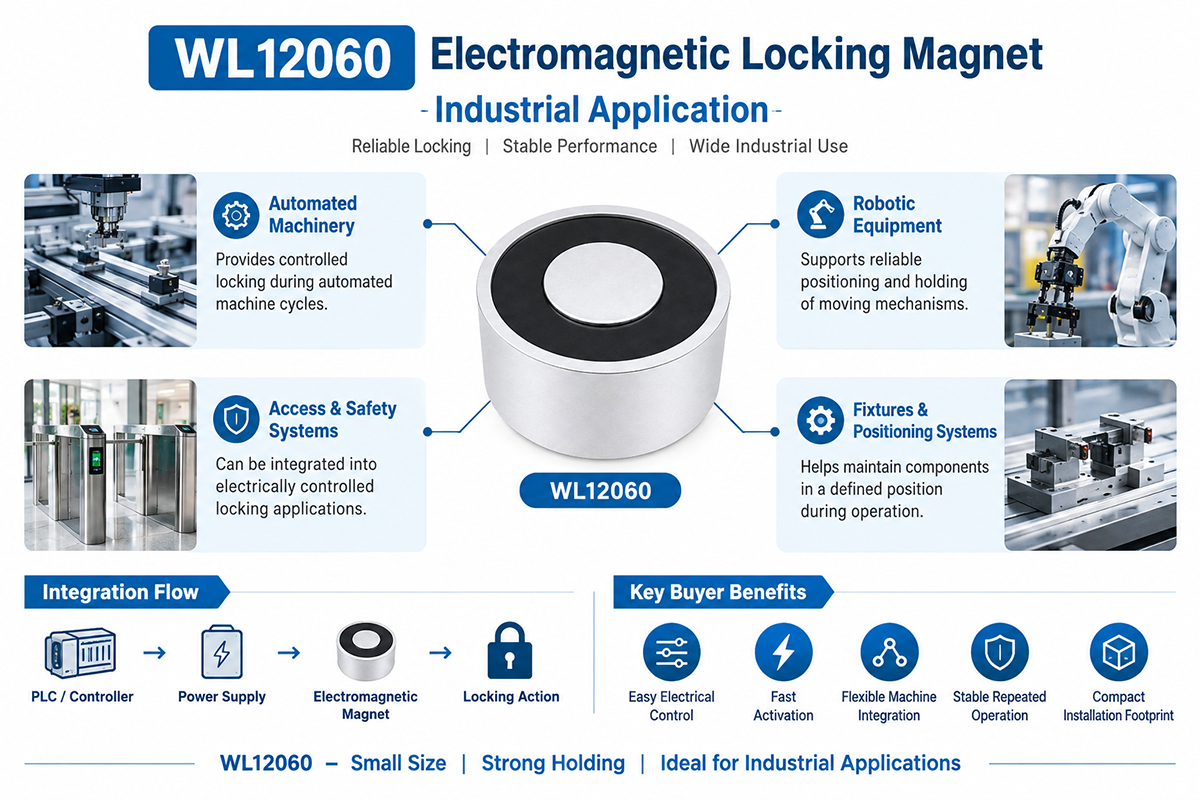
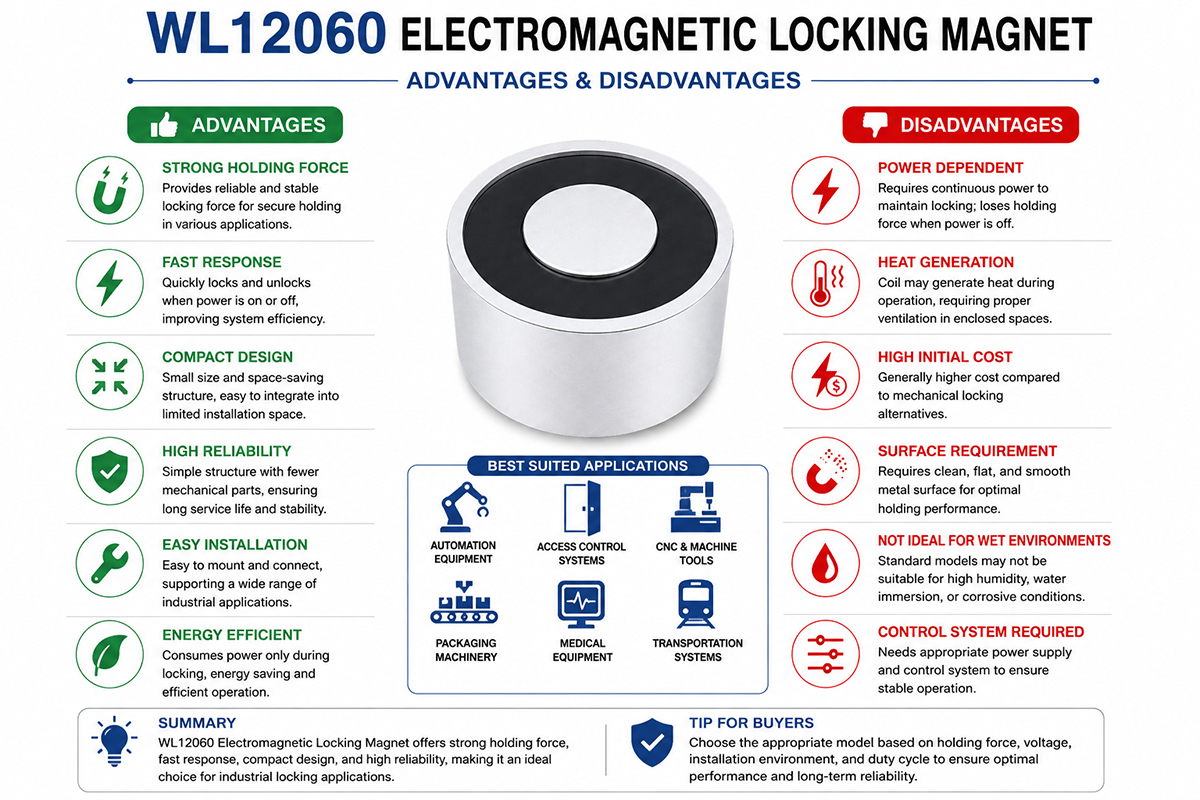
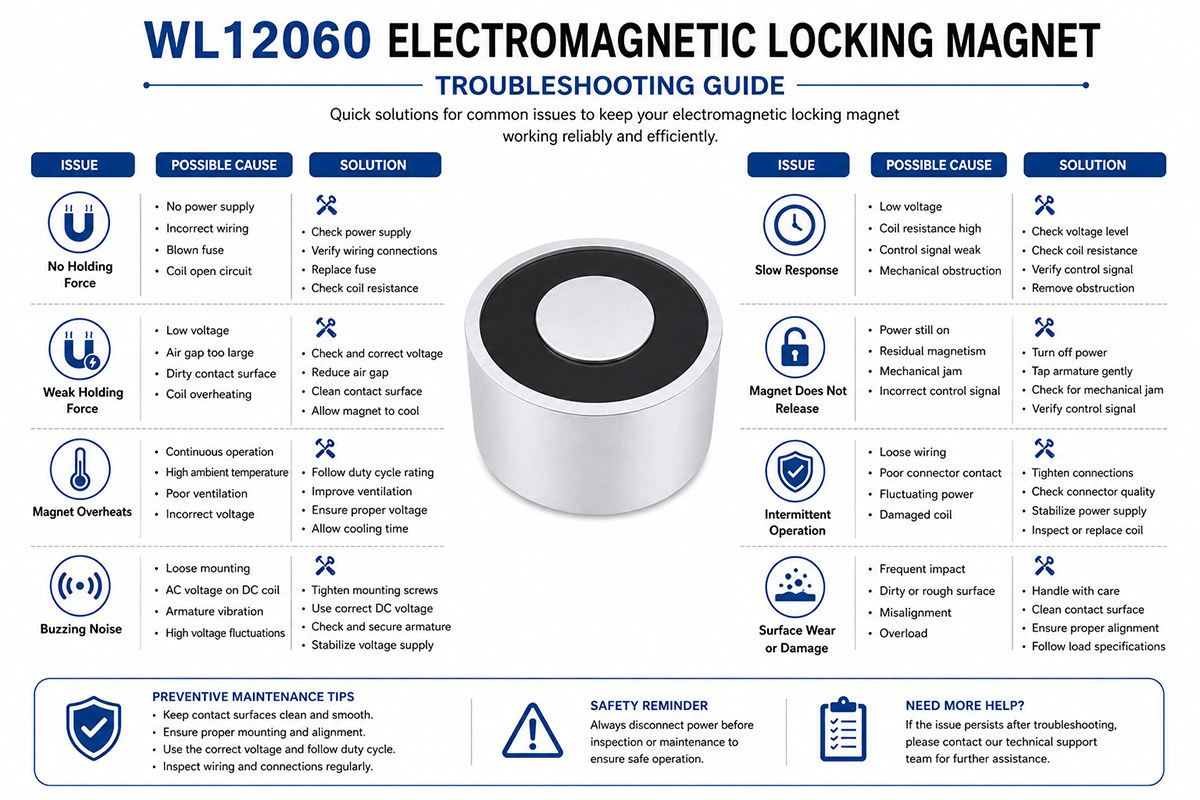
How to Select an Electromagnetic Locking Magnet
When choosing an electromagnetic locking magnet, you cannot just take the unit with the highest holding force. The magnet must be selected taking into account mechanical, electrical and environmental requirements of the application.
1. Calculate Minimum Required Holding Force
Determine the required force to hold a door, cover, panel or machine component closed. Consider vibration, impact, movement and external forces. The magnet shall operate with safety margin rather than at the maximum holding force all the time.
2. Check Voltage Requirement
Verify the voltage of the control system, i.e. 12 VDC, 24 VDC or others. The magnet’s voltage rating should match the voltage of the power supply. Mismatched voltage can result in weak holding, overheating or coil burnout.
3. Determine the Duty Cycle
Find out whether the magnet will be operated continuously or intermittently. In case of the continuous duty application, the magnet’s coil should be designed to remain energized for the extended period with acceptable temperature rise.
4. Consider the Available Installation Area
Check the mounting hole diameter, dimensions of the magnet and the position of the armature and the available installation area. Alignment is crucial . If there is a non-uniform air gap, the magnetic holding force can be significantly reduced.
5. Assess Environmental Requirements
Select the appropriate housing and protection level for outdoor machinery or equipment in a factory where there is dust, moisture, oil or vibration. The operating temperature should be within the range of the manufacturer’s specifications.
6. Consider Release Requirements
Determine what happens to the system if the power fails. The locking configuration should correspond to the safety policy of the application. Safety critical machinery should not depend on the locking magnet itself but on the complete locking system.
7. Consider the Electrical Integration
Check compatibility with the PLC outputs, relays, sensors, switches and access control systems. Also check current draw and switching requirements.
8. Consider OEM Customization
Customized mounting hole diameter, dimensions, voltage rating, connector arrangement and magnetic performance will help improve installation and operation reliability for volume equipment.
Tips to Avoid Common Mistakes During Electromagnetic Locking Magnet Design
Avoid guessing the holding force. Calculate the actual mechanical force and apply a proper engineering safety factor.
Consider the air gap. Dust, paint, improper alignment of magnet and armature, deformation can significantly reduce the magnetic force.
Select the correct voltage. Always use the coil rating consistent with the control voltage.
Consider the heat generation. With continuous energization, coil temperature can increase and thermal behavior should be accounted for.
Consider the mounting hardware. The mechanical fastener has to withstand the expected vibration and loads.
Consider the power loss behavior. Determine whether a specific fail-safe or fail-secure configuration is needed for the application.
Check the alignment before installation. Armature must make a good contact with the magnet surface.
Consider the environment. Dust, moisture, oil and temperature can influence long-term reliability.
Do not design only the magnet. Evaluate the entire locking system including control and mechanical components.
Do not skip the prototype testing. The testing should determine holding force, temperature, cycle life and release behavior.


