


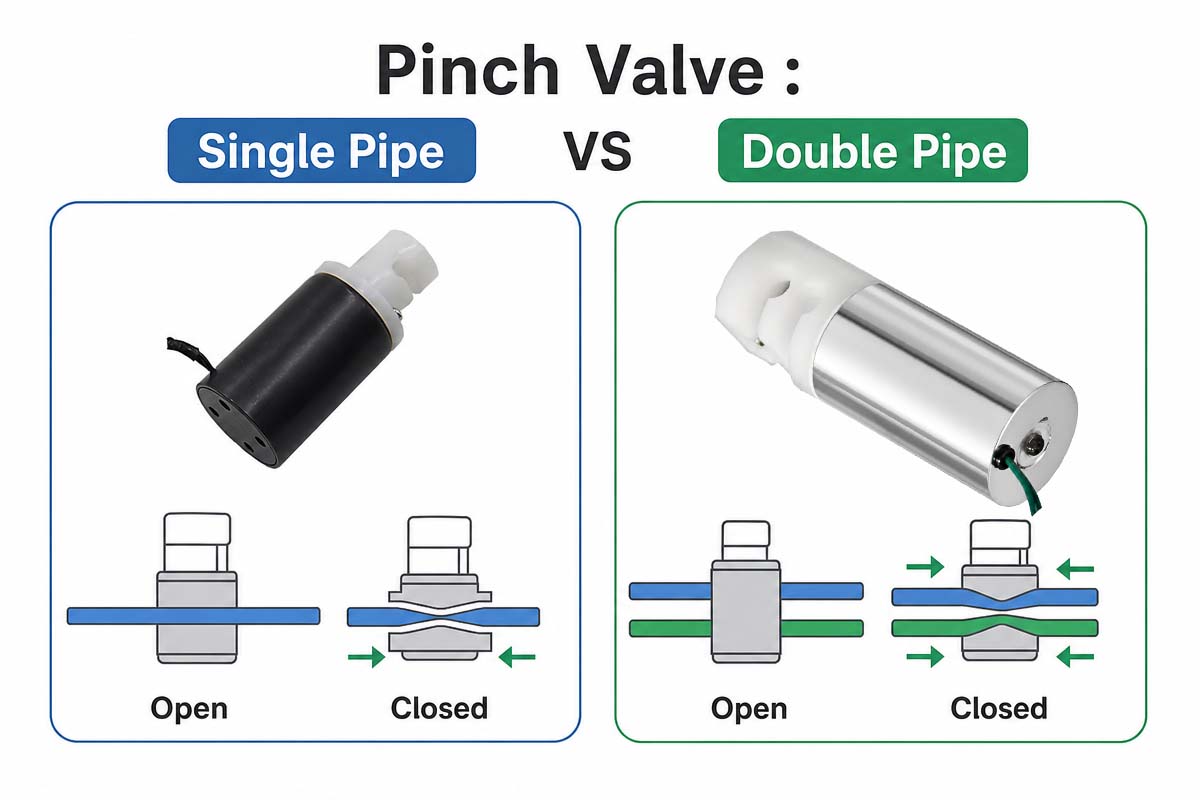
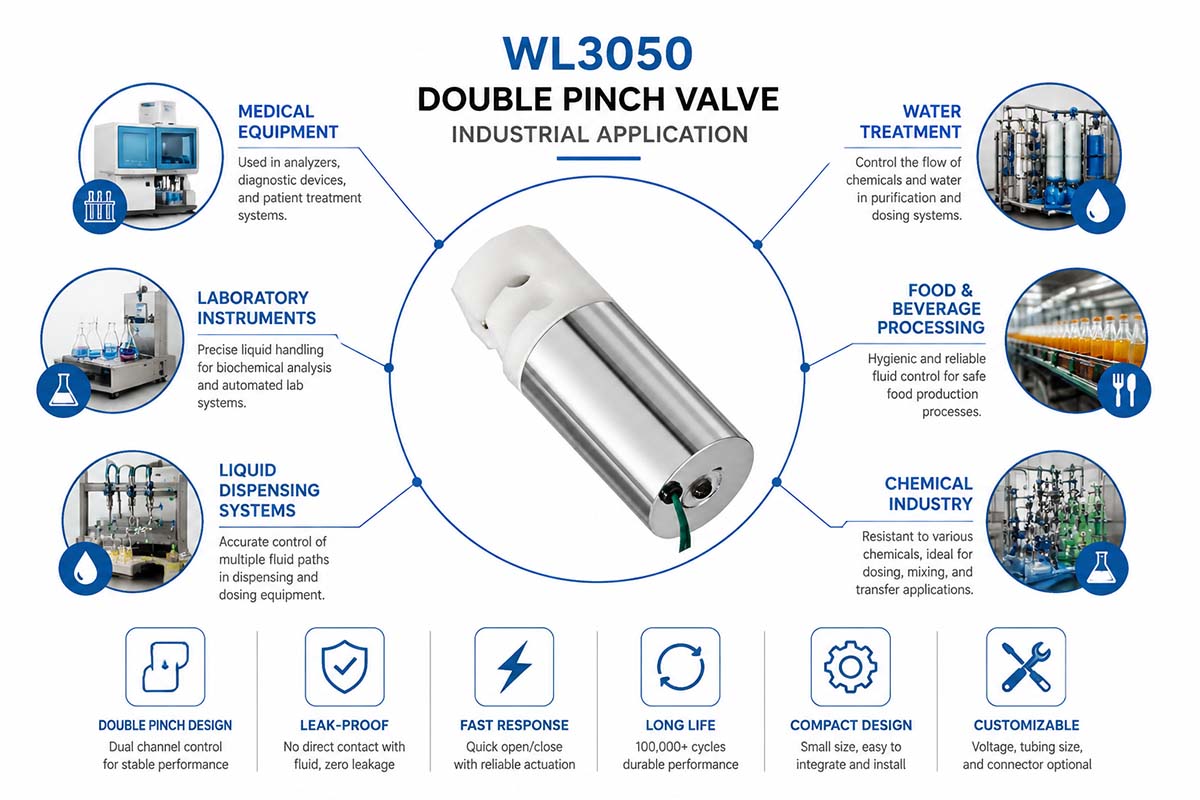
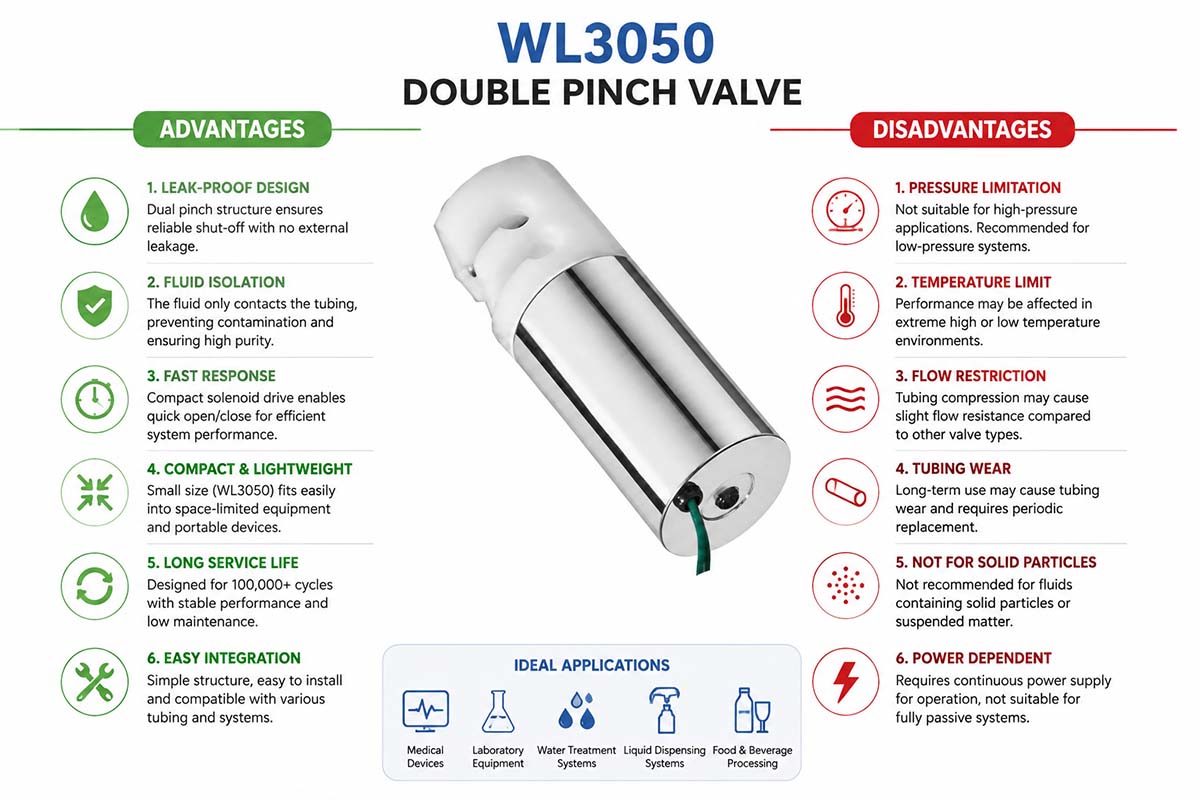
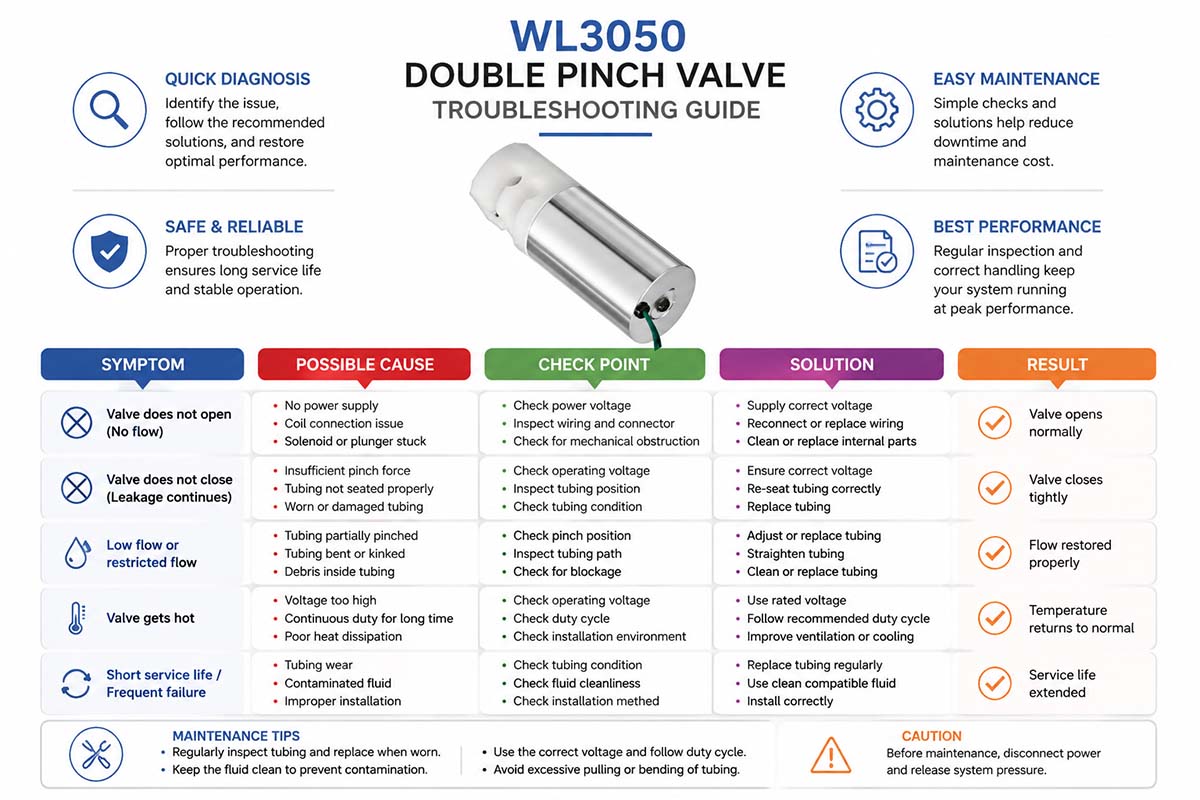
How to Select a Double Pinch Valve?
Careful thought should be taken for the mechanical design, the liquid characteristic, the electrical requirements, and the application condition in the selection of the suitable double pinch valve. Selected valves can guarantee stable performance, longer service life, and flow control dependability.
1. Show the size and material of the tube.
The first step is to determine the specifications of the tubing. Valve performance is directly related to the tube outer diameter, inner diameter, wall thickness, hardness, and material.
Different applications require different tube materials:
medical tube silicone
general-purpose PVC liquid control tube
PTFE tube for chemical resistance
special elastomers for high-temperature applications
The pinch force should match the tube hardness to achieve perfect shutoff without damaging the tube.
2. Check the operating voltage and power requirement.
Double pinch valves are usually actuated by electrical actuators such as solenoids.
Typical voltage is
5V DC, 12V DC, 24V DC
48 Volt DC
The engineers have to take the following factors into consideration:
available power source
current usage
duty cycle
heat generation
response time requirements
For medical devices, the low-power design is preferable to reduce the thermal impact.
3. Confirm closing force requirement
One of the most important parameters is the closing force.
If the force is too weak:
The tube may not be completely closed.
fluid can be escaped
Flow control is unstable.
If the force is too strong:
Tube life can be shortened.
The actuator can become larger.
energy consumption increases
It is necesachieve to find a balance between sealing performance and tube durability.
4. Consider the speed of response
Some applications require higher switching speed than other applications.
The applications include
diagnostic methods
automatic analyzers
may need fast-response valves. Dispensing Machines
Response time is affected by actuator structure, spring design, moving parts, and electrical parameters.
5. Determine cycle life requirements
Industrial and medical devices may need to survive thousands or millions of cycles of operation.
The key points are
tube endurance strength
wear, mechanical
actuators’ durability
work environment
Test a high-quality double pinch valve in real working condition.
6. Take into account the installation dimension.
Small medical devices have limited internal space.
The engineers have to evaluate:
valve size
mounting hole
connector position
cable orientation
maintenance access
Many OEM equipment manufacturers need custom designs.
7. Choose a reputable manufacturer
The professional pinch valve manufacturer should provide:
engineering support
prototype creation
performance test
customized tools
quality control documents
Selecting the right manufacturer can reduce the development risks and guarantee the product reliability.
How to Avoid the Common Mistakes in Double Pinch Valve System Design and Solutions
Design engineers who design double pinch valve systems will take care of the valve size and operating voltage and ignore the important aspects related to the mechanics and applications. These mistakes may cause leakage, poor lifetime, unstable behavior, or development costs.
1. Incorrect Selection of Tubing
One of the most common mistakes people make while designing a pinch valve system is selecting tubing that is either too rigid or too soft.
Too rigid tubing can be pinched too strongly, while too soft tubing may get distorted after repeated use.
Solution:
Select tubing based on the following parameters:
Chemical compatibility
Temperature range:
Pressure specifications
Expected lifetime
2. Pinch Force Inadequate
Some valve systems may neglect the forcrequired to pinch the tubing completelyng.
Possible consequences:
Fluid leakage
Partial shut-off
Poor repeatability
Solution:
The valve should be tested with real tubing and operating pressure before finalizing the design.
3. Duty Cycle Ignored
Some electromagnetic pinch valves may develop excessive heat during continuous operation.
Incorrect duty cycle selection may result in the following:
Coil overheating
Reduced life span
Malfunction
Solution:
Please clarify whether the application requires:
Pulse mode of operation
Intermittent operation
Continuous holding operation
4. Excessive Size of Valve Design
A larger size of the actuator does not necessarily indicate better performance.
Some of the disadvantages of oversized design are
Increased cost
Increased equipment size
Increased power consumption
Answer: Solution:
Adapt the force, stroke, and design to the actual requirements.
5. Lack of Prototype Testing
Theoretical calculations may fail to reveal the problem of real application.
Solution:
Perform prototype testing of:
Flow characteristics
Leakage of
Audio
Temperature
Lifetime


