Compact Tubular Actuator for Engineering Systems
Tubular Actuator Applications in Automation Systems.
High Performance Tubular Actuator for Smart Industry solution
Tubular Actuator for Medical and Automation Systems
Compact Linear Tubular Solenoid for Precision Control Systems
Energy Efficient Tubular Actuator Technology Guide
Compact Tubular Actuator for Engineering Systems
Tubular Actuator Applications in Automation Systems.
High Performance Tubular Actuator for Smart Industry solution
Tubular Actuator for Medical and Automation Systems
Compact Linear Tubular Solenoid for Precision Control Systems
Energy Efficient Tubular Actuator Technology Guide

WL2432 Tubular Actuator for Industrial Automation Solutions

The tubular actuator solenoid is a linear actuator used in modern industrial equipment. It is based on the use of the electromagnetic force. It transforms the electrical energy into linear mechanical movement in a controlled manner. Thanks to the tubular design, such a linear actuator provides maximum force output with minimum dimensions. The tubular actuator solenoids are extensively used in automation equipment, medical devices, vending machines, security locks, and valve control systems. They provide fast response, extended life and stable performance under constant operation. Tubular solenoids are preferred in the field of precision engineering due to simple design and reliable operation. They can be used in pull or push applications as required by the system. Engineers appreciate such actuators due to simplicity in integration and minimal maintenance requirements. Tubular actuator solenoids are increasingly used as the elements of modern industrial motion control systems due to the development of the industry of automation solutions.

Tubular Actuator Solenoid Product Overview

The tubular actuator solenoid is a precision-made electromagnetic device which allows efficient linear motion control. It has a small cylindrical construction consisting of a coil, plunger and return spring. When it is energized, it generates the magnetic field which provides the controlled movement of the plunger. It is known for its fast response and high reliability and is used widely in automation, medical and industrial systems. Its compact design allows efficient integration into limited space applications. The solenoid is designed for long operational life and dependable performance in the demanding conditions. It is an integral part of modern motion control and automation engineering systems worldwide.

HOW TUBULAR ACTUATOR SOLENOID WORKS

The operation principle of a solenoid tubular actuator is based on the principle of electromagnetic induction. Upon applying electric current to the coil, the magnetic field is generated inside the tubular actuator solenoid. As a result, the internal plunger is attracted to the energized coil. Upon de-energization, the return spring pushes the plunger back to its initial position. Thus, precise control of the linear motion is provided using simple ON/OFF mechanism. Its efficiency depends on the coil power, applied voltage and air gap. The tubular design provides efficient magnetic circuit which means that it provides maximum force output and response compared to open frame solenoids. It is widely used in automation, valve control, and mechanical locking systems.

 KEY FEATURES Of TUBULAR ACTUATOR SOLENOID

Tubular actuator solenoids provide high compactness, efficiency and fast response. The tubular design allows efficient concentration of the magnetic flux and provision of stable linear motion output. The solenoids are designed for long operational life with minimal maintenance requirements. They are designed for efficient continuous duty and high speed switching. They provide precise control which makes them excellent solution for automation and control systems. Improved durability and resistance to environmental factors is provided due to the sealed tubular design. Easy installation and flexible mounting options improve the process of integration. The tubular actuator solenoids are available in a wide variety of voltages and stroke lengths to fit different industrial applications.

Compact Tubular Actuator Solenoid Video

Compact Tubular Actuator Solenoid Detailed Display

Tubular Actuator Solenoid Technical Datasheet

Brand Weilong Technology Model Number WL 2432
Rated Voltage (V) DC 12 or 24 V Rated Power(W) 10–15 W
Work Model  100 000 Lifespan Cycles Push PUll Force (N)  100 Gf at stroke distance of 10 mm
Stroke(mm) 3–10 MM Reset Time(s) 1 S 3S Off


Service Life 300 Thousand Times Certification CE,ROHS,ISO9001,
Material Carbon Steel Housing with Zinc Plated Coating Lead Wire Length(mm) 200
Install Style both side with three mounted Screw Holes for easy setting up Tolerance of Dimension  +/-  0.1 MM
Water-proof  None Insulation Class F  Cel.  150 Degree
Hi-Pot Test AC 600V 50/60Hz 1 s Non-excitation Holding Force 0
Working Temperature -10°C-100°C Duty Cycle 1-100%
Thread Depth(mm) / Payment Term TT, or LC At Sight
Sample Order Yes Warranty 1 Year
MOQ 500 pcs Supply Ability 5000 pcs per Week
Delivery Time 30 Days Port of Loading shenzhend

Why the popularity of Tubular Actuator Solenoids increases?

Nowadays, the modern industrial and automation systems require tubular actuator solenoids as the perfect solution for the compact and efficient motion control solution. _

1.📏 Compact size for modern equipment

Industries are developing towards smaller and smarter devices. Tubular solenoids provide high force output in a very small cylindrical body making them the perfect choice for space-limited applications like vending machines, medical devices and smart locks.

 2.⚡ High Efficiency and Fast Response

They provide fast and immediate linear motion upon energization for high-speed switching in automation systems. The fast response improves the production efficiency.

 3.🎯 High Precision Linear Movement

Tubular solenoids provide smooth, accurate and repeatable motion, unlike many mechanical systems and are essential for robotics, valve control and precision equipment.

4.🔧 Simple system integration

Their simple design and standardization allow efficient integration in the existing mechanical and electronic systems without complicated modifications.

5. 🏭 Broader industrial applications

They are used in many industries:

Automation equipment

Medical material

Automotive systems

Access Control

Vending machines

This diversity greatly increases their market demand.

6.🔋 Energy efficient operation

Modern tubular solenoids are more energy-efficient and easier to thermally control.

 7. 🛠️ Durable and Reliable

Thanks to few moving parts and robust design they can operate for millions of cycles reducing the maintenance costs and downtimes.

8. 📈 Development of Automation and Smart Industry

The demand for compact electromagnetic actuators like tubular solenoids is increasing due to the growth of the Industry 4.0 and smart manufacturing technologies.

9. ✅ Conclusion

Tubular actuator solenoids are appreciated for their compact design, fast response, high precision and industrial versatility and represent one of the most efficient solutions for modern automation systems.

Tubular Actuator Solenoid for Industrial Application

Tubular Actuator Solenoid for industrial application

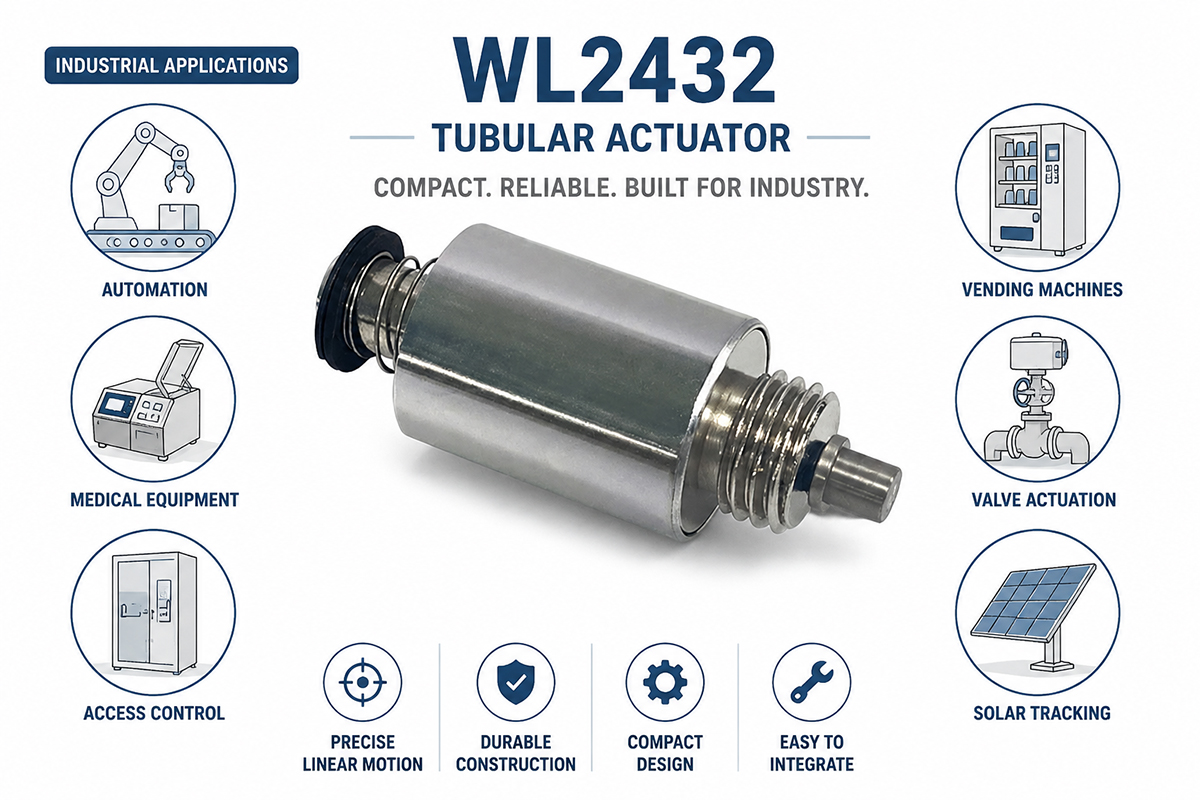
Tubular actuator solenoids are widely used in a great number of industrial and commercial applications due to the small size and dependability. They are used to provide positioning, locking and control mechanisms in automation systems with precise linear movement. They are used to efficiently control the release mechanisms in vending machines. The tubular solenoids are used in medical equipment to provide precise linear movement in diagnostic and fluid control equipment. They are used in automotive applications in fuel systems, locking mechanisms and control valves. They are used to actuate clamping, ejecting, switching and many other functions in industrial machinery. They are used in access control systems, e.g. electronic locks and security devices. They are also used in robotics and smart home systems to provide controlled motion functions. Their fast response and high reliability make them a great solution for high-cycle operations. Their compact design allows easy fitting into the space-limited equipment. Their versatility across industries makes them a vital part of modern engineering and automation solutions which require efficient and precise linear actuation.

Tubular Actuator Solenoid advantage and disadvantage

Tubular Actuator Solenoid advantage and disadvantage

Tubular Actuator Solenoid Strengths and Weaknesses

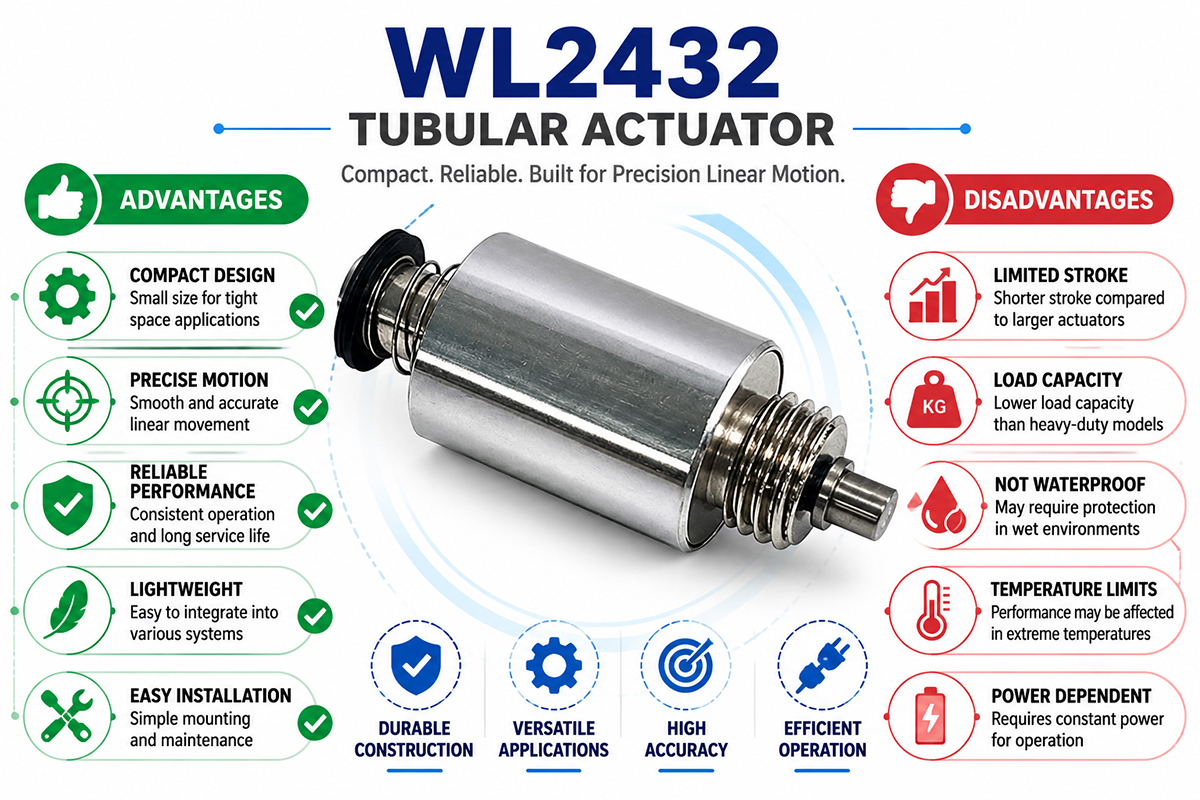
Tubular actuator solenoids are popular in automated equipment thanks to their small size, reliable operation, and exact linear displacement. Still, as any electromagnetic actuators, they have certain advantages and disadvantages that must be considered while choosing one actuator or another.

✅ Strengths of Tubular Actuator Solenoids

1. Small Size

Compact cylindrical (tubular) form factor provides high electromagnetic force density, which makes them perfect for automated machines with limited installation space.

Advantages

Easier integration into small equipment

Reduced equipment size

Flexible mounting options

2. Quick Reaction

Response of tubular solenoids occurs in an instant, which makes them useful in automated equipment.

Advantages

Faster production cycles

Exact switching

Increased operating efficiency

3.Reliable Operation

Small number of moving parts and simplicity of the mechanical design ensures long lifespan and reliable operation.

Advantages

Millions of operating cycles

Reduced maintenance needs

Less downtime

4. High Force-to-Size Ratio

Optimized magnetic circuit ensures the highest electromagnetic force per unit size of the actuator.

Advantages

Increased force output

Effective use of installation space

Suits for demanding applications

5. Easy Installation

Cylindrical form factor of the tubular solenoids simplifies their integration into automated equipment.

Advantages

Reduced time of installation

Simple replacing

Reduced installation cost

6. Minimal Maintenance Needs

There are no gears, belts or other transmission mechanisms, which reduces maintenance.

Advantages

Minimal operating costs

Increased reliability of the equipment

7. Multiple Voltages Available

Multiple voltage ratings available for tubular applications lude:

6V DC

12V DC

24V DC

48V DC

Custom voltages

It increases their compatibility with different control systems.

8. Various Applications

These actuators are popular in:

Industrial automation

Medical devices

Vending machines

Electronic door locks

Valve control systems

Packaging machinery

Textile equipment

Robotics

❌ Weaknesses of Tubular Actuator Solenoids

1. Short Stroke

Tubular actuators are meant to work in conditions of short linear displacements.

Limitation

Can not be replaced by electric cylinders or linear motors where long stroke is needed.

2. Reduction of Electromagnetic Force in Long Strokes

Strength of the electromagnetic force of tubular actuator depends on the air gap. The higher it is, the weaker the force is.

Consequence

Longer strokes usually lead to lower force output.

3.Heat Generation

Operation causes heating of the coil.

Danger

Increased coil temperature

Reduced lifetime of the insulating material

Reduced efficiency

Proper designing of duty cycle is required.

4. Increased Power Consumption at Activation

Strong magnetic field requires a large amount of current.

Consideration

Power supply must be designed properly for peak current consumption.

5. Binary Action

Tubular solenoids are intended mainly for linear actuation.

Limitation

Applications which require positional control might benefit from using servo actuators or linear actuators powered by a stepper motor.

6.Sensitive to the Misalignment

Improper installation can cause increased friction and decreased efficiency.

Recommendation

Use accurate alignment and eliminate side loads during installation.

7.Additional Protection Against Environment Needed

Standard products might be not protected against harsh environment.

Protection

Waterproofing

Dust protection

Corrosion resistance

Heat resistance

8 Advantages vs. Disadvantages Comparison

Advantages Disadvantages
Compact design Limited stroke length
Fast response Force decreases over long strokes
High force-to-size ratio Coil generates heat during continuous use
Long service life Requires adequate power supply
Easy installation Mainly suitable for ON/OFF motion
Low maintenance Sensitive to mechanical misalignment
Reliable operation May require environmental protection
Wide industrial applications Not ideal for long-distance linear travel

Tubular Actuator Solenoid Troubleshooting Guide

Tubular Actuator Solenoid Troubleshooting Guide

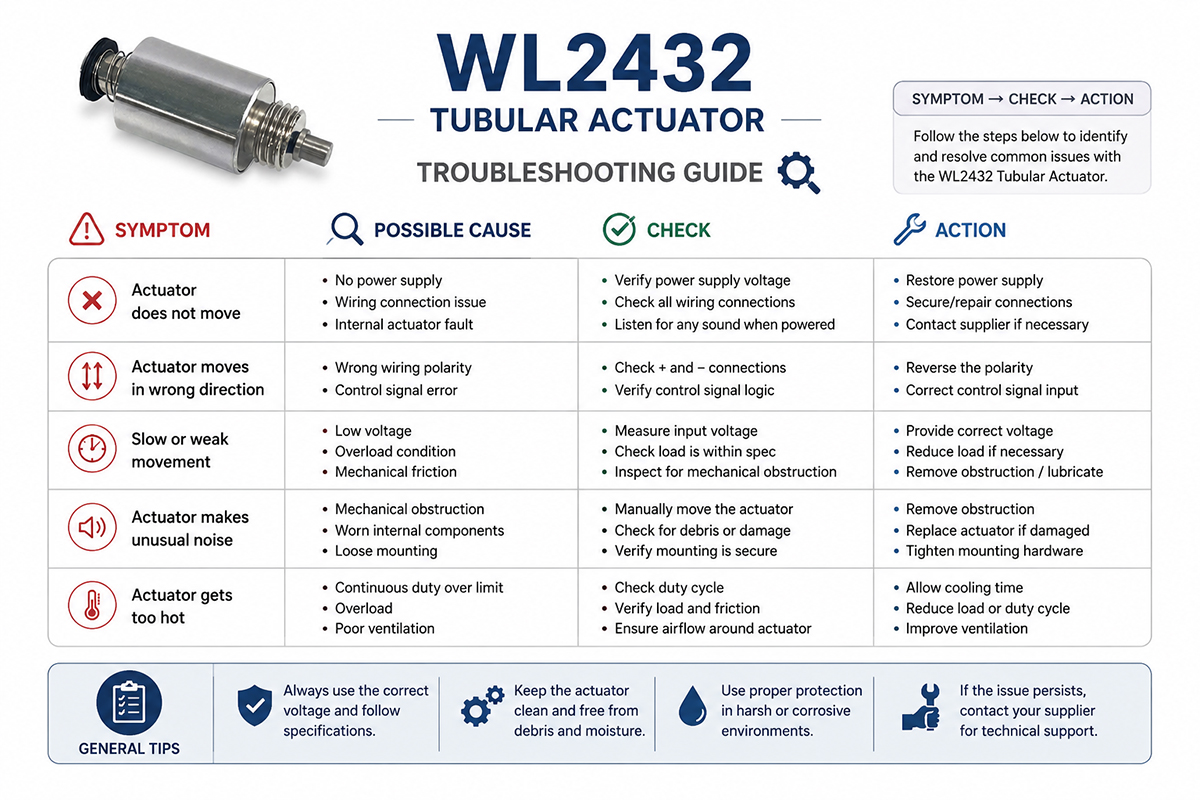
Tubular actuator solenoid troubleshooting starts with determining the symptom. The first thing to check if the actuator doesn’t move is the power supply and the wiring connections. Usually, it is a loose connection or incorrect wiring which results in malfunction. Slow or weak movement could be caused by low voltage or mechanical friction. It is recommended to check input voltage and proper load matching.

If the actuator moves in the wrong direction, it is necessary to check for the polarity or control signal error. In most cases, the problem is solved by reversing the leads or fixing control logic. The unusual noise during operation is a sign of internal wear, dirtiness or loose mounting. The performance can be improved by cleaning and tightening the components.

The overheating of the solenoid is usually a result of high duty cycle or poor ventilation. To avoid the damage, the frequency of operation should be reduced or the ventilation improved. Mechanical obstruction and free movement of plunger are critical in any situation. Regular maintenance prevents the long-term failure. If the problem persists, it is recommended to replace the solenoid or contact the manufacturer.

FAQs of Tubular Actuator solenoid

1. What is tubular actuator solenoid used for?

A tubular actuator solenoid converts electrical energy into exact linear motion. It is used widely in automation systems, medical devices, vending machines and valve control systems where fast and accurate movement is required.

2. How does a tube type solenoid actuator work?

It operates on the principle of generating the magnetic field when it is powered. The coil attracts the internal plunger in straight line providing controlled motion. The return spring returns it to initial position when power is turned off.

3. What is the difference between tubular solenoids and other solenoids ?

A tubular solenoid is a compact cylinder with higher force output. They have better magnetic flux utilization and are appropriate for space limited applications with high precision.

4. Can Tubular Actuator Be Operated Continuously?

Depending on the design they can be used in continuous or high duty cycles. Thermal management is required to avoid overheating and to provide long service life.

5. Which industries utilize tubular actuator solenoids?

Due to their reliability and compact size, they are used extensively in industrial automation, medical equipment, automotive systems, vending machines, access control systems and smart devices.

6. Typical problems in tubular solenoids are:

No movement (power failure), weak force (low voltage), overheating (high duty cycle), mechanical obstruction inside the actuator.

7. How long does a tubular solenoid last?

Life expectancy is determined by load, duty cycle and operating conditions. High quality tubular solenoids can last for millions of cycles if properly installed and maintained.

8. How to select the correct tubular actuator solenoid?

It depends on the force requirement, stroke length, voltage, duty cycle, available installation space and environmental conditions.

How to choose the right tubular actuator solenoid ?

The selection of a tubular actuator solenoid should be done taking into account the requirements and operating conditions of the application. The first consideration is the requirement for force. The higher the required force is, the stronger the coil and the magnetic design will be required for proper operation. The next parameter is the stroke length. It is the distance which the plunger has to travel to perform its function. The proper voltage selection is also crucial as the solenoids are usually supplied in DC or AC versions and in common voltages like 12V, 24V, and 48V.

Another important aspect is the duty cycle. The tubular actuator solenoid with better thermal management and high heat resistance will be required for the continuous or frequent operation. When selecting the sealed or protected design, the environmental factors like temperature, humidity and dust/moisture exposure should be also considered.

The mechanical integration of the solenoid is equally important. It is the task of the engineer to make sure that the mounting style, alignment and available space are appropriate. The compact design is preferred in cramped installations. Besides, the response time requirements, especially in case of high-speed automation systems should be also taken into account.

The material will influence the longevity and resistance to corrosion, especially in demanding environment. The industrial applications usually use the stainless steel housing. The electrical efficiency should also be considered to decrease the power consumption and heat generation.

The lifecycle expectations are also important to consider as some applications require million-cycles operation without failure. Manufacturer reliability, certification and testing standards cannot be overlooked as well.

In the end, the cost/performance ratio should be the driving force for the selection process. Proper selection of the tubular actuator solenoid will allow obtaining stable performance, long service life and efficient integration into the system for the range of industrial automation applications.

How to Avoid Design Mistakes While Working With Tubular Actuator Solenoids

Design of a tubular actuator solenoid involves a number of factors which include electromagnetic performance, mechanical structure, heat dissipation, and many more. It is possible to save resources and increase reliability of your solenoids by avoiding design mistakes at early stages of their development. The following list of the most critical tips will help you make the right design decisions.

1. Proper Estimation of Force Requirement

Before designing your coil and plunger you should estimate the necessary pull/push force. Too small force could not move the load whereas too large force will lead to higher energy costs.

Tip: Do not forget about initial pull force as well as holding force that is required along the whole stroke.

2. Appropriate Selection of Stroke Length

Stroke length is one of the critical design parameters as it defines the force of your actuator. The longer the stroke the smaller the available force. Unnecessarily long stroke leads to low-performance actuator.

Tip: Make the stroke length as short as possible.

3. Choice of Correct Voltage and Current

Voltage depends on the power supply which can be 12VDC, 24VDC, or 48VDC.

Tip: Estimate voltage tolerance and current capacity before designing the actuator.

4. Estimating Duty Cycle of Your Tubular Actuator Solenoid

One of the most common mistakes of designers consists in forgetting about the duty cycle of the actuator.

Tip: Take care of proper heat dissipation as continuous-duty actuators need better thermal management than intermittent ones.

5. How to Avoid Excess Heating

Overheating is one of the primary reasons of early failure of solenoids. It destroys insulation and decreases service life.

Tip: Improve ventilation, select high-temperature insulation material, and properly wind the coil.

6. Optimizing the Magnetic Circuit

Poor magnetic circuit leads to the decrease in efficiency and force of the actuator.

Tip: Reduce the gap, select high-permeability magnetic materials, and minimize magnetic leakage.

7. Ensuring Mechanical Alignment

Misalignment between plunger and guide tube leads to increased friction, decreased force, and wear.

Tip: Follow tight machining tolerances and provide smooth linear motion.

8. Choosing Proper Spring Force

The spring should reliably reset the plunger without significant decrease of the force of the actuator.

Tip: Achieve the balance between spring and electromagnetic forces.

9. Protection Against Environment

Industrially used actuators may face various environmental conditions such as dust, moisture, vibration, oil, or even chemical corrosives.

Tip: If necessary, select stainless steel housing, apply the special coating, or design the solenoid in sealed manner.

10. Avoiding Side Loads

Side loads create additional friction, bending, and wear whereas solenoids are designed for axial linear motion.

Tip: Use the additional guide mechanism in case side loading cannot be avoided.

11. Estimating Requirements of Response Time

Response time is a parameter which differs from system to system. While some automation systems require rapid actuation, others need higher holding force.

Tip: Optimize your coil design, plunger mass, and spring properties according to the response speed required.

12. Taking into Account the Ease of Manufacture and Maintenance

Too complex design raises manufacturing costs and makes maintenance difficult.

Tip: Try to use standardized parts and components.

Get A Free Quote Now

Contact Form

Related Products

Related News

Scroll to Top

Get A Free Quote Now !

Contact Form
If you have any questions, please do not hesitate to contact us.
Weilong Solenoid Company Culture
