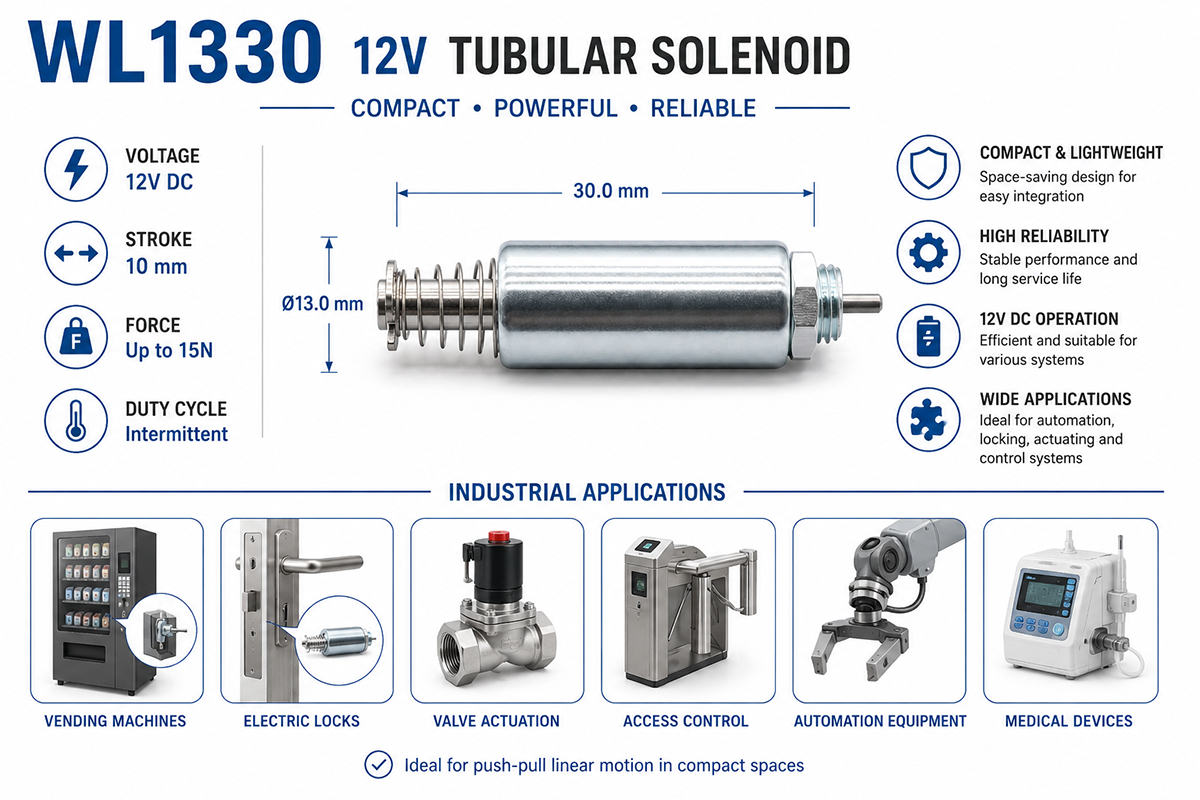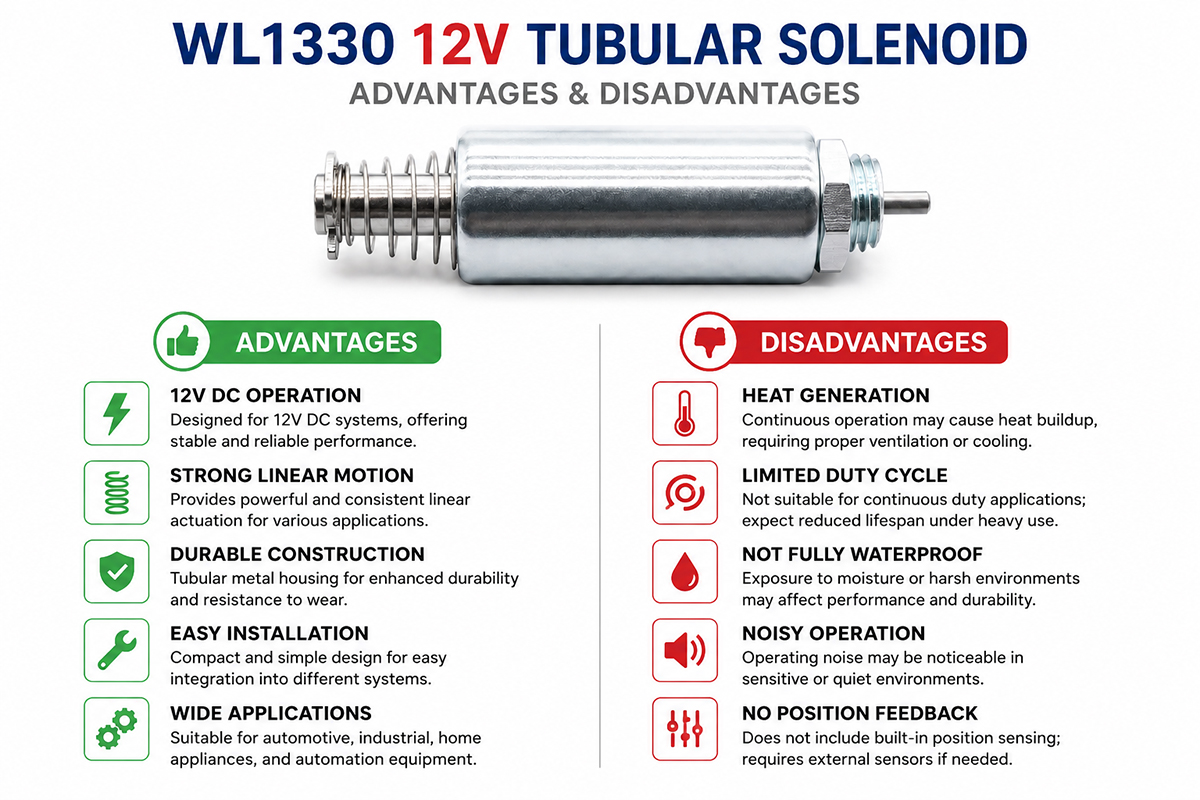
Compact 12V Tubular Solenoid Advantages
Smaller size
Greater force to size ratio
Faster response
More reliable lifetime
Minimal maintenance requirement
Higher efficiency
Noiseless operation
Easy integration into electronic devices
Flexible push and pull arrangement
Perfect for customized OEM solutions.
Compact 12V Tubular Solenoid Limitations
Decreasing output force with increasing stroke
Generating heat in long-time usage
Limited movement in comparison with the motors
Proper power management needed
Voltage above the recommended can reduce service life
Continuous duty solenoids can be costlier.
12V Tubular Solenoid Troubleshooting Guide
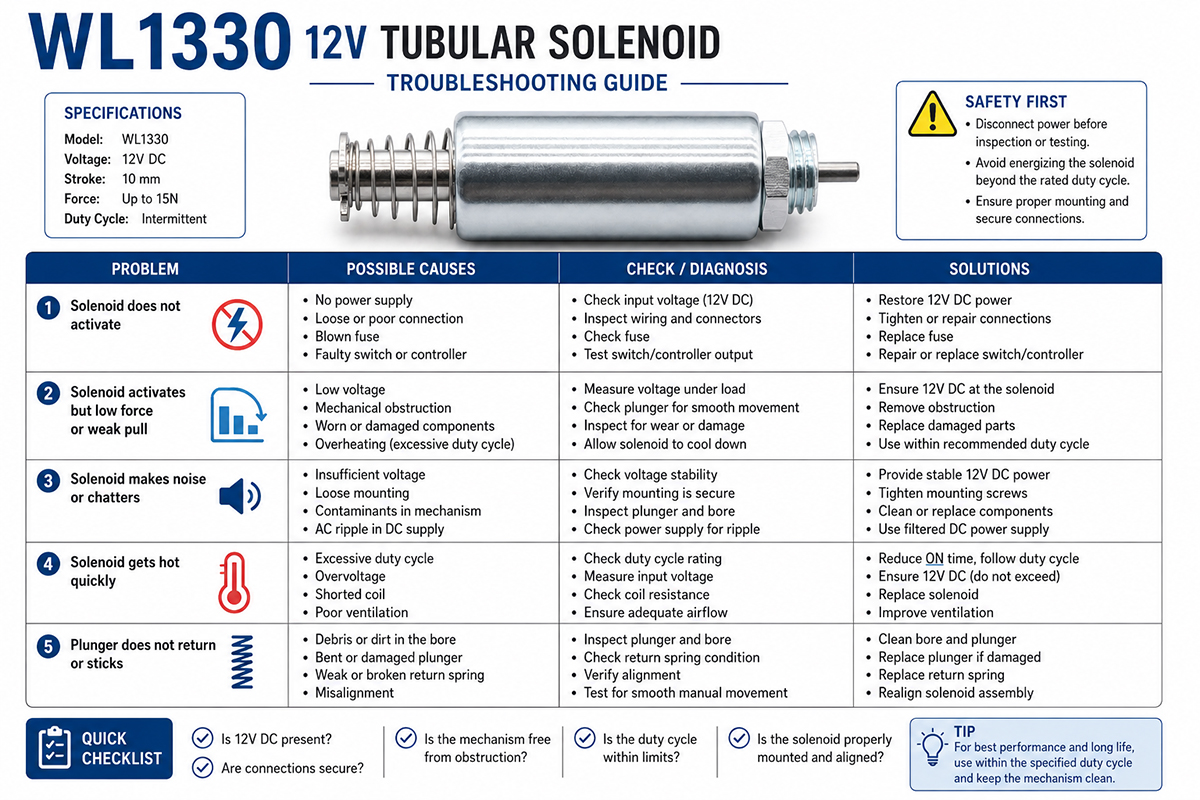
This guide offers a logical sequence that can help to troubleshoot a 12V tubular solenoid in the most efficient manner.
First one :
The first step to diagnose a problem with the device is to try listening and observing. If there is a distinct audible “click,” electrical and mechanical parts of the device work properly. In case if there is no sound or some buzzing noise, then most likely there is an electrical problem with the device, and you have to use a multimeter to find a solution.
Here is a list of steps that can be used to troubleshoot the solenoid:
Preliminary Visual & Mechanical Inspection
First of all, it is important to conduct a preliminary inspection before conducting any measurements.
Second step:
Inspect Plunger: Manually move the plunger of the device (metal stick that is supposed to move when the solenoid operates). If the plunger is stuck inside, it may be jammed, and this means that the device heats up as the coil does not shift.
Third Step:
Check the Wiring & Connection: Pay attention to possible defects and corrosion on the wiring, as well as on the connections and the grounding.
Check for Signs of Damage: Inspect for possible cracks on the casing since it might mean that moisture entered into the solenoid and caused an electrical fault.
Four Step:
Electrical Test Using Multimeter
This step is the most important one because this test allows diagnosing the problem of a solenoid in its true nature. Please note that it is recommended to disconnect a solenoid from its source of electricity before starting the tests.
Five Step:
Measure the Coil Resistance
How to: Place the test probe tips of a multimeter onto the terminals of the solenoid coil.
What to Expect?
An open circuit (infinite resistance): This suggests that a coil is damaged internally and that the device needs to be replaced.
A short circuit (very low resistance): A short circuit will cause a very high current through the coil, and this is why this condition leads to overheating and damage.
Proper Resistance: You need to compare this value with the specifications of the device, and usually, the resistance for a 12V miniature solenoid is approximately 48 Ohm with the operating current equal to 250 mA. If you do not have technical documentation, you need to remember that resistance of a solenoid of such power is usually several dozens of Ohm.
6 Measure Supply Voltage While Operating
How to: Connect a solenoid and measure the voltage across the terminals of the device with a multimeter probe tips.
What to Expect:
There Is No Voltage: This suggests that you have a problem either with a power source or with switch wiring;
Low Voltage: A solenoid requires at least 9.0V DC, and if the voltage is lower, it suggests that the battery capacity is insufficient or that the voltage was dropped due to low cross-section cables (resistance increases with the temperature rise).
Troubleshooting Guide table chart for 12V Tubular Solenoid
| Problem |
Possible Cause |
Solution |
| No movement |
No power supply |
Check voltage and wiring |
| Weak force |
Low voltage |
Verify power source |
| Overheating |
Excessive duty cycle |
Reduce energizing time |
| Slow response |
Mechanical friction |
Clean moving parts |
| Excessive noise |
Loose installation |
Tighten mounting |
| Coil burnout |
Overvoltage |
Use rated voltage |
| Plunger sticking |
Dirt contamination |
Clean and lubricate |
| Intermittent operation |
Poor electrical connection |
Inspect terminals |
| Short service life |
High impact load |
Add damping mechanism |
| Inconsistent stroke |
Incorrect alignment |
Reinstall properly |
Regular inspection and preventive maintenance greatly improve reliability and service life.