

Chapter 1 : Introduction
Air core coils are widely applied in modern electronics and form an important component of circuits requiring stable inductance and high precision. The quality of air core coils has great influence on product performance and should be taken into account. Air core coils have a significant impact on signal integrity, energy efficiency, and overall stability in the field of communication systems, sensors, medical devices, and industrial control systems. It is important for engineers and product developers, who want to create highly performing and durable electronic systems.
Chapter 2: Why Air Core inductor Coils Matter in Electronics
Air core coils are inductive elements which do not use a magnetic core, but rely on air instead. The absence of core allows preventing core losses such as hysteresis and eddy currents, which makes air core coils appropriate for high frequency applications. The performance of air core coils depends on their design accuracy, winding uniformity, and quality of materials. High quality air core coils provide stable inductance values, which are required for circuit stability. Otherwise, low quality manufacturing results in inductance variations and tuning errors. Such variation can negatively affect the performance of RF circuits, filters, and other precision analog systems.
Chapter 3:the types of Air core inductor Coil
Air-core inductors are mainly classified by their geometric shape, the type of conductor used and their application.
3.1: Classification of Shapes
The physical shape of the coil determines its magnetic field pattern, performance and ideal use case.
Solenoid Coils Most common type, wound like a spring. They are very popular and provide a good compromise between performance and simplicity.
Toroidal Coils: Wound on a donut or torus shaped form. The main advantage of them is that they confine the magnetic field inside the coil, thus reducing electromagnetic interference (EMI) with the neighboring components.
Spiral/Planar Coils Flat coils shaped in a spiral pattern, often formed on circuit boards. They are ideal for applications where there are height restrictions.
Staple Coils: A specialized geometry used in some miniaturized or MEMS (Micro-Electro-Mechanical Systems) designs, but less common.
3.2 Classification According to Conductor Type
In high frequency applications and in the audio range the type of wire affects efficiency and purity of the signal.
Single-Wire Coils The simplest and least expensive type, these employ one strand of insulated wire.
Litz Wire Coils: Consist of multiple strands of insulated wire twisted together. This design reduces energy loss due to the “skin effect” at high frequencies and is therefore preferred in high-end audio crossovers.
Foil coils: Use flat copper foil instead of round wire. They have a very large surface area and so minimize resistance and distortion, generally considered the premium choice for audio applications.
3.3 Classification by Applications
The performance requirements of a circuit often dictate the type of air-core inductor to be used.
RF & High Frequency Inductors: For VHF/UHF (Very High Frequency / Ultra High Frequency) radio applications. They are normally small (inductance in the nanohenry range) and designed for high performance (high Q factor) and stable inductance over a wide temperature range.
Audio Crossover Coils: Used in speaker crossovers to filter frequencies. They sound clean . They don’t have a magnetic core to saturate , so they give very low distortion . Available in single wire, Litz or foil types.
MEMS & Power Inductors Ultra-miniature inductors built on silicon chips. They are used in very-high-frequency power conversion and prized for tiny footprint and low parasitic losses.
3.4 Air Core vs. Ceramic Core Note
You may hear it called a “ceramic core inductor”. These are the same functionally as air-core inductors. They are grouped together because the magnetic properties are not affected by whether the material is ceramic or plastic; it just provides the coil with a physical structure to wrap around.
Chapter 4: the Stability of Inductance and Signal Integrity of Air Core Coils
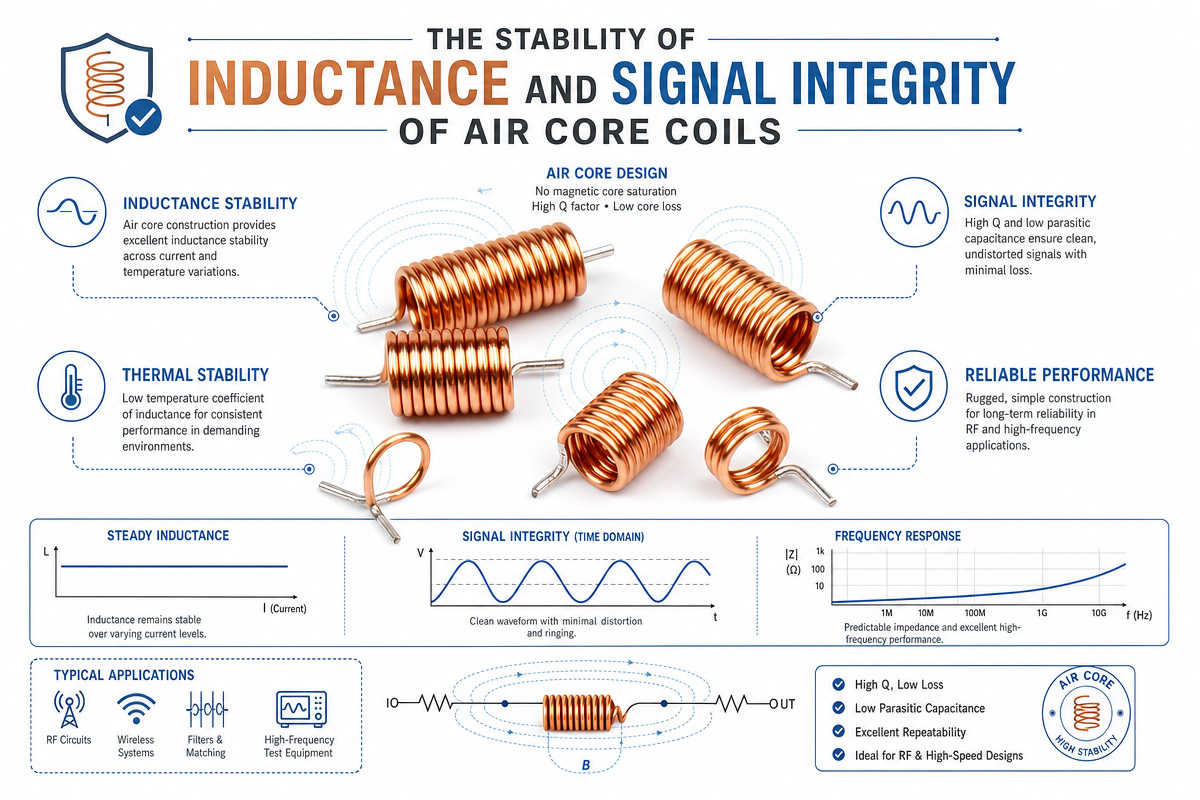
Inductance stability is one of the key features of air core coils. High quality air core coils can maintain their inductance stably during time, under temperature changes and frequency variations. Being manufactured accurately, air core coils demonstrate reliable behavior of electromagnetic properties and ensure the functioning of circuits according to design. Poor quality air core coils usually lack accurate winding geometry and, therefore, cause inductance variation. This feature is especially negative for signal integrity in communication systems. Hence, it is necessary for engineers to check air core coils prior to applying them in electronic systems. Air core coils are widely applied in high frequency electronics due to their ability to stabilize inductance.
Chapter 5: Energy Efficiency and Power Loss
Air core inductor greatly influence energy efficiency of the system. High quality air core coils allow minimizing the resistive losses and improving energy transfer in the circuit. Efficient air core coils make it possible to reduce heat generation and improve the performance of device, which is important for battery powered and energy sensitive applications. Low quality air core coils tend to have larger resistance and nonuniform winding, which increases energy loss. In such way, the efficiency of air core coils greatly influences the performance and energy efficiency of electronic systems.
Chapter 6: Reliability and Environmental Resistance
Air core coils operate in different conditions and can be affected by temperature, humidity, and vibrations. High quality air core coils are designed in order to endure external stresses and demonstrate stable electrical parameters. This allows providing the same product performance in harsh conditions and using air core coils in automotive, aerospace, and industrial systems. The poor quality of air core coils causes mechanical deformations and insulation destruction under environmental influence and leads to system failure and performance degradation. In such way, air core coil quality is an important aspect of product design and reliability.
Chapter 7: Air core inductor Product Life Cycle and Long Term Stability
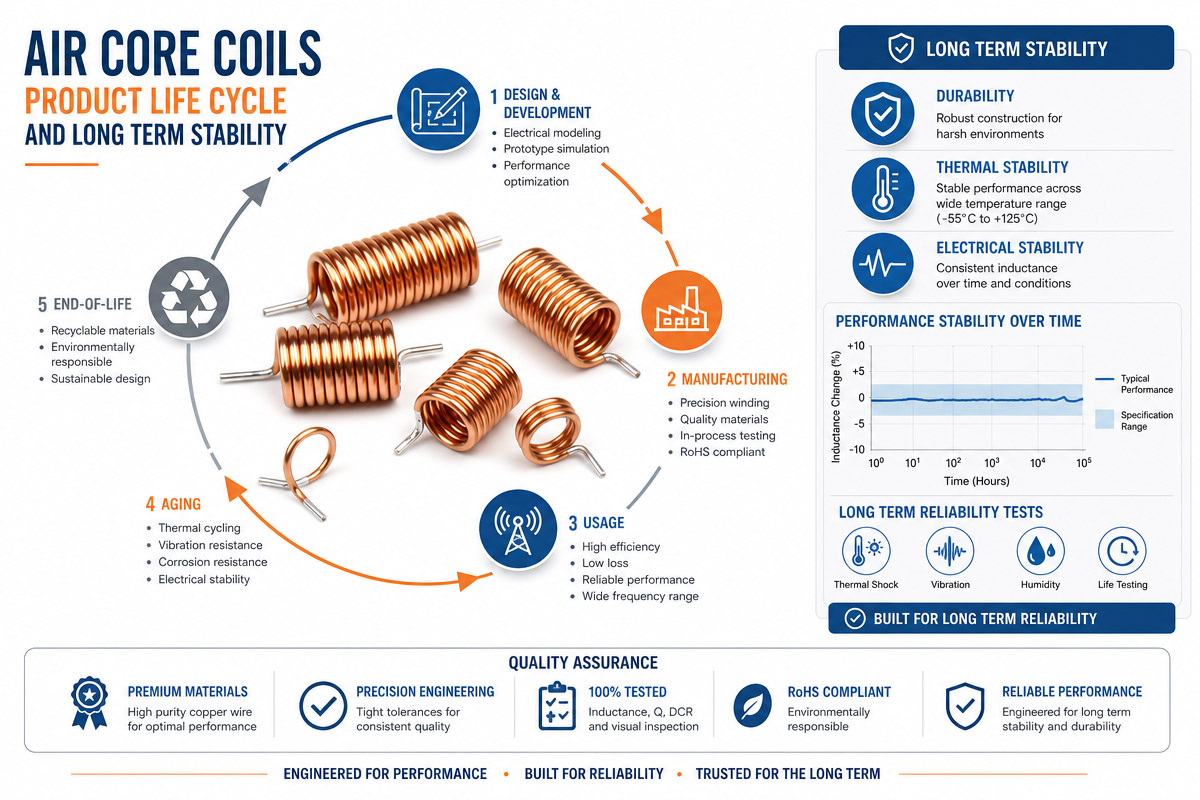
Durability of electronic products is related to the durability of their components, including air core coils. The high quality air core coils ensure stable performance of circuits in the course of time and contribute to long term product stability. Using superior materials and accurate winding provides outstanding long term reliability and reduces maintenance expenses and increases customer satisfaction. Otherwise, the low quality air core coils will become defective and drift or fail, which will shorten the life of product and increase warranty expenses. It is important to select high quality air core coils in order to increase the product durability and competitiveness.
Chapter 8: Design Accuracy and Manufacturing Repeatability
Manufacturing accuracy is an important factor, which greatly affects the performance of air core coils. High quality air core coils are made by using the advanced technology of winding which ensures uniform spacing, precise number of turns, and winding geometry. Any small design difference can lead to the difference in performance, which is important for high frequency circuits with their reliance on resonance and filtering. High quality suppliers use the strict requirements to quality control and provide the high repeatability of production in order to ensure stable performance and low variability of end products.
Chapter 9: Air core coils Performance Requirements and Applications
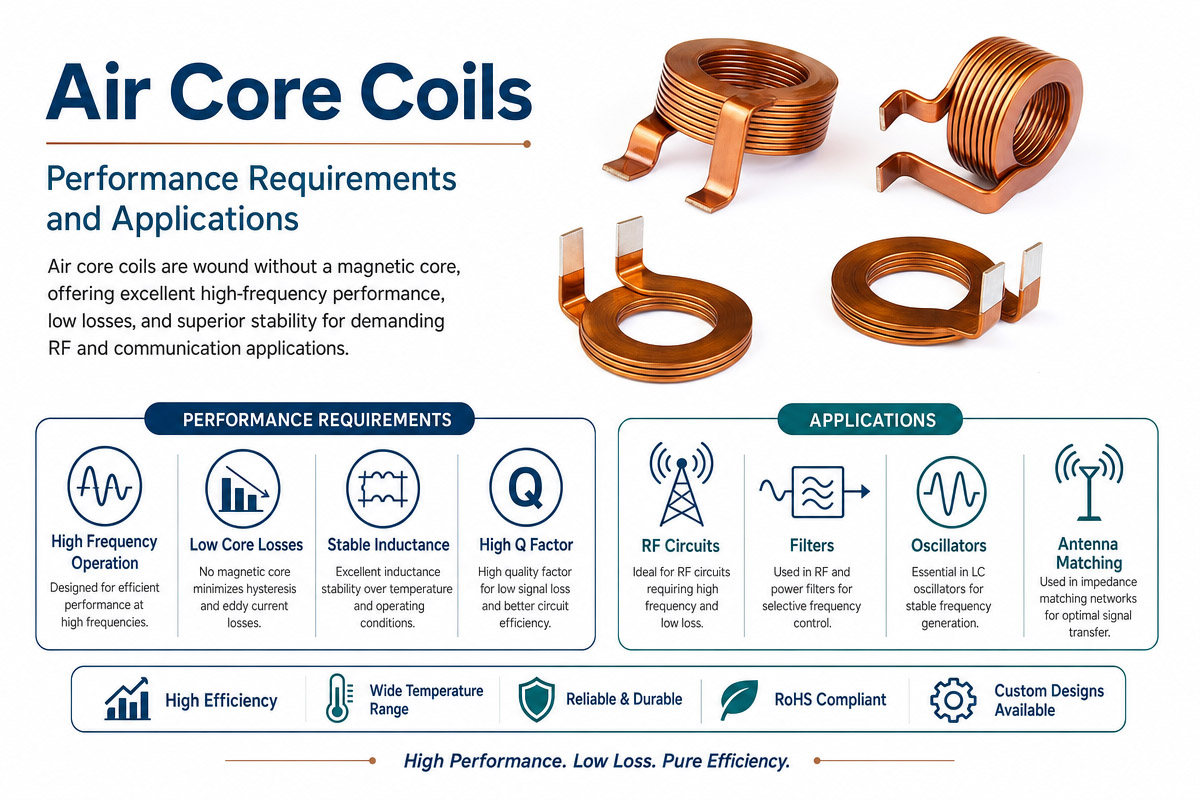
Different specifications are required for air core coils, depending on the application area. For example, RF communication systems require very stable coils with low parasitic capacitance, while power electronics need to have the ability to handle the current. While selecting air core coils, it is necessary to understand application requirements and take into account inductance range, Q factor, thermal stability, and physical size. Using the appropriate air core coils makes it possible for the final product to meet the requirements in terms of performance.
Chapter 10: Effect of Air Core Coil Quality on Product Performance
The quality of air core coils has great effect on product performance and should not be underestimated. The high quality air core coils provide stable inductance, improve the energy efficiency, and increase the long term reliability. Poor quality air core coils provide inductance variability, losses, and system instability. Even the small variations in air core coils can cause the big performance differences in sophisticated electronics. The high quality air core coils are required in order to achieve the optimal performance, especially in high frequency and precision applications.
Chapter 11:How to Choose a Air Core inductor coil
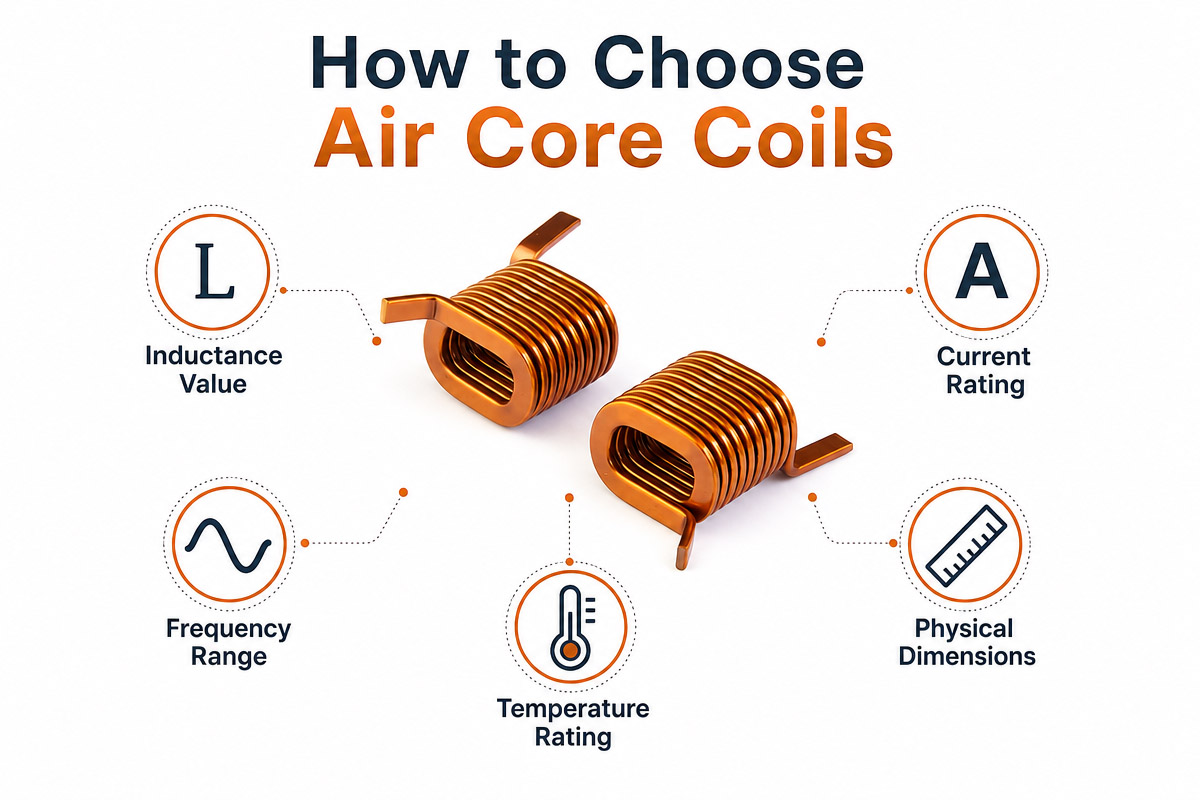
An air-core inductor is a design decision based on a series of compromises. They are the right choice when you need predictable performance without the distortions and losses of magnetic cores but at the cost of size and efficiency.
This is a step by step guide to help you choose the right one for your project.
11.1. Decision: Is Air-Core Right for You?
First, make sure an air core inductor is the best fit for your application. It shines where you need linear, low-loss performance.
Why air core?
No Saturation & Perfect Linearity The inductance is independent of the current passing through it. This makes it ideal for high power, high current or signal applications where distortion is unacceptable such as high quality audio crossovers and RF transmitters.
No Core Losses: Absence of magnetic material, absence of hysteresis or eddy current losses. This gives a large efficiency advantage especially at high frequency where core losses in ferrite or iron cores increase.
When to not use it?
Size Limitations: An air-core inductor generally requires many more turns to produce a given inductance, so it is larger and heavier than its cored counterpart.
High Inductance Requirements: The design is bulky and expensive for higher inductance values.
EMI Concerns: Uncontained magnetic field can radiate more and interfere with nearby components (EMI).
11.2. Define Your Critical Electrical Parameters
Having decided that an air-core inductor is the way to go, you have to calculate the parameters of its core. These numbers depend on your circuit design.
Inductance (L): This is where you start. What henries (or microhenries, mH) will you need?
Operating Frequency (f): Air cores really come into their own at very high frequencies (e.g. RF, >100 MHz, or in high frequency switching power supplies). They are too large for most applications at 50/60Hz. That operating frequency is a big one but the optimal geometry is a function of many things .
Current (I): You’ll need to know the RMS current (to calculate power loss) and the peak current (to make sure your wire can handle the surge).
Inductance Formula: You can use formulae such as Wheeler’s for a single-layer solenoid to estimate the turns you need based on your geometry. The inductance (L) in henrys can be estimated as:
L=0.001 • N 2
⋅ L = 0.001⋅N r 2 228 r + 254 l 228
where N is the number of turns, r is the coil radius in meters, and l is the coil length in meters (> 0.8r).
11.3. Optimize the geometry of the physical structure
Your coil is a physical balancing act in design. For a given inductance value, you’re trading off size vs DC resistance (DCR) vs self-capacitance.
Single-Layer vs Multi-Layer Single-layer coils have significantly lower self-capacitance and thus have a higher self-resonant frequency (SRF). This makes them the choice for RF and high-frequency applications above ~3 MHz. Multi-layer coils are more common at lower frequencies where the primary objective is maximum inductance from a given length of wire.
The Brooks Coil: If you have a multi-layer winding, the Brooks coil geometry (roughly square cross-section for the winding, and mean radius = 1.5 x winding depth) will give you the maximum possible inductance for a given length of wire.
Geometry Impact For high frequency applications, stray capacitance can kill performance. By spacing the turns, the capacitance is reduced but the size is increased and the inductance can be slightly reduced.
Core : It’s a ” air core ” meaning you don’t use magnetic material , but you can wind it on a non magnetic former such as a plastic or cardboard tube . For high power applications mechanical support able to withstand electromagnetic forces is essential.
11,4. Deal with the Unavoidable Losses and Impacts
If you have no magnetic core then your main worries are the copper.
Copper Loss & Heat: The main loss in an air-core inductor is the I squared R loss in the wire. Air-core inductors can be large, making them effective heat sinks, which is a benefit in high-power designs.
Skin and Proximity Effects: At high frequencies, current is forced to the surface of the conductor (skin effect) and the magnetic fields of adjacent turns force it to one side (proximity effect). This increases the AC resistance and hence the loss. The usual way to mitigate this is to use Litz wire (a bundle of thin insulated wires) especially in multi-layer windings.
Stray Capacitance Every coil has parasitic capacitance between its turns. This can make the inductor behave like a resonant circuit at high frequencies. Try to keep the coil to one layer with the turns spaced apart to get the highest possible self-resonant frequency (SRF).
Example: Selecting an air-core inductor for a high frequency filter
Let’s say you are designing a high frequency filter for an audio system or RF circuit.
You want a linear inductor that won’t distort with saturation, so you go for air-core.
Your circuit runs at a high frequency and you need an inductance of 0.33 mH.
You select a single layer coil to keep the self capacitance low and the self-resonant frequency (SRF) high.
You buy a pre-made air-core inductor, such as a Mundorf MCoil L125 with a DCR of 0.18 Ω, for your audio crossover application.
Or you can build it yourself. You decide to wind a test circuit with a PVC tube of magnet wire to make the exact inductance you need with the Wheeler formula .
Summary Table: Important Design Considerations
Air-Core Inductor Factor FactorWhy It’s Important
Core Material Nothing (Air / Insulator)The inductance remains constant regardless of current . No signal distortion .
Losses Only copper lossesVery efficient at high frequencies (no core losses: hysteresis/eddy currents).
Inductance vs SizeBigger for same LBecause there is no magnetic core you need more turns to achieve a given inductance.
High Frequency Limit Very good (GHz range)Good at very high frequencies where core materials become lossy.
EMI/RFI Stray field increases More radiation; requires careful placement, orientation or shielding.
The weighting of these factors will differ for your specific application, whether it is a power converter or a loudspeaker crossover. For example, a power converter may be optimized for maximum efficiency by minimizing copper loss, whereas an audio crossover may be optimized for linearity.
What inductance are you aiming at ? What is the frequency of operation ? I can help you to identify the geometry.
Chapter 12: FAQs
Q1. What are air core coils used for?
Air core coils are used in RF circuits, filters, oscillators, sensors, and communication systems where the loss and high frequency operation is required.
Q2. Why are air core coils preferred for high frequency applications?
Because of the absence of core losses (hysteresis and eddy currents), which allows air core coils to operate at high frequencies.
Q3. How does quality affect air core coil performance?
High quality air core coils provide stable inductance, better efficiency, and longer life, while poor quality coils can cause signal distortion and energy loss.
Q4. What should I consider when choosing air core coils?
The inductance tolerance, Q factor, thermal stability, material quality, and application requirements.
Q5. Can air core coils degrade over time?
Yes, the low quality air core coils can become defective due to the environmental stress and poor materials, while high quality coils provide long term stability.
Chapter 13: Summary
In conclusion, air core coils are important for the performance, stability, and reliability of modern electronic systems. The quality of these components has a great influence on product performance in all aspects – from inductance accuracy and energy efficiency to environmental resistance and long term durability. While their contribution cannot be underestimated, the high quality air core coils provide stable electrical parameters, minimize the energy loss, and increase the operational stability.


