
Mini Tubular Solenoid Solutions for Compact Devices
Mini Tubular Solenoid Guide for Precision Motion Use
Mini Tubular Solenoid Applications in Automation System
Mini Tubular Solenoid Benefits for Modern Equipment
Mini Tubular Solenoid Design for Reliable Operation
Mini Tubular Solenoid Technology for Smart Systems
Mini Tubular Solenoid Solutions for Compact Devices
Mini Tubular Solenoid Guide for Precision Motion Use
Mini Tubular Solenoid Applications in Automation System
Mini Tubular Solenoid Benefits for Modern Equipment
Mini Tubular Solenoid Design for Reliable Operation
Mini Tubular Solenoid Technology for Smart Systems

WL0822 Mini Tubular Solenoid Industrial Solution

A mini tubular solenoid is a compact electromagnetic actuator that converts electricity into linear motion by means of a magnetic field produced by a coil. Mini tubular solenoids consist of a coil wound around a tubular housing, a plunger, and a return spring. Once electric current is supplied to the coil, a magnetic field is formed within the housing. Thus, the plunger moves as a result of magnetic attraction or repulsion. Mini tubular solenoids find wide application because of their small size and efficient work as well as stable performance characteristics in automation devices, medical equipment, security devices, vending machines, automotive devices, and consumer electronics requiring exact linear motion.


Mini Tubular Solenoid Product Overviwe

Mini small electromagnetic devices that are intended for generating linear motion in demanding applications. A mini tubular solenoid is characterized by a tubular housing, precision winding of a coil, and a plunger that performs motion in a straight direction. Push/pull force in minimal space. Mini tubular solenoids differ in various voltage ratings, force capacity, and stroke lengths. Mini tubular solenoids feature a durable design with a high service life and ease in maintenance. Mini tubular solenoids are used in automation machinery, medical instruments, electronic locks, vending machines, and automotive devices needing precise motion control.

Working Principle of Mini Tubular Solenoid

The operation of a mini tubular solenoid relies upon the principle of electromagnetism. It contains a coil made of copper wires wrapped around the housing and a plunger made of ferromagnetic material.

Electric current is supplied to the coil.

A magnetic field is generated by the coil.

A magnetic field pulls the plunger into the central part of the coil.

The plunger moves in a straight direction, performing pushing and pulling actions.

Once the power source is disconnected, a spring returns the plunger into its initial position.

Main Characteristics of Mini Tubular Solenoid

Mini tubular solenoids possessseveralf advantages, making them a suitable option for numerous tasks. The cylindrical housing allows installing these devices in places with limited space. Moreover, mini tubular solenoids demonstrate fast response time, precise motion control, and long-term operation over millions of strokes. Tubular housing increases the efficiency of the magnetic field and protects the internal parts from dust and dirt. Mini tubular solenoids can be obtained in push, pull, latching, or special configurations. Besides, they have an extremely high power-to-size ratio, producing considerable forces for their small size. Mini tubular solenoids can boast numerous advantages, such as high service life, ease in maintenance, and customizable stroke length, voltage rating, and other features.


Company Mini Tubular Solenoid Video

Company Mini Tubular Solenoid Detailed Display

Compact Mini Tubular Solenoid Datasheet

Brand Weilong Technology Model Number WL0822
Rated Voltage (V) DC 5 V or 12 V or 24 V Rated Power (W) 3-5 W
Work Model Tubular Push-Pull Type Holding Force (N) 0.1 to 0.3 N
Stroke (mm) 3-5 MM Reset Time(s) 30 ms
Service Life 100,000 shots Certification CE, RoHS, ISO9001,
Material Carbon Steel Housing with Zinc Plated Coating Lead Wire Length (mm) 200
Holding Force:  1.8 Kgs Tolerance of Dimension  +/-  0.1 MM
Water-proof  None Insulation Class F
Hi-Pot Test AC 600V 50/60Hz 2s Non-excitation Holding Force 0
Working Temperature -10°C-100°C Duty Cycle 1-100%
Working Duty 10%–30% Payment Term TT, or LC At Sight
Sample Order Yes Warranty 1 Year
MOQ 1000 pcs Supply Ability 5000 pcs per Week
Delivery Time 30 Days Port of Loading shenzhen

Why Is the Mini Tubular Solenoid Becoming So Popular?

The popularity of mini tubular solenoids is not accidental. There are a few reasons why they have become increasingly popular. They have a unique combination of qualities, including high efficiency, reliability, and low size. These qualities have made them an essential part of our lives in the era of automation and electronic devices.

Here are the main reasons for the rising popularity of mini tubular solenoids:

1. Rapid industrial automation

The primary reason is the global trend towards automation. Manufacturers seek to boost efficiency and productivity, thus increasing the use of actuators in their machinery, among other technologies. Mini tubular solenoids are ideal for that purpose due to being able to provide fast and precise actuation and reduced cost of operations. The global market for tubular solenoids is estimated to grow from around $799 million in 2024 to $1.5 billion in 35 at a CAGR of 6%

2. Trend towards miniaturization

“With electronics getting smaller and more powerful, the components inside also need to become smaller.” Miniature solenoids have been trending upward for years due to their ability to provide high force in very compact spaces. As a result, designers choose tubular solenoids for tight spaces that still require high force.

“More and more applications have been found for tubular solenoids.”

3. Long and durable

High-quality tubular solenoids are capable of lasting very long. Their closed metal shell makes them robust as opposed to the open-frame design. High-quality mini tubular solenoids can operate without lubrication for 25 million cycles. That kind of durability and reliability make them suitable for applications such as medical devices, automatic teller machines, and automated industrial machines.”

4. Wider applications across key industries

Mini tubular solenoids have gained popularity in multiple fields of industry, including:

Medical devices: Used in diagnostic devices, ventilators, and infusion pumps that require high reliability and precision.

Automotive: Growth of electric cars is a factor. They also serve in automotive systems such as fuel injection, transmission controls, and locking mechanisms.

Consumer electronics and smart home: Smartness of homes makes the demand for miniature solenoids for home appliances and office automation devices go up. They are commonly found in lock systems in particular.

In summary, mini tubular solenoids are so popular because they address a very important engineering problem of our era: how to fit a powerful linear motion actuator in a very small space.


Mini Tubular Solenoid Industrial Application

Mini Tubular Solenoid Industrial Application

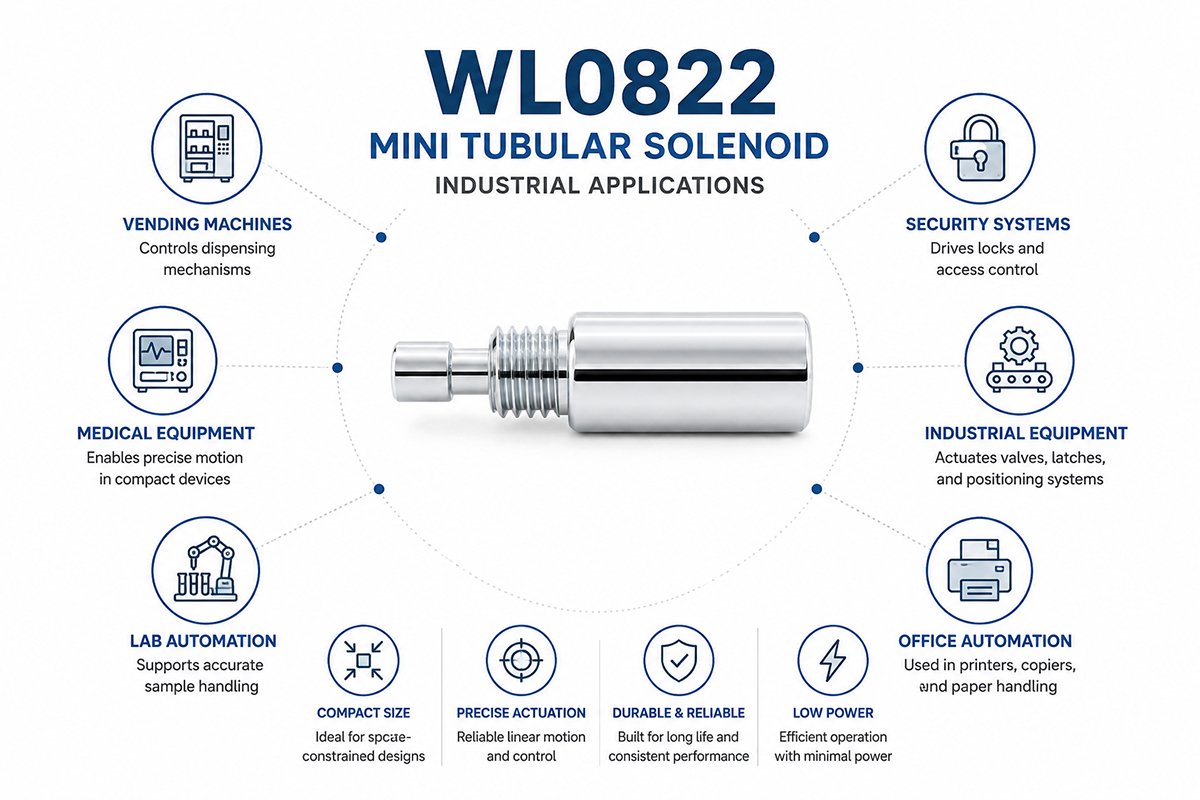
Mini tubular solenoids are used widely across a broad spectrum of industries due to their compactness, reliability, and ability to provide precise motion control.

Mini tubular solenoids are employed in automation machinery, sorting systems, robots, packaging machines, and assembly lines. Mini tubular solenoids can be found in diagnostic instruments, drug dispensers, patient monitoring equipment, and automation laboratories in the medical equipment industry.

Mini tubular solenoids are installed in security systems for electronic locks, access control devices, safes, and advanced locking systems. Mini tubular solenoids are used in the automotive industry in order to create fuel systems, door locking mechanisms, climate control units, and electronic control modules.

Vending machines, printers, scanners, game consoles, and household appliances rely on mini tubular solenoids. Telecommunication equipment is equipped with mini tubular solenoids for switching and positioning operations. Compact size and durable construction make mini tubular solenoids applicable in aerospace equipment and military systems. Mini tubular solenoids can also be found in ticketing machines, payment terminals, cash-handling equipment, and intelligent retail systems. Mini tubular solenoids constitute an integral part of modern electromechanical systems because of their flexibility, durability, and accuracy of linear motion.


Mini Tubular Solenoid Advantage and Disadvantage

Mini Tubular Solenoid: Advantages and Disadvanage

Mini Tubular Solenoid  Advantages

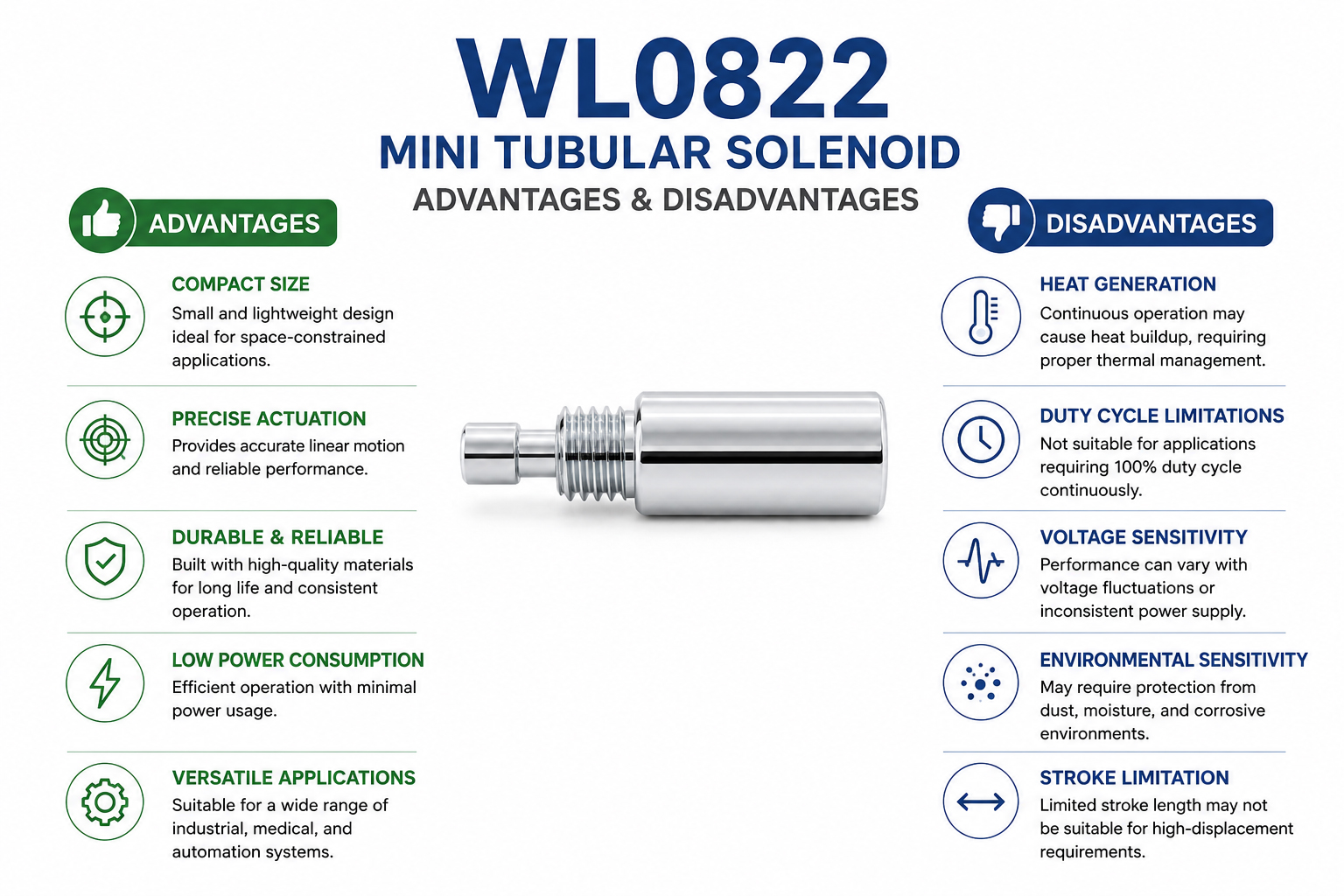
Mini tubular solenoids are very useful due to a variety of features. They are compact and yet provide excellent performance characteristics. They feature quick responses and reliable linear motion controlled by an electrical signal. The cylindrical shape allows the concentration of the magnetic flux better and protects the internal components from contamination. Furthermore, they require minimum maintenance and are highly reliable and durable, allowing millions of cycles of actuation. It is versatile enough to be used in multiple industries and applications.

Mini tubular solenoids are also affordable, energy-efficient, and configurable depending on design requirements.

Mini Tubular Solenoid  Disadvantages

Although there are plenty of advantages of mini tubular solenoids, there are also some disadvantages. Long stroke applications experience decreased force output, and insufficient cooling during continuous use commonly causes coil overheating. Certain applications may require additional hardware or circuits to provide the desired performance.

Noise is produced by the actuator during the actuation process, which may not be suitable for some applications. Small size limits the maximum force that is exerted; therefore, large actuators are more suitable for heavy-duty tasks.

Mini Tubular Solenoid Troubleshooting Guide

Mini Tubular Solenoid Trouble Shooting Guide

Proper troubleshooting is critical for the effective performance of these devices.

Doesn’t activate

Check power supply voltage

Check wire connections

Check coil continuity

Check control signals

Small actuation force

Check input voltage

Mechanical interferences

Check plunger alignment

Check load requirements

Heating problems

Look up duty cycle specifications.

Reduce the continuous energization time

Ensure sufficient ventilation

Check the voltage rating

Too much noise

Verify secure mounting

Check for the spring’s condition.

Check plunger alignment

If possible, minimize impact loads

Intermittent operation

Check electrical connections

Check wires for being loose

Test switching device

Check coil insulation

No response

Remove dirt from working parts

Reduce the level of friction

Check the stability of power supply voltage

Make sure that the solenoid is clean and free of contaminants

Proper maintenance and operation greatly prolong the service life of mini tubular solenoids


FAQs Of Industrial Tubular Mini Solenoid

1. What is a micro tubular solenoid

It is a small, cylindrical device that converts electrical energy to mechanical motion. Unlike open-frame solenoids, they have a closed metal case (made of highly permeable steel) that encloses the magnetic field within it. This leads to a relatively high force output for their size and also decreases electromagnetic interference.

2. "Push" vs. "Pull": what's the difference?

“Pull” type mini tubular solenoids pull the plunger inward towards the middle of the coil; “push” types, conversely, push the plunger outward. Mini tubular solenoids come in both configurations to cater to diverse mechanical linkages and applications.

3. Can I get a custom stroke length?

Yes, the stroke length could be adjusted for some applications. However, one should bear in mind that in tubular solenoids there is an inverse relationship between stroke length and the force output, meaning that the smaller the stroke, the greater the force is generated.

4. What is the lifetime?

Depends on the application. Standard units are rated for approximately 2 million cycles, whereas heavy-duty types reach 10 million. Life span varies greatly based on side load, plunger speed, and frequency of usage.


5. Do I need a return spring?

Most miniature tubular solenoids lack an integrated return spring, so the application must provide the spring component separately. Otherwise, a custom return spring needs to be ordered.

6. Temperature range

Typical coils are designed to operate in temperatures no higher than 120°C (248°F). The typical temperature of the coil is around 85°C (185°F). Testing at temperatures above 20°C is advised.

7. Can they run continuously (100% duty cycle)?

They can work continuously; however, it is important that duty cycle has significant influence on thermal rise. For 100% continuous operation, voltage reduction is necessary to ensure that temperature remains under permissible value (120°C)


8. What are the typical applications?

Their compactness and efficiency make them useful for medical devices, locking mechanisms, office automation, and compact industrial equipment.

Mini Tubular Solenoid Selection Criteria

Choosing mini tubular solenoids involves a thorough assessment of working conditions and technical specifications of the intended application.

1. Calculate Required Force

Calculate the force needed for the motion of the load in each possible condition. And do not forget about such elements as friction, gravity, and safety margin in calculating force values.

2. Determine Stroke Length

Stroke length is the distance the plunger moves in the process of operation. Select a mini tubular solenoid able to generate force in the whole length of the stroke.

3. Voltage Selection

Mini tubular solenoids may have various DC/AC voltage ratings. Make sure that the selected solenoid is compatible with the power source of the system.

4. Evaluate Duty Cycle

A duty cycle is the measure of how frequently a solenoid operates in one hour. Continuous duty designs should avoid overheating and have high reliability.

5. Consider Response Time

Fast actuation requires solenoids with fast switching ability and low inertia of parts.

6. Evaluate Environmental Conditions

temperature, humidity, dust, vibration, and chemical contact. Select appropriate material and protection grade depending on the environment.

7. Check Mounting Specifications

Solenoid dimensions, mounting design, and method of connection should be chosen according to the available space.

8. Check Lifecyle Requirements

Long-term applications require models with high lifetime and low wear during millions of cycles.

10. Save Energy Consumption

Powerful solenoids with high power efficiency consume less energy and produce less heat, especially in cases of battery-powered systems.

11. Consider Customization Options

Plungers, brackets, connectors, and special stroke designs can be useful for many applications.

Tips to Avoid Common Mistakes When Designing Mini Tubular Solenoids

Don’t assume that force calculations are not needed

Don’t compromise on stroke lengths

Don’t forget to consider limitations on duty cycle

Effective power management prevents coil from overheating

Use proper materials according to environmental conditions

Consider mounting and proper alignment of the assembly

Don’t overload plunger on the side

Check that voltages match

Apply proper safety factors during the design stage

Test the model prototype before full-scale production

Life cycle requirements should be considered at the design stage

Mini tubular solenoids should be able to dissipate heat effectively for continuous operation


Get A Free Quote Now

Contact Form

Related Products

Related News

Scroll to Top

Get A Free Quote Now !

Contact Form
If you have any questions, please do not hesitate to contact us.
Weilong Solenoid Company Culture