Permanent Holding Magnet for Heavy Duty Clamping
Permanent Holding Electromagnet Technology Trends
Permanent Holding Electromagnet OEM Manufactuter
Permanent Holding Electromagnet in Robotics Lines
Compact Permanent Holding Electromagnet Design
Permanent Holding Electromagnet Safety Features
Permanent Holding Magnet for Heavy Duty Clamping
Permanent Holding Electromagnet Technology Trends
Permanent Holding Electromagnet OEM Manufactuter
Permanent Holding Electromagnet in Robotics Lines
Compact Permanent Holding Electromagnet Design
Permanent Holding Electromagnet Safety Features

WL8245 Industrial Permanent Holding Electromagnet Guide

A Permanent Holding Electromagnet is a specific kind of electromagnetic device that is capable of holding a holding force without the constant use of electric power. Usually, it is a combination of permanent magnets with a switchable system of a coil, which allows changing magnetic force when charged. Unlike common electromagnets, the latter ones do not require constant power input. Hence, the energy-efficiency is high, which makes the product suitable for safety-critical systems and heavy industrial use

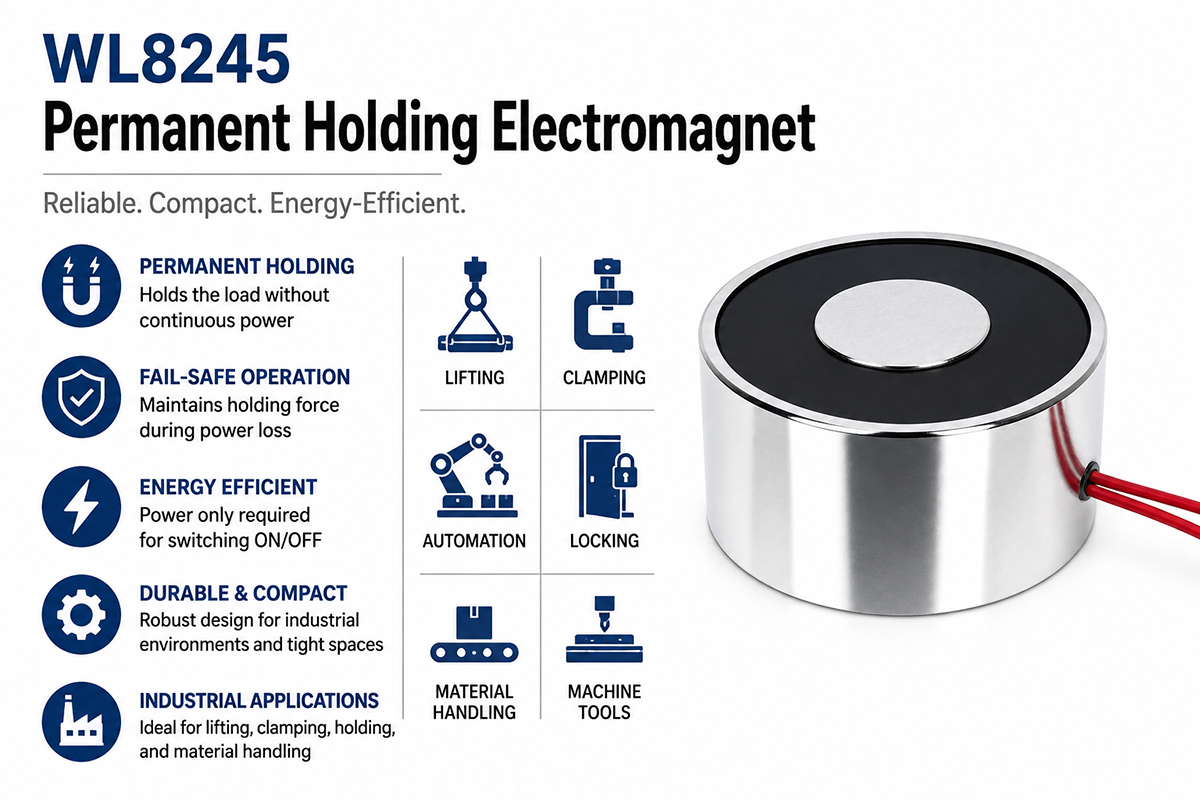
The main features of a permanent holding electromagnet include high retention force and negligible or zero power consumption. To reach high energy efficiency, the device combines permanent magnets with electromagnetic coils. These units are failsafe as they always maintain their holding force even in the case of the loss of electricity. Thanks to the compact design, they can easily fit into industrial machines and automation systems. They are designed to last long in tough industrial environments owing to low maintenance needs. It also offers the possibility of quick change in response to turn off or turn on the system. It is especially valuable in manufacturing, robotics and material handling systems to provide reliable magnetic performances with consistent holding force.

Permanent Holding Electromagnet Product Overview

A permanent holding electromagnet is a high-tech industrial magnet used for secure retaining. They are highly effective because they combine the advantages of permanent magnet and electromagnet technologies to produce consistent force. The device has broad applications in the automation, robotics, machining, and material handling fields. The product is designed to be durable, long-lasting, and reliable under difficult conditions. Compact size with powerful magnetic force enables easy integration into mechanical systems.

Industril Permanent Holding Electromagnet Video

Industril Permanent Holding Electromagnet Detailed Display

Industrial Permanent Holding Electromagnet Datasheet

WL8425 Permanent Holding Electromagnet Products Data Sheet
Product name: Permanent Holding Electromagnet Insulation Class: B
Model: WL-8425-24V Hi-Pot test: AC750V/2S
Size: Ø82 x H45 Service Life: >500 Thousand
Holding Force: 1900 N Lead time: 3~5 days if in stock
Voltage: DC 12V/24V Sample Order: Acceptable
Power: 43 W MOQ: 200 PCS
Duty Cycle: 10% Warranty: 2 Years
Lead Wire: Bottom edge out 25cm or customized Origin: Dongguan, Guangdong
Action Form: Energise to release Surface: Electroplating (Zn Coating)
Install thread size: M5 x H19 Material: steel & enameled wire
N.W.: 168 g Certificate: CE/ROHS

Permanent Holding Electromagnet Principle of Operation

The working principle behind a permanent holding electromagnet is the integration of permanent magnetism and electromagnetism control. The permanent magnets form a magnetic field, ensuring reliable retention of ferromagnetic materials. When electrical current passes through, the coil generates the magnetic field, altering the magnetic flux of the device.

During the operation process, the magnetic circuit of the device is closed. Thus, the magnetic force is maintained without consuming energy. The polarity is adjusted to neutralize the magnetic force, allowing the load to be released with the help of a short electric pulse. The automatic restoration occurs after switching.

The abovementioned scheme is very effective because it saves energy by consuming energy only during switching. Moreover, it also provides reliable safety by guaranteeing retaining power during any power failures.


Permanent Holding Electromagnet Industrial Application

Permanent Holding Electromagnet Industrial Application

Applications of a Permanent Holding Electromagnet

This electromagnet is widely used in the fields of industrial automation and mechanical systems that require effective holding and economy of power. They are used in CNC machining centers for firm clamping of materials. In robotics, it helps position and grasp ferromagnetic objects.

This permanent holding electromagnet is used in material handling systems to lift, retain, and transport metal sheets or assemblies. In the automotive industry, they are used to position and retain parts in position before the welding and assembly of vehicles.

The permanent holding electromagnet can be used in security systems like locks of doors, industrial brakes, and failsafe mechanisms. They stabilize machinery components under high-speed operation. They also enable smooth load handling in transportation systems such as automated guided vehicles (AGVs).

Because of their energy efficiency, they are perfect for continuous systems. Besides, it guarantees safety of operation in emergency systems that need power backup, as they retain force without consuming any power supply.

Advantages and Disadvantages of This permanent holding electromagnet

Permanent Holding Electromagnet Advantage and Disadvantage

Permanent Holding Electromagnet Advantages

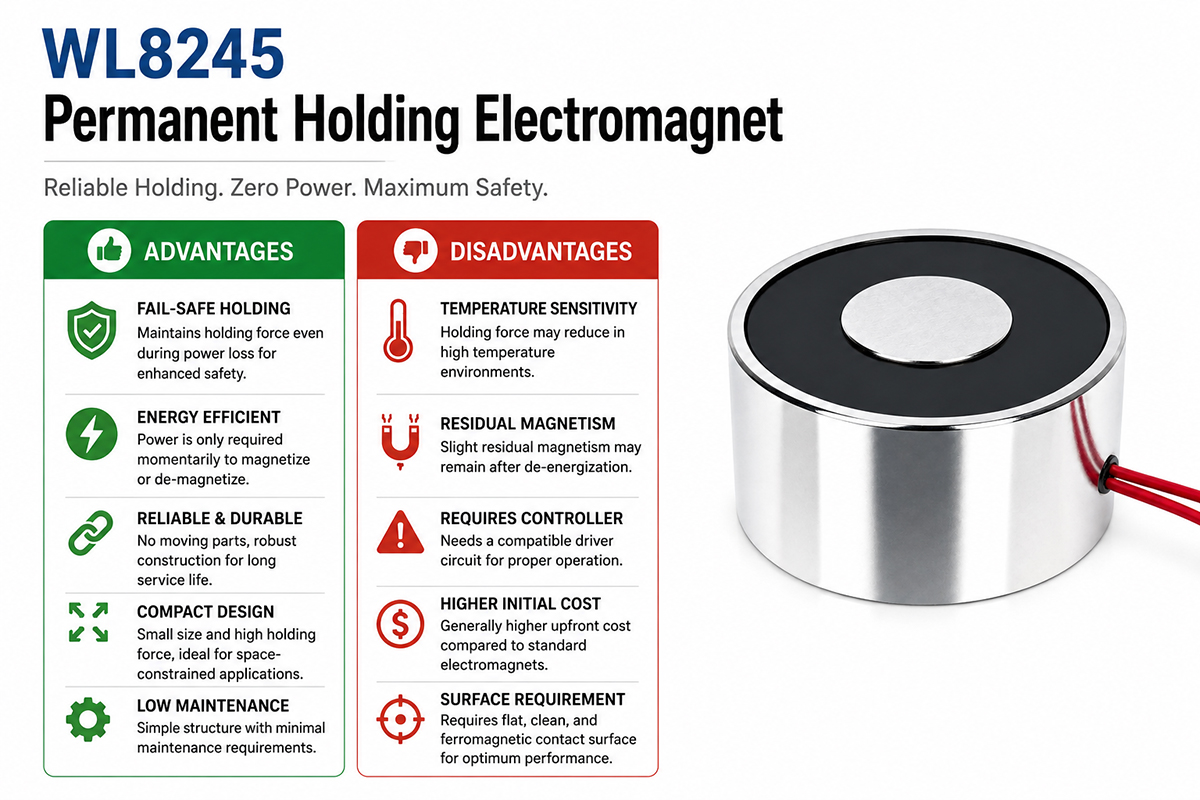
Firstly, one of the major advantages of a permanent holding electromagnet is its energy efficiency. The product consumes low energy in the industry because energy is consumed only when the magnetic field is switched. Another great advantage is the failsafe performance, as a load will always be securely retained even in case there is a lack of power.

Permanent Holding Electromagnet Disadvantages

Moreover, they provide a high magnetic force within a compact unit, allowing easy integration into mechanical designs. Also, this electromagnet is characterized by heat resistance and low maintenance, increasing energy efficiency and life span of the system.

However, some disadvantages should be mentioned. Namely, its price may be somewhat higher than for common electromagnets due to complex magnet construction inside the system. Its circuitry is complex, requiring advanced engineering. Some models may experience slow switching compared to simple solenoids. Besides, the performance of the magnet may depend on the temperature and quality of materials. They can also be restricted to ferromagnetic materials.

Nevertheless, despite these drawbacks, the abovementioned device proves extremely advantageous for modern industrial automation and machinery systems.

Permanent Holding Electromagnet Troubleshooting Guide

Permanent Holding Electromagnet Troubleshooting Guide

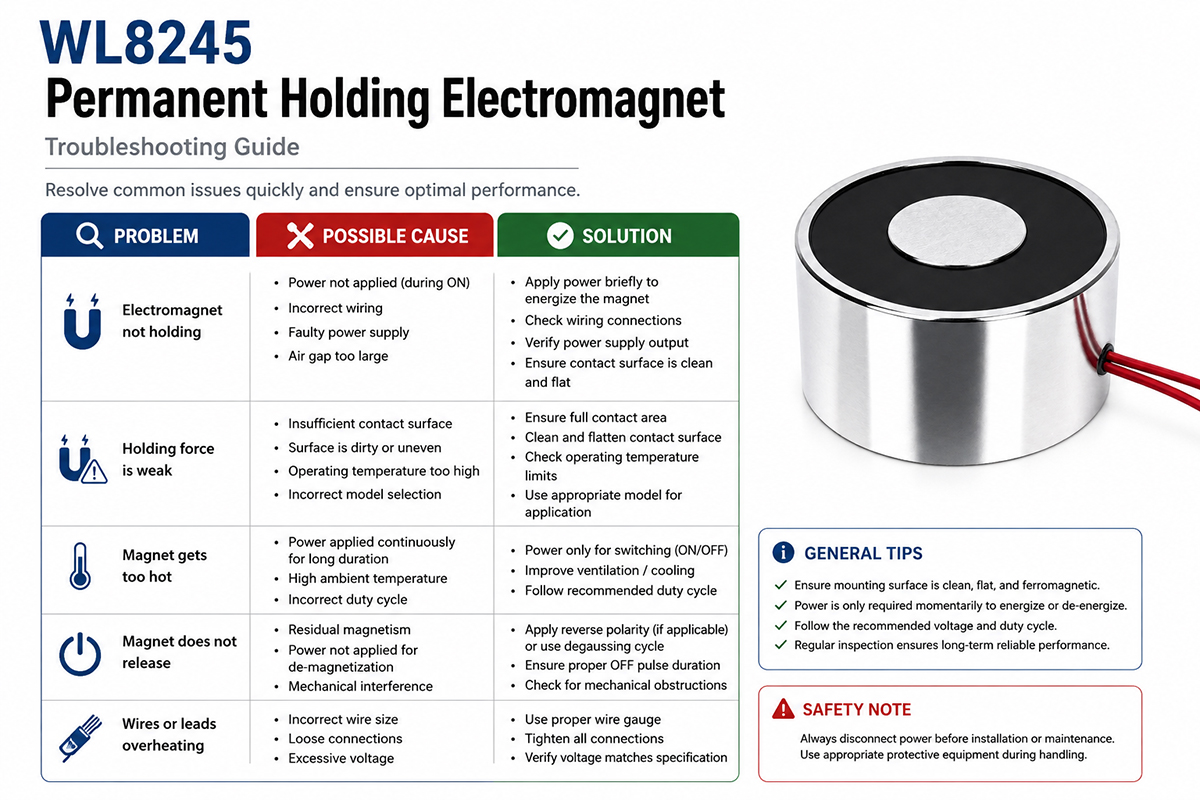
A permanent holding electromagnet may have issues such as low magnetic force, switching failure, overheating, or mechanical misalignment. A common issue is that the electromagnetic has low magnetic force. Contaminants, including oil, dust, or rust, cause such a problem between the magnet and the steel surface. Cleaning both surfaces may help solve the problem.

Another issue is that the magnet will not release the load. In such a case, it could be attributed to insufficient excitation of the coil, wrong voltage level, or malfunctioning circuits. One thing to do in this situation is checking whether there is an appropriate power supply to energize the coil and that the voltage is accurate. Checking for coil resistance could help detect damage in the coils.

There could be instances when the magnets heat up. Overheating may be due to too many switching processes in too short a period or inappropriate duty cycles. Though these magnets have less power requirements during holding process, frequent switching could lead to heating of the magnetic field.

A magnet may fail to perform optimally because of mechanical misalignment. Misaligned magnets cannot make optimal contact and, hence, produce reduced force. It is critical that the two surfaces in contact are flat and clean.

Sometimes the residual force prevents easy release of the object. To solve this problem, a demagnetization pulse can be done or the time setting changed appropriately.

Environmental issues such as extremely high temperatures or vibrations could cause poor performance in the long run. Proper installation and regular checks are important for optimal operation of these magnets.


8 Questions on Permanent Holding Electromagnet

1. What exactly is a permanent holding electromagnet?

Unlike regular electromagnets that only generate magnetic force when electricity is supplied, a permanent holding electromagnet uses a built-in permanent magnet to generate a magnetic field. The holding force is maintained without any continuous power, but only when needed for “switching.” In simple words, it is an “energize-to-release” device.

2. How does it differ from a regular electromagnet?

The main difference from regular electromagnets is in energy consumption. While a standard electromagnet requires constant electric current, the device described above consumes little power and holds workpieces without any electricity. Thus, it is more energy-efficient and safe.

3. Do they generate heat?

Regular electromagnets consume a lot of power because of constant electrical current and, hence, produce lots of heat. In contrast, there is very little heat produced by permanent magnets because electrical coils remain active for several seconds at most. The holding state is characterized by zero energy use.

4. What happens to the holding force when the power fails?

Unlike regular electromagnets, there is no effect of power failure on the holding force of these devices. Actually, the holding force remains unchanged during holding (100%). In case of power outage while holding something, permanent magnets will continue to keep the workpiece securely attached.

5. Will it release completely when turned off?

There will be no release because of the magnetic force. Actually, there is always a tiny part of the holding force that cannot be removed (about 3-4%). This is why sometimes magnets tend to release very slowly or incompletely. In order to solve this problem, place thin films of nonmagnetic materials on the poles of the magnet.

6. What affects the holding force?

Though the holding force is specified in manufacturers’ catalogs, there are several factors that actually affect holding force:

Air Gap: Dust, oil, paint, roughness – all these decrease holding significantly.

Material Type: These magnets work great with low-carbon steels. Other steels have less holding force.

Part thickness: If the material is too thin, the flux goes through without saturation.

7. Can I use them with stainless steel or aluminum?

No—aluminum, brass, and similar metals will work poorly because the magnetic field simply penetrates through them.

But stainless steel—yes, it works perfectly! All you need to remember is that Austenitic stainless steels are non-magnetic and cannot hold.

Ferritic and martensitic grades can hold perfectly but usually have less force than mild steel.

8. Can I use them to hold thin or small workpieces?

Unfortunately, it might be difficult with regular magnets. General-purpose magnets might have problems with holding workpieces below 100 mm x 50 mm and thin parts less than 20 mm thick.

However, fine-pole holding electromagnets are specially designed for small workpieces.

How to Choose a Permanent Holding Electromagnet?

There are several considerations to make when choosing a permanent holding electromagnet. The first one is the holding force. It depends on the total load, safety margin, and vibration in the environment.

The next factor is the length of the stroke or air gap. The longer the gap, the smaller the magnetic field. The magnet should fit into the design with enough space for holding. Flat contact surfaces are better.

Electrical factors are also critical. The control voltage, pulse time and switching method should be chosen carefully so as not to disrupt the system. A proper specification of the coils guarantees switching reliability.

Environmental factors cannot be overlooked. If the magnet will be exposed to extremely high humidity and temperatures or high amounts of dust particles, protection should be provided.

When using magnets in high speed systems, it is necessary to consider the duty cycle. Holding requires low power usage but if frequent switching is needed, cooling measures might be needed.

Mechanical issues should also be considered. It is crucial that the size, shape and the attachment methods are appropriate for the existing machinery.

Safety should also be considered when picking out magnets. Lifting or locking applications require fail-safe designs with holding redundancy.

Packing Mistakes & How to Avoid Them

Permanent holding electromagnets need to be packaged in such a way to minimize damage or demagnetization. Not providing sufficient magnetic isolation in packing is a mistake. Packing many magnets together causes mechanical damage to them.

Another mistake is not adding shock absorbing material during transportation. Failure to add materials like rubber or foam leads to scratching of the surface during shipment, leading to reduction in performance.

Another common mistake is improper orientation. Without adequate magnetic shielding, the magnetic field will attract metallic objects.

Without appropriate moisture protection, the magnet will eventually corrode. Humidity needs to be absorbed in case of humid or dusty environments.

Also, inadequate labeling leads to improper handling and storage. Polarity, voltage, and instructions should be clear.

To prevent these problems, it is necessary to individually pack these magnets using magnetic shielding materials. Shock-absorbing materials also need to be used to prevent any surface damage. Moisture absorption should be provided. Proper packaging will guarantee performance and reliability during use.

Get A Free Quote Now

Contact Form

Related Products

Related News

Scroll to Top

Get A Free Quote Now !

Contact Form
If you have any questions, please do not hesitate to contact us.
Weilong Solenoid Company Culture