Heavy Duty 12V Push Pull Solenoid for Industry application
Industrial Heavy Duty 12V Push Pull Solenoid
Reliable 12V Push Pull Solenoid for Automation
High Force Heavy Duty 12V Push Pull Solenoid
Custom Heavy Duty 12V Solenoid Solutions
Industrial Grade 12V Push Pull Solenoid Unit
Heavy Duty 12V Push Pull Solenoid for Industry application
Industrial Heavy Duty 12V Push Pull Solenoid
Reliable 12V Push Pull Solenoid for Automation
High Force Heavy Duty 12V Push Pull Solenoid
Custom Heavy Duty 12V Solenoid Solutions
Industrial Grade 12V Push Pull Solenoid Unit

WL6496 Heavy Duty Push Pull Solenoid guide

A Heavy Duty 12V Push Pull Solenoid is essentially an electromagnetic actuator. It changes electrical energy into linear mechanical motion. If you apply 12V DC power to its coil, it generates a magnetic field. This field, in turn, makes a ferromagnetic plunger move either out or in, creating mechanical action.

Now, why do we need the heavy-duty version?

It’s because these bad boys are made to put out more force, operate for longer stretches, and last a while in tough conditions. Plus, they see a ton of action in various fields – from farm machines and security gear to vending machines and medical gadgets. So, in situations where you’d typically go for regular solenoids, these heavy-duty ones give more juice when it comes to magnetic oomph, heat tolerance, and durability.

So, what’s the big deal about Heavy Duty 12V Push Pull Solenoids?

For one, they are everywhere in industrial setups because of how straightforward they are. Plus, not only are they speedy and tiny, but they also consistently deliver and are pretty much set-and-forget technology.


Heavy Duty Push Pull Solenoid Product Overview

A heavy Duty Push Pull Solenoid packs some real muscle and flexibility. And whether it’s moving bits in a factory line, securing entrances, or fine-tuning complex gear in clinics, they remain top picks when quick, strong, consistent motion counts.

The Heavy Duty Push Pull Solenoid is a wonderful electromagnetic actuator used in industrial automation and motion control. It turns electrical energy into linear mechanical work really well and reliably.

This heavy-duty push-pull solenoid has top-notch parts like premium copper coils, precisely made plungers, and robust magnetic housings. This gives them a big advantage—they put out heaps of force and last a long time. Plus, they come in different sizes for various jobs and can even be customized for specific tasks.

Because of their compact design and quick response times, they’re particularly well-suited for many applications. Think industrial machines, security setups, farm equipment, medical devices, and auto-control systems – the list goes on!


Heavy Duty Push Pull Solenoid Video

Heavy Duty Push Pull Solenoid Detailed Display

Heavy Duty Push Pull Solenoid Data Sheet

Brand Weilong Technology Model Number WL6469
Rated Voltage (V) DC 12V, 24v and 36V Rated Power (W) 100W–150W
Work Model Pull-Push Type Holding Force (N) 60 N
Stroke (mm) Customized Reset Time(s) 1S
Service Life 200 Thousand Times Certification CE, RoHS, ISO9001,
Material Carbon Steel Housing Lead Wire Length (mm) 200
Install Style mounted screw hole for easy setup Tolerance of Dimension  +/-  0.1 MM
Stroke Distance  5–15 MM Insulation Class B
Hi-Pot Test AC 600V 50/60Hz 2s  Salt Spraying Testing 48 Hours without Red Rushing
Working Temperature -10°C-60°C Duty Cycle 1-30%
Thread Depth (mm) 30 * 20 mm mounting plate Payment Term TT, or LC At Sight
Sample Order Yes Warranty 1 Year
MOQ 500 pcs Supply Ability 5000 pcs per Week
Delivery Time 30 Days Port of Loading shenzhen

how the heavy duty push pull solenoid actually works

Just think magnets in action. Power up the coil with 12V DC, and as current passes through, it forms a magnetic field. This field grabs a free-moving plunger and drags it towards the center. Now this movement? It ends up providing that crucial push or pull needed to control things like valves, switches, and locks. But once you cut the juice, a return spring pops the plunger back to where it started.

The beauty here is in the simplicity: turn the power on, get your movement, switch it off, and reset. Boom, quick and dependable control every time.


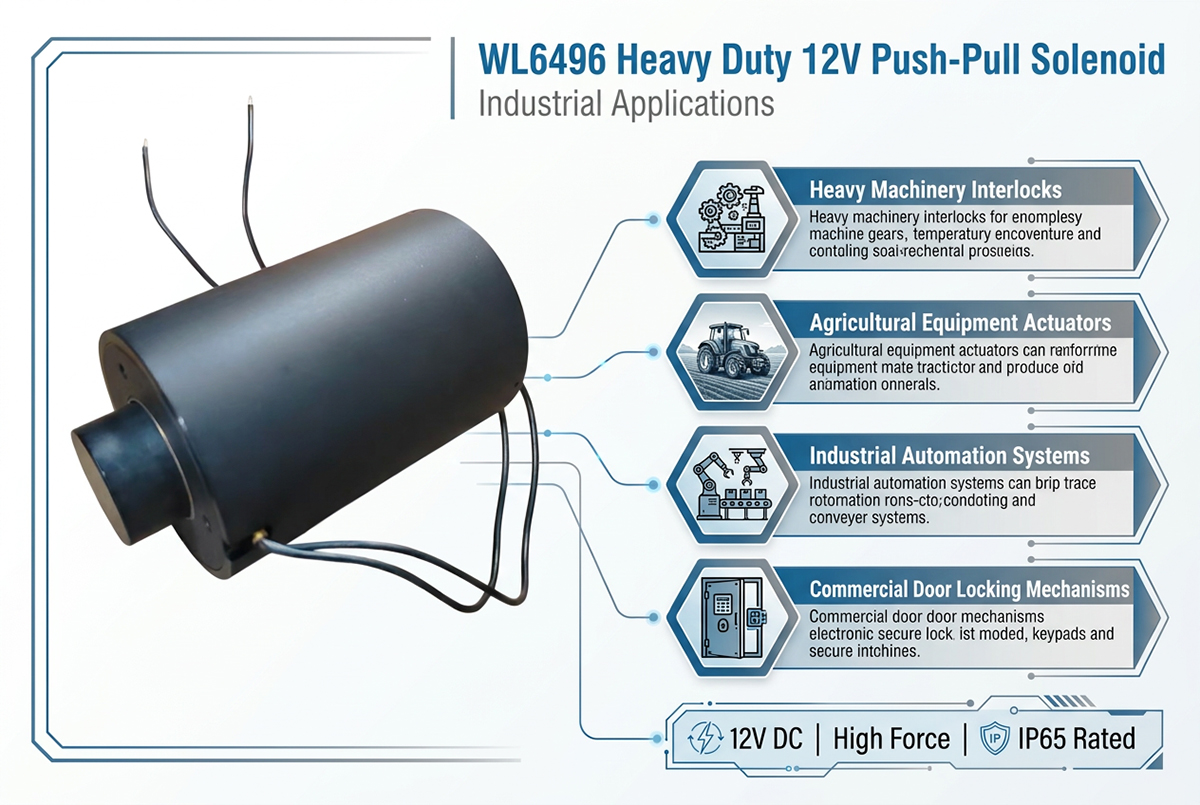
Heavy Duty Push Pull Solenoid Application

Heavy Duty Push Pull Solenoid Application

The heavy duty push pull solenoid is a wonderful electromagnetic actuator used in industrial automation and motion control. It turns electrical energy into linear mechanical work really well and reliably.

The heavy duty push pull solenoid has top-notch parts like premium copper coils, precisely made plungers, and robust magnetic housings. This gives them a big advantage—they put out heaps of force and last a long time. Plus, they come in different sizes for various jobs and can even be customized for specific tasks.

Because of their compact design and quick response times, they’re great for lots of applications. Think industrial machines, security setups, farm equipment, medical devices, and auto-control systems—the list goes on!

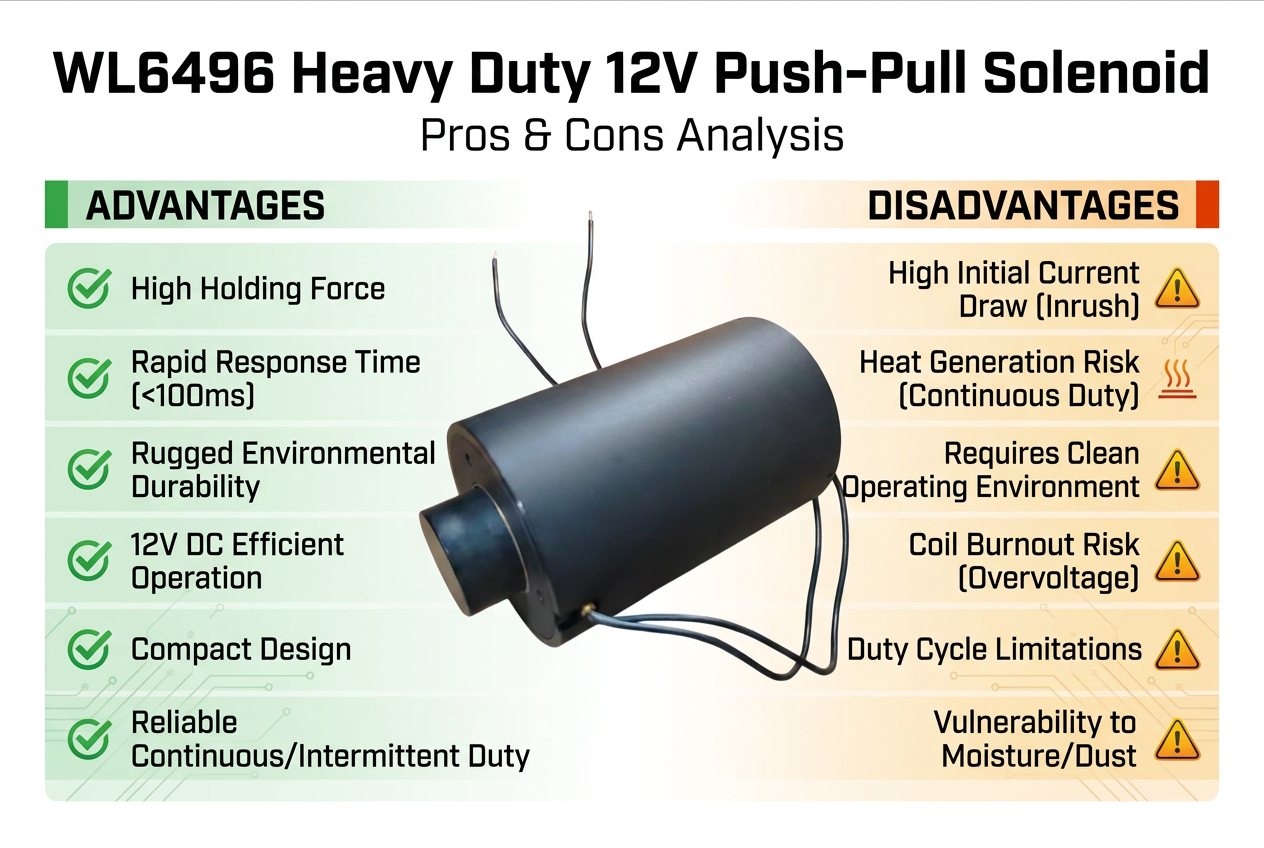
Heavy Duty Push Pull Solenoid Advantage and Disadvantage

Heavy duty push pull solenoid advantage and disadvantage

When talking about heavy-duty push-pull solenoids, let’s hit on what makes them tick. At the top of the list? Their might and ability to quickly react, along with that durable dual-action feature. Not forgetting their solid build, which promises to last over a million cycles. Add in customization for different voltages and strokes, plus the fact they fit nicely into automated setups – yeah, talk about versatility!

They’re champions in industrial automation where keeping machines humming matters. Picture sorting gear, packing units, and assembly lines running smoothly thanks to these parts. They bring precision safety to security setups too, with everything from lock controls to access points using them. Same goes for agriculture and tough working conditions, or the exact motions demanded by medical tech and other systems.

Despite all this cool functionality, they still stand out for being easy to drop into projects. From installation to upkeep (or lack thereof), and even how economically they run, solenoids stack up. Factor in easy adjustments and the dependability in repeated uses, and they look almost too good to be true.

Yet, every tool has limits, right?

With these solenoids, stretching the stroke means less force. Run them continuously, and heat becomes a factor. Compared to motor-driven parts, they don’t reach as far or handle as many cycles before needing a break. Matching a part perfectly to each job is key.

In sum, a heavy-duty push-pull solenoid packs some real muscle and flexibility. And whether it’s moving bits in a factory line, securing entrances, or fine-tuning complex gear in clinics, they remain top picks when quick, strong, consistent motion counts.

Now, sometimes these babies run into some issues. One big one is when the solenoid won’t move at all. This could be due to wrong voltage, a broken coil, or wires that aren’t tight. Another hiccup is when the force output is weak, maybe because of low voltage or something blocking the stroke. They can also get too hot if you keep pushing them too hard or don’t let them cool down. And strange noises? That can happen when things are loose or worn out.

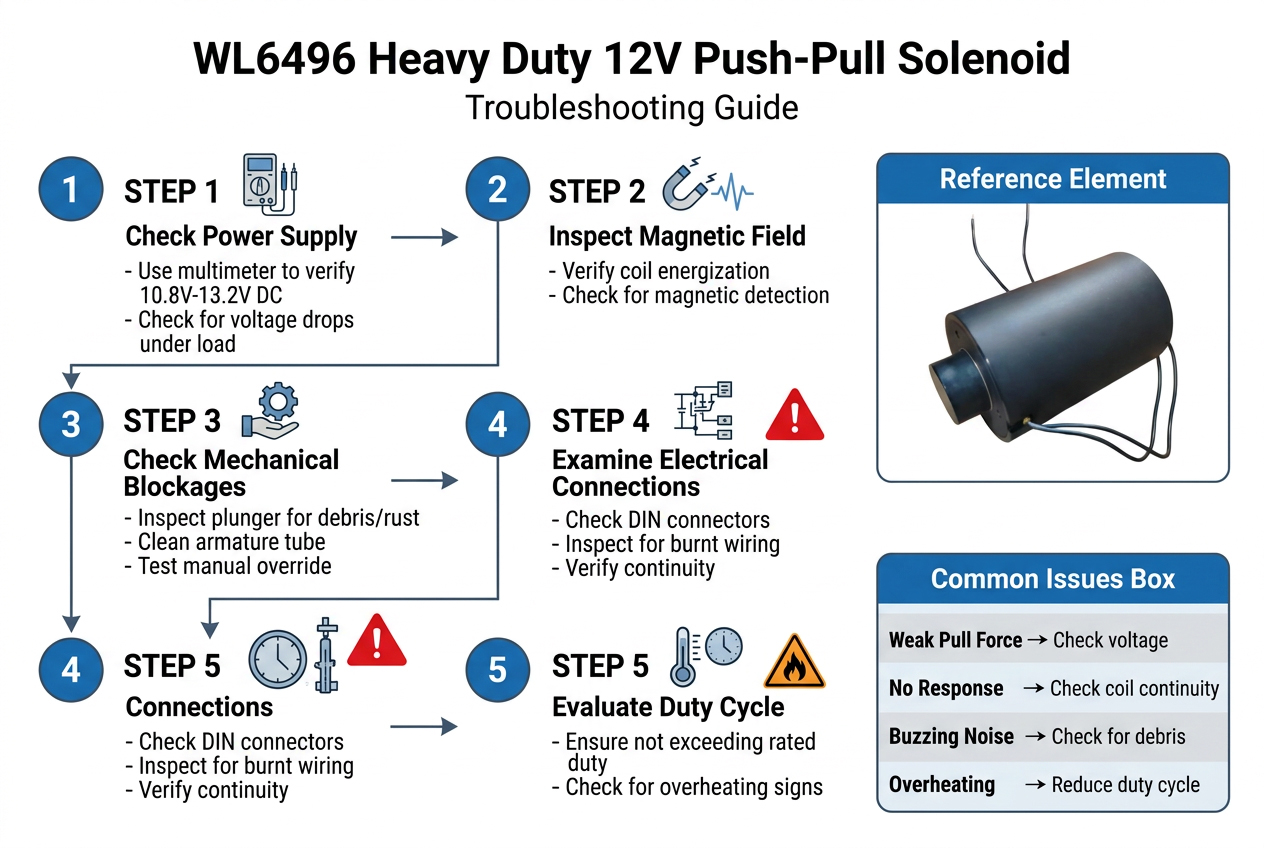
Heavy Duty Push Pull Solenoid Troubleshooting Guide

Heavy duty Push Pull solenoid Troubleshooting guide

Proper care and regular checks will make these suckers last longer. Checking voltage, tightening parts, and making sure everything’s securely in place can fix most issues.

When you’re picking out a heavy duty push pull solenoid, watch out for common mistakes. Some folks only look at max force and ignore the stroke length needed for the job. And forget about it—you have to consider both! Ignoring the duty cycle is also a mistake. Using a solenoid meant for bursts here and there in a setup that runs constantly will shorten its lifespan.

Other oversights include overlooking how harsh your environment might be—like dust, moisture, intense vibrations, and super-hot or super-cold temps. Make sure to account for these when choosing your parts.

Lastly, people sometimes fall into the trap of thinking cheaper means better savings. But cheap materials mean less durability and more hassles down the road. Instead, look for a good combo of price and quality, ensuring parts meet the proper standards and that you’ve got experts backing them up.

Heavy Duty Push Pull Solenoid FAQS

1. What exactly is a Heavy Duty Push Pull Solenoid?

It’s a device changing electrical input to a push or pull motion. Power it with 12V DC, and it shifts objects in a straight line using a sliding metal piece—the plunger.


2. Wondering how much force of heavy duty push pull solenoid can get?

Well, output varies based on its size, construction, length of movement, and voltage input. Some smaller units deliver just a little power, while industrial giants hit over 500 Newtons.


3. Ever considered running one nonstop?

If it’s made for round-the-clock operation – aka rated for a 100% duty cycle – then yes, go ahead. But beware; pushing regular-duty solenoids past their limits ends in overheating disasters.

4. When testing yours and puzzled by excessive heat?

Heat up on startup is okay, yet far too much could hint at misuse, poor cooling, or working under specs. Choosing correctly ensures this doesn’t happen.

5. What about longevity?

Lifespan depends on several criteria, such as operational tempo, heat conditions, and environmental influences. With smart build, these gadgets can breeze through more than a million operations without a hitch.

6. And for the perfect fit on force and travel?

Start by sizing the load, factoring in the stretch for smooth motion and bumps along the way. Remember, more distance means less might, so review that force-stroke graph closely.

7. How to do the heavy duty push pull solenoid customization?

Indeed, producers often bend rules on volts, push-pull range, and mount types. These tweaks hone parts specifically for unique roles.


8. Final stop - what is a primary applications of heavy duty push pull solenoid?

You’ll see these in action across industrial automation zones, in packers, vehicles, security doors, vend units, med devices, transport networks, and so much more. Whenever snappy reactions and durable precision come first, you’ll spot them busy at work.

In a nutshell, savvy selection comes down to clear needs analysis, close attention to tech specs, and an eye for potential snags. Good hunting for your ideal solenoid partner!

When you’re choosing a heavy duty push pull solenoid, be careful of common mistakes. Some folks only look at max force and ignore the stroke length needed for the job. And forget about it—you have to consider both! Ignoring the duty cycle is also a mistake. Using a solenoid meant for bursts here and there in a setup that runs constantly will shorten its lifespan.

Other oversights include overlooking how harsh your environment might be—like dust, moisture, intense vibrations, and super-hot or super-cold temps. Make sure to account for these when choosing your parts.

Lastly, people sometimes fall into the trap of thinking cheaper means better savings. But cheap materials mean less durability and more hassles down the road. Instead, look for a good combo of price and quality, ensuring parts meet the proper standards and that you’ve got experts backing them up.

Picking out the perfect heavy duty push pull solenoid isn’t too tricky if you follow these steps.

First off, get a handle on your application needs. Calculating the right amount of force is crucial. Figure out how much weight you need to shift and don’t forget to add in extra juice for friction and sudden bursts of movement. Make sure the solenoid you pick is up for the job at the length of stroke you need.

Next, know your stroke length. That’s how far the plunger travels, and it directly impacts the force it can exert. So, make sure the force-stroke chart fits your plan.

Also, double-check your power source. You must have a steady 12V DC flow. If not, the solenoid’s performance could tank.

The frequency and duration the solenoid runs—known as the duty cycle—matters a lot. Will it work in short bursts or do continuous duties? Knowing this helps a ton.

Don’t overlook the environment where the solenoid will do its work. Think about temps, humidity, and any risks of corrosion. You want to be sure it won’t falter due to harsh surroundings.

For industrial gear that sees tons of use, lifespan is key. High-quality models often crank out hundreds of thousands or even millions of cycles.

Don’t skimp on space constraints and setup specifics. Verify what fits where and plan out wiring logistics.

Some might benefit from customization, like tweaked lengths or special mounting. Getting these adjustments makes the solenoid tailor-made for the task.

Lastly, opt for a reputable manufacturer that provides rigorous tests like force checks and endurance trials. Such certification boosts reliability and eases your mind.

So, there you have it. With careful thought to force, stroke, duty cycle, lifespan, and setup, you’re well on your way to selecting a stellar heavy-duty push-pull solenoid.

Get A Free Quote Now

Contact Form

Related Products

Related News

Scroll to Top

Get A Free Quote Now !

Contact Form
If you have any questions, please do not hesitate to contact us.
Weilong Solenoid Company Culture