Air Core Inductor Coil for RF Systems Design
High Frequency Air Core Inductor Coil solution
Air Core Inductor Coil for Power Circuits
Air Core Inductor Coil in Automation System
Air Core Inductor Coil for Signal Control
Air Core Inductor Coil for Precision Circuits
Air Core Inductor Coil in Telecom Industry
Air Core Inductor Coil for RF Systems Design
High Frequency Air Core Inductor Coil solution
Air Core Inductor Coil for Power Circuits
Air Core Inductor Coil in Automation System
Air Core Inductor Coil for Signal Control
Air Core Inductor Coil for Precision Circuits
Air Core Inductor Coil in Telecom Industry

WL1914 Industrial Air Core Inductor Coil Guide

An air core inductor coil is an electronic component made by winding conductive wires in the form of a coil without using any magnetic core materials. Unlike the iron core inductor coils, air core inductors do not have any magnetic core materials inside. It uses air as the magnetic path for the flow of electricity. Hence, there will be no magnetic core losses or magnetic saturation in this coil. Air core inductors are ideal for the applications involving high-frequency circuits. Such types of coils can be used in radio communication, audio equipment, antennas, filters, oscillator circuits, and industrial electronic systems.

Product Overview of Air Core Inductor Coil

The air core inductor coil is a high-quality electronic component intended for use in high-frequency applications. Thanks to its advanced winding techniques, it is very stable in its inductance and provides reliable electrical performance. The use of air as the magnetic path makes the coil free of saturation and magnetic hysteresis. This electronic component is ideal for use in RF and communication devices, industrial electronic equipment, and audio equipment. There is a wide range of different sizes, wire diameters, and inductance values.

Industrial Air Core Inductor Coil Video

Industrial Air Core Inductor Coil Detailed Display

Industrial Air Core Inductor Coil Data Sheet

Item Description
Air Core Inductor Coil Enameled copper wire
Wire Diameter 0.20 (AWG options available)
Winding Type Single-layer round or sectional  winding
Core Material Air (non-magnetic) Copper wire
Footprint length 15 mm
Encapsulation Optional varnish, epoxy, or coating
Mounting Through-hole / Custom

Electrical Specifications (Typical)

Parameter Description
Inductance Range 0.1 µH – 100 µH (customizable)
Inductance Tolerance ±2%, ±5%, ±10%
DC Resistance (DCR) 14 Ohm with 5.5 turns
Q Factor High Q, optimized for frequency range
Self-Resonant Frequency High, application-dependent


Operating Frequency kHz to MHz range
Rated Current Custom per design
Insulation Resistance ≥100 MΩ

Working Principle of Air Core Inductor Coil

An air core inductor coil works on the basic principle of electromagnetic induction. In an air core inductor, there will not be any magnetic cores. Hence, when the electric current flows in the conductive wire, the magnetic field is produced within the coil. When the electric current through the conductive wire changes, the corresponding change in the magnetic field takes place, which leads to the creation of the reactive component in it. This reactive component acts as an opposition to the rapidly changing current. The value of the inductance depends on several factors like the number of turns, coil diameter, spacing, and wire diameter of the air core inductor.

Features of Air Core Inductor Coil

  1. Excellent high-frequency performance
  2. No magnetic saturation of core
  3. Low core loss and distortion
  4.  Stable inductance characteristics
  5. Light and compact design
  6. Rapid response of electromagnetic field
  7. High Q factor in RF circuits
  8. Suitable for precise signal transmission.
  9. Adjustable size and inductance
  10. 10. Dependable and thermal stability


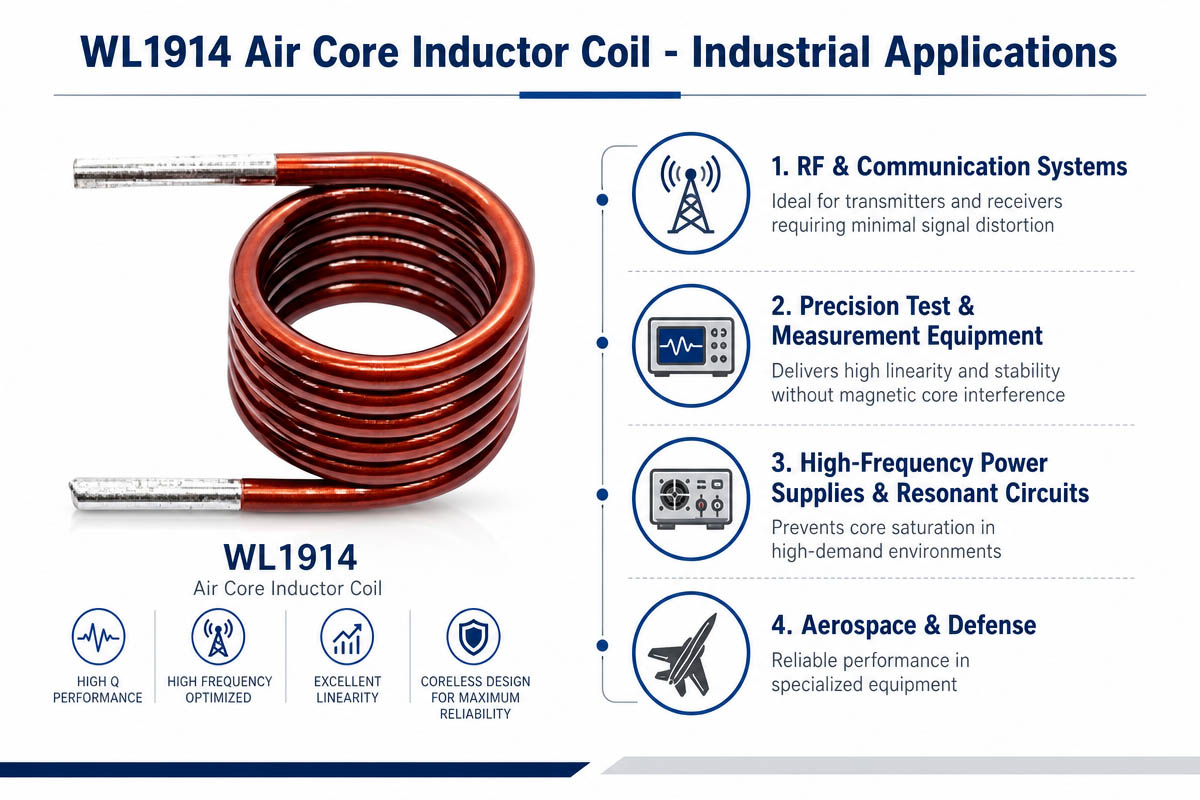
Industrial Air Core Coil Application guide

Air Core Inductor Coil Industrial Application

There are many practical applications for air core inductors in the fields of electronics, audio, communications, and automation systems. Since air core inductors have excellent inductance characteristics, such kinds of coils are mostly used in RF communications equipment, signal filters, antennas, etc. In audio systems, crossover circuits use air-core inductor coils to provide distortion-free sound transmission. Air core inductors are extensively used in medical electronics for precise signal performance.

These inductors also serve various sensing, control, and filtering applications in industrial electronic systems. Oscillators and tuning circuits in radio, TV, and communication equipment require the use of such inductors. These coils can be found in almost all electronic and consumer devices like televisions, radios, mobiles, PC boards, etc.

Why are air core coils getting so popular?

Air core coils are of increasing interest due to the high-frequency performance, small size, fast response, and low energy loss requirements of today’s electronic and industrial systems. Unlike regular iron-core inductors, air-core coils use air as the magnetic medium. This removes core losses and magnetic saturation problems.

Here are the main reasons why they are becoming more popular:

1. Outstanding High-Frequency Characteristics

Air core coils work very well in high-frequency circuits because they have

Very low iron loss
Low hysteresis loss loss
Lower eddy current generation
High-frequency inductance stability

This makes them perfect for:

RF Communications Systems
Wireless charging 5G devices
Antennae
Tesla’s coil
Signal filter

Iron core inductors tend to heat up and lose efficiency at high frequencies; air core coils do not.

2. No Magnetic Saturation

Conventional magnetic-core inductors can reach a point called magnetic saturation, after which the core cannot store any additional magnetic energy.

Air core coils do not have this problem at all. Air cannot be magnetically saturated.

Benefits are:

Enhanced linearity
Stable inductance
More precise signal transmission
Stable operation at various currents

This is particularly true in:

Electronics Precision
Sound equipment.
RF amplifiers.
Instruments of measurement
3. Rapid Electromagnetic Response

Air core coils are very fast at responding to current changes in the absence of a magnetic core slowing magnetic field changes.

This provides benefits in the following: the following:

High-speed switch circuits
High-speed communication.
Pulse electronics
Induction heating systems

Due to the need for fast electromagnetic response in modern electronics, the demand for air core technology is rising.

4. Less Production of Heat

Air core coils have no iron core and therefore reduce:

Eddy-current loss
Core heating Waste of energy

This increases:

System performance
Lifespan heat stability

In compact electronics and automotive systems, low heat is very valuable.

5. Compact and Lightweight Design

Air-core coils are usually:

Less lightweight, more customizable

This is consistent with trends in:

Miniaturized electronics
Wearable technology
Mobile medical equipment
Drones, aerospace electronics

Modern compact products require manufacturers to use light electromagnetic components.

6. Better Signal Purity

Air-core coils produce less magnetic distortion and interference.

This type of coil improves the signal quality for the:

Audio crossing systems
RF tuning
Television equipment.
Scientific instruments

Air core inductors are preferred, especially in high-end audio systems, because they produce a cleaner sound with less distortion.

7. Increasing Demand for Wireless Technology

The swift increase of

Charging without wires
Internet of Things gadgets
EV charging
NFC system
Intelligent devices
5G communications

has increased the demand for efficient, high-frequency inductors significantly.

Air core coils are one of the best choices for these applications.

8. OEM Applications Easy Customization

Air core coils offer a highly flexible design.

Different wire gauge
Flat wire structures
Custom value inductances
Various shapes and sizes.

They can be tailored by OEMs to meet specific industrial needs.

This flexibility is fueling adoption in custom electronics and industrial automation.

Common Applications of Air Core Coils
Electronics Consumer
Wireless charging
Smartphones, Tablets
Wearable
Industrial Equipment
Induction-heating
High-frequency converter
Sensor’s
Automotive
Wireless charging for EVs
Radar systems
EMC Filter
Communications
RF transmitters
Antennae
Amplifiers of the Signal
Audio Systems
top-class speakers
Crossovers Amplifiers
Principal Limitation of Air Core Coils

Air core coils are popular but have some disadvantages:

Less inductance than an iron-core coil
More peaks and valleys
Magnetic field concentration weaker

Hence, they are not suitable for low-frequency, heavy power applications like large transformers.

Future Trend of Air core Coils

As electronics continue to trend towards the following:

Increased frequencies
Smaller devices.
Faster switching
Wireless energy
Low-loss systems

Air core coils will also be more and more popular in the industrial and consumer markets.

Analysts expect demand in the fields of EVs, renewable energy, AI hardware, and wireless communication to grow at a rapid pace.

Industrial Air Core Inductor Coil Advantage and Disadvantage

Air Core Inductor Coil Advantage and Disadvantage

Air Core Inductor Coil Advantage

Air core inductor coils possess various advantageous properties that are useful for their applications. The main advantage of this type of coil is that they have stable characteristics due to the absence of any magnetic core materials. The inductors that have a magnetic core suffer from saturation problems at high frequencies. However in this case the air core eliminates such problems.

Another benefit is that they do not have any core loss or hysteresis. Therefore, the air core coils provide efficient performance and improved distortion levels. These coils also provide superior linearity and have high Q factor. These features are important in RF applications.

In addition to that, air core inductor coils are very light in weight and compact. These inductors can respond quickly to different signals, thus providing stable performance at varying frequencies. Moreover they can be easily customized with the requirement of the customer.

Air Core Inductor Coil Disadvantages

The air core inductors also have some drawbacks. As already said above, this coil does not have any magnetic core. Consequently, the inductance values are smaller compared with iron core coils. The increase of inductance implies that the number of coil turns would be larger. In turn, the size of the coil and its resistance would become higher. These inductors may also have weaker magnetic fields than magnetic core coils. Moreover, air core coils may exhibit low efficiency at high currents because of copper losses.

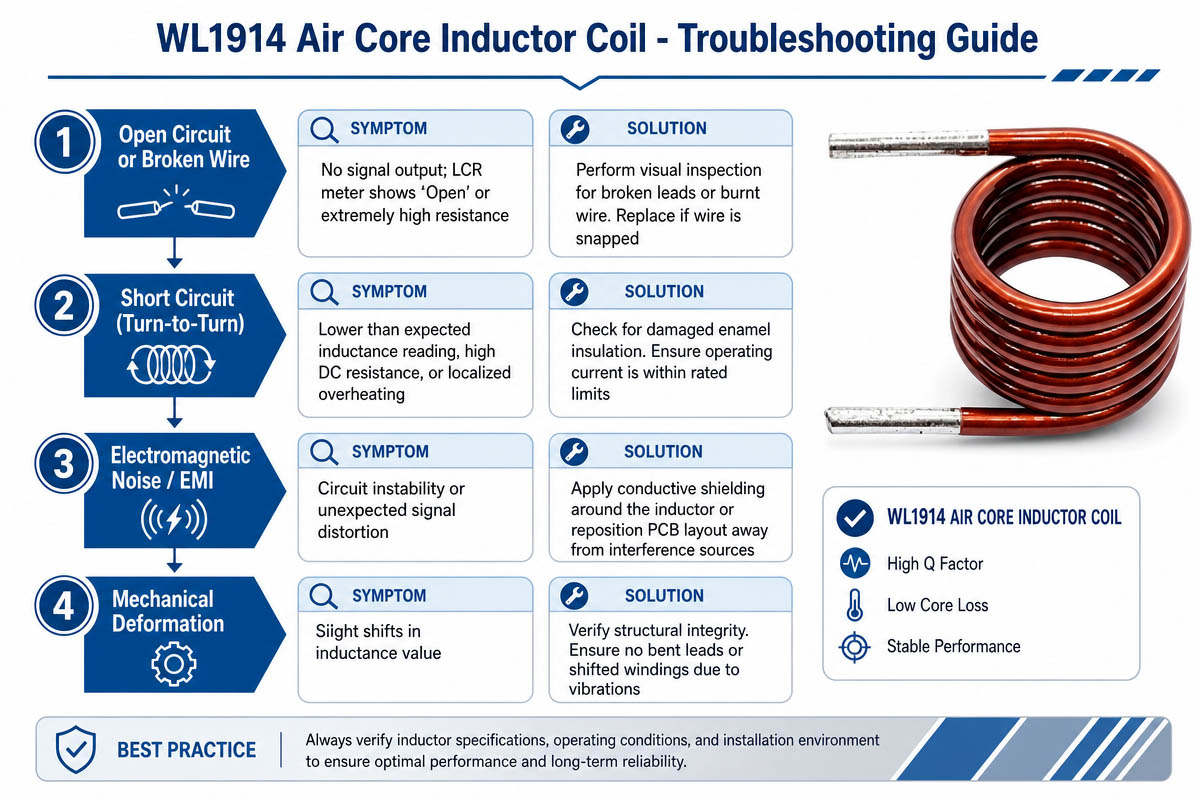
How to Troubleshoot an Air Core Inductor Coil?

Air Core Inductor Coil Troubleshooting Guide

Several problems can occur during the work of air core inductor coils. One of the most common problems is the unstable inductance that is caused by loose winding or wrong spacing. This issue negatively influences the quality of the transmitted signal. Another problem may be overheating caused by large currents, poor ventilation or inappropriate wire size. When air core inductors are positioned too close to other electronic elements, electromagnetic interference might be created.

Wrong inductance values in RF systems would lead to improper tuning. Other possible issues include broken solder joints or damaged copper wire resulting in faulty circuits. In order to troubleshoot these problems, firstly you should visually examine the coil for physical damage or discolorations. Secondly, measure inductance and resistance with testing equipment. Do not operate inductor coils at temperatures that exceed specified range. Install the appropriate spacing if you experience too much noise.


Air Core Inductor Coil FAQs

Q1. What is an Air Core Inductor Coil?

An air core inductor is an electronic component, which is formed by winding a conductive wire into a coil without using magnetic cores.

Q 2. What are the advantages of air core inductors?

Air core inductors have no magnetic saturation, provide high-frequency stability, exhibit low core losses, have fast signal response, and provide linearity of output. They are ideal for RF and communications applications.

Q 3. Where are air core inductors used?

Such inductors are mostly used in high frequency RF communications systems, antennas, audio crossover systems, industrial electronics, oscillators and various kinds of filters.


Q 4. Why is the magnetic core not used in air core inductors?

Magnetic core is absent in order to avoid hysteresis and eddy current losses that reduce the efficiency of the air core coil.

Q 5. How to select the best air core inductors?

You need to know the inductance value, frequency, current, wire diameter, Q factor, inductor size and other parameters of your application prior to making a purchase.

Q 6. Are air core inductor coils customizable?

Certainly. You may customize air core inductors according to any requirements of your OEM or industrial projects. Wire size, inductance value, coil numbers, mounting, leads can be customized to fit the requirements of your circuit.

Q 7. What causes overheating in air core inductor?

Overheating occurs when the inductor is operated under excessive current loads. The wrong wire diameter and poor ventilation may also contribute to this phenomenon.

Q 8. What is the difference between Air Core Inductors and Iron Core Inductors?

Inductors with iron cores are used for applications requiring low frequency and high power because they have large inductance. Air core inductors have large frequencies because they do not suffer magnetic saturation.

Tips to avoid common mistakes while selecting air core coils

Choosing the wrong air core coil might lead to bad results both for the performance of the circuit and the reliability of the product. Some of the common mistakes made while purchasing are mentioned below:

  • Forgetting about operating frequency. Since air core inductors are intended for high-frequency applications, selecting the wrong inductance value would affect signal stability.
  • Neglecting current handling ability. An inappropriate inductor rating would result in overheating.
  • Considering only coil size without checking other parameters. Q factor, resistance, inductance tolerance, etc.
  • Not considering the impact of the external environmental factors. Temperature, vibration, moisture, etc.

In order to avoid these errors, you should take several important steps:

  1. Clearly indicate the parameters of your application in advance.
  2. Check the datasheet of the electronic component and compare the electrical parameters to the requirement. Request samples to test if necessary.
  3. Work with professional manufacturers of air-core inductors and get quality engineering support.

How to Select An Air Core Coil

Selecting the right kind of air core inductor coil requires several aspects to be considered. Firstly, establish the purpose of the inductor—radio communications, audio crossovers, industrial electronics, or filtering applications. All these applications require different inductance values, operating frequencies, and current handling capacities.

As we already said, the first thing to pay attention to is the inductance value. Make sure that the air core inductor coil you choose would meet the circuit requirements and provide good signal performance. Operating frequency is also very important because these coils are designed for high frequencies. Don’t forget to check the Q factor, especially when you select RF system inductors. The higher the Q value the coil will have, the more efficient your circuit will be. The diameter of the wire and size of the inductor should also be considered.

Environmental factors can also play an important role. If your application experiences vibration or high temperature, then you should consider choosing appropriate insulation materials. The quality certificates of the manufacturer should also be checked out.

For OEM and industrial projects, you can also negotiate with a manufacturer regarding such aspects as inductor mounting type, lead spacing, coil dimensions, etc. Getting some prototypes before ordering large volumes would be a good idea. A reliable manufacturer would guarantee high-quality products.

Get A Free Quote Now

Contact Form

Related Products

Related News

Scroll to Top

Get A Free Quote Now !

Contact Form
If you have any questions, please do not hesitate to contact us.
Weilong Solenoid Company Culture