Durable Metering Pump Solenoid for Industry
Metering Pump Solenoid for Chemical Systems
Efficient Metering Pump Solenoid Technology
Heavy Duty Metering Pump Solenoid Systems
Industrial Grade Metering Pump Solenoid Use
Smart Metering Pump Solenoid Design Guide
Durable Metering Pump Solenoid for Industry
Metering Pump Solenoid for Chemical Systems
Efficient Metering Pump Solenoid Technology
Heavy Duty Metering Pump Solenoid Systems
Industrial Grade Metering Pump Solenoid Use
Smart Metering Pump Solenoid Design Guide

WL7050 High Precision Metering Pump Solenoid Guide

A metering pump solenoid is a device used to actuate a metering pump piston. It consists of a coil and a plunger or armature. Electromagnetic forces in the coil cause the plunger movement, resulting in fluid flow through a pump chamber.

Metering pump solenoid valves are extensively used in various dosing and fluid control applications. Such solenoids are used in chemical dispensers, water treatment plants, medical devices, laboratory equipment, food processing machines, and industrial automation equipment.

The metering pump solenoid is more compact than motor-driven counterparts and exhibits high response times. They also feature a simple construction and require relatively less maintenance. They are especially well-suited for small-flow- rate liquid dosing in industrial operations.

High Precision Metering Pump Solenoid Overview

The metering pump solenoid is an electromagnetic actuator used to control precise fluid dosing and flow rate applications. It transforms electrical signals into mechanical motion, thus driving a metering pump.

Such solenoids can be found in various fluid transfer and dosing applications, including water treatment, medical equipment, food processing, and industrial automation systems.

The key advantages of a metering pump solenoid is reliability, energy efficiency, simplicity,, and long operating life. Thanks to precise electronic control, they provide high performance and stable operation even under challenging conditions.

High Precision Metering Pump Solenoid Video

High Precision Metering Pump Solenoid Detailed Display

Precision Metering Pump Solenoid Datasheet

Brand Weilong Technology Model Number WL7050
Rated Voltage (V) DC220V Rated Power (W) 150–200 W
Work Mode Push and Pull Holding Force (N) 30 kg
Stroke (mm) 2-5 MM Customized Working Duty 10%
Service Life 200 Thousand Times Certification CE, RoHS, ISO9001,
Material Superior Magnet Iron Lead Wire Length (mm) 200 MM
Install Style Screw Tolerance of Dimension  +/-  0.1 MM
Water-proof  None Insulation Class B
Hi-Pot Test AC 600V 50/60Hz 2s Non-excitation Holding Force 0
Working Temperature -10°C-100°C Duty Cycle 1-100%
Thread Depth (mm) / Payment Term TT, or LC At Sight
Sample Order Yes Warranty 1 Year
MOQ 1000 pcs Supply Ability 5000 pcs per Week
Delivery Time 30 Days Port of Loading shenzhen

How a metering pump solenoid works

The metering pump solenoid functions using electromagnetism. When energized with electric current, a magnetic field is created by the solenoid that moves the plunger or armature. This process moves a diaphragm or piston inside a metering pump chamber, thus driving fluid flow.

When power is cut off, the spring returns the armature to the original position. Thus opening the intake valve and allowing fresh liquid into the metering pump chamber.

The process described above occurs constantly in a metering pump solenoid to deliver precise fluid dosing. The output flow is defined by the frequency and length of pumping strokes.

The feature of a metering pump solenoid

The key features of a metering pump solenoid include fast response, accuracy in fluid dosing, high durability, and low maintenance. They are precise and reliable and well-suited for automation and liquid control in various industries.

The other important feature of these solenoids is energy efficiency. They can work for long periods of time consuming relatively low amounts of energy. A simple design also helps them to consume less electricity and be easy to integrate into small machinery.

They are robust devices that are able to operate in harsh industrial conditions with stable performance. Metering pump solenoids can work in corrosive environments due to special materials used in their construction.


high Precision Metering Pump Solenoid Application

Metering Pump Solenoid Industrial Application

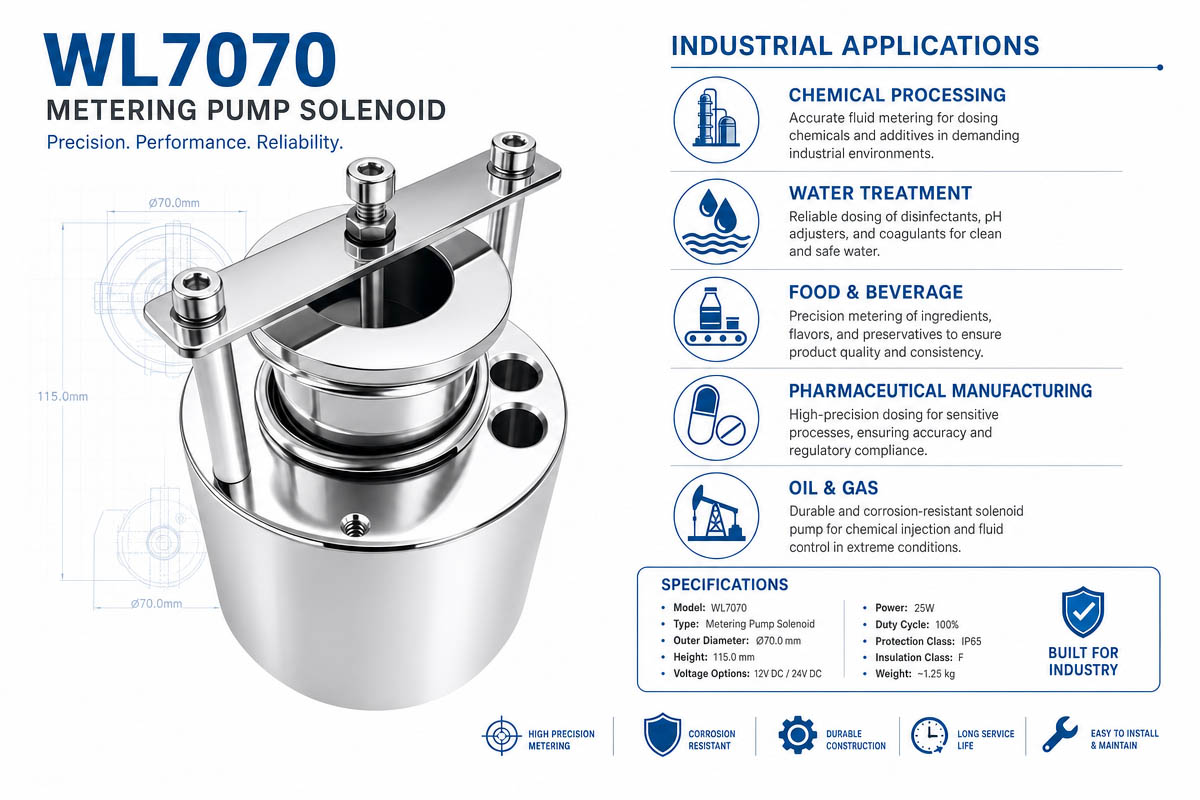
Solenoids for metering pumps are widely used in various industrial applications. Such solenoids are mostly employed for precise liquid dosing and flow control purposes.

One of the most common applications for these devices is water treatment facilities. In such facilities, solenoids are used to inject various chemicals into water, including chlorine and other disinfectants. They are also used in pH adjustment systems.

Solenoids for metering pumps are also used in various chemical industries to precisely dose and control the concentration of acids, alkalis, solvents, and other compounds. Such solenoids are often used in production processes where precise fluid dosing is needed.

These solenoids can also be used for chemical dosing and injection in food and beverage machinery. They are used for accurate dispensing of various flavors, preservatives, and other liquids used in food processing plants.

Medical and laboratory applications are the other common applications for these solenoids. They are widely used in various medical and laboratory equipment to provide precise fluid delivery.

Another popular application is agriculture, where solenoids for metering pumps are used to accurately dispense fertilizers or pesticides in irrigation systems. These solenoids can also be used in other agricultural machinery.

Such solenoids are widely used in industrial automation equipment. They can be found in numerous industrial devices that need precise fluid injection or transfer. Lubricators, coolant, and chemical dispensing systems are just a few examples.

These solenoids are also used in textile processing equipment, printing machines, environmental protection machinery, fuel additive systems, and other industrial machinery.

Metering Pump Solenoid Advantage and Disadvantage

Metering Pump Solenoid Advantage and Disadvantage

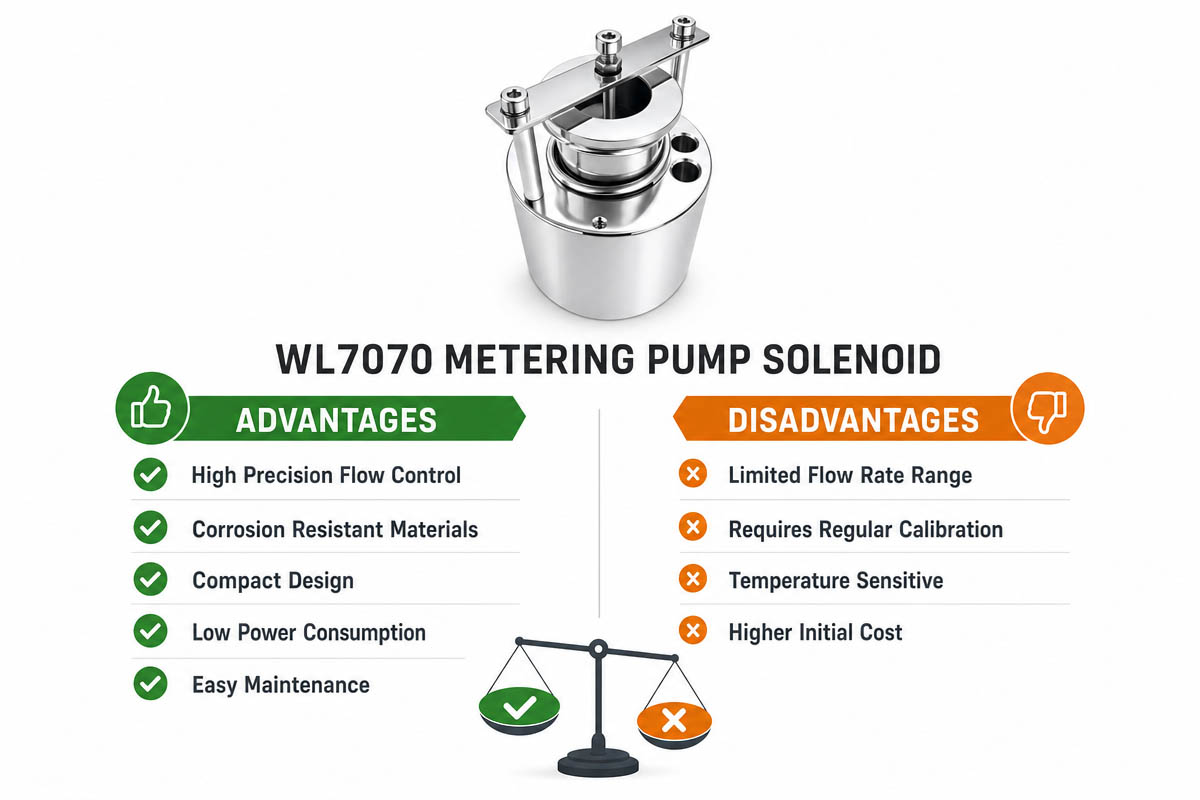
There are several advantages of using these solenoids in fluid dosing applications. First of all, solenoids for metering pumps are extremely precise and accurate devices that allow controlling even small volumes of liquid. This makes them great for use in chemical dosing systems, laboratories, and other applications.

Another benefit of solenoids for metering pumps is their small size. Compared to motor-driven solutions, such solenoids are more compact, easier to mount, and have simpler control electronics. Furthermore, they consume less energy and feature fewer moving parts.

Another benefit of metering pump solenoids is rapid response time. These solenoids are much faster than motor-driven solutions and allow for precise and rapid dosing of liquids.

Reliability is one of the key benefits of using solenoids for metering pumps. These devices are known for their long operating life and high stability during continuous operation. Their performance rarely changes, and they are almost immune to breakdowns and maintenance issues. Moreover, they feature relatively low operating expenses.

However, there are several disadvantages to metering pump solenoids as well. First of all, they cannot be compelling for large liquid volumes. Moreover, they generate significant heat when working at a high frequency.

Another disadvantage is the possibility of vibration and noise when operating. These devices may produce loud sounds and vibrate significantly during the operation. Furthermore, they have shorter lifespans when working in an aggressive environment.

Overall, both types of devices offer advantages and disadvantages, and you can use each in various industrial applications depending on the task.

Metering Pump Solenoid Troubleshooting

Metering Pump Solenoid Troubleshooting Guide

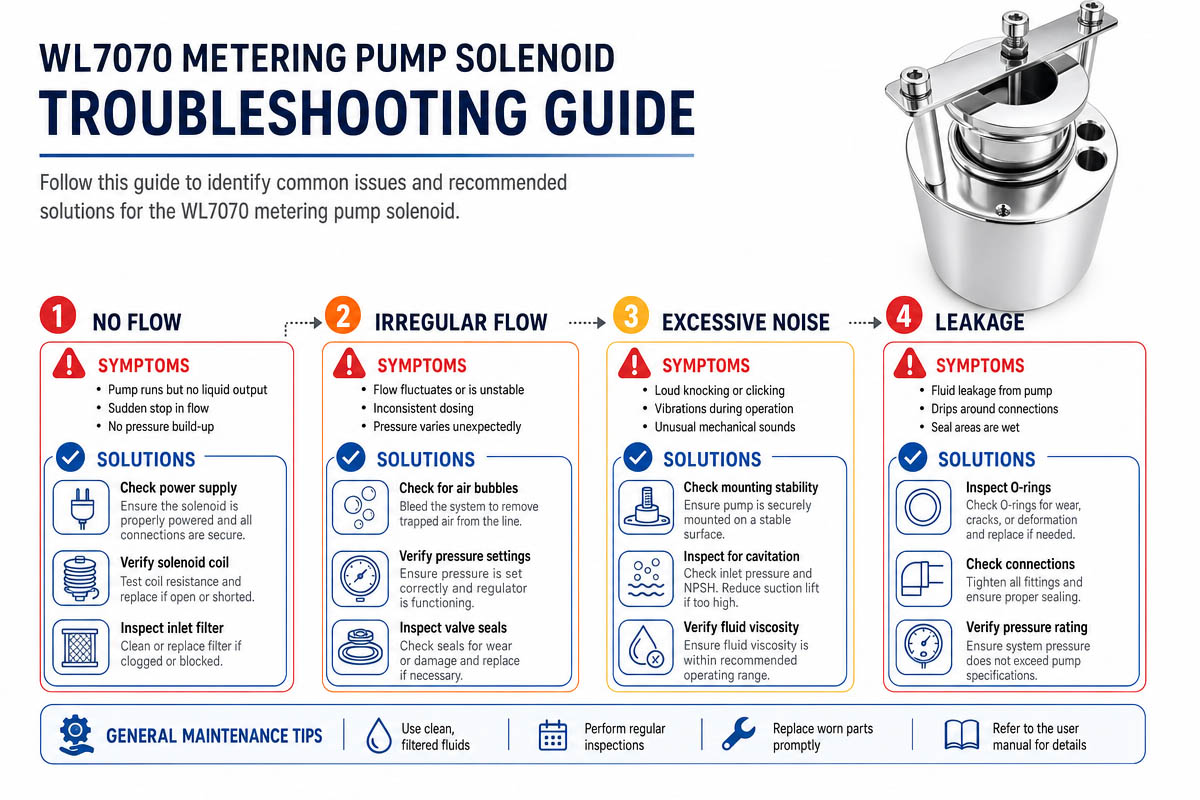
There are several problems that may occur during the operation of solenoids for metering pumps. Among them are inability to start working properly, poor pumping performance, fluid leakage, and other issues. Let’s discuss possible reasons and solutions for each of these problems in detail.

First of all, a solenoid may fail to start working due to improper voltage setting or damage to the coil itself. Other reasons for a metering pump solenoid failure to start may be poor electrical connections or overheating. To solve these issues, users can try changing the voltage, repairing damaged parts, or improving airflow.

Poor pumping performance may occur for several reasons, the most common of which is voltage problems. Low input voltage leads to insufficient magnetic force and affects performance. Other possible reasons are worn or damaged springs and plungers.

Fluid leakage can occur due to damage to plungers, worn diaphragms, or poor seals. It is important to regularly inspect these parts and change them as soon as you notice any signs of wear.

Overheating is common with metering pumps working at high frequency and voltage levels. To solve this problem, one can change operating frequency and use a proper voltage setting. Additionally, it is possible to improve ventilation around the solenoid.

Vibration is the other common problem with metering pump solenoids. They usually vibrate because of the lack of sufficient lubrication, damaged parts, or imbalanced weight distribution. To solve this problem, users can properly lubricate their solenoids and balance them.

Fluid Leakage

Loose mechanical connections can lead to noise problems with these solenoids. To rectify it, users should properly assemble their device. It is also recommended to perform regular maintenance procedures to prolong the life and improve the performance of the metering pump solenoid.


Metering Pump Solenoid FAQs

1 : What is a Metering Pump solenoid and what does it do?

Answer: Solenoids for metering pumps are devices that convert electrical energy into mechanical motion to drive metering pump plungers. These devices are used in a wide variety of industrial applications.


2: How does a Metering Pump solenoid work?

Answer: When applying voltage to a solenoid, it forms a magnetic field that causes armature movement. This results in piston motion inside the metering pump chamber that delivers fluid.


3: Why should I use a solenoid in my Metering Pump?

Answer: Metering pump solenoids provide fast reactions, precise dosing, and excellent performance. They are also durable, easy to use, and consume relatively low amounts of energy.


4: Why does my Metering Pump solenoid overheat?

Answer: Heat generation is an inherent feature of all solenoids. However, wrong voltage setting, continuous operation and high operating frequency may result in excess heat.


5: Why is my Metering Pump solenoid poorly performing?

Answer: A low voltage level is the main reason for the weak performance of metering pump solenoids. Other reasons may include worn springs and plungers, as well as fluid contamination.


6: What is the average lifetime of a Metering Pump solenoid?

Answer: The lifetime of these devices may vary depending on usage mode and solenoid design. Generally, they are reliable and can work many million times under normal conditions.


7: How should I pick appropriate Metering Pump solenoids?

Answer: Voltage setting, force, frequency, operating temperature, size, and other factors have to be considered when selecting a suitable solenoid.


8: Where are Metering Pumps solenoids typically used?

Answer: Water treatment facilities, chemical plants, medicine, labs, and other industries employ metering pump solenoids for precise fluid dosing applications.

How to avoid common mistakes while choosing a Metering Pump Solenoid

There are a few common mistakes that users make while selecting a metering pump solenoid. One of the most frequent ones is the inability to determine the right amount of force needed. Solenoids need a specific amount of magnetic force to drive metering pump pistons or plungers.

Another common mistake is wrong voltage settings. Excessive or insufficient voltages may affect solenoid performance or reduce their life. To resolve this problem, one should select a proper voltage setting that fits his particular metering pump’s application.

Material compatibility is also crucial when picking appropriate solenoids. They should be resistant to a particular type of chemical; otherwise, their lifetime can significantly decrease. To achieve this goal, special materials like stainless steel are used.

Frequency and temperature are important factors as well. Continuous operation at high frequencies may reduce the performance of a metering pump’s solenoid, while temperature influences the magnetic properties of its core.

Moreover, you should also take a solenoid’s dimensions into account. Sometimes, users should customize solenoids to ensure their perfect operation. Size constraints play an important role when choosing appropriate devices.

Finally, it is also important to take into account energy consumption and lifetime when picking a particular solenoid. The solenoid should have enough force and be resistant to wear to provide years of stable operation.

Choosing a Metering Pump Solenoid

You should consider a number of important technical characteristics of these devices during their selection. First of all, voltage setting is crucial in ensuring stable operation. It is important to know if the solenoid needs AC or DC current. The voltage range should also be taken into account.

Force requirement and stroke length are also essential characteristics of such solenoids. Solenoids should produce a specified amount of force to drive metering pump plungers effectively. Too low forces can result in unstable or non-uniform pumping cycles.

Duty cycle is another factor that needs to be considered while choosing a metering pump’s solenoid. Depending on the application, the result may vary. Duty cycles are especially important for solenoids that have to work continuously without breaks.

Moreover, the speed of actuation and operating frequency should also be considered to ensure proper performance. Solenoids should produce magnetic fields fast enough for quick pumping cycles.

Temperature is an important aspect of the selection process. Various metering pump solenoids work well in different temperature ranges. High temperatures, humidity, dust, or corrosive liquids require particular design considerations.

Chemical properties of the working medium also have to be considered when selecting solenoids for metering pumps. The chemical resistivity of plungers and housing is particularly important for solenoids operating in aggressive environments.

Size is also important because it determines the ability to mount a solenoid in a compact location. Users sometimes require customized metering pump solenoids.

Lifespan and energy efficiency are important factors for determining the performance of the device and ensuring long operating life.

Get A Free Quote Now

Contact Form

Related Products

Related News

Scroll to Top

Get A Free Quote Now !

Contact Form
If you have any questions, please do not hesitate to contact us.
Weilong Solenoid Company Culture
