New Gear Shift Solenoid for Auto Systems
Transmission Gear Shift Solenoid Info
Auto Gear Shift Solenoid Solutions
Automotive Gear Shift Solenoid Features
New Automatic Gear Shift Solenoid Uses
Reliable Automatic Gear Shift Solenoid Design
New Gear Shift Solenoid for Auto Systems
Transmission Gear Shift Solenoid Info
Auto Gear Shift Solenoid Solutions
Automotive Gear Shift Solenoid Features
New Automatic Gear Shift Solenoid Uses
Reliable Automatic Gear Shift Solenoid Design

WL0741 Automotive Gear Shift Solenoid Guide

An automotive gear shift solenoid is a special electromagnetic device used in automotive automatic transmission systems for gear-shifting processes. The automotive gear shift solenoid consists of the process of converting electrical energy into mechanical energy and allows the transmission fluid to flow through certain passages of the gearbox. The automotive gear shift solenoid is controlled by the transmission control module (TCM) or engine control unit (ECU) to provide optimal gear shifting in the vehicle. Such devices can be found in many passenger cars, trucks, hybrid vehicles, and commercial vehicles.

Best Feature of Automotive Gear Shift Solenoid

The automotive gear shift solenoid possesses the qualities of small size, fast reaction time, and high-accuracy of the transmission control. Durability and strength of electromagnetic coils, accurate valve movement, and low power consumption make this device highly efficient. In addition, the solenoid is resistant to temperature extremes and vibrations and therefore suitable for automotive use.

This device provides precise control of the flow of hydraulic fluid allowing smooth gear engagement and increased driving comfort. There are many high-quality seal designs preventing oil from leaking inside the solenoid assembly. Moreover, many gear shift solenoids have been designed to last a long time, and require little maintenance. They are compatible with modern ECU/TCM systems and indispensable in automatic/hybrid transmission systems.

high performance transmission solenoid Overview

Automotive Gear Shift Solenoid—Overview

The WL 0714 automotive gear shift solenoid is a miniaturized electromagnetic actuator, which is used for controlling the gear-shifting process of an automatic transmission. Using electrical signals, the device regulates the flow of the hydraulic fluid in an automatic transmission system.

The WL0714 automotive gear shift solenoid has the advantages of high compactness, reliability, and fast response in harsh automotive conditions. The solenoid can be used for passenger cars, trucks, hybrid, and electric automobiles. The device is characterized by rugged and corrosion-proof winding and high-precision valve movement design.

The use of the automotive gear shift solenoid improves the efficiency, driving comfort and overall performance of the automatic transmission.

Compact automotive gear shift solenoid Video

Automotive gear shift solenoid detailed Display

Automotive gear shift solenoid Technical Data Sheet

Brand Weilong Technology Model Number WL0741
Rated Voltage (V) DC12V Rated Power (W) 7-10 W
Work Mode Push and Pull Holding Force (N) 2.5 N
Stroke (mm) 4 MM Customized Working Duty Continuous
Service Life 200 Thousand Times Certification CE, RoHS, ISO9001,
Material Superior Magnet Iron Lead Wire Length (mm) 200 MM
Install Style Screw Tolerance of Dimension  +/-  0.1 MM
Water-proof  None Insulation Class B
Hi-Pot Test AC 600V 50/60Hz 2s Non-excitation Holding Force 0
Working Temperature -10°C-100°C Duty Cycle 1-100%
Thread Depth (mm) / Payment Term TT, or LC At Sight
Sample Order Yes Warranty 1 Year
MOQ 1000 pcs Supply Ability 5000 pcs per Week
Delivery Time 30 Days Port of Loading shenzhen

Automotive gear shift solenoid Application

Automotive Gear Shift Solenoid Application

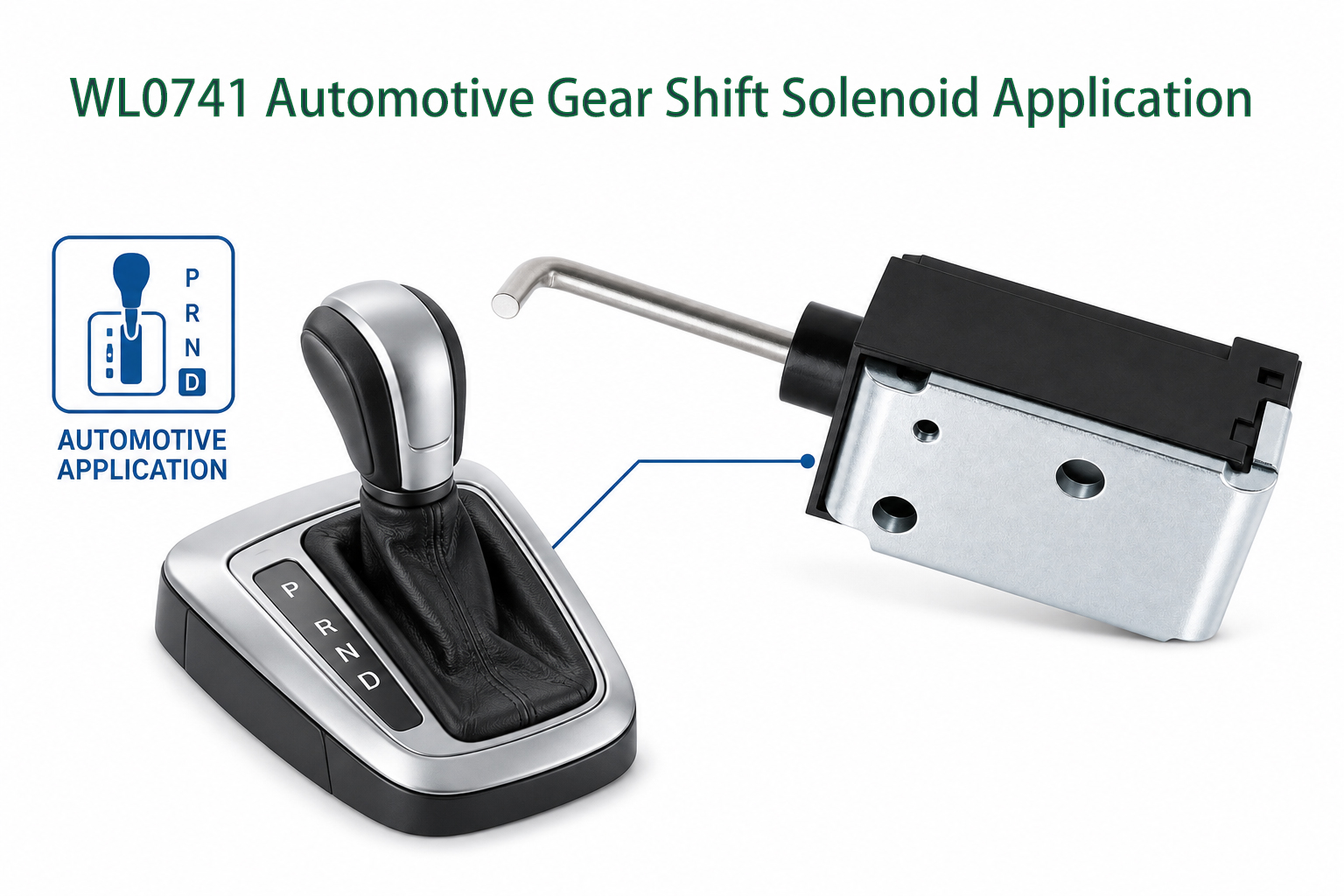
The automotive gear shift solenoid is widely used in automotive transmission systems for gear control purposes. They are primarily used in automatic transmissions for controlling hydraulic fluid flow and gearbox clutch engagement for gear shifting operations.

There is extensive usage of gear shift solenoids in passenger automobiles to improve vehicle driving comfort, fuel economy, and transmission efficiency. These solenoids are also employed in commercial trucks to provide reliable operation and stability under heavy loads. Hybrid and electric vehicles also use gear shift solenoids to manage hybrid and power transmission functions.

The automotive gear shift solenoids are extensively used in the CVT, DCT, and other electronic control automatic transmissions. They also apply in transmission lock-up systems and intelligent automotive technology.

There are some applications for high-speed gear shift solenoids in sports cars and racing automobiles. Fast operation of these devices allows for quick gear shifting for improved acceleration and driving performance. Due to their accuracy and responsiveness, automotive gear shift solenoids are crucial in automotive engineering and intelligent vehicle systems of the future.

car transmission solenoid Advantage and Disadvanatge

Automotive Gear Shift Solenoid advantage and disadvantage

Benefit of Automotive gear shift solenoid

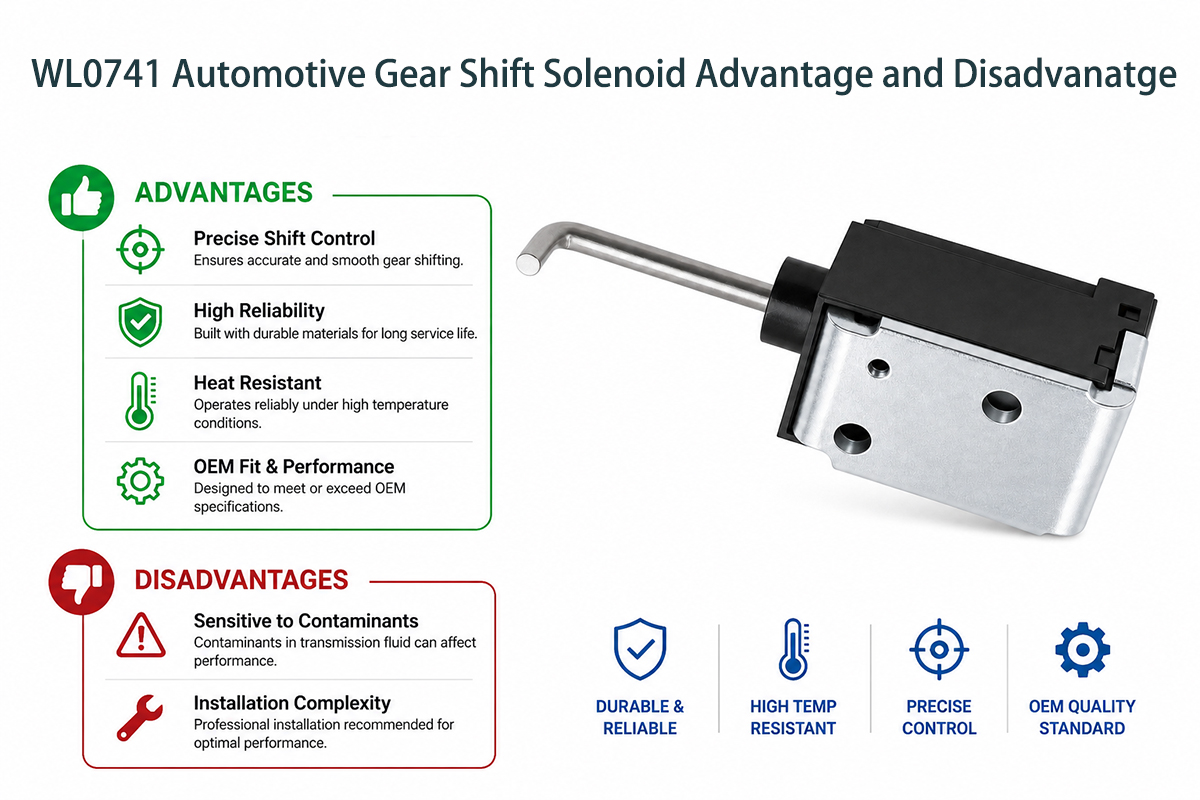
The automotive gear shift solenoid is useful for enabling automatic transmission control that increases driving comfort and vehicle efficiency. Fast operation time guarantees smooth gear shifts and optimized automatic transmission operation. These solenoids reduce fuel consumption by providing proper gear control and pressure regulation.

In addition, such devices possess compact dimensions, allowing easy integration with the modern transmission systems. High-end automotive solenoids operate reliably, consuming low energy and having long service life. Moreover, modern gear shift solenoids can work with intelligent vehicles and hybrid transmission systems.

Drawback of Automotive gear shift solenoid

However, automotive gear shift solenoids often wear out or fail due to overheating, contamination, and continuous use. Malfunctioning solenoids will result in improper gear shifting, transmission slippage, and activation of the transmission warning light.

The solenoids must work in conjunction with the vehicle’s ECU/TCM systems, and therefore poor products may encounter overheating or electrical problems. Moreover, the maintenance and replacement of the device may require expensive diagnostic equipment.

Automotive Gear Shift Solenoid Troubleshooting Guide

Automotive Gear Shift Solenoid Troubleshooting

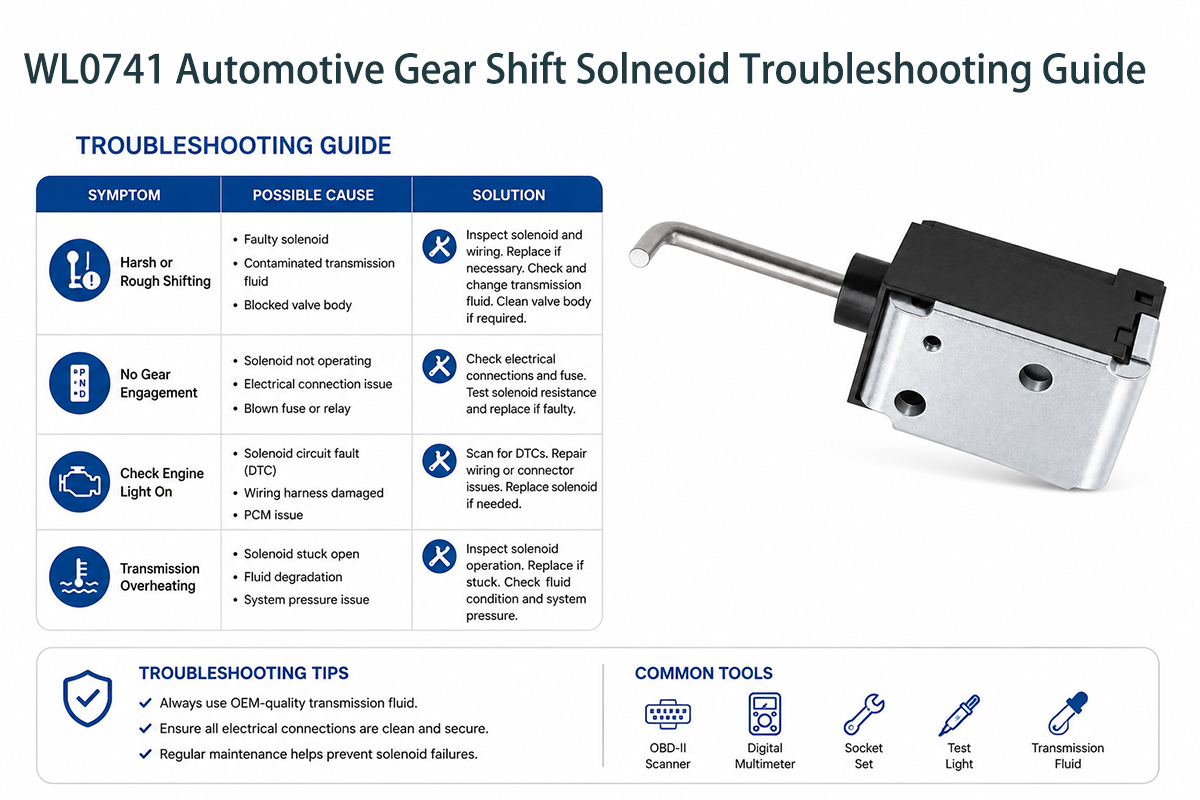
Problems related to the operation of the solenoids could affect transmission performance and safety. Such malfunctions can also manifest themselves in delay shifting, hard gear shifts, transmission slippage, and warning light activation.

One of the most common issues is electrical malfunction caused by faulty coil windings or damaged electrical wires. You can check for electrical problems in voltage, resistance, and contact conditions of the solenoid.

Another problem can be fluid contamination that blocks the hydraulic passages and prevents the valves from moving freely. Changing the transmission fluid and cleaning the solenoids will increase the performance.

Overheating is another serious issue that can cause failures. The solenoids can be damaged due to the heat, affecting insulation materials. Using appropriate transmission fluid and proper cooling can minimize the effects of overheating.

Operation might also be influenced by mechanical failure, fatigue of the springs, and oil leakage. Severe problems may require replacement of the entire shift solenoid.


FAQs of Automotive Gear Shift Solenoid

1. What is an automotive gear shift solenoid?

An automotive gear shift solenoid is a hydraulic solenoid in an automatic transmission. It receives commands from the Transmission Control Module (TCM) about regulating the flow of fluid inside the transmission. The solenoid activates and deactivates hydraulics to channel the fluid to the correct clutch packs/bands so as to engage the appropriate gear. There are two main types: On-off type – controls fluid pathways Pulsed type (variable force) – controls fluid pressure to achieve smooth shifting.

2. Symptoms of a malfunctioning solenoid

Some of the symptoms of a faulty shift solenoid include:

Check Engine/Transmission Warning Light: The engine finds a problem in the circuitry of the vehicle or its performance and activates the light

Hard or Uneven Shifting:

Incorrect fluid pressure can result in the vehicle hard shifting or skipping gears during the process (e.g., going directly from 1st to 3rd)

Delayed Engagement: There can be a 2-3 second delay when shifting from Park or Reverse to Drive.

Stuck in Gear (Limp Mode): In the event of failure, the vehicle locks into a particular gear (usually 2nd or 4th). This limits its ability to move.

Transmission Slip: Engine RPMs are higher than normal, but the vehicle acceleration is not happening as expected.

3. Why do shift solenoids go bad?

There are many reasons for this and most of them relate to the health of the transmission fluid. Some of them are:

Contamination: Dirt, metal shavings, or debris from the friction material during normal wear can cause problems in the screens/filters of the solenoids.

Electrical Problem: Inside coil of the solenoid can either burn out (open circuit) or short circuit so that it no longer receives signal from the TCM

Mechanical Sticking: Old transmission fluid can accumulate and create sludge inside the solenoids, causing sticking.

Wiring Problem: Corroded connection or wiring damage between the solenoid and the TCM can interfere with the electrical signal to the solenoid.


4. Can I test my shift solenoid myself?

Professional scanners work best, but you could conduct some simple checks using a digital multimeter (DMM):

Resistance test: Locate solenoid’s connector and take its resistance value in ohms. A good solenoid usually measures between 10 and 30 ohms. If you get 0 ohm (“short”) or “OL” (open/infinity), then the coil is bad.

Power Check (if safe): Attach 12V power and ground terminals to the solenoid. You should hear the “click” sound when the valve inside the solenoid opens. Failure to hear the click indicates the valve is stuck.


5. Do I have to replace my entire transmission if the solenoid goes bad?

No, normally not. Solenoids are serviceable components located within the valve body of the transmission. Replacement of these parts would require draining the fluid, removing the transmission oil pan, or possibly the valve body as well. In recent years, some transmissions have their solenoids included in a “TEHCM” unit, which must be replaced as a whole unit. In case of contamination, the solenoid needs replacement, but it is recommended to change your transmission fluid and filter at the same time.

6. What causes the P0796 or P1858 diagnostic code?

Some of the OBD-II codes related to solenoids are listed below:

P0796 (Pressure Control Solenoid C Performance/Stuck Off): The TCM detects that the solenoid has a problem with regulating the hydraulic pressure in the high-range gears (e.g., 3rd-4th). This often leads to harsh shifting and slippages.

P1858 (Gear-shifting solenoid, open circuit/shorted to B+): It is an electrical problem with a particular shift solenoid circuit. This usually causes the vehicle to enter “limp mode” (stuck at 4th gear) since the TCM cannot control the solenoid for shifting.


7. How can I avoid shift solenoid problems?

The key factor in preventing problems is maintaining good transmission function:

Regular fluid changes: Changing the transmission fluid and filter according to the intervals recommended by the manufacturer. Fluid becomes worn and forms sludge that can cause problems for the solenoids.

Keep it clean: Avoid getting any dirt into the dipstick tube when checking the fluids.

Work the problems early: Any slight “clunk” noise or hesitations should be taken care of. Debris in the fluid could travel and damage your newly installed solenoid or other internal components.

8. How to distinguish between a pressure control solenoid and a shift solenoid?

Both these solenoids are part of the same group but perform distinct duties:

Shift solenoids: These are basically ‘on/off’ switches. They regulate the flow of the fluid in certain circuits to choose which gear is selected (e.g., turn the 2-4 band).

Pressure Control Solenoid (PCS) and EPC Solenoid: These solenoids are classified as ‘variable force’ solenoids. They control the amount of pressure that is applied to the aforementioned clutches. The PCS determines whether a shift feels smooth or hard.


Automotive Gear Shift Solenoid Selection Guide

The correct choice of the automotive gearshift solenoid is essential for providing reliable transmission performance. There are several factors that you should pay attention to while selecting your device.

Firstly, always check the transmission and vehicle compatibility. Every automatic transmission requires the particular solenoid design, voltage ratings, installation structure, and hydraulic control capabilities.

Secondly, consider the voltage ratings and electrical properties of the device. Typically, these components are designed to work with 12V/24VDC. Coil resistance, electrical current, and duty cycles should match the vehicle’s control system and be within specified limits to avoid overheating or malfunction.

Thirdly, think about the environment where the solenoid will operate. Automatic transmission systems usually experience high temperatures, vibration, hydraulic fluid pressure changes, and other challenging operational conditions. Quality solenoids are made of thermal-resistant materials with durable seals and corrosion-proof metals.

Response time and accuracy are also very important. Fast-action solenoids will provide efficient transmission control and driving comfort, while precise valve movement will ensure an optimal gear-shifting process.

Consider lifetime and reliability while selecting automotive solenoids. Purchase items that can operate reliably and effectively under continuous automotive operations. Reliable suppliers offer their product’s specifications and certificates for performance analysis.

Finally, install the solenoid according to the specified installation dimensions and connectors’ types. An improper size will lead to oil leakage, vibration, or failure of electrical contacts.

Professional automotive gear shift solenoid manufacturers can help you select the best solution that will improve driving performance and vehicle efficiency.

Get A Free Quote Now

Contact Form

Related Products

Related News

Scroll to Top

Get A Free Quote Now !

Contact Form
If you have any questions, please do not hesitate to contact us.
Weilong Solenoid Company Culture
