Push-Pull Frame Solenoid for Industrial Systems
Push-Pull Solenoid in Automation Equipment
Frame Solenoid for Smart Lock Applications
Push-Pull Solenoid for Precision Motion Use
Push-Pull Solenoid for Access Control Devices
Push-Pull Solenoid for Precision Motion Use
Push-Pull Frame Solenoid for Industrial Systems
Push-Pull Solenoid in Automation Equipment
Frame Solenoid for Smart Lock Applications
Push-Pull Solenoid for Precision Motion Use
Push-Pull Solenoid for Access Control Devices
Push-Pull Solenoid for Precision Motion Use

WL0946 Industrial Use of Push-Pull Frame Solenoid

A push-pull type frame solenoid is a device that produces mechanical motion when supplied with electrical energy. These solenoids comprise a metal frame, coil, a return spring, and a plunger. When the coil receives the current, it creates a magnetic field, leading to movement of the plunger. In some push-pull solenoids, the plunger retracts inside the coil, resulting in bidirectional movement.

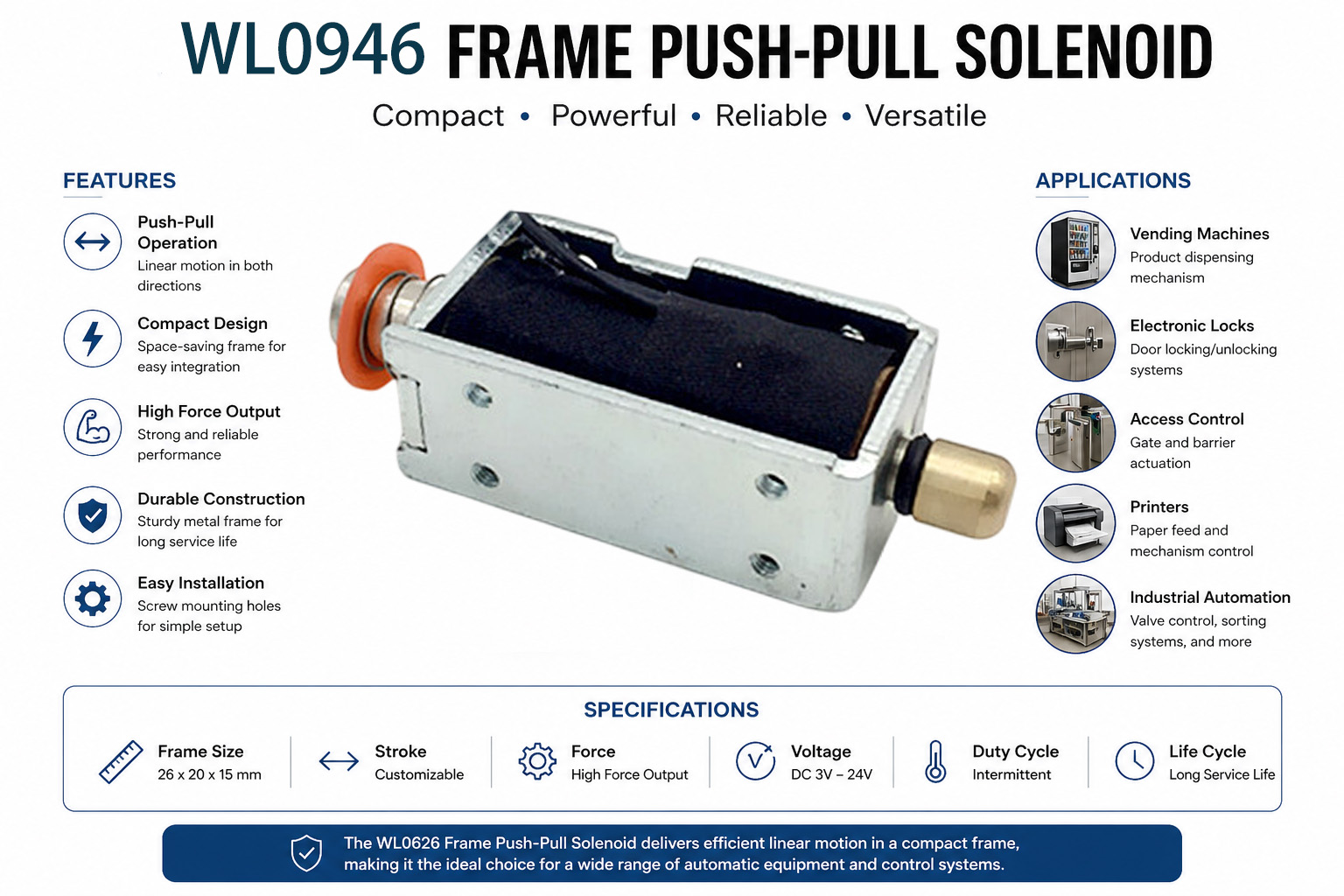
A push-pull frame solenoid finds application in a wide range of systems due to its simplicity and functionality. It provides quick and efficient movement in two directions. The compact size allows incorporating it in multiple devices. You can use it in automation, locks, vending machines, and medical equipment. Push-pull frame solenoids are durable and reliable, making up important parts of electromechanical systems.


Key Features of Push-Pull Frame Solenoid

The push-pull frame solenoid is a relatively small, reliable, and functional electromechanical actuator. Such actuators perform two types of movement: push and pull, providing operational convenience. They respond rapidly and deliver stable performance, making them reliable. A metal housing contributes to their durability and heat dissipation. Available in 6V, 12V, and 24V versions, push-pull solenoids can be found among multiple DC versions.

Installation is easy and maintenance is negligible. They operate quietly and consume minimal power. They exhibit steady stroke lengths and enjoy high service lifespans.

Push-Pull Frame Solenoid Product Overview

Push-pull frame solenoids represent electromechanical actuators designed to move a plunger in two directions thanks to the creation of magnetic fields. This process occurs because of electrical impulses provided for them.

Such solenoids boast long lifespans and stable performance thanks to quality metal frames and high-end coils. There are several options for voltage variations. All of them have the same stroke length.

Being highly regarded in automation equipment, locking systems, vending machines, and control devices, push-pull frame solenoids demonstrate their reliability, installability, and versatility.

Push-Pull Frame Solenoid Product Video

Push-Pull Frame Solenoid Detailed Display

Push-Pull Frame Solenoid Technical Datasheet

Brand Weilong Technology Model Number WL0946
Rated Voltage (V) DC12V  or 24V Rated Power(W) 11.5 W
Work Mode Push and Pull Holding Force (N) 500 GF at 3 mm, 400 GF at 5 MM
Stroke(mm) 2-5 MM Customized Working Duty Continuous
Service Life 200 Thousand Times Certification CE, RoHS, ISO9001,
Material Superior Magnet Iron Lead Wire Length (mm) 200 MM
Install Style Screw Tolerance of Dimension  +/-  0.1 MM
Water-proof  None Insulation Class B
Hi-Pot Test AC 600V 50/60Hz 2s Non-excitation Holding Force 0
Working Temperature -10°C-100°C Duty Cycle 1-100%
Thread Depth(mm) / Payment Term TT, or LC At Sight
Sample Order Yes Warranty 1 Year
MOQ 1000 pcs Supply Ability 5000 pcs per Week
Delivery Time 30 Days Port of Loading shenzhen

Push-Pull Frame Solenoid Industrial Application

WL0946 Push-Pull Frame type Solenoid Application

Among the uses of push-pull solenoids are locking in access control systems. For instance, you may find it used in smart locks, cabinet locks, and electronic door locks.

In addition, they are applicable in vending machines and ticketing systems. Push-pull solenoids are helpful in automation equipment for performing functions such as sorting, switching, and positioning.

Moreover, they are applied in medical equipment for the purposes of valve and fluid control and positioning. In the automotive industry, push-pull solenoids actuate locking mechanisms and other systems. Besides, they are employed in office automation equipment as well as in gaming machines, ATMs, and locker systems.

Being small, quick-responding, and consistently functioning, push-pull frame solenoids become an important part of many systems and equipment.

Advantages and Disadvantages of Push-Pull Frame Solenoid

WL0946 Push-pull Frame Type Solenoid Advantage and Disadvantage

Push-Pull Frame Solenoid Pros & Cons

Push-pull solenoids are advantageous in many ways. Firstly, they are compact and lightweight. Secondly, the possibility of push/pull movement gives additional flexibility. Moreover, simplicity leads to reliability and minimization of maintenance. Fast response time and stable work are other benefits. Being energy efficient, they consume small amounts of energy but produce sufficient force. They are durable and have high lifespans.

Nonetheless, push-pull solenoids suffer from certain disadvantages. Firstly, they produce small amounts of force, restricting their application in heavy-duty tasks. Furthermore, push-pull solenoids have a limited duty cycle that restricts the continuous operation of these actuators without control. Other possible issues include poor performance in cases of voltage fluctuation or wrong installation. In addition, they get worn out with time.

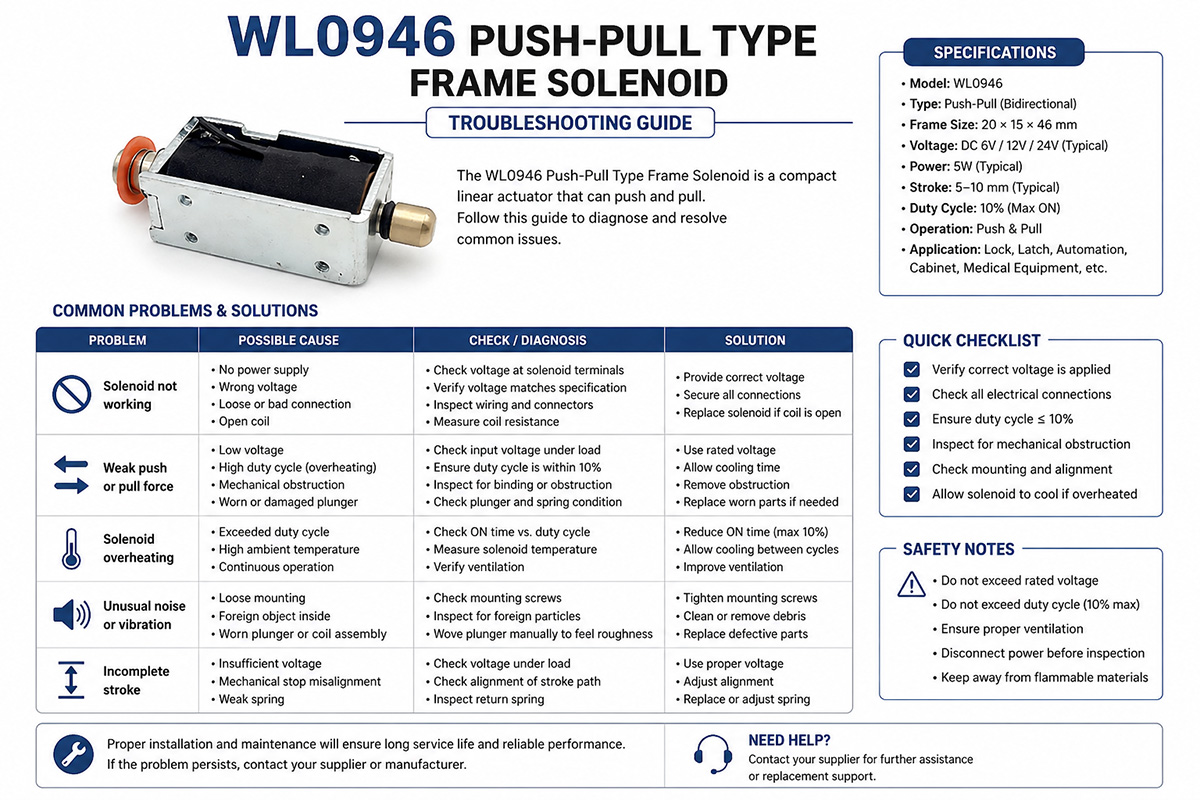
Troubleshooting guide of push-pull Frame Solenoid

ush-pull Frame Solenoid Troubleshooting guide

1. Solenoid Doesn’t Work

Check power supply and voltages

Verify wiring connections

Measure resistance of the test coil

2. Weak Push/Pull Power

Confirm the voltage input is correct

Look for any obstructions

Inspect the plunger

3. Overheated

Ensure the duty cycle is correct

Reduce the continuous operating time

Improve cooling conditions

4. Vibration or Noise

Tighten mounting components

Check the alignment

Remove debris or foreign objects

5. Partial Stroke

Check installation and alignment

Inspect the return spring

Make sure of sufficient voltage

FAQs Of Push-Pull Frame Solenoid

Question 1: What is the purpose of the push-pull type solenoid frame?

The purpose is to produce movement in two opposite directions: pull and push.

Usage examples: smart locks, vending machines, automation devices, medical equipment, office machines.

Question 2: What is the difference between push force and pull force?

The latter one (inward movement) is bigger due to the concentration of the magnetic field while moving inside. Push force is lower because of mechanical extension.

Question 3: May a push-pull frame solenoid operate continuously?

Continuous operation for most standard solenoids is unacceptable.

Duty cycle percentage ranges from 10% to 25%. Continuous energizing causes overheating and reduces lifespan.

Question 4: Which voltage values are applicable for push-pull frames?

DC voltage variations: 6V, 12V, 24V., we can also do Custom voltage accordingly.

Question 5: Why my push-pull frame solenoid becomes overheated.

Reasons of overheating include high duty cycle, continuous energizing, incorrect voltage, and high ambient temperature.

Question 6: What should be done to prolong the lifespan of my solenoid?

Correctly operating solenoids require respecting the duty cycle, providing the right voltage, preventing mechanical obstacles, and providing good ventilation.

Question 7: Why the push or pull force is weak?

Possible reasons: insufficient voltage supply, too-long stroke requirements, mechanical obstacles, and worn parts. Increase performance through providing correct energy and adjusting the alignment.

Question 8: How to choose the appropriate push-pull solenoid?

The selection depends on force, stroke length, voltage, duty cycle, installation space.

Selection Criteria of a Push-Pull  Frame Solenoid

What does it mean to choose a right push-pull solenoid frame? You should understand that strength is not everything. To get a good balance between the cost and performance, you need to make sure that your choice will be adequate for real working conditions. This way, you won’t overestimate requirements and overspend money. At the same time, underestimation will lead to early failures. Here’s a step-by-step guide to choosing the most suitable push-pull type solenoid frame:

Step 1: Determination of the Needed Strength Force

Starting from load.

Calculating the minimum needed force, including friction, adding an additional 20-30% of safety.

Checking both:

Inward pulling force

Force moving outward – note that it is weaker than the pulling force.

Tip: Force rating refers to 0 mm stroke length provided by suppliers; stroke increase results in reduction in force.

Step 2: Calculation of Stroke Length

How long does the plunger need to travel?

Usual range for frame solenoids: 2-10 mm.

Longer stroke length equals less force availability.

Step 3: Compatibility of Solenoid with Voltage and Power Supply

Check solenoid compatibility with existing power system:

Voltages range: DC 6V, 12V, 24V.

Make sure of:

Stable and consistent voltage source

Availability of current capability

Voltage inconsistency may result in poor force generation or overheating.

Step 4: Duty Cycle

Very common mistake.

Solenoids have a duty cycle of around 10%-25%.

Example: ON – 1 sec., OFF – 9 sec. (10%)

Case of need for continuous operation:

Use a latching solenoid

Include a cooling design

Step 5: Pull-In/Release Time

If you need to operate rapidly (as in the case of lockers and vending machines):

Check pull-in and release times, especially if it should happen fast.

If needed, use a spring for faster return.

Step 6: Space Availability for Installation

Evaluation of the installation place:

Small dimensions of frame solenoids, but still consider:

Stroke clearance

Matching mounting holes

Provision of sufficient room for cables

Step 7: Environmental Conditions

Realistic estimation:

High temperature accelerates wear-out of coils

Humid environment, dust, etc. – need protection

Presence of vibration – solenoid needs sturdy mounting

For harsh conditions: choose IP-rated or hermetic solenoids.

Step 8: Lifespan & Reliability Requirements

Things to specify:

Cycle life, e.g., 100K-1M cycles

Class of insulation of the coil

Plunger & spring quality (high price means high quality)

The main reason for frequent failure in cheap models: poor coils winding and materials.

Step 9: Sound Requirements

Application cases:

Medical devices

Office equipment

Specify your preferences about dampers (rubber ones or soft landing mechanisms).

Step 10: Cost versus Quality

Just do not always opt for the cheapest version.

Comparative analysis:

Normalized force

Thermal properties

Reliability of manufacturer

A higher price may eventually decrease your expenses.

Why is the push-pull frame solenoid getting so popular in smart locking systems?

Push-pull frame solenoids have become one of the most popular actuators for smart locking systems. But it happens not by chance. Here’s how:

1. Quick response to control signal

The push-pull solenoid immediately converts the electrical impulse into the movement of the lock bolt

No gearboxes, shafts, and rotors are used

The stroke occurs at an angle of up to 90 degrees

It is ideal for implementing a quick response to the command in real-time

👉 In the case of a smart lock, this feature allows us to:

Reduce response time

Optimize synchronization with sensors and control units

2. Small size of the device

Smart locks are becoming smaller and thinner, which makes them suitable for use in various applications, including:

Glass locks

Frameless locks

Locks that do not require installation in the door jamb

Push-pull solenoids

Compact design

Fit perfectly into any lock body, even those that are difficult to reach

Enable handle-free locks operating by push-pull method

That is why push-pull solenoids are used in smart locks of all types, including:

Cabinet locks

Hotel locks

Office locks

3. Simple control

Solenoids are binary actuators:

Apply voltage -> move

Stop supplying voltage -> reset

Such simplicity of the actuator allows us to easily integrate it with:

Microcontrollers (ESP32, Arduino, etc.)

Implement various functions in a simple way

Reduce the likelihood of equipment malfunction due to software errors

Therefore, they are most commonly used in:

Home systems

Locks powered by batteries

Wireless locks

4. Strong clamping force with minimal energy consumption

Push-pull solenoids allow us to implement a strong clamping force while minimizing energy consumption

Short impulses to activate a solenoid

Ability to hold a door closed without continuous energy supply

As a result, the lock has:

Increased battery life

Reduced energy consumption

5. High reliability and long service life

When comparing solenoids and motors, we get the following advantages of solenoids for high-performance locks:

Simplification of construction

Reduction of the number of movable elements

Elimination of gear wear

Typically, such actuators provide millions of operating hours and require almost no maintenance.

6. Smooth and quiet user interaction

Push-pull solenoids work faster and quieter than many types of motors

In the case of smart locks, this feature provides:

Decrease noise level during unlocking

Increase comfort of use

Moreover, combined with push-pull door opening mechanism, users will only need to push or pull a door

7. Perfect solution for automated locks and smart ecosystems

Modern locks are integrated into:

Mobile applications

Cloud platforms

Smart home systems

In this case, push-pull solenoids are a great choice because they allow you to immediately respond to digital commands and implement additional functions such as:

Automatic locking/unlocking

Remote unlocking

Timed unlocking

8. Economical and convenient manufacturing

Manufacturing costs compared to motors and gear systems are lower

Assembly process is simpler

Customization options are increased

That is why they are widely used in smart products:

Smart lockers

Parcel boxes

Sharing access systems

9. Conclusion

Push-pull frame solenoids are increasingly being used in smart locks. The reason is obvious – they combine the best features of smart and automated locks: quick response, energy efficiency, compactness, easy control, reliability, and versatility.


Get A Free Quote Now

Contact Form

Related Products

Related News

Scroll to Top

Get A Free Quote Now !

Contact Form
If you have any questions, please do not hesitate to contact us.
Weilong Solenoid Company Culture