Traction Solenoid for Industrial Automation
DC Traction Solenoid for Linear Motion
Compact Traction Solenoid Actuator Design
Industrial Pull-Type Solenoid Applications
Traction Solenoid for Smart Lock Systems
High-Performance Linear Traction Solenoid
Traction Solenoid for Industrial Automation
DC Traction Solenoid for Linear Motion
Compact Traction Solenoid Actuator Design
Industrial Pull-Type Solenoid Applications
Traction Solenoid for Smart Lock Systems
High-Performance Linear Traction Solenoid

WL2584 High Force Traction Solenoid Solutions

A traction solenoid, also known as a pull solenoid or linear solenoid, is an electromagnetic actuator designed to generate linear pulling motion when energized. It operates by converting electrical energy into mechanical movement through electromagnetic force. When current flows through the coil, a magnetic field is created, pulling the plunger into the coil body. This motion is typically used to perform mechanical tasks such as pushing, pulling, locking, or triggering mechanisms.

Because of their simple structure and efficient operation, traction solenoids are ideal for applications requiring precise and repeatable linear motion control in a cost-effective and durable solution.

 Main Features of Traction Solenoid

The traction solenoid offers a compact design, fast response, and high reliability for linear motion control applications. They operate on DC voltage, such as 12V or 24V, and provide strong pulling force within a short stroke range. The structure is simple, consisting of a coil, plunger, spring, and housing, ensuring durability and easy maintenance. These solenoids support customizable stroke length and force output to meet different application requirements. They are energy-efficient, highly repeatable, and suitable for continuous or intermittent duty cycles. Their stable electromagnetic performance makes them ideal for automation, locking systems, and industrial control mechanisms requiring precise actuation.

WL2584 Traction Solenoid Product Overview

A traction solenoid is an electromagnet that converts electrical energy into pulling forces for producing linear motions. It is composed of the coil winding, movable plunger, spring, and solenoid body. After being powered by the DC current, it forms an electromagnet, which pulls the plunger to create a motion. The return spring returns the plunger to its origin position after power removal.

Traction solenoids can be classified as open frame traction solenoids or tubular traction solenoids according to their different performance requirements and applications. They can also be made to work with different voltages, stroke lengths, and pulling forces. Thanks to their unique features such as fast response, reliable performance, and compact size, they are widely applied in automation, locking systems, vending machines, vehicle systems, and medical devices.

With the above advantages, such as their simple structure and high repeatability, traction solenoids play a crucial role in modern electromechanical actuators.

WL2584 Traction Solenoid Video

high speed response linear solenoid actuator Detailed Display

WL2584 AC Traction Solenoid Datasheet

Brand Weilong Technology Model Number WL2584
Rated Voltage (V) AC220V  611A Rated Power (W) 180-200W
Work Mode Pull Type Holding Force (N) 40 N
Stroke(mm) 10-20 MM Customized Working Duty 25%
Service Life 200 Thousand Times Certification CE, RoHS, ISO9001,
Material Superior Magnet Iron Lead Wire Length (mm) 200 MM
Install Style Screw Tolerance of Dimension  +/-  0.1 MM
Water-proof  None Insulation Class B
Hi-Pot Test AC 600V 50/60Hz 2s Non-excitation Holding Force 0
Working Temperature -10°C-100°C Duty Cycle 1-100%
Thread Depth(mm) / Payment Term TT, or LC At Sight
Sample Order Yes Warranty 1 Year
MOQ 500 pcs Supply Ability 5000 pcs per Week
Delivery Time 30 Days Port of Loading shenzhen

WL2584 AC Traction Solenoid Application

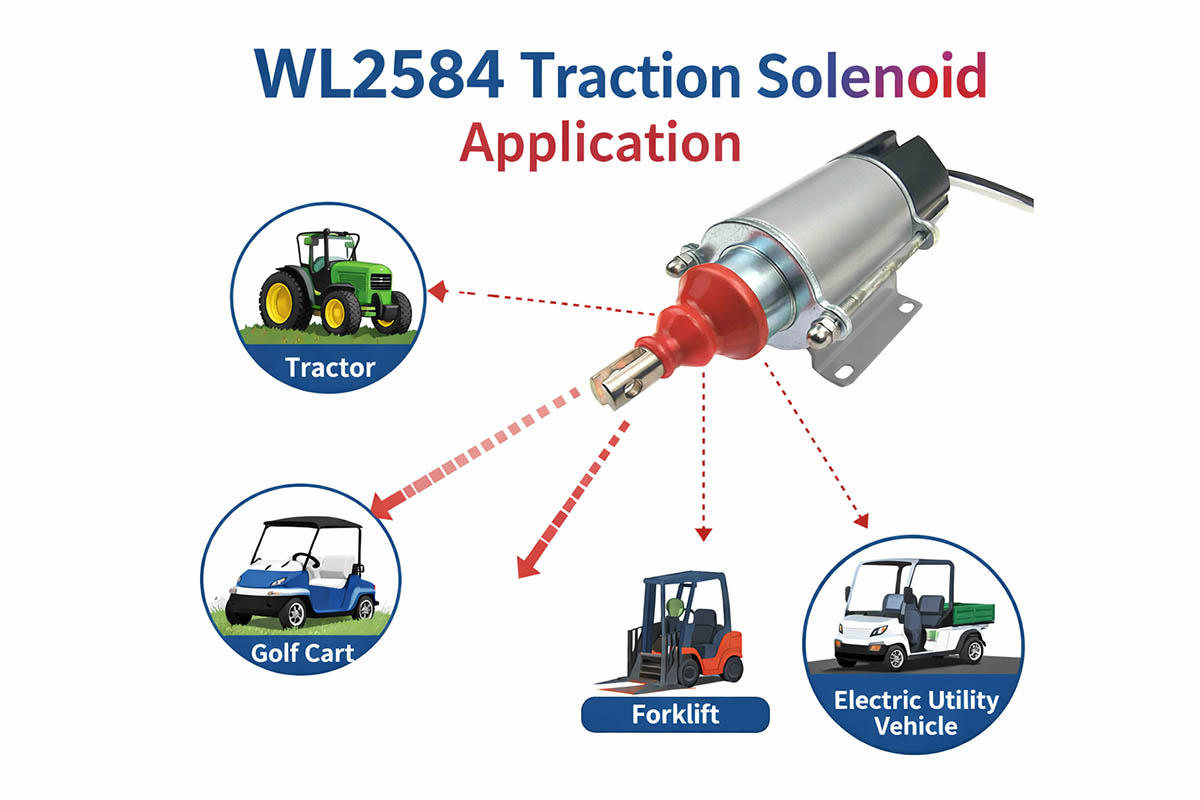
WL2584 Traction Solenoid Application

Traction solenoids are widely used across multiple industries due to their versatility and reliable linear motion capabilities. In industrial automation, they are commonly integrated into control systems, machinery, and production lines for triggering mechanical actions such as positioning, locking, or releasing components. In vending machines and payment systems, traction solenoids are used to control dispensing mechanisms and locking systems.

In the automotive industry, traction solenoids are applied in door locking systems, fuel control valves, and transmission mechanisms. Their fast response and compact size make them suitable for space-constrained environments. In smart home and security systems, they are frequently used in electronic locks, access control devices, and smart locking solutions.

Medical equipment also benefits from traction solenoids, where precise and controlled motion is required in diagnostic and treatment devices. Additionally, they are used in office automation equipment, robotics, and consumer electronics for switching, latching, and mechanical actuation tasks. Their ability to deliver consistent force, repeatable motion, and long service life makes them a preferred choice for engineers designing reliable electromechanical systems.

WL2584 Traction Solenoid Advantage & Disadvantage

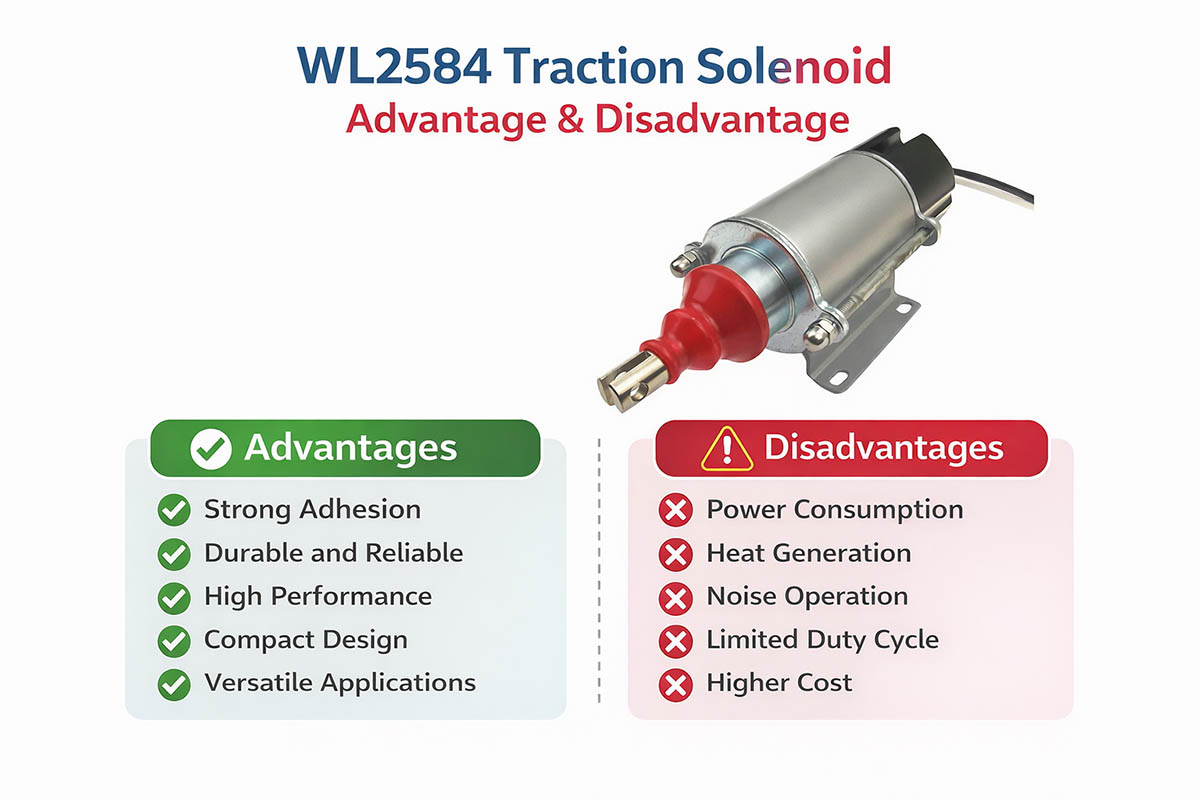
WL2584 Traction Solenoid Advantage and Disadvantage

Traction solenoids offer several advantages that make them highly suitable for industrial and commercial applications. One of the main benefits is their simple and compact structure, which allows easy integration into various devices. They provide fast response times, enabling quick activation and precise control of mechanical movement. Their electromagnetic operation ensures consistent and repeatable performance over long periods. Traction solenoids are also cost-effective compared to more complex actuator systems, making them ideal for mass production applications. Additionally, they can be customized in terms of voltage, stroke length, and force to meet specific requirements.

However, traction solenoids also have some limitations. One of the primary disadvantages is that their force output decreases as the stroke length increases, which may limit their effectiveness in long-distance applications. They also generate heat during continuous operation, requiring proper duty cycle management to prevent overheating. Compared to motor-based actuators, traction solenoids typically offer limited stroke length and motion flexibility. Noise and vibration may also occur during operation in certain designs. Despite these limitations, they remain highly effective for short-stroke, high-speed, and repetitive linear motion tasks in industrial and automation systems.

Troubleshooting of Traction Solenoid (Pull Solenoid)

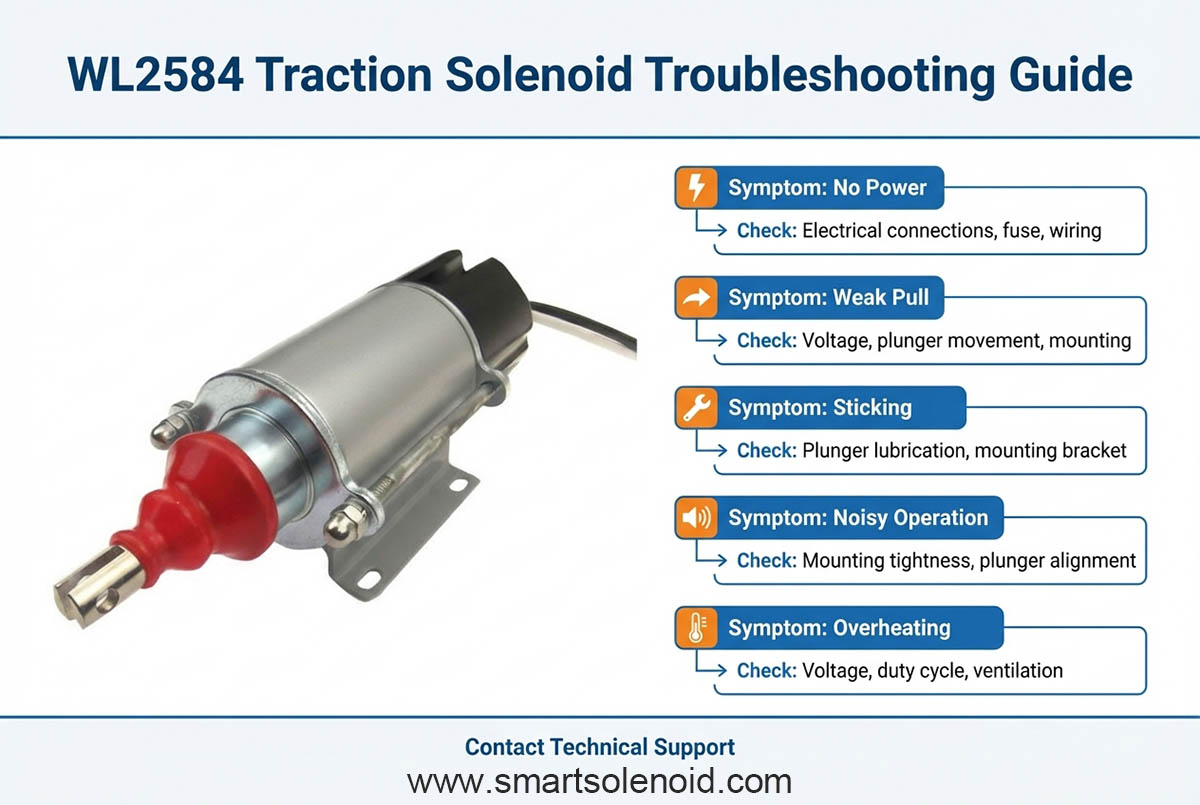
WL2584 Traction Solenoid Trouble Shooting Guide

A traction solenoid is a kind of electromagnetic actuator, which might encounter some technical problems because of various reasons. Here is a systematic troubleshooting guide, listing some common problems, their causes, and solutions for you.

🔧 1. Solenoid Does Not Actuate

Possible Causes:

-No power supply / wrong voltage

-Broken wiring and connectors

-Coil burned out (open circuit)

-Control circuit problem

Solutions:

-Ensure correct input voltage

-Repair wiring or connectors

-Replace burned-out coil (coil resistance = infinity)

-Make sure the control circuit works

⚙️ 2. Weak Pull Force

Possible Causes:

-Incorrect input voltage or current

-Incorrect power supply

-Air gap too large

-Plunger misalignment

-Partial coil problem

Solutions:

-Input voltage = rated voltage (e.g., 12V DC or 24V DC)

-Upgrade power supply if necessary

-Fix mechanical misalignment of installation

-Solve plunger movement problem

🔥 3. Overheating

Possible Causes:

-Operation exceeds duty cycle

-Overcurrent/overvoltage

-Inadequate ventilation

-Inappropriate coil design for the application

Solutions:

-Operate within rated duty cycle

-Proper ventilation

-Stabilize power supply and current/voltage

-Higher thermal rating for solenoid

🧲 4. Plunger Sticking or Not Returning

Possible Causes:

-Dirt or debris inside the solenoid

-Lack of lubrication

-Damaged return spring

-Mechanical damage

-Corrosion and rust

Solutions:

-Eliminate dirt inside the solenoid

-Manual movement

-Replace damaged springs

-Keep internal surfaces of solenoid clean

⚡ 5. Excessive Noise or Vibration

Possible Causes:

-Loose mountings

-Improper alignment

-DC ripple in power supply

-Worn mechanical components

-End stroke impact

Solutions:

-Fix loose mounting

-Make sure correct alignment

-Upgraded stable power supply

-Replacement of worn mechanical parts

🔌 6. Intermittent Operation

Possible Causes:

-Loose electrical connection

-Unstable power supply

-Fluctuation of control signal

-Inner coil degradation

Solutions:

-Inspect electrical connections

-Stabilize power supply voltage

-Stabilize control signal

✅ Preventive Maintenance Tips

-Properly operating within voltage and duty cycle

-Maintaining the solenoid clean

-Proper installation alignment

-Avoiding overload situations

-Regular inspection of wires and connectors

-Proper and regulated power supply


FAQs Of AC Traction Solenoid

1. Why are traction solenoids useful?

This type of solenoid converts electrical energy to linear pulling movement. These devices are widely used in smart locks, vending machines, the automotive industry, and other control applications.

2. What does a traction solenoid do?

When a direct voltage is supplied, a coil generates a magnetic field, causing the plunger to move. Thus, linear movement is induced. The return spring moves the plunger back to its initial position once the power is switched off.

3. Difference between Push & Pull Solenoids?

While pull solenoids move plungers inward, the latter push them outward. Push-pull solenoids are a type of traction solenoid.

4. Which factors affect the pull force of a traction solenoid?

A traction solenoid produces force depending on the current in the coil, the number of turns, voltage, air gap, and stroke length. The further the distance of the stroke is, the lower the force is.

5. Can a traction solenoid work continuously?

Continuous solenoids operate in constant conditions, while intermittent ones only do so occasionally. Not taking the rating duty cycle into consideration can lead to overheating the unit.


6. What voltages are offered by traction solenoids?

Standard voltage options include 12V DC and 24V DC. Custom voltages can be developed according to your needs.


7. Overheating reasons in traction solenoids?

Overheating may occur due to excessive voltage, excessive run-time, poor cooling conditions, inappropriate power supply.

To prevent overheating, consider the appropriate voltage and duty cycle.

8. Tips to select an optimal traction solenoid?

Depending on required force, stroke length, voltage, duty cycle, installation space and working environment, it will be necessary to choose the optimal traction solenoid.

Selection Guide of a Traction Solenoid (Linear Solenoid Actuator)

The selection process of a traction solenoid (also referred to as a pull solenoid or a linear solenoid actuator) is quite critical for proper function, durability, and compatibility of the device with your particular case. Regarding engineers who need to buy one, the following may serve as a useful selection guide.

🔧 1. Estimate the required force

Force is the most crucial parameter.

Establish the force level for a given stroke length.

Note that the force decreases as the stroke increases.

Think about the safety margin that can vary from 20% to 50%.

A tip:

be certain to consult the vendor’s force vs. stroke graph.

📏 2. Determine the stroke length.

The stroke refers to the distance the plunger moves.

Short strokes provide more force than long ones.

Several mm to tens of mm is a common stroke value.

Important aspect to take into account:

ensure that the traction solenoid produces sufficient force at a correct stroke position.

3, Define Rated Voltage

Common voltage options include:

12V DC

24V DC

Custom voltages

Important:

Please ensure that the power supply is compatible.

Sufficiently stable voltage ensures consistent performance.

Low voltage results in low force production.

High voltage leads to overheating.

4. Specify the Duty Cycle and Mode of Operation

The duty cycle characterizes the period of time during which the traction solenoid can remain active.

Continuous duty (100%) provides prolonged performance.

Intermittent duty refers to the on-off operation sequence.

Consider the following factors:

Heat generation

Cooling conditions

Application usage frequency

5. Working Conditions of Environment

Estimate environmental characteristics:

Temperature range

Humidity

Exposure to dust and moisture

Corrosive conditions

Solution:

Choose an appropriate solenoid enclosure (open frame/tubular).

Consider applying protection coating/sealing.

6. Solenoid Type Selection

Various types are designed for specific applications:

Open-Frame Solenoid: economical and convenient design

Tubular Solenoid: small size, safe to use, efficient

Push-Pull Solenoid: bidirectional displacement

Latching Solenoid: energy-efficient, stays on without power supply

7. Dimensions and Installation Space Requirements

Measure the installation space

Orientation and mounting hole configuration

Ensure there is sufficient room for the plunger movement

Important aspect:

Sol’s operation efficiency can depend on mechanical interference.

8. Electrotechnical Specifications

Coil resistance

Power consumption

Power rating (W)

Connector type and wiring

Compatibility with the control system (PLC, PCB, etc.).

9. Speed and Response Time

Automation applications require fast responses

The speed is affected by voltage, coil design, and load

Short strokes react faster.

10. Lifetime Expectation

Consider the following aspects:

Expected number of cycles

Material quality

Plunger and spring durability

11. Customization Needs

In case standard options are not suitable:

Custom stroke length

Custom force output

Mounting customization

Custom winding or voltage

✅ Checklist of Required Solenoid Characteristics

Make sure you establish the following parameters before purchasing your traction solenoid:

Required force at the given stroke ✔

Length of stroke ✔

Voltage and power supply ✔

Duty cycle ✔

Environmental conditions ✔

Size and installation space ✔

Lifetime expectation ✔

Get A Free Quote Now

Contact Form

Related Products

Related News

Scroll to Top

Get A Free Quote Now !

Contact Form
If you have any questions, please do not hesitate to contact us.
Weilong Solenoid Company Culture
