


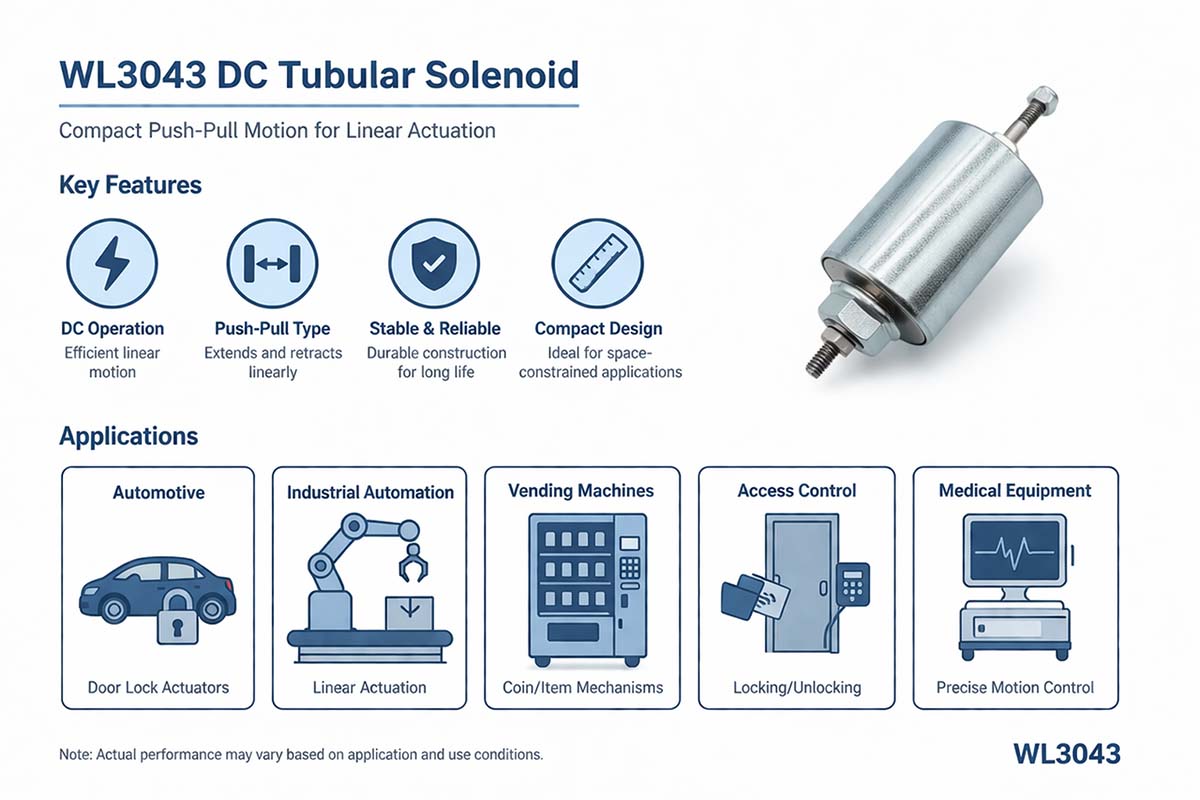
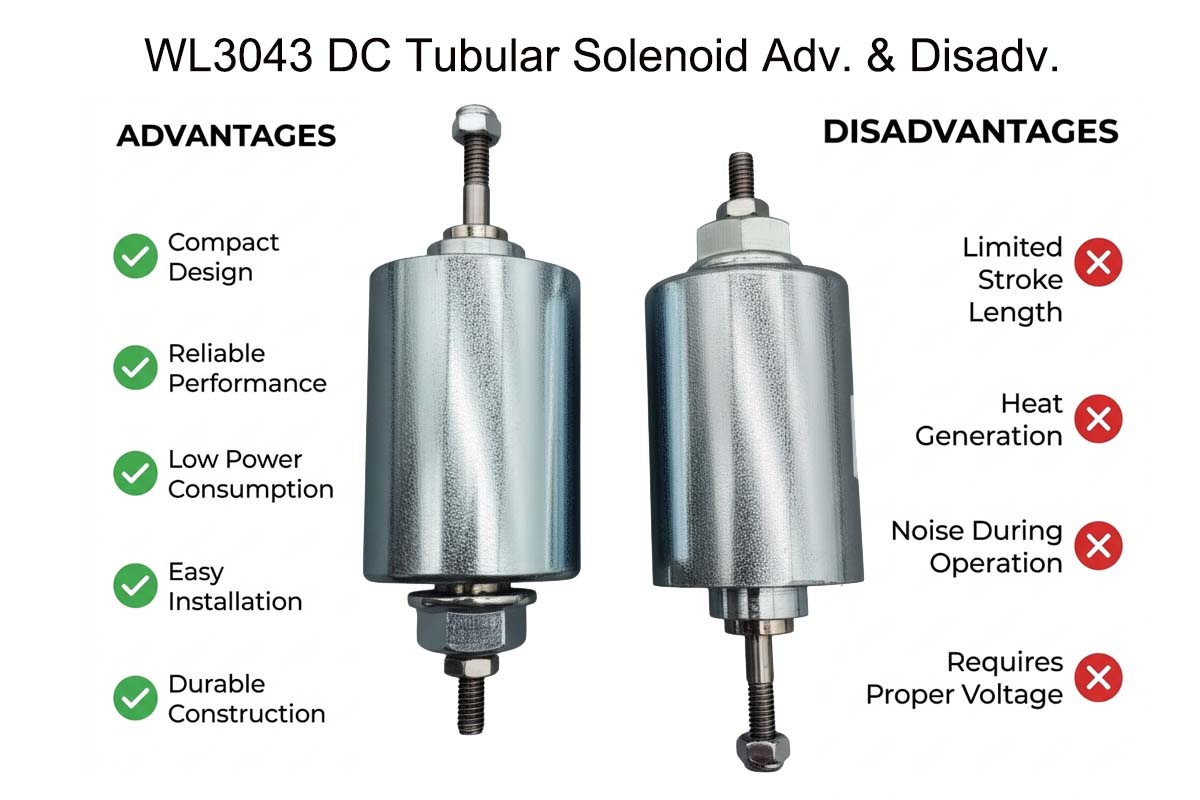
How to Pick a DC Tubular Solenoid
Picking a DC tubular solenoid is very important for its performance, cost-effectiveness, and durability. The first and most important step is making sure the specifications of the solenoid meet the specifications of the application.
1. Define Force Requirement (Most Important)
Determine the amount of force required to move the load.
To ensure safety, always add a safety factor of 1.2 to 1.5.
Consider friction, gravity, and other external factors.
👉 For example:
If the load requires 20N of force, choose a solenoid that can produce at least 30N.
2. Stroke is how far the plunger has to go.
The main rule is the longer the stroke, the lower the force.
If you want to get the most done, you want to use the shortest stroke possible.
👉 Typical tubular solenoid stroke: 2mm to 30mm
3. Check Duty Cycle (Very Important)
What is duty cycle: how long it’s ON vs. how long it’s OFF
For example:
25% duty cycle: short bursts
100% duty cycle: continuous operation
The equation for duty cycle is Duty Cycle = ON / (ON + OFF) * 100.
If the duty cycle is wrong, overheating or burnout will happen.
4. Common voltage levels: 6V, 12V, 24V (all DC)
Must match your voltage supply
More voltage does not mean more force.
Power has an impact on:
Making heat
Response speed
Efficiency
✅ 5. Look at the Force vs. Stroke Curve
Important: Solenoids DO NOT produce a linear force curve.
When stroke is 0 (i.e., closed), maximum force is present.
As you open it up, the force decreases.
Always check the curve for your solenoid to ensure you get enough force at your working stroke.
6. Choose between Push or pull-type solenoids.
Pull type:
More force
More effective
Push type:
Used for designs where you need something to move outward.
Check:
Length
Diameter
7. Thread or bracket for mounting
If you want more power:
More size
8. Check response time and speed.
Important for autonomous operation
Affected by:
Voltage Load mass
Force of spring return 👉 Smaller solenoids = faster response. Larger solenoids = stronger but slower.
9. Select protection according to:
Dust: IP protection
Water: IP65/IP67
High temperatures imply high insulation class.
Corrosion: Housing must be stainless or coated.
10. Lifetime and Dependability
Life expectancy: 1 to 10 million cycles
Influenced by:
Duty cycle on the side load Temperature Mechanical wear For applications requiring long life:
Select a solenoid with a guided plunger
Select a solenoid with no side force applied.
✅ 11. Requirements for Customization
Determine if you need:
Custom stroke
Voltage: special
Design: water-tight
Type of connector Mounting brackets and tubular solenoids are commonly customized by OEMs. Quick Selection Checklist (Very Helpful)
To make an informed selection decision, consider:
✔ Required force: with safety factor ✔ Stroke length ✔ Duty cycle ✔ Voltage and power ✔ Space: where it will be installed ✔ Environment: IP protection ✔ Lifetime: requirement ⚡ Tips from the pros (from experience)
Always select a solenoid with slightly more force than you need.
Don’t leave it energized if not rated to do so.
Don’t operate it without spring and plunger in place.
Don’t just look at nominal values: also examine the data sheet curves.
For precision applications, test the load of a real-world application.
When choosing a DC tubular solenoid, it’s not just the size and voltage that are important. Other considerations include force, stroke, duty cycle, and environment. The most important factors are:
👉 Duty Cycle + Stroke + Force
After that, it is easy to select the correct model by referring to the datasheet or performance curves.


