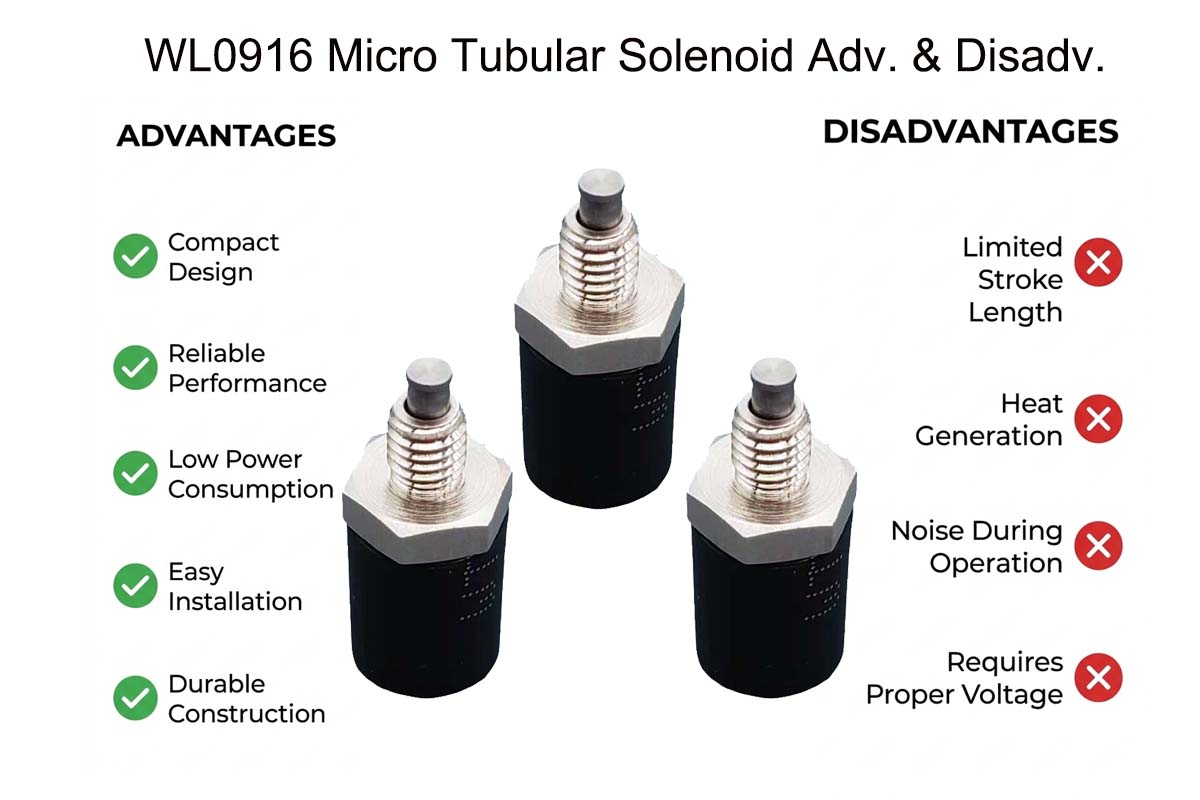
Pros and cons of Micro Tubular solenoid
Pros of Micro Tubular solenoid
Improved Force-to-Size Ratio: Tubular magnetic circuit design provides better flux concentration compared to frame-type solenoids, resulting in more force in a more compact package.
Precise Control: Stroke length is very consistent and can be duplicated, which is advantageous in precise control applications.
Increased Operating Life: Micro tubular solenoids are capable of providing more than 1 million cycles if the duty cycle is correctly managed.
Materials: High-temperature insulation, corrosion-resistant housings, and sealed housings are advantageous in the application of the solenoids in harsh environments.
Less Power Consumption: Magnetic design is very efficient and requires less power in comparison to other actuation technologies.
Cons of Micro Tubular solenoid
Limited Stroke Length: Tubular solenoids have a shorter stroke length, usually not more than 15mm, which is not advantageous in comparison to other actuation technologies such as pneumatic cylinders and linear motors.
Heat Generation: Tubular solenoids are prone to heat generation if they are continuously operated and if the proper management of the duty cycle is not achieved.
Force Degradation over Stroke Length: Force is degraded as the plunger is extended from the core.
Magnetic Interference: Despite the fact that it is shielded, magnetic interference may still come from ferrous materials not inside the solenoid.
Noise that can be heard: The noise it produces is a clicking sound, and this may not be desirable in places where noise is a problem.
Fixing problems with the Micro Tubular Solenoid
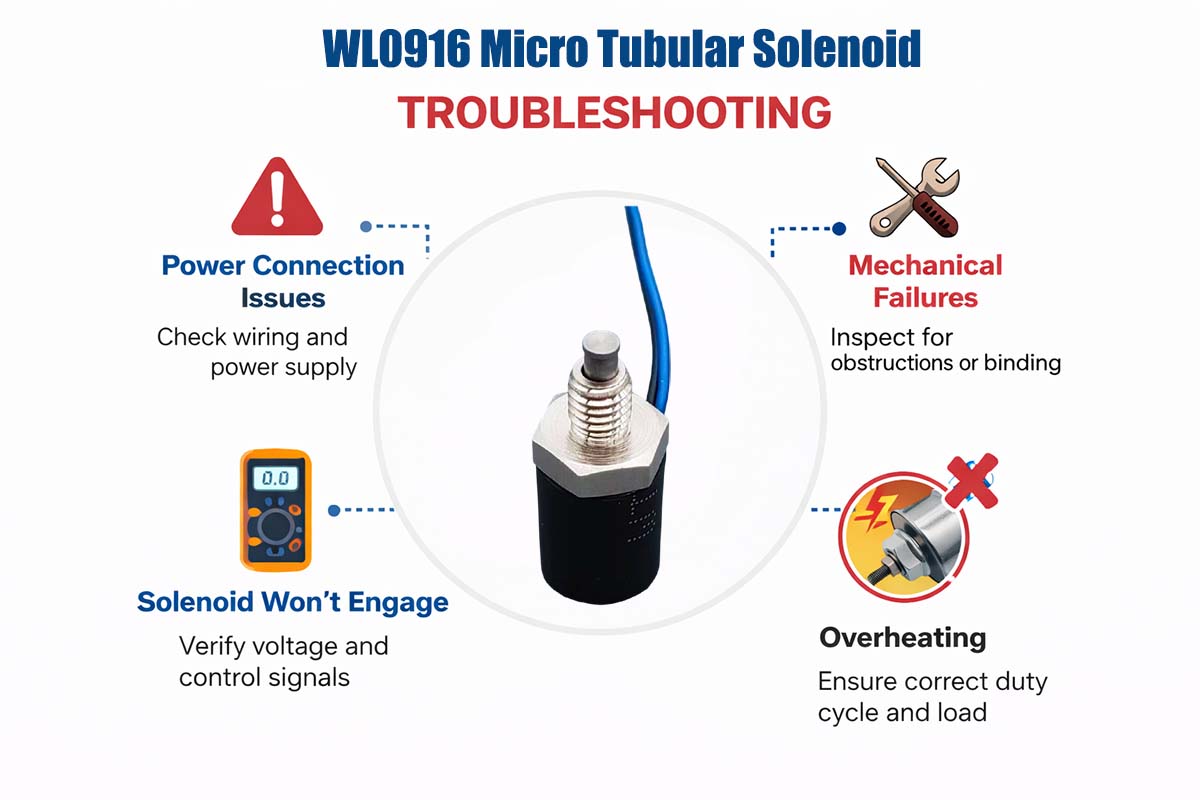
The Micro tubular solenoid is used extensively in industrial automation, precision devices, and small control devices. However, unless it is used correctly or unless the weather is right, it may not function to its full potential. Here is a step-by-step guide on how to fix problems with it:
1. The solenoid is not functioning at all (i.e., there is no movement).
Possible Reasons
There is no power supply or wrong voltage • There is loose or damaged wiring • The solenoid coil is burnt out • The plunger inside is stuck Solutions
Use a multimeter to measure voltage • Check wiring and connectors • Check resistance in coil (infinite = burnt coil) • Check plunger for blockages
2. The coil is getting too hot or is burnt out.
The power is left on after the duty cycle • The voltage is too high (wrong) • The plunger and spring are not inside • There is not enough heat dissipation Solutions
Use the right voltage rating and follow the duty cycle provided (e.g., 10%, 25%, 100%) • Use the right voltage rating • Make sure plunger and spring are in place • Improve ventilation or use a heat-resistant coil.
3. Weak force or not enough stroke.
Possible Reasons
Unstable voltage or low voltage • Air gap is too wide • Plunger is worn out or not aligned correctly
Load is more than the rated force Solutions
Ensure the voltage supply is stable • Reduce the distance of the stroke
Ensure everything is in line and change the parts • Ensure you choose one with extra force in case you need it
4. Slow response or delayed action Possible causes
Low voltage at the input • Friction and dirt in the tube
Weak spring for the return motion • Too high a temperature in the room Solutions
Ensure the voltage is at the right level • Clean the tube and the plunger inside • Change or improve the spring • Ensure the cooling is good 5. Noise or Vibration Possible Causes
Mounting not tight • AC power causing objects to vibrate • Parts inside the tube worn out • Plunger not in line Solutions
Ensure the mounting screws are tighter • Ensure you are using DC power • Ensure you change the parts • Ensure everything is in line correctly
6. The plunger is stuck or will not go back. Here are some possible causes.
Inside the tube, dirt, dust, trash, etc. • Spring is broken or weak • Rust and not enough oil • Side load is applied to the plunger Solutions
Ensure regular maintenance is done • Ensure you change the spring • Ensure you apply the right lubricant (if possible) • Ensure you don’t apply lateral force to the plunger
7. Intermittent Operation: Possible Causes
- A power supply that is not stable • Electrical connections that are not tight
- The coil is partially broken
- Triggering of overheating protection
Solutions
Use a steady power supply • Check the wiring again
Check the consistency of the coil resistance
Let it cool down or change the duty cycle ________________________
🧰 Tips for Preventive Maintenance
- Always operate it within the rated voltage and duty cycle • Don’t operate the power supply without the plunger in place
- Ensure the solenoid is clean and devoid of dust.
- Don’t apply too much side load or misalign it.
- Check the coil’s resistance and temperature from time to time
✅ Quick List for Buyers
- Check the voltage (DC/AC) and power rating. • Check the stroke and force requirements • Check the duty cycle – is it continuous or intermittent?
- Ensure there is enough space for installation and cooling.
- Select the degree of protection required—IP rating