Custom Push Pull Tubular Solenoid solution
Tubular Solenoid Push Pull Design Explained
High Force Push Pull Tubular Solenoid Guide
ompact Tubular Solenoid for Push Pull Use
Push Pull Tubular Solenoid Applications Guide
Choosing the Right Tubular Push Pull Solenoid
Custom Push Pull Tubular Solenoid solution
Tubular Solenoid Push Pull Design Explained
High Force Push Pull Tubular Solenoid Guide
ompact Tubular Solenoid for Push Pull Use
Push Pull Tubular Solenoid Applications Guide
Choosing the Right Tubular Push Pull Solenoid

WL4343 Push Pull Tubular Solenoid Complete Guide

What is a Push Pull Tubular Solenoid?

An electromechanical device known as a push pull tubular solenoid is one that is used to convert electrical current into linear motion. A solenoid consists of a coil, a movable plunger, and a tubular casing. The solenoid’s coil generates a magnetic field that, when the solenoid is activated, causes the plunger to move in a linear fashion. The solenoid could either push or pull the plunger depending on the design. The solenoid’s tubular casing ensures it is efficient, long-lasting, and able to prevent the entry of dust and moisture into the solenoid. The push pull tubular solenoid is widely used in automation and locking systems, as well as in various industrial applications that require precise control in a small space.

The Features of Push Pull Tubular Solenoid

The push pull tubular solenoids have a small size, which makes the solenoids last longer and work better. The solenoids have a lot of power in comparison to their size, making them work better. The tubular solenoids are very efficient in their working, making them the best solenoids in the market. The solenoids have the capability to push as well as pull, making their applications very wide. In most cases, the solenoids use very little power, making them long-lasting if used in the right way. Some solenoids are also waterproof, making their applications very wide. Some solenoids are available in 6V, 12V, 24V, etc.

WL4343 Push Pull Tubular Solenoid Description

Push Pull Tubular Solenoid Product Overview

The push pull tubular solenoid is a high-performance linear actuator that has the ability to control motion in a reliable and efficient manner. It features a small tubular shape and produces a lot of magnetic force with minimal loss of energy. It can perform push and pull functions and comes in different voltages and stroke lengths. It has a robust case that makes it immune to dust and other elements of the environment, making it suitable for business and industrial applications. This push pull tubular solenoid is used extensively in automation devices, locking mechanisms, vending machines, and devices that need precise and consistent linear motion.

WL4343 Push Pull Tubular Solenoid Video

WL4343 Push Pull Tubular Solenoid Detailed Description

WL4343 Push Pull Tubular Solenoid Technical Data Sheet

Brand Weilong Technology Model Number WL 4343
Rated Voltage (V) DC 12 or 24 V Rated Power(W) 3 W
Work Model  1 Million Lifespan Cycles Holding Force (N)  300 Gf
Stroke(mm) 3-5 MM Reset Time(s) 1 S 3S Off
Service Life 300 Thousand Times Certification CE,ROHS,ISO9001,
Material Carbon Steel Housing with Zinc Plated Coating Lead Wire Length(mm) 200
Install Style both side with three mounted Screw Holes for easy setting up Tolerance of Dimension  +/-  0.1 MM
Water-proof  None Insulation Class F  Cel.  150 Degree
Hi-Pot Test AC 600V 50/60Hz 1 s Non-excitation Holding Force 0
Working Temperature -10°C-100°C Duty Cycle 1-100%
Thread Depth(mm) / Payment Term TT, or LC At Sight
Sample Order Yes Warranty 1 Year
MOQ 500 pcs Supply Ability 5000 pcs per Week
Delivery Time 30 Days Port of Loading shenzhen

Product detail diagram

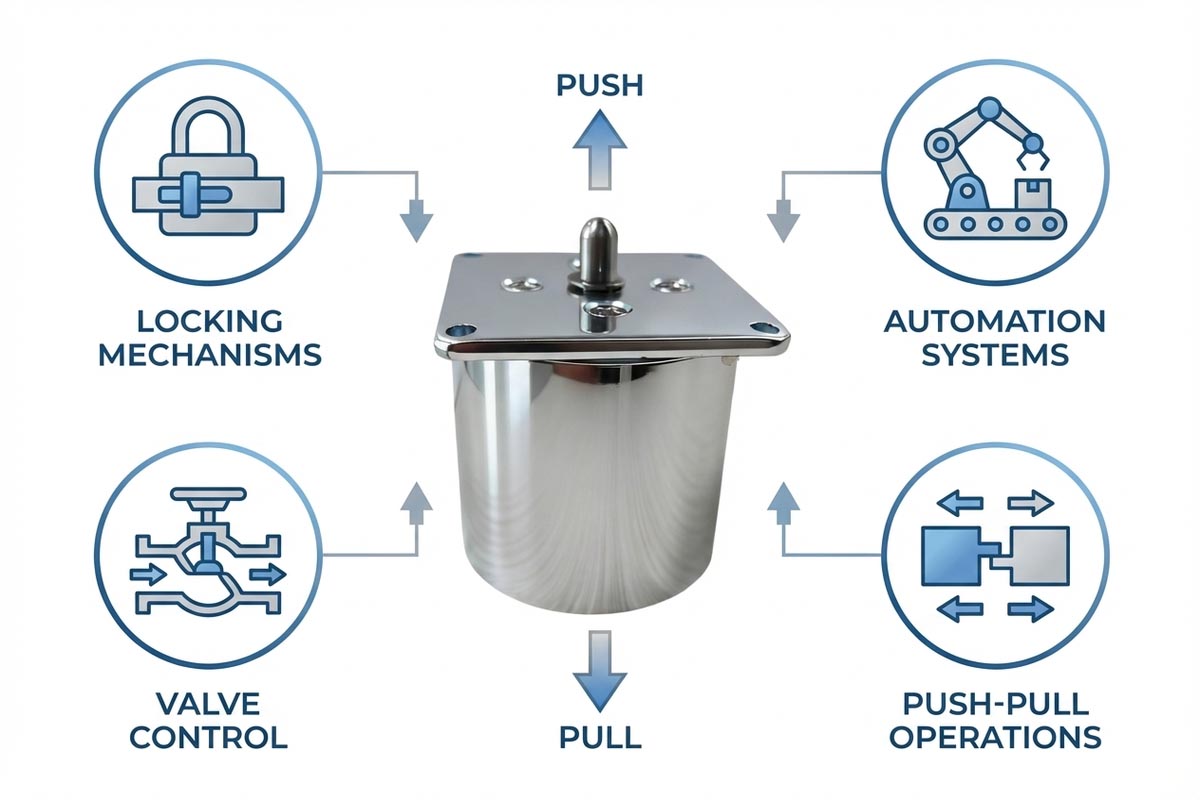
WL4343 Push Pull Tubular Solenoid Application

WL4343 Push Pull Tubular Solenoid Application

The tubular solenoids are being applied in many different industrial fields because the solenoids are very small in size and powerful in action with a long service life.

In automation systems, they are often utilized in sorting machines, packaging machines, and robotic systems that require rapid and predictable movements. They are utilized in the control of the locking, dispensing, and handling of coins in vending machines and kiosks.

Push Pulll Tubular solenoid can be found in various automotive systems such as fuel systems, door locks, and control valves. They can also be found in various medical devices to ensure that diagnostic tools and fluid control systems operate precisely as they should.

Tubular solenoids can be found in various office equipment such as printers, copiers, and scanners. They can also be found in smart locks, cabinets, and security systems where it is essential for them to operate precisely as they should.

Push-pull tubular solenoids can be very effective in both consumer products and industrial equipment. They can be used in various ways, take up little space, and operate in precisely the same way each time. They are thus very effective in both consumer products and industrial equipment.

Advantages and Disadvantages of Push Pull Tubular Solenoid

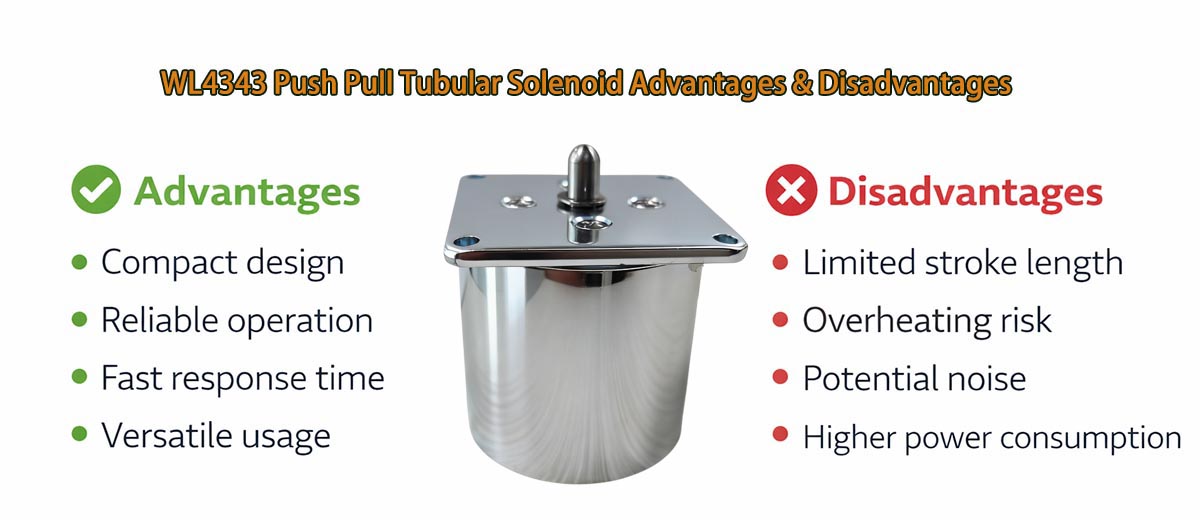
WL4343 Push Pull Tubular Solenoid: Adv. and Disadv.

The Push Pull Tubular Solenoid Pros and Cons

The Pros of Push Pull Tubular Solenoids

Push-pull tubular solenoids can be very effective in both consumer products and industrial equipment. They are very efficient since they have a closed magnetic circuit. They take up little space, making them very effective in modern devices. The tubular design ensures that dust, moisture, and mechanical damage do not reach the internal components. They operate precisely and quickly, especially in high-frequency operations. They are not very complicated, making them very effective. They do not need much maintenance since they are not very complicated.

The Cons of Push Pull Tubular Solenoids

There are various problems associated with tubular solenoids. Despite having some good qualities, they have various shortcomings. They have a shorter stroke length compared to other linear actuators. They tend to get hot when something is run through them. The stroke limits the force. They need a constant source of power. They tend to be less effective when they operate in both directions. They tend to overheat and lack enough force when they operate at an improper voltage. They tend to be very expensive, especially when they need to be customized.

A guide to fixing problems with push-pull tubular solenoids


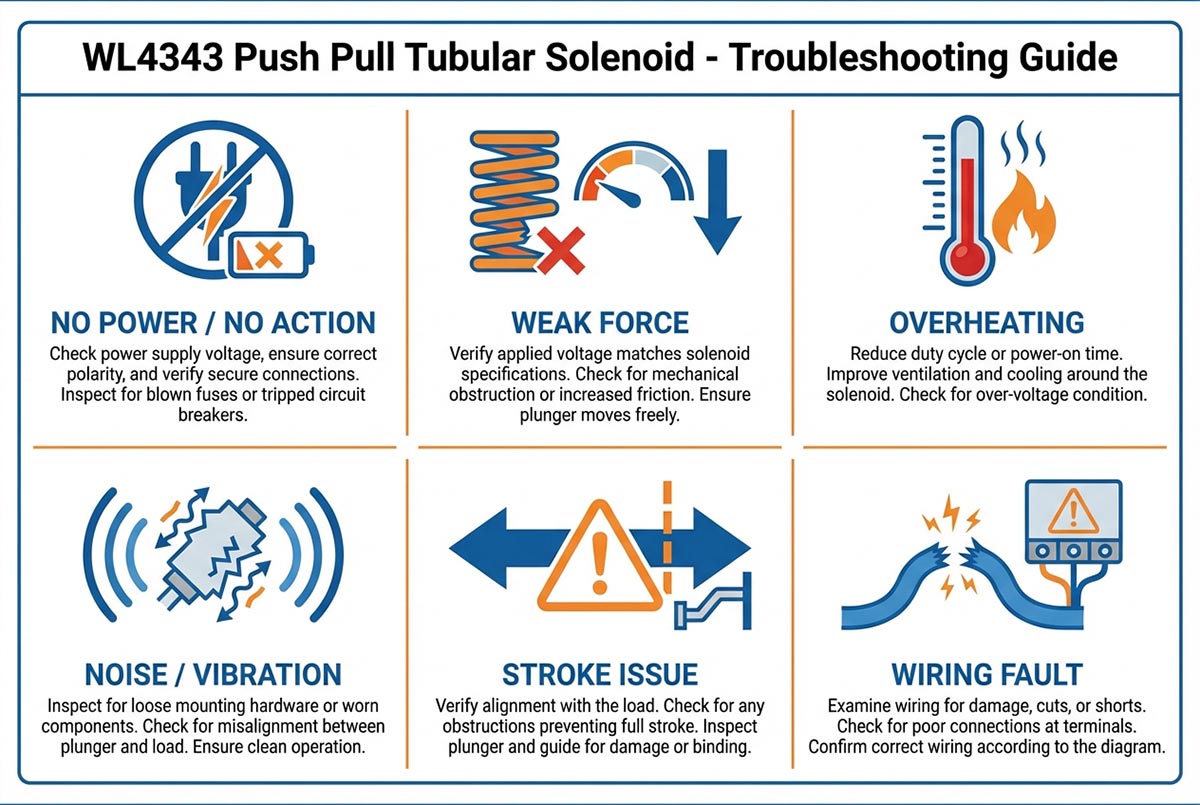
WL4343 Push Pull Tubular Solenoid Troubleshooting Guide

1. The solenoid is not working (i.e., there is no movement).

Possible Reasons:
• No power supply or wiring that is not correct
• Voltage is not correct
• Burnout of coil
Solutions:
• Check wiring and power supply
• Check if voltage is correct by making sure that it is the same as what it is supposed to be.
• Check if coil is working by using a multimeter and making sure that it has continuity. If not, replace solenoid.


 2. Weak or Not Enough Force

Things that could be causing it:
• Low voltage input
• Stroke is too long for force required
• Magnetic interference and/or misalignment
Answers:
• Make sure that voltage supply is correct and stable
• Make sure that solenoid has sufficient force or that stroke length is not too long
• Ensure it is installed straight and not obstructed in any way.


3. Getting Too Hot

Possible Reasons:
• Too long duty cycle – it is being used all the time
• Too much voltage
• Not enough air flow Solutions:
• Use it only sometimes, as recommended by the duty cycle.
• Use the right amount of voltage.
• Ensure the solenoid is cool enough by making it better or selecting one that operates all the time.


4. Slow Reaction Time – Action Takes a Long Time

Possible Reasons:
• Not enough power
• Too much friction – could be because of the moving parts or trash in the solenoid
• Return spring is weak Solutions:
• Increase the power supply but within safe limits.
• Clean the interior as well as the plunger area.
• Replace the spring


5. Noise or Vibration

Possible Reasons:
• Not installed correctly
• AC ripple in a DC-powered solenoid
• Parts are worn out
Answers:
• Ensure the screws and brackets are tightened.
• Buy a stable DC power supply.
• Check the solenoid parts and replace if worn out.


6. Plunger Stuck or Not Returning

Possible Reasons:
• Contamination – could be because of dirt, rust
• Broken or weak spring
• Solutions for misalignment:
• Clean and oil (if okay)
• Change the return spring
• Ensure the installation was aligned correctly. 


7. Short lifespan

Possible Reasons:
• Getting too hot due to high duty cycle
• Too high a voltage
• Too much mechanical load solutions:
• Operate within the rated duty cycle
• Operate at the right voltage
• Decrease the load or select a model with a higher rating


8. Work that comes and goes

Possible Reasons:
• Not enough connection between connectors or wires
• Not enough stability in the power supply
• Internal coil damaged
Possible solutions:
• Check to ensure all electrical connections are safe
• Ensure the power supply is regulated
• Check the coil’s resistance and replace if necessary.


✅ Expert Tips for Dependable Operation

• Be certain the force, stroke, and duty cycle are appropriate for your application.
• Only energize the solenoid if you’re supposed to.
• Be certain the solenoid is clean and correctly mounted.
• Be certain you’re using the right voltage control—avoid voltage spikes.
 

FAQ Of Push Pull Tubular Solenoids

1. What is a push pull tubular solenoid?

The push pull tubular solenoid is an electromagnet that converts electrical energy directly into straight-line motion. It has a plunger that moves in a certain direction that is either pushing or pulling. It is more efficient and safer than an open-frame solenoid.

2. What are your voltage options?

The most common voltages used by push-pull tubular solenoids are DC voltages of 6V, 12V, and 24V. However, it is also possible to design a voltage that can be used depending on a particular application.

3. What is the maximum force that a tubular solenoid can produce?

The maximum force that a tubular solenoid can produce depends on different factors like design, voltage rating, and stroke length. Generally, a shorter stroke has a higher force. A force and stroke curve is provided by most manufacturers.

4. Can a tubular solenoid run all the time?

The standard solenoids are designed to run a duty cycle that can happen at different times. However, a solenoid can run continuously if it is designed to manage heat.

5. How long can a tubular solenoid last?

The tubular solenoid can last for millions of cycles if it is well-designed and well-maintained. However, this depends on factors like duty cycle and voltage stability.

6. Do tubular solenoids keep water and dust out?

There are a lot of tubular solenoids that are protected by IP ratings like IP65. That means that they are resistant to water and dust. That allows them to be used even in harsh environments like outside.

7. What are some of the most important uses?

These are used a lot in vending machines, smart locks, car systems, medical equipment, office equipment, and industrial automation systems.

8. Is it possible to design push-pull tubular solenoids that are unique?

Yes. Most manufacturers allow you to customize things like stroke length, force, voltage, mounting style, connectors, and environmental protection to meet your project’s needs.

How to choose the push pull tubular solenoid ?

In order to ensure that the push pull tubular solenoid functions well and is reliable, it is essential that you think critically about a few crucial factors.

First, it is essential that you determine the amount of force and stroke length that you need. It is crucial that the specifications of the solenoid match the needs that you have since the amount of force tends to decrease as the length of the stroke increases.

Secondly, choose a power supply and a voltage that are right for your application. 6V, 12V, and 24V DC are all commonly used voltages. However, your power supply should be able to deliver sufficient voltage without overheating or slowing down.

Thirdly, check the duty cycle rating. It is wise to choose a solenoid that can be used at high duty cycles or continuously if your solenoid will be working a lot or all the time. Otherwise, it will have a reduced lifespan through overheating.

Lastly, if your solenoid will be used outside and exposed to harsh weather conditions like dust and moisture, ensure that it is rated adequately. A good solenoid should be able to withstand harsh weather conditions.

Fifthly, check the size and mounting restrictions. Although tubular solenoids are compact and can be easily installed in most applications, their compactness and mounting style need to be considered.

Lastly, check how your solenoid will react in terms of response time and lifespan. However, if you are working with a good manufacturer, you are guaranteed that your solenoid will meet all your technical requirements. In addition to that, a good manufacturer will allow you to customize your solenoid in a variety of ways. For instance, the type of connector that will be used, the type of plunger, return spring, and housing are all areas that can be customized.

Get A Free Quote Now

Contact Form

Related Products

Related News

Scroll to Top

Get A Free Quote Now !

Contact Form
If you have any questions, please do not hesitate to contact us.
Weilong Solenoid Company Culture
