
 Chapter 1: Overview of the Product
An AC solenoid pump is an electromagnetic fluid pump that generates linear motion via the magnetic field of an alternating current (AC) source. The linear motion of the pump makes it possible to transport fluids with precision.
The AC solenoid pump is commonly used in the following industries:
Medical equipment
Water treatment plants
Delivery of drinking beverages
Chemical dosing
Industrial automation
The compact size, precision, and reliability of the AC solenoid pump make it an ideal choice.
Chapter 2: AC Solenoid Pump Types and Important Characteristics
2.1 AC Solenoid Diaphragm Pump
Description: The fluid is transferred by means of a flexible diaphragm, driven by electromagnetic forces.
Important Characteristics:
Superb resistance to chemicals (PTFE, EPDM options)
Leak-free operation with no fluid contact with moving metal parts
Suitable for sensitive, corrosive, or clean fluids
Long service life with minimal maintenance requirements
Quiet operation, unlike piston types
Suitability: Food, beverage, chemical dosing, medical applications
2.2 AC Solenoid Piston Pump
Description: The pump generates precise fluid displacement with the ability to increase pressure with the help of the piston.
Important Characteristics:
Ability to handle high pressure
Strong, long-lasting mechanical structure
Accurate fluid dosing
Suitability for viscous fluids
Greater pressure rating than the diaphragm type
Suitability: Dosing applications with high-pressure, industrial cleaning equipment
2.3 Self-Priming AC Solenoid Pump
Description: The self-priming pump is specially designed to operate without the need for priming.
Important Characteristics:
Automatic startup without the need for priming effectively manages sporadic operation.
It avoids damage from dry starting.
It increases the ease of operation.
Perfect for systems that operate frequently.
Ideal For: Beverage makers, water dispensers, and laboratory equipment.
2.4 High-Frequency AC Solenoid Pump Overview:
It offers more consistent and continuous operation by using higher actuation speeds.
Important Features:
It offers greater stability in the rate of flow.
It lessens pulsations compared to regular pumps.
It is perfect for semi-continuous or continuous operation.
It offers greater efficiency in automated systems.
It offers faster response.
Ideal For: Continuous operation, dosing systems, and automation systems.
2.5 Micro/Mini AC Solenoid Pump Overview: It is a small pump intended for small-scale or portable devices.
Important Features:
It is extremely lightweight and small.
It uses minimum power.
It is perfect for integration in tight spaces.
It operates silently.
It is economical.
It is ideal for OEM applications.
Ideal For: Compact appliances, medical devices, and portable devices.
2.6 AC Solenoid Pump with High Temperature Overview: It is intended for operation in high-temperature environments.
Important Features:
It offers insulation of the coils.
It offers consistent performance at high temperatures.
It offers extended life expectancy.
It is ideal for systems using steam or hot water.
Ideal For: Industrial heating systems, steam systems, and coffee makers.
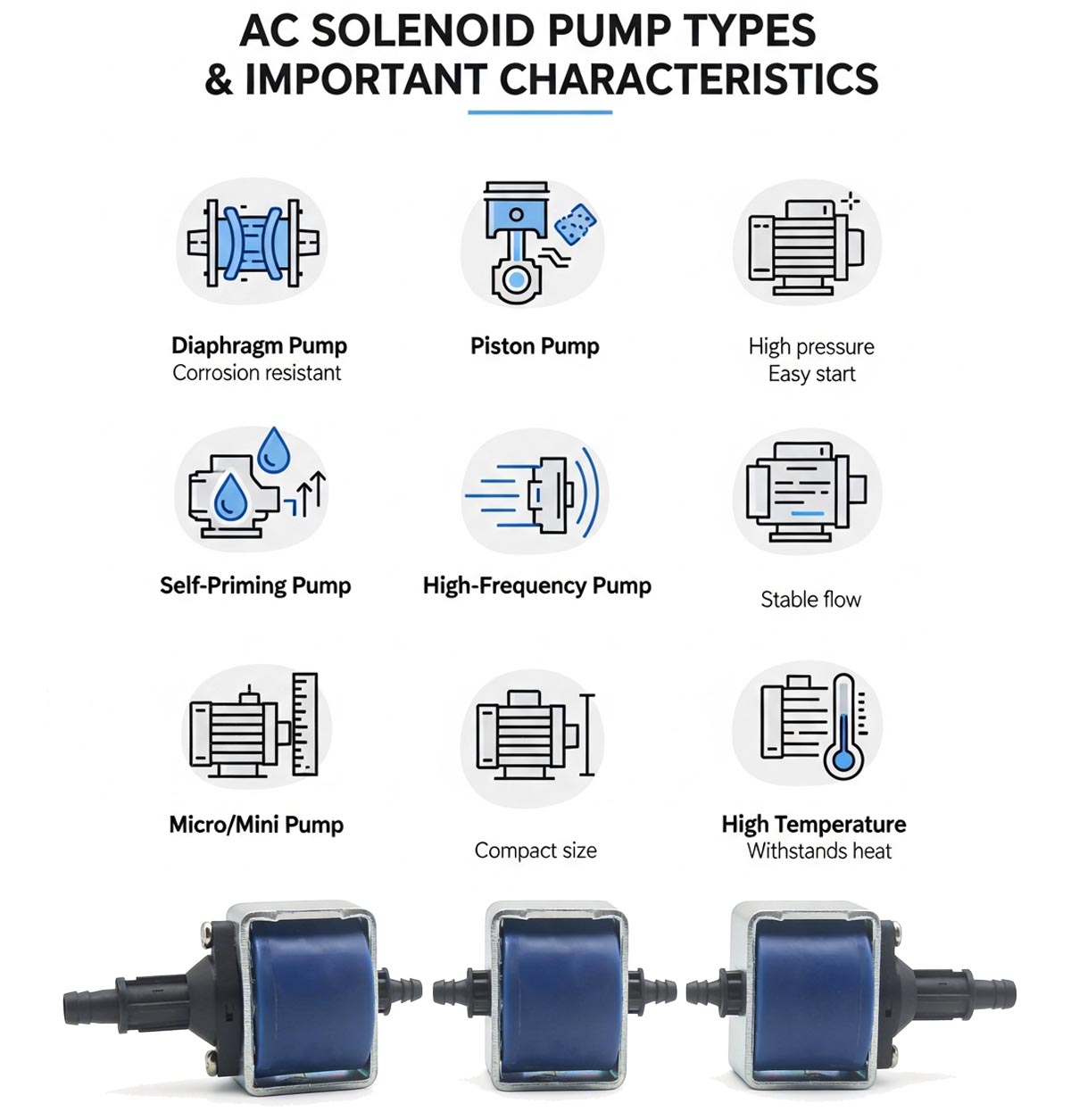
Quick Selection Guide
| Application Needs | Recommended Type |
| Corrosive liquids | Diaphragm pump |
| High pressure | Piston pump |
| Easy start/intermittent | Self-priming pump |
| Stable continuous flow | High-frequency pump |
| Compact equipment | Mini/Micro pump |
| High-temperature fluids | High-temp pump |
Chapter 3: Principle of Operation
The principle of operation of the AC solenoid pump is by using the concept of electromagnetic induction.
The coil is connected to the AC power supply.
A magnetic field attracts the plunger/armature.
A piston or diaphragm is moved by the mechanical action.
Check valves are used to pull and push the fluid.
It offers pulsating flow by using the AC supply.
Fluid delivery is therefore precise and consistent.
Principal Elements and Organization
The major components of an AC solenoid pump include the following:
A coil, which is an electromagnet that generates a magnetic field.
A plunger/armature that generates motion through the magnetic field.
Fluid is moved by the action of a diaphragm or piston.
Check the inlet and outlet valves, which control the direction of the fluid.
A pump housing that provides protection.
A spring that returns the plunger to its original position.
Power input, which is an electrical connector
Chapter 4: Important Solenoid Pump Parameters to be Used in Industry
When selecting a pump, one should be very careful about
4.1 Rate of Flow
In terms of L/min or mL/min
Must be appropriate for the application
4.2 Range of Pressure
Finds out how effectively the pump will operate against system resistance
4.3 Voltage and Frequency
110V/220V AC, 50/60 Hz is standard
4.4 The power consumption
Determines the power consumption as well as heat produced
4.5 Duty Cycle
Continuous or Intermittent operation
4.6 Fluid Compatibility
Materials should not corrode or react with chemicals
4.7 Sound and vibration
Important in hospitals and laboratories
Chapter 5 : Benefits of Using AC Solenoid Pumps
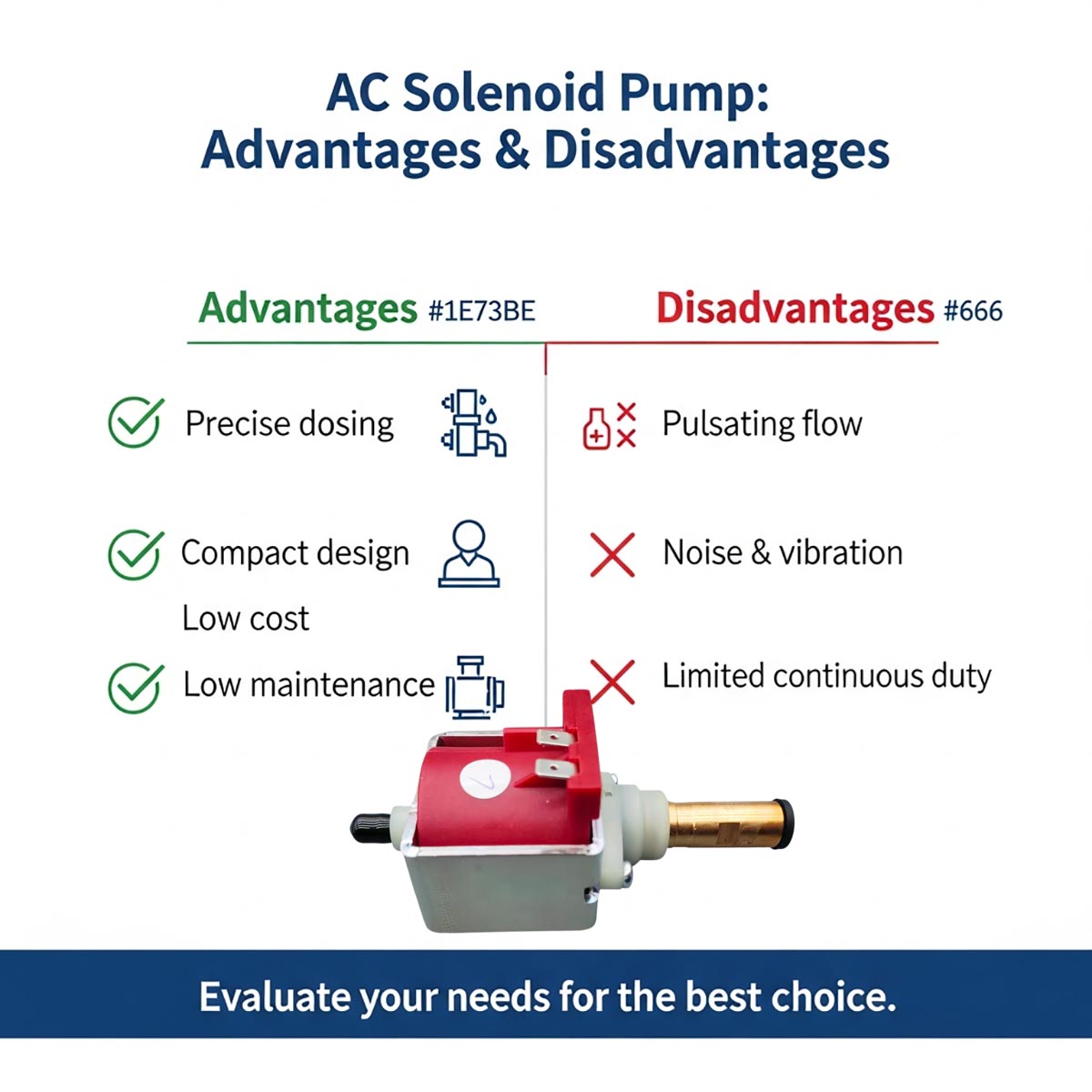
5.1 Accurate control of fluid
Provides precise control of fluids
Accurate flow rates
Perfectly suited to applications that need dosing and metering
Suitable for medical, laboratory, automation industries
5.2 Simple and small structure
No complex moving parts as with conventional pumps
Easy to integrate into small as well as complex systems
Lightweight with space-saving design
5.3 A solution that doesn’t cost too much
Costs of creation as well as maintenance are low
Affordable for OEM as well as large-scale industry
Long life with minimal maintenance
5.4 Reliable operation on a time-to-time basis
Suitable for cyclic operation involving start/stop
Automated systems that always operate reliably
Perfectly suited to supplying fluids on demand
5.5 Self-priming ability
Can operate without having to prime it manually
Makes life easier
Operates more simply
5.6 Works with lots of things
Works with different kinds of fluids, such as air, water, and chemicals
Different kinds of materials used to resist corrosion
Works in lots of different fields
❌ Chapter 6: Drawbacks of Using AC Solenoid Pumps
6.1 Flow Output Pulses
Flow does not go on and on.
May need to use dampeners.
Not good for applications where flow should always be continuous.
6.2 Limited Range of Pressure
Not good for applications with high pressure.
Performance will be lessened when lots of work is to be done.
6.3 Vibration and Noise
Makes a clicking or buzzing noise when it works.
May need to make a special design to reduce noise when used in quiet places.
6.4 Making Heat
The coil gets hot when used for a long time.
If used too long, overheating may occur.
Needs good ventilation.
6.5 Limited Capacity to Work Continuously
Lots of them are designed to work sometimes.
Working continuously may shorten life.
Needs to meet the needs of the duty cycle.
6.6 Sensitivity to Power Supply
A steady supply of AC voltage is needed.
Any changes may lessen the life of the device and make it less efficient.
Chapter 7: Troubleshooting of AC Solenoid Pumps
7.1 Issue: Pump does not work.
Solution:
– Check power supply.
– Check the coil.
– Check the connections of the wiring.
7.2 Issue: Low Flow Rate.
Solution:
– Check if the entrance/exit is blocked.
– Check if the diaphragm is worn out.
– Check if air leaks.
7.3 Problem: Too Much Noise.
Solution:
– Check if parts are loose.
– Check if plunger/spring is worn out.
– Check if installed correctly.
7.4 Issue: Getting too hot
Continuous duty overrating
Mismatch in voltage
Not enough airflow
Chapter 8: Important Things to Think About When Buying an AC Solenoid Pump
Type of use (medical, industrial, food-grade)
Pressure and flow rate that are needed
Works with both 110V and 220V AC voltage
Compatibility of material with fluid
Requirements for duty cycle
How much noise you can handle
Certifications and dependability of suppliers
Quick Troubleshooting Table
| Problem | Main Cause | Solution |
| Not working | Power/coil issue | Check voltage & replace coil |
| Low flow | Blockage/wear | Clean or replace parts |
| No fluid delivery | Airlock/valve issue | Prime and check valves |
| Noise | Loose parts | Tighten/replace |
| Overheating | Overuse | Improve cooling |
| Leakage | Seal damage | Replace seals |
Chapter 9 : Things to Think About When Buying an AC Solenoid Pump
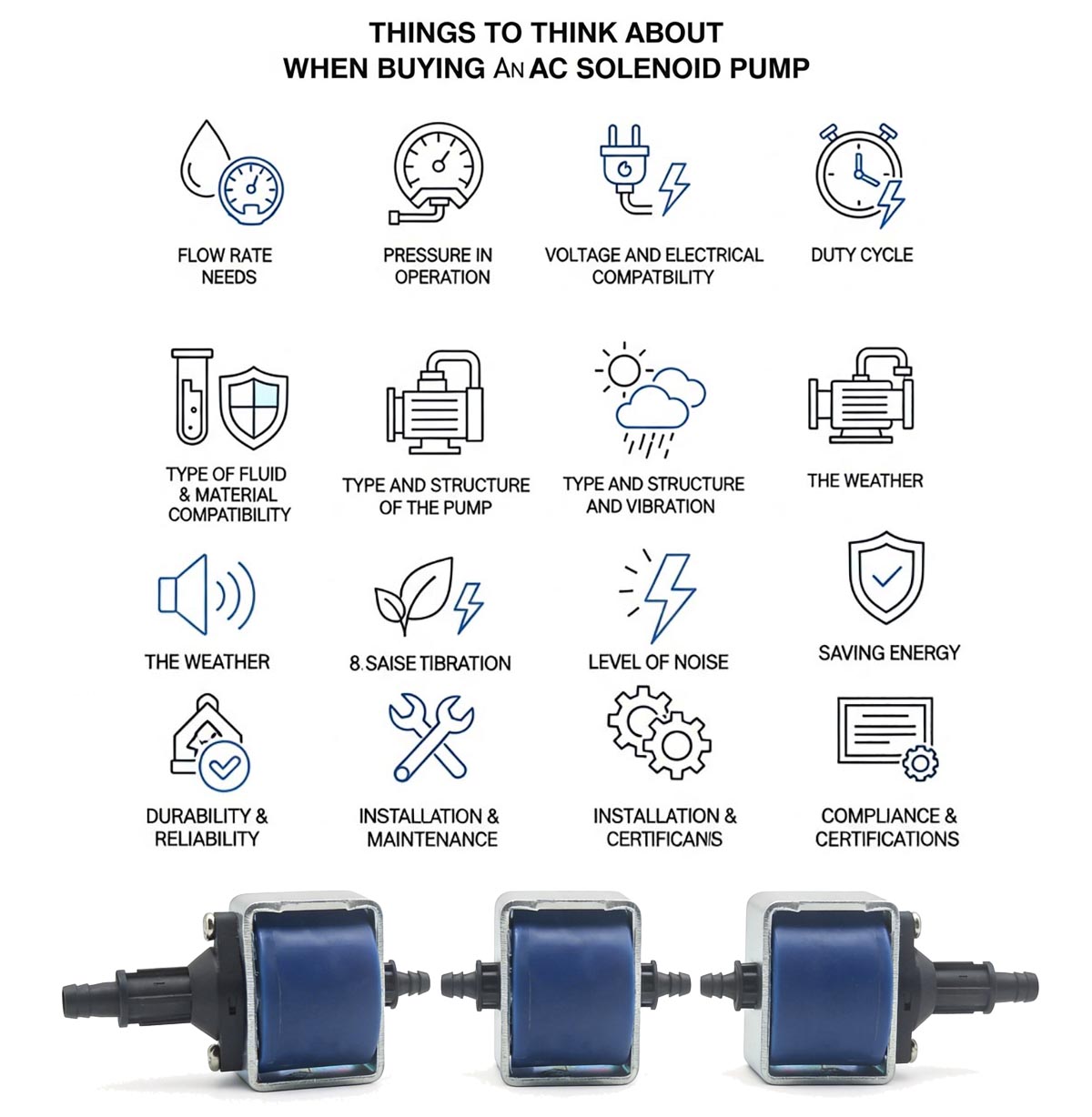
It is very important to choose the right AC solenoid pump to make sure that the system works well, is reliable, and saves money in the long run. The following are the most important things that industrial buyers should think about before they buy something.
9.1 Flow Rate Needs
In L/min or mL/min,
Must be exactly what your system needs
Pumps that are too small slow down flow, and pumps that are too big waste energy.
Proper sizing makes sure that everything works well and doesn’t cause pressure drops.
9.2 Pressure in operation
Check the range of maximum and working pressure.
Make sure the pump can handle changes and resistance in the system.
To avoid failure, don’t go over the rated pressure.
Choosing the wrong pressure can cause problems or damage
9.3 Voltage and electrical compatibility
110V/220V AC, 50/60Hz are common choices.
Make sure it works with your power supply.
Think about how much power it uses and how much current it needs to start.
A difference in voltage could damage or break the coil.
9.4 Duty Cycle (Mode of Operation)
Intermittent vs. continuous operation
Pumps with a continuous rating are needed for high-duty jobs.
Overloading causes things to get too hot and wear out faster.
Duty cycle has a direct effect on how long something lasts and how reliable it is.
9.5 The type of fluid and the materials that work with it
Let’s think about how fluids behave:
Corrosive
Sticky
Grade for food
Selecting appropriate materials:
PTFE
EPDM
Stainless steel : Wrong choice could cause rust or leakage
9.6 The Weather
Range of temperatures
Exposure to dust and humidity
Areas that are corrosive or explosive
Select pumps that are appropriate according to their IP rating.
9.7 Type and Structure of the Pump
Piston vs diaphragm
Self-prime
Models with high frequencies or standard frequencies
Different structures have different levels of pressure, flow, and durability.
9.8 Level of Noise and Vibration
Important when:
Using it for medicine
Using it in the lab
Using it inside: If necessary, think about one that is quiet or has a vibration-dampening feature.
9.9 Saving energy
Using energy affects business expenses in the long run.
AC solenoids tend to get hotter than DC.
Selecting appropriate coil type.
Energy-saving pumps save business expenses in the long run
9.10 How long it lasts and how reliable it is
Look at:
Life cycle (for example, millions of cycles)
Quality of construction
Brand name: High-quality pumps save maintenance costs.
9.11 What you need to do to install and maintain it
Easy to set up
Availability of spare parts
When maintenance is required
Pumps that are easy to maintain save business expenses.
9.12 Compliance and Certifications
Certifications for CE, UL, and RoHS
Industry approvals for food and medical applications
The process of certification ensures that all the conditions for the global market, quality, and safety are met.
Quick List for Buyers
✔ Check the flow rate and pressure ✔ Check if the voltage matches ✔ Check the duty cycle rating ✔ Check if the fluid type is compatible ✔ Check the conditions of the environment ✔ Check if it is reliable and certified
Chapter 10 : Mistakes People Make When Choosing a Solenoid Pump
Choosing the wrong voltage specification
Not paying attention to duty cycle limits
Not thinking about how chemicals work together
Selecting based only on price
Not thinking about how easy it is to get to maintenance
Chapter 11: Tips for Installing and Maintaining
Tips for Installing
Make sure the voltage connection is correct.
Put it in a place where it won’t move or shake.
Use the right tubing and fittings
Keep the flow going in the right direction.
Tips for Keeping Things Running
Clean the inlet filters on a regular basis.
Check the diaphragm and the valves
Don’t let it run dry.
Make sure the cooling and ventilation are working properly.
Chapter 12 : Last but not least: Buy smart, install correctly, and grow quickly.
But it is not sufficient that one is familiar with the specifications of the right AC solenoid pump. One must also ensure that the pump is going to be sufficient for one’s actual needs. A good pump can ensure that everything runs more smoothly, with less downtime and more reliable products. To ensure that everything runs at optimal performance, one must take the time to determine one’s actual needs, select a reliable supplier, and install everything properly.
Chapter 13: Frequently Asked Questions About AC Solenoid Pumps
1. What is an AC solenoid pump?
An AC solenoid pump is an electromagnetic pump that uses an alternating current to move objects in a straight line. This allows it to move liquids using a diaphragm or piston action with great accuracy. It is often used in applications where liquids are measured and controlled.
2. Can AC solenoid pumps be used at all times?
Most AC solenoid pumps are designed to be used in short bursts. However, the pump must be designed for continuous use in order for it to be used at all times. If not, the device may overheat and have a shorter lifespan.
3. What kinds of liquids can an AC solenoid pump handle?
An AC solenoid pump can handle the following:
Water
Gas or air
Chemicals that are light
Liquids that are safe to eat
👉 To avoid corrosion, it is important that the materials used are compatible with each other, such as PTFE, EPDM, and stainless steel.
4. What is the reason behind the solenoid pump’s loud noise?
Most of the time, the reason behind the loud noise is:
Electromagnetic vibration (normal use)
Components that are not tight
Components that are worn out
Using rubber mounts or dampers can help quiet things.
5. How long does an AC solenoid pump usually last?
The life expectancy depends on how it is used and how it is constructed, but it is usually within this range:
500,000 to 3,000,000 times
Using it correctly is one thing that can extend service life significantly.
6. Why is my solenoid pump in my air conditioner getting too hot?
Some common reasons include:
Going beyond duty cycle ratings
Incorrect voltage supply
Lack of proper ventilation 👉 Always following instructions and ensuring proper cooling is essential.
7. How do I select the best AC solenoid pump?
Some key aspects to think about when selecting include:
Pressure and flow rate requirements
AC Voltage Requirement (110V/220V)
Duty Cycle
Compatibility with Fluid
Environment :Setting these parameters correctly will ensure that you get the best.
8. Do you need to take care of your AC solenoid pump?
Yes, it is a good idea to perform routine maintenance on your solenoid pump:
Checking valves and cleaning filters
Checking diaphragm and seals
Don’t run it out of fluid
Checking connections on wires
Preventive maintenance reduces downtime and increases reliability.

