Durable Push Pull Latching Solenoid in Manufacturing
Energy-Efficient Push Pull Solenoid for Industry Use
High-Performance Push Pull Solenoid for Industrial Gear
Industrial Machines Using Push Pull Latching Solenoids
Industrial Push Pull Latching Solenoid Applications
Push Pull Latching Solenoid for Industrial Automation

WL1035 Push Pull Latching Solenoid Guide

What does a Push Pull Latching Solenoid do?

The Push Pull Latching Solenoid is an electromechanical device that converts electric energy to linear motion and latches at the end of its stroke without the need for a continuous supply of energy. A latching solenoid does not require constant current to remain on, unlike the regular solenoid, which requires constant current to remain on.

The solenoid coil generates a magnetic field that pushes the plunger forward or backward when it is provided with a short pulse of electric current. The permanent magnet or latch holds the plunger in position until it is provided with the next pulse, which changes its direction of motion.

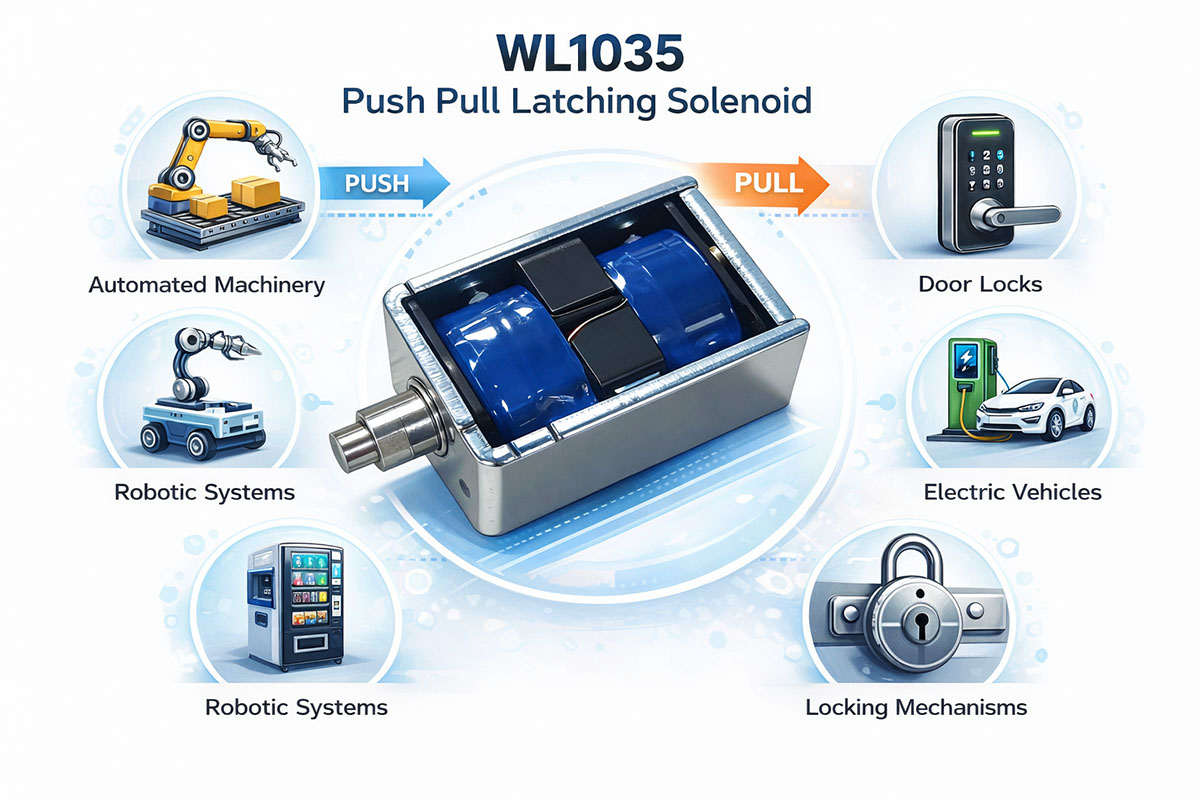
The push pull latching solenoid is used in energy-efficient devices like smart locks, vending machines, medical devices, and automation systems, owing to its ability to consume energy only when it is turned on.


custom push pull latching solenoid manufacturer

A look at push-pull latching solenoids

A push-pull latching solenoid is a type of bistable solenoid that has the ability to save energy. They control movement in a way that is efficient in the use of energy. They consist of a coil, a plunger, and a permanent magnet. They are used in devices that save energy and battery devices. They are used because they only require power when they are switched on. Currently, push-pull latching solenoids have become essential devices in automation, smart devices, and industry due to their small size and ability to be customized in many ways.

WL1035 Push Pull Latching Solenoid Video

WL1035 Push Pull Latching Solenoid Detailed Display

WL1035 Push Pull Latching Solenoid Technical Data Sheet

Push Pull Latching Solenoid Product Detailed 

Brand Weilong Model Number  AS 1035
Rated Voltage (V) DC 12V 18V and 24V Rated Power(W) 24 W
Work Model Pull Push Type Holding Force (N)  280 GF
Stroke(mm) 3-8 MM Customized Reset Time(s) 0.2S ON, 2S OFF
Service Life 100 Thousand Times Certification CE,ROHS,ISO9001,
Material Superior Magnet Iron Lead Wire Length(mm) 200 MM
Install Style Screw Tolerance of Dimension  +/-  0.1 MM
Water-proof  None Insulation Class B
Hi-Pot Test AC 600V 50/60Hz 2s Non-excitation Holding Force 0
Working Temperature -10°C-100°C Duty Cycle 1-100%
Thread Depth(mm) / Payment Term TT, or LC At Sight
Sample Order Yes Warranty 1 Year
MOQ 1000 pcs Supply Ability 5000 pcs per Week
Delivery Time 30 Days Port of Loading shenzhen
Unit Features:
Housing:  Carton steel housing with Zinc Coating, smooth surface with RoHS
Compliance , 96 hours Slat spraying testing. Anti-rusty.
Plunger:  Dia. 4-10 mm,  Carbon Steel materials with Zinc coating. Smooth surface.
Stroke range:   4-8 mm
Resistance :  6 Ω
Current: 12A
Wattage:    24 W
Power Source:  DC 12V, 18 V or 24 V
Holding Force:   20 N
Power Source:  DC 12, 18 or 24 available for selection
Copper Coil:  Pure Copper coil with reliable temperate rise.
Insulation Class:    B 130 0C
Duty Cycles: 0.2 s On,  1.8 s Off

WL1035 Push Pull Latching Solenoid Applicaiton

wL1035 Push Pull Latching Solenoid Application

In modern electromechanical systems, where efficiency and switching reliability are critical, push-pull latching solenoids are highly prevalent.

In smart locking systems, they are used in the majority of applications. Latching solenoids have been used in electronic door locks, vending machines, and other access systems. They require power only when they switch.

In automated systems in manufacturing plants, push-pull latching solenoids have been used to control mechanical gates, valves, and other systems. Their compact size makes it easy to integrate them into robots and automated systems.

In the medical industry, push-pull solenoids have been used in portable diagnostic systems and medical devices. In medical systems, it is critical to use as little power as possible.

Another area is the use of electronics in cars. Fuel control, safety lock, and switch devices need latching solenoids.

They are used extensively in smart home devices, intelligent cabinets, parcel lockers, and remote control devices.

Push-pull latching solenoids are used in many modern devices because they are highly reliable, use extremely low power, and can be controlled with great accuracy.


Advantages and Disadvantages of Latching Solenoids DC 12V

WL1035 Latching Solenoid Advantage and Disadvantage

Push Pull Solenod Pros and Cons

Pros

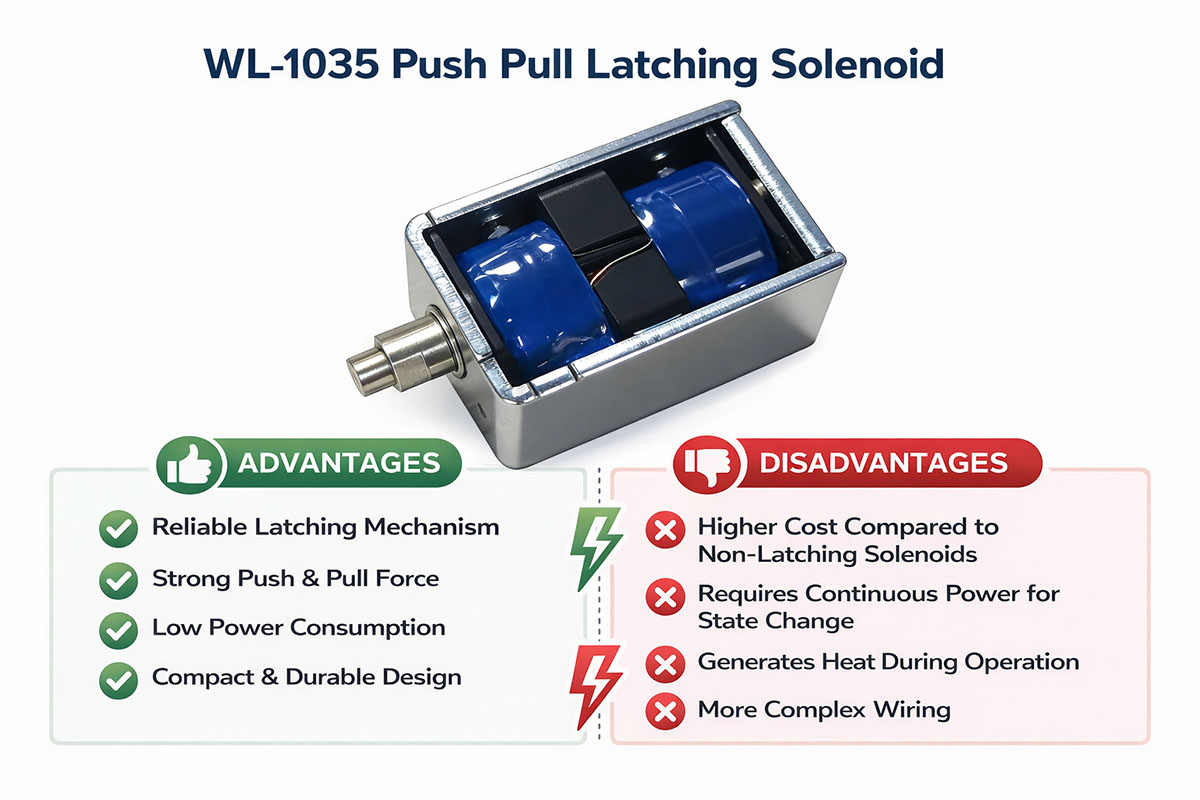
The most significant advantage of push-pull latching solenoids is that they use less power. They use a lot less power because they only need to use power when they switch.

Another significant advantage of push-pull latching solenoids is that they make the system highly reliable and extend the lifespan of the devices used in the system by minimizing heat generation. They can even remain in position even if the power supply is switched off due to their bistable design.

They are extremely small and light, which makes them highly useful in portable devices and areas where space is at a premium. They are highly useful in automation devices because they can switch quickly and can be controlled precisely.

Cons

Push-pull latching solenoids have some drawbacks, even though they have some advantages.

The permanent magnet mechanism used in push-pull latching solenoids makes them more complex compared to normal solenoids.

They may require sophisticated control circuits to create the correct switching pulse.

The holding force is not as great as that of solenoids that are permanently supplied in some circumstances.

They may not function correctly if they are not designed properly, and they may not function correctly in the long run due to possible magnetic and mechanical problems.

How to Fix a Push-Pull Latching Solenoid

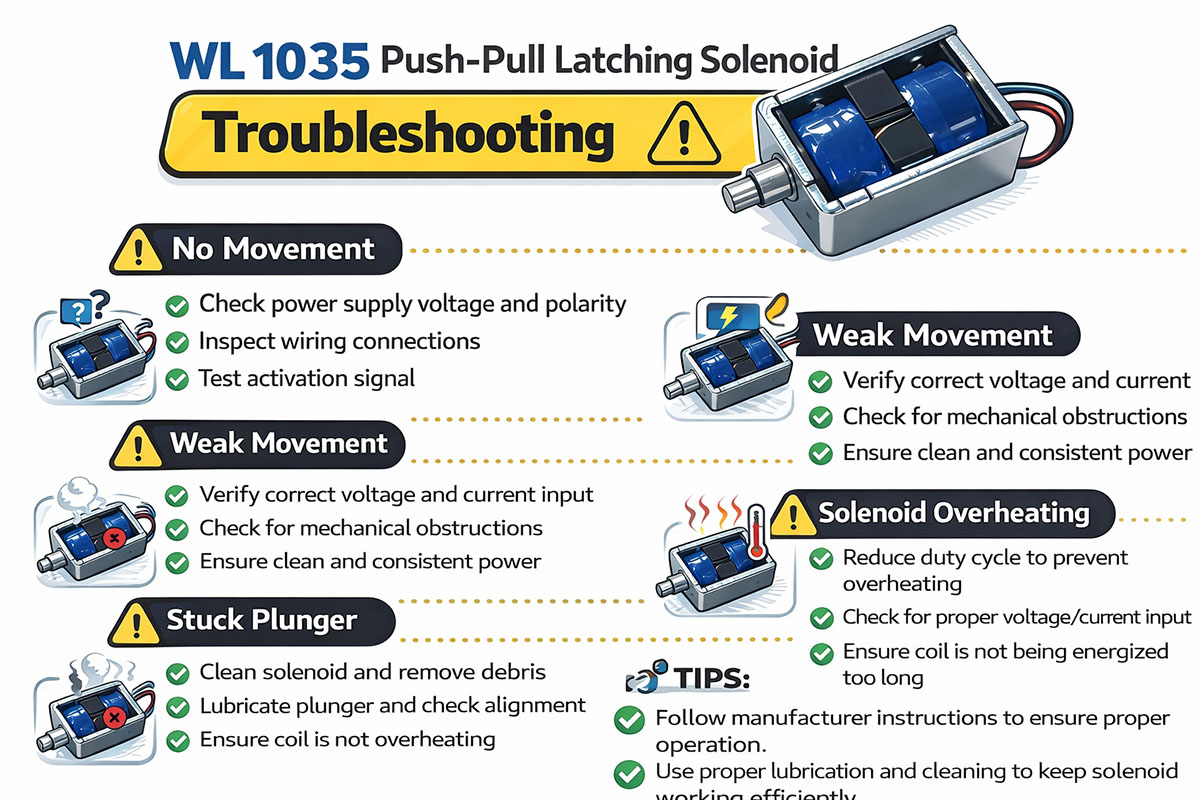
Problem: The solenoid does not move

Cause: No power supply

Cause: No wiring

Cause: Weak movement

Cause: Not enough voltage or damaged coil.

Problem: Unable to Latch

Reason: Magnet is no longer strong or is not aligned properly.

Overheating is the problem.

Cause: Too much duty cycle or incorrect voltage.

Problem: Slow reaction time.

Reason: Too much friction or debris on machine.

Just checking and controlling electricity will make everything a lot more reliable.

Troubleshooting of Latching Solenoid

WL1035 Push Pull Latching Solenoid FAQ

1. What is a latching solenoid that locks and unlocks by pushing and pulling?

A push pull latching solenoid is an electromechanical device that converts electrical energy into linear motion. It uses a permanent magnet to latch in a pushed or pulled position. This means that the solenoid will only use a pulse of electricity to switch from one position to another. This is good for the energy supply.

2. What does a push-pull latching solenoid do?

A push-pull latching solenoid operates on a basis of two positions. A pulse of electricity in one direction will push a plunger. A pulse in the other direction will pull a plunger. A permanent magnet is used to hold it in place even without electricity. This means that we will use less energy.

3. What are the most important parts?

A standard push-pull latching solenoid consists of:

A coil winding that produces a magnetic field.

A plunger or armature that moves in a straight line.

A permanent magnet that holds the solenoid in place.

A housing frame that holds everything together.

A lead wire connector that is used to connect wires.

4. What are the most important parts?

A push-pull latching solenoid is able to hold in place without electricity.

Low energy usage: pulses are required

Quick response: takes only milliseconds to turn on

Long-lasting: fewer malfunctions due to heat because of low duty cycle

Versatile: small and can be used for many purposes


5. What are the most prevalent uses?

Automobile systems: locks for doors, seats

Vending machine systems: control over dispensing mechanisms

Industrial systems: safety or automation latching

Robotics: fast response for switches or grippers

Locking systems and electric strikes for access control

6. How do you select the right push-pull latching solenoid?

Stroke length: how far the plunger travels

Holding force: how much force is required

Voltage and current ratings compatible with control system

Duty cycle: how frequently it is used

Environmental conditions: how it stands up to dust, moisture, or extreme temperatures


7. What are the advantages over regular solenoids?

Efficient: only requires a small amount of power

Stable holding: does not have heat build-up because it only uses current when it must

Longer life: does not have as much wear and tear because it only uses a little power

Compact: works well in tight spaces

8. What are the disadvantages or limitations?

Pulse required: must ensure that the right current pulse is used

Range of force: generally lower than high-power continuous solenoids

Magnetic Interference: Strong magnetic fields can interfere with the solenoid

Price: can be more than simple solenoids

How to Choose the Right Push-Pull Latching Solenoid

  1. Determine your needs.

What type of action is required? Is it a “push” action, a “pull” action, or both? Push-pull latching solenoids will perform both functions, but one or the other might be more critical for your specific application.

What is the stroke length? Determine how far the armature or plunger must travel to function properly.

What is the operating cycle? Determine how often the solenoid will be required to operate. Solenoids that will cycle many times are required for high-frequency operation.

  1. Review the electrical specifications.

Determine if the solenoid will operate with your system voltage (e.g., 12VDC, 24VDC, 48VDC).

Determine if the current and power requirements are acceptable for your system.

Push-pull latching solenoids use a magnetic latch to hold their position without continuous power. This is more energy-efficient. Make certain your control system is able to supply the correct pulse for latching or unlatching.

  1. Consider the mechanical aspects.

Force output: Make certain that your solenoid is able to push or pull enough for your specific requirements. Manufacturer’s graphs show force required for each stroke.

Options for Installation: Consider the type of mounting that will work best for your assembly. Consider whether you need a rod-style, hollow, or custom-shaped plunger.

  1. Thinking About the Environment

Temperature: Consider whether the solenoid will work well in the environment in which you live. Extreme heat can damage the insulation of the coil.

Protection Rating: Consider solenoids with enclosures that have IP ratings for use in wet, dusty, or corrosive environments.

Vibration and Shock Resistance: Consider solenoids that can withstand vibrations, especially in applications that are mobile or used in industrial settings.

  1. Thinking About Durability and Maintenance

Duty Cycle: Consider whether continuous or intermittent operation is required. Latching solenoids are more efficient in applications that do not require constant operation.

Selecting the Right Materials: Consider stainless steel plungers, robust coil construction, or strong housing materials to prolong life expectancy.

Push-Pull Solenoids require little maintenance, but it is necessary to think about the moving parts.

  1. Thinking About Control and Integration

Driver Circuit Compatibility: Consider whether the control circuit can handle the pulse that will lock and unlock the door.

Feedback: Some solenoids come with switches that can be used to connect to other systems.

Physical Space: Consider whether the solenoid will fit into the assembly without interfering with other components.


Factor Consideration
Stroke Required travel distance
Force Push/pull load requirements
Voltage & Current Match system supply & driver
Duty cycle Intermittent or frequent actuation
Environment Temp, moisture, vibration
Mounting Compatibility with assembly
Latching type Bistable or reversible polarity

Get A Free Quote Now

Contact Form

Related Products

Related News

Scroll to Top

Get A Free Quote Now !

Contact Form
If you have any questions, please do not hesitate to contact us.
Weilong Solenoid Company Culture
